Tag Archives: social treatment

Guest Post: Sex and Scoliosis

This is a Guest Post by Atlasien. It was originally published here.

I’m a multiracial Asian-American woman, Southerner, third-culture kid and mommyblogger. I’ve been living in the Atlanta area for more than a decade now. I mainly blog about race and foster care adoption. My husband and I have a 7-year-old son that we adopted as an older child. I enjoy this blog, and I’ve learned a lot of important stuff about disability issues by reading here.

What does scoliosis have to do with sex?

There are a lot of connections. I guess I’ll need to start by explaining scoliosis. It’s a common disorder, but one that is often very misunderstood by the general public, as well as many non-orthopedic doctors. Most people vaguely remember a scoliosis check from their school days. Sometimes the kids are lined up in a row, and told to take off their shirts and bend over while a medical professional inspects them from the back. The experience is obviously rather humiliating and tends to cause a lot of nervous laughter.

Scoliosis — a sideways, left-right asymmetry of the spine — is the most common form of spinal deformity. It can also be accompanied by other forms of spinal deformity, like kyphosis (AKA hunchback) and extreme lordosis (AKA swayback). It sometimes comes as a package deal along with disorders of connective tissue, or with cerebral palsy and spinal bifida. In those cases, scoliosis is often diagnosed at a very early age.

The other kind of scoliosis, the much more common kind, seems to come out of nowhere. It’s known as adolescent idiopathic scoliosis or AIS. “Idiopathic” is from the same Greek root as “idiot” and basically means “we have no idea what causes it.” Though recent research has shown that it’s actually genetic, and they’ve even tracked down the genetic location (but only if you’re white, which is bizarre, because there isn’t any significant racial/ethnic difference in prevalence rate). Someone with this kind of scoliosis (usually a girl, as the incidence of more serious curves among women is 7-10 times that of men) is born with a normal-looking spine. Before puberty, the spine begins to bend and curve. Maybe it stays there… maybe it gets worse through puberty. Then maybe it stays there, or maybe it gets a lot worse close to menopause. Without major surgery, it’s essentially a one way road. In scoliosis vocabulary, when curves get worse, it’s called “progression”. “Progression” is bad. Arresting progression is good.

According to this NIH resource, “Of every 1,000 children, 3 to 5 develop spinal curves that are considered large enough to need treatment.” If you adjust for sex, the rate climbs up to almost 1% of all girls. I don’t know of any source that says actually how many girls receive treatment of which types. Treatment means to watch, take lots of x-rays, determine progression, and if it looks like progression is, well, progressing, to brace. Or in very serious cases, go directly to spinal fusion.

A pre-teen girl, front and back view, with her face obscured.  She has a metal brace that has one rod running up the front to a metal collar, and two rods in the back.  There is a fiberglass girdle across the abdomen and down to the hips.  There is a strap hooking to both sides of the metal rod in the front.  Descriptive text provided by Don.

That’s the “Milwaukee” variant of brace. It’s the kind I had. It’s made from hard plastic and steel. It’s expensive, ugly, frightening, and extremely uncomfortable. The family nickname for my brace was “The Iron Maiden”. You can climb into it and strap it on and off, and adjustments of the screws will accommodate changing body shape during puberty. I think you’re supposed to wear it until a few years past puberty, when your spine growth finally halts. The brace is an old form of treatment and it’s shown to be moderately effective at arresting progression.

Three images of the back of a young woman.  In each, there is an obvious curvature of her spine.  It's an S-style curve.  The middle portion of her back, around the shoulder blades, is off-set to the right, while the shoulders and hips line up relatively evenly.  Descriptive text by Don.

Many girls experience horror and anger when they find out what bracing is going to mean for their lives, and that it won’t even fix them, it will just probably keep them from getting any worse.

It was easier for me to accept my fate. First of all, my mother also has idiopathic scoliosis, and her curve was fairly serious. Hers is comparable to the woman pictured above. She had not been treated as a girl, and her scoliosis had slowly progressed as she went into middle age. She eventually had a spinal fusion — two long steel rods screwed into her spine — and was in the hospital for two weeks. So I had a strong motivation to make sure my curve didn’t progress as far as my mother’s. She was also a positive role model for me. I saw her as an active, glamorous woman who refused to be limited by scoliosis. I tried to adopt the same stoic attitude toward my own scoliosis. Second of all, my orthopedist said it was OK to only wear my brace 12 hours a day, which meant I slept in it, but I didn’t have to wear it to school. I think he may have subscribed to the philosophy that although the brace should really be worn 23 hours a day, there’s so much social stigma attached to it that many girls rebel, and won’t wear it at all, whereas a private bracing regimen has more likelihood of consistent follow-through.

I don’t know if it would have made school any worse. I’ve written before about the extensive racist abuse, and sexualized racist abuse, I got in late elementary and middle school.

I was harassed so much in the locker room my first year of middle school that I refused to change my clothes at all. P.E. was a living nightmare full of verbal attacks and physical threats from larger girls. I spent much of my time desperately thinking of ways I could get a medical excuse. Unfortunately, aside from my scoliosis, I was healthy as a horse. I refused to participate in activities anyway, and sat with the asthma-sidelined section. I’m still bitter about this experience because it taught me to associate healthy athleticism with emotional trauma and racist bullying. Maybe if I’d had my brace on, I could have gotten my coveted medical excuse.

It was something I never, ever thought of at the time, though. The orthopedist’s word was the word of law. And the brace was something to be hidden. I think this is a common tendency among brace-wearers. Girls that age don’t want to be seen in a brace. For photos, they’ll take off the brace. If they’re told to wear it to school, they’re mocked and stared at. At the time, I considered myself very lucky that I was able to hide my brace from other kids my age.

I don’t know much about disability theory and disablism, but I’ve been reading through blogs about it, and it’s very interesting in relation to scoliosis. I don’t identify as a disabled person/person with disabilities, and I don’t think many other people with idiopathic scoliosis do. But many of us have also gone through an intensely emotional adolescent period where we’re viewed as disabled.

One of the hallmarks of disablism is that it strips away sexuality. The prejudice against disabled people includes thinking they are not supposed to exist sexually, have sexual desire or be desired.

Being braced means going through puberty strapped and screwed in to a weird exoskeleton that incarnates the negation and emprisonment of your sexuality. Your breasts and hips are starting to grow. They might start to bump painfully against the brace. So you have to visit the doctor — often an older man — who adjusts your screws to accommodate your new growth.

The brace seems anti-sexual, but it also has positive sexual connotations. The light at the end of the dark tunnel is that the brace will “keep you normal”. You’ll get through puberty and enter into sexually desirable womanhood without too much spinal deformity… the brace will preserve you. The brace probably becomes the most significant physical object in your life, for good and for evil.

I certainly didn’t receive any counseling about my scoliosis. I don’t know if it’s common today to have counseling as part of the bracing process. If it’s not, it should be. Girls who have gone through bracing feel like it’s them, alone, against the world. Although it’s quite a common experience, by medical and social tradition, the disorder is isolated and hidden.

This study showed that bracing doesn’t affect self-image much. However, it also takes places in Sweden, where school environment I’m sure is quite different than in the U.S. This other U.S. study tells a somewhat different story: “Scoliosis was an independent risk factor for suicidal thought, worry and concern over body development, and peer interactions after adjustment. CONCLUSION: Scoliosis is a significant risk factor for psychosocial issues and health-compromising behavior. Gender differences exist in male and female adolescents with scoliosis.”

After bracing, scoliosis, and deformities of the spine in general, become almost invisible. It’s extremely rare to have a spinal deformity so pronounced that anyone can tell by looking at you when you have clothes on. People with idiopathic scoliosis “pass”. People have known me for years, even decades, without knowing I had scoliosis. Then one day they’ll see me in a bathing suit — and not even the first time they saw me in a bathing suit, but maybe the first time they really focused on my back — and they’ll burst out with something like, “OH MY GOD DID YOU KNOW SOMETHING IS REALLY WRONG WITH YOUR SPINE!!

Once it stops being invisible, it’s all of a sudden very, very visible. I guess it’s sort of like shaking hands with someone and suddenly realizing they have six fingers.

If I’m not experiencing any back pain, I rarely think about my scoliosis, although I sometimes worry about my future. Pregnancy is not a risk factor for progression, but menopause is. Right now, my thoracic curve is 36 degrees. If it gets past 40, I might need spinal fusion surgery. This is a mostly safe procedure, but it’s still really scary, and involves weeks in the hospital. Click on the following link if you’ve seen enough David Cronenberg movies that you think you can handle it (link to nightmarish spinal fusion surgery image). Spinal fusion partially reverses the curve, arrests or slows down further progression and relieves chronic pain. You’re still reasonably flexible afterwards, but there are potential complications, and I’m not considering surgery at this stage. If I refused surgery, and my curve happened to progress further, I would start to have more pain and diminished lung capacity. Past 60 degrees, I might start to experience severe and constant pain in my back and/or ribs, and my internal organs would get squeezed together and I might start to have breathing problems. Past 80 degrees I might have lung AND heart problems.

But I don’t stay up night worrying about the risks of progression. Many people have more uncertainty about their medical future than I do. For example, if I had diabetes, I might worry about having a foot amputation.

Since I grew up with scoliosis, it’s taken me a while to understand how it looks from the outside. Aesthetically speaking: not good. We’re conditioned to associate left-right symmetry with health and general well-being. People with moderate scoliosis, like me, often look symmetrical from the front, but asymmetrical from the back, and I suppose that seems eerie and perhaps even deceptive and sneaky. There’s a lot of really negative associations in popular culture (e.g. Hunchback of Notre Dame). When mean-spirited people do “retard” imitations they’ll often hunch up one shoulder and stagger in order to simulate a deformed spine.

I don’t talk about scoliosis casually because a) I don’t have any major health problems because of it, so there’s not that much to talk about b) I’m afraid of it being used against me. I’ll put it on medical history forms when I know I can be assured of privacy. It was used against me recently when I applied for private disability insurance. I thought it would be a good idea to have a separate private policy in case I lost my job for any reason. I did a ton of research, spent a lot of time talking with the salesman, and ended up with a quote that specifically excluded anything going wrong with my reproductive system AND my back. I changed my mind and decided it wasn’t worth buying since so much of my body was apparently un-insurable. They excluded my ENTIRE BACK. Hypothetically speaking, if I got in a minor car accident, and as a result developed the exact same kind of back problems that anyone without scoliosis would develop, nothing would be covered. What a terrible deal. No thanks!

The health implications of my scoliosis are not that extreme, and I don’t need any accommodations to perform any major life activities, which is why I don’t consider myself disabled.

– I have foot pain in my arch if I don’t wear comfortable shoes. I can wear platforms, but I can’t wear high heels.
– I have to be a bit careful doing things like yoga and pilates.
– I have to stay reasonably active in order to be 100% pain-free. When I get too sedentary, I start having back pain and rib pain. If I ever had an illness that forced me to rest all the time, I’d be in big trouble. Exercise and stretching are highly effective for scoliosis back pain. Other options I would consider to control pain if it ever got worse include drugs, physical therapy and adult braces. There are a gazillion alternative health “cures” for scoliosis back pain suffering, but they strike me as being of very dubious efficacy.
– I have to watch my posture
– I have to watch my weight. Excess weight leads to back pain. Being underweight might be even worse, because being underweight is connected to bone density loss, and people with scoliosis have lower than average bone density anyway.

None of these problems are really unique to scoliosis. Plenty of able-bodied and disabled people have back pain or foot pain.

This link from Eurospine.org sums it up: “Progression of scoliosis can involve an aesthetic problem and lead to functional problems. Respiratory disorders may develop in large curves greater than 80 [degrees]. Nonetheless, the mortality rates and vital prognosis in individuals with scoliosis are comparable to those of the general population.”

It’s the “aesthetic problem” of scoliosis that’s unique. Like I mentioned before, left-right symmetry is wound up with definitions of health and beauty across many different cultures. People like me are aware of this on a subconscious or barely conscious level. 99.99% of the time I forget that I don’t fit that symmetrical standard. Every so often I’m reminded, and it feels a bit painful. There are subtle psychological effects. Vague feelings of being a secret curved impostor in a straight-backed world. Times when I feel like my spine is an enemy working against me… times when it hurts to breathe and the pain makes me feel angry at my spreading rib bones, and I wish I could reach inside of myself and squeeze them back into place. Sometimes I’m bitter about the inches of height I lost to scoliosis.

Back to sex. Even without bracing, there’s still a sexual paradox when it comes to scoliosis. Have you ever seen a picture of a woman with scoliosis and/or kyphosis that was not anonymous, depersonalized, clinical, grim and depressing? Like the photos I included above? Scoliosis is profoundly unsexy.

On the other hand, when women pose provocatively, they often throw one hip to the side and put one shoulder forward.Why is that pose sexy? Maybe it makes us look femininely defenseless and vulnerable, as opposed to a masculine, stick straight pose. That’s going along with a typical sexist definition of “femininity”. There’s another less sexist possibility… the pose is also highlighting the flexibility of the spine. So in that sense, the woman is showing off her body’s capacity by bending in a certain way.

There’s a comic book artist, Rob Liefeld, who was (in)famous starting in the 1980s for drawing unrealistic women. The conventions of drawing women are in comics are easy to criticize, but Liefeld’s stuff is… well…I guess you’d have to see the spinal curvature to believe it.

Iconic Rob Leifeld drawing of a super heroine.  She's posing facing right, turning her head over her shoulder.  She has an impossibly-narrow abdomen, and spine curvature similar to severe lordosis, an inner curve of the spine.  She is not wearing very much clothing.  Description by Don.

That’s supposed to be sexy. For the audience of predominantly young men who made Liefeld very popular, it must have been sexy. This is a funny analysis of the above drawing by a group of women comic book artists:

Take note of Avengelyne’s waist and how it is thinner than her head. Minus the hair. Note how it hangs beneath her ribcage like a suspension bridge, rather than actually supporting the top of her body. (Her torso must be kept afloat by those helium breasts.) Note the scoliosis gone grossly untreated. Note the little leather bags which wouldn’t fit around a normal person’s wrist. Especially note that the artist put her in the most obvious POSE to exaggerate the spine: a profile shot with negative space between her back and arm. That’s correct – our intrepid heroine’s spine would appear yanked. Avengelyne is a SWAYback™.

The humor is partly at my expense. But I can’t help laughing. It’s a highly sexualized image, but not one that I identify with in any way.

But here’s a poster image I ran across that uses stupid sexist humor to make fun of a real woman, and I don’t find it funny at all.

A woman is facing straight on the camera, with her weight obviously all on one side.  She's curved her body to look like an S.  Text reads: Scoliosis: Making an otherwise beautiful girl look pitiful.  Image is from Motivated Photos.com, description by Anna

It really illuminates the double standard that women are subjected to. You’re supposed to be sexy so that you please men. But if it looks like you’re trying TOO hard, men (and other women) will make fun of you. If you don’t wear makeup, you’re a [insert homophobic slur]. Wear too much makeup, you’re a [insert transgender-phobic slur]. Curve your back, look sexy. Curve it too much, it looks like you’re deformed. Argh!

Thanks to my brief readings of disability theory, I realize that making fun of people with spinal deformities isn’t something I should just accept as the natural order of things, especially because this humor is connected to moral judgments of disability. That is, the idea that physical body difference reflects some kind of moral failing. When it comes to scoliosis, I think the general public halfway believes that scoliosis is the fault of the person’s family. There’s a myth that giving young kids backpacks that are too heavy will make their spines curve (totally not true). When people are adults, “she should have had that corrected” is sometimes an assumption. A lot of people don’t realize that the only sure way to even partly reverse a curve is spinal fusion, which also leaves a giant seam-scar running up your back. Another judgment is that a person with scoliosis must be poor. It’s true that I’m very lucky I had access to bracing; if I wasn’t born into a middle-class family in a rich country, my curve would be a lot worse by now. So there are major class differences in scoliosis, but ultimately, we’re all in different positions on the same boat because there is no way to permanently and completely reverse adult scoliosis.

Thanks to flickr, I did actually find some images of scoliosis that I think are beautiful and help affirm positive self-image and sexuality. I wish I’d found a greater variety of body types, but these images are great to start off with. Some are post spinal fusion.

First, here’s the typical clinical picture. It shows everything that’s wrong with the body.

A woman is facing away from the camera, with arrows pointing to various parts of body to describe them.  Head not centered over body.  One shoulder (right) higher.  One shoulder blade (right) higher and possibly more prominent.  Spine obviously curved (to the left).  One hip (left) more prominent.  Unequal gaps between the (left) arm and the trunk.  Description by Anna

Now here are the flickr pictures. They show the open possibility and vitality of a body with scoliosis.

Man with scoliosis facing away from the camera.  Someone has drawn his spine on his back with make up.
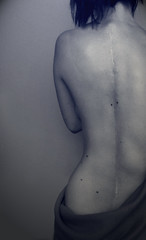
black and white photo of a woman facing away from the camera, wearing only a towel or blanket.  Her spine is curved, and her scars are visible.

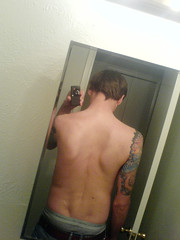
man facing away from camera.  The photo is in a mirror.  One can see both his scoliosis scars from surgery and his elaborate arm tattoo.

woman facing away from the camera.  She is caught in the middle of dropping an apple behind her back, both arms curved behind her.

woman facing away from the camera.  The image is otherwise in black and white, except for her vivid red hair and lips.  She is wearing a black dress with part of the back cut out.  It clearly shows the curve of her spine.

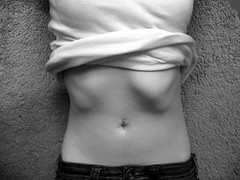
photo is in black and white of a woman's lower torso, with a pronounced rib-cage and a pierced belly button

woman facing straight on the camera.  She is wearing both a brace, as described above, and a purple corset.

woman facing left from camera, with back facing camera.  She's wearing an back brace, and balancing on a small ball.

It’s heartening to see a bunch of pictures like that. There are more photos at this link.

When I walk, my right hip swivels a bit higher and wider than my left hip. I’ve had people tell me it looks sexy. I’ve had people ask if I’ve hurt my foot. Neither reaction bothers me anymore. The way I walk is just the way I walk. It gets me where I need to go.

Acknowledgements for this post: thanks to Thorn for commenting about this issue, and mentioning how it negatively affected your adoption homestudy due to ignorance on the part of the social worker. Also thanks to Deesha Philyaw on Twitter for mentioning the Judy Blume book about a girl who goes through bracing: Deenie. I wish I’d gotten a chance to read that book when I was a girl, and it sounds really interesting.

How to Be a Good Doctor

Update: It was pointed out, correctly, that part of this post contained a statement that made a generalization based on age. That statement has been removed and the post updated with this message. It’s not feminist, and it doesn’t belong here. I’m sorry.

I actually had a really good experience with a physician recently. Like outstanding. With a specialist even — an endocrinologist, so if anyone in the northeast Texas general area needs one, I can recommend him without hesitation. I was kind of nervous; I’d seen an endo before when I was starting my transition but stopped because he was a really huge jerk. (My GP wasn’t entirely comfortable with writing scripts for hormone replacement but has been willing to for a while now. She’s also recommended and trans- and queer-friendly.)

Accessibility was poor to okay: I could have done with a chair by the reception window while waiting for them to copy my ID and insurance card. To get from the curb cut by the reseved parking to the front door, one has to go down the sidewalk across the front of the patio to where the ramp up the patio is. At least three cars were parked so that their noses stuck out over the sidewalk. If you couldn’t squish down to 18″/46cm wide, you couldn’t get through there. The doors were all unpowered and the front doors were on the heavy side. I didn’t see Braille signs at all. There was, blessedly, no music and no TV in the waiting rooms. The exam room was freezing; fortunately for me I’m tall and the ceiling was low and I was able to close the air conditioning vent but that’s not a widely available option. There were wide spaces around the furniture in the waiting room that looked like they’d easily accommodate wheels and other assistive devices. Some of the furniture was squishy but some wasn’t and the non-squishy furniture had arms to push up with.

They got to me right about when my scheduled appointment was. They weighed me, measured my height — 202lbs/91.5kg and 5’11 3/4″ (yes, they really measured me to the quarter inch ((sheesh)) and yeah I’m that tall — people comment constantly on how nice it must be which it kind of is except when I’m trying to buy clothes: for all that they love models my height designers apparently don’t believe women don’t come my size and shop at Target)/182cm — with my boots off, and they did bring me a chair for getting them on and off without my having to ask for one.

We waited in the exam room less than ten minutes. Maybe five. The office had mailed me a new patient packet with all the usual stuff to fill out (and the usual uninclusiveness of gender- and sex-variant people on the form, sigh *tick* F). The doctor apparently had spent the five minutes reading and absorbing it because he came in and introduced himself and greeted the wife and me as Mrs. and Mrs. Brown. It felt really good because NO ONE DOES THIS even the people who know we are legally married. Holy shit. The wife explained that I had an autism spectrum disorder and was not having a good day communication-wise. Also that even though I was not talking much today I was plenty smart (which is a construction I’m unfond of) and could understand doctor jargon (this I’m fine with — it’s a skill, not a definition of a person). He told us that on Mondays he had a resident following him around and would we mind if he joined us for the exam?

I’ve had doctors ask this badly before. Often it’s with said resident already present so refusal is an explicit personal rejection and difficult for even a lot of neurotypical folks, never mind those of us with moderate to severe social anxieties. This doctor asked it with the resident on the other side of a closed door. It really actually felt like I could have said no and it would have been okay.

He liked that I had typed up a list of all my surgeries and meds, the dosages, the schedules for taking them, and what they’re for — it’s a long list, twelve prescription meds total — and expressed sympathy that I needed them all. Even though my wife was helping me communicate, he mostly spoke with and to me. Once when he was looking at his notes he missed that I was nodding in response to his question and he apologized for not watching to see my response. When he was working out what labs to order, he noticed what insurance we had and apologized that we couldn’t use the lab in his office but would have to go to the one (not far away) that our insurance company had a contract with or we’d have to pay for the lab work. A DOCTOR. I’ve never run into one that noticed this stuff before, never mind knew what to do with our insurance company.

In short he seemed to be respectful of all the ways I was different: physically impaired, neurologically variant, queer, trans, everything. And genuinely respectful, too, not in that fake-ass “I don’t see the ways people are different from me” bullshit. [Age-based generalization removed by the author.] It was a really nice part of what’s been a string of mostly crappy days.

I’d really rather not have anything endocrinologically jacked up (and given the pattern of other Stuff that has been tested for, I’m not expecting that anything will be very wrong here either). But if I have to have something like that, I’m glad I know who to go to. ‘cos expertise is one thing. Respect like this — on the first time seeing me, on one of my bad days? — is rare. I wish I could drag all the bad doctors I’ve been to and gritted my teeth through seeing to make them watch this young man do brilliantly with a patient who is admittedly not exactly the most conformative person ever and yell “See? This is how you do it! This is how you make all your patients feel like you care about them.”

Cross-posted at Impermanent Records.

Disability Is …?

(Originally posted July 2009 at Feministe, three rivers fog.)

We had a really good discussion about nondisability. It got derailed, a bit, because it depended on our ability to reasonably define disability. And it’s a subject that has come up in every discussion we’ve had these couple weeks. What is it?

I advocate an intentionally overbroad definition of disability. And I definitely see a tendency, with certain medical conditions, not to identify — on that inner level, what “feels right” — as disabled.

I support every person’s right to self-determination, to define their own experiences, and to identify however feels most right for them. I do not want to try to pressure people into identifying in a way they do not feel comfortable. But I do think that part of this tendency, this reticence, is rooted in a sort of ableism. Not ableism as in “internalized negative feelings about PWD” — but ableism as in “a certain understanding of how the world works and how society is/should be structured” … or, you might say, a certain model.

I want to explore a few things — explore our assumptions behind the word “disabled.”

1.

Think, for a minute: visualize a disabled person. Just a generic idea of a disabled person. What would you say are the requirements to qualify as disabled?

Do you have to be disabled — in a dictionary definition sort of way? Disabled, unable, incapable? Unable to work, or unable to participate in social activities, or unable to take care of oneself? Is there a certain level of un-able-ness one must reach to qualify as disabled?

If so, what do you call the people who don’t reach that level — but who share many, if not all of the exact same problems with accessibility in society, who face the same obstacles in their path, the same ignorance and hostility? The people who have the same condition, but face different accessibility problems because they are trying to navigate the workplace, living independently — who are able to do these things — but who still have to fight with the outside world to be able to live their life how they want to?

Are these people disabled? No? Are they abled, then? Are they privileged over the people who meet that level of un-able-ness?

Am I “temporarily able-bodied” because I can push myself enough to work full-time?
Because I can walk? Drive? Prepare meals? Go to sports events and concerts?
What about the fact that I still have to fight with my doctors over medication? That I still have to approach HR at work to tell them about everything I need to be able to work there?
What about the fact that without the drugs I am taking and my TENS machine and my access to health care and workplace accommodations and accessible parking, all of a sudden I wouldn’t be able to do those things anymore?

Is my disability about my inner feelings when I get home and slouch in pain — is it about what is going on in my body? Because I still have pain, whether I am well-treated and working or untreated and housebound. I still have fatigue. I still struggle when I stand up from a sitting position, still need help getting out of the car if I haven’t taken at least a few painkillers already that day. All that stuff is still there.

Or is it that my disability something beyond me — not having to do with me at all? Not defined by what is going on inside my body, but defined by whether society is working with my body or working against it?

2.

I’m going to let you in on a secret. A lot of us people who do fit the classic dictionary definition of “disabled”don’t feel “disabled” either. We don’t always feel un-able. We feel like “just people.” Normal people living a normal life, just happen to have some sort of neurological or physiological difference, but that isn’t our defining characteristic or something that is always forefront in our minds, it’s just one part of us that doesn’t always make that big a difference in our life at all.

3.

Remember, briefly, the social and medical models of disability.

Under the medical model, a person must justify their claim to disability. A person must fit neatly into a narrow diagnosis with a Latin-based name. The person must be cleanly categorized. Their experiences must fit a prepared check list.

The medical model says that your body fails to be normal in this particular way: so we must devise a way to force it to be normal, and that will solve the problem.

Naturally, such an approach to disability will wind up excluding a good many people who don’t fit those boxes cleanly, who appear close to normal — and that just can’t be right; there must be a logical explanation, like that they are over-worrying, imagining things, that they like being sick and want the world to treat them with kid gloves. After all, there is no proof that they deviate from the normal — so they have failed to justify themselves as different.

The medical model, in this way, denies community and services to people who still face considerable obstacles to full participation in society because they have failed to prove that they deserve that “special treatment.” They have failed to prove themselves as disabled enough. They aren’t “other” enough to be Othered.

The medical model imposes strict and narrow definitions — which become boundaries which must be policed.

What do you do when you’re caught in the middle? Different, but not different enough to be Othered, but still needing services (benefits, accommodations) which are only given to Others.

4.

Informed by the social model, “disability” becomes a marker not for condition (mental or physical) — not for “what I feel inside, what I experience inside” — but instead for the fact that our condition is maligned or neglected (or both) by the rest of society.

Disability is not a matter of my condition, but a matter of the group I am assigned because of that condition.

Perhaps it could be said as such: Disability is not a condition, it is a status.

5.

The classic analogy to explain the social model is this:

Many sighted people have less-than-perfect sight. If assistive devices — glasses or contact lenses — were not so widely available and accessible, many of these people would be prevented from full participation in many aspects of society.

But because society sees fit to prioritize this assistance, to make sure glasses/contacts are widely available and accessible so that every less-than-perfect sighted person can have clearer vision — because society decided that no person should be blocked from access because of hir different vision — this condition is no longer a disability.

This is a useful thought experiment. But it is not a perfect analogy. Many blind people still face considerable access blocks. This only really applies to people who are sighted, but whose sight is not precisely “normal.” Perhaps because society can, for the most part, bring abnormally-sighted people to normal-sightedness, whereas it cannot do the same to blind folk.

There’s a lot to explore here.

6.

The word disability isn’t perfect. I don’t know that I would choose it, were we to start over with a blank slate. Nor do I know that most people who are active in the disability community would choose it.

What I do know is this: people who don’t feel, literal-dictionary-definition disabled, embrace the word and run with it. They can make it something all their own.

Queer is a less-than-perfect word when you consider its literal definition, too. Yet the queer community has decided that they’re gonna take this thing and make it into what they want it to be. And they’re making something pretty damn awesome.

I don’t feel dis-abled. I feel people-are-willfully-ignorant and access-to-good-care-is-restricted-in-unnecessary-ways and the-medical-industry-has-no-respect-for-me. Among other things.

And I’m sure other disabled folk feel why-isn’t-there-a-wheelchair-ramp-for-this-public-use-building and nobody-has-to-accommodate-my-needs-until-they-get-sued-why-don’t-we-have-an-oversight-board-that-makes-them-do-it-right-from-the-fucking-start and you-aren’t-providing-alternatives-so-I-can-access-your-lecture-even-though-I-can’t-[hear-what-you-speak/see-what-you-write/be-there-in-person-at-all]. Among other things.

People who identify as disabled (or are identified as such by society) don’t necessarily always think the dictionary definition of the word applies to them. There are disabled people in wheelchairs or braces who still work, still have families, still go to parties. There are disabled people who appear totally abled yet can’t work, can’t perform certain self-care, and so on.

The word “disability,” in the disability movement right now, already refers to a great variety of individual conditions, abilities, approaches…

And for the most part, when a person appears whose condition challenges the current boundaries of abled/disabled, the disability community is completely ready to revise their assumptions and welcome that person (and hir companions) into the movement.

Because, here’s the thing…

7.

The disability movement has a lot to offer to a lot of different people — not all of those people who may identify as disabled.

And this is part of why I do not want to pressure people to change their identification. They don’t have to identify as a disabled person, or a person with a disability, to still become a part of the disability movement, to benefit from it, to help move it forward.

What I am wanting to do is not change people’s minds about how they individually self-identify. What I want to do is explore the cultural phenomenon that is certain groups rejecting the label of disability.

Anyway: the disability movement is working hard to change the way we approach the world. From an approach that excludes non-normal people to an approach that stops INcluding by certain standards and starts just treating all persons as fundamentally human, period.

Under the current system, when a woman becomes pregnant and plans to keep the child, we expect the child to be free of disability. What’s that refrain from the supposedly-gender-enlightened? “I don’t care whether it’s a girl or a boy, as long as the baby comes out healthy!

When we encounter a person, we expect that person to be abled. When we imagine a “person” — just a generic, default person — we imagine that person as able-normative.

Currently, things go like this: 1. World expects “normal.” 2. Non-normal people come along. 3. Oops!

What disabled people want is more like this: 1. World is prepared for any number of different things. 2. We come along. 3. Hey, we were expecting you!

This approach is what defines the disability movement. We want to change the world so that the world stops treating us as unexpected — and therefore a disappointment — and therefore has not prepared for us — and therefore we have to constantly fight with the world to make it change every little individual thing it has set up wrong.

This approach, applied broadly, has benefits for so many more people than only the classically, dictionary-definition disabled.

This is the world I want to live in (bold emphasis added)…

My body isn’t the enemy, I realized.

It’s not my physical self that creates all my problems.

It’s all the external expectations of it.

Disability isn’t the result of individual defects, deviations from the able-bodied norm. Disability is the result of a society that fails to accommodate these differences.

What if we saw these differences as variation, not deviation? After all, we fully expect our children to be born with any number of different eye colors. Why is it any less when it comes to physical and mental abilities?

Can you shape a world in your mind where there is no norm? What does it look like? How does it differ from the world you live in today? What do you expect of people as a whole in order to support those currently disadvantaged?

The more I think, the more confused I become. It seems impossible to structure society so that everyone is brought to a similar level of ability across the board. But it does seem possible to structure society so that those fully-abled work to make up for those straightforwardly lacking, and everyone works with each other in full expectation of a wide range of ability across the populace, and all of this is seen not as hassling and burdensome, noble and heroic when someone takes it on—but as mundane, everyday, simply expected, no different from separating out your recyclables or driving on the right side of the road: something that everybody does, because it isn’t that hard to do, and it benefits yourself as well as those around you, so it’s stupid and even outright reprehensible not to.

That is the world I want to live in.

[Reading back, I cringe at the use of the words “straightforwardly lacking.” Proof that we are all still learning, still building.]

What if things did happen that way? What if we just rushed to give, knowing that those around us would rush to give back?

and in this POV, the centering of individualism falls apart — because that’s not what life is about. life is give and take, push and pull, you do this for me (that i don’t do well/don’t like to do, but that i want/need) and i’ll do this for you (that i do well/like to do, and you want/need).

disability, really, when you get down to it, is the ultimate unraveling of that ball of individualism — it FORCES you to look at all these little things that go into the living of a life, and realize that not all of them are yours to do or yours to control — and also to realize how many of those little things YOU affect for OTHER people’s lives — and to finally give up, and fall back into the arms of the community.

it means you have to stop looking at things as “mine, yours, this person’s, that person’s” etc. you have to stop keeping the damn tally — and just rush to give, knowing that those around you will rush to give back…

so many people are afraid to admit that ultimately, they DO depend on the people around them, and their accomplishments are not solely their own, and the things they do, affect people besides themselves. but it’s all true! and it’s not a bad thing, if you look at it the right way.

This is everything we are trying to change.

And when we are successful: it will be good for so many people. It will benefit a great many, people who might not consider themselves part of this movement, but who will see their life become substantially easier or better, because this movement has destroyed the system that puts obstacles in their path.

8.

There is a lot people can learn from the disability movement — even if they don’t consider themselves a part of it.

This is why I, and others, explicitly tie our disability activism to our feminism. Believe it or not, there are things that non-disabled feminists can learn from disabled ones about how to refine, how to better our (not their, OUR) feminist movement.

There are things the disability movement is accomplishing that the feminist movement has fallen short on. Things that disability activists are paying attention to that feminists have forgotten.

And it makes a difference in women’s lives.

9.

There are substantial immediate benefits to individuals, as well. Many of you who do not feel “disabled” nonetheless benefit directly from the Americans with Disabilities act and other non-discrimination legislation. And that’s only in the realm of the state (legal sense).

Consider the pharmaceutical industry. The alternative medicine industry. Consider protections on health insurance that prevent companies from discriminating against people with pre-existing conditions or prevent them from denying certain treatments.

These are all things the disability movement has had part in. Often, the disability movement has been the sole force pushing for these things — when other movements fall short, and forget us.

And there is, therefore, substantial benefit to involving oneself in the disability movement. Because it is working for you. So it will do good for you and for us if you directly engage with it — help it refine its purpose — help direct its actions — help challenge preconceptions.

If you will stand with us, if you will be — a friend, or a family member — whatever role you feel comfortable taking, we will stand, sit, lean or lie beside you. We will be there with you, however you identify.

We want more people to engage with us — on an honest, good-faith level.

Some of those people will find themselves beginning to identify as a part of this movement, as a person with a disability. Some people will not, but will remain our friend, our ally.

No matter which: we are happy to have you.

***

ETA: I really should have included a link to this post from Joel at NTs Are Weird — from the perspective of the autistic community. I ain’t the only one beating this drum! I remember reading this post a long while back, and it has informed my politics a great deal. And I think it is necessary reading for anyone engaging with the disability movement. And he does a great job wrapping up the many elements of this post! 😉 Take it away (bold emphasis mine):

Welcome to the disability community! […]

Yes, that’s right, you’re DISABLED. Yep, you can pick that word apart and tell me why you aren’t, but, trust me, you are. And, no, I don’t mean that you are less or more functional than anyone else. I mean that you are part of a community defined by society’s institutions and programs, a community formed because of our minority status and the fact that society expects certain strengths and weaknesses, and anyone who doesn’t have that same pattern of strengths and weaknesses is going to have trouble in this society.

Yep, that’s the social model. It’s not the “OH MY GOD, I AM SO BROKEN AND LIFE SUCKS AND I WANT TO BE NORMAL BECAUSE EVERYTHING WOULD BE WONDERFUL AND I WOULD HAVE LOTS OF MONEY AND A GIRLFRIEND AND A NICE CAR” view of disability. But it is recognition that we have trouble in society as it is currently set up. You’ll also notice that it is not a view that accepts society as a static, unchangeable, and morally good entity, but rather as an institution that can and should change – even when people have a hard time seeing how it could.

In addition to this, I want you to know that there is “nothing new under the sun.” You don’t need to reinvent disability theory […]

One example – although the victory isn’t yet fully realized – find out why there public transit has to at least make *some* effort at accommodation in the US. Yep, I know it still sucks, and there are tons of problems – I’m not saying anything different. But I can assure you of this: Without good advocacy, there wouldn’t be a wheelchair lift on any bus except one owned by a nursing home – and even that one might not have one.

Find out why people with cerebral palsy can go to US schools today, even if their natural speech is hard to understand, thanks to assistive technology and good law. Sure, schools, technology, and law aren’t good enough yet, but they are way better than they were 40 years ago. Why?

Better yet, learn how you can make a bus in your city more accessible both to yourself and to someone with a different kind of disability. Learn about your schools and what can be done to help others with disability. Not just autistic people, but people with all types of disabilities. Do you know what you will find if you do this? You’ll find out quickly that it also helps you, even if that wasn’t the goal of the movement.

For those of you who are already doing these things – thanks! It’s good for us to stop reinventing the wheel once in a while.

Depending on narcotics

IMG_0172I take six medications. Five of them — the antiepileptic, the antidepressant, the non-narcotic pain killer, the muscle relaxer, and the oral contraceptive — are covered through a mail-order service. I receive a 90-day supply in my mail box every three months. No hassle. If a prescription runs out, my doctor is notified electronically, he then sends the new script electronically, and everything proceeds as normal with absolutely no additional step required of me. The only thing I do is click on the check-out button on the web site every three months. That’s it. No calling. No physical piece of paper to pick up. No wait at a retail pharmacy. Just a click and several days’ wait.

There’s one other medication I take. That medication serves the exact same purpose as all five others: it relieves my pain so that I can get on with my daily functions. I take it regularly, just like all five others. I have been taking it regularly for over five years now for the same reason. But this medication is not covered by the mail order service, because it is not considered a “maintenance medication” — despite that it fills the exact same maintenance role all five others fill, just by a different mechanism.

So for this medication, I am only allowed a 30-day supply at a time, and no refills — a brand new script each fill, which requires my doctor’s input each time. I have to call my doctor no sooner than the exact day it was filled last month, unless it falls on a weekend in which case I might get away with calling up to 2 days early. Then I have to call back a couple days later to see if the script has been written. If it has, it is printed out, and I have to physically walk in to the office, stand in line to see a receptionist, have them take a copy of the script with my photo ID, sign and date the copy, and walk out with the script. Then I have to physically take it into a retail pharmacy, wait in line, hand it to the pharmacy technician, then wait the required time for it to be filled. If there are no problems with my insurance, I then must physically present myself and pay for the prescription. Then I can walk out the door with my medication.

(And this is the process with a doctor who’s relatively friendly about the matter.)

It is quite a different process and one overflowing with “veto points” — points at which any party involved can cause any sort of problem and stop the whole process up. Maybe my doctor is on vacation and won’t be back for two weeks. He is the only one in my clinic who will write this script. I can’t call earlier in anticipation of his absence; they will not write the script before the last runs out. In that case, I’m stuck until he comes back. Maybe the system spits out some sort of error, like the one I received today: I was told the script must be written by my original prescriber. Which is this doctor. So now they have to go back and ask for the script all over again, and he isn’t in til tomorrow, and it’s not guaranteed to go through smoothly then. There have been other errors.

Maybe the insurance says no. For any number of reasons; I’ve dealt with prior authorization errors, quantity limit errors, errors because my insurance has suddenly decided to list me as living in an assisted-living home and cannot fill a prescription if I am. Maybe the pharmacy hits a snag, like the time they would not fill a written prescription until 2 a.m. that night because the insurance company said so, even if we paid out of pocket without billing the insurance.

And I’m going to keep running into these issues, and I will run into new errors every few months. I may have solved the last problem, but there’s always something new to pop up. I can never rely on this medication being filled on-time. It simply does not happen the majority of the time. No matter how diligent I am, how patient I am, how clearly and politely I explain myself — or how despondent I get, how emotional I get when telling them but I cannot work without this medication, and I don’t have leave on this job, and I can’t afford to be fired for missing work. Or whatever other pickle I’m in at the moment. It doesn’t matter. I do everything right and there will still be regular problems in getting my medication filled on time.

I’m sure, by now, you’ve figured out that this particular medication is a narcotic pain killer — hydrocodone (generic for Vicodin). I take it for chronic pain. I have been taking it for over five years this way, with the doses varying between one-and-a-half per day and three per day. And the only medical trouble I have ever had on it is when there was an excessive delay in refill during a bad pain flare and I got to go through the withdrawal for two weeks. (And I can tell you from experience: hydrocodone withdrawal is nothing compared to Effexor withdrawal.)

Narcotic pain killers can be a valid option for chronic pain patients. They fill a void left by other treatments which still aren’t effective enough to address our symptoms, which can easily be disabling. As you can see, I take plenty of other medications. But if I want to be able to get up and do something, I still need the pain relief the hydrocodone provides. So I take it. Because I like to be able to get up and do things. Like make the bed in the morning and feed the cats and make myself lunch and possibly run errands. Or — you know — work. Those silly sorts of things.

Here’s the thing, though. In both common culture and the medical industry, chronic pain patients who take these medications to be able to perform everyday, ordinary tasks that currently-able people take for granted — like bathing or showering or washing dishes or dropping their kids off at school — are still constructed as an addict just looking to get high.

You could almost kind of expect that for the narcotics. Most people do not understand the distinction between addiction and dependence. (Which is, basically, the distinction between taking a medication for a medical purpose so that you can go on living your everyday life, vs. taking a medication when you have no medical need so that you can escape from your everyday life.) This distinction exists for a reason; developing a tolerance for a medication is not a bad thing in and of itself, and must be weighed against the benefits that medications brings to the person.

Addiction calls to mind, though, a life being torn down. Addiction calls to mind a person who is seeing the detriment of a drug outweighing the benefit. A person whose life is falling apart because of the drug.

A chronic pain patient taking a narcotic pain killer under the close supervision and guidance of a knowledgeable doctor is exactly the opposite: sie is a person whose life is coming back together because of the drug.

But this image is not easily shaken in people’s minds. And so the chronic pain patient is reimagined as the addict. Hir behaviors are twisted to fit the common conception of the addict. If sie ever lets out a drop of disappointment at having problems with accessing this medication which is helping to put hir life back together — that is seen as drug-seeking behavior. And if sie lets out any sort of relief at the feeling sie experiences after taking the pill and having the crushing weight lifted from hir muscles — that is seen as “getting a high.” Heaven forbid sie show any emotion beyond just relief — like perhaps pleasure or happiness — at being able to perform everyday functions again. And any moodiness or other undesirable behavior can be easily attributed to hir “addiction.”

What’s strange, I notice, is that this reimagining is applied not only to chronic pain patients who take narcotics — but to any chronic pain patients who takes any pain relieving drug.

Take, for example, the anti-epileptic I take. It is not a narcotic. It cannot be abused — that is, if you do not have a neurological pain disorder, it will not do anything for you. You can’t use it to get high, get low, or get anything — except a couple hundred dollars poorer every month.

The only way this pill does anything for you is if you have some sort of nerve problem. And even then, the effect isn’t a “high.” Rather, it levels your pain threshhold — brings it closer to “normal.” No artificial mood effects, no giddiness, no lift. Just level.

And I still see this medication treated very similarly. Patients who take it are described in the same terms you would describe a drug addict.

And it’s just one of many. Any drug that relieves pain for a person with chronic pain will be painted in the same strokes.

At issue, here, is the conventional wisdom that our pain is imagined, that it has no real basis, or even then that it isn’t as bad as we make it out to be. That is the belief that feeds this twisted construction.

Because if you are imagining your pain, there is nothing legitimate you could be getting out of that drug. And if you aren’t getting anything legitimate out of it, but you’re still taking it — and getting upset when you don’t have it — well, that’s classic addict behavior, isn’t it?

If our pain were recognized as real and legitimate — if those messed-up-in-so-many-ways Lyrica commercials didn’t start out with “My fibromyalgia pain is real!” — this wouldn’t happen as much. Because if our pain is real and legitimate, then it is real and legitimate to seek relief for it.

(Of course, that assumes that pharmaceuticals are accepted as a real and legitimate way to relieve that pain.)

But people are going to have trouble with that. They don’t want to accept our pain. They don’t want to admit that it is real. They want to keep believing that it must be imagined. Because then, they can comfort themselves, in that murky area beneath our conscious thought, that they would never end up in our situation. They could never end up with any sort of medical condition. And if they did, well, they know how to do everything right, so they would never be affected by it.

This is why they scoff at our assertions that our experiences are real. This is why our conditions are jokes to a great many people. This is why “fibromyalgia is bullshit” has been the leading search term to my blog. This is why they seek so desperately to deny that these drugs — any drug — could be having a legitimate effect on us. This is why they treat us like addicts. Because they can see how we might reasonably be having real pain, and they can see how these drugs might reasonably be legitimately relieving it, and they can see how we might reasonably be upset if we are consistently denied access to the one thing that allows us to live our lives the way we want to.

And if all that is reasonable, then — shit — they could wind up in the same place someday. And none of their can-do bootstrap individual determination could magically get them out of it.

Addicts we are, then.

Yes, it DOES make a difference

(Cross-posted at three rivers fog.)

I wrote this yesterday in an extreme fog and do not have the spoons to rework and polish it. Apologies for the brainspill, but these days it’s the only option I have.

***

For background, see Ouyang Dan’s post on the problematic aspects of the TV show House. Don’t tell me that people realize this is fictional. Don’t tell me that people know how to maintain that separation. Some do. Many don’t. And they’re everywhere. At the bottom of the totem pole… and in positions of power over the very people they are prejudiced against.

***

I was called back to work two weeks ago. I work at a government office that provides certain assistance programs. (Once you go to work for one government agency, you realize there are a whole lot more of them than you ever thought before.) I really don’t want to go into it any more specifically than that.

It’s been very rough on me. Last winter, work was physically draining. I basically have two whole hours every day that I am awake and not at work, preparing for work, or traveling to and from work, and semi-conscious. Not only am I so physically exhausted that I go to bed three hours after work ends, I am so physically exhausted that my brain just cannot be pushed any further. I have trouble comprehending the blogs and news sites I normally read; writing is usually out of the question. Of course, we won’t even talk about anything more physical than that — even preparing a boxed dinner for myself is too difficult. My apartment is even more a mess than usual, because I don’t have the energy to pick up the clothes that I shed as soon as I get the front door shut, the mail and personal items that trail after me from the couch to the bedroom…

Unfortunately, so far this year, it hasn’t just been physically draining. I’ve been dealing with a sudden onset of severe migraines, and not the type of migraines I’ve had since childhood and have an intimate knowledge of — these are more classic migraines, the nausea, the aura and vision distortion, the intense pain and pressure behind the eyes… The pain is not as overwhelming as my normal migraines (where a twitch of the toe makes me want to scream or cry or at least moan, but the movement and force of emitting any noise at all would hurt even worse, so I just curl up and remain frozen in misery), but the experience is just as miserable because it block’s my brain’s ability to function, even to process the smallest of information. I’ve been having trouble writing six-digit numbers on the top of each application. And normally I work faster than the worker next to me, but the past two weeks she’s been cranking out work three times faster than me.

It’s frustrating. I’ve been doing everything in my capacity to do to fight these headaches off. Everything. And no, I don’t want any helpful suggestions. But regardless, even with all the desperate measures I have been taking, they persist.

On top of it all, my endometriosis has decided to flare up at the same time. So I get double nausea, extreme abdominal cramps, persistent pelvic pain and other symptoms.

I’ve been in a lot of pain.

I take a lot of medications. For pain. I take medications that have no effect on people who do not have a specific type of pain disorder. And I take medications that people who are not in pain popularly take to get high. (I do not, for the record, take anything to get high myself.) And I put up with a lot of shit to continue taking one of few medications that works and that enables me to work.

(I guess I could give it up and therefore be putting up with less shit. But then I’d, you know, not be able to work. And for so long as I have the option to be able to work, I’m taking it. Because I may not even have that option forever. Situations change, bodies change, and bodies change how they react to medications over time. I’m doing what is necessary for myself and my family at this point in our lives.)

So, at work today.

I sit on the far side of the first floor of our building, along with all the other people working in my particular program, the people working on another program, and a couple stray general clerks across from all of us. The other program’s supervisor and one of the other program’s workers (OPS/OPW hereafter) were talking about a certain case, a woman who was being denied medication and needed help obtaining it. This was before lunch, it was a general talk in a work context, that is how to get the problem solved.

My husband and I went home for lunch, as we do regularly, given that we live less than five minutes from our workplace. It takes half the lunch period but it is worth the spoons because it makes the workday so much more bearable — two four-hour chunks rather than one long nine-hour one. We sit around, watch The People’s Court reruns, eat our lunch and laugh at the cats who get in silly, hyper, meddling moods around that time.

I returned from lunch, feeling a lot better having had a break from the fluorescent lighting and ambient noise of the HVAC system. And a few minutes after I got back, sitting next to the OPS scanning documents into the computer system, OPW wandered back over and began talking again about the client from before.

The medication? Oxycontin. Her doctor has been prescribing it to her for over 15 years.

And the conversation? Went like this. (As typed soon after in an email to my husband, as close as I could get to what they actually said, given how stunned and hurt I was while it was happening.)

OPW: do you watch house?
OPS: no not really
OPW: well he has some sort of leg injury, but he takes that other one, what is it? vicodin
OPS: uh huh
OPW: and they sent him to rehab, and he just had to find something to occupy his mind so he wouldn’t think about it
OPS: yeah they get addicted so easy
OPW: and now they put him on regular pain killers and he’s doing just fine
OPS: yeah a lot of the time tylenol or advil works just as well, people just want the high
OPW: exactly, and their doctors prescribe it to them and they hand it out to family members…

And the conversation went on like this for a couple minutes, with the two of them walking back and forth fetching printed documents, attending to the scanning etc.

I just… I’m not terribly private about my condition. I don’t bring it up, but if it’s relevant I talk about it. I do try to avoid telling my coworkers that I take narcotic medications (as opposed to just “medications”) but I have gone over it specifically with HR as it can be a security issue in some agencies.

I was sitting right there. OPW sits on the other side of me, and had to walk around me to get to where OPS was at the scanner. I was sitting right there.

They were talking about me.

They weren’t thinking of me, of course. They’d never make that connection. I’m young and thin and pretty enough. They know I work hard. Most of my office loves the hell out of me.

But if I had spoken up — rather than sitting there holding my breath trying not to cry — how would that opinion change? Would they start seeing me as lazy, as slacking off? Would they whisper about me every time I went to the water fountain for a drink? What was I taking? What was I doing with it? Would they start taking certain behaviors as symptomatic of addiction? If I passed too well one day, appearing to be just fine (to them; I am good at covering up my pain) — would they take that as evidence that I couldn’t actually be in pain and couldn’t really need that medication? And if I didn’t pass well one day — especially these days, when I’ve been stopped more than one time as someone remarks on how deathly pale I am and asks if I’m OK and tells me to take a break — would they see that resulting, not from my pain, but from the supposed addiction?

They were talking about me. They didn’t even know it. But I am that person on that medication. Pushing through the pain to keep working.

The difference is, Dr. House is a character.

I’m real.

And that woman. These were the attitudes of the people who were helping her resolve an issue. As much as I wish otherwise, workers do have some degree of latitude in deciding how they are going to approach a case, and can apply the law in different ways for different people, even if it appears pretty strict on paper.

I am that woman.

I have been there. I am there. I have to deal with unsympathetic figures in obtaining my treatment. Doctors, nurses, office staff, pharmacists, insurance reps, welfare reps, other reps. I have issues I have to call to have resolved. I have that person on the other line who’s promising me on the one hand to resolve the issue — but on the other hand …? How can I ever know?

I don’t know what was going on in this woman’s life. I don’t know if she’s dependent (there is a difference). I don’t know if she would be better off on another course of therapy. Or whether she’s tried all those other courses and they’ve given her awful side effects or they’re contraindicated given her particular condition or they’re unavailable to her due to income or access. I don’t know.

Maybe she’s abusing. Maybe she’s handing it out on the street corner.

Maybe she’s just like me. Just one person trying to power through this world as best she can. And this is the best way she’s found to do it.

Conceptualizing disability

Amanda flags a great post by Anne C at Existence is Wonderful, which catalogues “three different ways of looking at autism — in terms of neurological structure, in terms of lived experience, and in terms of outward behavior.”  And Anne does such wonderful things with this delineation. Click through to read the whole post, which addresses attitudes toward autism in particular, but I think Anne hit on something that can be safely generalized outward — her three approaches toward autism can also, in fact, be three approaches toward disability.

[aut_concept_chart.png]AnneC’s chart: Conceptualizing Autism, transcribed below[1. The chart reads in three columns, transcribed here:

* Not Outwardly Visible (Indicated by comparison studies of tissues from autistic and non-autistic brains, and some imaging studies)
* Neurology (Brain Structure/Wiring): Autistic and non-autistic brains are different at the physical level!
* Some studies suggest: Differences in “minicolumn” cell concentration and size; Local/global processing differences; White/gray matter ratio differences … but there is still no conclusive “autism brain scan.”

* Not Outwardly Visible (Can be extrapolated from tendencies in performing certain cognitive tasks, and from autistic self-reports and introspection)
* Cognitive & Perceptual Style: What characterizes the experience of being Autistic
* Tendency to notice and attend to different stimuli than non-autistic people; Language processing differences (learns and uses language atypically); Sensory processing differences; Different memory and problem-solving strategies

* Outwardly Visible (Patterns & tendencies in a person’s actions, demeanor, etc.)
* Observable Traits/Behavior: What usually gets a person identified/diagnosed as Autistic
* Atypical/”uneven” development (skills acquired in nonstandard order and manner); Diagnostic criteria (i.e. DSM); Behavioral tendencies indicate underlying differences, but do not comprise those differences!

]

Some highlights, all emphasis mine.

My guess is that there are probably multiple underlying structural variations that can produce “autistic phenotypes”, and it will be interesting to see how this pans out, but at any rate, one important aspect of how I presently conceptualize autism is the fact that some structural differences do seem to really exist. And if the difference does indeed go “all the way down” to the brain, as it appears to, then it makes very little sense to (as some seem to) view autism as some kind of disruptive “module” overlaid upon a typical brain.

This is significant both in the cognitive science and the ethics realm, as it indicates (a) that experiments presuming autistic brains to be “broken versions of normal brains” are likely useless, and (b) that the best ways to help autistic people learn and develop functional skills are those which acknowledge an underlying and pervasive difference as opposed to those which presume that autism can be “removed” or “trained out” by simply eliminating surface behaviors.

Yes! Autism, or any disability, is not a case of “a normal brain gone wrong.” It is not a defect or even a modification of a “normal” brain. It is, simply put, variation. We will never overcome society’s confusion and mistreatment toward pwd as long as we think there is any such thing as a “normal” brain (or body) at all. Is any one color or pattern of a cat’s coat a “normal” one? Or are there many varieties, none inherently better or more-important than the others?

At heart of society’s approach toward disability is the assumption that there is a standard template for the human body, and if any one body turns out to be different, it is a deviation from that standard. As such, the solution to any problems resulting from said differences is to attempt to make up for that “deviation,” to attempt to make the “defective” body more like the standard template in whatever way possible.

Put this way, it is obvious that this approach is misguided at best. The solution is not to change the individual body to fit the narrow, faulty expectations, but to adjust those expectations to include the range and diversity of the human experience.

Similarly:

Mind you, none of this is meant to imply that I (or the researchers engaging in the experiments demonstrating visual-spatial trends in autistic persons) believe that autistic people cannot be disabled. Certainly, “uneven” development (which may include significant delays alongside “advanced” skill acquisition in some individuals), communication difficulties, and consequent social, educational, and occupational issues are very real. However, the existence of real disabilities and difficulties need not imply that the “whole person” is somehow diminished by the fact of being autistic, or that one cannot have attributes which exist as both strength and weakness depending upon the context.

This is where Anne comes back around to detail the third approach (outwardly knowable traits). She observes:

The orange column on the right of the diagram summarizes what most people probably think of as “autism” — that is, the externally-visible things that generally get people suspected of being, or identified as being, autistic in the first place.

This is where we see such things as diagnostic checklists, observations about a person’s developmental milestones (and when/if they meet certain expected ones), outward actions, language use, body language, tone of voice, social/educational/occupational success (or lack thereof) in the absence of modifying factors, etc.

What is interesting, and perhaps a bit unnerving, is that this category is at once the one people tend to put the most stock in (in terms of identifying autistics, in terms of determining what educational supports we might need, etc.) and the one most subject to cultural biases, personal biases, misinformation, and the ever-changing social lens through which different kinds of people are generally viewed.

…which, honestly, is a bit scary and unsettling for those of us who are going to be the ones to bear the consequences of any such things.

“What can I do?”

Access is an all-consuming endeavor in a disabled person’s life. I love that the disability community learned to frame it that way: it emphasizes that the problem is not the person, their body or their condition; the problem is society’s indifference.

Many accessibility solutions are structural; they require collective action — constructing spaces such that wheelchairs can be used within them; hiring interpreters and providing caption services… these are not actions that can be undertaken by a single person.

What is unfortunate about this, though, is that it relieves the fully-abled individual of hir responsibility to hir disabled counterparts. It means the fully-abled individual can safely get away with never thinking about disability, and the connection between societal access and hir actions specifically, at all. Sie never has to consider how her attitudes and behaviors very really shape the environment of hir peers. Sie never has to stop and think, how does what I am doing affect those around me, and how can I change that to make things better for them?

When all solutions are collective, your own actions become invisible. Your contribution to the world around you becomes invisible. The power you hold over other people becomes invisible. Your status as part of the problem becomes invisible.

So let’s be clear — YOU ARE PART OF THE PROBLEM. And there is no instant solution, no magic words that can make that “go away.”

But what can you do?

I thought of what I think is an illustrative example the other day.

When I was attending college, I had a lot of walking to do — at least a mile from my dorm to each class, and of course the walking in between. It was exhausting, and it was one of the major factors that led me to drop out the first time.

One of my classes was on the sixth floor of the humanities building. Another was on the fifth floor of the math and science building. And I had several choices on how to reach those points:

1. The elevator.

2. The escalator (in the math building).

3. The stairs.

Here’s the irony: the only accessible solution was the stairs.

I have a physical disability. That disability is also invisible. I can climb stairs, but when I do it precludes any remotely physical activity (up to and including sitting upright) for a couple days, compounded the more flights I have to climb.

This was not teneble, not when I had to do this three times a week, and that doesn’t even include the energy required to walk to the building in the first place, to sit in the hard uncomfortable chair for an hour taking notes, and the energy I needed to do the home assignments, projects, and studying necessary for the class. And that doesn’t account for my four other classes!

So: Why couldn’t I use the elevator?

Well, because everyone else was using the elevator — so many people that there was a long line and usually a 15-20 minute wait before you could step foot in one.

Again, I have an invisible disability. I could have pushed to the front of the crowd every day, jostling my way through dozens of people to weasel my way in the door. And that would have made me kind of an asshole, you know?

So what do I say? “EXCUSE ME, I’M DISABLED, I NEED TO GET IN.” And everybody would turn to look at my lanky eighteen year old body, with no visible deformities, no mobility aids or other assistive devices or personal aide or caretakers, having walked in the front door just fine. And then everybody would be thinking that I was kind of really an asshole.

Complicating things is that at the time, my severe anxiety was undiagnosed and untreated. There was no way I could have even squeaked out a humble “excuse me,” much less forced my way through the crowd, much less shouted for all to hear that they needed to get out of my way and give me “special treatment.” Oooh, how I loathed special treatment. It made me feel like I was, you know. Disabled. Not normal.

Anyway.

This crowd existed in front of every elevator in every building on campus. Not all of the people waiting at that elevator were healthy enough to take the stairs. There were surely others with invisible illnesses like me, and others yet who just weren’t in the greatest shape, and so on. But the majority of those folks took the elevator because it was there. And those folks are the ones who made my life, and my participation in society, that much harder back then.

So: Why couldn’t I use the escalator?

Here’s a different problem. A lot of kids used the escalator. An escalator, as you know, is basically a revolving set of stairs that moves upward, so that you don’t have to do any climbing to get up to the next floor.

But here’s the problem. Everyone who took the escalator? Walked up it.

Everyone.

Now, if I wasn’t going to be climbing the stairs, why the hell would I go and climb the escalator? The entire point is to spare me that climb, right?

But I couldn’t use it that way. If I stood still on a single step, that would clog up the line of kids studiously climbing, climbing. They were narrow enough for two small people to stand side by side, but then not everyone is small, and we also had to carry our bulky book bags and such with us. So if one person stays still, there is a bottleneck effect — only a trickle of people can squeeze through, and everyone else gets stuck behind you standing still.

Assuming everyone in that crowd is healthy, someone who stands like that and creates that kind of jam is, again, kind of an asshole — right? So what was I supposed to say? “I’m disabled, sorry.” While everyone stares at the back of my entirely healthy-looking body for the next few minutes.

Right.

So: what was I left with? Well. The stairs were pretty free. Maybe I could have started to carry a cane, just to visually signal to people that I was sick. Even though I didn’t need that cane and wouldn’t know what to do with it. Do I hunch myself over, tousle my hair and do my best to act like I’m ninety years old and barely hanging on? Just so people would maybe, just maybe, believe me?

Or maybe… maybe everyone else involved could have stopped and thought about how their actions were affecting other people. Because I sure as hell wasn’t the only one facing this dilemma.

Just because the elevators and escalators existed did not mean they were therefore accessible to the people who needed them. Because accessibility is more than structural. It also counts on the actions of each individual.

Yes, you are part of the problem. There are times where you are in the way, where your actions are creating difficulties in someone else’s life. And you probably can’t even see it. But, you know — maybe you would — if you started looking.

Who hates to hear they look great?

(Originally posted July 2007 at three rivers fog)

Over half of the chronically ill*:

In a recent survey of 611 chronically ill individuals, done by the National Invisible Chronic Illness Awareness Week committee, 53.27% of the respondents said that the most frustrating or annoying comment people make about their illness is “But you look so good!”

“Although telling someone they look good is often seen as a compliment,” says Lisa Copen, founder of National Invisible Chronic Illness Awareness Week “it feels like an invalidation of the physical pain or seriousness of one’s illness and the suffering they cope with daily.”

Absolutely.

This is a sore spot for many with “invisible” conditions: that is, disabilities or impairments that aren’t visible to the eye, that don’t cause outward physical deformities or leave other telltale signs. The icon of the disabled in our society is a stick figure in a wheelchair; many healthy folks don’t realize that a good many of the people milling around them, though appearing outwardly healthy, can be suffering a chronic illness that leaves them impaired or outright disabled.

These illnesses can range from diabetes to chronic fatigue syndrome to cancer to eating disorders.

And because they are invisible, they can be harder to understand. People can’t see what’s wrong with you, so they assume there isn’t anything wrong (and we’re back to that white male able-bodied heterosexual default “person” again). Even presented with evidence, many people still insist that there can’t be anything really wrong. As people who have battled depression surely find familiar, you’re expected to just get out and get some sun, go out with friends, or otherwise push through. Most of us, after all, have experienced periods of sadness, pain or fatigue, or times when we were excessively hard on ourselves over our physical appearance—and healthy people will be able to recover from these things and move on. They have little concept of living with these things every minute of every day for the rest of your life.

And of course, no one can be expected to fully understand. But there are certainly conversational landmines that even the most well-meaning and sympathetic person can inadvertently step on. “You look great!” is one of them. Naturally, everyone loves a compliment (although many, especially women, are trained to feel a need to debate or deny those comments so as not to seem unduly self-confident). But when these compliments are offered as a refutation to a person’s complaints that they are feeling down or tired or overwhelmed, it leaves a person feeling (recall that teenage angst) that they aren’t really understood.

I’ll grant that I don’t tend to mind these comments as much; they blow over me a bit more easily. But a couple more comments that the committee picked out tend to dig under my skin:

* “If you stopped thinking about it and went back to work…” (12.42%)

ARGH!

I’ve been told to “think positive” my way out of the pain countless times. I have news for these people. I thought-positived my way through my entire first nineteen years of life. Despite living with a pain processing disorder that can make carrying in a few grocery bags feel like running a marathon, I pushed my way through school on nothing but Tylenol. And then I very nearly failed out of high school because I overworked myself. I was out of school for so long that the attendance office started calling and leaving threatening messages that I needed to come back or… I would go back to school for half a day and then take off my three-days-without-a-doctor’s-note just recovering from those three and a half hours sitting in a chair, not even enough mental energy left to learn: just enough to be present.

I then pushed myself through college, thinking that if I could just keep at it I could be “normal.” After six weeks I had to drop all my classes; I was stuck in bed in too much pain to so much as microwave myself a Hot Pocket for lunch; I lived on a big pan of bread bedside until I was able to go back home. I was bedridden and then housebound for three months thereafter.

I learned to pace myself after that; I dropped down to twelve units when I was able to return to college, and then mid-semester had to drop half those just to be able to finish half my work in the remaining half. (One prof cut me slack and gave me an A based on the work that I did, the other didn’t and gave me a C- because though I did good work, I didn’t do enough work to earn the grade. I still can’t decide which approach affords me more dignity.) Then I dropped down to six units the next semester and wasn’t able to finish it out. The pain catches up to me.

Then, a year later, I started working. Ten hours a week. And after six months I had to quit. It was killing me. I couldn’t walk when I woke in the morning; it felt like daggers shooting through the floor into my feet with the slightest of weight. I was feeling the migraines coming back, and my painkiller use was shooting upward at a rate I was decidedly not comfortable with. And my bosses were jerks to boot (“I’m fifty years old, honey, I hurt too.” “…!!!! [splutter]”).

No. I can’t be normal. Even if I look like any other perfectly healthy twenty-one-year-old (albeit with somewhat darker circles under her somewhat baggier eyes). I have to pace myself. I can’t take any more than two showers a week (and showers-per-week is a good gauge of my health at the time; when it drops below one, I know I’m in trouble). I can’t get out of the house too much (the effort trying to make myself look half-presentable, even after I ditched the somewhat exacting patriarchy standards, is too much, and then I’m out of my comfort zone where I can sit, stand, lie how I need, when I need and where I need, have my medicine and a drink at hand and heating pads and pillows ever-ready). I can’t take on too many out-of-house commitments, if any, and it has to be a pretty flexible definition of “commitment” to boot. My husband works full time and I not at all, and he still does half the housework. I’ve learned to ask for help when I’m struggling instead of stubbornly insisting I can do it myself. Etc. I’ve had to accept all these things. It’s a heavy hit to your pride, trust me.

Which reminds me of the last one that bugs the shit out of me:

3. You’re so lucky to get to stay in bed all day.

Oh, honey. I’d give anything to trade you…

*(A side note: I find it frustrating that a good chunk of stories I receive on fibromyalgia are press releases, seeking to advertise a new “alternative” treatment or, in some other way, make money off those suffering. A good chunk of the rest is business stories talking about how a condition impacts corporate profits. The remainder are slice-of-life stories that often get the facts pathetically wrong. I’d say perhaps one out of every thirty or forty stories that come my way seem to approach the condition in a respectful and accurate tone. This, despite being a press release, was one of them.)

Outrageous pre-existing conditions

(Originally posted a month ago at three rivers fog; in the meantime, news also came out that things like acne were considered pre-existing conditions as well: consider any and all further outrage well and fully included in the subject of this post.)

You’ve undoubtedly heard the news already. A history of domestic violence or C-section are considered, by private US health insurance companies, to be “pre-existing conditions,” which are used as a basis for denying coverage, rescinding coverage, charging higher rates, or other discriminatory practices.

Of course, this is outrageous. Why should a woman who has been beaten by some asshole be denied health care coverage? It isn’t fair.

But there’s something wrong here. And not just with this discriminatory practice — but with the people breathlessly reporting it.

Because, you see, it is being reported, not as:

Pre-Existing Condition Exclusions Are Morally Wrong, but as

How Dare They Treat DV Victims and Mothers the Same Way They Treat Women with Depression, Diabetes and Cancer!

It is being reported as different from “normal” pre-existing condition exclusions. It is being reported as being especially wrong. As being worse. A true moral violation, taking things to a new level.

But why?

Here’s the thing. Insurance companies refuse coverage to people with pre-existing conditions (anything from asthma to leukemia) because they know these people will be highly likely to incur greater costs than healthy patients. The entire rationale for excluding them is because they cost more money.

If you have had a C-section once, you are much more likely to end up having another one if you ever give birth again. If you have a history of domestic violence, you might end up with an abusive partner again, and end up needing care.

Yeah, it’s complete bullshit that these people would be refused health care. It’s downright immoral.

But why is it especially immoral to refuse health care to these women — but not to women with osteoporosis or an anxiety disorder or back pain? Or Ehler-Danlos Syndrome or food allergies or heart disease or lung cancer?

How is it any different?

Victims of domestic violence don’t deserve to suffer consequences for something that is not their fault. This is truth. It contributes to the very popular cultural myth that victims are somehow to blame for the abuse they suffer — that they must have done something to provoke it, or that they should have left, etc. All this stuff is highly damaging.

But that doesn’t make it different than telling a woman with lung cancer that she can’t have care because her disease is somehow her fault. Which contributes to the very popular cultural myth that people with medical conditions are somehow to blame for them — that they must have done something to earn them, that it’s their own fault they ended up that way, and therefore they lose rights to certain things because they are inflicting the costs of their mistakes on the rest of us.

Because if you haven’t done anything wrong, you won’t ever end up sick. If you do end up sick, there must be something you did wrong.

Maybe that woman smoked. And maybe that other woman slapped her boyfriend first. And that woman who was raped wore a short skirt and flirted with the man first. That does not make this violation her fault. This is basic feminist theory. “Blaming the victim.”

Health care is a human right. We all deserve basic health care that respects a person’s dignity and integrity and humanity.

So why are these things different? Especially outrageous?

I can’t identify any reason except one.

Because they apply to healthy women.

It’s understandable why health insurance companies would refuse care to women with arthritis. It makes sense that they would deny care to women with psychiatric disorders.

Because we, as a society, think it is OK to deny quality of life and societal access to people with medical conditions, disabilities and chronic illnesses. We have determined that it makes sense to discriminate against them. We get why these things are done. And they’re done to those people. Over there. Not to me and mine.

But C-sections? Why, one-third of mothers in the US will have a C-section instead of a vaginal birth! That affects me and mine. Therefore, it is especially outrageous — that we would be treated like we treat them.

Oh, but that’s not how you think?

Really?

What justification is there for acting as though these practices are any worse than the practice of denying coverage to women who have lupus?

There isn’t any that isn’t rooted in a deeply ableist bias.

How about we get outraged by the fact that there is any such thing as a pre-existing condition exclusion at all? I can get behind you on that one.