This is a Guest Post by Atlasien. It was originally published here.
I’m a multiracial Asian-American woman, Southerner, third-culture kid and mommyblogger. I’ve been living in the Atlanta area for more than a decade now. I mainly blog about race and foster care adoption. My husband and I have a 7-year-old son that we adopted as an older child. I enjoy this blog, and I’ve learned a lot of important stuff about disability issues by reading here.
What does scoliosis have to do with sex?
There are a lot of connections. I guess I’ll need to start by explaining scoliosis. It’s a common disorder, but one that is often very misunderstood by the general public, as well as many non-orthopedic doctors. Most people vaguely remember a scoliosis check from their school days. Sometimes the kids are lined up in a row, and told to take off their shirts and bend over while a medical professional inspects them from the back. The experience is obviously rather humiliating and tends to cause a lot of nervous laughter.
Scoliosis — a sideways, left-right asymmetry of the spine — is the most common form of spinal deformity. It can also be accompanied by other forms of spinal deformity, like kyphosis (AKA hunchback) and extreme lordosis (AKA swayback). It sometimes comes as a package deal along with disorders of connective tissue, or with cerebral palsy and spinal bifida. In those cases, scoliosis is often diagnosed at a very early age.
The other kind of scoliosis, the much more common kind, seems to come out of nowhere. It’s known as adolescent idiopathic scoliosis or AIS. “Idiopathic” is from the same Greek root as “idiot” and basically means “we have no idea what causes it.” Though recent research has shown that it’s actually genetic, and they’ve even tracked down the genetic location (but only if you’re white, which is bizarre, because there isn’t any significant racial/ethnic difference in prevalence rate). Someone with this kind of scoliosis (usually a girl, as the incidence of more serious curves among women is 7-10 times that of men) is born with a normal-looking spine. Before puberty, the spine begins to bend and curve. Maybe it stays there… maybe it gets worse through puberty. Then maybe it stays there, or maybe it gets a lot worse close to menopause. Without major surgery, it’s essentially a one way road. In scoliosis vocabulary, when curves get worse, it’s called “progression”. “Progression” is bad. Arresting progression is good.
According to this NIH resource, “Of every 1,000 children, 3 to 5 develop spinal curves that are considered large enough to need treatment.” If you adjust for sex, the rate climbs up to almost 1% of all girls. I don’t know of any source that says actually how many girls receive treatment of which types. Treatment means to watch, take lots of x-rays, determine progression, and if it looks like progression is, well, progressing, to brace. Or in very serious cases, go directly to spinal fusion.

That’s the “Milwaukee” variant of brace. It’s the kind I had. It’s made from hard plastic and steel. It’s expensive, ugly, frightening, and extremely uncomfortable. The family nickname for my brace was “The Iron Maiden”. You can climb into it and strap it on and off, and adjustments of the screws will accommodate changing body shape during puberty. I think you’re supposed to wear it until a few years past puberty, when your spine growth finally halts. The brace is an old form of treatment and it’s shown to be moderately effective at arresting progression.

Many girls experience horror and anger when they find out what bracing is going to mean for their lives, and that it won’t even fix them, it will just probably keep them from getting any worse.
It was easier for me to accept my fate. First of all, my mother also has idiopathic scoliosis, and her curve was fairly serious. Hers is comparable to the woman pictured above. She had not been treated as a girl, and her scoliosis had slowly progressed as she went into middle age. She eventually had a spinal fusion — two long steel rods screwed into her spine — and was in the hospital for two weeks. So I had a strong motivation to make sure my curve didn’t progress as far as my mother’s. She was also a positive role model for me. I saw her as an active, glamorous woman who refused to be limited by scoliosis. I tried to adopt the same stoic attitude toward my own scoliosis. Second of all, my orthopedist said it was OK to only wear my brace 12 hours a day, which meant I slept in it, but I didn’t have to wear it to school. I think he may have subscribed to the philosophy that although the brace should really be worn 23 hours a day, there’s so much social stigma attached to it that many girls rebel, and won’t wear it at all, whereas a private bracing regimen has more likelihood of consistent follow-through.
I don’t know if it would have made school any worse. I’ve written before about the extensive racist abuse, and sexualized racist abuse, I got in late elementary and middle school.
I was harassed so much in the locker room my first year of middle school that I refused to change my clothes at all. P.E. was a living nightmare full of verbal attacks and physical threats from larger girls. I spent much of my time desperately thinking of ways I could get a medical excuse. Unfortunately, aside from my scoliosis, I was healthy as a horse. I refused to participate in activities anyway, and sat with the asthma-sidelined section. I’m still bitter about this experience because it taught me to associate healthy athleticism with emotional trauma and racist bullying. Maybe if I’d had my brace on, I could have gotten my coveted medical excuse.
It was something I never, ever thought of at the time, though. The orthopedist’s word was the word of law. And the brace was something to be hidden. I think this is a common tendency among brace-wearers. Girls that age don’t want to be seen in a brace. For photos, they’ll take off the brace. If they’re told to wear it to school, they’re mocked and stared at. At the time, I considered myself very lucky that I was able to hide my brace from other kids my age.
I don’t know much about disability theory and disablism, but I’ve been reading through blogs about it, and it’s very interesting in relation to scoliosis. I don’t identify as a disabled person/person with disabilities, and I don’t think many other people with idiopathic scoliosis do. But many of us have also gone through an intensely emotional adolescent period where we’re viewed as disabled.
One of the hallmarks of disablism is that it strips away sexuality. The prejudice against disabled people includes thinking they are not supposed to exist sexually, have sexual desire or be desired.
Being braced means going through puberty strapped and screwed in to a weird exoskeleton that incarnates the negation and emprisonment of your sexuality. Your breasts and hips are starting to grow. They might start to bump painfully against the brace. So you have to visit the doctor — often an older man — who adjusts your screws to accommodate your new growth.
The brace seems anti-sexual, but it also has positive sexual connotations. The light at the end of the dark tunnel is that the brace will “keep you normal”. You’ll get through puberty and enter into sexually desirable womanhood without too much spinal deformity… the brace will preserve you. The brace probably becomes the most significant physical object in your life, for good and for evil.
I certainly didn’t receive any counseling about my scoliosis. I don’t know if it’s common today to have counseling as part of the bracing process. If it’s not, it should be. Girls who have gone through bracing feel like it’s them, alone, against the world. Although it’s quite a common experience, by medical and social tradition, the disorder is isolated and hidden.
This study showed that bracing doesn’t affect self-image much. However, it also takes places in Sweden, where school environment I’m sure is quite different than in the U.S. This other U.S. study tells a somewhat different story: “Scoliosis was an independent risk factor for suicidal thought, worry and concern over body development, and peer interactions after adjustment. CONCLUSION: Scoliosis is a significant risk factor for psychosocial issues and health-compromising behavior. Gender differences exist in male and female adolescents with scoliosis.”
After bracing, scoliosis, and deformities of the spine in general, become almost invisible. It’s extremely rare to have a spinal deformity so pronounced that anyone can tell by looking at you when you have clothes on. People with idiopathic scoliosis “pass”. People have known me for years, even decades, without knowing I had scoliosis. Then one day they’ll see me in a bathing suit — and not even the first time they saw me in a bathing suit, but maybe the first time they really focused on my back — and they’ll burst out with something like, “OH MY GOD DID YOU KNOW SOMETHING IS REALLY WRONG WITH YOUR SPINE!!”
Once it stops being invisible, it’s all of a sudden very, very visible. I guess it’s sort of like shaking hands with someone and suddenly realizing they have six fingers.
If I’m not experiencing any back pain, I rarely think about my scoliosis, although I sometimes worry about my future. Pregnancy is not a risk factor for progression, but menopause is. Right now, my thoracic curve is 36 degrees. If it gets past 40, I might need spinal fusion surgery. This is a mostly safe procedure, but it’s still really scary, and involves weeks in the hospital. Click on the following link if you’ve seen enough David Cronenberg movies that you think you can handle it (link to nightmarish spinal fusion surgery image). Spinal fusion partially reverses the curve, arrests or slows down further progression and relieves chronic pain. You’re still reasonably flexible afterwards, but there are potential complications, and I’m not considering surgery at this stage. If I refused surgery, and my curve happened to progress further, I would start to have more pain and diminished lung capacity. Past 60 degrees, I might start to experience severe and constant pain in my back and/or ribs, and my internal organs would get squeezed together and I might start to have breathing problems. Past 80 degrees I might have lung AND heart problems.
But I don’t stay up night worrying about the risks of progression. Many people have more uncertainty about their medical future than I do. For example, if I had diabetes, I might worry about having a foot amputation.
Since I grew up with scoliosis, it’s taken me a while to understand how it looks from the outside. Aesthetically speaking: not good. We’re conditioned to associate left-right symmetry with health and general well-being. People with moderate scoliosis, like me, often look symmetrical from the front, but asymmetrical from the back, and I suppose that seems eerie and perhaps even deceptive and sneaky. There’s a lot of really negative associations in popular culture (e.g. Hunchback of Notre Dame). When mean-spirited people do “retard” imitations they’ll often hunch up one shoulder and stagger in order to simulate a deformed spine.
I don’t talk about scoliosis casually because a) I don’t have any major health problems because of it, so there’s not that much to talk about b) I’m afraid of it being used against me. I’ll put it on medical history forms when I know I can be assured of privacy. It was used against me recently when I applied for private disability insurance. I thought it would be a good idea to have a separate private policy in case I lost my job for any reason. I did a ton of research, spent a lot of time talking with the salesman, and ended up with a quote that specifically excluded anything going wrong with my reproductive system AND my back. I changed my mind and decided it wasn’t worth buying since so much of my body was apparently un-insurable. They excluded my ENTIRE BACK. Hypothetically speaking, if I got in a minor car accident, and as a result developed the exact same kind of back problems that anyone without scoliosis would develop, nothing would be covered. What a terrible deal. No thanks!
The health implications of my scoliosis are not that extreme, and I don’t need any accommodations to perform any major life activities, which is why I don’t consider myself disabled.
– I have foot pain in my arch if I don’t wear comfortable shoes. I can wear platforms, but I can’t wear high heels.
– I have to be a bit careful doing things like yoga and pilates.
– I have to stay reasonably active in order to be 100% pain-free. When I get too sedentary, I start having back pain and rib pain. If I ever had an illness that forced me to rest all the time, I’d be in big trouble. Exercise and stretching are highly effective for scoliosis back pain. Other options I would consider to control pain if it ever got worse include drugs, physical therapy and adult braces. There are a gazillion alternative health “cures” for scoliosis back pain suffering, but they strike me as being of very dubious efficacy.
– I have to watch my posture
– I have to watch my weight. Excess weight leads to back pain. Being underweight might be even worse, because being underweight is connected to bone density loss, and people with scoliosis have lower than average bone density anyway.
None of these problems are really unique to scoliosis. Plenty of able-bodied and disabled people have back pain or foot pain.
This link from Eurospine.org sums it up: “Progression of scoliosis can involve an aesthetic problem and lead to functional problems. Respiratory disorders may develop in large curves greater than 80 [degrees]. Nonetheless, the mortality rates and vital prognosis in individuals with scoliosis are comparable to those of the general population.”
It’s the “aesthetic problem” of scoliosis that’s unique. Like I mentioned before, left-right symmetry is wound up with definitions of health and beauty across many different cultures. People like me are aware of this on a subconscious or barely conscious level. 99.99% of the time I forget that I don’t fit that symmetrical standard. Every so often I’m reminded, and it feels a bit painful. There are subtle psychological effects. Vague feelings of being a secret curved impostor in a straight-backed world. Times when I feel like my spine is an enemy working against me… times when it hurts to breathe and the pain makes me feel angry at my spreading rib bones, and I wish I could reach inside of myself and squeeze them back into place. Sometimes I’m bitter about the inches of height I lost to scoliosis.
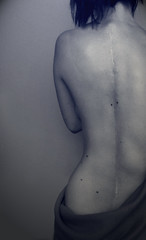
Back to sex. Even without bracing, there’s still a sexual paradox when it comes to scoliosis. Have you ever seen a picture of a woman with scoliosis and/or kyphosis that was not anonymous, depersonalized, clinical, grim and depressing? Like the photos I included above? Scoliosis is profoundly unsexy.
On the other hand, when women pose provocatively, they often throw one hip to the side and put one shoulder forward.Why is that pose sexy? Maybe it makes us look femininely defenseless and vulnerable, as opposed to a masculine, stick straight pose. That’s going along with a typical sexist definition of “femininity”. There’s another less sexist possibility… the pose is also highlighting the flexibility of the spine. So in that sense, the woman is showing off her body’s capacity by bending in a certain way.
There’s a comic book artist, Rob Liefeld, who was (in)famous starting in the 1980s for drawing unrealistic women. The conventions of drawing women are in comics are easy to criticize, but Liefeld’s stuff is… well…I guess you’d have to see the spinal curvature to believe it.

That’s supposed to be sexy. For the audience of predominantly young men who made Liefeld very popular, it must have been sexy. This is a funny analysis of the above drawing by a group of women comic book artists:
Take note of Avengelyne’s waist and how it is thinner than her head. Minus the hair. Note how it hangs beneath her ribcage like a suspension bridge, rather than actually supporting the top of her body. (Her torso must be kept afloat by those helium breasts.) Note the scoliosis gone grossly untreated. Note the little leather bags which wouldn’t fit around a normal person’s wrist. Especially note that the artist put her in the most obvious POSE to exaggerate the spine: a profile shot with negative space between her back and arm. That’s correct – our intrepid heroine’s spine would appear yanked. Avengelyne is a SWAYback™.
The humor is partly at my expense. But I can’t help laughing. It’s a highly sexualized image, but not one that I identify with in any way.
But here’s a poster image I ran across that uses stupid sexist humor to make fun of a real woman, and I don’t find it funny at all.

It really illuminates the double standard that women are subjected to. You’re supposed to be sexy so that you please men. But if it looks like you’re trying TOO hard, men (and other women) will make fun of you. If you don’t wear makeup, you’re a [insert homophobic slur]. Wear too much makeup, you’re a [insert transgender-phobic slur]. Curve your back, look sexy. Curve it too much, it looks like you’re deformed. Argh!
Thanks to my brief readings of disability theory, I realize that making fun of people with spinal deformities isn’t something I should just accept as the natural order of things, especially because this humor is connected to moral judgments of disability. That is, the idea that physical body difference reflects some kind of moral failing. When it comes to scoliosis, I think the general public halfway believes that scoliosis is the fault of the person’s family. There’s a myth that giving young kids backpacks that are too heavy will make their spines curve (totally not true). When people are adults, “she should have had that corrected” is sometimes an assumption. A lot of people don’t realize that the only sure way to even partly reverse a curve is spinal fusion, which also leaves a giant seam-scar running up your back. Another judgment is that a person with scoliosis must be poor. It’s true that I’m very lucky I had access to bracing; if I wasn’t born into a middle-class family in a rich country, my curve would be a lot worse by now. So there are major class differences in scoliosis, but ultimately, we’re all in different positions on the same boat because there is no way to permanently and completely reverse adult scoliosis.
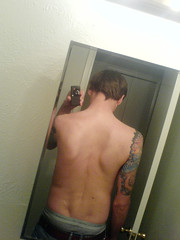
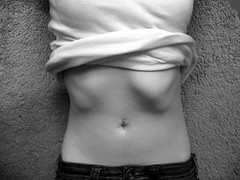
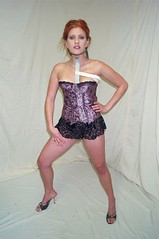
Thanks to flickr, I did actually find some images of scoliosis that I think are beautiful and help affirm positive self-image and sexuality. I wish I’d found a greater variety of body types, but these images are great to start off with. Some are post spinal fusion.
First, here’s the typical clinical picture. It shows everything that’s wrong with the body.

Now here are the flickr pictures. They show the open possibility and vitality of a body with scoliosis.



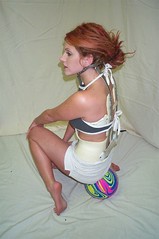
When I walk, my right hip swivels a bit higher and wider than my left hip. I’ve had people tell me it looks sexy. I’ve had people ask if I’ve hurt my foot. Neither reaction bothers me anymore. The way I walk is just the way I walk. It gets me where I need to go.
Acknowledgements for this post: thanks to Thorn for commenting about this issue, and mentioning how it negatively affected your adoption homestudy due to ignorance on the part of the social worker. Also thanks to Deesha Philyaw on Twitter for mentioning the Judy Blume book about a girl who goes through bracing: Deenie. I wish I’d gotten a chance to read that book when I was a girl, and it sounds really interesting.
Good stuff! I have Ehlers-Danlos, and scoliosis is my new thing. Well, maybe not so new, but it’s definitely bumped to the top of my list. The curve in my neck has completely reversed, which is tons of fun. I have finally gotten swaybacked enough that my abdomen sticks out just enough to make me look about 4 months pregnant. But since my spine is basically a Slinky, that all may reverse or just swap sides.
I was just yesterday remembering how, about 9 years ago, well before my EDS diagnosis, a friend of mine told me “you don’t walk, you strut.” It was kinda sexy then, but looking back on it, I know it was the beginning of my spinal problems. I also found high heels to be easier to wear than flats then, both because of my narrow feet, and because they accomodated my swayback stance better. It is odd that just a few extra degrees of spinal curve can make someone cross the line from being perceived as sexy to abnormal-looking.
Those are some interesting pics! I’ll have to poke around and look at more of those later.
Thank you for this post.
Like you, I wore a brace through all of middle school and I don’t currently consider myself disabled. This is pretty similar to the one I had to wear in the late 90s, and I can see how far orthopedics have come when I compare it to the picture you posted. However, I had to wear mine to school every day, under my clothes, except I could take it off for PE. I don’t know my angle as I haven’t been to a specialist since that last visit when they told me I didn’t have to wear the brace anymore – it was the best day of my life.
I was teased for wearing a brace, even by my friends. It definitely affected my self image. I doubt I would be the person I am today if I did not have idiopathic scoliosis. I think back to the overconfident girl I was at 11 and compare to the shy, self-conscious woman I was at 14, and it makes me very sad. I don’t really talk about it that much, but I am haunted by some of the events – the day my 6th grade teacher took me outside and said that other students complained that “I smelled”, because of the white undershirt I wore under the brace to prevent chafing. The girls that would sneak up behind me and knock softly on the brace and then giggle, thinking that I wouldn’t feel it.
I’ve gotten used to the “whoah!” reaction when people see me in a bathing suit for the first time. My shoulders and hips are relatively square but there is a 1″ difference between the height of my waist on the right and on the left – making me look more like a tube than my average measurements would seem to. I can’t really wear belts around “the thinnest part of me” or “natural-waist” dresses.
I have been thinking about getting a “commemorative” tattoo for the last 5 years or so, but I guess I’m afraid that it would be ruined if I have to get surgery later in life.
One thing I’ve noticed is that I just can’t use the elliptical machine at the gym. Something about that “natural” motion is hell on the muscles on the “weaker” side of my back. Just thinking about it gives me back spasms.
Sorry this is so long. I feel like I have no one to share some of this stuff with.
Thank you so much for this. I was diagnosed at age 5 (still am rooting out how being asked to walk up and down in a hallway in your underwear at the doctors office can f’ your boundaries) and monitored because of the perceived severity of it past my teens. The curve is so low they would have had to do surgery but because of my various privileges (insurance + money + body) I haven’t had to have surgery, although chronic knee problems and now aching hips are teaching me this is a ‘forever’ thing.
I was put in ballet as part of my treatment, and living at the edge of a white middle class suburb I knew a couple of girls who had the same health problem – and all had surgery which makes me wonder if that is chosen as ‘less scarring’ than the backbrace… which is a bit of a cultural example (featured in movies) of ‘teenage horrific experience.’ Until now I hadn’t ever seen what a brace really looked like, or heard from a person what their experience was with it. I also haven’t heard what long lasting effects have on other bodies.
So thank you for making this space.
Thank you for such a personal and also informative post.
.-= Sweet Machine´s last blog ..Some applicants are more equal than others =-.
[long swearing session deleted] I didn’t know it could start to progress again at menopause. SHIT. I wore the Milwaukee model for 9 years (no surgery), and when I was finally discharged from the clinic they told me I was DONE. I’m now AT menopause, and you’re telling me there’s a risk I’ll have to do it all again? SHIT.
This study showed that bracing doesn’t affect self-image much. However, it also takes places in Sweden, where school environment I’m sure is quite different than in the U.S.
I’m in the UK, and you can bet it affected my self image. When I finally stopped wearing it, I got my mum to go through the family photo albums and remove all the pictures where my brace was visible, because I’d found one by accident and it made me physically sick to look at it. In fact I still can’t look at the pictures in this post.
I’m sorry, that’s all the reaction I have at the moment.
Guess I’m not sleeping tonight. : (
Once it stops being invisible, it’s all of a sudden very, very visible. I guess it’s sort of like shaking hands with someone and suddenly realizing they have six fingers.
This made me laugh. My scoliosis is very minor, but I have three fingers on one hand; when somebody asks if I’ve noticed, I say innocently, “What, there’s something wrong with my hands?” and lift them up so I can glance at them, ‘notice’ the deformed hand, and shriek in horror.
Thank you for this post. The pictures from Flickr are beautiful and profound.
This is a wonderful post. Thank you.
My friend Rosemary has scoliosis, and last year she got a beautiful tattoo of a rose on her back. Its stem follows the curve of her spine. It’s gorgeous.
I have scoliosis. This post was painful to read. I really wanted a brace, but bitterly resented the fact that it was too late for me, because my parents ignored my concerns that something was up with my back.
Now I am at least 80 degree curve, and I am experiencing breathlessness. I have reduced lung capacity. While there may be other things also experiencing breathlessness, I am really scared. I hope I never need surgery. Its spectre was a big cause for my depression. I’m also sure scoliosis has contributed to my long-standing chronic illness.
Having scoliosis was the cement to my conviction that I was asexual. I remember telling the surgeon I didn’t care how I looked, and I didn’t want surgery. I was actually attracted to girls, but I didn’t know that at the time. Given I was the school’s most unpopular person, a brace could hardly have made things worse.
If I really really don’t need surgery, I am getting a tattoo of a gnarled curved tree along my spine, to represent strength. But I can’t bear the thought of it being cut into so I have to be really sure. Can I ever really be sure?
Wow, painful issue is painful. And it’s not just the arthritis in my spine.
Thanks so much for this post, I learned a lot. Also, thanks to the commenters for sharing such painful memories.
This started on me remembering being called crooked in school and my mother telling me to straighten up. I don’t remember the angle, or anything really, and I don’t know what the future for hold.
But you got me thinking about it again, and I thank you for that.
thank-you for this post! i’ve been lurking around here since the blog opened, drinking in all the fantastic posts and commentary.
i’ve been thinking about my (mild) scoliosis a bit more than usual in the last few days, since i was offered some unsolicited advice on how to fix/help with it by someone who probably shouldn’t have.
i’ve had people blame me for my scoliosis from a quite early age (it was discovered by a doctor when i was 5 or 6), both in terms of having “bad posture” (which i suspect was actually my unknowing attempt from an early age to find a comfortable position to sit in, given the unusual curvature of my spine) and being told that i was “giving myself” scoliosis by carrying things that were too heavy for me. (what was i supposed to do, *not* participate in activities because i couldn’t fit all the equipment in my school bag and i had to walk to school?) my scoliosis is caused by a hemivertebra, by the way.
thankfully, it’s never really led me to feel that i can’t be attractive, although it has at times led me to feel like i can never be “normal”.
i love the idea of getting a tattoo that follows the curve of my spine. thanks for sharing, people!
Thanks for the kind words and thanks to everyone for sharing their stories.
One thing I forgot to mention in the post is that I’ve found a good resource in the forums at scoliosis.org. There are a lot of people there asking questions like “is it time for me to get surgery?” “should I get surgery?” “does X treatment actually work?” and a lot of other people answering them.
Thank you so much for writing this! I don’t have much to say because I’m so overwhelmed — you’ve written so many of the things I’ve thought over and over in my own head.
Thank you for this. I have had scoliosis for as long as I can remember. It was a very minor issue until my early 20s, when the background pain, which had previously been like white noise, turned into a front and center shrieking pain. I very rarely talked about the pain up until recently, because I felt like talking about it meant complaining, and I felt like I had no right to complain. Partly because “someone always has it worse” and partly because at some point in my life I assumed pretty much everyone had constant pain, they just didn’t talk about it because it was of so little importance. I’m not sure why I got this idea, but it’s still strange to me to imagine that there are people who don’t live in pain. In my experience, it seems typical that women experience pain and suffer silently, though I can’t remember anyone ever teaching me this.
Since seeing the sway of my spine lit up from behind (this past summer), I have become hyper-aware of my scoliosis and how it affects me. I had never had an x-ray of my back before, had never had tangible evidence that there was something wrong. For me, that x-ray gave my pain a sense of validity. I wonder why the pain itself wasn’t valid enough.
Another thank you for this post and for sharing so much–I was aware of scoliosis and some of the treatment process (my cousin has it), but I’ve learned quite a bit.
Thank you for this post, it puts into perspective what my mother went through…my mother has a degree of scoliosis (she’s now 85) and had to make various decisions about her treatment over the years. She never went into any detail about them, I think feeling that they were hers to make – which I totally respect.
Eventually she decided she’d prefer not to be ‘messed about with’ and, while disabled from other causes (she has diabetes, ischemic heart disease, arthritis in just about every joint to the point where she can barely walk and cataracts) she manages to live alone in her own home with care provided every day by the local authorities. (She’s in the UK.)
wow, how inspirational you are! ^^
during middle school and high school, i’ve held my self-esteem down. scoliosis is not just a physical condition, but also emotional. but, rather than suppressing my emotions, i began to accept, realize, and embrace it. and the only way i can is through dance. I love the uniquenness of my back as much i love dance. scoliosis is me. Not ugly at all. \(^^)/ *empowering!!!
Thank you for posting this. There’s a great deal here I didn’t know myself – including the bit about progression occurring again at menopause. Now I’ll know to watch that and seek treatment when the time comes.
My scoliosis wasn’t diagnosed until after puberty, when I started to wear more fitted clothes and my mom noticed the unevenness of my waist and hips. It was something I’d noticed long before, but I’d simply assumed it was what women’s hips did and actually liked the way each hip had its own unique curve. (Still do, come to think of it, though it’s easy to forget how much I like it now that I’ve learned to associate it with my scoliosis.)
Looking back now, I honestly can’t say whether I’d rather have learned about it earlier, when there was still time to do something about it. It’s difficult to weigh the possible benefits of bracing against the stigma associated with spinal deformities and, in the event of having to wear a brace to school, essentially outing myself to my peers as someone with a physical abnormality at an age when kids are cruel and self-image is a delicate thing. It never occurred to me until now that it’s symptomatic of an ableist society that it isn’t an easy call.
Thanks for posting this. I don’t feel so alone anymore. I have been told that my back was disgusting by a family member when she saw me in a bikini. I will never forget that comment for as long as i live. I think about my 30 degree curve at least once a week. Buying clothes can be a nightmare and sometimes the anger when i see myself in the mirror of the fitting rooms nearly brings me to tears. I hope others are coping better than me. I know 30 degrees isn’t so bad but it’s ruined any confidence i once had and now i’m dreading menopause. 🙁
Thank you for this post. I feel like it was a good introduction for someone like me. I first heard of scoliosis when I was about 12, and read the young adult novel, Deenie. It made a strong impression on me. Years later, I learned a little more about scoliosis because one of my favorite actors, Sarah Polley, has it. (I believe she’s had surgery for it.) The pictures you shared were very helpful. I never understood what scoliosis might look like – and now I think I’ve probably seen many people who have it, and simply never knew. The stories about negative school experiences (both in comments and in the article) are just heart breaking to me. My parents pulled me out of school in 7th grade (age 12) in part because they thought I’d have a hard time with peers and peer pressure. Sometimes I rue that decision; sometimes I think it was best for me when I hear about the cruelties folks suffered in middle and high school.
Interesting to hear your perspective.
I wore a brace for one year durning middle school and it was nothing short of terrible. I had to wear it twenty three hours a day. I did not tell any of my friends and avoided conversation with my siblings about it until hight school when I decided to stop wearing the brace and going to the doctor. My curve was than 30 degrees.
I am a first year in college and am a distance runner. Within the last six months I have been experiencing extreme back pain. My self-image has been affected, allowing my friends to call me “square body” or “short torso syndrome” because I do not have a waist. I get made fun of for being figety (which is hard to explain to others that I am constantly moving because I am never comfortable)
But, the point is that I finally faced my fears and went back to a doctor and was told that my curvature is 58 degrees. I am planning on getting spinal fusion done in May.
I am fearful of surgery. But, this is life and what I must do.
Best of luck and hope your curvature does not worsen.
I was diagonsed with scoliosis at 11. One of my aunts (she had the same problem), detected it and told my mom to have it checked out. My mom yelled at me constantly for not sitting or standing up straight & this would bring me to tears as I couldnt understand why. She would see that my posture was poor but I didnt recognize it, it felt normal to me.
In terms of teasing, i did get teased at school and “hump-back” was quite a popular term for me.
But all in all those pictures that you posted made me realize that I dont have to give into to the pressures or opinions of other people because sometimes up to this day it still hurts a bit when I see that I’m not what society perceives as “normal”. I still wear almost anything that is in fashion but I hate dresses, but that has nothing to do with my hips. However, I’m a bit nervous about wearing a bathing suit.
So many posts. I am 47 and I have had a 37 degree curvature since I was a young girl. My sister, 5 years younger, had spinal surgery at 14 and is still having problems due to refusing to wear her post-surgical brace after horrendous taunts at school. Very sad. I am again facing another x-ray soon to keep an eye on things. My story is a mix of all of the above posts. I grew up in an isolated region, very insular and hid my ugly body under large clothes and very long hair. High School was awful and was so unhappy as I really had no access to learn about the condition. My first evaluation was when my sister’s curvature started its assault on her little body, then I spoke up. But too late for bracing I was told, along with I was to just deal with it and my doctor even said it was more noticeable as I was quite lean, so maybe put on some weight! Hideous approach. So my life has been hard, lots of self loathing and I am very self conscious, and hate wearing clothes. Honestly it takes me ages to get ready as I hate what I see in the mirror and hate how the clothes fight with my body. I have a wonderful 20 year old son and manage to have great friends and career. But would have happily curled up in a hole and died. My right shoulder blade has a life of its own, I cannot sit still stand still lie still for long without going crazy. You all know this anyway. It is so nice to finally get in the mood to talk online. I don’t talk about it to hardly anyone. My colleagues at work don’t say and I don’t say, only to a couple who I have caught looking at me in that way. One friend did say recently, when I was leaning over doing something, ‘oh my god, what is wrong with your back!?’ and it still freaks me out and puts me in a depressed state for days. My partner is gorgeous and fully understanding, I am happy he loves me as I am. But I am in the throes of more pain lately and concerned it may be getting worse. That’s all now, my back hurts from sitting here too long haha!
Last August I had spinal fusion surgery, now 14 of my vertebra are fused together. I’m 16, a junior in high school, and can’t attend full time. I go to intense physical therapy twice a week.
I wore the brace for over a year before the surgery. My brace doctor promised me that it would stop the curve. It never did. It had a hole cut out on one side for my ribs, which made an off-putting lump on my side. I was to wear it 20 hours a day.
My grades this year have tanked since I keep missing school. And I’m supposed to be healed by now, but somethings still wrong.
I’m so happy to have found this~
My scoliosis is not very pronounced, but because of where it is my waist is crooked, which has always made me feel insecure about my body. Reading this helped me feel like I’m not the only one with these problems… something I really needed right now.
Thank you so much 🙂
reading this post brought me to tears. I have had scoliosis since I was 13 (I’m 26 now – wow, I just realised that’s half of my life) and I get so upset about it as no one I know could relate. I sometimes stand in the mirror and just stare at my back and hips. I try about 50 different stances to try to make it less obvious but none work. I’ve been told by physios, chiros and orthopedic docs that I’m the worst case they’ve seen. How badly that guts me….
I was lucky my parents cared about me so much. They ‘forced’ me to wear a Boston brace knowing how much it would help me. They even threw me a back brace party to introduce it to my friends to help them understand. I had a big strong group of friends at my all girls school so there was zero bullying.
I guess what upsets me most is that I know this is permanent and will only get worse. I just don’t know how I’m going to cope with that when I get older. Pregnancy scares the crap out of me. I’ve heard horror stories….
Sorry this is so long, but I too have had no one to discuss this with that can relate……
Really glad to have a post like this. People without this condition just wouldn’t understand how it feels to be like this. I have it since I was 10. It was a nightmare. At first check, the doctor asked me to have the surgery. But my mum was reluctant, she was afraid of complications. And I am glad she didn’t let me have that surgery. I have been living it with 8 years now. It doesn’t really bothers me. Sometimes I will think of it, get depressed a little while, but then decide to get on with life. School was definitely hard. High School in my country was still fine, we wore uniforms, mine was loose fit so it wasn’t that obvious, college was bad. I transferred twice then decided I couldn’t take it anymore. People were staring at you like you are a weirdo with some kind of disease or illness. And they start avoiding you. That feeling is one of the worst. Some may think that being fat or obese is the worst feeling, but I’ll tell you, having this condition is the worst. At least, you can exercise and lose weight, but this, you can do nothing about it. I have learnt to accept it now. I can’t do anything about it, so I’ll just let it go. I am living like no other people. But I never thought of getting into relationships, imagine, what your partner will do or say, when he/she found out that you have this condition. gosh. Don’t dare to think of getting pregnant of having kids. Sex, would be the last thing on my mind. The future? Its always full of hope. Don’t give up on yourself. I have already decide to spend all my life alone. I don’t really care, I just need to live my life to the fullest for myself. All the best to the others who have this condition. May you all get well and better. Don’t give up on yourself, and believe that you are normal and fine. You are just as great as others. You are great.
Hi everyone! I am now 56 years old and have had scolisis since I was 14. At that time my symptoms of one “raised” hip, uneven shoulders, and obvious ribcage on the right side of my back had my mom take me off to the doctor’s. He found that the curve -which eventually went to 75 degrees, had to be taken care of with a spinal fusion and harrington rod. I guess I was a bit of a pioneer for that kind of surgery–my rods and all have been “in there” for 42 years now! As some encouragement to those young people facing this challenge, I have to say that the operation, 3 months is a body cast, and then 3 months in a brace all worked out well for me. My curve was reduced to just over 20 degrees. I went on to become a school teacher, married and successfully went through 2 pregnancies. I have just retired from teaching.,I had no pain during all that time. Now, as menopause is raging, I can feel twinges in my back and can only assume that changes in discs, etc. are going to be causing me some problems. However, I am so thankful for the wonderful years I’ve been given, that I’m planning on looking this in the face and doing whatever I can to keep myself fit and the pain under control, as much as it’s in my power to do.
Thanks for the forum and comments–it’s nice to know we’re not alone! Hope I’ve been of encouragement to someone! Donna
Thank you so much for this post (and to the commenters). I’m 26 and I’ve struggled with scoliosis since I was 15. I have an S curve (37 lumbar, 30 upper last I had checked). I struggle with discomfort (physical and emotional) over this condition every day. Scoliosis is always on the back of my mind. I’m extremely self conscious of the bulge on my left waist and my overly defined right waist. When I’m at the beach or the pool, all I can do is look enviously at all the other women with straight spines. It’s sick, really.
Over the past year or so, callanetics, yoga and my chiropractor have brought me some relief. My right side is no longer as compressed as it once was, my hips have leveled out a bit and my shoulders aren’t as uneven. But everytime I look in the mirror, all I can see is my deformity. Thanks for posting the artsy pictures. I’ve seen a few other pictures of women with scoliosis that I find very beautiful as well. I suppose it’s just hard to see that beauty in my own body after dwelling on the negative for so long. It’s very nice to read and see that I’m not alone.
This post and all the stories following really caused a spur of emotions inside of me. I’m recently 18, my scoliosis was more or less discovered when I was 13, and I had surgery when I was sixteen.
In 2005, when my curvature was first noticed, the upper one was only about 8 degrees and the lumbar around 13 degrees. Three years later, I found myself looking at an x-ray up in the doctor’s office, feeling like my life was over as I stared, and stared, at a black and white image showing my once almost unnoticeable scoliosis as a respective 59 and 73 degrees respectively. At the time, I hadn’t ever heard of Ehlers-Danlos Syndrome (which, by now, it has been confirmed I have). The doctors had told me it should have stopped when I had hit my full height.
What was problematic is that I hadn’t been growing vertically at all. I was curving at the same rate of growth. Which was really, really fast. I never hit my ‘true height’. I had been about 5’10” at one point; the day of the surgery I was measured to be 5’8″.
People should not be worried about have scoliosis surgery that much. It hurts, yes, but you get over it. I barely remember it because of the crazy amount of painkillers. I think the worse part was being told to sit up the next day.
And, the scar? I’d much rather it than a crooked spine– mind you, my curves aren’t gone 100% and my spine isn’t even in the middle of the back of my neck. I’m proud of my scar. I wear low-back tops to show it off. People aren’t grossed out by it, they admire it, as well as the ‘courage’ it takes to exhibit it so freely.
Once again, I thank you for posting this. Below is my own piece of scoliosis- the progression x-rays from 2005 through 2009.
M.
http://i174.photobucket.com/albums/w94/SinLark/SpinalProgression.png
Hey K, your comment that scoliosis is worse than being obese b/c “At least, you can exercise and lose weight, but this, you can do nothing about it” is incredibly rude and insensitive. I have a diagnosed endocrine disorder, and no amount of exercise will EVER change my body. Finding the body/fat acceptance movement has been a lifesaver, and learning to love/accept myself as I am has for me been tremendously empowering. Comments like yours a) plays one stigmatized condition against another, which misses the point, and b) upholds a set of stereotypes/faulty assumptions about fat bodies that are actually not true. Dieting only works long-term for about 5% of people, so telling me that I can just exercise and lose weight, esp with my particular physiology, is somewhat akin to if I were to tell you to just suck it up and stand up straight. Please think more carefully about the assumptions you make about other people’s bodies and their experiences in them.
My names Victoria, I’m sixteen and I have scoliosis. My turn was nearly eight degrees and I had a brace for at least five years. I had to wear it everyday, but I was ridiculed so much in school there is not one day I didn’t think of suicide. It hurt horribly. I could not stand up for more than twenty minutes and I had no friends. I was called cruel names like Quasimodo and Camel back. These words pierced me so, I refused to wear my brace and my back progressively got worse. It finally got to the point where I needed to have surgery. I cried my eyes out. There was a chance that I wouldn’t make it and it was the hardest decision my mother has ever had to make. I got the surgery May 14, 2007. It turns out that I got a new type of MRSA that clung on to the titanium rods in my back and they had never seen something like it before. For those of you that don’t know, Methicillin-resistant Staphylococcus aureus (MRSA) is a bacterium responsible for several difficult-to-treat infections in humans. It may also be called multidrug-resistant Staphylococcus aureus or oxacillin-resistant Staphylococcus aureus (ORSA).
MRSA is, by definition, any strain of Staphylococcus aureus bacteria that has developed resistance to beta-lactam antibiotics which include the penicillins (methicillin, dicloxacillin, nafcillin, oxacillin, etc.) and the cephalosporins.
MRSA is especially troublesome in hospitals where patients with open wounds, invasive devices and weakened immune systems are at greater risk of infection than the general public. But they had to try me on a new medication and it rotted the enamel in my teeth. I stayed in the hospital for nearly two months in a drug induced coma. I was in so much pain. I woke up hearing the doctor tell my mother to make funeral arrangements for me, telling her that I only had a 20-30% chance of living. Now, nearly four years later, I am STILL in as much pain as I was. I have back spasms almost everyday. But, it’s something I have to live with, I have arthritis in my back, and I can only stand for 45 minutes at a time. I can not sleep on my back and I’m only sixteen. There’s still day’s where I think of dying. putting myself out of all this pain. Doctors can’t help me any further. I’m sorry this post was so long, I just felt the need to share my story with these bloggers.