Category Archives: social attitudes

Yeah, what *about* your free speech “rights”?

Here at FWD, it is not unusual for us to get quite a few comments in mod that question, take issue with, or outright berate our fairly rigorous comments policy and iterations thereof in varying degrees. Many of these comments are some variation of “But what about my right to express my opinion?” or “But…free speech!”

Unsurprisingly, many of the comments that try to take us to task for “prohibiting” free speech are from non-regular (and, in some cases, first-time) commenters. I try to give people — on the internet and off — the benefit of the doubt. Perhaps these folks who try to direct the conversation to their supposed right to say whatever they want “because of the First Amendment” are just unaware that many social justice-focused blogs — especially those written by people who are members of various marginalized and/or traditionally underrepresented groups — have commenting policies, usually for very specific reasons. Perhaps they think that the First Amendment entitles them to say whatever they want without also getting called on it. Perhaps they think that bigoted or hateful speech is okay, since it’s “just” on the internet and therefore cannot be taken seriously or do any “real” damage. Perhaps they think that someone needs to pay Devil’s advocate when talking to (or about) disabled feminists and other people who do not represent (or are not represented by) the majority, and they are reasonable/intellectual enough to do the job!

Here’s the thing: This website is not  run by U.S. government or employees of the U.S. government who are representing their place of work. This is a privately-owned website.  Its contributors, commenters and readers are not all from or living in the U.S. The First Amendment applies, by and large, to the United States government’s attempts to contain and/or regulate things that people say or opinions that they want to express in myriad formats. In other words, “freedom of expression” does not automatically mean that you can bust out with some bigoted crap, and then whine or call foul when the blogger or author chooses not to publish or engage with said bigoted crap, or when someone else (perhaps another commenter) calls you on this crap. Free speech is not equivalent to some sort of magical blogular free-for-all. The “free speech!!11” defense (if you want to call it that) also has the unintentional side effect of privileging US-centric notions of being able to say certain things, apparently without consequence — something that some other countries do not appear to take so lightly (see, for example, British libel laws).

From a more anecdata-ish perspective, I have noticed that many of the people, at least on the internet, who cry “free speech!!1” in defense of their supposed right to say “un-PC” things/play Devil’s advocate/et cetera are people with various kinds of privilege (white, heterosexual, abled, cis, class–to name just a few) who simply do not seem to want to give up — or, sadly even so much as critically examine — one or more of the types of unearned privilege that they have. Put simply, they just want to shut people (who oftentimes aren’t just like them for one reason or another) up using the trump card of free speech. It seems to me that the thought process might go a little something like this: Who cares if there’s a person (or people) on the other side of that computer screen? I have the right to steamroll over their lived experiences, or tell them how wrong they are ’cause “normal” people don’t feel this way, or tell them to suck it up/grow a thicker skin, or that they’re just making things up so they can be angry about stuff, or looking for stuff to get mad about, or seeing things that “aren’t there” (because if I can’t see it, it must not be there!) or use any number of derailing tactics that are not pertinent to the actual discussion at hand, or direct the discussion to my experiences and feelings as a privileged/non-marginalized person and thus re-center my own (and the majority’s) importance in a discussion that is not even about me, because it’s within my FREE SPEECH!!1 rights to do all of this and more!

Boy, that must be really fun, getting to justify making things all about you and your “rights” all of the time in spaces that are run by people who are — gasp! — different than you, and who may not have much of a safe ‘net space anyway, since the entire web is full of people who probably share at least some of your oh-so-contrarian outlook on things (not to mention some of your privilege[s]).

The free-speechers also tend to miss one important thing: If they want to spew uninformed, privilege-encrusted opinions using this excuse, and their comment gets published publicly, it is perfectly within reason for bloggers, writers and other commenters to use their free speech “rights” to respond right back.

We Need to Consider More than Universities

There’s a lot of really good stuff out in the blogoamorphia[1. Sphere, pshyeah.] about sexual assault on uni campuses. The focus is specifically on USian colleges and universities though Rape Culture exists pretty much everywhere with only slight variation. It’s worth reading, if you’re up to reading about sexual assault at all. (I’m not always.)

Predators are good at target selection. All of them. We see this in the uni rapists who repeatedly assault vulnerable young people. And the analysis of these assaults and assailants is valuable. I hope the attention being focused on this issue leads to real change in how sexual assault is treated by colleges and universities because the status quo is disgusting. Victims are made to undergo ‘mediation’ with their assailants in the name of ‘fairness;’ people known to administrations to be serial rapists face only the most cursory of punishments while their victims often leave, faced with an environment that could hardly be more obviously hostile; the government agencies tasked with reducing rape on uni campuses in the US have hardly bothered to appear to do anything at all.

But I’m a little uncomfortable that the focus is on the most privileged, most visible, most likely to be photogenic segment of sexual assault victims. Not that these people don’t need or deserve attention–they do. (And really I’d like there to be much more awareness that the things cis men do to each other are not HILARIOUS PRANKS but are sexual assault and should be treated as such. Cis men, you have a task: Even if you can’t be arsed to end sexual assault of other folk by cis men, you may wish to end assaults on yourselves by cis men. Hop to it.) I just worry that the pattern we see so often where the most privileged people are centered and marginalized people are pushed to the edges will repeat itself. That sexual assault victims whose circumstances differ will have a more difficult time being heard. That there will be a sense of “Well fuck we already had to care about these college [het cis probably currently non-disabled largely white largely middle-to-upper-class] girls getting raped and now you want us to care about you? Sorry, we’re all out of giving a shit.”

Because predators aren’t just at universities and colleges. All those uni students will leave school eventually. Not all predators even go to uni. They will all be looking for targets. Not only will they choose targets that are vulnerable and have a low risk of incurring negative consequences, they will seek out environments where there are large concentrations of their preferred targets. They will search for jobs where they will be in positions of authority over those targets. Predators that prefer children try to get jobs in schools or in religious settings. Predators that prefer disabled people, mentally ill people, or elderly people look for work in hospitals and supportive care facilities. Predators that prefer sex workers become pimps or police.

Part of the problem is going to be that people will be able to relate to the uni predators better. University-age women are often attractive people by accepted standards of beauty. Raping a pretty young cis woman is understandable–the rapist was attracted to her and wanted to fuck her and wanted to cut through all the preliminary bullshit and get right to the fucking. It’s harder for people to imagine wanting to fuck children or older people or disabled people or crazy people or fat people. Who’d find that attractive? (Who would rape you?)

It isn’t about sexual attraction. A predator’s preferred type of victim may not have anything to do with the sort of people xe finds attractive in non-predatory relationships (assuming xe has any) and may be of a different gender from xer orientation. Cis men who identify as straight and prey on children who read as male by ciscentric standards aren’t necessarily lying about their orientation, even to themselves. Predation isn’t about sex despite there being sexual gratification involved. (Though the predator xerself likely doesn’t understand this.) It’s about the predator making xerself feel powerful by stripping xer victims of power. It’s about the predator boosting xer self-confidence by humiliating xer victims. It’s about the predator feeling safer by making someone else afraid. It’s about hate. It’s about entitlement. It’s about controlling the behavior of others. And like all kinds of abuse, it’s about making the victims responsible for the emotions and actions of the predator.

Sex is just the mode of abuse. The choice of victim is about getting away with it.

So how do we not lose track of this? How can we address the issue of rape on university campuses without centering that experience of rape and marginalizing others? How can mainstream anti-rape activists not treat our experiences of rape as Other, as exotic, as something incomprehensible? Because that path leads to paternalism and patronization. It’s not good for us no matter how well-intentioned. It’s the sort of thing that leads to disabled people with ovaries being sterilized without their consent or knowledge at the behest of guardians who simply assume, with ample justification, that they will be raped in institutional care facilities. Since there’s nothing they can do about that (as we all know rape is a force of nature and not an act performed by humans capable of changing their behavior[2. MY SARCASTIC VOICE LET ME SHOW IT YOU.]) they can at least protect those people with ovaries from some of the potential things that could result from said rape. That one of the things they are protecting people with ovaries from is the possibility of bearing a child and being a good and loving parent–which happens even when a child is conceived by an act of rape–doesn’t occur to them. They know best, and they can’t imagine this person they’re placing in an institutional care facility being a good parent.

Cross-posted from my tumblr blog, Rabbit Lord of the Undead.

A Conversation in the Lunch Room

I was sitting in the lunch room at work with a group of co-workers, flipping through the newspapers. I came to an article on the suicide of Marie Osmond’s son, which led to the whole table discussing the incident. And it was immediately underlined for me how little most people know about mental illness and depression. Here’s a brief list of some of the questions and statements that came up during the discussion, the entirety of which I spent shrinking into myself and trying to be invisible:

  • “Is depression even a real disease?”
  • “People who commit suicide don’t really want to die – evolution wouldn’t let us have suicidal tendencies because it goes against survival.”
  • “It must be because his mom had mental health problems too.” Someone inquired if depression was hereditary and the original speaker replied “No, but being around depressed people can turn you into a depressed person.”
  • “I once knew a bipolar. She married my cousin and my mom got so mad, like you should never marry a bipolar because it’s not a good idea for them to have kids.”

Finally, a young man told a long story about his ex-girlfriend, who had experienced major depression, and how it affected her and the serious limitations it caused her. It was a great illustration of the reality of depression and the changes it can cause in day to day life. It was unfortunately concluded with a “so that’s why you can’t be in a relationship with those people, it’s just too hard.”

We’ve got a long way to go, y’all.

“Defiant Birth”: Impolite Women Who Didn’t Make History

[WARNING for this post: ableism within and without the medical system, pregnancy/baby losses mentioned]

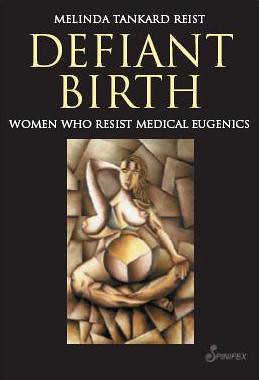
defiantbirthDefiant Birth: Women Who Resist Medical Eugenics, by Melinda Tankard Reist, is a book about women. It is a book about families. It is a book about resistance. It is a book about women who refuse to be told what they “should” do with their own bodies by healthcare staff, friends, and family.

It is a book of stories, of women’s voices.

All of the women in the book have chosen to continue pregnancies against medical advice. The medical advice is based on something about the pregnancy falling outside of the very narrow “norm” – the women’s disabilities, their “elderly” ages, a diagnosis (or misdiagnosis) of a fetus labelled “defective”. There is a woman with diabetes in her forties; a woman who chose to carry to term and birth two babies with anencephaly; women with babies with trisomy 21; women living with HIV; women with incorrect prenatal diagnoses of lethal conditions; a woman with lupus and a woman with MCTD and pulmonary hypertension; a woman with Scheurmann’s disease of the spine; a woman with severe asthma; a woman with cerebral palsy; a woman and man both with dwarfism; a woman exposed to rubella during her pregnancy; a woman with thalidomide-related phocomelia; and more.

I’ll start by letting some of these women tell their own stories, as this is the significance of the book as I see it:

d. a. marullo writes:

The next day I went to see my regular doctor whom I hadn’t seen yet. He was my general practitioner and I’d known him for eighteen years. I told him the news and he tightened up his face and looked at his paperwork while speaking.

“Well, you’re going to terminate, right? I mean it would be the smart thing to do!” I was so devastated by his words I almost started crying.

“I haven’t really decided anything,” I said. […]

“Well, the numbers add up, after all – your age and all. It’s probably not going to be normal!”

Teresa Streckfuss writes:

“He came bursting into our room and listened for Benedict’s heartbeat and said, “Okay, that’s all fine,” before awkwardly leaving us again. Lucky he left. If he hadn’t I might have screamed, “THAT’S ALL FINE? THAT’S ALL FINE? GET OUT OF MY ROOM! MY BABY HAS JUST DIED! IT’S NOT ALL FINE! WHAT DO YOU MEAN, THAT’S ALL FINE?” I know what he meant. Our ‘non-viable fetus’ had died, as expected. He failed to recognise that we had just lost a person, someone we loved.

Johanne Greally writes:

On returning home I went to see my doctor. I was totally unprepared for his reaction. “There will be no problem getting you an abortion,” he said. “You meet all the requirements on both physical and mental grounds.” “But,” I stammered, “I don’t want an abortion. I want a baby.” I felt shocked, belittled, and disempowered by him.

“Your back is unable to support just you, let alone a baby. You will never be able to carry a baby. You will be in a wheelchair by the time you are seven months.” It was true that my back couldn’t support me at that time, and I had been trussed up in a corset-type back brace off and on for over a year, so that I could not move around freely even without a baby.[…] All through the pregnancy my back continued to improve. I was now able to lift and bend, even chop wood by the time I was at the seven-month mark.

Heather Arnold writes:

The added pressure of a baby pressing on my lungs would cause more problems. This doctor also reinforced that the ‘standard of care’ in my condition would be to abort the baby. I told her immediately that abortion was not an option and that I would be carrying this baby as long as I possibly could. She encouraged me to go home and talk with my husband before making the decision, although my mind was already made up.

Leisa Whitaker writes:

I remember sitting in his rooms listening as he explained that there was a 25 percent chance that our child could still inherit the dominant achondroplasia gene and the dominant pseudoachondroplasia gene- a combination that they had never seen before anywhere in the world. They had no idea of what effect this would have on the baby – whether it would die soon after birth or if it would have lasting physical problems. They had absolutely nothing to go on. Having told us this, the specialist offered us an abortion. He asked us to think about whether we wanted to bring another dwarf baby into the world.

Rosaleen Moriarty-Simmonds writes:

We learnt this one day when my mum went to pick Deborah up from school, only to find her in floods of tears. The children in her class had been asked to tell a story about someone that they admired. She talked about her elder sister, who didn’t have any arms or legs, and Deborah was told off by the teacher for having “a horrible imagination!”

Jo Litwinowicz writes:

I heard mum calling dad to the phone and she asked me to repeat what I had said so I told them that I was expecting. Their reaction devastated me. “Well Jo, that news has turned this day into a tragic day. You are an irresponsible and stupid girl.” They might as well have kicked me in the stomach; I was so upset that I slammed the phone down. If my parents’ reaction was bad, what chance did we have with complete strangers?

When I went to see my doctor at his antenatal clinic his first words were, “God, you were the last person I thought I’d see here.” “Sorry to disappoint you,” I replied. He asked how we felt about the prospect of becoming parents, and we told him that deep down we had both secretly pined for a child and it was the greatest news ever. His response was to say that throughout my pregnancy, if I ever wanted an abortion, he could arrange it. […]

The next day there was a knock at the door and this woman said she was from Family Planning and could she come in for a chat. I joked, “You’re a bit too late.” She went on, saying how hard it was going to be to raise a child in my condition. I said, ‘What condition? You don’t know me and what I’m capable of. […] She calmly went on, “You do realise that when your child can walk and talk it will come to you and say, ‘I hate you, mother, because you can’t talk properly, you dribble and you’re in a wheelchair and I want a new mother.'”

Note that the stories are much longer and fuller than the bits I have picked out, which concentrate on ableist attitudes. There are many parts focusing on the authors’ happiness also!

One of the most powerful tools in our toolkit as PWD is to read the world in ways that others do not; to take tools for one purpose, and to use them for our own; to resist the appropriation of our stories for the political purposes of others. To this end I am also making a conscious choice to not review the introduction or closing words of the book here.

There are many stories in this book, and it is a book with multiple possible readings. I have deliberately avoided reading any other reviews while writing mine. I imagine that some may choose to read it as an anti-choice screed, just as some forced-birthers choose to see posts on FWD about the effects of ableism on pro-choice discourse as “on their side”. I choose not to read it that way. Only two or three times while reading did I get an sense of the voices possibly self-identifying as politically “pro-life”, and those moments were brief. One, who used the words “I chose life”, may or may not have been playing into the political nature of the phrase; either way, she is more than entitled to use the phrase in regard to her own personal choice. The other mentions in passing that she had worked at a “crisis pregnancy centre”, gave me a bit of a chill. But these are not the majorities of the stories, nor were they the most important or prominent parts of the stories in which they appeared.

The women who speak about their religion influencing their decisions, the women who touch on much-misused catchphrases like “I chose life”; these particular sentences did not resonate with me. However, not everything in this book needs to resonate with you for the stories to have power, for the experiences to speak. It was particularly noticeable that in some cases the medical staff just assumed that the choices to continue a pregnancy must be based in obedience to external religious edicts. The stories most of the women tell are quite different; their decisions were individual and deeply nuanced, not based in unquestioning submission to some sort of “authority”. Sometimes their religious beliefs were involved, and sometimes not; in no story did I read the story-teller proclaiming that other women’s choices should be legally constrained or outlawed. They are telling their own stories. I trust readers at this blog to handle the nuance, even as I might not trust those who bring their own agendas to the work.

Another issue I have with the book is the occasional mention of the experience of parenting a child with a disability as transformative for the parent. While this is not necessarily untrue, I think it needs to be written very carefully so as not to dehumanise or objectify the child, turn the child into an “inspiration” instead of a full, rounded person. I’m not sure whether that line was quite crossed – I’d have to re-read in detail, and the book has to go back to the library today! – but it skated close here and there.

If you’re looking for a statistical representation of how often prenatal diagnosis is wrong or misrepresented or used to pressure women, this is not the book for you. This books isn’t statistics; it’s lived experience. The stories have been chosen because they represent those times that women are pushed around or lied to or subject to misdiagnoses and poor medical care. The issue in the book is not whether this is a majority or minority experience, but that it happens at all, and that it can be handled very, very badly. Given the number of readers and writers on this site who’ve been stampeded in the healthcare system, I think many of us do have a sense of what it’s like to be on the receiving end of that treatment. In these stories, the stakes are high: the result of the stampeding, unresisted, would have been, in each case, a wanted pregnancy lost.

But I am overemphasising my nitpicking and reservations, here. In short, I recommend this book highly. The stories of disabled women, in particular, I found absolutely riveting. Their stories are vivid, immediate, at times horrifying, but more often joyful. The joy can be transcendent, yet entirely ordinary: the joy of a wanted baby, the magnificence of a disobedient woman.

I would love to see a followup book, in a similar format, with a broader scope. I’d like to see a book including stories from parents in non-Western countries; from trans or nonbinary parents; from very young parents; from undocumented immigrants and refugees and Indigenous people. A book including more analysis of the intersections of class and nationality and gender and race and queerness with disability could only be stronger. Whether we’re likely to hear that book from Reist is, well, a matter for debate; but she doesn’t, nor should she, have a monopoly on this type of story. As it stands, I am left thinking that it is only the privilege that the women in this book have – mostly white, mostly relatively wealthy – that allowed them to resist as they did, to survive as they did. The stories in this book are particular types of stories, and do not represent the realities of all pregnancies labelled “abnormal” for one reason or another.

However, even in its current form, I think this book should be considered a basic primer – for healthcare professionals, for pregnant people, for anyone else interested in disability and rebellion. It is not a primer about chromosome diagrams or placental configurations or how to eat or what to expect; but a primer about lived experience. The book covers what medical textbooks and pregnancy self-help books do not: the intimate, touching stories of women who rebel against crushing ableism.

Above all, Defiant Birth, to me, is defiantly pro-choice. It’s a book about reproductive justice. This book deserves its place in the stable of pro-choice works dedicated to the equally valid and necessary choice to not have a baby.

A Conversation With a Pharmacist

[Scene opens with a loooooooong wait in the pharmacy before my number finally “pings” on the digital number-pinging thingy, as I struggle out of my chair, and hobble up to the pharmacist’s window, and hook my cane on the window ledge for emphasis as I hand over my ID and number slip, wincing in the fluorescent lighting on the other side.]

Army Medic Pharmacist: One moment.

Me: No problem, Specialist. (I am well aware that two of my three expected prescriptions require me to wait as they are counted, twice, some other fun stuff, though I no longer have to run around to get them, and have to be signed for, so I amuse myself by reading the literature he hasn’t bothered to hand me yet.)

[AMP returns with the Civilian Pharmacist]

Civilian Pharmacist: You have taken pregabalin with topamax before?

Me: Yes.

CP: What about this antacid?

Me: No. But I assume it is the same as my previous one.

CP: Yes.

[I sign for one med. CP hands me two bottles.]

Me: There should be a third script.

CP: No, only the two.

Me: There should have been a vicodin script as well.

[CP raises her eyebrows at me]

CP: You are on pregabalin.

Me: Yes.

CP: That is a time released pain medication.

Me: Yes ma’am.

CP: You don’t need vicodin with a time released pain medication.

Me: With all due respect, ma’am, I usually have both.

CP: Well, there isn’t a script for it, and I don’t think you need it.

Me: Well, ma’am, there should have been one, and I am going to ask you to call my provider about it.

[Staring contest ensues between Me and CP. I win. CP picks up phone and asks AMP for Dr. Awesome’s number. I can hear Dr. Awesome on the other end apologizing for forgetting the script, that the computer wasn’t working right when I was in her office, which it wasn’t, and that she forgot to put it in before leaving the office, and would put it in the next day she was in.]

CP: Dr. [Awesome] apologizes for your inconvenience. You can pick up the script on Monday.

Fin.

I’m not here for your inspiration

I think I upset one of the newer employees at my favourite tea shop today. Most of the staff are used to my cynical reactions to newspaper discussions of how inspiiiiiiiiiiring people with disabilities are at this point.

But let me begin at the beginning.

Actually, no, let me begin with something important, since recent events have told me one cannot be too careful.

There is a certain way news media prefers to talk about people with disabilities. They like to tell our stories in a way that’s “inspiring”, that’s about making non-disabled people feel better about stuff. “Oh, look at how brave that person is, being all alive and stuff despite having a disability! I would rather be dead! That person/their parents/their loved ones are so brave and inspiring! I will now put issues of accessibility and disability out of my mind, because I have been inspired!”

These stories aren’t really about people with disabilities. They’re about making currently non-disabled people feel they know something, that they’ve been touched, that their lives could be suffering and badness, but look how lucky we all are. Look at the plucky crippled person, and be inspired. [This is, of course, why Helen Keller is reduced to “hand in water” stories.]

There are, of course, reasons why people with disabilities and their families participate in these stories, and I certainly don’t blame them. I know if someone offered to interview… wait, I’ve been interviewed a few times now about disability, and I did leap at the chance. I don’t think that people who are interviewed for these stories are doing anything wrong. They’re talking about their lives, and describing their experiences. No, it’s the way that these things are spun, the words being used by the reporters to fill in the gaps, that is the problem.

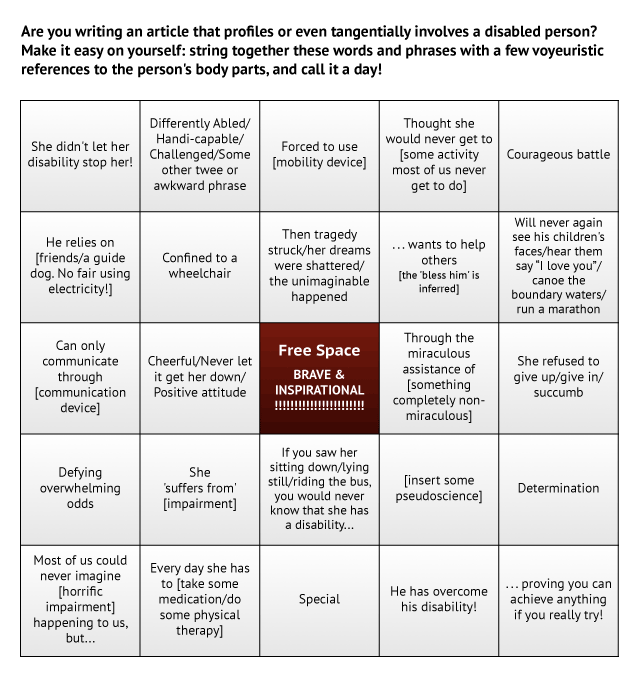
The tendency is so very very wide spread that Haddayr (with the help of Codeman) made a bingo card for us all:

Description follows

Description written by Haddayr:
Are you writing an article that profiles or even tangentially involves a disabled person? Make it easy on yourself: string together these words and phrases with a few voyeuristic references to the person’s body parts, and call it a day!

She didn’t let her disability stop her!
Differently Abled/Handi-capable/Challenged/Some other twee or awkward phrase
Forced to use [mobility device]
Thought she would never get to [some activity most of us never get to do]
Courageous battle
He relies on [friends/a guide dog. No fair using electricity!]
Confined to a wheelchair
Then tragedy struck/her dreams were shattered/the unimaginable happened
. . . wants to help others [the ‘bless him’ is inferred]
Will never again see his childrens’ faces/hear them say ‘I love you’ canoe the boundary waters/run a marathon
Can only communicate through [communication device]
Cheerful/ Never let it get her down/ Positive attitude
Free Space:
BRAVE & INSPIRATIONAL!!!!!!!!!!!!!!!!!!!!!!!
Through the miraculous assistance of [something completely non-miraculous]
She refused to give up/give in/succumb
Defying overwhelming odds
She ‘suffers from’ [impairment]
If you saw her sitting down/lying still/riding the bus, you would never know that she has a disability…
[insert some pseudoscience]
Determination
Most of us could never imagine [horrific impairment] happening to us, but…
Every day she has to [take some medication/do some physical therapy]
Special
He has overcome his disability!
. . . proving you can achieve anything if you really try!

So, let’s go back to my story.

I haven’t been following anything to do with the Olympics for reasons I won’t go into here, but I knew exactly what was going on when I glanced at Saturday’s Globe & Mail and saw this splashed across the front:

A Different Victory: When Alex Bilodeau’s brother cheered his gold, the triumph went more than one way. The skier and the painter find inspiration in each other – and neither one accepts limits. Ian Brown travels to the intimate heart of a family.

“Oh gosh!” I said to Don, in my overly chirpy sarcastic voice. “It’s going to be an inspiring crip story, I just know it! Quick, let us purchase this fine newspaper so we can be inspired!”

Poor dude behind the counter proceeded to tell me how inspiiiiiiiirng he found “the brother of the guy who won gold”, to which my response was… less so. “Inspiring crip stories irritate the fuck out of me.”

You know what would inspire me, gentle readers? Curb cuts being cleared of snow so Don & I could get across the street without having to go three blocks out of way first. But I guess when you’re a bitter, cynical, angry person who just hates fun, that’s what you get.

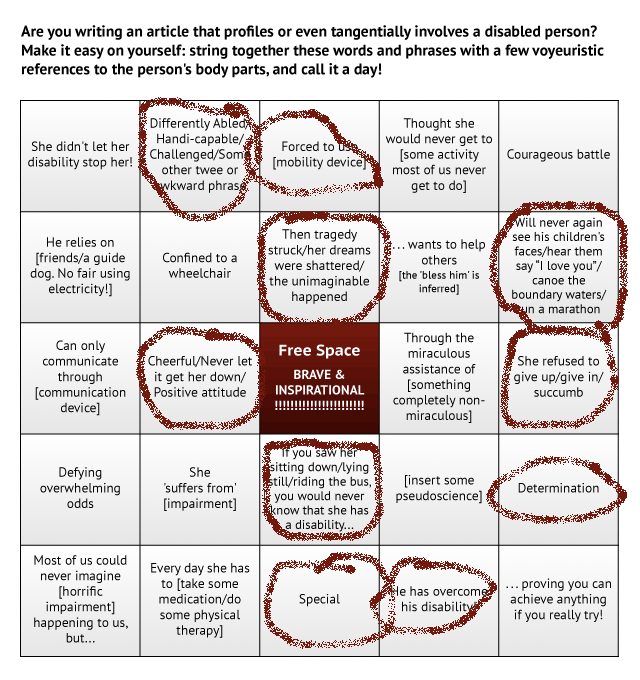
Sadly for all of us, Ian Brown’s articles don’t seem to appear on the Globe & Mail’s website (except perhaps behind the paywall), so I can’t let you read the inspiriiiiiiing story of Frédéric Bilodeau, but I can show you a BINGO card that Don & I filled out while we read it.

Description follows

Description: As above, but with the following squares circled:
Differently Abled/Handi-capable/Challenged/Some other twee or awkward phrase
Forced to use [mobility device]
Then tragedy struck/her dreams were shattered/the unimaginable happened
Will never again see his childrens’ faces/hear them say ‘I love you’ canoe the boundary waters/run a marathon
Cheerful/ Never let it get her down/ Positive attitude
Free Space: BRAVE & INSPIRATIONAL!!!!!!!!!!!!!!!!!!!!!!!
She refused to give up/give in/succumb
If you saw her sitting down/lying still/riding the bus, you would never know that she has a disability…
Determination
Special
He has overcome his disability!

Of course, what Frédéric Bilodeau’s story has actually managed to inspire is awesome comments at the Globe & Mail like this one:

Proud for so many reasons

Alexandre Bilodeau has provided something more than his magnificent gold performance (Gold Comes Home – Feb. 15). He has provided an example of the role that individuals with a disability play inspiring us as they overcome their challenges.

Thank you, Alex and Frédéric.

Brian Smith, Toronto

Mr Smith, with all due respect, we are not here to be your thrice-damned inspirations thank you very much. Be inspired! Lobby the Canadian government to provide funding for all universities to be fully accessible to people with disabilities! That would help lots of people with disabilities overcome their challenges!

The point of this post isn’t “here I am, talking about an article you can’t read, and being as sarcastic as possible, aren’t I witty?”. It’s actually to talk seriously about the way disabled people are written about. We’re allowed to be inspiring stories of overcoming adversity – and often those stories focus on the difficulties our loved ones have, and how hard it can be to have a disabled person in your life – or we can be a passive victim of crime. That’s it.

If new media actually presented people with disabilities as we actually are… well, that, gentle readers, would be actual news.

ETA: facesofcathy found that Ian Brown’s article’s up over at CTV. (Why? I don’t know.) Check it out: The Bilodeaus: Elusive truths from an unforgettable family. I haven’t done a side-by-side comparison of the text (I think the headings are different?) but it look pretty close.

Check out the comments if you like to headdesk over how inspiiiiiiiired people find these types of stories.

The perfect trifecta. And by “perfect”, I mean…

Sometimes, I’m almost tempted to believe there’s a special, special place in hell for people like US Republican State Delegate Bob Marshall of Manassas who says:

Disabled children are God’s punishment to women who have aborted their first pregnancy.

Yes, I’ll play that again.

Disabled children are God’s punishment to women who have aborted their first pregnancy.

Whatever happened to the “gift from God” inspirational-crip rhetoric?

And he didn’t shut up there. There’s more.

The number of children who are born subsequent to a first abortion with handicaps has increased dramatically. Why? Because when you abort the first born of any, nature takes its vengeance on the subsequent children.

He and others at the meeting suggest that Planned Parenthood should be renamed “Planned Barrenhood” or “Klan Parenthood”.

I do believe we have a perfect trifecta of menacing misogyny, violent disability hate, and misappropriating the civil rights movement for your bigoted cause. With a side serve of colossal, irredeemable scientific ignorance. And fail sauce.

Come filk with us – “Special Treatment” for PWD

Paul Kelly, if you’re not familiar with him, is a bloody marvellous Australian singer-songwriter. Some consider him the “poet laureate of Australian music”. He writes everything from fun-but-pointy ballads – Every Fucking City is one of my favourite anti-hero pieces – to political protest music.

You can read a little about him here at Debbie Kruger’s:

But there are songs that have specific intent – the ones for which he is known as “political commentator.” Songs such as “From Little Things Big Things Grow,” which he wrote with Kev Carmody about Aboriginal Land Rights, “Treaty” with Yothu Yindi on Land Rights and Reconciliation and “Little Kings,” from a more recent album Words and Music, about dissatisfaction with the Government. “Those songs are the exceptions,” Kelly concedes. “’Special Treatment’ is another one like that, a specific situation and write to it.”

Check out the song:

Lyrics are here. For those who can’t access the Youtube, it’s performed in a folky acoustic-guitar sort of way.

“Special Treatment” is a great example, in my opinion, of a piece of protest music written in first-person, using the point of view of members of a marginalised group of which the singer is not a member (I think, and please correct me if I’m wrong). Kelly is deeply respectful of the history, takes his subject seriously while introducing elements of dry humour, and has collaborated extensively with artists in the group in question. The piece targets authority sharply and with bite; its impact does not on stereotypes, mocking, fetishisation, or Othering of Aboriginal and Torres Strait Islander people.

I’m acutely aware that I run the risk of ‘splaining here, and I suspect that similar grievance-politics dynamics apply elsewhere in the world: but just to dip both toes in and take that risk for a moment: a common complaint among white middle-class Australians (WMCAs) is that Aboriginal and Torres Strait Islander people in Australia get “special treatment” from government. WMCAs complain when there are funded Aboriginal health services attempting to make tiny inroads into the appalling longevity statistics, the 20-year Gap, the rates of trachoma and hookworm and pneumonia and STDs and nutritional deficiencies. WMCAs complain when there are tutoring and bridging programs assisting Aboriginal people from remote areas to go to university, attempting to address the massive gulf between educational opportunities, entrenched discrimination, and difficulties of transitioning from remote areas to urban universities with a completely different cultural milieu.

WMCAs complain when Aboriginal people who are out of work are offered barely enough support to not starve their families; when there are programs to assist the Aboriginal prisoners who survive prison to transition back to the community; when mental health support programs are offered in an effort to reduce the 8x suicide rate among young Aboriginal people; when STD and contraception services are funded for young Aboriginal women who are raped at extraordinary rates; when funding for domestic violence and violence reduction programs are offered to women who live in fear. All this and more is dismissed as unfair “special treatment”.

In response to a post I wrote responding to a post by CarrieP at Big Fat Blog – in which Carrie wished that fat people were offered the same level of “special treatment” and respect that people with disabilities are – megpie wrote a touching filk to the tune of Kelly’s “Special Treatment”. (OK, verse three is the same – and applies pretty precisely to the situation of forcibly-institutionalised PWD.) Check it out (while listening to the Kelly original, if you can) – and add your own verses in comments.

I can’t enter my child’s classroom
Although the door’s right there
I’m stuck outside my child’s classroom
Blocked by a single stair

I get special treatment
Special treatment
Very special treatment

I’d like to work an eight hour day
In an office on main street
But they won’t offer me the same pay
Or add a ramp my chair needs

Say it’s “special treatment”
Special treatment
Very special treatment

Mother and father loved each other well
But together they could not stay
They were split up against their will
Until their dying day

They got special treatment
Special treatment
Very special treatment

Mama gave birth to a healthy child
A child she called her own
Strangers came and took away that child
To a stranger’s home

She got special treatment
Special treatment
Very special treatment

I’m not allowed to cry out loud
I’m not allowed to scream
I’m not allowed to show my rage
I’m not allowed to dream

After all, I get special treatment
Special treatment
Very special treatment

Who Killed Civil Discourse? Evelyn Evelyn, Marginalization, and Internet Discussion

Hello. I am Annaham (yes, I have a name). I am the person who posted a critique of Evelyn Evelyn on this website, which kicked off something of an internet controversy. For those who’ve just joined us, I made a post about Amanda Palmer and Jason Webley’s side project Evelyn Evelyn, Lauredhel made another post soon after, and things got a little out-of-control, to say the least. Because my post was part of this whole storm of various substances — both gross and not — I feel some responsibility to share my reaction to what’s gone down thus far.

I’d like to take a moment to talk about some basic principles of anti-oppression activism and social justice work that intersect with the work we do here at FWD, as some very specific structural issues and contexts are absolutely relevant in this discussion. Often, marginalized people are encouraged and expected to be sensitive and accommodating to the attitudes and prejudices of the dominant culture and to those of less-marginalized (ie: more privileged) people. However, this sensitivity and accommodation usually does not run both ways. Marginalized people, if they criticize something that (for example) leaves them out or makes them feel awful, are often told that they are being overly sensitive or overemotional, that they just misunderstand intent, that they are exaggerating, or that their tone is not polite enough. They are then expected to modify their behavior — and their self-expression —  to fit with the norms and values of those who are more privileged.

What the less-privileged have to say is usually not accorded much importance, critical thought, or respect, and yet they are supposed to prioritize, be patient with, and generally assign more importance to views, values and norms that are not their own. People in marginalized communities are often expected to educate the more privileged majority. They may be expected to patiently explain basic concepts, sometimes repeatedly. And if those with more privilege decide that they do not agree (with the less-privileged group’s tone, focus, or any number of other things other than the actual argument that is being made), those with less privilege are told, with varying degrees of subtlety, to shut the fuck up.

All the while, the perspectives, attitudes, norms and values of those with more privilege are made neutral. The power dynamics are rendered invisible, because that’s just the way things are, so there’s no point in trying to change any of it. Why are you so angry?  You’re just looking for things to get mad about. You just like being offended. Why can’t you focus on other/more important things? It wasn’t meant that way. You need to hold your tongue until you’ve done x, y and z. Quit taking it personally. You’re ruining everyone’s good time. Stop trying to make everyone pay attention to your pet issue, because it doesn’t affect anyone other than you. Your demands are unreasonable. Stop complaining. Shut up.

And when things don’t go entirely smoothly (which happens often), those not in a position of privilege are often blamed for it: Well, what did you expect, using that tone? You’re the one who brought it up; you’re the one who rocked the boat.

Unfortunately, these tactics are extremely common when it comes folks’ objections against many sorts of media and pop culture critique and/or backlash against critical engagement with cultural works. In other words: These are not new patterns.

I am definitely not saying that everyone has to agree with the critiques that I and others have made regarding Evelyn Evelyn; I am not suggesting that ideological lockstep is a worthy end-goal. What I am saying is that the humanity of marginalized people — those who have traditionally been left out, and who are often on the receiving end of justifications for said exclusion(s) — is not up for debate. The humanity of the participants in this discussion — that of the creators/artists, fans, and those of us who have come forward with critiques — is similarly not up for debate. What I posted, and what I am posting here, was (and is) my take on the matter. I do not, nor do I want to, claim to speak for all PWDs, or all disabled feminists, or all fans of AfP and/or Jason Webley who are also disabled or feminists, or both. We all have our different takes on Evelyn Evelyn and how things have unfolded, and I think it is a good sign that so much discussion has come from this.

As I have stated here on FWD and elsewhere, I am a fan of AfP and have been for a number of years. Many of the people who have raised concerns about Evelyn Evelyn are fans, potential fans, or former fans (and there have been solid points raised by non-fans, too). Dreamwidth’s Anti-Oppression Linkspam community has, at present, four roundups collecting posts on the matter from around the web.  I suspect that many of us who have posted on the Evelyn Evelyn project with a critical eye are not raising these concerns simply to bug or irritate Amanda and Jason, or their fans. However, there are quite a few people who seem eager to dismiss those of us with legitimate concerns as “haters” who just don’t understand art. The hostile messages from “haters” that Amanda has received are not legitimate critiques. These are personal attacks, not arguments of substance.

I almost feel like it should go without saying that I do not support people making these attacks on Amanda, but just to make it very clear: I am very much against people using this controversy — and the complex issues raised — as a bandwagon upon which they can leap to make personal attacks and/or comments about Amanda’s personal life or who she is. Unfortunately for those of us who have been trying to bring attention to Evelyn Evelyn-related issues and seriously discuss them, the “haters” are distracting from these same issues (and are apparently effective at it). I have also heard that people are making threats of physical violence against Amanda. That is not okay. It is never, ever acceptable to make threats of violence against anyone, regardless of your disagreement. That is basic human decency. It is truly disheartening to me, and to the other FWD contributors, that some are using this very difficult situation as an excuse to make horrific threats. We fiercely condemn these attacks.

One of the comments I received was from someone who, as far as I can tell, thought that my post seemed “insincere,” with a bonus implication that I was and am making other PWDs look bad “in the eyes of the abled.” Comments of this sort are often aimed at members of marginalized groups who are expected speak for everyone in their group when confronted; it basically boils down to “You are making other [disabled people] look bad.” I have to wonder why this same thing was not said to the AfP fans who found it necessary to show up here to derail, break out tone arguments,  tell me and my fellow contributors that we are crazy and/or should shut up, and who dismissed us on Twitter as just bitching about the project. It’s interesting, and rather telling, that some fans have used these tactics against me, my fellow FWD contributors, and other people who have critiqued the project, but could not (or did not want to) step back and consider their own behavior.

We were, in various other places around the web, called “retarded,” “angry bloggers,” had the legitimacy of our contributors’ disabilities questioned, and (trigger warning) threatened with rape (link goes to a screencap of a comment left on Amanda’s blog) — among many, many other things. In the comments thread to my original post, I was told that I need to focus on more important issues, that I was blowing things out of proportion, that I was censoring people and/or trampling on their free speech rights by laying out guidelines that specifically told potential commenters  to not leave derailing comments,  and that intent should excuse offensiveness. Eventually, I lost my patience.

There were also quite a few personal-attack comments left in the moderation queue; for obvious reasons, these were not published. These attacking comments were a significant part of why I closed comments on the post, though I did not explain that in my final comment. My decision was not about “censoring” what anyone had to say, or infringing upon “free speech” rights (this is a private website — one that has contributors, commenters and readers who are not only from the U.S.), or only about the fact that I lost my patience after having explained certain concepts over and over again; I and my fellow contributors simply could not deal with the personal attacks, threats, and violent language being left in the mod queue anymore.

Here is just a sampling of some of these unpublished comments from the mod queue (possible trigger warning):

“What’s the matter with you?”

“cant handle it? then just fucking die!”

“fuck u die slow nigga!”

“ONOEZ SOMEONE WANTED TO SMACK SOMEONE SUCH VIOLENCE!!! Typical retarded comment on an idiotic, stupid, moronic, weak, and lame blog. Fucking oversensitive twits.”

I think there is something analogous here to some of the more hateful comments that Amanda received on Twitter and elsewhere, but that is a bit of a tangent.

Going through the mod queue for that post was not an experience that I would want anyone to have. I could talk about the fact that it got to the point where it exhausted me to look at the comments; about the extreme anxiety and emotional hurt I felt while reading some of the comments that attacked me as an individual and/or questioned my mental health status; about how it feels to notice that your physical pain level — already there as a result of a chronic pain condition — goes up a few notches as you read criticism(s) directed not at your argument, but at you. I have a feeling that were I to discuss this in depth, some would likely construe it as “ANGRY BLOGGER BLAMES AMANDA PALMER FANS FOR HER OWN PAIN” or accuse me of using my disability as an excuse for being “too sensitive.” I get more than enough of that outside of the blogosphere.

I need a break from having attempted to be civil and polite and explain very basic concepts to a select few people who have no interest in substantially engaging with me or with others who have raised concerns about Evelyn Evelyn.  Simply put, I need some time to recharge my politeness batteries, as well as my hope that some people — and I include many of Amanda’s fans in this category  — do want to listen, learn and discuss without derailing or attacking. I wish I could address every critique that’s come our way, but I am pretty worn out (and I suspect that many of you — disabled and not — know the feeling).

In the interest of full disclosure, I should mention that Jason and I have been communicating via e-mail — he emailed me shortly after my other post went live — and discussing many of these issues in more detail; for that, and for his willingness to engage, listen, and consider the critiques that have come up, I thank him.

I wish Amanda and Jason success with their endeavors; I do not wish to shut either of them up or, worse, endorse that Evelyn Evelyn not go forward at all. There is, as I have said, quite a bit of difference between critiquing a portion of someone’s work and wanting to shut them up or silence them; I have aimed for the former. I ask, however, that they engage critically with and take seriously the numerous points that have been brought up, both about (trigger warnings apply to the first two links) specific aspects of the project and the response to critiques so far. Taking on such huge issues will doubtlessly be a difficult and ongoing process. Of course, Amanda and Jason will probably interpret all of this in different ways. What happens next does not have to be “perfect” — nor 100% Annaham-approved (because that would be unrealistic and silly), but it would be fantastic for these two very talented musicians and performers to bridge the gaps between their good intentions and what actually shows up onstage and on the album.

What are the ultimate lessons here? What can people on all sides of this discussion take away? Right now, I don’t know, and for the moment, that is okay with me. I still believe that better things are possible. I refuse to give up that hope.

[Special thanks to meloukhia for ou’s help in putting together links and other material for this post.]

Please read and abide by our comments policy.
For Cereal, Jessica at Jezebel? PTSD after obstetric assault is “hysterical”?

[WARNING: descriptions of obstetric rape and PTSD]

At Jezebel, Jessica writes: Is Having A Baby A Traumatic Event?

A new survey says that 9% of postpartum women suffer from post traumatic stress disorder. You know, the same disorder that Iraq vets and plane crash survivors get. Something does not compute here,[…]

Have we become so precious and hyper-conscious that something women have been doing for time immemorial is now ranked alongside war as a painful event?[…]

Certainly, having a bowling ball of a baby shooting out your vag isn’t a picnic for anyone, but the hysteria surrounding something so matter-of-fact is troubling.

“Hysteria”. Yes, “hysteria”. She went there. She used the prime misogynist slam against women, blaming wandering uteruses. Unbefuckingllievable.

I’m only surprised there wasn’t a “princess” or a “delicate flower” thrown in there too. Or maybe a few accusations of insurance fraud, hm? That would just put the icing on the hateful cake.

Get back to me when you’ve been stripped, dehumanised, isolated, forcibly starved, and strapped to a table for 12 or more hours during the hardest work of your life. Get back to me when you’ve been subjected to a series of non-emergency procedures on your body with neither consent nor medical justification. Get back to me when you’ve been imprisoned in hospital.

Get back to me when you’ve been held down by two or three people while someone – or more than one someone – pushes their fingers into your vagina while you say “No”. Get back to me when you’ve been screaming “NOOOO! STOP!!!” and been ignored while someone cuts your body open and shoves metal forceps into you. Get back to me when you’ve been strapped to a table and operated on and had your protestations about the anaesthetic not working being ignored. Get back to me when you’re left bleeding and vomiting on a table, without access to help, wondering if you’re bleeding to death, and you’ve had your newborn baby taken away from you without explanation or good reason except an over-the-shoulder “we don’t have enough staff right now”.

Get back to me when you’ve spent months of your life – the months you thought would be a joyful, perhaps sleep-deprived, milky daze – having violent flashbacks and nightmares. Shambling through the day barely able to function, unable to bond with your newborn. Bursting into tears and panic attacks many times a day. Avoiding public places lest you suddenly start sobbing and need to run. Not able to have anyone touch you.

Get back to me when you’re hunched in a corner, unable to work, unable to care for yourself, unable to speak, and all anyone can say to you is “All that matters is a live baby”.

I hope you never experience these things. Because they can be horrifying, life-changing, deeply traumatic events. The only promise I can make you is that I won’t call you “precious” or “hysterical” if you’re ever in this terrible position.

Medical assault is assault. Obstetric rape is rape. Trauma is trauma. Some people who have experienced these things get PTSD.

And it’s not up to you, or anyone else, to instruct them that they haven’t – especially in explicitly woman-hating terms.

You don’t get to judge.

No, no, no, no, no.