Category Archives: social attitudes

Dear Imprudence: A “Tired Wife” Strikes Back?

The hits just keep on comin’, thanks to Slate. Earlier this month in Dear Prudence, we got to read this winner:

Dear Prudence:
My husband had a stroke 18 months ago. At first he was unable to speak and his right side was paralyzed. He regained his speech and, with a lot of work, got full use of his arm and leg. But the stroke made it impossible for him to practice his profession, and he continues to have short-term memory problems. He’s home on extended leave. My problem is that he is obsessed with what he has lost and how bad things are. When I come home from work—I have to keep us fed and housed—all I hear about is what a terrible state he’s in. I’ve tried various things: We’ve gone to a counselor, his doctor has given him anti-depressants, I’ve encouraged him to go back to his hobbies. I try to plan things that will be enjoyable for him. Nothing is working. He won’t take up his hobbies or socialize, and he dwells so completely on the negative that even his closest friends are getting weary. It seems to me that he should be grateful he survived and regained so much. I am so exhausted by his negativity that sometimes I just wish I could leave him, but I would never do that. Is this the way it’s going to be forever? –Tired Wife

First, something tangential: Is this not THE perfect mishmash of weird disability-related hangups from an abled person plus some lovely Feminine Mystique-era gender(ed) expectations? It’s like it was made for a takedown on this site.

Moving on: On one hand, I can certainly see why this woman is frustrated. Adjusting to newly-acquired disability can be an extremely difficult process — not only for the person with the disability, but for their relatives and loved ones as well. However, there are a ton of stereotypes made explicit in this woman’s letter, not least of which is the “he’s just so NEGATIVE!” and the related expectation that her actions and her efforts will somehow make him become a happy, compliant Good Cripple. I have to wonder, has she stopped to consider that adjustment to disability is a long process? Or that having to go on leave from one’s job due to a newly acquired disability might, in fact, be extremely taxing on one’s self-image? Apparently not — all that matters is that he show proper gratitude (and non-“negativity”!) for all of her efforts, and not trouble her with his “dwell[ing] completely on the negative.” I am sure that many of us would find it hard to be “grateful,” too, if we had someone treating us this way due to our disability (or disabilities). Once again, a disabled person’s feelings and experiences are steamrolled over in favor of those of a person who is not disabled, and this is apparently acceptable because they are in a relationship.

The gender question, too, is worth a look; while it’s pretty common knowledge that women, on average, do much more “caretaking” work inside the home than men (at least in the U.S.), there are a few things that stick out, mostly based on what the letter writer does not mention. Was she primarily responsible for managing her husband’s schedule and social life before his stroke? If “nothing is working,” has she spoken with him about it? Please understand that I am not trying to blame her for larger sexist patterns of who tends to do the home-related care-taking and who does not; it does, however, seem odd that she has not (as far as we know) attempted to speak with her husband about this — his “negativity” nonwithstanding.

The sense that I get from this letter, overall, is that this woman has spent a huge amount of time and energy trying to fulfill the role of the “perfect” wife, and now that her husband cannot fulfill the complimentary “perfect husband”/breadwinner role, her resentment is close to bubbling over. Add to this much of mainstream white, abled feminism’s emphasis on “independence” — which seems to exist in a magical land where no one is (or should be) dependent on anyone else — it is not terribly surprising that she feels that her only option would be to leave her “negative,” disabled partner. That these seemingly opposing tendencies could show up in one letter is not surprising, either.

So, what do you think, commenters?

Quickhit: “From Cool to Crippled” in advertising

Bad Cripple shows us a couple of ads, in Why Equality is Elusive, Part I and Part II.

DontDriveStupid ad

Description [emphases are mine]: The ad is headed, in red,

“Drive stupid and score some kickin’ new wheels.”

This heading is placed beside the image of an slim adolescent boy, white-appearing and dark-haired, wearinga red T-shirt, black jeans, and black Converse-style sneakers. He is sitting in a hospital-style wheelchair. His arms are slumped on the armrests, his back hunched, and his head bent such that his face is in shadow and not clearly visible.

The small text in the ad reads:

“Nothing’s cooler than the day you get your driver’s license. But as soon as you start driving stupid, it’s not so cool anymore. Texting, using your iPod, racing, they all fall under the category of stupid. And dangerous. So before you get behind the wheel and try to prove how cool you are, here’s a little harsh reality. Nothing kills more Utah teens than auto crashes. Not fazed? Okay, how does the thought of spending the rest of your life in a wheelchair grab you? Look, every year far too many Utah teens go from cool to crippled in the blink of an eye. So if you’re one of those drivers who think they have something to prove, you can start shopping for your wheelchair now. And hey, if you think that’s harsh, wait until the day you roll it into school.

Drowsy Driving | Distracted Driving | Aggressive Driving | Impaired Driving | Not Buckling Up
Zero Fatalities
DontDriveStupid.com

As Bad Cripple says:

But the ad relies on antiquated and deeply rooted fears to scare teens noting that “every year far too many Utah teens go from cool to crippled in the blink of the eye”. Great, this undermines forty years of legislative initiatives meant to empower people with a disability. Teens are being taught that a wheelchair is akin to a tragedy, a fate worse than death.

If you go to the website, the header currently has a headshot of a conventionally-pretty white brunette girl with sutured wounds on her cheek and lip. The heading says, “Driving stupid can really make you look bad.”

So there’s the Don’t Drive Stupid campaign: it is assumed that for teen boys using a wheelchair is worse than death – and for teen girls, the worst possible fate is to have minor wounds on her face.

It is interesting to contrast these official messages – ableist, sexist, objectifying, dehumanising – with the posters made by high school students themselves for the campaign: a car knocking the motif off a signpost, ‘When you drive you hold someone’s life in your hands”, “you know you’re tired when you swerve to miss your car freshener“, “Last message received” with a crash and a breaking cellphone, and various others – none of which rely on stereotypes about marginalised groups at all.

~~~~

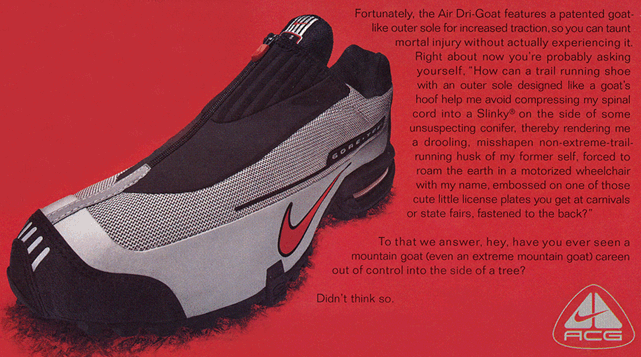
Next up, Bad Cripple brings us this Nike advertisement:

Air Dri Goat ad

Description: A Nike shoe sits on a red background. The text reads:

Fortunately, the Air Dri-Goat features a patented goat-like outer sole for increased traction, so you can taunt mortal injury without actually experiencing it. Right about now you’re probably asking yourself, “How can a trail running shoe with an outer sole designed like a goat’s hoof help me avoid compressing my spinal cord into a Slinky on the side of some unsuspecting conifer, thereby rendering me a drooling, misshapen, non-extreme-trail-running husk of my former self, forced to roam the earth in a motorized wheelchair with my name embossed on one of those cute little license plates you get at carnivals or state fairs, fastened to the back?”

To that we answer, hey, have you ever seen a mountain goat (even an extreme mountain goat) careen out of control into the side of a tree?

Didn’t think so.

Bad Cripple commentary reads, in part (check out the rest):

If anything is unusual about the above Nike ad it is the fact it was pulled. Imagery of this sort is sadly the norm and abounds. I see it every day on television, in newspapers, on the internet and in a plethora of magazines. Some people in disability studies call such images examples of the “defective person industry”.

Yup.

“Saying conjoined twins are disabled is insulting!”: Evelyn Evelyn, redux

[Cross-posted to Hoyden About Town]

Something that has really struck me about the conversations around Evelyn Evelyn is the reaction that “Conjoined twins don’t have a disability! To say they do is insulting!”

Not all commenters make the link between the two statements – some stop at the first – so I’ll take these two separately.

A little background: Evelyn Evelyn is Amanda Palmer and Jason Webley’s new ‘art project’, presented as fact but understood as fiction, in which they “discover” poor struggling musically-gifted conjoined twin orphan women, save them from their child porn and circus-exploitation past, and help them – in a long drawn-out process, due to the women’s traumatic fallout and difficulty relating – produce their first record. Palmer and Webley dress up as the twins to perform on stage, co-operating to play accordion, ukelele, and sing. They can barely restrain their sniggers while they interview about this oh-so-hilarious and edgy topic. More in the Further Reading.

“Conjoined twins don’t have a disability!”

So, a note on normalcy. The idea that some people would shout in defence “But conjoined twins don’t have a disability!” took me by surprise. I wonder how these people are defining “disability” in their heads, if they’ve ever thought about the subject – do they picture a hunched figure, withdrawn, unable to work, self-care or socialise? Do they picture someone undergoing huge medical procedures, someone with prostheses or other visible aids? What is the image in their heads?

Because disability can be all of these things, and none of these things. Disability isn’t a checklist, or a fixed point. Disability – and normalcy – are socially constructed. Disability is the interaction between a characteristic or a group of characteristics often called “impairments”, and a world that recognises people with these characteristics as abnormal.

Disability is considered a tragedy, a fate to be avoided at all costs. Disabled people are those that society defines as “abnormal”. Disabled bodies are the ones that don’t fit in typical boxes. Disabled people are people that the physical and social environment doesn’t accommodate. Disabled people are considered defective, deformed, faulty, frightening, feeble, freakish, dangerous, fascinating. Disabled people are stigmatised, laughed at, looked down upon, marginalised, Othered. Disabled people are medicalised. Disabled people are defined in terms of how currently-nondisabled people view them.

Disabled bodies are those that are subject to the able-bodied stare.

It is obvious with the most cursory of glances that in our society, conjoined twins are disabled. Society does not accommodate them. They are medicalised from fetushood. They are spectacle. Their operations are videoed and broadcast across the world. They are displayed, tested, stared at, discussed, and mocked, purely because of the shape and layout of their bodies. They are the subject of comedy fiction and “inspiring” tragedy nonfiction.

How can people simultaneously look at this project as funny and edgy and worth paying money to stare at, while considering conjoined twins to be “not disabled”? Why are their bodies so hilarious, then? Why is it so funny when Palmer and Webley cripdrag-up in that modified dress? Why do they snigger and smirk as they talk about “the twins” and their tragic tale? They do this – you do this – because you do see these bodies as Other. Fascinating, bizarre, freakish. Fodder.

People with disabilities resist these definitions, resist being marginalised, Othered, stared at, compulsorily medicalised. (Just as we try to resist, where possible, being beaten, abused, raped, exploited, exhibited, forcibly sterilised.) We laugh at ourselves plenty. We reclaim terms like “crip” and “gimp” and “crazy”. This does not grant able-bodied people free rein to mock us, to play schoolyard imitative games, to use child porn survivors as a little bit of “colour” for their projects.

There is a lot more to be said on the social construction of normalcy. I strongly recommend Lennard Davis’ Enforcing Normalcy . For more reading, check out this booklist at Hoyden About Town, our booklist here at Disabled Feminists, and our blogroll.

“To say that conjoined twins have a disability is insulting!”

This one’s quicker and easier to debunk. No, it’s not insulting. It’s as simple as that. It’s not an insult because being disabled is not an inferior state. Saying that someone is disabled is no more insulting than saying “Lauredhel’s a woman” or “Barack Obama is black”.

Being disabled just is.

~~~

Further reading on the Evelyn Evelyn conversation:

Annaham’s post here at FWD, Evelyn Evelyn: Ableism Ableism?

Amanda Palmer’s blog: The Whole Story Behind “Evelyn Evelyn” [WARNING: invented story about child sexual abuse and exploitation; the other links discuss this also]

Amanda Palmer’s blog: Evelyn Evelyn Drama Drama

Jason Webley: Blog #1 – Evelyn

Amanda Palmer’s twitter, in which she remarks “setting aside 846 emails and removing the disabled feminists from her mental periphery, @amandapalmer sat down to plan her next record.”, and follows up “pain is inevitable. suffering is optional.”

SPIN magazine: Meet Amanda Palmer Proteges Evelyn Evelyn

Sady at Tiger Beatdown: AMANDA PALMER WANTS TO SHOCK YOU. Just Don’t Get Upset About It, ‘Kay?

TVTropes: Rape Is The New Dead Parents

The linkspam roundups: First, Second, Third (and possibly more as time goes on)

Accessibility & Sustainable Transportation

Last week I attended a meeting at my university campus regarding sustainable transportation options for the next five to ten years. We’re at an interesting point in time here, as both the transit routes and the university are putting in long-term planning, so we may have a chance to push for real, useful, interesting change that can have long-term impact on both the university community and the greater community.

I would say “Ask me what wasn’t covered at all!” but I’m sure you can all guess – accessibility was never mentioned, even though the initial study into the needs of students, faculty and staff on campus had raised issues of accessibility.

But! Credit where credit is due. I brought this up at the meeting, and then again (as in, ten minutes later) with head of my particular branch of student government, and this afternoon attended a meeting including myself, the president of my particular branch of the student union, and student accessibility services to talk about concerns regarding accessible transport and sustainable transport.

Basically, the topics of conversation were around the fact that we’re a growing campus, we have greater needs regarding getting people to and from campus every day, but we want those needs to be Green in focus. The initial meeting I attended last week focused on things like faculty bus passes, incentives to car pool, and what encourages people to walk or bike to campus.

What we talked about today were more focused ideas that were inclusive of people with physical and sensory disabilities. I wanted to talk about this here, because I have no illusions: Even with student accessibility services there, we were still only talking from a limited perspective. I focus a lot on mobility needs, and more specifically on the needs of people using wheelchairs, for reasons I think are obvious, and the gentleman from student accessibility services then focused a lot on issues around students with low-vision, or who are blind.

I figure I’ll use our meeting for a greater discussion here. I want to both bring attention to others about sustainable transportation conversations and how to include concerns about accessibility and people with disabilities in them, but also I want to have more feedback and input. There are new students every year, new faculty who may have different issues regarding transportation and accessibility. The more we talk, the more we collectively can ask for things that will aid as many of us as possible.

Things that were brought up:

– Sidewalks. We talked about how horrible they are around the university, although this is pretty universal in our city. SAS brought up the needs of students who are low-vision or blind about sidewalks, including the need for high-contrast paint jobs on the curbs and around obstructions, and to have some sort of guide on the actual sidewalk for canes.

– Buses. More seating for bus stops around campus. Pushing to get more accessible routes to come here. Stop announcements (municipally they’re on the agenda for next year). Giving out cards to people so they can just show their card (usually something bright) so the bus driver will just lower the low-floor buses without you needing to ask. A recording to indicate when the next bus is coming.

I happen to know from looking at the current five-year plan regarding the bus service here that it will cost $1500 per stop to get a stop up to what they want for accessibility needs, and that a route must be entirely made up of those stops before it is allowed to carry people who use wheelchairs. This is a long-term project, sadly.

– Parking. I confirmed that here there is no additional charge for parking passes if you have a disability, you get guaranteed parking, and if there is a greater need for parking in front of a building, Facilities Management will actually designate more spots accessible. I don’t know how that plays out in reality, though. (I note there’s only one accessible parking space in front of the Library, for example.)

What are your thoughts regarding this?

Either/Or – Both/And

One of the ways mainstream media talks about things is in binaries. People are either book readers or they read nothing at all, for example. Women are either sluts or they aren’t having any sex at all.

People are either caregivers or they have disabilities and thus are cared for.

Or so I keep hearing.

So, when we talk about needs relating to children with disabilities, somehow the idea that there may be parents with disabilities who are primary caretakers for these children is missed. When we talk about caring for elderly or disabled parents or extended family members, we don’t talk about how to do that if you are also disabled. Because people with disabilities are cared for, right? You can’t be both cared for and caring for someone, right? Right?

Right now, I’m getting a lot of literature sent my way about “caring for” a spouse with Cancer. That literature will often include the information given by Family Caregiver Network Society: “We understand the common feelings of isolation, helplessness, exhaustion, stress, anger and guilt faced by family caregivers.”

All of that is often true for caregivers. But for some of us, that stuff is unrelated to being a caregiver because it comes from our status as people with disabilities in the first place.

I think this feeds into the ideas of disabled people as passive receptors of whatever, who never act on their own, who can’t act on their own, and whose only stories are those of being a burden. These perceptions feed into how and what support is given to families affected by disabilities that have long-term caring needs, what accommodations are made for meetings with caregivers (I was invited to a meeting in a space that isn’t wheelchair accessible, for example), and basically how society views everything to do with being disabled. Suddenly, your whole life is perceived as a burden to others, with nothing to live for and nothing to look forward to.

I know there are readers of this blog who are disabled and care for others, either in their homes or workplaces. I want to talk about how we are both disabled and carers. [1. ETA: It is not my intention to imply that if you are not both/and in this case, you are somehow a burden or not worth talking about, or ruining it somehow for everyone else. I am just focusing this particular discussion on that bit of intersectionality.]

Evelyn Evelyn: Ableism Ableism?

Let’s get something out of the way: I say this out of love and respect. I say this as a fellow artist (albeit an unknown one). I also very much doubt that the people involved in this project have created it with any bad intentions. That said, however, intentions don’t equal a free pass for an end result, particularly if the end result is problematic.

I am conflicted, to put it mildly, about this latest project in which singer and pianist Amanda Palmer has involved herself (full disclosure: I am a fan of Palmer’s music). For those who need a refresher, she and fellow musician Jason Webley are performing together as Evelyn Evelyn, a fictional set of conjoined twins and former circus performers with an elaborate past who reside in (of course!) Walla Walla, Washington. The group’s upcoming self-titled album seems to be getting quite a bit of press in the indie world. Part of the press release reads as follows:

Rather than being limited by their unique physical condition, the Evelyn sisters prove that two heads are indeed better than one. Audiences will marvel at the twins as they dexterously perform their original compositions on piano, guitar, ukulele, accordion and even drums.

Ah, yes! It’s the “overcoming disability” trope, with a heaping side of totally unexpected and not-at-all-stereotypical circus-freakdom. Might Evelyn Evelyn be musical Supercrips?

And then:

Unsatisfied with the grind of circus life, at the age of nineteen the twins decided to explore a solo career. It was then that they were discovered by Amanda Palmer and Jason Webley, who heard the twins’ music on MySpace. Webley and Palmer encouraged the twins and offered to help them record a proper album.

The album will be accompanied by a full US and European tour and – later this year – a graphic novel about the twins’ inspiring life, illustrated by Cynthia von Buhler and published by Dark Horse Press.

The stereotypes about disability here are pretty well-worn: according to this (fictional) backstory, the twins were “discovered by” and need “help” from two abled individuals, Palmer and Webley, to realize their musical potential. Add to this their “inspiring” origin story — which is fodder for a graphic novel tie-in — and you’ve got yourself one hell of a three-ring circus of disability stereotypes.

Thus far, it looks like Evelyn Evelyn’s primary aim is to be “inspiring” to abled folks (and to be a bit of creative fun for Palmer and Webley). The three songs currently available on MySpace only serve to continue this trope; “A Campaign of Shock and Awe,” in particular, casts the twins as “the 8th wonder of the natural world.” Good to know that even fictional people with disabilities are not exempt from being cast as “wonders” from which non-disabled people can draw inspiration and “marvel” at. Sound familiar? Add in a dash of hipster ableism and you’ve got something that looks positively transgressive, especially in comparison to the rest of the music industry.

Unfortunately, Evelyn Evelyn seems like a project that is far from actually being transgressive, even given the initial appearance of said transgression (because what’s more shocking and weird than conjoined twins, at least according to abled culture?). The project, as far as I can tell, makes no reference to the ways in which actual people with disabilities are treated in Western culture; this probably seems like a tall order for any musical project, but there is a chasm of difference between at least acknowledging that there are people like this (in this case, conjoined twins) who do exist and that they probably are affected by ableism, and outright appropriation of this uniqueness in the name of art. Certainly, Evelyn Evelyn is fictional, and while Palmer and Webley are not required to make any sort of political statement, the seeming lack of awareness that there are actual conjoined twins and that they do not only exist for abled artists’ dressing-up-and-performing purposes is rather troubling.

The larger cultural context of treatment of real people with disabilities, too, is conveniently forgotten (see the lyrics to “A Campaign of Shock and Awe”); the twins seem to exist in a world that is completely free of ableism (in forms subtle and not), harsh social treatment of PWDs by abled people, and pernicious, damaging stereotypes. This is particularly disappointing given that Palmer has written some great, quite un-stereotypical songs about PWDs and people with mental health conditions (one of which I wrote about in a blog post for Bitch Magazine).

I am a person with disabilities. I am a music fan. I am (sort of) an artist — one who mostly does graphic work about the disabilities of non-fictional people. However, Evelyn Evelyn, as a multimedia project, seems designed to keep people like me — real people with disabilities — out; this is not a new thing, considering the attitudes that folks in our culture hold about people with disabilities and their acceptable social roles. There are other, more creative ways to portray people with disabilities that don’t rely on facile stereotypes or on the ways that PWDs are already represented in popular culture. Representing Evelyn Evelyn as variously inspiring, freakish, weird and a “wonder” just reinforces existing stereotypes about PWDs, while ignoring the cultural context in which the project was conceived; while Evelyn Evelyn may be artistic and, at first glance, “different,” the attitudes beneath the project’s surface seem awfully mainstream.

Special commenting note: First-time commenters, please read and abide by our comments policy. Kindly refrain from commenting if your argument consists of any of the following: “You just don’t get it,” “You do not understand art,” “You are taking this too seriously,” “Evelyn Evelyn is not real, therefore the stereotypes about disability examined here do not matter,”  “Justify your experience and/or disability to me, NOW,” “Why are you criticizing Amanda Palmer? She is brilliant; how dare you!” I am familiar with all of these arguments — please be aware that they will probably not add anything to the discussion because they are classic derailing tactics, and I will most likely decline to publish comments that utilize the above arguments.

Similarly, this is not a thread in which to discuss how much you like or dislike Palmer or Webley’s music in general; comments to the effect of “Her/his music sucks and here’s why” will not be allowed, as they are also derailing.

What is the Real Goal of Fraud Investigations?

California is in the midst of a major budget crisis. The past year has seen immense and drastic cuts to social service budgets throughout the state, including elimination of all state funding ($16 million) to domestic violence shelters (which was later partially restored by legislative action) and near-total decimation of funds for AIDS testing and prevention programs to save $52 million. Even with those catastrophic cuts, the state is still in massive financial difficulty: “The state has a $6.6 billion shortfall in the current fiscal year ending June 30 and is looking at a $12.3 billion hole for the new budget year. There is $1 million in reserve.”

This means that any dollar currently being spent has been extensively reviewed and evaluated and a very conscious decision has been made to prioritize spending in that area. For example, the state is still willing to spend money for California counties to investigate potential fraud in the In-Home Supportive Services (IHSS) program. IHSS is an essential program for many of California’s low-income elderly people and people with disabilities. Through the program, individuals are allotted a certain number of hours of assistance with personal services including bathing and grooming, home services such as cleaning, cooking, and errands including buying groceries and picking up prescriptions. The theory of the program is that assisting people this way allows them to continue living independently in their communities rather than in a long-term care facility, which not only preserves independence and dignity for program recipients, but also is a huge cost-savings measure for the state. If program recipients were to move to long-term care facilities, their costs would almost certainly be paid for by the state’s Medicaid program. And look at the cost differential: “The average cost of a skilled nursing facility is $55,000 a year. The average cost of in-home services in California is $10,000.”

Despite the cost savings realized by this program (I’m beyond the point where I think a state will prioritize and fund a program simply because it’s something that PWDs need to maintain independence and dignity), there have been massive cuts to the benefits portions of IHSS. The hourly wage paid to the home health providers has steadily declined and is now at $8.60 an hour. Needless to say, these extremely low wages make it nearly impossible for a PWD with IHSS benefits to find a home care provider with any kind of training or experience. There have also been steady erosions to the group of individuals who will be eligible for IHSS, with criteria requiring a higher and higher level of disability or functional impairment in order to qualify for the program.

The only area of program funding that has increased is fraud detection, with a grant of $26.5 million to counties to engage in fraud detection. That’s the equivalent of approximately 3 million service hours at the current rate of pay. There are also new requirements in the program that must be met by both recipients and providers in order to receive services: all providers must go through a criminal background check process, including fingerprinting; all program applicants and recipients must be fingerprinted and must place a fingerprint signature on each timesheet submitted for payment. It also requires counties to conduct unannounced home visits.

In the abstract, some of this seems to make sense. We don’t want health providers with criminal backgrounds coming into the homes of vulnerable people and exploiting or harming them. Except that the majority of providers are actually family members or immediate relatives of the PWD and the fingerprints can take up to 9-12 months to be cleared by the state, causing huge delays for PWDs who need vital services and delays in bringing often essential income to low-income families. (Not to mention how low-income people of color are likely disproportionately targeted by law enforcement and subject to criminal penalties.) It also seems reasonable to ensure that scarce service dollars are actually going to people who need and deserve them, rather than people receiving them fraudulently. But there has been a lot of research on IHSS fraud in the past, and it simply does not seem to be very prevalent: an audit released last year (pdf link) found a fraud rate of only 1% in the program. A recent program in Sacramento turned up similarly low levels of program fraud: “The Sacramento County District Attorney, who received more than $3 million from the state for anti-fraud efforts, reported last week that after four months her office had uncovered a total of 19 cases of fraud out of more than 42,000 homecare clients in the County.” That’s a rate of 0.04%. And if we estimate that each of those 19 cases fradulently took $10,000 a year from the state, that $190,000 in fraudulent benefits is dwarfed by the $3 million spent to identify that fraud.

So – these changes and programs are not about protecting recipients. They’re not about preventing widespread rampant fraud. What are they about? Some testimony at a recent legislative hearing sheds some light:

Nancy Jo Riley of San Diego testified that she and her client were “randomly selected” for a fraud investigation last October as part of a new “anti-fraud” initiative by the state. According to Ms. Riley, the agent from the Department of Health Care Services (DCHS) first threatened in a phone call to cut off all IHSS unless she and her client met with him immediately. At the subsequent meeting, the investigator asked her and her client a long series of “humiliating” questions. He then said he could not understand why a person with a severe disability like his should be subject to a fraud investigation in the first place.  He also said that her client, whose hands are frozen in a fist-like position because of his disability, would “probably” be exempted from new fingerprint requirements for homecare consumers.

These rules are an effort to make it harder for people to get services or to continue receiving services. They are an effort to erect barriers to service so substantial that PWDs cannot surmount them. They designed to humiliate and shame recipients for their disability status, to force them to prove themselves, their disabilities, and their functional impairments over and over again. They don’t even make sense from a cost perspective, as they spend far more in detection than is saved by the fraud they ostensibly prevent. They’re not targeting people who are fraudulently receiving services. They are targeting the very people the program is supposed to help.

Gender, health, and societal obligation

Kate Harding, writing at Broadsheet:

“If you ask us,” say Glamour editor Cindi Leive and Arianna Huffington, “the next feminist issue is sleep.” Personally, I never would have thought to ask those two what the next feminist issue is, but they make a pretty good case. “Americans are increasingly sleep-deprived, and the sleepiest people are, you guessed it, women. Single working women and working moms with young kids are especially drowsy: They tend to clock in an hour and a half shy of the roughly 7.5-hour minimum the human body needs to function happily and healthfully.” The negative effects of chronic sleep deprivation are well-documented, but that doesn’t inspire enough people to prioritize rest, and women often end up in a vicious cycle of sacrificing sleep in order to do extra work and make sure their domestic duties are fulfilled, causing all of the above to suffer. “Work decisions, relationship challenges, any life situation that requires you to know your own mind — they all require the judgment, problem-solving and creativity that only a rested brain is capable of and are all handled best when you bring to them the creativity and judgment that are enhanced by sleep.”

So many obligations are heaped on the shoulders of women, and it is pretty much impossible to fulfill all of them even if you completely neglect your own needs. Of course, trying to tend to your own needs means even fewer of those obligations fulfilled, and there are cries and admonishment of selfishness and failure and responsibility to others waiting for you should you assert your right to self-care, because by asserting the right to take time and energy exclusively for yourself, you are stealing time and energy that belongs to others.

Sleep is a contested act in American society (perhaps in others too, but I can only speak to the US): getting little of it becomes a point of pride; getting a lot of it is a symbol of laziness, selfishness, sloth, dirtiness, carelessness. People are expected to perform amazing tasks on as little sleep as possible, which is completely counterintuitive, because most people are going to perform worse with insufficient sleep — consider it a generalized manifestation of the supercrip phenomenon: exactly the people who are least supported/enabled to do something are the ones who are expected to do it better than normal people.

Better sleep would surely benefit many of us, but why?

According to Leive and Huffington, the main benefits realized are in service of others; the main beneficiaries are the people around you. Or, if you see the benefits, they are benefits that stem from an obligation to others, any self-benefit remaining firmly subordinate to the “greater good” of one’s family, colleagues and community members.

We should be well familiar with the concept of women as public property. Women’s bodies, women’s time, women’s possessions, women’s decisionmaking capacity, women’s self-determination — just about anything a woman possesses, though she doesn’t really possess. Rather, she is allowed use of something that is under her care but not her ownership: it belongs instead to the people around her.

Feminists are familiar with the idea that our society considers female reproductive organs to be public property. A woman’s vagina should be available for all comers (men), and simultaneously be unavailable so as not to waste its value to its eventual sole owner (a man). A woman’s uterus is to be used for the good of the human species/civilized society: the right kind of women are to reproduce as much as possible, so that their kind remain the dominant group in both pure numbers and in overall power. (On the other hand, the other kinds of women are called upon to perform the rough, menial work necessary to uphold modern society, while not polluting the human species by reproducing themselves.)

But honestly, public ownership of women extends so much further than their reproductive systems.

No woman is allowed to assume ownership of any part her physical self, her time or purpose: it is still an “indulgence” for a woman to eat anything more substantial than a leaf of lettuce, still “sinful” to enjoy less than 100 calories of overprocessed puddings and crackers. It is still somehow selfish to take a long bath or to sit and rest for an hour’s time, still slothful to refrain from moving, working, pushing, rushing every single moment of every day.

Women’s work, in general, is under-valued and un(der)paid — and it is uncompensated precisely because women’s time, their energy, their effort, do not actually belong to the women themselves, but rather to the rest of the world. It is theirs to use whenever, however, and however much they wish, and isn’t it ridiculous to suggest they should pay for the use of something that belongs to them in the first place?

This is all part and parcel of living in a patriarchy, a predictable result when society relies upon a person’s gender to determine hir position in society, the things sie will do, the roles sie will play, the direction hir life will take. But gender is not the only variant in play here. In fact, I believe that gender is actually secondary here to another factor — it is merely one avenue of manifestation for our cultural construction of health.

Surely you have heard of the theory that gender is not an inherent trait, but a performance. This theory is definitely not without flaws, but I bring it up in hopes that it provides a familiar framework for a discussion on the social construction of health.

Health, you see, is not merely an inherent trait. Health, instead, emcompasses a variety of factors, including a person’s intrinsic qualities but also the environment in which they operate and their everyday behaviors.

Health is not just what a person is. Health is also what a person does. And what drives a person to do something is not wholly internal, but rather is largely influenced by external factors.

Gender, for instance, is both an internal sense of being and something we do for other people, something we do because we want other people to think about us, react to us, in certain ways. And the things we do, and the expected reactions to them, are different depending on which culture we are operating in — dependent on where we live, on our ethnicity, on our class background, on any number of other things. What it means to wear certain types of clothing is different in different cultures. What it means to speak a certain way is different in different cultures. And so on.

This framework is — I hope — useful for understanding what health actually is.

The form “health” takes is different depending on the expectations of the culture you live in.

The ultimate importance of that so-defined “health” is different depending on the expectations of the culture you live in.

The role “health” plays in the culture, what “health” means in that culture, the way the people of that culture interact or engage with that idea of “health,” are different depending on the expectations of the culture you live in.

What you do to achieve “health” is different depending on the expectations of the culture you live in.

How your health affects your position in life, your economic opportunities, the support that is offered for you to live the kind of life you desire, are all different depending on the expectations of the culture you live in.

(And yes, all of this is just as true in a culture that makes use of the scientific method and sees itself as cool and rational. What is investigated, and how, and how the results are interpreted, and what lessons are drawn from those results, and how those lessons are applied in everyday life — all these things must grow out of the culture they happen in! )

Health, then, is not merely a personal state, but rather a cultural fulfillment. Health (of whatever kind) is expected of you, expected by the people around you. Your health is not your own, but instead belongs to your family, your community and your wider culture. You must achieve and maintain (whatever kind of) health, not because it benefits you personally, but because you will have deeply failed your fellow members of society if you don’t.

And this is what underlies the problematic aspect of Leive and Huffington’s statements. They are not suggesting that the sleep deficit for women is a problem because the woman herself feels fatigue or cognitive dysfunction. They are suggesting that the sleep deficit for women is a problem because the woman cannot fulfill the expectations of health — and the performance of duties that rely on that state of health — that society has for her. They are suggesting that the sleep deficit for women is a problem because then that woman personally fails her family, community and country.

Here, then, her lack of sleep lays bare her duty to society based on particular qualities she holds. But the disparity between her duty and her male peer’s duty would not exist if all of us did not have a duty to society to achieve and maintain a certain kind of health.

And Leive and Huffington, purporting to be advocating on women’s behalf, do nothing but reinforce the same system that screws women disproportionately when they center a woman’s obligations to the people around her over the personal experience of the woman herself.

And here, I hope, feminists will understand what disability activists mean when we talk about the supposed obligation of mentally ill people to submit to (certain kinds of) treatment for the sake of the rest of society — or what fat acceptance activists mean when we talk about the supposed obligation of all people to be as thin as possible for the sake of the rest of society — and so on.

Eating “healthy” (as determined by mainstream cultural wisdom, largely controlled by wealthy white temporarily-abled folk) is not done solely for oneself. Neither is “exercise” (of course, what counts as physical-activity-that-improves-health is controlled by the same people who control what counts as food-that-improves-health). Participation in the paid workforce is not done solely for oneself — we are, in part, fulfilling the obligation of “responsibility” (which is a component of the health performance, because when health is lacking, the ability to work declines — so work, then, is a demonstration that you are fulfilling your health obligation).

When a person neglects to fill a health-related obligation, there is someone there to remind them of the cost to the rest of society. We’ve all heard figures on the cost of obesity, the cost of heart problems, the cost of low employment rates, the cost of suboptimal nutrition, the cost of insufficient sexual education, the cost of lost sleep… wait, that sounds familiar. Anyway, the cost might be in dollar figures, might be in time lost, might be in persons participating in x activity, or might be more intangible: work decisions, relationship challenges, judgment, problem-solving, creativity… wait a second, didn’t we just hear that? Oh yeah.

And that’s what’s wrong with this angle. Ladies, you are hurting your families! You are failing your communities! You’re dragging all of society down with you! When all you have to do is get an extra hour of sleep — seriously, how selfish are you, staying up to get the dishes clean after your kids have gone to bed so that they’ll have clean bowls to eat cereal out of in the morning?

Except that the entire reason women are getting less sleep than they need is because they’re busy fulfilling their obligations to the rest of the world. The entire reason women are getting less sleep than they need is because they’re required to be well enough to handle multiple shifts, every single day, for their entire adult lives. The entire reason women are getting less sleep than they need is because they’re required to get up at stupid o’clock every morning to handle all the things they’re required to do before going to work (including the obligations to project an image of “health” — to look and smell fresh and clean, to be sufficiently hair-free, to wear attractive clothing, to possibly spend time putting on a face full of makeup and making her hair look presentable — all which are wrapped up in appearing healthy to the people around you), and when they get home from work they still have to do the laundry and make the dinner and wash the dishes and pick up the floor and wipe down the kitchen and bathroom counters and possibly wrangle kids or partners all the while —

— and then they are getting chided by self-proclaimed women’s advocates because they spend too much time doing things for other people, and not enough time doing things for oneself… for… other people…

And it’s impossible to separate the demands of womanhood from the demands of ability. It’s difficult to differentiate the hierarchy of value imposed on people of different genders from the hierarchy of value imposed on people of differing abilities.

I’m sure you get, by now, how women get completely and utterly screwed in this situation. But I invite you to imagine, then, how disabled people get completely and utterly screwed by this situation — and then I invite you to imagine how a system that did not value people differently due to their differing abilities would also remove a lot of the pressure that is currently dumped on women.

A system of equal access, opportunity, value, for people of all types of abilities, would be radically better for people currently oppressed under this gender-based system.

And when you reinforce the ability-based system of oppression, you make things worse for the women living under it.

… just sayin’.

(Cross-posted at three rivers fog.)

Guest Post: Temporarily Able-Bodied: Useful, but not always true

by Laurie Toby Edison and Debbie Notkin
Body Impolitic

Following up our post here late last year about “disability and aging,” we’ve been thinking about the phrase “temporarily able-bodied,” a mainstay of disability community language which we’ve both been using for 30 years or so.

In Annaham’s Disability 101 post on this blog, she says:

“AB” is an abbreviation for able-bodied; “TAB” is a slightly more to-the-point abbreviation meaning “Temporarily Able-Bodied.” TAB refers to the inevitable—namely, that most of us will face disability at some point in our lives; whether it comes sooner or later varies depending upon one’s circumstances.

We have the highest respect for the use of TAB and “temporarily able-bodied.” Using it is a way for a disability activist (or anyone discussing disability) to quickly and effectively bring all of her/his listeners into one group: some of us are disabled now and many of us will be sooner or later. It’s a phrase that builds community, that reminds people that the needs of some are really the needs of everyone. It’s akin to “universal design” as a phrase reminding us of what brings us together, rather than what separates us.

At the same time, like any catchphrase, it’s oversimplified. Disability is not inevitable. Only two things are always temporary: life, and youth. Everything else is conditional, contextual, and/or statistical. Definitions of ability/disability are exceedingly complex; even definitions of “aging” are less obvious than they might immediately appear.

Ability is not always temporary. Two large groups of people are able-bodied until they die: first, those who age able-bodied (not just 90-year-old hikers but also people over 80 who walk to the grocery store every day and clean their own homes). Second, and harder to see, are the people who die able-bodied at any age. In a culture that tries not to admit that people die at all and is especially resistant to admitting that young people ever die, it’s important to remember that death and old age are not synonymous. And, of course, disability is not always permanent either: the world is full of people who are temporarily disabled.

To return to our catch-phrase, “temporarily able-bodied” is often used as a reminder that disability can come to any person at any time, that you can wake up able-bodied and go to sleep disabled, just as you can wake up alive and never go to bed again. In this meaning, it’s both true and useful. But it’s also used, somewhat more sloppily, as a prediction: you, the individual I’m talking to, will not always be able-bodied. And among the things that are disturbing about that usage is that it encourages the cultural conflation of “disabled” and “old,” so that people in their 30s or 40s who are in some kind of body pain say they “feel old,” when what they feel is pain.

We’ll both keep using “temporarily able-bodied” in conversations about disability. And in those conversations, when we have the time and space to elaborate, we’ll explain how we’re not using it.