Category Archives: accessibility

Am J Cardiol concern-trolling: “But mobility aids will stop them EXERCISING!”

So I stumble across this at Diabetes.co.uk: Mobility Scooters Can Increase Your Risk of Developing Daibetes and Heart Disease

“O really?”, thought I, “I wonder how well-controlled that scoldy little piece of disability panic was?” So I read on.

However, recent research suggests that mobility scooters can do more harm than good by heightening the risk of diabetes and heart disease .

“More harm than good?”, thought I, “I wonder who measured that? How did they decide which effects outweighed which in the goodness vs. badness stakes?” So I read on.

Astonishingly, a study of scooter users in the U.S.A discovered that almost one in five developed diabetes after buying one to get around.

“Huh”, though I. “One in five, eh? Hm, that doesn’t sound all that different from the baseline prevalence in the population, let alone the older/ill/disabled population.” So I read on.

The research, published in the American Journal of Cardiology, highlights how multiple benefits to patients’ health from being able to get around more easily are being erased by the effects on the cardiovascular system.

“Erased?”, thought I. “Completely wiped out? Huh. Was it the people concerned who decided this, or someone else?” So I read on.

Researchers are urging doctors to consider the risks of scooter use before making recommendations to patients invest in a scooter.

“*Doubletake*”, thought I. “Doctors should consider the risks? Doctors? Not, say, people with disabilities? Just doctors? Doctors should weigh up the risks before offering any options at all? Doctors should decide?” So I read on.

[…] There have even been incidents when scooters have killed individuals.

OMG RANDOM IRRELEVANT SCOOTERPANIC!

Moving on.

They recruited 102 patients, with an average age of 68, who had obtained medical approval for a scooter and monitored their health over six years. Even though patients stated that they felt better physically and mentally, tests demonstrated that 18.7 per cent developed diabetes during the follow-up period.

“Erm”, thought I, “Right then. Sure enough, it was an older population- nearly seventy years old on average. The prevalence of diabetes in the population older than 60 in the USA is 23.1%, and that’s not people who are already ill and have other risk factors. That’s not really a surprising number.”

“I wonder,” thought I, “I wonder how that control group did, the age- and disability-matched control group, the one who didn’t get scooters at the same time?”

OH WAIT.

Yeah, there wasn’t one. No control group.

Just a group of elderly people with cardiac failure, neurologic disease, disabling arthritis, and chronic lung disease. Just a group of people with disabilities trying to eke out a life and getting used as a Lesson To All Of Us about the dangers of sloth.

The abstract is here, in the American Journal of Cardiology. Effect of Motorized Scooters on Quality of Life and Cardiovascular Risk, Brian W Zagol and Richard A. Krasuski, Volume 105, Issue 5, Pages 672-676 (1 March 2010).

This sterling little doctor-centric chastisement does contain one really useful piece of information:

[…] significant physical and psychological improvements in all quality-of-life categories (p <0.001) [...]

I’ll say that again, ‘cos they buried the lead. After getting a scooter, people experienced:

[…] significant physical and psychological improvements in all quality-of-life categories (p <0.001) [...]

But the authors decided to slap a big ol’ “DESPITE” before this statement about how the lives of people with disabilities were improved by appropriate mobility aids, and instead go on to list the way several laboratory parameters became “worse” over time in this group of ill elderly people. In a study with NO. CONTROL. GROUP.

We have absolutely no idea how these laboratory parameters would have fared had the people concerned not obtained mobility scooters. All we know is that their quality of life improved significantly in all domains.

What the study fails to recognise – among other things – is that the alternative to getting about on mobility aids isn’t a day of jaunty strolling; it’s immobility. The alternative to going out sitting on a scooter isn’t a doubles tennis match and a brisk swim followed by a bootscooting class; it’s sitting at home.

But the quality of life of PWD, the lack of alternatives, is dismissed by these concerned medicos as a relatively trivial aside; as just one factor for doctors to consider before deciding whether to withhold their blessing – and their financial rubber-stamp – to mobility aids:

In conclusion, interventions, such as scooters, that improve self-perceived quality of life, can have detrimental long-term effects by increasing cardiovascular risk, particularly insulin resistance. Physicians should carefully weigh such risks before approving their use, as well as ensure healthy levels of activity afterward.

Dudes. Newsflash. You’re not the ones who should be carefully weighing this hypothetical “risk”. We are. And you sitting there planning to deliberately withhold mobility aid funding to the poorest people in the population because you think they might – not will, only might – see their blood glucose tweak a few points? Not ok.

You don’t get to dismiss the importance our self-perceived quality of life (“self-perceived”? Who do you think is the best person to assess our quality of life? You?) with a parenthetical “Despite”. What is important to us is important to us; you don’t get to override that with your misinformed concern-trolling. You don’t get to decide on your own, then inform us what’s important in our lives. You don’t get to exclude us from the conversation. You don’t get to tell us which risks are worth taking.

You don’t have the moral right to immobilise us based on your imposition of your own value system on our lives. You wouldn’t even have that right if this was good research. When it’s fucked-up hand-waving? Put the journal down, and start seeing real people. The people right in front of you, who are looking for independence, the ability to shop, the ability to socialise, the ability to go to the fucking doctor, the choice to have a better life. The life you’re planning to say “no” to.
Judge Orders New York to Move Mentally Ill Out of Adult Homes

From the New York Times:

New York State must begin moving thousands of people with mental illness into their own apartments or small homes and out of large, institutional adult homes that keep them segregated from society, a federal judge ordered on Monday. The decision, by Judge Nicholas G. Garaufis of Federal District Court in Brooklyn, followed his ruling in September that the conditions at more than two dozen privately run adult homes in New York City violated the Americans With Disabilities Act by leaving approximately 4,300 mentally ill residents isolated in warehouselike conditions.

The remedial plan offered by Judge Garaufis, drawn from a proposal presented by advocates for the mentally ill that was backed by the Justice Department, calls on New York to develop at least 1,500 units of so-called supported housing a year for the next three years in New York City. That would give nearly all residents the opportunity to move out of adult homes.

The Americans with Disabilities Act gives PWDs the right to live in the least restrictive housing possible – in this case, moving from adult homes into independent supportive living units. This is a great development for those previously forced to live in the abusive conditions of the group homes.

This lawsuit was filed after a series of articles in the NY Times about the horrific and abusive conditions present in group homes for adults with mental disabilities. It is unclear whether these changes would have taken place had the newspaper not devoted the time and resources to their year-long investigation of these conditions and problems.

Black, Hispanic, Poor people wait longer for breast cancer treatment, experience more recurrences

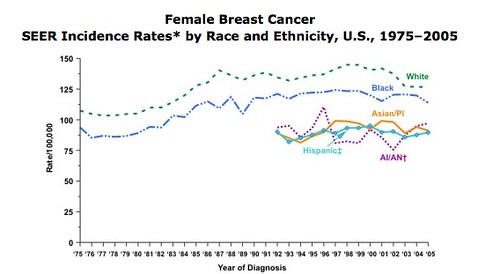
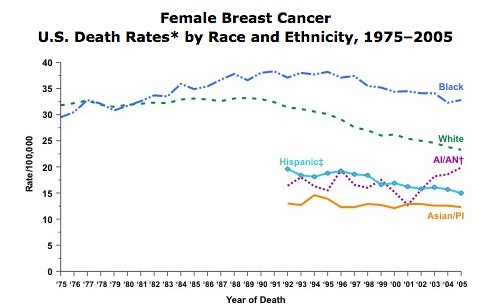
In the USA, Black women have the highest mortality from breast cancer of any other group, despite the rate of diagnosis of breast cancer being highest in White women. Hispanic women have a lower breast cancer diagnosis incidence than either, but mortality rates are disproportionately high in Hispanic women also. Here are the CDC incidence and mortality statistics over time:

“Incidence rate” means how many women out of a given number get the disease each year. The graph below shows how many women out of 100,000 got breast cancer each year during the years 1975–2005. The year 2005 is the most recent year for which numbers have been reported. The breast cancer incidence rate is grouped by race and ethnicity.

For example, you can see that white women had the highest incidence rate for breast cancer. Black women had the second highest incidence of getting breast cancer, followed by American Indian/Alaska Native, Asian/Pacific Islander, and Hispanic women.

Breast ca incidence stats showing White women at highest risk

The graph below shows that in 2005, black women were more likely to die of breast cancer than any other group. White women had the second highest rate of deaths from breast cancer, followed by women who are American Indian/Alaska Native, Hispanic, and Asian/Pacific Islander.

Breast ca mortality stats showing Black women at greatest risk

A number of contributors to this disproportionate mortality have been proposed, including environmental toxin and pesticide exposure, more aggressive tumours, and later diagnosis. Most alarmingly, the mortality gap seems to be widening.

This week’s British Medical Journal (BMJ) has an important article today demonstrating one of the consequences of healthcare racism in the USA:

Impact of interval from breast conserving surgery to radiotherapy on local recurrence in older women with breast cancer: retrospective cohort analysis[1]

The researchers analysed national cancer records for 18,050 US women, aged 65 or older and otherwise non-disabled, who were diagnosed with early stage breast cancer during an eleven year period to 2002, and who received breast conserving surgery and radiotherapy, but not chemotherapy.

30% of the women in this study had to wait more than six weeks after their surgery before they could have radiotherapy. Delays greater than six weeks were associated with a modest but significant increase in local recurrence of the breast cancer.

The study also showed that there was a continuous relationship between radiotherapy delays and local recurrence; the sooner radiotherapy was started, the lower the risk of cancer recurrence, and this relationship was strong. This is concordant with previous studies.

So who was subject to these long, risky delays in treatment?

Sadly, the answer will not surprise you: Black women, Hispanic women, and poor women. Black women were almost 50% more likely to experience a longer than six week gap before radiotherapy treatment, and Hispanic women experienced a 30% increase in risk of delay.

The followup was only five years long in this study, and breast cancer tends to be a cancer that bides its time; the increase in risk (and in consequence mortality) may be greater, even much greater, with longer followup. In addition, as local recurrence risk tends to more common in younger women and this study focused on older women, the effect could be more pronounced in the total population of those with breast cancer. In addition, the study studied mostly White women, as Black women tend to get their cancers younger and have a decreased likelihood of receiving breast-conserving surgery and radiotherapy. In other words, this study was set up in a way that made it, in some ways, particularly difficult to find a significant difference in the effect they were looking at; the fact that they still found one means that the effect is likely to be really quite pronounced.

The accompanying BMJ editorial by Ruth H Jack and Lars Holmberg[2] goes on to suggest one possible model of healthcare delivery that might alleviate these delays:

One good example of how practices can be improved is the Rapid Response Radiotherapy programme in Ontario. This programme has drastically shortened waiting times for patients having palliative radiotherapy by restructuring the referral process so that many patients are treated on the same day as their consultation.9 Countries where disconnected systems are responsible for different aspects of treatment will find it more difficult to ensure that diagnosis, referral, and treatment are not subject to delay.

++++++++++++++++++++++++++++++++++++++++++

[1] Impact of interval from breast conserving surgery to radiotherapy on local recurrence in older women with breast cancer: retrospective cohort analysis
Rinaa S Punglia, Akiko M Saito, Bridget A Neville, Craig C Earle, Jane C Weeks.
BMJ 2010;340:c845; Published 2 March 2010,
doi:10.1136/bmj.c845

[2] Waiting times for radiotherapy after breast cancer
BMJ 2010;340:c1007
Published 2 March 2010,
doi:10.1136/
bmj.c1007

Quick Hit — 4D Plexes

Movie poster from the Korean realease of Avatar, showing a white man on the left and his blue faced Avatar on the right, with fantasy creatures imposed in the bottom foreground. Bottom has Korean writing for title "Avatar".Our local theater in South Korea has one of the first and only 4D Plexes in the world (and it is currently showing Avatar, so I could possibly be entertained and annoyed and over-stimulated all at once! Whee!).

“The way the company finally cornered that elusive fourth dimension is by engaging all five senses: moving seats, wind, water sprinkling, lasers, and synthetic smells are all used in time with the movie.”

What are your thoughts/feelings on this so-called break through in the movie going experience? Does the thought of a moving seat and being accosted with sprinkling water and scent sound like an enhanced movie experience for you? Does it seem like it would just provide another barrier to your enjoyment?

Personally I picture myself using my popcorn bucket for something other than its intended purpose…

Have at it in comments.

How to Frame the Accommodations Debate

The concept of accommodations for employees with disabilities is one that exists all over the world. The basic principle of these laws is that an employee with a disability is entitled to changes to accommodate specific needs created by their disability in order to work. These can be changes in policies (changing a policy prohibiting eating at employee desks to allow an employee with diabetes to manage his blood sugar) or procedures (issuing company announcements both orally at staff meetings and by written memo to accommodate an employee with auditory processing difficulties), or even maintaining a scent-free or florescent light-free workplace, providing ergonomic modifications to workspaces, and beyond.

There are a lot of negative attitudes and assumptions surrounding workplace accommodations. It is often assumed that the employee with a disability (EWD for short) and their employer are in an adversarial position – the employee is asking for something they want but that the employer does not want to give. Providing the accommodation is seen almost universally as a loss for the employer, because providing it will cost them, either by purchasing new equipment or in administrative costs and hassle for changing existing policies and procedures. In the United States, it is often made very clear to employees that accommodations are provided solely because the Americans with Disabilities Act (ADA) requires employers to cooperate, not because the employer wants to assist with accommodations or believes it will improve the overall workplace in any meaningful way.

The cost of the accommodation, whether direct or indirect, is often seen as offsetting the worth or value of the EWD and limiting the benefit the employer can derive from an individual employee. More broadly, this is seen as discouraging employers from hiring EWDs in order to prevent the need for these accommodations. This means that accommodations are often seen as “special treatment,” for EWDs, requiring a whole set of special procedures by which EWDs can request accommodations and have them evaluated and special staff to learn the ADA and evaluate accommodations and …

Another feature of accommodations for EWDs is that although they are supposed to be individualized and tailored to the specific needs and responsibilities of an individual employee, employers often think of providing specific, pre-determined accommodations based on the type of disability the EWD has. For example, employers often consider themselves to have fulfilled their accommodation duties for people with physical disabilities if the workplace is wheelchair accessible and the parking lot has a handicapped parking space. Any additional requests from accommodation are likely met with bewilderment by the employer – “we already took care of all of the accommodation issues!”

It was with all of that in my mind that I read this recent article from ABCNews, with the headline “Employees Healthier When Boss Is Flexible.” The article discussed the benefits of flexible work schedules for employees without disabilities:

“Flexible working initiatives which equip the worker with more choice or control, such as self-scheduling of work hours or gradual or phased retirement, are likely to have positive effects on health and well being,” Clare Bambra of Durham University in the U.K., told MedPage Today. “Control at work is good for health,” Bambra said. Overall, the researchers found that situations that gave the employee more control over scheduling have positive effects on health and well being, particularly with regard to blood pressure, sleep, and mental health. A third study found significant decreases in systolic blood pressure and heart rate for workers with flexible scheduling, Bambra said. Conversely, Bambra and colleagues found that mandatory overtime and fixed-term contracts had absolutely no positive effects on health outcomes.

Although the article did not analogize these flexible work schedules under employee control to the principle of accommodations and disability was not explicitly mentioned in the article, I couldn’t help but connect the two. The idea of allowing an employee to control their own work schedule based on her own needs is exactly the principle behind accommodations – tailoring the work requirements and environment to the individual and specific needs of the employee, rather than requiring everyone to comply with universal policies set by the employer. It’s also implied that these flexible policies benefit the employer by creating healthier and happier employees who are, in turn, more productive at work.

This made me wonder if it would be helpful to adopt this framing for accommodations arguments, as in “see, assisting employees to accommodate their individualized needs results in better outcomes for both employees and employers!” Framing the argument that way addresses a lot of the negative issues around accommodations discussed above: the employee and the employer are working together rather than against each other; providing this flexibility is seen as a benefit to, not a loss for, the employer; this maximizes the work, worth and value of the employee rather than offsetting it; accommodations are good business practice rather than special treatment imposed by law; the individualized nature of accommodations is emphasized and changes must be dictated by the employee’s view of their own needs.

There is a potential drawback to this framing, however – it does not explicitly mention or focus on PWDs. I see this as potentially harmful given that the need for accommodations for PWDs is created by the historic and continuing othering of and discrimination against PWDs. (See amanda and wiki on the social model of disability for more about this.) Advancing the principle of accommodations for employees without explicitly focusing on PWDs removes a lot of the disability-based stigma from the discussion, but also removes the historical context that has created a need for accommodations. Similarly, framing the issue as a smart business practice than a civil rights issue removes the discussion of “special” rights or treatment, but removes focus from the fact that PWDs deserve these rights to counteract oppression based on their disability status.

This framing technique also dilutes the concept of what an accommodation is and extends it to all employees, whether or not they have disabilities. This could be dangerous, as it would allow employers to think about accommodations in terms of overall economic benefit – this might encourage them to deny specific accommodation requests that would be considered too costly for the company, or insufficiently beneficial to the overall bottom line. While that may be unwise for employers, given studies like this, it would not be illegal and would not be a civil rights issue for employees without disabilities. For EWDs, however, denying accommodations is a civil rights issue, because accommodations are required to allow EWDs equal access to employment benefits in light of the barriers that exist because of historic and continuing oppression and discrimination against PWDs on the basis of their disabilities. Expanding the focus of accommodations to all employees de-emphasizes the rights-based aspect of accommodations for PWDs to the point of invisibility.

I’m not sure whether the benefits or costs of this framing of the accommodations argument are stronger. What do you think? Have I ommitted any advantages of using this framing? Any disadvantages? Which framing – current rights-based arguments or these non-PWD centered business arguments – do you think is best?

A Conversation With a Pharmacist

[Scene opens with a loooooooong wait in the pharmacy before my number finally “pings” on the digital number-pinging thingy, as I struggle out of my chair, and hobble up to the pharmacist’s window, and hook my cane on the window ledge for emphasis as I hand over my ID and number slip, wincing in the fluorescent lighting on the other side.]

Army Medic Pharmacist: One moment.

Me: No problem, Specialist. (I am well aware that two of my three expected prescriptions require me to wait as they are counted, twice, some other fun stuff, though I no longer have to run around to get them, and have to be signed for, so I amuse myself by reading the literature he hasn’t bothered to hand me yet.)

[AMP returns with the Civilian Pharmacist]

Civilian Pharmacist: You have taken pregabalin with topamax before?

Me: Yes.

CP: What about this antacid?

Me: No. But I assume it is the same as my previous one.

CP: Yes.

[I sign for one med. CP hands me two bottles.]

Me: There should be a third script.

CP: No, only the two.

Me: There should have been a vicodin script as well.

[CP raises her eyebrows at me]

CP: You are on pregabalin.

Me: Yes.

CP: That is a time released pain medication.

Me: Yes ma’am.

CP: You don’t need vicodin with a time released pain medication.

Me: With all due respect, ma’am, I usually have both.

CP: Well, there isn’t a script for it, and I don’t think you need it.

Me: Well, ma’am, there should have been one, and I am going to ask you to call my provider about it.

[Staring contest ensues between Me and CP. I win. CP picks up phone and asks AMP for Dr. Awesome’s number. I can hear Dr. Awesome on the other end apologizing for forgetting the script, that the computer wasn’t working right when I was in her office, which it wasn’t, and that she forgot to put it in before leaving the office, and would put it in the next day she was in.]

CP: Dr. [Awesome] apologizes for your inconvenience. You can pick up the script on Monday.

Fin.

Parking spaces – Daily Mail Fail

The Daily Fail has a little maths problem. OK, they have a little everything problem, but in this particular case, well, you be the judge: Revealed: Why all those disabled bays stay empty

Hundreds of thousands of prime parking spaces in shopping centres are unused because of a legal obligation to provide four times as many disabled bays than are actually needed.

Supermarkets, shopping centres and leisure centres must allocate up to 6 per cent of their parking bays for disabled badge holders – even though just 1.4 per cent of the population is registered disabled*. […]

Campaigners are furious at the number of vacant disabled bays and believe more should be done to tilt the balance in favour of drivers with young children.

OK, so let’s do the math. On a small scale, anyhow. My family is 33.3% disabled. When we go out together, we need accessible parking 100% of the time. Oh, and we’re one of those mythical families, Daily Mail writers, that includes both a PWD and a young child. I know you think we don’t exist. But we’re right here.

Extrapolate up through the population, and suddenly those 6% figures (which only apply to small lots in the UK – large lots only need 4%) don’t look so excessive, do they?

Here’s another thing: When nondisabled people can’t find a space close by, they park further away and walk. When a disabled person can’t find an accessible space, she turns around and goes home. If the math doesn’t convince you, the social justice should.

In Australia? Only 1-2% – ONE to TWO PERCENT – of spaces are required to be accessible. 4% of Australians require accessible parking (do the math – this means that more than 4% of vehicles may contain a PWD who needs the accessibility), and that number is rising. AFDO recommends that a ratio of 10% may be more appropriate.

Many small businesses, including medical clinics, have no accessible parking at all. Many designated marked spaces do not meet standards and may not be accessible for all PWD – not wide enough, heavily sloping, blocked or non-existent access lanes and kerb cuts, further away from entrances than the “non-accessible” spots (I’m looking at you, IKEA), and so on.

“Cracking down” on parking permit abuse makes currently-nondisabled folks feel righteous, but it doesn’t do the job. We need more spaces, and we need compliant spaces.

*I’m assuming the 1.4% applies to those with blue badges in the UK, since around 20% of the population actually has a disability.

Come filk with us – “Special Treatment” for PWD

Paul Kelly, if you’re not familiar with him, is a bloody marvellous Australian singer-songwriter. Some consider him the “poet laureate of Australian music”. He writes everything from fun-but-pointy ballads – Every Fucking City is one of my favourite anti-hero pieces – to political protest music.

You can read a little about him here at Debbie Kruger’s:

But there are songs that have specific intent – the ones for which he is known as “political commentator.” Songs such as “From Little Things Big Things Grow,” which he wrote with Kev Carmody about Aboriginal Land Rights, “Treaty” with Yothu Yindi on Land Rights and Reconciliation and “Little Kings,” from a more recent album Words and Music, about dissatisfaction with the Government. “Those songs are the exceptions,” Kelly concedes. “’Special Treatment’ is another one like that, a specific situation and write to it.”

Check out the song:

Lyrics are here. For those who can’t access the Youtube, it’s performed in a folky acoustic-guitar sort of way.

“Special Treatment” is a great example, in my opinion, of a piece of protest music written in first-person, using the point of view of members of a marginalised group of which the singer is not a member (I think, and please correct me if I’m wrong). Kelly is deeply respectful of the history, takes his subject seriously while introducing elements of dry humour, and has collaborated extensively with artists in the group in question. The piece targets authority sharply and with bite; its impact does not on stereotypes, mocking, fetishisation, or Othering of Aboriginal and Torres Strait Islander people.

I’m acutely aware that I run the risk of ‘splaining here, and I suspect that similar grievance-politics dynamics apply elsewhere in the world: but just to dip both toes in and take that risk for a moment: a common complaint among white middle-class Australians (WMCAs) is that Aboriginal and Torres Strait Islander people in Australia get “special treatment” from government. WMCAs complain when there are funded Aboriginal health services attempting to make tiny inroads into the appalling longevity statistics, the 20-year Gap, the rates of trachoma and hookworm and pneumonia and STDs and nutritional deficiencies. WMCAs complain when there are tutoring and bridging programs assisting Aboriginal people from remote areas to go to university, attempting to address the massive gulf between educational opportunities, entrenched discrimination, and difficulties of transitioning from remote areas to urban universities with a completely different cultural milieu.

WMCAs complain when Aboriginal people who are out of work are offered barely enough support to not starve their families; when there are programs to assist the Aboriginal prisoners who survive prison to transition back to the community; when mental health support programs are offered in an effort to reduce the 8x suicide rate among young Aboriginal people; when STD and contraception services are funded for young Aboriginal women who are raped at extraordinary rates; when funding for domestic violence and violence reduction programs are offered to women who live in fear. All this and more is dismissed as unfair “special treatment”.

In response to a post I wrote responding to a post by CarrieP at Big Fat Blog – in which Carrie wished that fat people were offered the same level of “special treatment” and respect that people with disabilities are – megpie wrote a touching filk to the tune of Kelly’s “Special Treatment”. (OK, verse three is the same – and applies pretty precisely to the situation of forcibly-institutionalised PWD.) Check it out (while listening to the Kelly original, if you can) – and add your own verses in comments.

I can’t enter my child’s classroom
Although the door’s right there
I’m stuck outside my child’s classroom
Blocked by a single stair

I get special treatment
Special treatment
Very special treatment

I’d like to work an eight hour day
In an office on main street
But they won’t offer me the same pay
Or add a ramp my chair needs

Say it’s “special treatment”
Special treatment
Very special treatment

Mother and father loved each other well
But together they could not stay
They were split up against their will
Until their dying day

They got special treatment
Special treatment
Very special treatment

Mama gave birth to a healthy child
A child she called her own
Strangers came and took away that child
To a stranger’s home

She got special treatment
Special treatment
Very special treatment

I’m not allowed to cry out loud
I’m not allowed to scream
I’m not allowed to show my rage
I’m not allowed to dream

After all, I get special treatment
Special treatment
Very special treatment

Accessibility & Sustainable Transportation

Last week I attended a meeting at my university campus regarding sustainable transportation options for the next five to ten years. We’re at an interesting point in time here, as both the transit routes and the university are putting in long-term planning, so we may have a chance to push for real, useful, interesting change that can have long-term impact on both the university community and the greater community.

I would say “Ask me what wasn’t covered at all!” but I’m sure you can all guess – accessibility was never mentioned, even though the initial study into the needs of students, faculty and staff on campus had raised issues of accessibility.

But! Credit where credit is due. I brought this up at the meeting, and then again (as in, ten minutes later) with head of my particular branch of student government, and this afternoon attended a meeting including myself, the president of my particular branch of the student union, and student accessibility services to talk about concerns regarding accessible transport and sustainable transport.

Basically, the topics of conversation were around the fact that we’re a growing campus, we have greater needs regarding getting people to and from campus every day, but we want those needs to be Green in focus. The initial meeting I attended last week focused on things like faculty bus passes, incentives to car pool, and what encourages people to walk or bike to campus.

What we talked about today were more focused ideas that were inclusive of people with physical and sensory disabilities. I wanted to talk about this here, because I have no illusions: Even with student accessibility services there, we were still only talking from a limited perspective. I focus a lot on mobility needs, and more specifically on the needs of people using wheelchairs, for reasons I think are obvious, and the gentleman from student accessibility services then focused a lot on issues around students with low-vision, or who are blind.

I figure I’ll use our meeting for a greater discussion here. I want to both bring attention to others about sustainable transportation conversations and how to include concerns about accessibility and people with disabilities in them, but also I want to have more feedback and input. There are new students every year, new faculty who may have different issues regarding transportation and accessibility. The more we talk, the more we collectively can ask for things that will aid as many of us as possible.

Things that were brought up:

– Sidewalks. We talked about how horrible they are around the university, although this is pretty universal in our city. SAS brought up the needs of students who are low-vision or blind about sidewalks, including the need for high-contrast paint jobs on the curbs and around obstructions, and to have some sort of guide on the actual sidewalk for canes.

– Buses. More seating for bus stops around campus. Pushing to get more accessible routes to come here. Stop announcements (municipally they’re on the agenda for next year). Giving out cards to people so they can just show their card (usually something bright) so the bus driver will just lower the low-floor buses without you needing to ask. A recording to indicate when the next bus is coming.

I happen to know from looking at the current five-year plan regarding the bus service here that it will cost $1500 per stop to get a stop up to what they want for accessibility needs, and that a route must be entirely made up of those stops before it is allowed to carry people who use wheelchairs. This is a long-term project, sadly.

– Parking. I confirmed that here there is no additional charge for parking passes if you have a disability, you get guaranteed parking, and if there is a greater need for parking in front of a building, Facilities Management will actually designate more spots accessible. I don’t know how that plays out in reality, though. (I note there’s only one accessible parking space in front of the Library, for example.)

What are your thoughts regarding this?