Category Archives: accessibility

What is the Real Goal of Fraud Investigations?

California is in the midst of a major budget crisis. The past year has seen immense and drastic cuts to social service budgets throughout the state, including elimination of all state funding ($16 million) to domestic violence shelters (which was later partially restored by legislative action) and near-total decimation of funds for AIDS testing and prevention programs to save $52 million. Even with those catastrophic cuts, the state is still in massive financial difficulty: “The state has a $6.6 billion shortfall in the current fiscal year ending June 30 and is looking at a $12.3 billion hole for the new budget year. There is $1 million in reserve.”

This means that any dollar currently being spent has been extensively reviewed and evaluated and a very conscious decision has been made to prioritize spending in that area. For example, the state is still willing to spend money for California counties to investigate potential fraud in the In-Home Supportive Services (IHSS) program. IHSS is an essential program for many of California’s low-income elderly people and people with disabilities. Through the program, individuals are allotted a certain number of hours of assistance with personal services including bathing and grooming, home services such as cleaning, cooking, and errands including buying groceries and picking up prescriptions. The theory of the program is that assisting people this way allows them to continue living independently in their communities rather than in a long-term care facility, which not only preserves independence and dignity for program recipients, but also is a huge cost-savings measure for the state. If program recipients were to move to long-term care facilities, their costs would almost certainly be paid for by the state’s Medicaid program. And look at the cost differential: “The average cost of a skilled nursing facility is $55,000 a year. The average cost of in-home services in California is $10,000.”

Despite the cost savings realized by this program (I’m beyond the point where I think a state will prioritize and fund a program simply because it’s something that PWDs need to maintain independence and dignity), there have been massive cuts to the benefits portions of IHSS. The hourly wage paid to the home health providers has steadily declined and is now at $8.60 an hour. Needless to say, these extremely low wages make it nearly impossible for a PWD with IHSS benefits to find a home care provider with any kind of training or experience. There have also been steady erosions to the group of individuals who will be eligible for IHSS, with criteria requiring a higher and higher level of disability or functional impairment in order to qualify for the program.

The only area of program funding that has increased is fraud detection, with a grant of $26.5 million to counties to engage in fraud detection. That’s the equivalent of approximately 3 million service hours at the current rate of pay. There are also new requirements in the program that must be met by both recipients and providers in order to receive services: all providers must go through a criminal background check process, including fingerprinting; all program applicants and recipients must be fingerprinted and must place a fingerprint signature on each timesheet submitted for payment. It also requires counties to conduct unannounced home visits.

In the abstract, some of this seems to make sense. We don’t want health providers with criminal backgrounds coming into the homes of vulnerable people and exploiting or harming them. Except that the majority of providers are actually family members or immediate relatives of the PWD and the fingerprints can take up to 9-12 months to be cleared by the state, causing huge delays for PWDs who need vital services and delays in bringing often essential income to low-income families. (Not to mention how low-income people of color are likely disproportionately targeted by law enforcement and subject to criminal penalties.) It also seems reasonable to ensure that scarce service dollars are actually going to people who need and deserve them, rather than people receiving them fraudulently. But there has been a lot of research on IHSS fraud in the past, and it simply does not seem to be very prevalent: an audit released last year (pdf link) found a fraud rate of only 1% in the program. A recent program in Sacramento turned up similarly low levels of program fraud: “The Sacramento County District Attorney, who received more than $3 million from the state for anti-fraud efforts, reported last week that after four months her office had uncovered a total of 19 cases of fraud out of more than 42,000 homecare clients in the County.” That’s a rate of 0.04%. And if we estimate that each of those 19 cases fradulently took $10,000 a year from the state, that $190,000 in fraudulent benefits is dwarfed by the $3 million spent to identify that fraud.

So – these changes and programs are not about protecting recipients. They’re not about preventing widespread rampant fraud. What are they about? Some testimony at a recent legislative hearing sheds some light:

Nancy Jo Riley of San Diego testified that she and her client were “randomly selected” for a fraud investigation last October as part of a new “anti-fraud” initiative by the state. According to Ms. Riley, the agent from the Department of Health Care Services (DCHS) first threatened in a phone call to cut off all IHSS unless she and her client met with him immediately. At the subsequent meeting, the investigator asked her and her client a long series of “humiliating” questions. He then said he could not understand why a person with a severe disability like his should be subject to a fraud investigation in the first place.  He also said that her client, whose hands are frozen in a fist-like position because of his disability, would “probably” be exempted from new fingerprint requirements for homecare consumers.

These rules are an effort to make it harder for people to get services or to continue receiving services. They are an effort to erect barriers to service so substantial that PWDs cannot surmount them. They designed to humiliate and shame recipients for their disability status, to force them to prove themselves, their disabilities, and their functional impairments over and over again. They don’t even make sense from a cost perspective, as they spend far more in detection than is saved by the fraud they ostensibly prevent. They’re not targeting people who are fraudulently receiving services. They are targeting the very people the program is supposed to help.

A Letter for your Toolbox: How to ask for transcripts and subtitles

A while back, I talked about how to make your blog more accessible, and brought up the issues of transcription.

Transcription is damned hard work to do properly, which leaves a lot of people in bind. It’s time consuming, it can be difficult, it can cause pain, and this doesn’t even get into stuff like how some people with disabilities just can’t provide transcriptions, for whatever reasons.

So, what do we do with content like that, especially now that things like vlogs and videos are becoming more and more a part of the blogosphere?

I think this is something we need to spread around a lot more.

Often, people who create vlogs will have a script they are working with. I suspect that many of them could be talked into doing stuff like providing a transcript or even including subtitles for their videos. But the difficult thing is, how do we ask? How do we suggest that they do more?

As I’ve mentioned before, I’m a big fan of letters, and have written a few in my life. I know what the big challenging bit of letter-writing can be: where do you start?

So, here is something I’ve drafted up. I’ve sent it once so far, so I can’t tell you what the success rate is, but feel free to use it, adapt it to your purposes, and send it along to people who’s vlog content you would like to see have a transcription and/or subtitling.

Personalise it to your heart’s content, and ignore/add things as you see fit, and don’t fret about crediting me in any way.

It’s a tool in our toolbox to encourage wider web-accessibility. The more uses we get out of it, the better!

Dear [Person]

My name is [Anna], and I’m a big fan of your vlogs/videos [Here I listed two videos I really liked].

I would like to link them [on my blog, www.disabledfeminsts.com], but I have some difficulties.

I’m a proponent of increased web accessibility for people with a variety of disabilities. Part of this means including transcriptions of video content when I link things. This is so that people with a variety of needs, such as people who are Deaf or hard of hearing, have auditory processing disorders, or have other disabilities which make watching video content difficult, can still get the content of the video. It is also useful for people who are not native English speakers, and people who, for whatever reason, cannot have the speakers of their computers turned on. Providing transcriptions allows all sorts of people the opportunity to get the content from your videos who might otherwise not be able to.

I think your blogs/videos are great, but whenever I want to link them, I have to make a decision: Do I have the time/energy to transcribe this video so that everyone can get the content? If I don’t, do I link it anyway, and hope someone else will come along and provide a transcript for me? Or is it just easier over all to not link your videos?

Obviously, your videos are very popular, and you’re not hurting for viewers because I don’t link them on my site. But I do think you’re missing an opportunity to have even more people access your content.

I suspect that you script your videos in advance. Would it be possible for you to provide a transcript on your YouTube page, or in your blog, for new videos? As well, YouTube allows you to upload captioning on video content. They provide information on how to do that here: http://www.google.com/support/youtube/bin/answer.py?answer=100077

I know that creating video content is time-consuming, and I really respect the work you’ve done. Providing a transcript and subtitling would be a great way of allowing more people to access your content, which would be win-win for everyone.

Thank you for your time!

[Me!]

If you have success with a version of this letter, let me know!

The Opposite of “Disabled” is Not “Employable”

According to the United State government, disability is “the inability to engage in any substantial gainful activity by reason of any medically determinable physical or mental impairment(s) which can be expected to result in death or which has lasted or can be expected to last for a continuous period of not less than 12 months.” Or, in non-regulatory terms, disability is when a physical or mental impairment will last at least a year and will make someone unable to work. The ability to work is right there in the definition. A person who cannot work is disabled. If that person can work, they are not disabled. Disability and employability are mutually exclusive states of being.

That definition comes from the Social Security Administration and is applied to people applying for disability benefits, basically a wage replacement program to compensate for the salary the person cannot earn – so the focus on employability makes some sense. But more and more, I see this framework for defining and evaluating disability applied outside the benefits context, in deciding if someone is “‘really’ disabled.” It’s also notable that these wage replacement programs are the most commonly known and discussed form of disability-based benefits – while I’m used to seeing articles about how to handle the Supplemental Security Insurance (SSI) program, I rarely see coverage of programs from the Department of Rehabilitations, which provides vocational training and support to PWDs. And the false equivalence of disability and unemployability is problematic for a lot of reasons.

  • There are a whole lot of people with disabilities who are not employed due to problems with the economy and with employers who discriminate against PWDs when hiring or fail to sufficient accommodate PWDs while employed. Assuming that unemployment is due solely to a person’s disability status, rather than systemic stigma and discrimination, places the responsibility for finding and keeping a job solely on the shoulders of the PWD. This shifts focus entirely away from the employers who have ultimate power over whether an individual is going to have a job. Take a look at employment statistics for the federal government itself, where “the severely disabled represent 0.94 percent of the government’s workforce.” And despite those low numbers, the government has no problem telling people that unemployment is a disability issue.
  • When disability is defined as an inability to work, that overlooks an enormous segment of people with disabilities. About 37% of PWDs in the United States are employed – 8,581,869 people. But their ability to work does not negate or erase their disabilities. Those disabilities continue to exist and implying they do not lets employers off the hook for acknowledging and accommodating those disabilities in the workplace. It is already easy for an employer to overlook an informal request for accommodation or demand overbroad access to private medical files to “prove” whether or not the requesting employee “actually” has a disability in response to an accommodation request. It’s impossible to say how many employed PWDs have successfully requested and received needed accommodations relative to those who have been too intimidated to ask or had employers unwilling to fulfill their legal obligation to provide accommodations. But I would venture to guess that it’s quite difficult and involves risk for the individual employee. The stereotype that people who can work are not disabled and do not “really” need or deserve accommodation only encourages this behavior.
  • In our society, employability is often equated with worth and value on a fundamental level. In the current bad economy, lots of people have been losing their jobs, and half of them feel that being unemployed has changed their lives for the worse. Being unemployed is seen as shameful, humiliating, a sort of failure to grow up and develop into a “real person.” Obviously, having “disabled” be seen as a synonym for something with those negative connotations does a disservice to people in both groups.

Admit Two: Australian Companion Card scheme up and running

picture of Australian companion card sample, next to an ADMIT TWO ticketThe Australian Government officially launched the national Companion Card scheme around six weeks ago.
The Companion Card enables some people with disabilities to participate at venues and activities without incurring the cost of a second ticket for a carer. If a PWD requires an attendant in order to participate in the event or access the location, the ticket for their companion is free. Before the scheme came into being, people who had service animals could legally take them anywhere without extra payment, but people who had human carers had to pay extra. How did that make sense?

Who can qualify for a Companion Card? In my state (definitions are very similar state to state), the care-needs eligibility definition is:

Attendant care support includes significant assistance with mobility, communication, self-care, or learning, planning and thinking, where the use of aids, equipment or alternative strategies do not enable the person to carry out these tasks. It does not include providing only reassurance, social company or encouragement.

The definition also requires that the need for support be considered life-long, though the rationale behind this is not explained. There is no income test.

There is an additional note to participating businesses warning them not to use this as an excuse for poor accessibility:

The Companion Card was not developed to overcome or compensate for any particular venue’s lack of accessibility; including the absence of ramps, lifts, accessible toilets, appropriate signage or captioning, etc. Responsibility for these access issues remains with venue and activity operators.

There are currently 2700 affiliate organisations participating in the National Companion Card. So far the participants include the Melbourne public transport system, major sporting leagues and venues, various cinemas, Circus OZ, Fitness First Australia, Circus Royale, The Australian Ballet, Musica Viva, The Australian Rugby Union, and many smaller sporting and cultural venues and organisations.

This is a terrific idea, and one that needs to be adopted in more countries. It would also be good if Australian extends the scheme to temporary passes for tourists in the future; right now, you need to be a resident.

What’s the situation where you are? If you need human assistance in order to participate in the life of your community, do you need to fork out cash for an extra ticket?

Why “being nice” isn’t enough

On December 30, I wrote a post about the myth that people with disabilities are out to sue everyone else into compliance, booga booga fear the scary crippled people. In there I mentioned that Don & I had gone off to the mall and had difficulties getting into the shops, since apparently “wheelchair accessible” doesn’t mean “keep your aisles clear of junk”.

I wrote an email to the mall in question:

Subject: Accessibility and the Mall

Hello,

I recently visited your mall with my husband, a full-time wheelchair user. This was not our first visit to your mall, but it may be our last.

Many of the shops in your mall are not actually wheelchair accessible for a regular wheelchair user. The aisles between shelving units are rarely wide enough for a wheelchair user to not risk knocking something over. Often the aisles and open floor spaces are covered in sales items. Things jut into the aisles that could knock someone in the head. These issues do not even touch on sales staff that ignore people using wheelchairs [1. Oh, hey, we went to Don’s favourite Big & Tall shop in the other mall earlier this week. When he was by himself, and thus struggling with the sweaters, he got completely ignored. When I came into the shop to find him, I was offered assistance immediately. Even though she was standing not a foot from where Don was wheeling around looking for more sweaters, the same sales assistant completely ignored him. So, yeah, I’m going to be writing another email. But I’m especially annoyed because this is the only shop we’ve been to that sells clothing in Don’s size – where else are we going to go?], or stores that are so crowded that a wheelchair user cannot get around – both of which are human-related issues, and not ones I would expect mall administration to be able to deal with, although some sort of policy discussion on that would likely be helpful.

Although your mall has an accessibility policy, I can see nothing on your website that discusses if the stores within the mall are expected to uphold it, or what expectations the mall has that stores will be accessible.

We planned on spending the day yesterday taking advantage of the extended Sunday hours and Boxing Week Sales. Instead, we purchased one item and left. It was impossible for my husband to enter many of the stores that carry items we would want to purchase, or, if he could enter them, he could only get part of the way through the store before the above issues made it impossible for him to go any further back.

I feel many of these issues could be solved if the mall enforced an accessibility policy for the stores within it.

Thank you for your time,

Anna [Last Name]

I did get an email back, which was very polite and understanding and full of fluff. I won’t quote the whole thing, but this one line stood out to me:

Unfortunately we cannot enforce an accessibility policy, but we will be making every effort to encourage our retailers to provide barrier free access through education and an incentive program.

I don’t quite know why the mall can’t enforce an accessibility policy. I do know there is not a Canada-wide accessibility policy, and Nova Scotia is not exactly noted for accessibility-friendly policies.

In a world where people just needed to ask for assistance and voila, it would appear, as though magic, we wouldn’t need an accessibility policy. I could just drop an email to the mall, and that would be the end of it. Heck, I probably wouldn’t need to drop an email to the mall – from the goodness of their hearts, they would already have a thorough accessibility program in place, covering things I never think to ask for, like scent-free policies and braille signs and more seating [1. Well, I used to remember to ask for more seating, and then Don got a wheelchair and now I have to think about it.] and… well, things I never think to ask for.

This is why I’m displeased that my country doesn’t have even a token-effort federally mandated accessibility law. The mall, which can mandate things like “required to follow fire codes” and “required to open during mall hours” cannot (or chooses not to – I suspect the latter, frankly) require the same stores to follow an accessibility policy.

But yeah – if we’re all just really really nice, maybe they’ll do so anyway.

Backscatter X-ray scanners, security theatre, and marginalised bodies

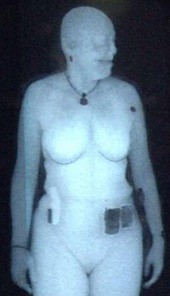
backscatter x-ray scan in which the body surface of a person is clearly visibleI’ve just been reading about backscatter X-rays and airport security in my local paper: UK brings in full body scanners. The UK is looking to push these into routine use, using the attempted attack at Christmas as an excuse. In this attack, the perpetrator had an incendiary device strapped to his leg, and managed to set his own pants on fire.

There has been controversy over the scanners since their existence hit the media several years ago. The full body scans show the body quite clearly – a bit like the images purported to be revealed by those “X-ray Glasses!!” advertised in old comic books.

Concern has largely centred around how the scanners might affect able-bodied cis people: that they will feel exposed, that the security people might be hur-hurring over their fat rolls or breasts, that the images might be saved. Security “experts” have scrambled to refute the claims, saying that only “same-sex” people will read the scans (as if this is supposed to be reassuring to non binary gendered people), that the scan reader will be in a separate room from the scannee, that the images will not be able to be saved with the technology. They assure us that there will be “privacy algorithms” in place.

If anyone believes airline security operators for a second when it comes to future commitments to respect the privacy of airline travellers? I’ve a harbour bridge I’d like to sell you.

The same security experts have assured the media that the scans will be optional, provided as a purely voluntary alternative to a full body pat-down. I’m going to go out on a limb right now and guess that the images are not, for example, an option for wheelchair users who can’t stand up out of the chair. Reassurance of options and choices are not particularly useful for the large swathes of the population who can’t access them.

Things that will likely show up in a full body scanner:

Urinary catheters.

Incontinence pads.

Colostomy and ileostomy bags.

PEG feeding tubes.

Mastectomy prostheses.

Certain medication pumps and implanted ports, such as insulin pumps.

TENS machines.

Pacemakers.

The bodies, including genitalia, of transgender and intersex and genderqueer people.

All of these are the signs of bodies already marginalised. Some of these signs may be clear on current security screenings – some may not.

People with marginalised bodies already have major issues with air travel – with the uncertainty of the security process, with the practicalities of dealing with aids and needs while travelling, with the spoon-sapping of travel, with no option but unfamiliar foods that may affect the body unpredictably, with the difficulty of maintaining personal privacy in prolonged periods in close quarters with others, with unpredictable delays that affect health, with security threats when bodies don’t ‘match’ identification documents.

Soon there may be one more element in the mix: the sure knowledge that one’s personal business will be laid bare in front of security-theatre goons who will almost certainly be poorly trained in disability awareness and gender tolerance.

I give it 24 hours before clandestine mobile phone images of travellers with marginalised bodies show up on the Internet.

Is this worth it?

Subtitles in Assassin’s Creed II and Ubisoft’s Pledge

I am somewhat of a gamer. I am not by any means an avid gamer or someone you should call up with questions. If you want a review of how easy a game is to play or how not confusing your controls are, I am your girl*.

I am mostly a computer gamer. I like my World of Warcraft just fine, thank-you. It has a lot of room for critique, and I have some letter writing campaigns to Blizzard in progress. But I like it. I have no love for Warhammer Online, having never played it after being promised by multiple reliable sources that I would be able to play it on my Mac, and after purchasing the Special Edition in order to get into the Beta, was most unpleasantly surprised. Whatthefuckever, I turned that store credit into a Wii Fit, something I actually used. And, no, I don’t care that you can now get it for Mac, they already shat in my Cinnamon Life. I am digressing when I just wanted to say that I prefer computer over console because I tend to find console controls too confusing for me —  all the button combinations are too much to keep track of. I like to set up my buttons in a row and get my “Pew Pew Moar” on. If it is more complicated than original Nintendo’s Super Mario Bros., I don’t really enjoy it. I just don’t have the reaction times or memory to figure out all of those buttons (and I don’t need an evo psych lecture on how girls just don’t have those skills, because I have many gamer skills that translate well into the PvP aspects of WoW…I just don’t have it for console gaming).

One thing that endeared me to WoW, however, is that all the dialogue is subtitled. I am not deaf, but I do sometimes have trouble sorting dialogue out from ambient noise, both in game and out. I don’t want to have to miss something in an otherwise mostly enjoyable game because I can’t understand what the NPCs are saying. It doesn’t matter how high you turn the volume, you just can’t get everything. WoW even lets me know when someone is yelling.

Back to console games…

One console game that I did pick up was Ubisoft’s Assassin’s Creed. There was a lot of excitement over this game, it was anxiously awaited — one of the most anticipated games of the year of its release. There was also a huge deal surrounding one of its lead developers that I will leave you to read up on,I just am too tired to rehash it — I was thrilled that it didn’t stop Jade Raymond from being a part of ASII’s team (no transcript at the link). Just for a fun exercise, Google “Jade Raymond + Assassin’s Creed II” and see how many search results come up with anything that has to do with how good she is at being a video game developer or producer, and then tell me why more women don’t go into that industry. The team at Ubisoft put in the beginning of the game that it was developed by a team of multi-cultural and religiously sensitive people from many diverse backgrounds. I found the game fantastic. The Guy beat it in just a couple of days (he eats games for breakfast like that), even if the ending did make him want to put it in the freezer, and even though I have only recently tried it, I have really enjoyed it. To me, the controls are really simple, the game play is methodical (note: things that really piss some gamers off appeal to me, as in part of my OC nature really likes the repetitive storyline, and the different things to complete. I *love* that, because it allows me to zone out, clearing my mind.), and the game itself is Really Fucking Beautiful. I love going to all the checkpoints and using the “eagle vision”, just viewing the cities.

One aspect that was missing from this design team, it seems, was someone who had input on accessibility, because one complaint I had, even before I was invested in disability activism to the degree I am now, is that it had no subtitles. Like I said, I often miss dialogue during cut scenes, and even if that does not affect my game play, it affects my gaming experience.

When Assassin’s Creed II came out I read in The Guys Game Informer that they made a lot of changes based on what fans wrote to Ubisoft asking for. Before I was willing to get this for The Guy for X-mas this year, I needed to see two things: 1) That the playable character could not drown in a two fucking inches of water, and 2) subtitles. Well what do you know, this iteration’s assassin can fucking swim, and Assassin’s Creed II includes subtitles for all of the game play.

Rawk.

We have it, and it both translates the Italian and has decent subtitles, although it doesn’t describe non-spoken sounds.

There’s more.

Ubisoft, apparently has made a commitment that they will always include the considerations of deaf and hard-of-hearing gamers in the development phases of their gaming creation. This is exciting news for me, coming from a company that I have come to really like. By like, I mean, has made the first non-Nintendo based console game that I can actually play (this is also because I find the new black controller included w/ the X-Box Elite military appreciation smaller than the original, and fits comfortably in my hands, even on a moderate pain day).

I am looking forward to finishing Assassin’s Creed so that I can move on to ASII, if for no other reason than for the subtitles. I wish they had made this pledge long ago. It is worth noting that I read on a gamer message board somewhere (I can’t find it now) that someone had written them, and they responded, saying they took that complaint very seriously, and now, here they have. This has raised Ubisoft in my mind.

Like it was hard to do at this point.

*I do sometimes call myself girl. I don’t have a problem with this.

More articles on subtitles in video games: Subtitles: Increasing Game Accessibility, Comprehension (Gamasutra)

Guest Post: Puppies and Pills Part 2

About thetroubleis: Thetroubleis is a 19 year old with bipolar disorder, social anxiety disorder, generalized anxiety disorder and dyspraxia. She’s a WOC who is also a transracial adoptee and pansexual/queer, depending on how she’s feeling that day. She enjoys knitting, video games and is a music geek.

Puppies and Pills Part 1.

I’m back, did you miss me? I’d like to talk a little bit about the service dog community and public perception of service dogs and I’m hoping this will be interesting to more people them just me. Your comments and questions are appreciated.

All of my experience with the service dog community is online, which makes things a bit different than they would be if I was interacting in person. Any statements I make are huge generalizations, so please, take them will a grain of salt. This isn’t make to pick on anyone person or any particular community.

The online service dog community can be a bit abrasive, in part because of the worry about fakers. There are cases of people coming in and learning the lingo and the lay to pass a pet dog or an emotional support animal off as a service dog. While I recognize this is a problem, I do think that we could cut people a little slack. I see a lot of the aggressive questioning being directed at people interested in a service dogs for psychiatric issues, because of confusion people have about the difference between a psychiatric service dog and an emotional support animal.

However, the online service dog community is also very helpful. They are willing to point people at programs or trainers that suit their needs and help people with financial difficulties come up with ideas for funding. The community is ready to help with writing campaigns at a sign of injustice and isn’t afraid to take mistaken or bigoted people to task, even if they write for well respected newspapers. If someone’s service dog gets sick they are always there with support and help finding ways to get treatment if money becomes an issue. The people in the service dog community care and they care passionately.

If you can’t meet teams in your area the online service dog community is invaluable and I’d say they are great even if you can. It’s great to have people who get it, even if we disagree on some issues. It’s great to have others who can understand what it’s like to have an access issue, or what it’s like to take a dog to the zoo.

This actually brings me to my next point, access for service dog handlers and the public. It’s a joyful topic, full of good times and understanding and caring business owners.

Okay, I lied. The general public’s understanding of service dogs or in some cases that there is anything beyond guides is very low. It makes sense that more people know of guide dogs, as they are did start the first service dog schools and hold their dogs to a very high standard. I must say that the constant questioning of whether I am blind is most annoying, not because I’m insulted, but because what my disability is or isn’t is not up for public consumption. When one adds in American society’s feelings towards mental illness, I rarely feel disclosure is in my best interest. Some in the service dog community itself are still against the idea of service dogs for people with mental illness, so I expect even less acceptance of the general population.

One thing that gets to me is how few business owners know the law. Right now I’m covered under Maine state law, but I do think that a business owner should at least know the ADA [Americans with Disabilities Act} at this point. It has been nearly 20 years, after all. So, I take pamphlets with me, even when I don’t have Figaro, to tell businesses about their rights and responsibilities. I figure if I keep this up, it should cut down on access issues, not only for me, but for all teams.

One thing I wish people understood is that petting a service dog can put the handler in danger. Yes, our dogs are trained to ignore you, but even the best dog breaks training. I love Figaro, but I wish people would talk to me not him and accept that maybe I don’t feel like talking that day. Drive by petting is one of my peeves, because by the time I process it, people tend to be too far away for me to scold or educate. I understand that people love dogs, but just as you shouldn’t go around grabbing a person’s wheelchair, you shouldn’t touch my dog without my permission. He’s not a public petting zoo.

People have attacked service dogs, kicked them, spat on them, set their dogs on them. This is unacceptable. Beyond the fact that a service dog may be someone’s independence, it’s also a living creature worthy of respect. Our dogs are not abused slaves and honestly, I think most service dogs have a better life than most pet dogs. What pup wouldn’t want to travel with their person and help them out, all the while seeing new things and people?

I try to believe that people are mostly good, if misguided, and therefore I’m going to keep educating. I hope that someday access issues will be far and few between and more people who could benefit from a service dog could have the partnership I’m able to have.

This is my next to last post in this series and next time, I’d like to talk a bit about cost of a service dog and ways to get a service dog.

An emotional support animal (ESA) is a US legal term for a pet which provides therapeutic benefit to its owner through companionship and affection. Emotional support animals are not specially trained to ameliorate disability as psychiatric service dogs are. They require only as much training as an ordinary pet requires in order to live peacefully among humans without being a nuisance or a danger to others.

Question Time: Spoon-saving Wee Web Widgets

I’m probably the last person on the block to find out there’s a better way to delete hundreds of old comment subscriptions in livejournal. I’ve been going to the Subscription Tracking page and deleting each one by hand – which then forces a reload of the page, sending Firefox to using 100% of one of my CPUs, and generally taking a whole lot of time, spoons, and aggravation.

Searching around, I now find that Afuna has a Greasemonkey script, Delete Multiple Subscriptions, that at least makes the job easier. You click on the little trashcan, it highlights with a red box, then when you’re done selecting the outdated subscriptions you click “Delete” at the bottom. Hoorah!

Now, if anyone finds a way to mass delete the oldest x00 subscriptions, or all those older than x0 days, please, please, please let me know.

I’ve also only just discovered YousableTubeFix, which makes my Youtube use much easier. YousableTubeFix allows you to customise a whole lot of interface stuff on Youtube:

Removes ads and unwanted sections (configurable), allows downloading and resizing videos, displays all comments on video page, expands the description, can prevent autoplay and autodownload, adds a HD (High Definition) select, etc…

I’ve been attached to Remove It Permanently forever, though it seems rather flaky these days and probably needs updating. It gives a different set of functions from Adblock. I see there’s a Yet Another Remove It Permanently, but I haven’t tried it yet.

There’s another one I use all the time, for websites with colour schemes I find unreadable (white on black, grey on black, pale grey on white, light green on medium green…): Black And White, a little bookmarklet, shift most pages to plain black text on a white background.

These particular scripts and extensions may not be accessible to all users – so I’d love to hear your tips and experiences.

What other wee web widgets make your life easier? Spill! Shar

It’s a scooter, not a Mack truck

Something I’ve noticed a lot since starting to drive a scooter is how TERRIFIED people are.

Really.

On the sidewalks, I zoom along at six kilometres an hour if I’m unaccompanied and there’s no one around. That feels really zoomy to me, having not locomoted that fast bipedally for quite some time.

But when I’m in a place with people around, or in a shopping centre, I dial the speed right down to minimum. This is actually a fairly slow walking pace.

Yet every single time, people look frightened, and leap out of my way – when they’re not deliberately ignoring me and completely blocking the way while I wait or request passage.

Partners grab their partners to pull them aside, with alarmed looks on their faces, as if tackling them out of the path of a speeding bus in a spectacular Hollywood scene. Parents grab their toddlers and whisk them into arms, glaring at me as if I was charging the kid brandishing a sword and ululating. People in groups jolt visibly when and if they decide to finally acknowledge my existence, and make a giant production, involving a lot of discussion and back and forth and extendings-of-arms, of shuffling each other around to make space for me to get by. People blocking aisles with their angled trolleys ignore me for as long as possible, then make a big deal of moving the trolley, as if they’re compassionate solicitous generous souls who are doing me a giant favour.

People. PEOPLE. It isn’t a drama. It isn’t a big deal. It’s just a scooter with wheels. I’m quite obviously riding slowly and carefully – slower than you’re walking, most of the time. I can see your toddler, your husband, your friend, with these here eyes in my head, and much as I occasionally joke about scooter-mounted flamethrowers, I’m not actually planning to mow them down in cold blood. I don’t take up five metres of side-to-side space; you don’t need to flatten yourself against the wall as if you’re in a commando movie; you need only make enough space for me to get where I’m going.

Just treat me as you would any other human.