Category Archives: feminism

Anger as a Constructive Force

Note: This is kind of an old post, but I think it’s still useful.

I’m sure that many of you have heard variations on the following:

“You’re just too angry. Your anger alienates people/potential allies and might make them afraid to associate with you! They won’t want to be on your side because of your anger.”

This statement, or a variation thereof, is often wielded at feminists, people of color (particularly women of color), radical progressives, non-mainstream members of the LGBTIQA community, disabled and chronically ill folks, atheists, fat acceptance activists, and others in order to get them to capitulate to some weird, unseen social standard that requires that they not offend anyone even as they fight to be heard and taken seriously, as well as for social and political justice.

There is a difference between being angry for its own sake, and turning one’s anger into action. For whatever reason, mainstream Western culture has decided that people who have historically been put down, devalued and mistreated by those in the majority should fight for their rights, but they should “be nice” while they do so. The messages that historically devalued groups have to get across, even if said messages are quite radical, should apparently be palatable even to the people who have the most social currency in mainstream society. What’s radical about that?

Anger makes people fundamentally uncomfortable, and I think that this discomfort often discourages constructive work. When those who need to express their anger, somehow, are not allowed to do so, the anger can become toxic. Instead of a catalyst for change, it becomes a symptom of a missed opportunity.

My own anger is something that I’ve just begun to embrace after years of stuffing it down and having it reappear at other times, often to my own detriment. Certainly, I may be too angry. I may indeed alienate people with some of my words. However, do I really want those who cannot “handle” what I have to say as allies, if I have to add, for example, rainbows and unicorns and puppies to my outlook on the world in order to make my outlook more palatable? No.

Anger, if used in a constructive manner, can be a great creative force. Most of the cartoons that I draw and have drawn start or started as brief doodles about things that make me or have made me angry. When I can create something that has been inspired by my own strong feelings, I feel much better and more able to cope with things such as my illness, and the physical pain and fatigue that come with it. When I take the opposite tack–that is, when I hold my anger in and don’t do anything with it–I feel worse.

[Originally posted at HAM.BLOG on August 7, 2008.]

We Need to Consider More than Universities

There’s a lot of really good stuff out in the blogoamorphia[1. Sphere, pshyeah.] about sexual assault on uni campuses. The focus is specifically on USian colleges and universities though Rape Culture exists pretty much everywhere with only slight variation. It’s worth reading, if you’re up to reading about sexual assault at all. (I’m not always.)

Predators are good at target selection. All of them. We see this in the uni rapists who repeatedly assault vulnerable young people. And the analysis of these assaults and assailants is valuable. I hope the attention being focused on this issue leads to real change in how sexual assault is treated by colleges and universities because the status quo is disgusting. Victims are made to undergo ‘mediation’ with their assailants in the name of ‘fairness;’ people known to administrations to be serial rapists face only the most cursory of punishments while their victims often leave, faced with an environment that could hardly be more obviously hostile; the government agencies tasked with reducing rape on uni campuses in the US have hardly bothered to appear to do anything at all.

But I’m a little uncomfortable that the focus is on the most privileged, most visible, most likely to be photogenic segment of sexual assault victims. Not that these people don’t need or deserve attention–they do. (And really I’d like there to be much more awareness that the things cis men do to each other are not HILARIOUS PRANKS but are sexual assault and should be treated as such. Cis men, you have a task: Even if you can’t be arsed to end sexual assault of other folk by cis men, you may wish to end assaults on yourselves by cis men. Hop to it.) I just worry that the pattern we see so often where the most privileged people are centered and marginalized people are pushed to the edges will repeat itself. That sexual assault victims whose circumstances differ will have a more difficult time being heard. That there will be a sense of “Well fuck we already had to care about these college [het cis probably currently non-disabled largely white largely middle-to-upper-class] girls getting raped and now you want us to care about you? Sorry, we’re all out of giving a shit.”

Because predators aren’t just at universities and colleges. All those uni students will leave school eventually. Not all predators even go to uni. They will all be looking for targets. Not only will they choose targets that are vulnerable and have a low risk of incurring negative consequences, they will seek out environments where there are large concentrations of their preferred targets. They will search for jobs where they will be in positions of authority over those targets. Predators that prefer children try to get jobs in schools or in religious settings. Predators that prefer disabled people, mentally ill people, or elderly people look for work in hospitals and supportive care facilities. Predators that prefer sex workers become pimps or police.

Part of the problem is going to be that people will be able to relate to the uni predators better. University-age women are often attractive people by accepted standards of beauty. Raping a pretty young cis woman is understandable–the rapist was attracted to her and wanted to fuck her and wanted to cut through all the preliminary bullshit and get right to the fucking. It’s harder for people to imagine wanting to fuck children or older people or disabled people or crazy people or fat people. Who’d find that attractive? (Who would rape you?)

It isn’t about sexual attraction. A predator’s preferred type of victim may not have anything to do with the sort of people xe finds attractive in non-predatory relationships (assuming xe has any) and may be of a different gender from xer orientation. Cis men who identify as straight and prey on children who read as male by ciscentric standards aren’t necessarily lying about their orientation, even to themselves. Predation isn’t about sex despite there being sexual gratification involved. (Though the predator xerself likely doesn’t understand this.) It’s about the predator making xerself feel powerful by stripping xer victims of power. It’s about the predator boosting xer self-confidence by humiliating xer victims. It’s about the predator feeling safer by making someone else afraid. It’s about hate. It’s about entitlement. It’s about controlling the behavior of others. And like all kinds of abuse, it’s about making the victims responsible for the emotions and actions of the predator.

Sex is just the mode of abuse. The choice of victim is about getting away with it.

So how do we not lose track of this? How can we address the issue of rape on university campuses without centering that experience of rape and marginalizing others? How can mainstream anti-rape activists not treat our experiences of rape as Other, as exotic, as something incomprehensible? Because that path leads to paternalism and patronization. It’s not good for us no matter how well-intentioned. It’s the sort of thing that leads to disabled people with ovaries being sterilized without their consent or knowledge at the behest of guardians who simply assume, with ample justification, that they will be raped in institutional care facilities. Since there’s nothing they can do about that (as we all know rape is a force of nature and not an act performed by humans capable of changing their behavior[2. MY SARCASTIC VOICE LET ME SHOW IT YOU.]) they can at least protect those people with ovaries from some of the potential things that could result from said rape. That one of the things they are protecting people with ovaries from is the possibility of bearing a child and being a good and loving parent–which happens even when a child is conceived by an act of rape–doesn’t occur to them. They know best, and they can’t imagine this person they’re placing in an institutional care facility being a good parent.

Cross-posted from my tumblr blog, Rabbit Lord of the Undead.

“Defiant Birth”: Impolite Women Who Didn’t Make History

[WARNING for this post: ableism within and without the medical system, pregnancy/baby losses mentioned]

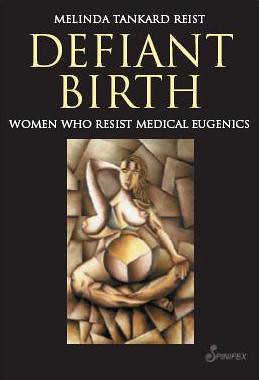
defiantbirthDefiant Birth: Women Who Resist Medical Eugenics, by Melinda Tankard Reist, is a book about women. It is a book about families. It is a book about resistance. It is a book about women who refuse to be told what they “should” do with their own bodies by healthcare staff, friends, and family.

It is a book of stories, of women’s voices.

All of the women in the book have chosen to continue pregnancies against medical advice. The medical advice is based on something about the pregnancy falling outside of the very narrow “norm” – the women’s disabilities, their “elderly” ages, a diagnosis (or misdiagnosis) of a fetus labelled “defective”. There is a woman with diabetes in her forties; a woman who chose to carry to term and birth two babies with anencephaly; women with babies with trisomy 21; women living with HIV; women with incorrect prenatal diagnoses of lethal conditions; a woman with lupus and a woman with MCTD and pulmonary hypertension; a woman with Scheurmann’s disease of the spine; a woman with severe asthma; a woman with cerebral palsy; a woman and man both with dwarfism; a woman exposed to rubella during her pregnancy; a woman with thalidomide-related phocomelia; and more.

I’ll start by letting some of these women tell their own stories, as this is the significance of the book as I see it:

d. a. marullo writes:

The next day I went to see my regular doctor whom I hadn’t seen yet. He was my general practitioner and I’d known him for eighteen years. I told him the news and he tightened up his face and looked at his paperwork while speaking.

“Well, you’re going to terminate, right? I mean it would be the smart thing to do!” I was so devastated by his words I almost started crying.

“I haven’t really decided anything,” I said. […]

“Well, the numbers add up, after all – your age and all. It’s probably not going to be normal!”

Teresa Streckfuss writes:

“He came bursting into our room and listened for Benedict’s heartbeat and said, “Okay, that’s all fine,” before awkwardly leaving us again. Lucky he left. If he hadn’t I might have screamed, “THAT’S ALL FINE? THAT’S ALL FINE? GET OUT OF MY ROOM! MY BABY HAS JUST DIED! IT’S NOT ALL FINE! WHAT DO YOU MEAN, THAT’S ALL FINE?” I know what he meant. Our ‘non-viable fetus’ had died, as expected. He failed to recognise that we had just lost a person, someone we loved.

Johanne Greally writes:

On returning home I went to see my doctor. I was totally unprepared for his reaction. “There will be no problem getting you an abortion,” he said. “You meet all the requirements on both physical and mental grounds.” “But,” I stammered, “I don’t want an abortion. I want a baby.” I felt shocked, belittled, and disempowered by him.

“Your back is unable to support just you, let alone a baby. You will never be able to carry a baby. You will be in a wheelchair by the time you are seven months.” It was true that my back couldn’t support me at that time, and I had been trussed up in a corset-type back brace off and on for over a year, so that I could not move around freely even without a baby.[…] All through the pregnancy my back continued to improve. I was now able to lift and bend, even chop wood by the time I was at the seven-month mark.

Heather Arnold writes:

The added pressure of a baby pressing on my lungs would cause more problems. This doctor also reinforced that the ‘standard of care’ in my condition would be to abort the baby. I told her immediately that abortion was not an option and that I would be carrying this baby as long as I possibly could. She encouraged me to go home and talk with my husband before making the decision, although my mind was already made up.

Leisa Whitaker writes:

I remember sitting in his rooms listening as he explained that there was a 25 percent chance that our child could still inherit the dominant achondroplasia gene and the dominant pseudoachondroplasia gene- a combination that they had never seen before anywhere in the world. They had no idea of what effect this would have on the baby – whether it would die soon after birth or if it would have lasting physical problems. They had absolutely nothing to go on. Having told us this, the specialist offered us an abortion. He asked us to think about whether we wanted to bring another dwarf baby into the world.

Rosaleen Moriarty-Simmonds writes:

We learnt this one day when my mum went to pick Deborah up from school, only to find her in floods of tears. The children in her class had been asked to tell a story about someone that they admired. She talked about her elder sister, who didn’t have any arms or legs, and Deborah was told off by the teacher for having “a horrible imagination!”

Jo Litwinowicz writes:

I heard mum calling dad to the phone and she asked me to repeat what I had said so I told them that I was expecting. Their reaction devastated me. “Well Jo, that news has turned this day into a tragic day. You are an irresponsible and stupid girl.” They might as well have kicked me in the stomach; I was so upset that I slammed the phone down. If my parents’ reaction was bad, what chance did we have with complete strangers?

When I went to see my doctor at his antenatal clinic his first words were, “God, you were the last person I thought I’d see here.” “Sorry to disappoint you,” I replied. He asked how we felt about the prospect of becoming parents, and we told him that deep down we had both secretly pined for a child and it was the greatest news ever. His response was to say that throughout my pregnancy, if I ever wanted an abortion, he could arrange it. […]

The next day there was a knock at the door and this woman said she was from Family Planning and could she come in for a chat. I joked, “You’re a bit too late.” She went on, saying how hard it was going to be to raise a child in my condition. I said, ‘What condition? You don’t know me and what I’m capable of. […] She calmly went on, “You do realise that when your child can walk and talk it will come to you and say, ‘I hate you, mother, because you can’t talk properly, you dribble and you’re in a wheelchair and I want a new mother.'”

Note that the stories are much longer and fuller than the bits I have picked out, which concentrate on ableist attitudes. There are many parts focusing on the authors’ happiness also!

One of the most powerful tools in our toolkit as PWD is to read the world in ways that others do not; to take tools for one purpose, and to use them for our own; to resist the appropriation of our stories for the political purposes of others. To this end I am also making a conscious choice to not review the introduction or closing words of the book here.

There are many stories in this book, and it is a book with multiple possible readings. I have deliberately avoided reading any other reviews while writing mine. I imagine that some may choose to read it as an anti-choice screed, just as some forced-birthers choose to see posts on FWD about the effects of ableism on pro-choice discourse as “on their side”. I choose not to read it that way. Only two or three times while reading did I get an sense of the voices possibly self-identifying as politically “pro-life”, and those moments were brief. One, who used the words “I chose life”, may or may not have been playing into the political nature of the phrase; either way, she is more than entitled to use the phrase in regard to her own personal choice. The other mentions in passing that she had worked at a “crisis pregnancy centre”, gave me a bit of a chill. But these are not the majorities of the stories, nor were they the most important or prominent parts of the stories in which they appeared.

The women who speak about their religion influencing their decisions, the women who touch on much-misused catchphrases like “I chose life”; these particular sentences did not resonate with me. However, not everything in this book needs to resonate with you for the stories to have power, for the experiences to speak. It was particularly noticeable that in some cases the medical staff just assumed that the choices to continue a pregnancy must be based in obedience to external religious edicts. The stories most of the women tell are quite different; their decisions were individual and deeply nuanced, not based in unquestioning submission to some sort of “authority”. Sometimes their religious beliefs were involved, and sometimes not; in no story did I read the story-teller proclaiming that other women’s choices should be legally constrained or outlawed. They are telling their own stories. I trust readers at this blog to handle the nuance, even as I might not trust those who bring their own agendas to the work.

Another issue I have with the book is the occasional mention of the experience of parenting a child with a disability as transformative for the parent. While this is not necessarily untrue, I think it needs to be written very carefully so as not to dehumanise or objectify the child, turn the child into an “inspiration” instead of a full, rounded person. I’m not sure whether that line was quite crossed – I’d have to re-read in detail, and the book has to go back to the library today! – but it skated close here and there.

If you’re looking for a statistical representation of how often prenatal diagnosis is wrong or misrepresented or used to pressure women, this is not the book for you. This books isn’t statistics; it’s lived experience. The stories have been chosen because they represent those times that women are pushed around or lied to or subject to misdiagnoses and poor medical care. The issue in the book is not whether this is a majority or minority experience, but that it happens at all, and that it can be handled very, very badly. Given the number of readers and writers on this site who’ve been stampeded in the healthcare system, I think many of us do have a sense of what it’s like to be on the receiving end of that treatment. In these stories, the stakes are high: the result of the stampeding, unresisted, would have been, in each case, a wanted pregnancy lost.

But I am overemphasising my nitpicking and reservations, here. In short, I recommend this book highly. The stories of disabled women, in particular, I found absolutely riveting. Their stories are vivid, immediate, at times horrifying, but more often joyful. The joy can be transcendent, yet entirely ordinary: the joy of a wanted baby, the magnificence of a disobedient woman.

I would love to see a followup book, in a similar format, with a broader scope. I’d like to see a book including stories from parents in non-Western countries; from trans or nonbinary parents; from very young parents; from undocumented immigrants and refugees and Indigenous people. A book including more analysis of the intersections of class and nationality and gender and race and queerness with disability could only be stronger. Whether we’re likely to hear that book from Reist is, well, a matter for debate; but she doesn’t, nor should she, have a monopoly on this type of story. As it stands, I am left thinking that it is only the privilege that the women in this book have – mostly white, mostly relatively wealthy – that allowed them to resist as they did, to survive as they did. The stories in this book are particular types of stories, and do not represent the realities of all pregnancies labelled “abnormal” for one reason or another.

However, even in its current form, I think this book should be considered a basic primer – for healthcare professionals, for pregnant people, for anyone else interested in disability and rebellion. It is not a primer about chromosome diagrams or placental configurations or how to eat or what to expect; but a primer about lived experience. The book covers what medical textbooks and pregnancy self-help books do not: the intimate, touching stories of women who rebel against crushing ableism.

Above all, Defiant Birth, to me, is defiantly pro-choice. It’s a book about reproductive justice. This book deserves its place in the stable of pro-choice works dedicated to the equally valid and necessary choice to not have a baby.

Who Killed Civil Discourse? Evelyn Evelyn, Marginalization, and Internet Discussion

Hello. I am Annaham (yes, I have a name). I am the person who posted a critique of Evelyn Evelyn on this website, which kicked off something of an internet controversy. For those who’ve just joined us, I made a post about Amanda Palmer and Jason Webley’s side project Evelyn Evelyn, Lauredhel made another post soon after, and things got a little out-of-control, to say the least. Because my post was part of this whole storm of various substances — both gross and not — I feel some responsibility to share my reaction to what’s gone down thus far.

I’d like to take a moment to talk about some basic principles of anti-oppression activism and social justice work that intersect with the work we do here at FWD, as some very specific structural issues and contexts are absolutely relevant in this discussion. Often, marginalized people are encouraged and expected to be sensitive and accommodating to the attitudes and prejudices of the dominant culture and to those of less-marginalized (ie: more privileged) people. However, this sensitivity and accommodation usually does not run both ways. Marginalized people, if they criticize something that (for example) leaves them out or makes them feel awful, are often told that they are being overly sensitive or overemotional, that they just misunderstand intent, that they are exaggerating, or that their tone is not polite enough. They are then expected to modify their behavior — and their self-expression —  to fit with the norms and values of those who are more privileged.

What the less-privileged have to say is usually not accorded much importance, critical thought, or respect, and yet they are supposed to prioritize, be patient with, and generally assign more importance to views, values and norms that are not their own. People in marginalized communities are often expected to educate the more privileged majority. They may be expected to patiently explain basic concepts, sometimes repeatedly. And if those with more privilege decide that they do not agree (with the less-privileged group’s tone, focus, or any number of other things other than the actual argument that is being made), those with less privilege are told, with varying degrees of subtlety, to shut the fuck up.

All the while, the perspectives, attitudes, norms and values of those with more privilege are made neutral. The power dynamics are rendered invisible, because that’s just the way things are, so there’s no point in trying to change any of it. Why are you so angry?  You’re just looking for things to get mad about. You just like being offended. Why can’t you focus on other/more important things? It wasn’t meant that way. You need to hold your tongue until you’ve done x, y and z. Quit taking it personally. You’re ruining everyone’s good time. Stop trying to make everyone pay attention to your pet issue, because it doesn’t affect anyone other than you. Your demands are unreasonable. Stop complaining. Shut up.

And when things don’t go entirely smoothly (which happens often), those not in a position of privilege are often blamed for it: Well, what did you expect, using that tone? You’re the one who brought it up; you’re the one who rocked the boat.

Unfortunately, these tactics are extremely common when it comes folks’ objections against many sorts of media and pop culture critique and/or backlash against critical engagement with cultural works. In other words: These are not new patterns.

I am definitely not saying that everyone has to agree with the critiques that I and others have made regarding Evelyn Evelyn; I am not suggesting that ideological lockstep is a worthy end-goal. What I am saying is that the humanity of marginalized people — those who have traditionally been left out, and who are often on the receiving end of justifications for said exclusion(s) — is not up for debate. The humanity of the participants in this discussion — that of the creators/artists, fans, and those of us who have come forward with critiques — is similarly not up for debate. What I posted, and what I am posting here, was (and is) my take on the matter. I do not, nor do I want to, claim to speak for all PWDs, or all disabled feminists, or all fans of AfP and/or Jason Webley who are also disabled or feminists, or both. We all have our different takes on Evelyn Evelyn and how things have unfolded, and I think it is a good sign that so much discussion has come from this.

As I have stated here on FWD and elsewhere, I am a fan of AfP and have been for a number of years. Many of the people who have raised concerns about Evelyn Evelyn are fans, potential fans, or former fans (and there have been solid points raised by non-fans, too). Dreamwidth’s Anti-Oppression Linkspam community has, at present, four roundups collecting posts on the matter from around the web.  I suspect that many of us who have posted on the Evelyn Evelyn project with a critical eye are not raising these concerns simply to bug or irritate Amanda and Jason, or their fans. However, there are quite a few people who seem eager to dismiss those of us with legitimate concerns as “haters” who just don’t understand art. The hostile messages from “haters” that Amanda has received are not legitimate critiques. These are personal attacks, not arguments of substance.

I almost feel like it should go without saying that I do not support people making these attacks on Amanda, but just to make it very clear: I am very much against people using this controversy — and the complex issues raised — as a bandwagon upon which they can leap to make personal attacks and/or comments about Amanda’s personal life or who she is. Unfortunately for those of us who have been trying to bring attention to Evelyn Evelyn-related issues and seriously discuss them, the “haters” are distracting from these same issues (and are apparently effective at it). I have also heard that people are making threats of physical violence against Amanda. That is not okay. It is never, ever acceptable to make threats of violence against anyone, regardless of your disagreement. That is basic human decency. It is truly disheartening to me, and to the other FWD contributors, that some are using this very difficult situation as an excuse to make horrific threats. We fiercely condemn these attacks.

One of the comments I received was from someone who, as far as I can tell, thought that my post seemed “insincere,” with a bonus implication that I was and am making other PWDs look bad “in the eyes of the abled.” Comments of this sort are often aimed at members of marginalized groups who are expected speak for everyone in their group when confronted; it basically boils down to “You are making other [disabled people] look bad.” I have to wonder why this same thing was not said to the AfP fans who found it necessary to show up here to derail, break out tone arguments,  tell me and my fellow contributors that we are crazy and/or should shut up, and who dismissed us on Twitter as just bitching about the project. It’s interesting, and rather telling, that some fans have used these tactics against me, my fellow FWD contributors, and other people who have critiqued the project, but could not (or did not want to) step back and consider their own behavior.

We were, in various other places around the web, called “retarded,” “angry bloggers,” had the legitimacy of our contributors’ disabilities questioned, and (trigger warning) threatened with rape (link goes to a screencap of a comment left on Amanda’s blog) — among many, many other things. In the comments thread to my original post, I was told that I need to focus on more important issues, that I was blowing things out of proportion, that I was censoring people and/or trampling on their free speech rights by laying out guidelines that specifically told potential commenters  to not leave derailing comments,  and that intent should excuse offensiveness. Eventually, I lost my patience.

There were also quite a few personal-attack comments left in the moderation queue; for obvious reasons, these were not published. These attacking comments were a significant part of why I closed comments on the post, though I did not explain that in my final comment. My decision was not about “censoring” what anyone had to say, or infringing upon “free speech” rights (this is a private website — one that has contributors, commenters and readers who are not only from the U.S.), or only about the fact that I lost my patience after having explained certain concepts over and over again; I and my fellow contributors simply could not deal with the personal attacks, threats, and violent language being left in the mod queue anymore.

Here is just a sampling of some of these unpublished comments from the mod queue (possible trigger warning):

“What’s the matter with you?”

“cant handle it? then just fucking die!”

“fuck u die slow nigga!”

“ONOEZ SOMEONE WANTED TO SMACK SOMEONE SUCH VIOLENCE!!! Typical retarded comment on an idiotic, stupid, moronic, weak, and lame blog. Fucking oversensitive twits.”

I think there is something analogous here to some of the more hateful comments that Amanda received on Twitter and elsewhere, but that is a bit of a tangent.

Going through the mod queue for that post was not an experience that I would want anyone to have. I could talk about the fact that it got to the point where it exhausted me to look at the comments; about the extreme anxiety and emotional hurt I felt while reading some of the comments that attacked me as an individual and/or questioned my mental health status; about how it feels to notice that your physical pain level — already there as a result of a chronic pain condition — goes up a few notches as you read criticism(s) directed not at your argument, but at you. I have a feeling that were I to discuss this in depth, some would likely construe it as “ANGRY BLOGGER BLAMES AMANDA PALMER FANS FOR HER OWN PAIN” or accuse me of using my disability as an excuse for being “too sensitive.” I get more than enough of that outside of the blogosphere.

I need a break from having attempted to be civil and polite and explain very basic concepts to a select few people who have no interest in substantially engaging with me or with others who have raised concerns about Evelyn Evelyn.  Simply put, I need some time to recharge my politeness batteries, as well as my hope that some people — and I include many of Amanda’s fans in this category  — do want to listen, learn and discuss without derailing or attacking. I wish I could address every critique that’s come our way, but I am pretty worn out (and I suspect that many of you — disabled and not — know the feeling).

In the interest of full disclosure, I should mention that Jason and I have been communicating via e-mail — he emailed me shortly after my other post went live — and discussing many of these issues in more detail; for that, and for his willingness to engage, listen, and consider the critiques that have come up, I thank him.

I wish Amanda and Jason success with their endeavors; I do not wish to shut either of them up or, worse, endorse that Evelyn Evelyn not go forward at all. There is, as I have said, quite a bit of difference between critiquing a portion of someone’s work and wanting to shut them up or silence them; I have aimed for the former. I ask, however, that they engage critically with and take seriously the numerous points that have been brought up, both about (trigger warnings apply to the first two links) specific aspects of the project and the response to critiques so far. Taking on such huge issues will doubtlessly be a difficult and ongoing process. Of course, Amanda and Jason will probably interpret all of this in different ways. What happens next does not have to be “perfect” — nor 100% Annaham-approved (because that would be unrealistic and silly), but it would be fantastic for these two very talented musicians and performers to bridge the gaps between their good intentions and what actually shows up onstage and on the album.

What are the ultimate lessons here? What can people on all sides of this discussion take away? Right now, I don’t know, and for the moment, that is okay with me. I still believe that better things are possible. I refuse to give up that hope.

[Special thanks to meloukhia for ou’s help in putting together links and other material for this post.]

Please read and abide by our comments policy.

Pop Culture: The Good Wife & Disability

About two or three weeks ago, I finally got around to noting the existence of the show The Good Wife. And then I watched every episode I could, as quickly as I could, because wow is this show good.

It’s one part legal drama, one part family drama, and one part mysterious conspiracy theory drama. The Wikipedia summary is pretty good: “The storyline focuses on Julianna Margulies as Alicia Florrick, the wife of Peter Florrick (Chris Noth). Her husband has been jailed following a very public sex and corruption scandal. She returns to her old job as a litigator to rebuild her reputation and provide for her two children.”

Except the whole article somehow manages to skip over how feminist the show is. In the early episodes, Alicia has a male coworker who is pretty damn sexist to her, including talking down to her, ignoring what she says entirely, and acting like her being both older and a parent makes her not very smart. Later episodes have her pointing out how she keeps getting shunted aside to “hand hold” clients, which she admits is important but is curtailing her career. And these things are shown as being bad, not as being acceptable because, you know, woman.

The show is filled with interesting relationships between women as well. We’ve got Alicia’s relationship with both her investigator, Kalinda, and one of the managing partners, Diane. Both relationships are complicated by professional needs and the fact that they’re still working in a sexist office environment. Diane is involved in EMILY’s List, and there’s an implication that her “pet project” is looked down on by her male colleagues.

At home, Alicia’s mother-in-law has come in to help care for the kids while she’s working and Peter’s in jail, and their relationship is also complicated, with concerns about parenting and their different views of Peter’s prison sentence.

I just love this show. Love it.

But I’m not just talking about it here because it’s awesome. It also managed to (mostly) side-step some disability fail that I was expecting.

The rest of this is full of spoilers for Season 1, Episode 4, “Fixed”.
Continue reading Pop Culture: The Good Wife & Disability

Gender, health, and societal obligation

Kate Harding, writing at Broadsheet:

“If you ask us,” say Glamour editor Cindi Leive and Arianna Huffington, “the next feminist issue is sleep.” Personally, I never would have thought to ask those two what the next feminist issue is, but they make a pretty good case. “Americans are increasingly sleep-deprived, and the sleepiest people are, you guessed it, women. Single working women and working moms with young kids are especially drowsy: They tend to clock in an hour and a half shy of the roughly 7.5-hour minimum the human body needs to function happily and healthfully.” The negative effects of chronic sleep deprivation are well-documented, but that doesn’t inspire enough people to prioritize rest, and women often end up in a vicious cycle of sacrificing sleep in order to do extra work and make sure their domestic duties are fulfilled, causing all of the above to suffer. “Work decisions, relationship challenges, any life situation that requires you to know your own mind — they all require the judgment, problem-solving and creativity that only a rested brain is capable of and are all handled best when you bring to them the creativity and judgment that are enhanced by sleep.”

So many obligations are heaped on the shoulders of women, and it is pretty much impossible to fulfill all of them even if you completely neglect your own needs. Of course, trying to tend to your own needs means even fewer of those obligations fulfilled, and there are cries and admonishment of selfishness and failure and responsibility to others waiting for you should you assert your right to self-care, because by asserting the right to take time and energy exclusively for yourself, you are stealing time and energy that belongs to others.

Sleep is a contested act in American society (perhaps in others too, but I can only speak to the US): getting little of it becomes a point of pride; getting a lot of it is a symbol of laziness, selfishness, sloth, dirtiness, carelessness. People are expected to perform amazing tasks on as little sleep as possible, which is completely counterintuitive, because most people are going to perform worse with insufficient sleep — consider it a generalized manifestation of the supercrip phenomenon: exactly the people who are least supported/enabled to do something are the ones who are expected to do it better than normal people.

Better sleep would surely benefit many of us, but why?

According to Leive and Huffington, the main benefits realized are in service of others; the main beneficiaries are the people around you. Or, if you see the benefits, they are benefits that stem from an obligation to others, any self-benefit remaining firmly subordinate to the “greater good” of one’s family, colleagues and community members.

We should be well familiar with the concept of women as public property. Women’s bodies, women’s time, women’s possessions, women’s decisionmaking capacity, women’s self-determination — just about anything a woman possesses, though she doesn’t really possess. Rather, she is allowed use of something that is under her care but not her ownership: it belongs instead to the people around her.

Feminists are familiar with the idea that our society considers female reproductive organs to be public property. A woman’s vagina should be available for all comers (men), and simultaneously be unavailable so as not to waste its value to its eventual sole owner (a man). A woman’s uterus is to be used for the good of the human species/civilized society: the right kind of women are to reproduce as much as possible, so that their kind remain the dominant group in both pure numbers and in overall power. (On the other hand, the other kinds of women are called upon to perform the rough, menial work necessary to uphold modern society, while not polluting the human species by reproducing themselves.)

But honestly, public ownership of women extends so much further than their reproductive systems.

No woman is allowed to assume ownership of any part her physical self, her time or purpose: it is still an “indulgence” for a woman to eat anything more substantial than a leaf of lettuce, still “sinful” to enjoy less than 100 calories of overprocessed puddings and crackers. It is still somehow selfish to take a long bath or to sit and rest for an hour’s time, still slothful to refrain from moving, working, pushing, rushing every single moment of every day.

Women’s work, in general, is under-valued and un(der)paid — and it is uncompensated precisely because women’s time, their energy, their effort, do not actually belong to the women themselves, but rather to the rest of the world. It is theirs to use whenever, however, and however much they wish, and isn’t it ridiculous to suggest they should pay for the use of something that belongs to them in the first place?

This is all part and parcel of living in a patriarchy, a predictable result when society relies upon a person’s gender to determine hir position in society, the things sie will do, the roles sie will play, the direction hir life will take. But gender is not the only variant in play here. In fact, I believe that gender is actually secondary here to another factor — it is merely one avenue of manifestation for our cultural construction of health.

Surely you have heard of the theory that gender is not an inherent trait, but a performance. This theory is definitely not without flaws, but I bring it up in hopes that it provides a familiar framework for a discussion on the social construction of health.

Health, you see, is not merely an inherent trait. Health, instead, emcompasses a variety of factors, including a person’s intrinsic qualities but also the environment in which they operate and their everyday behaviors.

Health is not just what a person is. Health is also what a person does. And what drives a person to do something is not wholly internal, but rather is largely influenced by external factors.

Gender, for instance, is both an internal sense of being and something we do for other people, something we do because we want other people to think about us, react to us, in certain ways. And the things we do, and the expected reactions to them, are different depending on which culture we are operating in — dependent on where we live, on our ethnicity, on our class background, on any number of other things. What it means to wear certain types of clothing is different in different cultures. What it means to speak a certain way is different in different cultures. And so on.

This framework is — I hope — useful for understanding what health actually is.

The form “health” takes is different depending on the expectations of the culture you live in.

The ultimate importance of that so-defined “health” is different depending on the expectations of the culture you live in.

The role “health” plays in the culture, what “health” means in that culture, the way the people of that culture interact or engage with that idea of “health,” are different depending on the expectations of the culture you live in.

What you do to achieve “health” is different depending on the expectations of the culture you live in.

How your health affects your position in life, your economic opportunities, the support that is offered for you to live the kind of life you desire, are all different depending on the expectations of the culture you live in.

(And yes, all of this is just as true in a culture that makes use of the scientific method and sees itself as cool and rational. What is investigated, and how, and how the results are interpreted, and what lessons are drawn from those results, and how those lessons are applied in everyday life — all these things must grow out of the culture they happen in! )

Health, then, is not merely a personal state, but rather a cultural fulfillment. Health (of whatever kind) is expected of you, expected by the people around you. Your health is not your own, but instead belongs to your family, your community and your wider culture. You must achieve and maintain (whatever kind of) health, not because it benefits you personally, but because you will have deeply failed your fellow members of society if you don’t.

And this is what underlies the problematic aspect of Leive and Huffington’s statements. They are not suggesting that the sleep deficit for women is a problem because the woman herself feels fatigue or cognitive dysfunction. They are suggesting that the sleep deficit for women is a problem because the woman cannot fulfill the expectations of health — and the performance of duties that rely on that state of health — that society has for her. They are suggesting that the sleep deficit for women is a problem because then that woman personally fails her family, community and country.

Here, then, her lack of sleep lays bare her duty to society based on particular qualities she holds. But the disparity between her duty and her male peer’s duty would not exist if all of us did not have a duty to society to achieve and maintain a certain kind of health.

And Leive and Huffington, purporting to be advocating on women’s behalf, do nothing but reinforce the same system that screws women disproportionately when they center a woman’s obligations to the people around her over the personal experience of the woman herself.

And here, I hope, feminists will understand what disability activists mean when we talk about the supposed obligation of mentally ill people to submit to (certain kinds of) treatment for the sake of the rest of society — or what fat acceptance activists mean when we talk about the supposed obligation of all people to be as thin as possible for the sake of the rest of society — and so on.

Eating “healthy” (as determined by mainstream cultural wisdom, largely controlled by wealthy white temporarily-abled folk) is not done solely for oneself. Neither is “exercise” (of course, what counts as physical-activity-that-improves-health is controlled by the same people who control what counts as food-that-improves-health). Participation in the paid workforce is not done solely for oneself — we are, in part, fulfilling the obligation of “responsibility” (which is a component of the health performance, because when health is lacking, the ability to work declines — so work, then, is a demonstration that you are fulfilling your health obligation).

When a person neglects to fill a health-related obligation, there is someone there to remind them of the cost to the rest of society. We’ve all heard figures on the cost of obesity, the cost of heart problems, the cost of low employment rates, the cost of suboptimal nutrition, the cost of insufficient sexual education, the cost of lost sleep… wait, that sounds familiar. Anyway, the cost might be in dollar figures, might be in time lost, might be in persons participating in x activity, or might be more intangible: work decisions, relationship challenges, judgment, problem-solving, creativity… wait a second, didn’t we just hear that? Oh yeah.

And that’s what’s wrong with this angle. Ladies, you are hurting your families! You are failing your communities! You’re dragging all of society down with you! When all you have to do is get an extra hour of sleep — seriously, how selfish are you, staying up to get the dishes clean after your kids have gone to bed so that they’ll have clean bowls to eat cereal out of in the morning?

Except that the entire reason women are getting less sleep than they need is because they’re busy fulfilling their obligations to the rest of the world. The entire reason women are getting less sleep than they need is because they’re required to be well enough to handle multiple shifts, every single day, for their entire adult lives. The entire reason women are getting less sleep than they need is because they’re required to get up at stupid o’clock every morning to handle all the things they’re required to do before going to work (including the obligations to project an image of “health” — to look and smell fresh and clean, to be sufficiently hair-free, to wear attractive clothing, to possibly spend time putting on a face full of makeup and making her hair look presentable — all which are wrapped up in appearing healthy to the people around you), and when they get home from work they still have to do the laundry and make the dinner and wash the dishes and pick up the floor and wipe down the kitchen and bathroom counters and possibly wrangle kids or partners all the while —

— and then they are getting chided by self-proclaimed women’s advocates because they spend too much time doing things for other people, and not enough time doing things for oneself… for… other people…

And it’s impossible to separate the demands of womanhood from the demands of ability. It’s difficult to differentiate the hierarchy of value imposed on people of different genders from the hierarchy of value imposed on people of differing abilities.

I’m sure you get, by now, how women get completely and utterly screwed in this situation. But I invite you to imagine, then, how disabled people get completely and utterly screwed by this situation — and then I invite you to imagine how a system that did not value people differently due to their differing abilities would also remove a lot of the pressure that is currently dumped on women.

A system of equal access, opportunity, value, for people of all types of abilities, would be radically better for people currently oppressed under this gender-based system.

And when you reinforce the ability-based system of oppression, you make things worse for the women living under it.

… just sayin’.

(Cross-posted at three rivers fog.)
Do you REALLY trust women?

For the purposes of this post, I would like to remind everyone that the range of disability includes people who are mentally ill, paralyzed, Blind, Deaf, permanently injured, autistic, physically disfigured, with compromised immune systems or disordered speech or chronic pain or cognitive impairments, and many, many others. Disabilities may be fatal or not, may be degenerative or not, may be apparent or not. Being painful, fatal, stigmatized, or poorly understood does not mean that life is not worth living, and I will not tolerate any attempts to enforce a hierarchy of disability; there is no category of Especially Bad Disability that destroys any chance of worthy life.

A blue-purple sunburst in the background, white letters reading "TRUST WOMEN: Blog for Choice Day 2010"

Blog for Choice Day 2010

Have you ever participated in the stigmatizing of pregnncy, childbirth and childrearing when the parent, child, or both have, or could have or obtain, disabilities?

Have you ever participated in the cultural narratives that say:

  • Older women should not have children because their children are more likely to have a disability
  • Women with disabilities should avoid having children because their children might also have a disability, and it would be wrong, unjust and cruel to give birth to a child that is not in perfect health
  • Women with disabilities should avoid having children because only temporarily-abled women can properly parent a child, or being a mother with a disability would somehow deprive the child of necessary experiences or put a burden on the child
  • Women with disabilities should avoid having children because they are more likely to be poor and need public assistance, and their children would also be more likely to use public assistance in the future, resulting in a drain on temporarily-abled taxpayers
  • Women with disabilities would be selfish to have children, and to do so would contribute to environmental destruction, economic decline, and even degradation of the human species, and they and their children would be less valuable members of society because of their lack of perfect health
  • It would be a tragedy to have a disabled child, disabled children are less desirable than temporarily-abled children
  • Life with a disability is inherently worse than life without one; life without a disability is the baseline by which all life should be measured, so of course to have a disability would be a negative and would make a person’s life worse
  • Disabled children are a burden on their temporarily abled parents, more so than any other child would be, and this is because of the child’s disability rather than because of the lack of support and affirmation throughout all levels of society for PWD and their loved ones
  • Of course it is more desirable for a child to be perfectly healthy than to have some sort of medical imperfection, and those medical imperfections are a big stress and hassle on the temporarily abled people around the child, and there is something wrong with the child for failing to meet an impossible standard of perfection
  • Health and ability are objective concepts and our current cultural wisdom on them are completely right and the medical industry that puts them forth is infallible; our ideas about health and ability are the only right way to look at things and can be universally applied
  • To violate those cultural ideas means that you are inherently flawed
  • The answer to all of this is to go to excessive lengths to avoid ever having, or being around someone who has, health problems, up to and including letting the least healthy die off or be terminated before they can live at all

You know what? I’ll bet you’ve all done it. Even the most radical disability activist has participated in some of these cultural tropes at some point in their lives.

But I’ll bet the vast majority of people “blogging for choice” would never think of disability as related to “choice” issues, and if they did, it would be for the right of temporarily-abled higher-class white Western women to terminate a pregnancy that has a more-than-minute chance of resulting in a less-than-perfectly-healthy child.

This is why the “choice” framework fails. It fails all of us, but it particularly fails those of us who fail to meet society’s idea of the optimal person: the pale, thin, beautiful, and financially comfortable picture of perfect health. The person who never relies on others (no!), is “self-sufficient,” and isn’t likely to end up a burden on the important people.

The rest of us can “choose” to stop existing.

Do you really trust women? Or are you perfectly willing to override their choices if you feel they threaten your comfortable position in society?

And you expect me to think you’re any better for my rights and needs than pro-lifers, why?

(Cross-posted at three rivers fog.)

Edit, Saturday 1/23: I am being very strict in moderating this thread. The primary response from people who do not identify as disabled seems to be “Well, I respect your choice, even though it is clearly cruel and bad/makes me ‘uncomfortable’/is the ‘wrong’ choice.” That is exactly the opposite of what this post is saying. If that is what you got out of this post, you have a LOT of stepping back, listening, and learning left to do.

I’m not asking you to be nice enough not to forcibly prevent us from ever having children, or anyone from ever having disabled children, even as you eagerly stigmatized disabled motherhood/childhood; I am asking you to genuinely examine the deep-rooted prejudices you have been taught and challenge your thinking on childbearing/rearing and disability. I am asking you to question why you have these ideas about disability, and whether they are appropriate to hold as a person committed to social justice. Including for women.

Because, here’s a hint: a lot of us women have disabilities, and all of us were children once, and some of us will have children of our own. And we are still women. Are you really protecting women’s freedom? Or are you merely preserving the temporarily-abled supremacist structure of society, with temporarily abled women as a convenient proxy?

I ask you to consider these prompts, to attempt to truly challenge your assumptions about disability and parenthood. If you aren’t willing to do that, please don’t drop in to explain why disabled women are “Doin It Rong.” Check your privilege. Thanks.

Feminist Icons

One of the fastest ways to make women with disabilities seem pathetic and worthless is to erase or ignore their lives. Why should the Feminist movement celebrate women like Helen Keller, when everyone knows that Keller’s entire contribution was she learned how to talk – and that was entirely Anne Sullivan’s work, after all.

This is, of course, completely untrue [1. Well, not the bit about the water, but that it’s the sum total of Keller’s accomplishments], but there was a concentrated effort to ensure that Keller’s accomplishments were ignored. “Radical Marxist” isn’t as nice a story as “deaf-blind woman overcomes”.

If you learned about Helen Keller in school at all, you probably learned the same pablum-esque story I did: Keller was a horrible brat of a child who screamed and kicked and was bad. Then, Anne Sullivan, that angelic woman, came along and, through her virtuous patience, finally got Keller to learn. She stuck Keller’s hand under the well water, and spelled “water” into her hand. And suddenly, Keller learned that “water” meant this stuff pouring over her hand. And then many years later she graduated from Radcliff College, and this is why all the students in my class should try their hardest, because look at how much Helen Keller accomplished, The End. [1. I think I’ve just described the plot of The Miracle Workeranother reason why I’m irritated that the show’s being put on. Ooh, let’s perpetuate the idea that Keller’s life began and ended at that water pump!]

This idea of Keller is so pervasive that even books written about Keller in her lifetime – books that she wrote the introduction for – include the same story. To be vain and quote an essay I wrote last semester:

The only blind person who is given any voice or agency within the work [Ishbel Ross’ Journey Into Light: The Story of the Education of the Blind] is Helen Keller, who wrote the forward for the book, and is presented as “[rising] above her triple handicap to become one of the best-known characters in the modern world.” … [D]espite dedicating a whole chapter to Keller, Ross makes no mention of Keller’s politics or activism, instead describing Keller’s grace, “agelessness”, and book collection.

No mention of her membership in the Wobblies [1. Industrial Workers of the World. They’re still around.]. I guess that didn’t fit the narrative.

I learned about Helen Keller’s actual life story by reading the book Lies my Teacher Told Me. [1. Loewen, James W. Lies my Teacher Told Me: Everything your American History Textbook Got Wrong, New York: Touchstone, 1995.] It’s a book that’s a bit hard for me to evaluate properly because I went to school in Canada and it’s focused on American education and teaching. The section Keller appears in (cleverly titled “handicapped by history”) talks about hero-building and erasing things that add complications in our respected leaders. About Keller, Loewen writes:

Keller’s commitment to socialism stemmed from her experience as a disabled person and from her sympathy for others with handicaps. She began by working to simplify the alphabet for the blind, but soon came to realize that to deal solely with blindness was to treat symptom, not cause. Through research she learned that blindness was not distributed randomly throughout the population but was concentrated in the lower class. Men who were poor might be blinded in industrial accidents or by inadequate medical care; poor women who became prostitutes faced the additional danger of syphilitic blindness. Thus Keller learned how the social class system controls people’s opportunities in life, sometimes determining even whether they can see. Keller’s research was not just book-learning: “I have visited sweatshops, factories, crowded slums. If I could not see it, I could smell it.”

At the time Keller became a socialist, she was one of the most famous women on the planet. She soon became the most notorious. Her conversion to socialism caused a new storm of publicity – this time outraged. Newspapers that had extolled her courage and intelligence now emphasized her handicap. Columnists charged that she had no independent sensory input, and was in thrall to those who fed her information. Typical was the editor of the Brooklyn Eagle, who wrote that Keller’s “mistakes spring out of the manifest limitation of her development.”

Keller recalled having met the editor: “At that time the compliments he paid me were so generous that I blush to remember them. But now that I Have come out for socialism he reminds me and the public that I am blind and deaf and especially liable to error. I must have shrunk in intelligence during the years since I met him” She went on: “On, ridiculous Brooklyn Eagle! Socially blind and deaf, it defends an intolerable system, a system that is the cause of much of the physical blindness and deafness which we are trying to prevent.” [1. LMTTM, 22-23]

Among other things, Keller helped found the American Civil Liberties Union, donated money to the NAACP, supported birth control, was part of the women’s suffrage movement, and spent time in Halifax. [1. What? I like my city! She spoke at the closing ceremonies of the Nova Scotia School of the Deaf and Dumb. I’ve read her letters to the principal. I get kinda wibbly. Helen Keller was here!]

When we talk about Women’s History – and I understand Women’s History month is in March in the US[1. It’s October in Canada.], so that’s not too long from now – we are doing something wrong if we do not include the lives of women with disabilities. Helen Keller isn’t the only woman with disabilities who has been ignored, erased, or sanitized for public consumption – it happens over and over, to queer women, to women of colour, to women who are ‘marked’ as ‘not-mainstream’.

I think we can do better than this. I think we’re brave enough to not only confront that important women of our past participated in and encouraged others to participate in abuse, neglect, genocide of certain groups of women, but also brave enough to celebrate histories outside the mainstream.

The Space Between…

Jennifer Hawkins, a white woman, poses nude with her arms purposefully placed, on the cover of Marie Claire magazine.This post originally posted at random babble… on 06 January 2010

The policing of other women’s bodies is never OK from a feminist standpoint. I can’t stress that point enough. It doesn’t serve any productive purpose in feminist discourse.

It is mostly an understood concept among people outside of the mainstream of feminism. Those who are able to work their theory around the concepts of white, straight, cis, upper-middle class, educated, able-bodied privilege.

Yet, a concept that still slips into the space between understanding is the difference between criticizing someone who comes from a place of thin privilege and tearing someone down for a body that is not like your own.

This article at Bitch, to me, was the latter.

It doesn’t seem like so long ago that I was a size 0. And yet, looking at myself now it feels so far away. That is something I am coming to grips with even today. But my mind remembers it all so well. How can nothing be something? And even at nothing I felt all my flaws. I covered in my towel so I didn’t have to glimpse myself in the mirror and be disgusted by what I saw. I still do that now! I refused to own a scale, afraid of what I would see (I still do that now!)…because it would send me into fits of fear and rage and crying…because no matter how much I threw up and refused to eat I could not weigh what all the charts said someone of my height and weight should…and my thighs jiggled and my belly bulged and my arms — while muscular from kitchen work — wiggled. Even though I was actually nothing. My clothing size was nothing.[1. Why are women’s sizes arbitrary numbers? Why can’t they be waist measurements? That would be more consistent?]

Jennifer Hawkins has thin privilege. Yes. She most certainly does. But when I was struggling I had two kinds of people to look at in magazines and on television: overly photoshopped women who were too perfect, and purposefully imperfect women meant to make me hate myself so that I would work to not be like them. There was no campaign of women of any size coming out to say “we are imperfect, but here we are“.

I will grant this: The Bitch piece does criticize the way that Jennifer Hawkins’ flaws have been the main focus of her nude cover. That is not the conversation that this cover should be invoking in feminist circles. But if she is talking about how hard this was for her, that is not something we should be criticizing. Dismissing her hesitancy, her own insecurities just because she is thin and has a different body type than someone else… that is not feminist either. When has it ever been OK for us to dismiss another woman’s experiences?

Why can’t we, as feminists, understand that?

She no longer has the protection of her Photoshop Deflector Shields, so she is in a vulnerable place, but her thin privilege doesn’t put her in the same place as all the fatties of the world who are crying in clothing stores because shirts are not made for their bodies. I get that. I think Kelsey Wallace at Bitch, for whom I just did a mostly lovely guest blogging stint w/ some of the FWD/Forward team, even gets that despite what I am garnering from her post.

Jennifer Hawkins is not the same as me. She does not know what it is like to walk into a doctor’s office and have hir assume that the pain or illness is caused by my weight before they know anything about me. She does not know the pain of the stares when I have trouble walking somewhere, as if it is definitely because I am a fattie. Or how clothes are made for people like her and not for me…or how society is made to make me feel like I am a big worthless pile of shit whose only chance at redemption is to adopt a “Lifestyle Change” for just sixty bucks a month or whatever.

But while we are throwing stones at Hawkins and scolding her for making us all feel like crap, let’s remember that she is entitled to feel like crap too. And other women who look like her, who aren’t models, who might feel like crap about themselves, they are allowed to feel that way too if they want too. Because some of them might be trying to recover or hold on or what the fuck ever. Maybe they are healthy, and have been told to Eat a Sandwich[2. Yes. I linked to them. I want people to see how awful that thread is, and how flippantly and dismissively that is defended, even when it is pointed out to the mod to be harmful. As in, she doesn’t care that some people find it harmful.], as if it funny or hip, but they can’t gain weight or can’t eat that much for whatever reason.

Or, maybe we, women of any size, are allowed to love our bodies and just be fucking happy, no matter what, and these women on these covers should show us that at any size we can all be beautiful (and maybe we will see more variance soon…but I am a silly, idealistic girl[3. I can’t back this up. I am not.]).

We can criticize thin privilege without policing other women’s bodies.

Just sayin’…

Lines in the Sand: Daly, Showalter and Tactics of Exclusion

The second-wave radical feminist theologian and professor Mary Daly died earlier this month, and there has been a veritable outpouring of eulogies from various feminist blogs.

Few of these eulogies have acknowledged Daly’s transphobia and racism.

I do not deny that Daly was an important figure in second-wave feminism, but to mourn her passing without a nod to her work’s more problematic aspects, or explorations of these aspects, are, to put it mildly, not good. In particular, the intense, hateful transphobia found in some of her writing, and her issues with unexamined white privilege and racism — which both QueenEmily at Questioning Transphobia and Sungold at Kittywampus cover very well in recent posts — strikes many as both deeply disturbing and an old pattern that has, and continues to, rear its grotesque head in certain segments of contemporary feminism. I include myself among those who are deeply troubled by Daly’s transphobic sentiments and her questionable record when it came to examining the entrenched racism and issues surrounding white privilege in the second-wave feminist movement.

I should probably mention at this point that I do not mean to appropriate or co-opt the struggles of trans* folks in any way, although my cis privilege will most likely be unintentionally reflected at points in this piece. Though the struggles of trans* people, trans feminists and PWDs and disabled feminists are not the exact same, some exclusionary tactics of certain cisgendered feminists and those of abled feminists sometimes take similar forms, especially within the mainstream feminist movement. The oppression of trans* folks and PWDs in cis, abled culture intersect in a number of ways; this post, however, barely scratches that surface. I believe that the many issues present in Daly’s work–as well as the reaction to her death around the blogosphere–can serve as just one entry point to discussions of the similarities in oppression(s) that trans* people and PWDs face. There are also clear differences, among them the fact Daly used language that can only be called genocidal, while many other feminists of her generation did not advocate such an extreme path when it came to keeping certain individuals out of feminism. I will be focusing on feminism’s exclusion of trans* and PWDs as reflected in the work of two very influential second-wave feminists here, but there is, of course, much more to these stories.

Daly’s penchant for exclusion and outright hatred (particularly of trans* individuals) couched in oddly phrased academic rhetoric unfortunately brings to mind another famous second-waver’s similar issues with people (particularly women) with disabilities. Princeton scholar Elaine Showalter — best known for bringing feminist literary theory to the fore in the academy at a time when such a discipline was, for the most part, inconceivable — dismissed disabling conditions like Chronic Fatigue Syndrome, Gulf War Syndrome and mental health issues such as Dissociative Identity Disorder (referred to in the text as Multiple Personality Disorder) in her 1997 book Hystories.

In Hystories, Showalter attempted to debunk “modern media epidemics” such as the aforementioned disabilities as well as more traditionally disproven phenomena such as alien abduction and satanic ritual abuse. In the book’s chapter on Chronic Fatigue, Showalter rather disingenuously declared that she did not want to “disparage the suffering” of people with such conditions only a few pages before she called CFS an extension of Western “fin de siecle [end of the century] anxiety.” She followed this stunning assertion with the claim that the Western news media was primarily responsible for making CFS into an escalating “psychogenic epidemic” (117, 131).

Like Daly’s severe opinion of trans* people as dupes of the medical industry (which Kittywampus cites in her post), Showalter also seemed to be taken with the idea that people with CFS are somehow being duped into thinking that they are ill because of the media focus on their condition. She wrote that many CFS patients and their defenders are “hostile to psychiatric or social explanations” of the condition, and that many of them react in a way that is not friendly to the labeling of CFS as “psychiatric” (128). However, the reactions of these same patients make sense if considered from a non-abled perspective. Showalter also seemed completely mystified by these “hostile” reactions. If CFS is just a manifestation of “fin seicle anxiety,” as she contended (adding that “emotions have tremendous power over the body”) she seemed to push the conclusion — without any scientific or medical proof — that many people with CFS have somehow been brainwashed into believing they have it; thus, the media-driven “hysterical epidemic” has worked.

Nowhere are feminists with Chronic Fatigue Syndrome or related conditions consulted; the not-so-feminist implication here is that feminists with Chronic Fatigue Syndrome either do not exist or are just victims of a “hysterical” media-led epidemic and therefore cannot be “real” feminists. This is similar to how trans* feminists were erased, excluded and castigated by Daly as somehow not “real” women or feminists, and as benefiting from patriarchy in a way that “real” women and feminists could not. To put it crudely: This is exclusionary bullcrap, and it does not do trans* people, people with disabilities, feminists who fit either (or both) of these categories, or the feminist movement as a whole any favors whatsoever.

Exclusion is not radical. It has never been radical. It is, in fact, extraordinarily status-quo. No one should be able to arbitrarily pick and choose who “belongs” in the feminist movement and who does not, especially if those who are being excluded because of their gender identity, sexual identity or disability actively identify as feminist. Feminism should be for a wide variety of people; exclusion, however, is something that is not — and has never been — very  feminist.

Author’s note: I will be moderating this thread with an iron fist; please have the courtesy to not try to tell me how Daly really was an ally to trans* folks, or how Showalter didn’t mean what she said about CFS *that* way, or that either author’s influence on the feminist movement somehow excuses their hatred and bigotry. Thank you.

[Cross-posted to Ham.Blog]
