Tag Archives: ableism

Recommended Reading for July 6, 2010

jadelennox (DW): How to fight ableism: some easy steps

So I thought it might be valuable to gather together some ways in which able-bodied people can do something about ableism in the world. Then, next time a person is feeling frustrated about ableism, and is thinking about doing some signal boosting of, say, some crappy thing the writers did on the latest episode of Glee, maybe that individual would have the option of committing to spending the same amount of time doing some more concrete fighting of ableism. Not that I’m critiquing the kind of signal boosting that a lot of us do on the blogosphere! But I’m assuming some people would find utility in hearing about other things they could do that might be useful.

Venus Speaks: Between the Lines

Today I realized something: How my disabilities shape the words I do, and more often don’t, say.

For instance: Whenever anyone uses the word “crippled”, I spot it from a mile away. Context doesn’t matter – it could be in anything – a novel, a newspaper article, a headline. “Recession cripples the American economy”, or “The onslaught cripples the meager defenses” or simply “crippling blow”.

Lauren McGuire at Sociological Images: On Disability and the Public Service Announcement [accessibility warning: embedded content lacks transcripts]

Disability-related PSAs cover a wide range of topics, but generally there are three main categories that the message falls into: how people with disabilities are viewed/treated by society, their value in the job market and society, and what their lives are like. Although these are pretty straightforward messages, there is a great deal of variety in the ways in which these basic messages are presented.

Michael Le at Racialicious: An Open Letter to Racebending.com Detractors

It’s easy to draw comparisons between the Airbender casting and an English actor playing an Irish one, or a Spanish actor playing an Italian actor. But it’s not really the same, and the reason is that Hollywood and media don’t consider whether an actor is Irish or Spanish or English. They think of that actor as “white.” The same is not true of actors who are Asian or Latino, who have to fight over the few roles specifically written for those ethnicities. And a lot of times, even when a role is steeped in Asian culture, even when a role is based on real-life individuals of Asian descent, those roles still go to white actors.

Garland Grey at Tiger Beatdown: CRAWLING OUT OF BED: Internalized Ableism and Privilege

In the two years since I have learned things about my own body. I have learned that once my knees start wobbling, GAME OVER. There is no powering through. There is no mystical internal light of determination that I can draw on – if I keep going my body will fail me. This has been a humiliating lesson to learn. But I can still walk. I can still exercise within limits and these limits expand the more I push them. I have also learned how much privilege I carry. I don’t have chronic insomnia like other members of my family. I’ve never lost a job because of being hospitalized, like my friends with Fibromyalgia. If I’m spending time with someone, and I don’t want to have to go into the whole story I can take an anti-inflammatory and ignore the pain, or blame it on fatigue.

Damn Y’all White Wolf

My [biggest] fandom is White Wolf’s Exalted. I’ve complained about it before and I’ll complain about it again.

I build characters because it’s fun and I often spend a lot of time working at it trying to make a person rather than a collection of attributes. Right now I’m working on a character who I actually have an expectation of playing and as ever I’m borrowing much from my life and some from various other places. This person is a rabbit (specifically this rabbit) shapeshifter with a very big hammer. Ou has told me ou doesn’t speak and I try to listen to my characters when they tell me things.

Also disabled folk can damn well be heroes. They don’t have to ‘overcome’ their conditions neither. I will try to not fuck this up too badly. Transient dysphasia and aphasia are conditions I have personal experience with but not full-time.

Thing is: Because I’m making a new character I’m taking an enormous hit on experience and power — the character I’ve been playing has more than twice as many experience points as the GM is giving me for my rabbit person. Ouch. (But I’m getting to tell a new story.) So I may do something I’m not entirely comfortable with: Use the Flaw system built into the game.

See, you can get points to buy Cool Shit by taking Flaws. Some of them are okay, like being wanted by authorities or being widely known as a demon or whatever. Some of them are more problematic, like missing body parts, mental illnesses, communication and sensory impairments.

Here’s the one for not speaking:

Mute
Cost: 1 pt. or 4 pts.
Your character is unable to speak normally. For one bonus point, the character is simply unable to speak above a whisper, while complete dumbness[1. Hi there, dumb means does not speak! I have not missed you.] grants four bonus points. A character with the one-point version automatically fails all Performance or Presence checks that require public speaking but faces no penalty on social attacks as long as his target can hear him, which requires the target’s player to succeed on a (Perception + Awareness) roll at difficulty 2.

A character with the four-point version of the Flaw automatically fails all Performance or Presence checks based on verbal communication and suffers a -5 penalty on all social attack rolls made for her unless the attack expressly has no verbal component. While there is no universal sign language in the Age of Sorrows, the character and her allies can communicate through an informal sign language if each of them commits one Linguistics slot to it.

Just kind of as an aside they tell us there are no widely-known gestural or tactile languages. None. There aren’t regional languages even. Anyone wanting to use one has to make up their own and teach it to whomever they want to communicate with. Deaf people wanting to build a community are going to have a tricky time of it in canon Exalted.

Sometimes I hate my game. I could use those four bonus points but that’s some horrible shit. But not using this mechanic isn’t going to make it disappear from the game either (there’s another player whose character made use of it — as a hot blind assassin chick). The casual disablism is not exactly unusual for gaming (and this isn’t even the worst example of disablism ((or casual bigotry)) I could pull from Exalted) where currently non-disabled developers assume a currently non-disabled audience and write accordingly. Because heroes are CND or super-crip amirite?

So yeah. I’ll probably do it. I’ll just feel icky about it. :(

Cross-posted: Aperiodically Legible.

Recommended Reading for June 15, 2010

dhobikikutti (DW): This is also needed: A Space In Which To Be Angry

And what I have realised is that there is a sixth component to [personal profile] zvi‘s rules, and that is that complaining about and calling out what you do not like does help, slowly, painfully, get rid of it.

Every time I see friends who make locked posts about fic that Others them, that writes appropriatively and ignorantly and dismissively and condescendingly and fetishistically about their identities, I think — there needs to be a space where this can be said.

damned_colonial (DW): Hurt/comfort and the real world [warning: derailing in comments]

Writing a short ficlet in which someone who has been abused/injured/disabled/etc is “comforted” and feels better seldom bears much relation to the reality of abuse/injury/disability/etc. Which, OK, we write a lot of unrealistic things. The problem with this one is that the idea of hurts being easily cured/comforted is one that also exists in the real world and harms real people. Almost anyone with a real-world, serious “hurt” has had people dismiss and belittle their experience on the assumption that they “should be over it by now” or that “if you just did X” the problem would go away. People are often treated badly or denied care on these grounds.

Pauline W. Chen, M.D. (New York Times): Why Patients Aren’t Getting the Shingles Vaccine

“Shingles vaccination has become a disparity issue,” Dr. Hurley added. “It’s great that this vaccine was developed and could potentially prevent a very severe disease. But we have to have a reimbursement process that coincides with these interventions. Just making these vaccines doesn’t mean that they will have a public health impact.”

Trine Tsouderos (Chicago Tribune/L.A. Times): The push and pull over a chronic fatigue syndrome study

Nine months later, the joyous mood has soured. Five research teams trying to confirm the finding have reported in journals or at conferences that they could not find the retrovirus, known as XMRV, in patients diagnosed with chronic fatigue syndrome, casting grave doubts on the connection.

Kjerstin Johnson at Bitch Magazine’s Sm{art} blog: Riva Lehrer’s body of art

To Lehrer, who has spina bifida, “Disability and art are natural partners. In order to have a good life with a disability, you have to learn to re-invent your world almost hour by hour. You discover ways to re-imagine everything, and how not to take the average answers to everyday questions…”

I Bet It’s Exactly Like That!

[Trigger Warning for descriptions of violent thoughts of self harm]

Oh, by now, faithful readers, you know where we are about to go. We are about to go on a little journey into my mind, the scary place that it is, where I open the floor to discussion about the ways that, once again! Stars and Stripes has managed to get so much so wrong. Because tonight, gentle readers, as I clutch the place that might be close to where my duodendum is and sip my Korean Red Ginsing tea, which the lady at the market told me might help my indigestion, I am reminded once again that I am my mental health are nothing but a metaphor to be co-opted at someone’s convenience!

Let me give you a little background here, because the only online version I can scrape up is this e-version of the print edition, and while WAVE found no accessibility issues with it, I am not going to guarantee that it will be accessible to everyone or accommodating of everyone’s needs. It is, however, a way around their habit of not putting all of their content in their online version (and also allows deployed troops to access the daily paper as well). The front page has the story’s picture, of a white male soldier in Army Green uniform: a light green collared shirt, black tie, green jacket with various awards and pins, a black belt, a black beret, holding a rifle with a bayonet affixed to it. The text on the photo says “Model soldiers [break] Every detail counts when you’re trying to join the storied Old Guard”. The actual article starts on page 4 if you are so inclined to read.

The Old Guard is a ceremonial guard that headquartered out of Fort Meyer, VA, and performs most of its duties in Arlington National Cemetary, similar to the Navy’s Ceremonial Guard, in that they perform many military funerals daily with the cleanest of precision. Their military bearing is expected to be above and beyond that of any other in their branch of service. Their uniforms are expected to be ridiculously perfect, with exquisite attention to the finest aspects of the details, not missing a single loose thread or even a speck of lint. A scuff on your shoe could set you back a week in training. They stand grueling hours at “attention” (The Navy’s Ceremonial Guard does this while holding the business end of the rifle and keeping the butt parallel to the ground for hours, I do not know about the Army’s Old Guard. Full disclosure: I once and briefly dated a guy from the Ceremonial Guard). Everything you know about military bearing is wrong when you arrive for duty, and it is re-taught to “look better”, including the way you turn, march, stand, dress, and press your uniforms (you are even issued special dress white uniforms that are made to withstand the repeated ironing in the Navy Ceremonial Guard).

Do you see what I did there?

I was able to give you some brief background on the very strict regulations of the Old Guard and the Ceremonial Guard without using ableist language. I didn’t once have to compare soldiers or sailors who are required to iron their uniforms exactly right, or who are trained to notice when their medals are one sixteenth of an inch off from the proper dress line to someone who actually obsesses over things like drinking bleach or shoving cork screws in her eyes. Or what it would feel like to jump from a fifth floor balcony.

Because these, my gentle readers, are actual obsessions. They actually intrude on your thoughts and disturb your life, and are really very upsetting, I can assure you. They make you do things, like pull out your hair, burn yourself with a curling iron, wash your hands again and again, and pick at the little imperfections on your skin. Yes sometimes you even iron your uniform again and again and again because you just can’t get it right and double creases are the End of The Universe as We Know It, but it might be because you are certain that if you stop then you are going to iron your hand, not because your Leading Petty Officer is going to chew you out (or your whole division, I mean, does the article expect me to believe that the entire Old Guard has Obsessive Compulsive Disorder? Because that is not on the application!) but maybe because you recently thought that you might do something very harmful to someone you loved if you stopped holding that iron very tightly. Even if your LPO has put the fear of Cthulhu in you.

Being part of an elite military unit who is honored to be charged with memorializing the fallen and handing flags to their loved ones* or escorting the President or guarding the Tomb of the Unknown Soldier is a pretty powerful thing, I am sure. The end result of the intense training, of the weeks and weeks of repeated inspections and physical demands, might very well leave some people with OC tendencies or maybe even OCD outright I suppose — I am not a doctor I don’t know and I don’t pretend to know every experience — but it isn’t the same as living with a condition that sometimes (OK, often) inhibits your day to day ability to live, interact, and (here’s the important one) do your job because you are busy carrying out compulsions to get the damned obsessions out of your head.

Yeah, getting worked up over a uniform inspection? I bet it’s exactly like that!

Only, I’ve been there and done that and bought the cheap t-shirt (hell, I’ve been the OC girl who has had to prepare for uniform inspections!).

It isn’t anything like that at all.

*I want to also point out that the article, for those of you who aren’t able/don’t want to read it via the e-reader the requirements for Old Guard: Must be 5’10 or taller, must have combat experience, blah blabbitty blah. Nothing like another exclusionary Old Boys Club for the military, so they can sit around and pat each other on the backs about how Awesome! they all are. I might note, out of some Branch Pride that the Navy Ceremonial Guard frequently wins the Joint Service competitions and they have *gasp* women in their guard.

Oh, and those people receiving flags? Always widows. Always. Way to erase anyone else who might be a surviving loved one of a fallen troop, there S&S, Army, and anyone else involve. UGH!

Kids these days! The “Generation Y” panic, privilege, and erasure

Recently, I read this odd article, penned by Judith Warner, in the New York Times–one in a stream of many that detail how excessively awful the current generation of young people (read: young workers) is at putting its collective nose to the grindstone, sucking it up, and generally not acting like a bunch of brats, or something.

Many of us have heard about, or come into contact with, some of these bright young things. They are heralded — or, more commonly, blasted — as naive, entitled, too optimistic, and over-confident. In many of these articles, their numerous faults are listed: They don’t know how to dress professionally! They expect to march into the workplace of their choice and immediately start making a six figure-salary! They think they are perfect! They want praise all of the time! (Does no one who writes these sorts of articles stop to consider that many human beings want praise when they complete a task to the best of their abilities?) They have tattoos, dyed hair, and iPods! EVERYBODY PANIC, because the American workplace is apparently going to be dragged down by Generation Y’s entitlement, narcissism and laziness! This narrative, however, seems to apply mostly to a very specific subset of the population (and even the picture that accompanies the NYT article reinforces this): young, able-bodied, middle to upper-middle class, college-educated white people.

This erases, or conveniently ignores, a hell of a lot of folks who are not young, abled, middle/upper-middle class, and white. It erases young workers who may not have had the “expected” educational opportunities (such as college), or who had to take more than the expected four years to finish their degree, or who did not finish school. It erases people whose parents or family members may not have been quite so “involved” in their education, or in their lives at all. Of course, it also erases young people with disabilities — both those who cannot work, and those who want to work but who may be bumping up against various narratives such as that of the “entitled” Generation Y kid. Some of us have psychological issues or disabilities that put us completely at odds with the “overly-confident” and “entitled” stereotype that apparently befits the current generation — because we cannot stop worrying despite the fact that we are supposed to be totally optimistic and confident all of the time, always thinking that the roads leading to our perfect job will be lined with rainbows, fluffy bunnies, and gold.

Some of us have physical disabilities, chronic pain, or chronic illnesses that prevent us from working 40-hour weeks (or more); asking for accommodations or disclosing our condition(s), we fear, may make us look “entitled,” or like we do not want to put in the time necessary to work our way up — even if this is not the case. The fact is that many people, and many young people, with disabilities are already at a tremendous disadvantage when it comes to the labor market and making a living. Not only are many people with disabilities, at least in the U.S., more likely to face lengthy stretches of unemployment and/or live in poverty regardless of age, but many face additional hostility, discrimination, and unreasonable demands, both in the workplace and from society at large because of their disabilities.

While I am not saying that these over-entitled Generation Y-ers don’t exist (I’ve had run-ins with quite a few of them, myself), I am struck by the fact that the narrative surrounding them is so dependent upon erasing or ignoring certain people whose bodies and experiences do not fit the “expected” attitudes about labor that have been traditionally upheld by American culture. Many of these attitudes, furthermore, rely heavily on binaries that reinforce who “counts” and who does not: You either work full-time, or you’re lazy. You’re willing to be mistreated in the workplace and do whatever it takes “for the job,” or you’re a wimp. Suck it up, or go home. If you’re not making enough money to live on or are poor, you just aren’t working hard enough. If you ask for “accommodations,” you’re asking for too much — just do your job! You have to work hard to “make it,” and if you don’t work hard enough, it’s your fault. If you don’t like your job or face daily mistreatment, you can always quit and find another one, right? But if you can’t, it’s your fault, and why did you quit that job, anyway? These attitudes surrounding work affect people with disabilities in a wide variety of age groups and generational cohorts, and this is a crucial part of why they are so important to critically question and examine.

The message for Generation Y, in general, may be “Get over yourself,” but the message for those who do not fit the characteristics of the “average” Generation Y worker is more severe — and ultimately more dire.

[Cross-posted at ham blog]

Recommended Reading for May 18, 2010

Pharaoh Katt at Something More Than Sides: I Dreamed That I Was Normal

I dreamed the world made sense,
That people never tried
To delve into my psyche and redefine my mind.

Gauntlet at Tumblr: Janet Street-Porter shares her thoughts on depression…

I think maybe what we are seeing here, is women who have a powerful voice in the media through their personal fame or newspaper column, sharing their experience in a way that will hopefully help to normalise the experience of mental health problems and help reduce stigma.

telesilla: 3W4DW — Day ???

I don’t need to explain to anyone why I’m on government assistance, because you know what? It’s none of anyone’s damn business.

Brendan Borrell (Los Angeles Times): Pro/Con: Time to reexamine bipolar diagnosis in children?

In a draft of the next edition of the Diagnostic and Statistical Manual of Mental Disorders — the American Psychiatric Association’s bible — a new label, temper dysregulation disorder with dysphoria, is proposed for these behaviors instead. Unlike bipolar disorder, the new label doesn’t specify that the disorder is a lifelong condition.

Recommended reading for May 11, 2010

sqbr at Poking at Thorns (with gloves on): Disability in Speculative Fiction: Monsters, mutants and muggles

Fiction reflects social attitudes, and the social attitudes to disabled people tend to suck. Disabled people are presented as scary, pathetic, exotic, demanding, laughable, etc. But some tropes are popular/unique to SF.

It’s not all bad: speculative fiction allows for powerful allegory, and can also make very interesting explorations/extrapolations of future attitudes/experiences of disability.

Jamer Hunt (Fast Company magazine): Our Bodies, Our Quantified Selves

The data generated by this micro-physics of the everyday has the potential to create unprecedented, massive databases available for projects from a dizzying array of fields. Imagine what researchers studying disease epidemiology might do with this information, or anthropologists exploring changing social patterns within the digital proletariat.

Courtney at From Austin to A&M: Cosplay, race, ability and gender; or, who gets to dress up as whom?

Doing cosplay as a femme!Doctor (or a black Doctor, or a visibly disabled Doctor, etc.) is part necessity (as in, I am in a lady-body, so if I want to cosplay as the Doctor, he would have to be a lady-body-Doctor, like a person in a wheelchair would have to be a wheelchair-user Doctor, or a black person would have to be a black Doctor). But it’s also a way for fans to see themselves in the Doctor, as the unquestioned protagonist of the show. Doctor Who fans can say all they like that DW is progressive enough in its way, but it’s still dated by its insistence that the main character be a white British man.

Lisa Sanders (NYT Magazine): Diagnosis — Pregnant and Pained

She didn’t have a fever, but the racking cough made her body ache all over. Her husband said it sounded as if she were coughing up a lung. Her OB said it was probably a virus. Whatever it was, it didn’t go away.

Switchin’ to Glide: “Independent Women”: Privileged Feminist Ideologies and Ableism

Independence or the pursuit thereof is a pursuit of privilege; the less that one has to depend on networks and relationships the more “successful” that person is. This is a profoundly ableist notion, in the sense that it constructs any sort of dependency as an obstacle to “success,” and because of the way our society is structured, people who are disabled are neccessarily dependent on various support systems.

BADD: A Screenshot’s Worth A Thousand Words

More for Blogging Against Disablism Day.

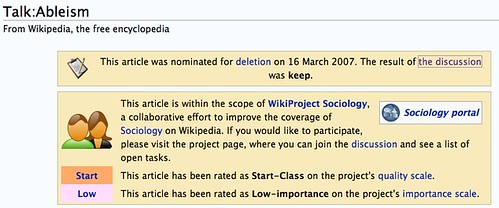
I just poked around the entry for “Ableism” on Wikipedia. On the Talk page, I found a box placing the Ableism article within WikiProject Sociology:

Screenshot: This article has been rated as Low-importance  on the project's importance scale.

“This article has been rated as Low-importance on the project’s importance scale.”

Ableism of low importance within Sociology? Erm, ooookay. Let’s have a closer look at their definition of “Low-importance”:

This article is of little importance to this project, but it covers a highly specific area of knowledge or an obscure piece of trivia.

20%, people. Disabled people form around 20% of the population in Australia and the USA (and similar numbers in similar societies). One in five. Discrimination is huge, it is institutionalised, it is very often legal. Disabled people are some of the most vulnerable, the most underemployed, the most abused, the most excluded, the most neglected, the most murdered people in our cultures.

“Low importance”? “Obscure piece of trivia”?

OK, so let’s have a look at some other big discriminations. Racism and sexism, are they categorised as obscure pieces of trivia too? (On Wikipedia, I wouldn’t be surprised…)

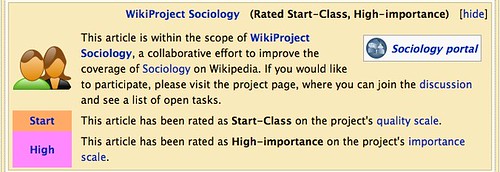
Screenshot: WikiProject Sociology (Rated Start-Class, High-importance)

Sexism is of High Importance. OK. I agree.

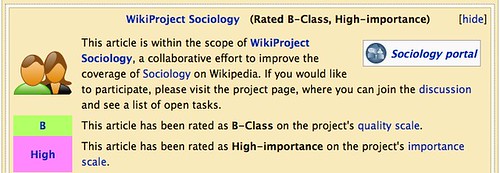
So, racism. I guess the importance of racism within sociology, according to Wikipedians, would be, oh, about similar to that of ableism?

Screenshot: WikiProject Sociology (Rated B-Class, High-importance)

OK, so racism is of High Importance also. OK. I agree with that too.

So why is Ableism of Low Importance? Why does the biggest encyclopedia on earth consider it to be of lesser importance than discrimination against other minorities? Why are sociologists learning and being taught that racism and sexism are The Discriminations, that all others are secondary or tertiary or not really worth bothering about? Why, when a person is both female and PWD, or of colour and PWD, or all three, and/or lesbian, trans, non-citizen, working class, and so on, is ableism automatically ranked as the least important discrimination they’ll encounter? Why are PWD losing this Oppression Olympics, a game we shouldn’t be playing in the first place? (“Intersectionality” hasn’t yet received a rating on the Importance scale at Wikipedia.)

Other topics considered more sociologically important than Ableism (not equal, but more), as far as Wikipedians are concerned, include:

est and The Forum in popular culture

Ralph Larkin

Wilhelm Dilthey

Vixen (comics)

Stay-at-home dad

Weddings in the United States

Truce term

Friendship Paradox

Heterophobia

Babywise

Boomerang Generation

eHarmony

Lavalife

OkCupid

Yahoo! Personals

Fritzl case

List of UFO religions

Greenbelt, Maryland

The Hapa Project

Biosocial criminology

Grand Tour

Speed dating

Blond

Schoolgirl

and Hooters.

I can’t count on anybody to understand. (Blogging Against Disablism Day 2010)

(Cross-posted at three rivers fog. See more BADD 2010 at Goldfish’s blog.)

I’m pretty open about my health issues. To be honest, I don’t know any other way to be. I know how to strategically hide my disabilities from strangers in passing interactions, but from the people with whom I interact on a daily basis? Given my appearance — tall, slim, young white girl, pretty enough, clean and conventionally dressed, perfectly middle-class — you’d think it would be easy to keep from communicating variant health, while in reality it is highly tasking. It takes energy to mask my medication-taking, body-resting, trigger-avoiding, activity-budgeting ways from the people around me, and I’m already running an energy deficit just to be around them in the first place.

So fuck it. I don’t hide it when I have to down a pill. If pain, fatigue, or cognitive issues are preventing me from doing something — a task requiring me to stand up or walk somewhere when my back pain is flaring up; speaking with anyone by telephone when my head is throbbing and my brain is not processing full sentences — I say so. I’ve stopped bothering to tuck in my TENS wires to make them completely invisible. When people ask me about the Penguins game last night, the response they hear begins with a mention of my 8:30 bedtime.

There are drawbacks to this. Sharing or not sharing information about one’s health is an extremely fraught decision; some people consider this information rude and gross (even when the actual content is totally innocuous), it can invite unwanted questions and speculation, and there are people who will use your undisguised behavior or the information you have volunteered against you in the future. It amounts to a choice between a life of concealment, which can quickly drain a person’s spirit and often aggravate their actual condition — and a life of vulnerability, never knowing what will be held against you, or by whom. Continue reading I can’t count on anybody to understand. (Blogging Against Disablism Day 2010)

Percy Jackson and the Olympians: The Lightning Thief — The Special Thing About You

Percy Jackson, a pale young man in a grey t-shirt and jacket holds a lightening bolt in his hands in a New York City Background.Every now and then a movie comes out and I get super excited about it because it sparks something form my childhood or youth that I love.

Percy Jackson and the Olympians did that. I loved Greek mythology in High School (even if I went a little cross-eyed reading The Odyssey and The Illiad). Hollywood is trying to make mythology cool again, and I was stoked about that.

I so wanted to see this movie…and because I think I live under a rock sometimes, I hadn’t heard it was a book series *scribbles a wish list*.

And then we went to the theater.

***Spoilers Ahead. Turn Back Now!***

Last Chance to Avoid Spoilers! Continue reading Percy Jackson and the Olympians: The Lightning Thief — The Special Thing About You