Tag Archives: intersectionality

Who Killed Civil Discourse? Evelyn Evelyn, Marginalization, and Internet Discussion

Hello. I am Annaham (yes, I have a name). I am the person who posted a critique of Evelyn Evelyn on this website, which kicked off something of an internet controversy. For those who’ve just joined us, I made a post about Amanda Palmer and Jason Webley’s side project Evelyn Evelyn, Lauredhel made another post soon after, and things got a little out-of-control, to say the least. Because my post was part of this whole storm of various substances — both gross and not — I feel some responsibility to share my reaction to what’s gone down thus far.

I’d like to take a moment to talk about some basic principles of anti-oppression activism and social justice work that intersect with the work we do here at FWD, as some very specific structural issues and contexts are absolutely relevant in this discussion. Often, marginalized people are encouraged and expected to be sensitive and accommodating to the attitudes and prejudices of the dominant culture and to those of less-marginalized (ie: more privileged) people. However, this sensitivity and accommodation usually does not run both ways. Marginalized people, if they criticize something that (for example) leaves them out or makes them feel awful, are often told that they are being overly sensitive or overemotional, that they just misunderstand intent, that they are exaggerating, or that their tone is not polite enough. They are then expected to modify their behavior — and their self-expression —  to fit with the norms and values of those who are more privileged.

What the less-privileged have to say is usually not accorded much importance, critical thought, or respect, and yet they are supposed to prioritize, be patient with, and generally assign more importance to views, values and norms that are not their own. People in marginalized communities are often expected to educate the more privileged majority. They may be expected to patiently explain basic concepts, sometimes repeatedly. And if those with more privilege decide that they do not agree (with the less-privileged group’s tone, focus, or any number of other things other than the actual argument that is being made), those with less privilege are told, with varying degrees of subtlety, to shut the fuck up.

All the while, the perspectives, attitudes, norms and values of those with more privilege are made neutral. The power dynamics are rendered invisible, because that’s just the way things are, so there’s no point in trying to change any of it. Why are you so angry?  You’re just looking for things to get mad about. You just like being offended. Why can’t you focus on other/more important things? It wasn’t meant that way. You need to hold your tongue until you’ve done x, y and z. Quit taking it personally. You’re ruining everyone’s good time. Stop trying to make everyone pay attention to your pet issue, because it doesn’t affect anyone other than you. Your demands are unreasonable. Stop complaining. Shut up.

And when things don’t go entirely smoothly (which happens often), those not in a position of privilege are often blamed for it: Well, what did you expect, using that tone? You’re the one who brought it up; you’re the one who rocked the boat.

Unfortunately, these tactics are extremely common when it comes folks’ objections against many sorts of media and pop culture critique and/or backlash against critical engagement with cultural works. In other words: These are not new patterns.

I am definitely not saying that everyone has to agree with the critiques that I and others have made regarding Evelyn Evelyn; I am not suggesting that ideological lockstep is a worthy end-goal. What I am saying is that the humanity of marginalized people — those who have traditionally been left out, and who are often on the receiving end of justifications for said exclusion(s) — is not up for debate. The humanity of the participants in this discussion — that of the creators/artists, fans, and those of us who have come forward with critiques — is similarly not up for debate. What I posted, and what I am posting here, was (and is) my take on the matter. I do not, nor do I want to, claim to speak for all PWDs, or all disabled feminists, or all fans of AfP and/or Jason Webley who are also disabled or feminists, or both. We all have our different takes on Evelyn Evelyn and how things have unfolded, and I think it is a good sign that so much discussion has come from this.

As I have stated here on FWD and elsewhere, I am a fan of AfP and have been for a number of years. Many of the people who have raised concerns about Evelyn Evelyn are fans, potential fans, or former fans (and there have been solid points raised by non-fans, too). Dreamwidth’s Anti-Oppression Linkspam community has, at present, four roundups collecting posts on the matter from around the web.  I suspect that many of us who have posted on the Evelyn Evelyn project with a critical eye are not raising these concerns simply to bug or irritate Amanda and Jason, or their fans. However, there are quite a few people who seem eager to dismiss those of us with legitimate concerns as “haters” who just don’t understand art. The hostile messages from “haters” that Amanda has received are not legitimate critiques. These are personal attacks, not arguments of substance.

I almost feel like it should go without saying that I do not support people making these attacks on Amanda, but just to make it very clear: I am very much against people using this controversy — and the complex issues raised — as a bandwagon upon which they can leap to make personal attacks and/or comments about Amanda’s personal life or who she is. Unfortunately for those of us who have been trying to bring attention to Evelyn Evelyn-related issues and seriously discuss them, the “haters” are distracting from these same issues (and are apparently effective at it). I have also heard that people are making threats of physical violence against Amanda. That is not okay. It is never, ever acceptable to make threats of violence against anyone, regardless of your disagreement. That is basic human decency. It is truly disheartening to me, and to the other FWD contributors, that some are using this very difficult situation as an excuse to make horrific threats. We fiercely condemn these attacks.

One of the comments I received was from someone who, as far as I can tell, thought that my post seemed “insincere,” with a bonus implication that I was and am making other PWDs look bad “in the eyes of the abled.” Comments of this sort are often aimed at members of marginalized groups who are expected speak for everyone in their group when confronted; it basically boils down to “You are making other [disabled people] look bad.” I have to wonder why this same thing was not said to the AfP fans who found it necessary to show up here to derail, break out tone arguments,  tell me and my fellow contributors that we are crazy and/or should shut up, and who dismissed us on Twitter as just bitching about the project. It’s interesting, and rather telling, that some fans have used these tactics against me, my fellow FWD contributors, and other people who have critiqued the project, but could not (or did not want to) step back and consider their own behavior.

We were, in various other places around the web, called “retarded,” “angry bloggers,” had the legitimacy of our contributors’ disabilities questioned, and (trigger warning) threatened with rape (link goes to a screencap of a comment left on Amanda’s blog) — among many, many other things. In the comments thread to my original post, I was told that I need to focus on more important issues, that I was blowing things out of proportion, that I was censoring people and/or trampling on their free speech rights by laying out guidelines that specifically told potential commenters  to not leave derailing comments,  and that intent should excuse offensiveness. Eventually, I lost my patience.

There were also quite a few personal-attack comments left in the moderation queue; for obvious reasons, these were not published. These attacking comments were a significant part of why I closed comments on the post, though I did not explain that in my final comment. My decision was not about “censoring” what anyone had to say, or infringing upon “free speech” rights (this is a private website — one that has contributors, commenters and readers who are not only from the U.S.), or only about the fact that I lost my patience after having explained certain concepts over and over again; I and my fellow contributors simply could not deal with the personal attacks, threats, and violent language being left in the mod queue anymore.

Here is just a sampling of some of these unpublished comments from the mod queue (possible trigger warning):

“What’s the matter with you?”

“cant handle it? then just fucking die!”

“fuck u die slow nigga!”

“ONOEZ SOMEONE WANTED TO SMACK SOMEONE SUCH VIOLENCE!!! Typical retarded comment on an idiotic, stupid, moronic, weak, and lame blog. Fucking oversensitive twits.”

I think there is something analogous here to some of the more hateful comments that Amanda received on Twitter and elsewhere, but that is a bit of a tangent.

Going through the mod queue for that post was not an experience that I would want anyone to have. I could talk about the fact that it got to the point where it exhausted me to look at the comments; about the extreme anxiety and emotional hurt I felt while reading some of the comments that attacked me as an individual and/or questioned my mental health status; about how it feels to notice that your physical pain level — already there as a result of a chronic pain condition — goes up a few notches as you read criticism(s) directed not at your argument, but at you. I have a feeling that were I to discuss this in depth, some would likely construe it as “ANGRY BLOGGER BLAMES AMANDA PALMER FANS FOR HER OWN PAIN” or accuse me of using my disability as an excuse for being “too sensitive.” I get more than enough of that outside of the blogosphere.

I need a break from having attempted to be civil and polite and explain very basic concepts to a select few people who have no interest in substantially engaging with me or with others who have raised concerns about Evelyn Evelyn.  Simply put, I need some time to recharge my politeness batteries, as well as my hope that some people — and I include many of Amanda’s fans in this category  — do want to listen, learn and discuss without derailing or attacking. I wish I could address every critique that’s come our way, but I am pretty worn out (and I suspect that many of you — disabled and not — know the feeling).

In the interest of full disclosure, I should mention that Jason and I have been communicating via e-mail — he emailed me shortly after my other post went live — and discussing many of these issues in more detail; for that, and for his willingness to engage, listen, and consider the critiques that have come up, I thank him.

I wish Amanda and Jason success with their endeavors; I do not wish to shut either of them up or, worse, endorse that Evelyn Evelyn not go forward at all. There is, as I have said, quite a bit of difference between critiquing a portion of someone’s work and wanting to shut them up or silence them; I have aimed for the former. I ask, however, that they engage critically with and take seriously the numerous points that have been brought up, both about (trigger warnings apply to the first two links) specific aspects of the project and the response to critiques so far. Taking on such huge issues will doubtlessly be a difficult and ongoing process. Of course, Amanda and Jason will probably interpret all of this in different ways. What happens next does not have to be “perfect” — nor 100% Annaham-approved (because that would be unrealistic and silly), but it would be fantastic for these two very talented musicians and performers to bridge the gaps between their good intentions and what actually shows up onstage and on the album.

What are the ultimate lessons here? What can people on all sides of this discussion take away? Right now, I don’t know, and for the moment, that is okay with me. I still believe that better things are possible. I refuse to give up that hope.

[Special thanks to meloukhia for ou’s help in putting together links and other material for this post.]

Please read and abide by our comments policy.

The Space Between…

Jennifer Hawkins, a white woman, poses nude with her arms purposefully placed, on the cover of Marie Claire magazine.This post originally posted at random babble… on 06 January 2010

The policing of other women’s bodies is never OK from a feminist standpoint. I can’t stress that point enough. It doesn’t serve any productive purpose in feminist discourse.

It is mostly an understood concept among people outside of the mainstream of feminism. Those who are able to work their theory around the concepts of white, straight, cis, upper-middle class, educated, able-bodied privilege.

Yet, a concept that still slips into the space between understanding is the difference between criticizing someone who comes from a place of thin privilege and tearing someone down for a body that is not like your own.

This article at Bitch, to me, was the latter.

It doesn’t seem like so long ago that I was a size 0. And yet, looking at myself now it feels so far away. That is something I am coming to grips with even today. But my mind remembers it all so well. How can nothing be something? And even at nothing I felt all my flaws. I covered in my towel so I didn’t have to glimpse myself in the mirror and be disgusted by what I saw. I still do that now! I refused to own a scale, afraid of what I would see (I still do that now!)…because it would send me into fits of fear and rage and crying…because no matter how much I threw up and refused to eat I could not weigh what all the charts said someone of my height and weight should…and my thighs jiggled and my belly bulged and my arms — while muscular from kitchen work — wiggled. Even though I was actually nothing. My clothing size was nothing.[1. Why are women’s sizes arbitrary numbers? Why can’t they be waist measurements? That would be more consistent?]

Jennifer Hawkins has thin privilege. Yes. She most certainly does. But when I was struggling I had two kinds of people to look at in magazines and on television: overly photoshopped women who were too perfect, and purposefully imperfect women meant to make me hate myself so that I would work to not be like them. There was no campaign of women of any size coming out to say “we are imperfect, but here we are“.

I will grant this: The Bitch piece does criticize the way that Jennifer Hawkins’ flaws have been the main focus of her nude cover. That is not the conversation that this cover should be invoking in feminist circles. But if she is talking about how hard this was for her, that is not something we should be criticizing. Dismissing her hesitancy, her own insecurities just because she is thin and has a different body type than someone else… that is not feminist either. When has it ever been OK for us to dismiss another woman’s experiences?

Why can’t we, as feminists, understand that?

She no longer has the protection of her Photoshop Deflector Shields, so she is in a vulnerable place, but her thin privilege doesn’t put her in the same place as all the fatties of the world who are crying in clothing stores because shirts are not made for their bodies. I get that. I think Kelsey Wallace at Bitch, for whom I just did a mostly lovely guest blogging stint w/ some of the FWD/Forward team, even gets that despite what I am garnering from her post.

Jennifer Hawkins is not the same as me. She does not know what it is like to walk into a doctor’s office and have hir assume that the pain or illness is caused by my weight before they know anything about me. She does not know the pain of the stares when I have trouble walking somewhere, as if it is definitely because I am a fattie. Or how clothes are made for people like her and not for me…or how society is made to make me feel like I am a big worthless pile of shit whose only chance at redemption is to adopt a “Lifestyle Change” for just sixty bucks a month or whatever.

But while we are throwing stones at Hawkins and scolding her for making us all feel like crap, let’s remember that she is entitled to feel like crap too. And other women who look like her, who aren’t models, who might feel like crap about themselves, they are allowed to feel that way too if they want too. Because some of them might be trying to recover or hold on or what the fuck ever. Maybe they are healthy, and have been told to Eat a Sandwich[2. Yes. I linked to them. I want people to see how awful that thread is, and how flippantly and dismissively that is defended, even when it is pointed out to the mod to be harmful. As in, she doesn’t care that some people find it harmful.], as if it funny or hip, but they can’t gain weight or can’t eat that much for whatever reason.

Or, maybe we, women of any size, are allowed to love our bodies and just be fucking happy, no matter what, and these women on these covers should show us that at any size we can all be beautiful (and maybe we will see more variance soon…but I am a silly, idealistic girl[3. I can’t back this up. I am not.]).

We can criticize thin privilege without policing other women’s bodies.

Just sayin’…

Lines in the Sand: Daly, Showalter and Tactics of Exclusion

The second-wave radical feminist theologian and professor Mary Daly died earlier this month, and there has been a veritable outpouring of eulogies from various feminist blogs.

Few of these eulogies have acknowledged Daly’s transphobia and racism.

I do not deny that Daly was an important figure in second-wave feminism, but to mourn her passing without a nod to her work’s more problematic aspects, or explorations of these aspects, are, to put it mildly, not good. In particular, the intense, hateful transphobia found in some of her writing, and her issues with unexamined white privilege and racism — which both QueenEmily at Questioning Transphobia and Sungold at Kittywampus cover very well in recent posts — strikes many as both deeply disturbing and an old pattern that has, and continues to, rear its grotesque head in certain segments of contemporary feminism. I include myself among those who are deeply troubled by Daly’s transphobic sentiments and her questionable record when it came to examining the entrenched racism and issues surrounding white privilege in the second-wave feminist movement.

I should probably mention at this point that I do not mean to appropriate or co-opt the struggles of trans* folks in any way, although my cis privilege will most likely be unintentionally reflected at points in this piece. Though the struggles of trans* people, trans feminists and PWDs and disabled feminists are not the exact same, some exclusionary tactics of certain cisgendered feminists and those of abled feminists sometimes take similar forms, especially within the mainstream feminist movement. The oppression of trans* folks and PWDs in cis, abled culture intersect in a number of ways; this post, however, barely scratches that surface. I believe that the many issues present in Daly’s work–as well as the reaction to her death around the blogosphere–can serve as just one entry point to discussions of the similarities in oppression(s) that trans* people and PWDs face. There are also clear differences, among them the fact Daly used language that can only be called genocidal, while many other feminists of her generation did not advocate such an extreme path when it came to keeping certain individuals out of feminism. I will be focusing on feminism’s exclusion of trans* and PWDs as reflected in the work of two very influential second-wave feminists here, but there is, of course, much more to these stories.

Daly’s penchant for exclusion and outright hatred (particularly of trans* individuals) couched in oddly phrased academic rhetoric unfortunately brings to mind another famous second-waver’s similar issues with people (particularly women) with disabilities. Princeton scholar Elaine Showalter — best known for bringing feminist literary theory to the fore in the academy at a time when such a discipline was, for the most part, inconceivable — dismissed disabling conditions like Chronic Fatigue Syndrome, Gulf War Syndrome and mental health issues such as Dissociative Identity Disorder (referred to in the text as Multiple Personality Disorder) in her 1997 book Hystories.

In Hystories, Showalter attempted to debunk “modern media epidemics” such as the aforementioned disabilities as well as more traditionally disproven phenomena such as alien abduction and satanic ritual abuse. In the book’s chapter on Chronic Fatigue, Showalter rather disingenuously declared that she did not want to “disparage the suffering” of people with such conditions only a few pages before she called CFS an extension of Western “fin de siecle [end of the century] anxiety.” She followed this stunning assertion with the claim that the Western news media was primarily responsible for making CFS into an escalating “psychogenic epidemic” (117, 131).

Like Daly’s severe opinion of trans* people as dupes of the medical industry (which Kittywampus cites in her post), Showalter also seemed to be taken with the idea that people with CFS are somehow being duped into thinking that they are ill because of the media focus on their condition. She wrote that many CFS patients and their defenders are “hostile to psychiatric or social explanations” of the condition, and that many of them react in a way that is not friendly to the labeling of CFS as “psychiatric” (128). However, the reactions of these same patients make sense if considered from a non-abled perspective. Showalter also seemed completely mystified by these “hostile” reactions. If CFS is just a manifestation of “fin seicle anxiety,” as she contended (adding that “emotions have tremendous power over the body”) she seemed to push the conclusion — without any scientific or medical proof — that many people with CFS have somehow been brainwashed into believing they have it; thus, the media-driven “hysterical epidemic” has worked.

Nowhere are feminists with Chronic Fatigue Syndrome or related conditions consulted; the not-so-feminist implication here is that feminists with Chronic Fatigue Syndrome either do not exist or are just victims of a “hysterical” media-led epidemic and therefore cannot be “real” feminists. This is similar to how trans* feminists were erased, excluded and castigated by Daly as somehow not “real” women or feminists, and as benefiting from patriarchy in a way that “real” women and feminists could not. To put it crudely: This is exclusionary bullcrap, and it does not do trans* people, people with disabilities, feminists who fit either (or both) of these categories, or the feminist movement as a whole any favors whatsoever.

Exclusion is not radical. It has never been radical. It is, in fact, extraordinarily status-quo. No one should be able to arbitrarily pick and choose who “belongs” in the feminist movement and who does not, especially if those who are being excluded because of their gender identity, sexual identity or disability actively identify as feminist. Feminism should be for a wide variety of people; exclusion, however, is something that is not — and has never been — very  feminist.

Author’s note: I will be moderating this thread with an iron fist; please have the courtesy to not try to tell me how Daly really was an ally to trans* folks, or how Showalter didn’t mean what she said about CFS *that* way, or that either author’s influence on the feminist movement somehow excuses their hatred and bigotry. Thank you.

[Cross-posted to Ham.Blog]

Less Than / More Than – My complicated thoughts on reproductive rights & feminist discussions

When I’m not being a student, I typically get temp jobs working in a variety of offices. Once things get settled, and folks realise I am married, they often start asking about kids. “Do you have kids? No? When are you having kids? It’s not too late, you know!”

This may seem like an opening for a post about being child-free, but it’s not.

I often put these questions off with flippancy or a shrug or just saying we’re not interested in having kids. In my experience, this will often have people leave the issue be.

Sometimes, though, people will hound and hound and hound.

“Oh, it’s different when they’re yours. But what about Don, what does he think of all of this? What about your parents? What about– what about– what about?” [1. Everything in quotation marks in this post is a paraphrase.]

Do you want to know the secret way of getting people to never again ask why you’re not having children?

At some point, drop into a conversation that your husband’s disability is genetic.

Without fail, that has stopped every single person who has asked and asked and asked about children, even when the “genetic” bomb isn’t dropped in a conversation about having children.

One of the reasons why the focus of abortion! abortion! abortion! whenever talking about reproductive rights really bothers me (and a lot of others) is because of the assumption that people like Don & I shouldn’t have children (because – oh no! – the child likely will have Marfan’s just like Don! And everyone knows people like Don are a burden on the system/have miserable lives/are never happy/can never be married/are all the same/should be stopped/are just an example for the rest of us). When people focus on reproductive rights only involving abortion, they neglect that, for people like us, the pushback is to not have children. Don’t burden the system. Think of the children – and don’t have any.

I’ve seen similar conversations play out around the feminist blogosphere. [1. I have decided not to link to specific examples, because it’s a general attitude I’m talking about here. And also, who wants to start a blog-war? Not I, said the Anna.] When older women have children, there is always a sudden upswing in “BUT THE CHILD MIGHT HAVE A DISABILITY!” (Yes, the child might. And the child might fall out of a tree and land wrong. Or the child might grow up to be the next Stephen Harper and prorogue Canadian government. WHO KNOWS!) “Think of the children!”

The same fears are reflected when discussing women with disabilities having children (with bonus “but how will she care for the child?”), or when parents forcibly sterilize their disabled daughters.

This pains me, perhaps especially as someone who doesn’t want children. It pains many other women who, for a variety of reasons, are discouraged or outright prevented from having children they want. That, in North America, these women are overwhelmingly women of colour, lower class, disabled, queer – that they’re often women who have been institutionalised in some way, be it a “medical” institution or a “criminal” one – is not a coincidence.

In my experience, marginalized voices who speak out about this disparity between on-line feminist discussions of abortion and on-line feminist discussions from a broader reproductive justice framework [1. FREE Halifax: Feminists for Reproductive Justice & Equality. We meet every other Tuesday for teach-ins & movies about Reproductive Justice. Look for us on Facebook.] are often shouted down, or ignored. We’re told our issues are “special circumstances”, or “pet projects” or “in the minority” or “don’t apply to as many people” or … Well, basically everything feminists in general are told when they talk about issues that are “special circumstances” that don’t apply to enough people (read: men) to count.

Frankly, I end up not knowing where to go from here. Do we, who are limited on spoons or forks or energy or time, keep trying to push for more mainstream feminist discussion on these issues? Do we form our own spaces, our own groups, and have our own discussions? Do we write blog posts that seem to dwindle down, rather than lead us all into the future?

I don’t know. I know and respect people who have made each of those choices, and still others that I haven’t mentioned. But I don’t know what the right one is.

Maybe they all are.

Veterans Find Self Expression and Therapy

Moderatrix’ Incredibly Verbose Note: The linked article in Stars & Stripes held a couple of problems for me. One: It gave an impression that pharmaceutical therapy is somehow not a reasonable treatment for people dealing with mental health or anxiety disorders. This should not be taken as the opinion of myself, nor any member of the FWD/Forward team. I believe that it shows how stigmatized that direction of therapy can be, and how mental health services can be socialized to make men feel “weak” for needing them. How a person chooses to treat their mental health or social anxiety disorders is between themselves and their health care provider. Comments judging this course of therapy will be deleted and the commenter possibly banned pending a review. I will not have someone coming to this board and seeing their choice of therapy, which is helping them, mocked or dismissed.

Two: The linked article says that bibliotherapy is “poetry therapy”, when nothing I have found is that specific. Anything that I have found online, as well as my background in Greek and Latin root words, says that bibliotherapy is any type of therapy using the written word as supplemental therapy. I found that statement by the S&S writer misleading. I am willing to be corrected, but I am more inclined to believe that it is a part of a broad spectrum of treatment options. I find it like saying that “pharmaceutical therapy” means keeping someone pumped full of morphine all the time (not that there is anything wrong with that if that is what you need to manage your specific needs).

Nonetheless, I found the article incredibly interesting, and am ecstatic to find that veterans are finding ways to get care in ways that make them comfortable. Enjoy.

Spc. Victoria Montenegro received an Army Commendation Medal, complete with a “V” for Valor for helping her other team mates when her vehicle exploded in Karbala, Iraq. That same accident also threw shrapnel into her forehead and right eye. It gave her a complex fracture and bone loss in her left hand.

It also left her with PTSD.

Spc. Matt Ping also came back from “The Sandbox”, his time spent in Northern Afghanistan, he found himself mixing flashback with childhood memories. For him, the thought of a pharmaceutical approach, the normal approach taken by the VA, was too unappealing.

For both of them, a different kind of therapy program has been incredibly beneficial.

The Walter Reed Medical Center in Washington, D.C. has a program, run by Roseanne Singer, that helps veterans deal with their PTSD through the written word, mostly poetry. Participants are welcome to come to an informal gathering that takes place in the lobby of the Mologne House. Participants are under no obligation to participate, they may come whenever they feel comfortable, talk as much or as little as they like, and share or not share what they have written. The program does not analyze or critique, but rather focuses on getting veterans who find it otherwise difficult to communicate their feelings to convey them through writing. Or, as Ping , also now a part of Lisa Rosenthal’s Vet Art Project in Chicago describes poetry therapy:

“Poetry helps me deal with coming back to a society that’s gone in a different direction,” Ping said. “Coming home is one of the strangest things I’ve ever encountered. The 16 months of isolation and being secluded and then coming back and trying to be the same person you were before you left. I don’t know if that’s possible.”

Ping also has a blog where he shares his poetry (I have only scanned the front page, and I make no guarantees about triggering language).

Montenegro’s poetry focuses on the pain of being a “young, short, wounded female in a world of men,”.

“A lot of times around the hospital, I’d be mistaken for somebody’s family member,” she said. “It bugged me.”

Overall, finds the self-paced program beneficial, and enjoys the control over her own healing the . There is no pressure to heal at an expected rate, no one telling her that she should be over it by now. If she doesn’t want to share something, she doesn’t have to.

You can read her poem “Perspectives” (which I thought was moving) at the S&S link, and if you have a flash player you can listen to her read it.

The more ways we find to help our returning troops the better. If they aren’t thriving in the traditional therapy programs (and I can understand why), or if they aren’t being given proper therapy in addition to their drug treatments (I can relate), then we need to find therapy programs that do help them. We owe it to them.

Jordan’s Principle

This post was originally published in July 2009 as part of International Blog Against Racism Week

One of the things that we talk about here, on occasion, is how lucky we are that Don is a white man with a disability living in Canada. Things become more complicated in my post-racial utopia of a country when someone of a different race is born with a disability.

Take, for example, the case of Jordan River Anderson, a First Nations boy from Norway House Cree Nation in Manitoba. Jordan was born with “complex health needs” (this is code for Carey Fineman Ziter Syndrome, a rare muscular disorder) and spent the first two years of his life in hospital. At that point, his doctors agreed that he could go home and live with his family, although he would need continuing care.

If Jordan hadn’t been First Nations, he would have gone home, and his care would have been paid for by the provincial government as part of his health care costs. However, as a First Nations child, the cost of Jordan’s care became an argument between the provincial and federal government. Neither wanted to pay for it, so Jordan stayed in hospital.

He died at age 5, having never been home.

First Nations advocates came together and wrote Jordan’s Principle:

Under this principle, where a jurisdictional dispute arises between two government parties (provincial/territorial or federal) or between two departments or ministries of the same government, regarding payment for services for a Status Indian child which are otherwise available to other Canadian children, the government or ministry/department of first contact must pay for the services without delay or disruption. The paying government party can then refer the matter to jurisdictional dispute mechanisms. In this way, the needs of the child get met first while still allowing for the jurisdictional dispute to be resolved.

This was adopted unanimously by the Canadian Government in December, 2007.

In principle.

Special Needs Kids May Be Forced Into Foster Care (May, 2008):

Government infighting has families in a northern Manitoba community in anguish about how to best care for their children.

The Norway House Cree Nation has told the families of children with special needs that they may be forced to give up their children because the First Nation can no longer pay for their care, and federal and provincial governments can’t agree on who should pay.

Charlene Ducharme works with the Kinosao Sipi Minisowin Agency, a social agency on the reserve, and said she has yet to see Jordan’s Principle in action. She said the children of Norway House deserve the same care that other Manitoba children get.

“Our premier said Manitoba would be the first one to implement Jordan’s Principle… we’re still waiting.”

Late in 2008, the Manitoba Government also adopted Jordan’s Principle.

However, in reality, very little has changed. According to a UNICEF report issued this year, in honour of the 20th Anniversary of the Convention of the Rights of the Child, First Nations, Metis, and Inuit children in Canada still suffer in comparison to other children:

1 in 4 First Nations children lives in poverty compared to 1 in 9 Canadian children on average.

In cities of more than 100,000 people, approximately 50 per cent of Aboriginal children under the age of 15 live in low-income housing, compared to 21 per cent of non-Aboriginal children.

In contrast to the national infant mortality rate of 5 infant deaths per 1,000 live births, the rate is 8 per 1, 000 among First Nations and 16 per 1,000 in Nunavut (where 85 per cent of the population is Inuit).

Only 63 per cent of First Nations children on selected reserves accessed a doctor in 2001; 46 per cent of Inuit children and 77 per cent Métis children did so, compared to 85 per cent of Canadian children on average.

Between 33 and 45 per cent of Inuit, Métis and First Nations children (on and off reserve) report chronic illness.

On-reserve First Nations child immunization rates are 20 per cent lower than in the general population, leading to higher rates of vaccine-preventable diseases.

38: The percentage of deaths attributable to suicide for First Nations youth aged 10 to 19. In 1999, the suicide rate among First Nations was 2.1 times higher than the overall Canadian rate. The rate of suicide for Inuit is 11 times higher than the overall rate of the Canadian population.

[Source] [Report Summary, WARNING: PDF]

Canada’s ranking on the Human Development Index, which is used by the United Nations to measure a country’s achievement in health, knowledge, and a decent standard of living is third. Evaluating the living conditions of First Nations, Inuit, and Metis people alone, their ranking is 68th.

My country prides itself on being “better” than the U.S. on issues of race.

Jordan died 800 km from home because he was First Nations. First Nations children in my country are not getting the care they need, the care available to other children, because they are First Nations.

This is not an improvement.

[International Blog Against Racism Week]

Guest Post: Sex and Scoliosis

This is a Guest Post by Atlasien. It was originally published here.

I’m a multiracial Asian-American woman, Southerner, third-culture kid and mommyblogger. I’ve been living in the Atlanta area for more than a decade now. I mainly blog about race and foster care adoption. My husband and I have a 7-year-old son that we adopted as an older child. I enjoy this blog, and I’ve learned a lot of important stuff about disability issues by reading here.

What does scoliosis have to do with sex?

There are a lot of connections. I guess I’ll need to start by explaining scoliosis. It’s a common disorder, but one that is often very misunderstood by the general public, as well as many non-orthopedic doctors. Most people vaguely remember a scoliosis check from their school days. Sometimes the kids are lined up in a row, and told to take off their shirts and bend over while a medical professional inspects them from the back. The experience is obviously rather humiliating and tends to cause a lot of nervous laughter.

Scoliosis — a sideways, left-right asymmetry of the spine — is the most common form of spinal deformity. It can also be accompanied by other forms of spinal deformity, like kyphosis (AKA hunchback) and extreme lordosis (AKA swayback). It sometimes comes as a package deal along with disorders of connective tissue, or with cerebral palsy and spinal bifida. In those cases, scoliosis is often diagnosed at a very early age.

The other kind of scoliosis, the much more common kind, seems to come out of nowhere. It’s known as adolescent idiopathic scoliosis or AIS. “Idiopathic” is from the same Greek root as “idiot” and basically means “we have no idea what causes it.” Though recent research has shown that it’s actually genetic, and they’ve even tracked down the genetic location (but only if you’re white, which is bizarre, because there isn’t any significant racial/ethnic difference in prevalence rate). Someone with this kind of scoliosis (usually a girl, as the incidence of more serious curves among women is 7-10 times that of men) is born with a normal-looking spine. Before puberty, the spine begins to bend and curve. Maybe it stays there… maybe it gets worse through puberty. Then maybe it stays there, or maybe it gets a lot worse close to menopause. Without major surgery, it’s essentially a one way road. In scoliosis vocabulary, when curves get worse, it’s called “progression”. “Progression” is bad. Arresting progression is good.

According to this NIH resource, “Of every 1,000 children, 3 to 5 develop spinal curves that are considered large enough to need treatment.” If you adjust for sex, the rate climbs up to almost 1% of all girls. I don’t know of any source that says actually how many girls receive treatment of which types. Treatment means to watch, take lots of x-rays, determine progression, and if it looks like progression is, well, progressing, to brace. Or in very serious cases, go directly to spinal fusion.

A pre-teen girl, front and back view, with her face obscured.  She has a metal brace that has one rod running up the front to a metal collar, and two rods in the back.  There is a fiberglass girdle across the abdomen and down to the hips.  There is a strap hooking to both sides of the metal rod in the front.  Descriptive text provided by Don.

That’s the “Milwaukee” variant of brace. It’s the kind I had. It’s made from hard plastic and steel. It’s expensive, ugly, frightening, and extremely uncomfortable. The family nickname for my brace was “The Iron Maiden”. You can climb into it and strap it on and off, and adjustments of the screws will accommodate changing body shape during puberty. I think you’re supposed to wear it until a few years past puberty, when your spine growth finally halts. The brace is an old form of treatment and it’s shown to be moderately effective at arresting progression.

Three images of the back of a young woman.  In each, there is an obvious curvature of her spine.  It's an S-style curve.  The middle portion of her back, around the shoulder blades, is off-set to the right, while the shoulders and hips line up relatively evenly.  Descriptive text by Don.

Many girls experience horror and anger when they find out what bracing is going to mean for their lives, and that it won’t even fix them, it will just probably keep them from getting any worse.

It was easier for me to accept my fate. First of all, my mother also has idiopathic scoliosis, and her curve was fairly serious. Hers is comparable to the woman pictured above. She had not been treated as a girl, and her scoliosis had slowly progressed as she went into middle age. She eventually had a spinal fusion — two long steel rods screwed into her spine — and was in the hospital for two weeks. So I had a strong motivation to make sure my curve didn’t progress as far as my mother’s. She was also a positive role model for me. I saw her as an active, glamorous woman who refused to be limited by scoliosis. I tried to adopt the same stoic attitude toward my own scoliosis. Second of all, my orthopedist said it was OK to only wear my brace 12 hours a day, which meant I slept in it, but I didn’t have to wear it to school. I think he may have subscribed to the philosophy that although the brace should really be worn 23 hours a day, there’s so much social stigma attached to it that many girls rebel, and won’t wear it at all, whereas a private bracing regimen has more likelihood of consistent follow-through.

I don’t know if it would have made school any worse. I’ve written before about the extensive racist abuse, and sexualized racist abuse, I got in late elementary and middle school.

I was harassed so much in the locker room my first year of middle school that I refused to change my clothes at all. P.E. was a living nightmare full of verbal attacks and physical threats from larger girls. I spent much of my time desperately thinking of ways I could get a medical excuse. Unfortunately, aside from my scoliosis, I was healthy as a horse. I refused to participate in activities anyway, and sat with the asthma-sidelined section. I’m still bitter about this experience because it taught me to associate healthy athleticism with emotional trauma and racist bullying. Maybe if I’d had my brace on, I could have gotten my coveted medical excuse.

It was something I never, ever thought of at the time, though. The orthopedist’s word was the word of law. And the brace was something to be hidden. I think this is a common tendency among brace-wearers. Girls that age don’t want to be seen in a brace. For photos, they’ll take off the brace. If they’re told to wear it to school, they’re mocked and stared at. At the time, I considered myself very lucky that I was able to hide my brace from other kids my age.

I don’t know much about disability theory and disablism, but I’ve been reading through blogs about it, and it’s very interesting in relation to scoliosis. I don’t identify as a disabled person/person with disabilities, and I don’t think many other people with idiopathic scoliosis do. But many of us have also gone through an intensely emotional adolescent period where we’re viewed as disabled.

One of the hallmarks of disablism is that it strips away sexuality. The prejudice against disabled people includes thinking they are not supposed to exist sexually, have sexual desire or be desired.

Being braced means going through puberty strapped and screwed in to a weird exoskeleton that incarnates the negation and emprisonment of your sexuality. Your breasts and hips are starting to grow. They might start to bump painfully against the brace. So you have to visit the doctor — often an older man — who adjusts your screws to accommodate your new growth.

The brace seems anti-sexual, but it also has positive sexual connotations. The light at the end of the dark tunnel is that the brace will “keep you normal”. You’ll get through puberty and enter into sexually desirable womanhood without too much spinal deformity… the brace will preserve you. The brace probably becomes the most significant physical object in your life, for good and for evil.

I certainly didn’t receive any counseling about my scoliosis. I don’t know if it’s common today to have counseling as part of the bracing process. If it’s not, it should be. Girls who have gone through bracing feel like it’s them, alone, against the world. Although it’s quite a common experience, by medical and social tradition, the disorder is isolated and hidden.

This study showed that bracing doesn’t affect self-image much. However, it also takes places in Sweden, where school environment I’m sure is quite different than in the U.S. This other U.S. study tells a somewhat different story: “Scoliosis was an independent risk factor for suicidal thought, worry and concern over body development, and peer interactions after adjustment. CONCLUSION: Scoliosis is a significant risk factor for psychosocial issues and health-compromising behavior. Gender differences exist in male and female adolescents with scoliosis.”

After bracing, scoliosis, and deformities of the spine in general, become almost invisible. It’s extremely rare to have a spinal deformity so pronounced that anyone can tell by looking at you when you have clothes on. People with idiopathic scoliosis “pass”. People have known me for years, even decades, without knowing I had scoliosis. Then one day they’ll see me in a bathing suit — and not even the first time they saw me in a bathing suit, but maybe the first time they really focused on my back — and they’ll burst out with something like, “OH MY GOD DID YOU KNOW SOMETHING IS REALLY WRONG WITH YOUR SPINE!!

Once it stops being invisible, it’s all of a sudden very, very visible. I guess it’s sort of like shaking hands with someone and suddenly realizing they have six fingers.

If I’m not experiencing any back pain, I rarely think about my scoliosis, although I sometimes worry about my future. Pregnancy is not a risk factor for progression, but menopause is. Right now, my thoracic curve is 36 degrees. If it gets past 40, I might need spinal fusion surgery. This is a mostly safe procedure, but it’s still really scary, and involves weeks in the hospital. Click on the following link if you’ve seen enough David Cronenberg movies that you think you can handle it (link to nightmarish spinal fusion surgery image). Spinal fusion partially reverses the curve, arrests or slows down further progression and relieves chronic pain. You’re still reasonably flexible afterwards, but there are potential complications, and I’m not considering surgery at this stage. If I refused surgery, and my curve happened to progress further, I would start to have more pain and diminished lung capacity. Past 60 degrees, I might start to experience severe and constant pain in my back and/or ribs, and my internal organs would get squeezed together and I might start to have breathing problems. Past 80 degrees I might have lung AND heart problems.

But I don’t stay up night worrying about the risks of progression. Many people have more uncertainty about their medical future than I do. For example, if I had diabetes, I might worry about having a foot amputation.

Since I grew up with scoliosis, it’s taken me a while to understand how it looks from the outside. Aesthetically speaking: not good. We’re conditioned to associate left-right symmetry with health and general well-being. People with moderate scoliosis, like me, often look symmetrical from the front, but asymmetrical from the back, and I suppose that seems eerie and perhaps even deceptive and sneaky. There’s a lot of really negative associations in popular culture (e.g. Hunchback of Notre Dame). When mean-spirited people do “retard” imitations they’ll often hunch up one shoulder and stagger in order to simulate a deformed spine.

I don’t talk about scoliosis casually because a) I don’t have any major health problems because of it, so there’s not that much to talk about b) I’m afraid of it being used against me. I’ll put it on medical history forms when I know I can be assured of privacy. It was used against me recently when I applied for private disability insurance. I thought it would be a good idea to have a separate private policy in case I lost my job for any reason. I did a ton of research, spent a lot of time talking with the salesman, and ended up with a quote that specifically excluded anything going wrong with my reproductive system AND my back. I changed my mind and decided it wasn’t worth buying since so much of my body was apparently un-insurable. They excluded my ENTIRE BACK. Hypothetically speaking, if I got in a minor car accident, and as a result developed the exact same kind of back problems that anyone without scoliosis would develop, nothing would be covered. What a terrible deal. No thanks!

The health implications of my scoliosis are not that extreme, and I don’t need any accommodations to perform any major life activities, which is why I don’t consider myself disabled.

– I have foot pain in my arch if I don’t wear comfortable shoes. I can wear platforms, but I can’t wear high heels.
– I have to be a bit careful doing things like yoga and pilates.
– I have to stay reasonably active in order to be 100% pain-free. When I get too sedentary, I start having back pain and rib pain. If I ever had an illness that forced me to rest all the time, I’d be in big trouble. Exercise and stretching are highly effective for scoliosis back pain. Other options I would consider to control pain if it ever got worse include drugs, physical therapy and adult braces. There are a gazillion alternative health “cures” for scoliosis back pain suffering, but they strike me as being of very dubious efficacy.
– I have to watch my posture
– I have to watch my weight. Excess weight leads to back pain. Being underweight might be even worse, because being underweight is connected to bone density loss, and people with scoliosis have lower than average bone density anyway.

None of these problems are really unique to scoliosis. Plenty of able-bodied and disabled people have back pain or foot pain.

This link from Eurospine.org sums it up: “Progression of scoliosis can involve an aesthetic problem and lead to functional problems. Respiratory disorders may develop in large curves greater than 80 [degrees]. Nonetheless, the mortality rates and vital prognosis in individuals with scoliosis are comparable to those of the general population.”

It’s the “aesthetic problem” of scoliosis that’s unique. Like I mentioned before, left-right symmetry is wound up with definitions of health and beauty across many different cultures. People like me are aware of this on a subconscious or barely conscious level. 99.99% of the time I forget that I don’t fit that symmetrical standard. Every so often I’m reminded, and it feels a bit painful. There are subtle psychological effects. Vague feelings of being a secret curved impostor in a straight-backed world. Times when I feel like my spine is an enemy working against me… times when it hurts to breathe and the pain makes me feel angry at my spreading rib bones, and I wish I could reach inside of myself and squeeze them back into place. Sometimes I’m bitter about the inches of height I lost to scoliosis.

Back to sex. Even without bracing, there’s still a sexual paradox when it comes to scoliosis. Have you ever seen a picture of a woman with scoliosis and/or kyphosis that was not anonymous, depersonalized, clinical, grim and depressing? Like the photos I included above? Scoliosis is profoundly unsexy.

On the other hand, when women pose provocatively, they often throw one hip to the side and put one shoulder forward.Why is that pose sexy? Maybe it makes us look femininely defenseless and vulnerable, as opposed to a masculine, stick straight pose. That’s going along with a typical sexist definition of “femininity”. There’s another less sexist possibility… the pose is also highlighting the flexibility of the spine. So in that sense, the woman is showing off her body’s capacity by bending in a certain way.

There’s a comic book artist, Rob Liefeld, who was (in)famous starting in the 1980s for drawing unrealistic women. The conventions of drawing women are in comics are easy to criticize, but Liefeld’s stuff is… well…I guess you’d have to see the spinal curvature to believe it.

Iconic Rob Leifeld drawing of a super heroine.  She's posing facing right, turning her head over her shoulder.  She has an impossibly-narrow abdomen, and spine curvature similar to severe lordosis, an inner curve of the spine.  She is not wearing very much clothing.  Description by Don.

That’s supposed to be sexy. For the audience of predominantly young men who made Liefeld very popular, it must have been sexy. This is a funny analysis of the above drawing by a group of women comic book artists:

Take note of Avengelyne’s waist and how it is thinner than her head. Minus the hair. Note how it hangs beneath her ribcage like a suspension bridge, rather than actually supporting the top of her body. (Her torso must be kept afloat by those helium breasts.) Note the scoliosis gone grossly untreated. Note the little leather bags which wouldn’t fit around a normal person’s wrist. Especially note that the artist put her in the most obvious POSE to exaggerate the spine: a profile shot with negative space between her back and arm. That’s correct – our intrepid heroine’s spine would appear yanked. Avengelyne is a SWAYback™.

The humor is partly at my expense. But I can’t help laughing. It’s a highly sexualized image, but not one that I identify with in any way.

But here’s a poster image I ran across that uses stupid sexist humor to make fun of a real woman, and I don’t find it funny at all.

A woman is facing straight on the camera, with her weight obviously all on one side.  She's curved her body to look like an S.  Text reads: Scoliosis: Making an otherwise beautiful girl look pitiful.  Image is from Motivated Photos.com, description by Anna

It really illuminates the double standard that women are subjected to. You’re supposed to be sexy so that you please men. But if it looks like you’re trying TOO hard, men (and other women) will make fun of you. If you don’t wear makeup, you’re a [insert homophobic slur]. Wear too much makeup, you’re a [insert transgender-phobic slur]. Curve your back, look sexy. Curve it too much, it looks like you’re deformed. Argh!

Thanks to my brief readings of disability theory, I realize that making fun of people with spinal deformities isn’t something I should just accept as the natural order of things, especially because this humor is connected to moral judgments of disability. That is, the idea that physical body difference reflects some kind of moral failing. When it comes to scoliosis, I think the general public halfway believes that scoliosis is the fault of the person’s family. There’s a myth that giving young kids backpacks that are too heavy will make their spines curve (totally not true). When people are adults, “she should have had that corrected” is sometimes an assumption. A lot of people don’t realize that the only sure way to even partly reverse a curve is spinal fusion, which also leaves a giant seam-scar running up your back. Another judgment is that a person with scoliosis must be poor. It’s true that I’m very lucky I had access to bracing; if I wasn’t born into a middle-class family in a rich country, my curve would be a lot worse by now. So there are major class differences in scoliosis, but ultimately, we’re all in different positions on the same boat because there is no way to permanently and completely reverse adult scoliosis.

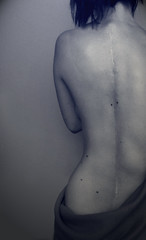
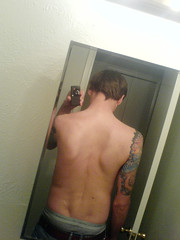
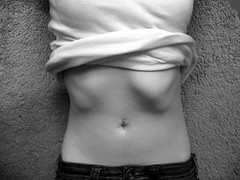
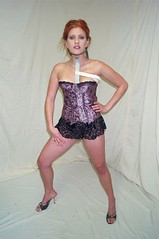
Thanks to flickr, I did actually find some images of scoliosis that I think are beautiful and help affirm positive self-image and sexuality. I wish I’d found a greater variety of body types, but these images are great to start off with. Some are post spinal fusion.

First, here’s the typical clinical picture. It shows everything that’s wrong with the body.

A woman is facing away from the camera, with arrows pointing to various parts of body to describe them.  Head not centered over body.  One shoulder (right) higher.  One shoulder blade (right) higher and possibly more prominent.  Spine obviously curved (to the left).  One hip (left) more prominent.  Unequal gaps between the (left) arm and the trunk.  Description by Anna

Now here are the flickr pictures. They show the open possibility and vitality of a body with scoliosis.

Man with scoliosis facing away from the camera.  Someone has drawn his spine on his back with make up.
black and white photo of a woman facing away from the camera, wearing only a towel or blanket.  Her spine is curved, and her scars are visible.

man facing away from camera.  The photo is in a mirror.  One can see both his scoliosis scars from surgery and his elaborate arm tattoo.

woman facing away from the camera.  She is caught in the middle of dropping an apple behind her back, both arms curved behind her.

woman facing away from the camera.  The image is otherwise in black and white, except for her vivid red hair and lips.  She is wearing a black dress with part of the back cut out.  It clearly shows the curve of her spine.

photo is in black and white of a woman's lower torso, with a pronounced rib-cage and a pierced belly button

woman facing straight on the camera.  She is wearing both a brace, as described above, and a purple corset.

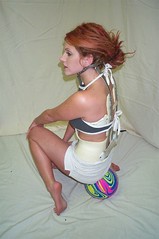
woman facing left from camera, with back facing camera.  She's wearing an back brace, and balancing on a small ball.

It’s heartening to see a bunch of pictures like that. There are more photos at this link.

When I walk, my right hip swivels a bit higher and wider than my left hip. I’ve had people tell me it looks sexy. I’ve had people ask if I’ve hurt my foot. Neither reaction bothers me anymore. The way I walk is just the way I walk. It gets me where I need to go.

Acknowledgements for this post: thanks to Thorn for commenting about this issue, and mentioning how it negatively affected your adoption homestudy due to ignorance on the part of the social worker. Also thanks to Deesha Philyaw on Twitter for mentioning the Judy Blume book about a girl who goes through bracing: Deenie. I wish I’d gotten a chance to read that book when I was a girl, and it sounds really interesting.

Recommended Reading for November 13

Mental Health and Promiscuity

However, even in this environment there is one area that has always troubled me and that revolves around the concept of promiscuity as diagnositic criteria.

My first and biggest problem with this is that I have NEVER heard this brought up as a symptom of mental illness when discussing a male. It is always something that is brought up about a female. I can’t help but assume that this is linked to the belief that “excessive” sexual activity is normal for a man and not a symptom of mental illness while no “healthy” woman would engage in or enjoy casual or alternative styles of sex. I also think it is linked to the belief that women are the only ones that have sex with other people due to low self esteem or possibly in a reckless manner because they have some self-destruct tendencies. See, sex is damaging to women, they can’t just enjoy casual encounters or engage in sex purely for self-satisfaction: they must be wounded in some way or they must be wrongly searching for the intimacy they so desire.

Reasonable Accommodation

I find myself caught between disabilities.

One of my most promising paths forward health-wise right now is finding a low-impact, non-repetitive form of exercise. Since I have done yoga in the past, I have been searching for a yoga studio. But since I’m in the western suburbs of St. Louis… there just isn’t much here. The most promising place, that offers classes that fit into my schedule, that is likely to be understanding and accomodating of my back issues, is Bikram.

Now I did Bikram a few years ago and loved it – unfortunately, over the course of a couple of months the humidity in the room (Bikram is “hot” yoga, done in a room that’s about 90 degrees) started making my hearing aids go wonky, so I stopped.

You Can Make Fun Of Us But You Can’t Give Us A Chance

The character was dressed in a blue latex suit that covered his head, and he was constantly babbling like an idiot and drooling on himself. I admit that I found the Handiman skits to be hilarious when when they first premiered. The disabled community had been non-existent in Hollywood up until then, and it continues to be non-existent today, so it was good to see some representation, and me not knowing how much of a negative image it was at the time, appreciated the recognition.

I was in my junior year in high school when Handiman made his debut. Ever since I was mainstreamed back in the fifth grade, I have always caught hell because of my disability. I remember being teased many a-day throughout grade school, high school and even college. Handiman perpetuated the stereotypes that people had about people with disabilities. Even to this day, the techniques have changed, but I pretty much know when people are trying to belittle me. Children aren’t as cunning or crafty to hide their emotions, so they would usually laugh or make “retarded-stupid” comments about me.

The Usefulness Factor

Sometimes you can maintain a career from your own home, such as on the computer or as a consultant on the phone. Sometimes you just need to stop and re-think the whole idea of being useful. The question of “why am I here?” seems to become magnified when you become confined to a small physical space with others doing all the things you used to do for yourself.

But that does not mean you have become useless. It is very easy to fall into the trap of believing that, especially when people say things like, “it must be so nice to be home all the time and do nothing!” It is not particularly nice to have no impressive answer when people ask what you do all day, but if you are able to ignore that and realize that everyone is on this earth for a reason, you are on your way to finding a new sense of purpose. Maybe not a financial one, but perhaps a spiritual one, which is even more important.

In the news:
Francesca Martinez: A Wobbly Girl Battles Against The Last Taboo [Although I disagree with the idea that disability is the “last taboo”]

Francesca Martinez’s victim is squirming. Trapped under the scrutiny of the comedian and fellow members of the audience at her show in Edinburgh, he is clearly wishing for the proverbial hole to open up. “What are you bad at?” asks Martinez. “Football,” comes the sheepish reply. “Were you born like that?” she enquires, head tilted in sympathy, “Couldn’t your mum have had a test when she was pregnant?” Turning to the man’s girlfriend, she simpers: “You are so brave. Well done… Does it mean he can’t have sex?”

Martinez’s humour bears a political sting. As one of a tiny number of disabled performers who have made it into the mainstream, she is not about to waste opportunities to ram home a message. Born with cerebral palsy, the 31-year-old refuses to accept the label of her condition, preferring to describe herself as “wobbly”.

Guest Post: Disability and Asexuality

Kaz is a German woman in her twenties, currently doing a maths PhD in the UK. She is on the autistic spectrum, stutters, and has been dealing with clinical depression on and off since her teens; she considers all of these disabilities. She is also aromantic-tending-towards-homoromantic asexual and identifies as queer. She blogged as Zailyn at WP for a while, but can now be found at either Dreamwidth or Livejournal, where she writes about fandom, disability, feminism, asexuality, and sometimes even maths.

Kaz’s note: First of all, this is not a 101-level post on either the asexuality or the disability side of things. However, I’m aware that asexuality isn’t really an issue that is on most people’s radars, so to anyone who doesn’t know much about it I suggest you check out AVEN in general and the Wiki in particular before reading or whenever you run into something that doesn’t seem clear.

Mod Note: Kaz & I talked and I’ve put in some links to terms as they come up.

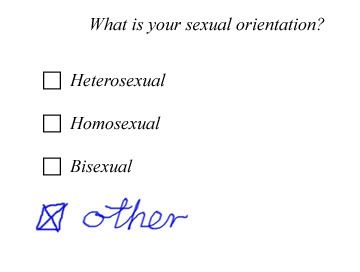
A list.  The header reads: What is your Sexual Orientation?  Typed underneath with check boxes is Heterosexual, Homosexual, Bisexual.  Written in, with a hand-drawn check box, is other.  The check box is filled in next to other

Talking about the intersection of asexuality and disability is pretty difficult, because “asexuality” gets another meaning in disability rights discourse: it’s used to refer to the various stereotypes about disabled people’s sexualities. People do often seem to realise that this is problematic when it’s pointed out to them. However, what not so many people realise off the bat is that it goes beyond just “problematic”.

The stereotypes in question actually consist of a wide variety of things tossed together, some of which are in line with asexuality but many of which seem to have little to do with asexuality or in fact to be entirely opposed to it (I am interested to see how the stereotype of the disabled woman not saying no because she feels lucky anyone wants her is supposed to relate to asexuality, for instance). What they have in common, however, seems to be: denying disabled people their sexual agency and the right to make decisions or have knowledge about their own bodies and sexualities. The stereotypes about disabled people’s sexualities seem quite in line with the common tendency to consider us childlike, helpless and needing to be protected for our own good.

Asexual adults? Are not children. Nor do we (or, at least, should we) lack agency. In fact, the very existence of the asexual movement shows that we are in opposition to a lot of these ideas! We’re organising, we’re campaigning, we’re demanding that our sexual identity should be recognised and considered valid; disabled people are stereotyped to not have a sexual identity at all. (There is a distinction between the lack of a sexual orientation and a sexual orientation incorporating lack of sexual attraction that most people miss, but that is crucially important in this context.) Taking all the stereotypes disabled people get hit with regarding sex and sexuality and claiming that they all boil down to making them like asexual people? Like me? Is something I actually find really offensive.

An example: the desexualisation of disabled people often gets used to justify giving them less extensive sex ed or no sex ed at all compared to abled people. However, saying this is because they’re stereotyped as asexual entirely misses the fact that – asexual people need sex ed too! At the moment, it’s true that a lot of us will probably need it less than most sexual people, but it is still necessary as a large portion of asexuals do end up having sex at some point in their lives. Also, if mainstream comprehensive sex ed ever gets away from the “put the condom on the banana” “tab A slot B” style of sex education and starts talking about things like sexual orientation, explicit consent, how to figure out whether sex is the right decision for you at a certain time, etc. – I’d argue that we need this kind of sex ed more than many sexual people, as being a sexual minority tends to lead to more confusion and needing to figure things out. (There’s a traumatic experience I could have happily avoided if sex ed ran more in this direction.)

Also, using the name of my sexuality for these stereotypes obscures the fact that actually, they have negative effects for me, too. For instance, there is an astounding amount of ableism in the arguments people use to try and invalidate asexuality, ranging from “you should get your hormones checked!” over “that’s a disability, not a sexual orientation” to “you’re just all autistic!” You can imagine how the last one feels to me as an asexual autistic person! Worse, parts of the asexual movement buy into this and will talk about how they’re not autistic, their sexuality is valid – unlike mine, apparently?

…hey, I recognise this argument! But wait a minute, we can’t very well call it stereotyping disabled people as asexual if it’s being used to invalidate the sexualities of asexual people.
Continue reading Guest Post: Disability and Asexuality

Disability Is …?

(Originally posted July 2009 at Feministe, three rivers fog.)

We had a really good discussion about nondisability. It got derailed, a bit, because it depended on our ability to reasonably define disability. And it’s a subject that has come up in every discussion we’ve had these couple weeks. What is it?

I advocate an intentionally overbroad definition of disability. And I definitely see a tendency, with certain medical conditions, not to identify — on that inner level, what “feels right” — as disabled.

I support every person’s right to self-determination, to define their own experiences, and to identify however feels most right for them. I do not want to try to pressure people into identifying in a way they do not feel comfortable. But I do think that part of this tendency, this reticence, is rooted in a sort of ableism. Not ableism as in “internalized negative feelings about PWD” — but ableism as in “a certain understanding of how the world works and how society is/should be structured” … or, you might say, a certain model.

I want to explore a few things — explore our assumptions behind the word “disabled.”

1.

Think, for a minute: visualize a disabled person. Just a generic idea of a disabled person. What would you say are the requirements to qualify as disabled?

Do you have to be disabled — in a dictionary definition sort of way? Disabled, unable, incapable? Unable to work, or unable to participate in social activities, or unable to take care of oneself? Is there a certain level of un-able-ness one must reach to qualify as disabled?

If so, what do you call the people who don’t reach that level — but who share many, if not all of the exact same problems with accessibility in society, who face the same obstacles in their path, the same ignorance and hostility? The people who have the same condition, but face different accessibility problems because they are trying to navigate the workplace, living independently — who are able to do these things — but who still have to fight with the outside world to be able to live their life how they want to?

Are these people disabled? No? Are they abled, then? Are they privileged over the people who meet that level of un-able-ness?

Am I “temporarily able-bodied” because I can push myself enough to work full-time?
Because I can walk? Drive? Prepare meals? Go to sports events and concerts?
What about the fact that I still have to fight with my doctors over medication? That I still have to approach HR at work to tell them about everything I need to be able to work there?
What about the fact that without the drugs I am taking and my TENS machine and my access to health care and workplace accommodations and accessible parking, all of a sudden I wouldn’t be able to do those things anymore?

Is my disability about my inner feelings when I get home and slouch in pain — is it about what is going on in my body? Because I still have pain, whether I am well-treated and working or untreated and housebound. I still have fatigue. I still struggle when I stand up from a sitting position, still need help getting out of the car if I haven’t taken at least a few painkillers already that day. All that stuff is still there.

Or is it that my disability something beyond me — not having to do with me at all? Not defined by what is going on inside my body, but defined by whether society is working with my body or working against it?

2.

I’m going to let you in on a secret. A lot of us people who do fit the classic dictionary definition of “disabled”don’t feel “disabled” either. We don’t always feel un-able. We feel like “just people.” Normal people living a normal life, just happen to have some sort of neurological or physiological difference, but that isn’t our defining characteristic or something that is always forefront in our minds, it’s just one part of us that doesn’t always make that big a difference in our life at all.

3.

Remember, briefly, the social and medical models of disability.

Under the medical model, a person must justify their claim to disability. A person must fit neatly into a narrow diagnosis with a Latin-based name. The person must be cleanly categorized. Their experiences must fit a prepared check list.

The medical model says that your body fails to be normal in this particular way: so we must devise a way to force it to be normal, and that will solve the problem.

Naturally, such an approach to disability will wind up excluding a good many people who don’t fit those boxes cleanly, who appear close to normal — and that just can’t be right; there must be a logical explanation, like that they are over-worrying, imagining things, that they like being sick and want the world to treat them with kid gloves. After all, there is no proof that they deviate from the normal — so they have failed to justify themselves as different.

The medical model, in this way, denies community and services to people who still face considerable obstacles to full participation in society because they have failed to prove that they deserve that “special treatment.” They have failed to prove themselves as disabled enough. They aren’t “other” enough to be Othered.

The medical model imposes strict and narrow definitions — which become boundaries which must be policed.

What do you do when you’re caught in the middle? Different, but not different enough to be Othered, but still needing services (benefits, accommodations) which are only given to Others.

4.

Informed by the social model, “disability” becomes a marker not for condition (mental or physical) — not for “what I feel inside, what I experience inside” — but instead for the fact that our condition is maligned or neglected (or both) by the rest of society.

Disability is not a matter of my condition, but a matter of the group I am assigned because of that condition.

Perhaps it could be said as such: Disability is not a condition, it is a status.

5.

The classic analogy to explain the social model is this:

Many sighted people have less-than-perfect sight. If assistive devices — glasses or contact lenses — were not so widely available and accessible, many of these people would be prevented from full participation in many aspects of society.

But because society sees fit to prioritize this assistance, to make sure glasses/contacts are widely available and accessible so that every less-than-perfect sighted person can have clearer vision — because society decided that no person should be blocked from access because of hir different vision — this condition is no longer a disability.

This is a useful thought experiment. But it is not a perfect analogy. Many blind people still face considerable access blocks. This only really applies to people who are sighted, but whose sight is not precisely “normal.” Perhaps because society can, for the most part, bring abnormally-sighted people to normal-sightedness, whereas it cannot do the same to blind folk.

There’s a lot to explore here.

6.

The word disability isn’t perfect. I don’t know that I would choose it, were we to start over with a blank slate. Nor do I know that most people who are active in the disability community would choose it.

What I do know is this: people who don’t feel, literal-dictionary-definition disabled, embrace the word and run with it. They can make it something all their own.

Queer is a less-than-perfect word when you consider its literal definition, too. Yet the queer community has decided that they’re gonna take this thing and make it into what they want it to be. And they’re making something pretty damn awesome.

I don’t feel dis-abled. I feel people-are-willfully-ignorant and access-to-good-care-is-restricted-in-unnecessary-ways and the-medical-industry-has-no-respect-for-me. Among other things.

And I’m sure other disabled folk feel why-isn’t-there-a-wheelchair-ramp-for-this-public-use-building and nobody-has-to-accommodate-my-needs-until-they-get-sued-why-don’t-we-have-an-oversight-board-that-makes-them-do-it-right-from-the-fucking-start and you-aren’t-providing-alternatives-so-I-can-access-your-lecture-even-though-I-can’t-[hear-what-you-speak/see-what-you-write/be-there-in-person-at-all]. Among other things.

People who identify as disabled (or are identified as such by society) don’t necessarily always think the dictionary definition of the word applies to them. There are disabled people in wheelchairs or braces who still work, still have families, still go to parties. There are disabled people who appear totally abled yet can’t work, can’t perform certain self-care, and so on.

The word “disability,” in the disability movement right now, already refers to a great variety of individual conditions, abilities, approaches…

And for the most part, when a person appears whose condition challenges the current boundaries of abled/disabled, the disability community is completely ready to revise their assumptions and welcome that person (and hir companions) into the movement.

Because, here’s the thing…

7.

The disability movement has a lot to offer to a lot of different people — not all of those people who may identify as disabled.

And this is part of why I do not want to pressure people to change their identification. They don’t have to identify as a disabled person, or a person with a disability, to still become a part of the disability movement, to benefit from it, to help move it forward.

What I am wanting to do is not change people’s minds about how they individually self-identify. What I want to do is explore the cultural phenomenon that is certain groups rejecting the label of disability.

Anyway: the disability movement is working hard to change the way we approach the world. From an approach that excludes non-normal people to an approach that stops INcluding by certain standards and starts just treating all persons as fundamentally human, period.

Under the current system, when a woman becomes pregnant and plans to keep the child, we expect the child to be free of disability. What’s that refrain from the supposedly-gender-enlightened? “I don’t care whether it’s a girl or a boy, as long as the baby comes out healthy!

When we encounter a person, we expect that person to be abled. When we imagine a “person” — just a generic, default person — we imagine that person as able-normative.

Currently, things go like this: 1. World expects “normal.” 2. Non-normal people come along. 3. Oops!

What disabled people want is more like this: 1. World is prepared for any number of different things. 2. We come along. 3. Hey, we were expecting you!

This approach is what defines the disability movement. We want to change the world so that the world stops treating us as unexpected — and therefore a disappointment — and therefore has not prepared for us — and therefore we have to constantly fight with the world to make it change every little individual thing it has set up wrong.

This approach, applied broadly, has benefits for so many more people than only the classically, dictionary-definition disabled.

This is the world I want to live in (bold emphasis added)…

My body isn’t the enemy, I realized.

It’s not my physical self that creates all my problems.

It’s all the external expectations of it.

Disability isn’t the result of individual defects, deviations from the able-bodied norm. Disability is the result of a society that fails to accommodate these differences.

What if we saw these differences as variation, not deviation? After all, we fully expect our children to be born with any number of different eye colors. Why is it any less when it comes to physical and mental abilities?

Can you shape a world in your mind where there is no norm? What does it look like? How does it differ from the world you live in today? What do you expect of people as a whole in order to support those currently disadvantaged?

The more I think, the more confused I become. It seems impossible to structure society so that everyone is brought to a similar level of ability across the board. But it does seem possible to structure society so that those fully-abled work to make up for those straightforwardly lacking, and everyone works with each other in full expectation of a wide range of ability across the populace, and all of this is seen not as hassling and burdensome, noble and heroic when someone takes it on—but as mundane, everyday, simply expected, no different from separating out your recyclables or driving on the right side of the road: something that everybody does, because it isn’t that hard to do, and it benefits yourself as well as those around you, so it’s stupid and even outright reprehensible not to.

That is the world I want to live in.

[Reading back, I cringe at the use of the words “straightforwardly lacking.” Proof that we are all still learning, still building.]

What if things did happen that way? What if we just rushed to give, knowing that those around us would rush to give back?

and in this POV, the centering of individualism falls apart — because that’s not what life is about. life is give and take, push and pull, you do this for me (that i don’t do well/don’t like to do, but that i want/need) and i’ll do this for you (that i do well/like to do, and you want/need).

disability, really, when you get down to it, is the ultimate unraveling of that ball of individualism — it FORCES you to look at all these little things that go into the living of a life, and realize that not all of them are yours to do or yours to control — and also to realize how many of those little things YOU affect for OTHER people’s lives — and to finally give up, and fall back into the arms of the community.

it means you have to stop looking at things as “mine, yours, this person’s, that person’s” etc. you have to stop keeping the damn tally — and just rush to give, knowing that those around you will rush to give back…

so many people are afraid to admit that ultimately, they DO depend on the people around them, and their accomplishments are not solely their own, and the things they do, affect people besides themselves. but it’s all true! and it’s not a bad thing, if you look at it the right way.

This is everything we are trying to change.

And when we are successful: it will be good for so many people. It will benefit a great many, people who might not consider themselves part of this movement, but who will see their life become substantially easier or better, because this movement has destroyed the system that puts obstacles in their path.

8.

There is a lot people can learn from the disability movement — even if they don’t consider themselves a part of it.

This is why I, and others, explicitly tie our disability activism to our feminism. Believe it or not, there are things that non-disabled feminists can learn from disabled ones about how to refine, how to better our (not their, OUR) feminist movement.

There are things the disability movement is accomplishing that the feminist movement has fallen short on. Things that disability activists are paying attention to that feminists have forgotten.

And it makes a difference in women’s lives.

9.

There are substantial immediate benefits to individuals, as well. Many of you who do not feel “disabled” nonetheless benefit directly from the Americans with Disabilities act and other non-discrimination legislation. And that’s only in the realm of the state (legal sense).

Consider the pharmaceutical industry. The alternative medicine industry. Consider protections on health insurance that prevent companies from discriminating against people with pre-existing conditions or prevent them from denying certain treatments.

These are all things the disability movement has had part in. Often, the disability movement has been the sole force pushing for these things — when other movements fall short, and forget us.

And there is, therefore, substantial benefit to involving oneself in the disability movement. Because it is working for you. So it will do good for you and for us if you directly engage with it — help it refine its purpose — help direct its actions — help challenge preconceptions.

If you will stand with us, if you will be — a friend, or a family member — whatever role you feel comfortable taking, we will stand, sit, lean or lie beside you. We will be there with you, however you identify.

We want more people to engage with us — on an honest, good-faith level.

Some of those people will find themselves beginning to identify as a part of this movement, as a person with a disability. Some people will not, but will remain our friend, our ally.

No matter which: we are happy to have you.

***

ETA: I really should have included a link to this post from Joel at NTs Are Weird — from the perspective of the autistic community. I ain’t the only one beating this drum! I remember reading this post a long while back, and it has informed my politics a great deal. And I think it is necessary reading for anyone engaging with the disability movement. And he does a great job wrapping up the many elements of this post! 😉 Take it away (bold emphasis mine):

Welcome to the disability community! […]

Yes, that’s right, you’re DISABLED. Yep, you can pick that word apart and tell me why you aren’t, but, trust me, you are. And, no, I don’t mean that you are less or more functional than anyone else. I mean that you are part of a community defined by society’s institutions and programs, a community formed because of our minority status and the fact that society expects certain strengths and weaknesses, and anyone who doesn’t have that same pattern of strengths and weaknesses is going to have trouble in this society.

Yep, that’s the social model. It’s not the “OH MY GOD, I AM SO BROKEN AND LIFE SUCKS AND I WANT TO BE NORMAL BECAUSE EVERYTHING WOULD BE WONDERFUL AND I WOULD HAVE LOTS OF MONEY AND A GIRLFRIEND AND A NICE CAR” view of disability. But it is recognition that we have trouble in society as it is currently set up. You’ll also notice that it is not a view that accepts society as a static, unchangeable, and morally good entity, but rather as an institution that can and should change – even when people have a hard time seeing how it could.

In addition to this, I want you to know that there is “nothing new under the sun.” You don’t need to reinvent disability theory […]

One example – although the victory isn’t yet fully realized – find out why there public transit has to at least make *some* effort at accommodation in the US. Yep, I know it still sucks, and there are tons of problems – I’m not saying anything different. But I can assure you of this: Without good advocacy, there wouldn’t be a wheelchair lift on any bus except one owned by a nursing home – and even that one might not have one.

Find out why people with cerebral palsy can go to US schools today, even if their natural speech is hard to understand, thanks to assistive technology and good law. Sure, schools, technology, and law aren’t good enough yet, but they are way better than they were 40 years ago. Why?

Better yet, learn how you can make a bus in your city more accessible both to yourself and to someone with a different kind of disability. Learn about your schools and what can be done to help others with disability. Not just autistic people, but people with all types of disabilities. Do you know what you will find if you do this? You’ll find out quickly that it also helps you, even if that wasn’t the goal of the movement.

For those of you who are already doing these things – thanks! It’s good for us to stop reinventing the wheel once in a while.