All posts by Anna

Recommended Reading for November 26

They hate you. Yes, you.

Because the first thing people use on us is always, “It’s not about you.” When I was a kid, when I first started reading about autism rights, it was so instinctive: of course it’s wrong to say “cure autism now.” Of course it’s wrong to say autism is a tragedy, a disease, it’s wrong to give kids electric shocks, it’s wrong to say you thought about killing your kid in a video about eliminating autistic people from the gene pool. Like Sinclair says it’s wrong to mourn for a living person. All this stuff was plain and clear and bright, and I was autistic, and I was being attacked.

Right?

Well, not to anyone else.

YouTube now adding close captioning automatically

We received word from our new star writer Tara that YouTube will begin using a machine to produce close captioning for its videos. At first, the “auto-caps” will only be seen on a select number of videos of the nearly 20 hours of footage uploaded to YouTube every minute.

This is an excellent step in the right direction to add more accessibility to the second most popular search engine on the planet. Deaf and hearing-impaired gamers will now be able to begin looking up cheat codes for their favorite video games just like everyone else!

Accessibility and Table Top Gaming: Rulebooks

To fully understand what accessibility means in a gaming context, game players and game designers need to think beyond simply what our own abilities are, and consider a larger audience that may not share the same physical abilities. If a game requires pointing a nerf gun at other players, how can you adapt the game (or can you?) for people who can’t point a nerf gun?

Also, proper accessibility for games requires not just that people with disabilities are able to participate, but that they can participate fully. In other words, in games with a Dungeon Master or Gamemaster, people with disabilities need to be able to take those roles as much as any other player of the game might. Game accessibility includes the ability to be the GM.

Captchas: The Bain of everyone’s Existence

So the question is how do you make a captcha accessible, without making it solvable by spam bots? There are actually many options. The current audio captchas include, typing in a set of numbers that you hear, and typing words that you hear. The draw back to both of these is that they can be difficult to hear, or too challenging. I often have to listen at least 2 to 3 times and then I still worry that I’ll get it wrong, but at least this option gives me the potential of being able to submit the form. Another option, and one of my favorites is to make the captcha a question that you have to solve, such as, “what is 2 plus four?” This is a simple math problem that most people should be able to solve, but it isn’t something a computer can solve. Finally, there soon will be a new option thanks to the work of the NFB and Townson University. They’re new system will use pictures of familiar objects and sounds that correspond to the pictures. If you are listening, the answer to the captcha is whatever the sound corresponds to. So for example the image may be of a lion, and the sound would be a lion roaring. The answer to the captcha is lion.

In the news:
New Grants Aim To Get More Disabled People Volunteering [UK]

Organisations can apply for grants between £250 and £5,000, which can be used to help overcome barriers that stop disabled people volunteering, such as specific equipment, a lack of suitable access and understanding of disability issues.

These grants are part of the £2 million ‘Access to Volunteering Fund’, which was developed by the Office of the Third Sector as a pilot scheme in Greater London, the West Midlands and the North West.

Please note: I’m in thesis crunch time now, so don’t hesitate to send me links to your own stuff, to other people’s stuff, or to the news, because my reading time on the internet is getting more and more limited. anna@disabledfeminists.com

Recommended Reading for November 25

On Living with Pain and Taking Care of One’s Self

I have been managing my chronic pain and taking care of myself for years. But taking care of myself requires the cooperation of other people, and that can be the most difficult challenge to overcome. I cannot take care of myself or be well if others do not take my pain seriously. Just because I was able to do X yesterday does not mean I can do it today. The pain comes and goes. Once it starts I have to let it take its course. But society caters to people who are able-bodied and physically strong. Illness and pain are not compatible with the typical pace of life, and I admit I have anxiety about falling behind.

Living with an invisible disability can be exhausting – not only because chronic, searing pain is energy-draining (in my case), but because it leaves behind no evidence. Communicating with others about my pain often leaves me feeling misunderstood and isolated. Sometimes I want to wear tops that reveal my scar all the time, in order to silently “prove” there’s a *real* reason I just want to lie down, can’t carry that ten pound box, or don’t want to stay out all night partying. I cannot shake the feeling that other people doubt me or believe I use chronic pain as an excuse to get out of doing certain things.

Insurance Company Revokes Depressed Woman’s benefits over Facebook photos

Mental illness is no exception to this rule: people think they know what it looks like, that they can spot a person with a mental illness a mile away, and that if a person doesn’t live up to those expectations, they’re either seeking benefits they “don’t deserve,” or seeking attention. And with regards to depression specifically (as it’s the topic of the original article, and my greatest knowledge base), they tend to think that if someone isn’t spending all of their time crying, frowning, or refusing to get out of bed, they can’t possibly have it.

Your Scooter Means You’re Poor

I have learned that differently abled means poor to many. It means that you are not working. It means that you have no identity or interests. I understand for many being differently abled means poverty because we live in a world that does easily make the accommodations that are necessary to participate in paid work. Knowing that this is the case, why does the stigma attach itself so ferociously? If a person is unable to work because of a lack of accessibility, why do we feel the need to persecute them because of the way our society is designed?

When I tell people that I write, the answer is usually that it makes sense. It does not occur to anyone that I chose this because of a love of writing and sharing ideas. Writing is something that I was interested in from the time that I was a small child. Because I am doing it, it certainly is not real work. Such ideas do not attach themselves to a friend of mine, who makes his living freelancing in this area. Sitting together, people will invariably ask him a multitude of questions, ignoring me completely. It is understood that he chose his work out of love and not convenience.

A Different Kind of Test

More than two dozen seniors at Lincoln University, in Oxford, Pa., are in danger of not being able to graduate this spring — not because they’re under disciplinary probation or haven’t fulfilled the requirements of their majors, but because they were obese as freshmen.

It might sound like a joke, or a violation of individual rights, but James L. DeBoy, chair of Lincoln’s health, physical education and recreation department, said he sees it as his “professional responsibility to be honest and tell students they’re not healthy.”

In the news:

Disability turns laughing matter in Channel 4 comedy show [Headline is really misleading past the first few paragraphs of the article] [Also, oh gosh! People with disabilities don’t all agree on everything! I love that they spelled that out in the article, but it always bothers me that this is considered news.]

Penned by writers from Skins and The Thick of It, the series features six disabled characters marooned on an island, including a blind man, a woman with cherubism and a paraplegic man. Each character is played by a disabled actor with the same disability, and one complains about the number of non-disabled actors portraying disabled people.

Liz Sayce, chief executive of the Royal Association of Disability Rights (Radar), says: “There is likely to be a storm of comment from disabled people and non-disabled people alike over Cast Offs. Some disabled people will find it funny and real – portraying disabled people as adults who swear, drink and have sex. A real break from covering disability with kid gloves, or not covering it at all. Others may well find it offensive.”

Recommended Reading for November 24

But Accessibility is Too Expensive

Due to the weather and being forced to stand, the pain was so terrible I was literally weeping silently. I walked into the office and asked to speak to someone in charge. I explained the issue and suggested that they install a platform, which would allow scooter and wheelchair users to watch the game. Like any other parent, I paid for my child to have this experience and it is completely unfair, that I should be forced to suffer, so that I can participate.

The woman gave me a depreciating smile and informed of the cost involved. Of course they will look into it and maybe in the spring they can do something. Isn’t that lovely. You will note, that she made certain to point out that I was asking her to spend money. This is always the excuse given when the disabled demand that accommodations be made so that we can participate. Shame on me for not having a normal body, which can tolerate standing for an hour outside on a cold Ontario fall evening.

Victim Art

I’m not sure what I think. I don’t know whether I would go to see such a performance. I don’t know whether I would call it art. I do think that inviting someone to film you at your most vulnerable moments is a gutsy statement of human vulnerability. And it forces me to think about what I call art.

Usually, I think of art as being the result/product/performance of a skill that is not commonly shared among people. Marcalo asks us to watch a moment of absolute lack of control. Usually, art is in the execution of the extraordinary — a painting, an image, a photograph, the playing of a piece of music — we are asked to watch a moment of incredible consciousness and intention. Marcalo strips that down. The way her body will move in the grip of a seizure may well be extraordinary, but it will also not be intended or conscious. Marcalo’s very idea makes me think. And think and think.

A Teaching Moment (Service Dog Etiquette 2)

I know I’ve mentioned in my first piece on service dog etiquette that many people make all kinds of errors in dealing with a service dog team, but it surprised me how many of them I face in hospitals and doctor’s offices.

The doctor who always stoops to say hello to my dog before he talks to me. (If he wasn’t a hard to replace doctor, I’d have a talk with him about it, but he’s of a specialty where I can’t afford to alienate my doctor)

The nurses who tell me that the dog is just fine where he is, and then struggle to straddle him or reach equipment across him, making all three of us uncomfortable.

The doctors I’m seeing for completely unrelated specialties who ask me what purpose the dog serves.

Common Barriers to [Website] Accessibility

Many web pages on the UIUC campus have the same barriers to accessibility. These can be relatively easy to spot and correct, so check out your pages to see if you have [them]

In the news:
‘Mad’ and proud of it [Note: Comments are a mess.]

Ms. Costa is one of the founders of the Mad Student Society (MSS), a group that has been able to make great strides in getting people to come out of their shells, form friendships, become politically active and feel better about themselves.

The group, made up mostly of students who have experienced the psychiatric system, use a once-a-month two-hour group talk to discuss personal issues and day-to-day difficulties “without fear that you’re going to be charted or pathologized” says Ms. Costa.

For MSS member Joel Zablocki, peer support is about being able to discuss all kinds of subjects with others who are at your level and have gone through similar experiences. “You don’t have the strange power dynamic of a doctor-patient relationship.”

Always feel free to email me with links to posts you think are appropriate for Recommended Reading. If you put FWD/Forward in the subject line, I’ll see it sooner. anna@disabledfeminists.com

Recommended Reading for November 23

There was no recommended reading on Friday because I forgot I hadn’t done one for the day after the Carnival. Oops!

Changing the Perception of Braille

I recently watched a Ted talk that focuses on the idea that how we feel about something is totally based on our perception. It seems to me that in ore for us to improve braille literacy, we are going to have to change people’s perceptions. Organizations like the NFB and ACB are already doing things to help change people’s attitudes towards braille, but I think we can go even further.

Many people are choosing to learn sign language because they think it’s cool. So the question is how do we make braille cool? I think we have to start with children and teens. When we’re younger, we tend to me more likely to accept change and set trends. With this in mind, I have a few ideas of how we can make braille cool in the eyes of our children, and if we can do that, then maybe that will translate to the adults in their life.

Blind Need More Access To the Written Word

I love to read, and I’ve been doing it ever since I was able. My wife is also an avid reader. But we are blind, and so are many of our friends. The organization I lead, the National Federation of the Blind of New York, is made up of blind people. Although many of us read everything we can get our hands on, we can’t get our hands on very much to read.

There are services for us, of course. Government entities and nonprofit organizations convert books into Braille, audio or digital form for our use. But only about 5 percent of all books published undergo such a conversion. The largest collection of books in Braille and audio form in the United States has, perhaps, 70,000 circulating titles in its collection. A few more selections are available as commercial audio books, but these are up to three times as expensive as print books.

Service Dog Etiquette Part 1:

I’m sure you’re thinking, how does my petting a service dog undermine his relationship with his person?

Well, it works in two ways. First off, my service dog works for me because he believes I am the most awesome person in the world and that all good things come from me. All petting, all praise, all toys, all games, his soft fluffy bed, all food, all treats – that all comes from me. Secondly, if someone other than me pets him, he starts thinking…oh, people will pet me. If people will pet me, it’s worth paying attention to people rather than my partner. If he pays attention to people rather than to me, I could have a nasty fall (among other things) – one that could injure both of us. Keep in mind when you read this that the average person who works with a service dog is more likely to be hurt, and hurt badly, by a fall. We tend to have service dogs because there is some kind of physical fragility or injury to us already, after all. When you’re dealing with guide dogs, I think the risk is even greater – a distracted guide dog might walk his person into traffic!

When People Say Stupid Shit

I. Cannot. Afford. A. Place. Alone.

My maths are simple. I have an income, which I get from the state until they figure out what sort of job I can handle with my disability. That income is all I have. Anything I might earn by teaching two hours a week (which I do) is subtracted from that income. That means that I cannot raise my income in any way. Unless, of course, I do so illegally, which would be pretty stupid considering the risk of discovery. My income is what it is and cannot be adjusted upwards. At all. Not until I get some help for my disability.

In the news:
Study Unravels Mystery of Dyslexia

New research may provide an answer as to why children with dyslexia often have difficulty hearing someone talk in a noisy room.

Dyslexia is a common, language-based learning disability that makes it difficult to read, spell, and write. It is unrelated to a person’s intelligence. Studies have also shown that patients with dyslexia can have a hard time hearing when there is a lot of background noise, but the reasons for this haven’t been exactly clear.

Now, scientists at Northwestern University say that in dyslexia, the part of the brain that helps perceive speech in a noisy environment is unable to fine-tune or sharpen the incoming signals.

60th Disability Blog Carnival: Intersectionality

Welcome to the 60th Disability Blog Carnival! Thank you to Penny at Disability Studies, Temple U for continuing to host the Disability Blog Carnival.

The 61st Blog Carnival will be hosted by Alison Bergblom Johnson at her blog, Writing Mental Illness, on December 13th (she requests submissions by December 4). Here’s her official call for submissions.

First, a personal comment from me: If you’re a regular reader of FWD/Forward, you probably know that I like to quote two or so paragraphs from everything I link, so that if people are just wanting to skim quickly over them and figure out what they want to read fast, they have that option.

I’ve tried to limit that here today, for two reasons. First, there are a lot more posts (I limit my recommended reading to five links). Second, it’s really hard to find just one or two paragraphs in most of these posts to link. “Is this the best paragraph? No, wait, look, later on, this paragraph is even better!” So, shorter excerpts because otherwise I’ll be quoting whole posts because they are very powerfully written, and need to be read as a whole, I think.

First Section: Intersectionality

At Ballastexistenz, Amanda writes This is not the post I started out writing, about intersectionality and the difficulties in writing about it:

So I will continue to move through the world (and the bits of the world that are around me will affect me, and I will affect them) and write (when I can) about specific aspects of my life, all of which have something to do with this thing they call intersectionality, whether that’s the topic of the day or not. Because I don’t stop being all these different sorts of person, when I stop specifically naming them.

At Urocyon’s Meanderings, Urocyon writes Intersectionality: It’s a way of life!, about the various identities that make up her life:

This has run long and personal, but it should give a pretty good idea of how I’ve been seeing intersectionality play out. Nobody and nothing exists in a vacuum. Everyone and everything is interconnected and interdependent. If you try to look at the world through a filter of “good” vs. “bad” oppositional dualism, all kinds of categories of people are going to be “bad”–and many of the “bad” people will fit into more than one category of badness.

Wheelchair Dancer, at Wheelchair Dancer, writes: Intersectionality, which is about internet feminism (as opposed to academic feminism) and the failure of intersectionality to really work on the web:

Internet feminisms are not so much representative of the scholarly field as a whole, but localized to individual websites and specific groups of people. At first glance, these sites are seemingly able to take on a diversity of perspectives; they have a large audience and multiple contributors. Despite this variation, however, internet feminism is not so much a set of philosophical perspectives, carefully worked out in conversation with other scholars, but a group of outlooks pulled together by friends and people who hold congruent (if not similar/the same) takes on stuff. Each website — each example of internet feminism — is thus a projection of the people who run, post on, and read a given site. They are examples — exemplifications, even — of feminism but they aren’t necessarily reference points to which one can go if you need to understand feminism.

Tera at Sweet Perdition writes Sweetie, asking how her treatment would change if her gender presentation, race, or age, amongst other things, were different.

But it is not niceness. It is You don’t belong here, dressed up in the prettiest Emperor’s clothes. Your kind belong somewhere else. And I am lucky as hell to get this form, this quiet suggestion that I am in the wrong place instead of disgust or gossip or a punch in the face or attempted murder or a refusal to acknowledge me at all.

anthea at Juggling with colours and smoke writes Dyspraxia and Gender, Part I, about gender and gender identity and being dyspraxic.

I don’t quite know what being female means to me. I don’t quite know what being dyspraxic means to me. But I think they’re quite capable of being parts of me that don’t undermine the validity of the other.

Bri at Fat Lot Of Good writes fat and depressed? or just fat? or maybe just depressed?, which is about being both fat and depressed, and the assumptions people make about both:

Like just because I am have depression (even when it is under control) I need someone else to tell me what is best for me, and the fact that I am fat and depressed…well, isn’t it obvious that if I lost weight I would no longer be depressed?

No, no and NO.

pgdudda, at Warp and Weft writes Hospitals: the Intersection of GLBT and Disabled Significant Others:

My partner of 13 years was recently hospitalized. His gall bladder was removed, and he had complications that extended his stay significantly. This was a very stressful time for both of us. The stress was compounded by the fact that (a) we are a homosexual couple, and (b) I have a significant hearing impairment. I have some thoughts for hospital personnel to consider when dealing with this particular intersection of queer-and-disabled.

hkfreeman, at The Living Artist, Touch/Don’t, which uses both art and words to discuss chronic pain:

While this piece is inspired by the personal, my hope is that it generalizes well to the experience of chronic pain, and also the experience of being a woman, and perhaps even the experience of being human: specifically portraying the conflict between the need for physical connection and the need for physical safety.

Kaz wrote a guest post for us here at FWD/Forward, Disability and Asexuality, about her experiences being both asexual and being on the autism spectrum:

Talking about the intersection of asexuality and disability is pretty difficult, because “asexuality” gets another meaning in disability rights discourse: it’s used to refer to the various stereotypes about disabled people’s sexualities. People do often seem to realise that this is problematic when it’s pointed out to them. However, what not so many people realise off the bat is that it goes beyond just “problematic”.

From The Mind Campaign, Mental Health Services for Refugees and Asylum Seekers: A Messy Picture, which is about … well, mental health services for refugees and asylum seekers in the UK:

But it is the plight of people who are seeking refuge in our country which has been highlighted by two new Mind reports which were launched yesterday. The product of two years of research seeking to understand the experiences of refugees and asylum seekers who experience mental health problems, the results make for interesting reading.

Jo Tamar, at Wallaby writes about the intersectionality between caregivers and disability:

So that’s intersectionality in one sense between being a carer and being a person with a disability: it is entirely possible (and based on the statistics above, maybe even likely) to be both.

But there’s intersectionality in another sense, too. The adverse effects of caring on a carer’s health and well-being has the potential to impact the person zie cares for. So the more difficult life is for the carer, perhaps the more difficult life may be for the person zie cares for.

Second Section: “General Posts” written by people with disabilities

At Bicoastal Gimps, shesabibliophile writes Ownership, which is about how the bodies of people with disabilities are often seen by others:

I would not be exaggerating if I said I have to deal with the hijacking of my ownership almost every day. There are few people who I feel completely comfortable around and who I know will not and do not take any power away from me unintentionally or intentionally. It’s a scary world for me, for us, but this world and my happiness is something I am willing to fight for.

Alison at Refract.Me writes Ablism 101, which is about the false assumptions people make about disability:

I’m talking about ableism. Ableism in the simplest meaning are societal prejudices about people with disabilities. It takes the assumption that being able-body, having a neurotypical mindset, boundless physical and mental endurance, etc. are normal. People that don’t fall into this category are abnormal.

Ginny, at Ginny’s Thoughts and Things, writes The World of Work, about pressure for blind people to be “the best” in order to demonstrate their worth:

See, the thing is, all of my life, the message I always got was that you’ve got to be twice as good at something to even be looked at the same way, or taken as seriously as, a sighted person. Being “just good enough” well, there was no such thing, because being “just good enough” for a blind person was “not good enough” for the sighted world.

hkfreeman writes on deafness, which is about the experience of being hard of hearing:

It can be difficult to imagine what life is like with a disability. For me, it is difficult to imagine what life would be like if I had normal hearing, but I am perpetually bombarded with reminders and barbs of how I experience the world in a different way, and how that difference is seen as a lack and a burden.

meloukhia, at this ain’t living, writes Nuance and Reproductive Rights, which is about disability and abortion, and how the abortion discussion is currently framed:

Views on abortion seem to fall into two broad camps: It’s always unacceptable and morally wrong (usually because people believe that a fetus has personhood) or it’s always acceptable (and the jury seems a bit mixed on morals). That doesn’t leave room for a lot of nuance, something I note in particular whenever discussions about abortion and disability crop up.

The next few posts are all posts from FWD/Forward Contributors and were on our blog:

By Laurdhel, Law & Order: “Dignity”, Worth, and the Medical Model of Disability, which talks about abortion and disability, and challenges the view presented both in Law & Order, and in feminist responses to the L&O episode she discusses:

As a feminist, I believe that we can have the abortion-rights conversation without marginalising, othering, and disparaging people with disabilities. I believe we can talk about abortion within that broader framework of reproductive justice, and that we can confront the ableism that creeps into some abortion-rights conversations head-on. This takes effort; we must think clearly, write carefully, read closely.

By kaninchenzero, Ill, which is about perceptions of mental illness, and about assumptions we make about violence and mental health:

Thing is, we’ll never know if Sodini was mentally ill or not. We can’t tell from what he left behind, and he’s no longer around to ask. The things he wrote aren’t all that unhinged; he just took the workaday hatred of black people and women that is everywhere in our society and picked up a gun and went hunting. And the mentally ill means violent narrative is false anyway

By Annaham, The Negative Side of Positive Thinking:

You’ve probably heard of positive thinking and its (supposed) benefits. You’ve also probably heard of things like The Secret, which is a self-help book and DVD (and they have other products, too, including a daily planner and something called an “affirmation journal”). For those of you who have had the good fortune to not have come into contact with The Secret, the basic premise is something that sounds pretty innocuous at first, if you don’t examine it too closely or think about it too hard: there is something called “the Law of Attraction,” which posits that the individual can attract their own good or bad circumstances in life just by thinking about them.

Oh gosh. Next time someone gives me the advice to add posts as they come in, I’m taking that advice!

I’ve really enjoyed reading all the posts at this Disability Carnival! If I had planned ahead, I could end with some way of saying “posts are great, and there’s lots of posts about disability all over the internet”, but I’ve just been kicked out of the lab I’m in and it is past my bedtime anyway. Thanks for all participants, and again to Penny for letting us host this time.
“Bad Cripple”

Last month, I went to a non-partisan Campaign School, where women learned the nuts and bolts of running a winning campaign for political office in Canada. We all said a bit about ourselves, and I stood up and introduced myself as a Disability Rights Activist.

I spent the rest of the weekend being told how “Bad Cripples” are ruining the system for everyone else, and how every problem that I discussed, from how low disability-support payments were to how difficult it is to get around the city with a wheelchair, was caused by That Person.

You know That Person. The one Everyone Knows who doesn’t have a real disability. They could work – of course they could! – they’re just in it to scam the system. This One is bad because whatever he claims about his disability, it’s obviously exaggerated because no one could be in that much pain. That One is bad because she decided to move to another province where the disability support payments are better – obviously she’s just in it for the money.

Regardless of where someone fell in the political spectrum, they felt it very important that I knew that it wasn’t the government’s lack of support for people with disabilities and their families, it wasn’t the surplus of societal barriers, it wasn’t even their own individual fears of disability that caused any financial distress. It’s those Bad Cripples who scam the system and totally ruin it for the Good, Deserving Ones.

People tell me anecdotes about Their Friend (or a Friend of a Friend) who totally confessed to scamming the system, or they tell me about how Their Friend isn’t really disabled, and they can tell, because of X, Y, or Z.

I’m going to confess something to you: According to the way a lot of people define “Bad Cripples”, Don and I are really Bad Cripples.

I’ll start out with the comments. Both of us have very bleak senses of humour, and both of us (me especially) say some of the most awful things. These include things like “I just married him for the disability cheques,” “Damn it, I should have lied and told everyone your Cancer spread so I could get extra time to finish my assignments,” “Oh, Don fakes not being able to talk very loudly so he doesn’t have to deal with the Student Loan people”, and even “Oh, the wheelchair’s just for show.”

You might be thinking “That’s obviously you joking around, Anna! No one really thinks you’re serious.”

Yes, yes they do. All the time. I’ve been talked to by professors about my joking comments about Don’s Cancer, and asked not to make them in front of other students. I’ve gotten really angry @replies on twitter about some of them. I have an email I can’t quite get myself to delete that’s all about how I’m a horrible wife who’s just using Don for his money.

I have no doubt that people have said, either to you or someone you know, something that sounds like they’re just gaming the system, including a breezy “Oh, I’m just gaming the system.” But you have no idea if they’re serious or not, or what their circumstances are, or how much pressure they’re under, internally or externally, to “pass for normal”.

The second reason people think of “fakers” is the “I know stories of people who don’t have real disabilities and they get all this financial support!”

Here’s the thing: I don’t have an obligation to tell you what my ability status is.

My ability status is between me and my doctor. I have made the choice to share it with a few friends, and my husband. I don’t have to tell you. I don’t have to tell my teachers. I don’t have to tell the pharmacist, the person who’s demanding I justify my tax-status, or my landlord. I have not discussed it with Student Accessibility Services on campus. I have not disclosed to the people on any of the committee meetings I’m on. I didn’t tell anyone at Campaign School.

Because it is none of their business.

I do not owe it to you, or anyone else, to explain why we’re raking in those big disability cheques.

I also want you to consider that you don’t always know what disability will look like.

You can’t tell by looking at my friend with the mental health condition that she tried to climb out a third floor window and jump because she couldn’t take the idea of another day at her job, but you can probably tell she isn’t working right now while she recovers from the experience. You can’t tell by looking at my friend that she was bullied so badly at work that she has panic attacks whenever she thinks of stepping foot in the neighbourhood of her former workplace. Until Don got his cane, and then his wheelchair, lots of people wanted to know why he wasn’t working – aren’t people who have mobility issues always in wheelchairs?

I know people who tell me “Bad Cripple” stories are trying to be helpful. They want me to know that they understand how difficult it is, and that if it weren’t for all those Bad, Faking Cripples out there, Don and I wouldn’t be living entirely off the largess of his family and my scholarship money. (The government expects that I should take out student loans to pay for Don’s medication that he needs to live. Oh goody – overwhelming debt in exchange for a husband who lives! Thanks, Nova Scotia! You continue to be awesome. Yes, the big disability cheques comment was a joke.) What I think they don’t want to do is question why it is so difficult. Bad Cripple stories give us someone – a conveniently faceless group that Doesn’t Include Us – to blame.

I think a lot of people are going to rush to tell me stories about how this all may be true, but they totally know of this person who is totally lying about being disabled. Please consider whether or not that anecdote will contribute to a conversation, or just remind people with disabilities that they’re viewed with suspicion and have to prove their status to you.

Recommended Reading for November 18

Should Disabled Characters Only Be Played By Disabled Actors?

I honestly think this is a difficult call. On the one hand the whole point of acting is to take on a personality of someone that isn’t you, hence the point of having straight actors play characters who are gay and vice versa. But there seems to be a catch 22 when it comes to actors who have disabilities. Blind actors are only allowed to play blind characters, which begs the question are they really acting? Obviously they’re not playing themselves, the character likely has personality differences, but why should they be restricted to roles where the audience knows they’re blind? This restriction says to me that directors can’t conceive a blind character playing someone who is sighted and so they don’t allow it, but really they are only restricting the number of roles that blind actors can audition for. So in that case maybe we should be upset that Helen Keller isn’t being played by a young actress who is deaf and/or blind.

The Intel Reader Photographs Text and reads it back to you

Intel’s Reader for the visually impaired isn’t a concept; it goes on sale today. Using an Atom processor, 5-megapixel camera, and Intel’s Linux-based Moblin OS, it turns book pages into digital text and MP3s…then reads aloud in a synthesized voice.

Brand it on the tip of your tongue

no matter how much you are learning, no matter how much power/money/influence you carry, no matter how much you always know the right things to say,

my body is not for you to exam, conquer, or casually observe
as if the strands of my hair were nothing more than pages of a magazine

the creator did not craft these hands, lungs, feet of mine so you can feel good about yourself. my issues are not for you to solve.

who said you could analyze me? i am not a hobby, a project, a case study

Are High Tech Prosthetics Fair?

This past week, another scientific study on running raised the issue of athletes with lower-leg amputations who use high-tech prosthetics having a bionic advantage in contests against ordinary competitors. Increasingly sophisticated innovations — like the carbon-fiber Cheetah Flex-Foot — appear to give amputee sprinters a technological edge in medium-distance races like the 400 meters. Isn’t opening able-bodied competitions to disabled athletes like the double-amputee Oscar Pistorius, fitted out with futuristic J-shaped blade extensions, just political correctness run amok?

ADHD website tells women they’re annoying

Annelise M. sent us a link to a relationships advice slide show at ADDITUDE, a website for people with Attention Deficit Disorder and other learning disabilities. The slide show title is “7 Tips for Better Communication in Your ADHD Relationships.” However, even though men are diagnosed with ADD and ADHD two to four times more often than women, the subtitle makes it clear that the advice is for women only and the text specifies “ADD women” and the “partner” or “spouse” is always a “him” (so also heterosexist). The advice was gender-neutral, but the authors decided to go with gender stereotypes instead.

Ableist Word Profile: Wheelchair Bound

Welcome to Ableist Word Profile, a (probably intermittent) series in which staffers will profile various ableist words, talk about how they are used, and talk about how to stop using them. Ableism is not feminism, so it’s important to talk about how to eradicate ableist language from our vocabularies. This post is marked 101, which means that the comments section is open to 101 questions and discussion. Please note that this post contains ableist language used for the purpose of discussion and criticism; you can get an idea from the title of the kind of ableist language which is going to be included in the discussion, and if that type of language is upsetting or triggering for you, you may want to skip this post.

I considered making this entire post “People don’t like being told they’re wheelchair bound. Stop doing it. Try ‘wheelchair user’ instead. Thank you.”

Then I remembered how often that argument is rejected. [My favourite: But I don’t like the terms that people with disabilities prefer, and I’m way more important!]

[I used to make really flippant comments about how no one is actually bound to their wheelchair, in order to make people think about what their words meant. Then I started reading reports of people being bound to their wheelchairs and, in extreme cases, left to die. Flippant comments are less funny after that.]

Shackling language like “wheelchair bound” is problematic because it leaves the average listener with the idea, again, that wheelchairs are a tragedy. You’re stuck in one, and it’s horrible, and you can’t do anything or go anywhere and it’s so very very sad, and isn’t their life such a tragedy. Just because of being bound to that wheelchair.

The thing is, a wheelchair is the exact opposite of a tragedy. As the blogger at Accessibility Net in New Zealand put it:

I then explain: I’m not wheelchair bound. I’m not tied to the wheelchair. To use the term “wheelchair bound” implies *limitations*. When in fact, the wheelchair is a tool of freedom. It’s without that wheelchair that I am seriously limited.

So each time I am told I am wheelchair bound, the implied message I get is “you’re in a wheelchair, you’re limited”. Yeah, I’m in a wheelchair, it gives me wings!

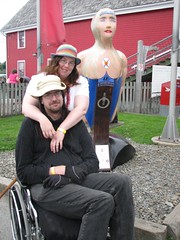
A white woman (Anna), sunburned and tired looking, stands behind a white man (Don), also sunburned and tired looking, in a manual wheelchair.  They are posed in front of a wooden figurehead of a mermaidThis certainly mirrors the experience Don had when getting his sexy sexy wheelchair of awesome. He went from not being able to get out of the house more than once a week, if that, to being able to not only go out several times a week, but doing it with only limited pain. The wheelchair opened up the possibility of our enjoying this strange, hilly city we moved to. [That’s us in the picture, after two days of handling the hills in historic downtown Lunenburg. Usually he uses an electric wheelchair, but we rented the manual for the trip. I vividly remember how exhausting getting up those hills were, which I think is obvious if you look at both our faces.]

Wheelchair user also reminds us who is (or should be) in charge of the chair. The person using the chair should be directing it, even if they’re not able to control it themselves. [This is a great post by Wheelchair Dancer about how to push a wheelchair. Learn it, live it, love it, folks.] When we talk about people who are using wheelchairs as though they have some agency, we’re reminding ourselves and others that they should have that agency.

Thirdly, wheelchair user is inclusive of people who are either full- or part-time wheelchair users. There are people who only have to use a wheelchair during high pain days, or in the winter, or after an accident, or for only six months, etc. “Wheelchair bound” always has an air of permanence to it, while wheelchair user can be both permanent or temporary, and using terms like full- or part- time wheelchair user reinforces the idea that folks who only use wheelchairs for certain activities aren’t faking a disability.

I hope this much longer version of my originally-planned post still gets at my basic argument: People don’t like being told they’re wheelchair bound. Stop doing it. Try ‘wheelchair user’ instead. Thank you.

Dear Disney & Pixar: Closed Captioning and Audio Descriptions are not “special features”

Codeman38 has been bringing people’s attention to the lack of accessibility features available in the rental version of Up:

However, Disney (the film’s distributor) released a special rental-only version of the DVD to the three above-mentioned rental chains, which lacks the bonus shorts from the retail DVD, the descriptive audio track, and the captions and subtitles in all three languages.

I know. It sounds utterly unbelievable– so I posted this DVD player screenshot of the rental version on Twitpic as proof. (And yes, the one menu item says “turn off closed captioning”, but that’s because I have it on by default; there’s none encoded on the disc.)

[See also Codeman38’s similar post on Accessibility Fail]

As Alena from Perspectives from a Blind Point of View puts it:

There is no excuse for this, especially for those who waited for the DVD release because they have a disability. People with disabilities shouldn’t have to pay extra to enjoy a movie, especially when the features were built in to make sure that the blind and deaf could better enjoy the film. I’d really like to know how this decision came to occur. It seems clear to me that Disney must not employ anyone with a disability in their marketing department, because if they did they would realize that this is likely to cause people to not buy the DVD, rather then increase sales.

The Consumerist reports this is a marketing decision on Disney’s part.

This leads me back into one of my ongoing (off-line) rants, which is the idea that people with disabilities are asking for some form of “special” treatment. No, they’re asking for the same thing everyone else does – to be able to rent the Newly Released Film from Blockbuster or Netflix or whatever, and enjoy it. The way they can do that is through these necessary features. They’re not “special”, they’re necessary. Just because they aren’t necessary for me doesn’t mean they aren’t necessary for other people.

This is pretty bad behaviour, and stuff that we need to be calling out.

Disney’s switchboard number is (818) 560-1000. I haven’t been able to find an email address or other contact information on this. If anyone else has any ideas, please let me know.

Recommended Reading for November 17

Ew, how 101

if you are nondisabled and working in the disability community…if you are white and working with people of color…if you are an adult working with youth…or, quite often, if you are a nondisabled white adult working with disabled youth, many who have been abandoned by our education system because of racism/classism/ableism…basically if you are a person who has authority and privilege and are working with people who traditionally have not…

think hard as hell before you leverage “professionalism.”

Antidepressants and Talk Radio

Now, you or I might speculate that for a woman to press charges against her husband and the father of her children, she has to be quite upset with him. Therefore we should 1) presume that this was a really scary or upsetting experience for her, and 2) acknowledge the likelihood that this is not the only disturbing, upsetting, controlling, or frightening thing her husband has done.

But at least one of these radio hosts, and the callers, wers less inclined to that view. Oh yes. One of the radio hosts did indeed say that it was not okay to drug someone without their consent, but I also got to hear people talking about how it’s okay to drug someone if you mean well by it. I also heard that it was okay to do if he wanted to watch the Superbowl and she wouldn’t calm down. I also heard that it was okay because it was just such a tiny little pill. I also heard that it was okay to do if he just really wanted her to stop fighting and relax.

School Using Lap Dances to Treat ADD closed

Are lap dances an effective therapy for attention-deficit hyperactivity disorder or drug addiction? It doesn’t seem like a question that should require a serious answer—but a state investigation of Oregon’s Mount Bachelor Academy (MBA) has substantiated allegations made by students and staff that such “therapy” was part of the school’s “emotional growth” curriculum and forced an emergency shutdown of the campus.

But Mrs Lincon, What about the play?!

Today the VA sent me a letter, with my name and address and social on it, detailing the reasons why the special transportation they have been providing to me was being terminated. They offered a generic list of alternative options, which included ‘asking for help from family and friends’ and ‘taking public transportation.’ In order to send this letter, of course, they would have to collect this information from me, from a file which might have detailed that my family is dead, and that the reason I do not take public transportation is because I have such bad panic attacks that I black out. Nevertheless, they forged on, much like the cheerful nurse I dealt with on the phone who commented on my tone of voice, “You sure don’t seem too happy about it!”

“I’m being treated for suicidal thoughts and depression after several suicide attempts.”

She transferred me without comment after that. Again, a moment’s notice would have provided her with that information. She didn’t bother.

In the news:

Bank challenges disability ruling [UK]

David Allen, who has muscular dystrophy, took action after Royal Bank of Scotland failed to put in wheelchair access at its branch in Sheffield.

The company was ordered to pay £6,500 in damages and given until the end of September this year to install a lift.

Richard Lissack QC, for RBS, told the Court of Appeal that the judge in the earlier ruling had got it wrong.

At a hearing at Sheffield County Court in January, Judge John Dowse ruled the bank had breached the Disability Discrimination Act.

Picture Post: Organs of Pills – pills carved up to look like the organs they’re supposed to help. No descriptions.