Category Archives: social attitudes

Less Than / More Than – My complicated thoughts on reproductive rights & feminist discussions

When I’m not being a student, I typically get temp jobs working in a variety of offices. Once things get settled, and folks realise I am married, they often start asking about kids. “Do you have kids? No? When are you having kids? It’s not too late, you know!”

This may seem like an opening for a post about being child-free, but it’s not.

I often put these questions off with flippancy or a shrug or just saying we’re not interested in having kids. In my experience, this will often have people leave the issue be.

Sometimes, though, people will hound and hound and hound.

“Oh, it’s different when they’re yours. But what about Don, what does he think of all of this? What about your parents? What about– what about– what about?” [1. Everything in quotation marks in this post is a paraphrase.]

Do you want to know the secret way of getting people to never again ask why you’re not having children?

At some point, drop into a conversation that your husband’s disability is genetic.

Without fail, that has stopped every single person who has asked and asked and asked about children, even when the “genetic” bomb isn’t dropped in a conversation about having children.

One of the reasons why the focus of abortion! abortion! abortion! whenever talking about reproductive rights really bothers me (and a lot of others) is because of the assumption that people like Don & I shouldn’t have children (because – oh no! – the child likely will have Marfan’s just like Don! And everyone knows people like Don are a burden on the system/have miserable lives/are never happy/can never be married/are all the same/should be stopped/are just an example for the rest of us). When people focus on reproductive rights only involving abortion, they neglect that, for people like us, the pushback is to not have children. Don’t burden the system. Think of the children – and don’t have any.

I’ve seen similar conversations play out around the feminist blogosphere. [1. I have decided not to link to specific examples, because it’s a general attitude I’m talking about here. And also, who wants to start a blog-war? Not I, said the Anna.] When older women have children, there is always a sudden upswing in “BUT THE CHILD MIGHT HAVE A DISABILITY!” (Yes, the child might. And the child might fall out of a tree and land wrong. Or the child might grow up to be the next Stephen Harper and prorogue Canadian government. WHO KNOWS!) “Think of the children!”

The same fears are reflected when discussing women with disabilities having children (with bonus “but how will she care for the child?”), or when parents forcibly sterilize their disabled daughters.

This pains me, perhaps especially as someone who doesn’t want children. It pains many other women who, for a variety of reasons, are discouraged or outright prevented from having children they want. That, in North America, these women are overwhelmingly women of colour, lower class, disabled, queer – that they’re often women who have been institutionalised in some way, be it a “medical” institution or a “criminal” one – is not a coincidence.

In my experience, marginalized voices who speak out about this disparity between on-line feminist discussions of abortion and on-line feminist discussions from a broader reproductive justice framework [1. FREE Halifax: Feminists for Reproductive Justice & Equality. We meet every other Tuesday for teach-ins & movies about Reproductive Justice. Look for us on Facebook.] are often shouted down, or ignored. We’re told our issues are “special circumstances”, or “pet projects” or “in the minority” or “don’t apply to as many people” or … Well, basically everything feminists in general are told when they talk about issues that are “special circumstances” that don’t apply to enough people (read: men) to count.

Frankly, I end up not knowing where to go from here. Do we, who are limited on spoons or forks or energy or time, keep trying to push for more mainstream feminist discussion on these issues? Do we form our own spaces, our own groups, and have our own discussions? Do we write blog posts that seem to dwindle down, rather than lead us all into the future?

I don’t know. I know and respect people who have made each of those choices, and still others that I haven’t mentioned. But I don’t know what the right one is.

Maybe they all are.

Quoted: Karl Michalak, “Face Value” (excerpt)

Everything healed up
but in a very strange way
Years later
when it was very obvious
that something was very wrong with my face
everyone
said one or more of the following:

It’s the Lord’s will.
Just learn to live with it.
It’s all in your imagination.
Don’t be so self-centered.
Shut up and do your homework.
Other people are worse off than you.

[Full text available in the 2004 anthology Queer Crips: Disabled Gay Men and Their Stories, edited by Bob Guter and John R. Kilacky.]

Backscatter X-ray scanners, security theatre, and marginalised bodies

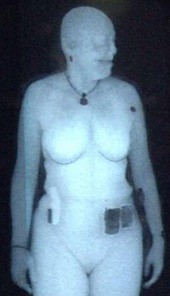
backscatter x-ray scan in which the body surface of a person is clearly visibleI’ve just been reading about backscatter X-rays and airport security in my local paper: UK brings in full body scanners. The UK is looking to push these into routine use, using the attempted attack at Christmas as an excuse. In this attack, the perpetrator had an incendiary device strapped to his leg, and managed to set his own pants on fire.

There has been controversy over the scanners since their existence hit the media several years ago. The full body scans show the body quite clearly – a bit like the images purported to be revealed by those “X-ray Glasses!!” advertised in old comic books.

Concern has largely centred around how the scanners might affect able-bodied cis people: that they will feel exposed, that the security people might be hur-hurring over their fat rolls or breasts, that the images might be saved. Security “experts” have scrambled to refute the claims, saying that only “same-sex” people will read the scans (as if this is supposed to be reassuring to non binary gendered people), that the scan reader will be in a separate room from the scannee, that the images will not be able to be saved with the technology. They assure us that there will be “privacy algorithms” in place.

If anyone believes airline security operators for a second when it comes to future commitments to respect the privacy of airline travellers? I’ve a harbour bridge I’d like to sell you.

The same security experts have assured the media that the scans will be optional, provided as a purely voluntary alternative to a full body pat-down. I’m going to go out on a limb right now and guess that the images are not, for example, an option for wheelchair users who can’t stand up out of the chair. Reassurance of options and choices are not particularly useful for the large swathes of the population who can’t access them.

Things that will likely show up in a full body scanner:

Urinary catheters.

Incontinence pads.

Colostomy and ileostomy bags.

PEG feeding tubes.

Mastectomy prostheses.

Certain medication pumps and implanted ports, such as insulin pumps.

TENS machines.

Pacemakers.

The bodies, including genitalia, of transgender and intersex and genderqueer people.

All of these are the signs of bodies already marginalised. Some of these signs may be clear on current security screenings – some may not.

People with marginalised bodies already have major issues with air travel – with the uncertainty of the security process, with the practicalities of dealing with aids and needs while travelling, with the spoon-sapping of travel, with no option but unfamiliar foods that may affect the body unpredictably, with the difficulty of maintaining personal privacy in prolonged periods in close quarters with others, with unpredictable delays that affect health, with security threats when bodies don’t ‘match’ identification documents.

Soon there may be one more element in the mix: the sure knowledge that one’s personal business will be laid bare in front of security-theatre goons who will almost certainly be poorly trained in disability awareness and gender tolerance.

I give it 24 hours before clandestine mobile phone images of travellers with marginalised bodies show up on the Internet.

Is this worth it?

Does Outright Speculation Make This Disabled Feminist Angry?

Answer: Yes.

Let’s talk about this piece-of-crap article recently published on that oh-so-“liberal” news n’ culture site, Salon.com. I’m prefacing this post with a warning for ableist language and concepts on the part of the article’s author, Rahul K. Parikh, M.D. The article begins as follows:

There was a time when a celebrity’s sudden death almost invariably meant illegal drugs…[a]nd so it seems with Brittany Murphy, the bubbly and bright actress who died of cardiac arrest at 32.

Yes, it seems. Point is, we don’t know much yet. There are other health-related issues or conditions that can lead to cardiac arrest, but is this acknowledged? Of course not! Parikh continues:

The coroner’s notes allegedly claim a pharmacopia in Murphy’s bathroom cabinet: Topamax (for seizures or migraines), methylprednisolone (a steroid), fluoxetine (an antidepressant), Klonopin (for anxiety), carbamazepine (for seizures or bipolar disorder), Ativan (for anxiety), Vicoprofen (pain reliever), propranolol (for hypertension, migraines or anxiety), Biaxin (an antibiotic), and hydrocodone (a narcotic pain reliever). Gone are the days of shameful crack pipes and empty gin bottles.

OH MY GOD, EVERYBODY PANIC.

Murphy’s medications, like those of [Heath] Ledger and Anna Nicole Smith, are on the shelves of your local drugstore, available with a simple trip to the doctor — or doctors — whom you merely need to convince that you need the stuff. Did one doctor prescribe her those meds? Did 10? We don’t yet know. But as a doctor myself, I just kept wondering (and not for the first time): What if doctors were more like librarians? Would Brittany Murphy still be alive?

Cue scary music! THE DANGER IS ON THE SHELVES OF YOUR LOCAL DRUGSTORE. Nevermind that people with chronic pain conditions and disabilities have to jump through numerous, often ridiculous hoops just to get, say, a month’s supply of medications that help them function and/or live life to the fullest extent possible. As one of these people, I am of the opinion that Parikh is being rather disingenuous here; these drugs, at least for us “average” folk with chronic pain issues, are usually not easy to obtain.

After nattering about how the medical field should follow the example of public libraries when it comes to monitoring people and their books meds, he continues:

One of the many negative consequences of such fragmentation is how ridiculously easy it can be to get drugs. Most doctors know patients who have desperately angled to get a prescription they don’t need, usually highly addictive pain medicines like Percocet or OxyContin. This is what we call “doctor shopping,” hopping from one physician to the next until they find someone willing to write a script. When the supply dries up, they go to another doctor, and then another. One 53-year-old man in California visited 183 doctors and 47 pharmacies in one year to support his addiction to painkillers.

Hey, nice use of anecdata there! What on earth does one 53 year-old guy in California have to do with Brittany Murphy’s situation? As for “most doctors” knowing a patient who has “angled” for meds they “don’t need” (who makes that judgement, I wonder?): cry me a goddamn river. The endless Helen Lovejoy-gasping about ADDICTION!!1 in fact makes it incredibly hard for some of us who need these medications to obtain them, and no amount of 1984-esque War is Peace anecdata–from someone, no less, who is supposed to help people in pain as part of his chosen occupation–is going to change that.

In short, the experiences of people with chronic pain are going be different than those of an able-bodied doctor, but nowhere is this acknowledged in this article–nor is it mentioned in many larger conversations about  painkillers and (possible) ADDICTION!!11.

Most of us who need these medications do not have the energy to doctor-shop. I do not wish to deny that painkiller addiction is a serious problem; it is, for some. Sadly, these sorts of “conversations” on the specter of supposedly widespread PAINKILLER ADDICTION!!!1–much like those focusing on the OBESITY CRISIS!!11–tend to focus entirely too much attention on extreme cases and anecdata, leaving out those who need these medications for legitimate medical reasons, and, I might add, some of whom spend a great portion of time proving said legitimacy in order to show that they are not addicts or doctor-shoppers.

But if “preventing” ADDICTION!11 in able-bodied people via endless hand-wringing about who “really” needs these drugs versus who doesn’t is the number one priority here, that is a problem. Yet again, the needs of those who are judged by society as most “important” or productive or fitting into able-bodied society are taken seriously, and the needs of those who do not fit this mold–because they need painkillers for actual pain and are therefore bad/unproductive/just a bunch of whiners–are ignored, or worse, actively shamed and castigated for things or circumstances that they cannot control.

And, as OuyangDan pointed out so eloquently on this very blog, there are a lot of things that we don’t know about Brittany Murphy’s death. Using her death as a poorly-researched, almost totally speculative “example” of the dangers of painkiller ADDICTION!!11 is not only tasteless, but it distracts from how ridiculously the concerns about painkillers, “legitimacy” and the specter of addiction are often framed by (mostly privileged) people who do not deal with these things in their daily lives.

Less infuriating: Many of the commenters seem to agree that this article and its “speculation” went too far, which is unusual for Salon commenters, as most of them tend to exemplify the worst of privileged white “liberalism” on a regular basis (as you would expect, this includes loads of abled privilege and the anecdata to back up their uninformed opinions).

Subtitles in Assassin’s Creed II and Ubisoft’s Pledge

I am somewhat of a gamer. I am not by any means an avid gamer or someone you should call up with questions. If you want a review of how easy a game is to play or how not confusing your controls are, I am your girl*.

I am mostly a computer gamer. I like my World of Warcraft just fine, thank-you. It has a lot of room for critique, and I have some letter writing campaigns to Blizzard in progress. But I like it. I have no love for Warhammer Online, having never played it after being promised by multiple reliable sources that I would be able to play it on my Mac, and after purchasing the Special Edition in order to get into the Beta, was most unpleasantly surprised. Whatthefuckever, I turned that store credit into a Wii Fit, something I actually used. And, no, I don’t care that you can now get it for Mac, they already shat in my Cinnamon Life. I am digressing when I just wanted to say that I prefer computer over console because I tend to find console controls too confusing for me —  all the button combinations are too much to keep track of. I like to set up my buttons in a row and get my “Pew Pew Moar” on. If it is more complicated than original Nintendo’s Super Mario Bros., I don’t really enjoy it. I just don’t have the reaction times or memory to figure out all of those buttons (and I don’t need an evo psych lecture on how girls just don’t have those skills, because I have many gamer skills that translate well into the PvP aspects of WoW…I just don’t have it for console gaming).

One thing that endeared me to WoW, however, is that all the dialogue is subtitled. I am not deaf, but I do sometimes have trouble sorting dialogue out from ambient noise, both in game and out. I don’t want to have to miss something in an otherwise mostly enjoyable game because I can’t understand what the NPCs are saying. It doesn’t matter how high you turn the volume, you just can’t get everything. WoW even lets me know when someone is yelling.

Back to console games…

One console game that I did pick up was Ubisoft’s Assassin’s Creed. There was a lot of excitement over this game, it was anxiously awaited — one of the most anticipated games of the year of its release. There was also a huge deal surrounding one of its lead developers that I will leave you to read up on,I just am too tired to rehash it — I was thrilled that it didn’t stop Jade Raymond from being a part of ASII’s team (no transcript at the link). Just for a fun exercise, Google “Jade Raymond + Assassin’s Creed II” and see how many search results come up with anything that has to do with how good she is at being a video game developer or producer, and then tell me why more women don’t go into that industry. The team at Ubisoft put in the beginning of the game that it was developed by a team of multi-cultural and religiously sensitive people from many diverse backgrounds. I found the game fantastic. The Guy beat it in just a couple of days (he eats games for breakfast like that), even if the ending did make him want to put it in the freezer, and even though I have only recently tried it, I have really enjoyed it. To me, the controls are really simple, the game play is methodical (note: things that really piss some gamers off appeal to me, as in part of my OC nature really likes the repetitive storyline, and the different things to complete. I *love* that, because it allows me to zone out, clearing my mind.), and the game itself is Really Fucking Beautiful. I love going to all the checkpoints and using the “eagle vision”, just viewing the cities.

One aspect that was missing from this design team, it seems, was someone who had input on accessibility, because one complaint I had, even before I was invested in disability activism to the degree I am now, is that it had no subtitles. Like I said, I often miss dialogue during cut scenes, and even if that does not affect my game play, it affects my gaming experience.

When Assassin’s Creed II came out I read in The Guys Game Informer that they made a lot of changes based on what fans wrote to Ubisoft asking for. Before I was willing to get this for The Guy for X-mas this year, I needed to see two things: 1) That the playable character could not drown in a two fucking inches of water, and 2) subtitles. Well what do you know, this iteration’s assassin can fucking swim, and Assassin’s Creed II includes subtitles for all of the game play.

Rawk.

We have it, and it both translates the Italian and has decent subtitles, although it doesn’t describe non-spoken sounds.

There’s more.

Ubisoft, apparently has made a commitment that they will always include the considerations of deaf and hard-of-hearing gamers in the development phases of their gaming creation. This is exciting news for me, coming from a company that I have come to really like. By like, I mean, has made the first non-Nintendo based console game that I can actually play (this is also because I find the new black controller included w/ the X-Box Elite military appreciation smaller than the original, and fits comfortably in my hands, even on a moderate pain day).

I am looking forward to finishing Assassin’s Creed so that I can move on to ASII, if for no other reason than for the subtitles. I wish they had made this pledge long ago. It is worth noting that I read on a gamer message board somewhere (I can’t find it now) that someone had written them, and they responded, saying they took that complaint very seriously, and now, here they have. This has raised Ubisoft in my mind.

Like it was hard to do at this point.

*I do sometimes call myself girl. I don’t have a problem with this.

More articles on subtitles in video games: Subtitles: Increasing Game Accessibility, Comprehension (Gamasutra)

On Speculation and Boundaries…

Brittany Murphy died today.

It took exactly five seconds for the speculation to start up about why she would die of cardiac arrest at the tender age of 32, and not quite double that for the snarky comments to seep out of the woodwork. Because certainly if she had an existing heart condition we all would have known about it, since we have that right to her privacy.

What we have, much like the public consumption we have of celebrities, especially women, is a perceived right to make snap judgments about their lives and their health.

Brittany Murphy’s death is tragic on its own merits. She was talented and only 32.

And if there is any truth to the speculation, then she was sick. If she was indeed sick, then we, despite what we think, do not have a right to flaunt that illness about. She was ill, and she lost. And to me, that means something, on a human, and mortal level. There but for the grace and all of that. When I read the comments that speculate about what illnesses she certainly had or what addictions would be necessary to cause this premature death it is like nails on a chalkboard while chewing tinfoil whilst walking on broken glass but not the fun Annie Lennox version with adorably mistreated Hugh Laurie. If there is any truth to it then she was one of us. She was possibly like me and she lost. That scares me at my core. That was one of us in there and instead of having a moment to appreciate the gravity of that we are ripping her apart and we don’t even know. We Don’t Fucking Know.

Also, last I checked it is bad form to speak ill of the dead. But I suppose I am still an idealistic, silly girl to expect people to treat other people with human dignity. I have spent too much time in social justice for that.

If not, then her death was simply a tragic and random happenstance.

If any information is released, we have to wait for it and presume that it is the truth, and if not, we have to go on with what we have.

And either way, it isn’t our business, really.

She died, and that itself is enough. It should be. She gave us entertainment and amusement. She did what she loved with her life.

We should give her a modicum of respect in death.

May she rest in peace.

For Cereal, Internet?

A periodic feature in which we highlight some of the more ableist posts and comments in the blogosphere – the things that made us throw up our hands and ask “FOR CEREAL???” *

Today’s edition: a post at Jezebel titled “Woman, Go Take Your Pills!”: Schoolgirls Respond To Samantha Bee’s Christmas Conspiracies. Which, already – are you for cereal, Jezebel? The post reviews a Daily Show segment in which Samantha Bee meets with schoolgirls and, in the tradition of the Daily Show, presents outlandish and absurd positions to them as serious arguments. For example, she tells them that she doesn’t believe that Obama was born in the United States. The humor in the segment is the shocked and outraged responses from the schoolgirls to these positions and arguments.

At one point in the segment, one of the schoolgirls tells Bee “woman, go take your pills.” Which is problematic for a whole slew of reasons – the assumption that irrational or absurd political arguments are a sign of underlying mental illness, the assumption that medication is an appropriate treatment for all mental illnesses, the assumption that bystanders have a right to dictate the treatment a person pursues or receives for a mental illness. But none of these problems seem to have occurred to Anna at Jezebel, who chose the phrase to title the piece.

And the immediate response of commenters wasn’t to push back against this ableism, or to explain why using such a phrase is problematic, but to embrace the phrase as their “new smackdown,” per boobookitteh, or celebrating the “straightforward verbal beatdown these girls delivered so awesomely,” per BillyPilgrimisnotmylover.

So I award a “FOR CEREAL?” to Jezebel for approving of the phrase and using it to title their post, and a second “NO REALLY, FOR CEREAL?!” to the commenters for enthusiastically embracing this offensive phrase as their new go-to insult.

*(Actually, what I say, and what I considered titling this, is “Are You Fucking Kidding Me With This Crap, Internet?” but I’m trying to use less salty language.)

“Bad Activist” moments

I read a blog post recently by a woman with muscular dystrophy and her experiences going out to eat in restaurants. The author mentioned how wait staff rarely give her a menu, or give her a children’s menu instead of the standard menu. When this happens, she often just looks on with her mom’s menu rather than asking the wait staff to give her her own adult menu. She described that as a “bad activist moment.” While I enjoyed and appreciated the rest of the post, and marveled at the ableism she routinely experiences – wait staff giving her a sippy cup to use?! – the idea of “bad activist moments” particularly stuck with me.

A “bad activist moment,” if I understand it correctly, is a potential opportunity to highlight ableism, educate TABs on the abilities of a PWD, and instruct people on the correct way to interact with a PWD. It could also apply in other contexts – the opportunity to highlight and correct patriarchal or sexist behavior, or racist behavior, or ageist behavior, or any number of other discriminatory and oppressive behaviors. In this context, the person experiencing or observing the problematic behavior is a member of the class negatively affected by such behavior, but it could also, for example, extend to me as a white woman observing behavior that discriminates against Latinos.

I definitely think this idea has value and recognize that the term “bad activist moment” is likely shorthand for “an identifiable moment of opportunity for direct personal activism that I didn’t take” rather than a judgment on whether the person is actually at heart a good or bad activist. But I’m concerned that framing it as a “bad activist moment” suggests that to be a good activist, we must speak up and speak out Every Single Time we observe negative behavior, not just that affecting PWDs, but that affecting or oppressing any minority group or marginalized class. I know that I do not do this and if I did, I would likely suffer significant consequences. I feel I’m already on the edge of being characterized (and thus dismissed) as the girl who has a problem with everything and is hyper-sensitive on these issues and cannot in any way ever take a joke ever – and that’s with me pointing out about 1 in ever 10 problems I see. I worry that if I devoted more time and energy to those issues, I’d be pigeonholed as “politically correct girl” and nothing I said would be taken seriously or considered.

More seriously, though, it is infinitely more risky to raise issues of discrimination and oppression when you are part of the group that is being discriminated against or oppressed. Not only might this require someone who is “passing” to identify and out themselves, but explicitly claiming membership in the targeted group can lead to further discrimination and marginalization. In the racial context, it’s often characterized (and thus dismissed) as someone “playing the race card.” I’m not aware of a similar term in the disability context, but the trope of an “uppity” activist who “thinks they’re entitled to something” extends to all oppressed or marginalized groups. Identifying as such opens a person up to further attacks and discrimination and even physical violence.

Even without these very real risks, I believe that we should all allow ourselves the option to pass up potential opportunities for activism while still considering ourselves to be good and powerful activists. Even if all we did was live our lives as PWDs, that in itself would be an activist act, demonstrating that PWDs have interests, passions, relationships, emotions, LIVES. We would qualify as activists even if we passed up every single potential opportunity to do affirmative activism work.

My ultra-wise co-contributor Chally once told me that taking care of myself was a feminist act. Placing myself at the top of my priorities – even though I am a woman and “should” prioritize caring for others or building a family, even though I am a PWD and thus “have minimal value or worth to society” – is an act of activism. Can I do more than that? Yes, and I do, but I always try to keep in mind that my activism is and should be secondary to my own well being. In part because I’m not going to be able to do any activism at all if I burn out or hurt myself physically or mentally doing activism work. But also because the simple act of prioritizing myself is, in itself, activism.

So take the opportunities for activism that you feel you can. And let the others go by. And remind yourself at the end of each day that you were a good activist that day.

Why ‘What People Think’ Matters

Permanent Limited Duty is an option that a service member has to being fully medically discharged.  It allows the member to stay active duty on a strict schedule and with very strict limitations of duty.  It allows them to fulfill their contract obligation as opposed to being released from it early.  There are specific criteria that must be fulfilled, including proving a need to be allowed to placed on PERMLIMDU Status.  For me, things like having a minor child who needed insurance and being unmarried and without another source of income would have been sufficient for me to prove a need for PERMLIMDU.  There are other factors involved, including approval from your CO and CoC.

In the year leading up to my Medical Board and subsequent discharge I was in so much pain and so tired all the damn time and overall not coping well with what was going on with my lack of medical care.  On top of all of my work and training and single motherhood was Physical Training (PT), which was increasing because as my body was struggling my readiness standards were falling due to my inability to push through the pain.  As I was forced to ease up I gained a little weight which meant I had to increase my PT.  Increased PT increased my pain, which increased my problems overall, and somewhere along the line something broke completely inside me.  It was a vicious circle of some of the most cruel means of my life.  I needed more PT, but increasing PT caused  more injury that meant I had to decrease the type, intensity and amount of PT my doctors would let me do.  That decrease caused weight gain…you can see where this is going…

Long story short, I had to be put on a day shift and have my hours reduced to half days because I was not doing so well.  While the rest of my friends and peers were moving on to the things that we had now spent over three years training for, things that were going to expand their careers, the actual finish line of all we had worked for, and I was riding a desk.  To be fair, it was a job I really grew to love and something I could see myself doing again.  My direct supervisor was awesome, and our division boss was incredible.  To date he is the most wonderful Senior Enlisted person I have ever had the honor of working for who also happened to be very supportive of my medical process.  But it wasn’t what I had trained for, and the sudden disappearance of all of my friends made that even more heavy for me.  I was devastated that I was missing that.  I felt, once again, like a failure, like my body was a failure.  The career I had worked for was crashing down around me and it seemed I had no one to support me through it.

When you are going through a serious medical Thing (for lack of a better…whatever) you start to notice that people tend to disappear.  I don’t know if it is too hard for them to handle or if they don’t give a fuck or what…but you run out of people who you can call to take you to a doctor’s appointment because whatever medication you are on makes you so dizzy you really shouldn’t drive, or people who you can call to watch your children while you go to physio.  You can’t get someone to hold your hand during an X-ray, let alone get them out for coffee.  While I adamantly maintain that my medical problems and disability were not brought on by depression as some would have you believe, being utterly alone during this time cause me an at the time crushing depression.  Sometimes I still feel it. I literally did not hear from my former friends.  Sometimes if you run into people you used to have energy to club or shop with they bring it up as a polite thing to say, kind of like when people say “How ya doin’?” and never really expect you to answer.  So when they would say “How’s…all your…stuff?” I would tell them, “Oh, it’s a big boring mess, how’re you doing?”.  If I actually did talk about it I would notice that they tended to not really want to talk to me again (even though most of them had to eventually because of my new job).

I still had to take my yearly training.  During my yearly training our annual Evaluations came out.  I was pleasantly surprised to receive a relatively high mark on mine.  My boss apparently thought that I was doing a lot in the hours I was allowed to be there during the day.  I worked as hard as I could with what I had to give, and someone noticed.  I was beginning to feel as though maybe I could still do something productive in the Navy, as if the thoughts of PERMLIMDU Status wouldn’t be the end of the World as I knew it.  I began to seriously consider it.  I was in my annual training with the sister of a friend whom I still had occasional contact with, and who was unhappy with her own eval.  As much as I sympathized with her situation, I understood that due to my circumstances our peer groups were different, and my evaluation was not competitive with hers.  I made it a point to not discuss my eval with her or even bring it up.  But when she asked me point blank about mine, my refusal to answer made her assume that mine was better, and this caused a riff between us that I had hoped to avoid. I felt awful, because she was a really great person whom I had actually though I had made friends with. It is such a tricky thing to make new friends when you are going through so much…

It was very difficult.  Nothing I could say was good enough.  It wasn’t fair, she said.  It was wrong, she said.  I was on the same fitness enhancement, she said, and I didn’t even work shift work, she said.  I only got that mark because I sucked up to my boss, she said, and because I “lucked” into a job above my pay grade, she said.  All she could see were the positive outcomes of what was, for me, a really shitty situation.  The one good thing I had going for me was that someone had need of a body to fill a position when my world fell apart, and that it could have been a semi-permanent thing.

That night I received a phone call from my friend, inviting me to meet her for coffee…something that we hadn’t done in I don’t know how long.  She certainly hadn’t had time for socializing in a long time, it seemed, and I was pleasantly surprised.  We met at the Starbucks near my house, another nicety, so I didn’t have to go far.  She treated and we split a big chocolate brownie, because we shared that superhuman tolerance I brag about.  We had polite chit chat and I really felt great getting to talk to her.

Until she brought up my eval.

She brought me there to defend her sister’s side of the whole thing — to tell me that she didn’t think it was fair that I would try to stay on in an office where I could get unfair evals when the rest of my peers were doing real jobs in the Navy.  I was so ashamed that I didn’t even think to argue on my own behalf.  To tell her that it would have been the best thing for me to do so.  That it would mean that I could still give my Kid insurance and have an income and finish my obligation.  That I would still have some connection to all the work I had put in.  But again, all anyone could see was how my situation was unfair to them (even though, in reality, it wasn’t, since my evaluations had no effect whatsoever, on theirs, in case I haven’t made that clear). No one else could see beyond how they felt, to what it meant for me and my family, to me and all the work I had done. Instead of a legacy of nothing finished, I could give something back. So, I lied. I said that I didn’t have that intention — I said I intended to quit and just go away.

But now I was just ashamed.

I was so embarrassed.  I put on my Brave Face and finished up the visit as well as I could.  I cried the whole way home.  I remember deciding that night that if I chose PERMLIMDU that people would all think that I was some big lazy slacker.  A Bad Cripple, even though some people would never see me as disabled at all, and why should they? I hadn’t even considered that label for myself yet. They would all see me as someone who was there to milk some system and gain some unearned privilege.  I had let someone who was supposed to be my friend shame me into giving up things that I needed for my life. So, when the choice came up with the Medical Board Liason and my Division Officer, I turned it down. Again, I lied. I said that it wasn’t something I thought I could do. It wasn’t what I joined the Navy to do, I said.

It is easy to say “who cares what people think” because we all want to assume that we don’t make decisions based on the feelings of others. But the guilt and shame we feel at the stares and hands of other people is hard to take, so much so that we will often expend our spoons to make the feelings go away — even if it is not to our own benefit.

One thing I should add: Through it all, I learned the value of the friends who come out of seemingly nowhere to support you, just when you least expect it, and the value of friends in Bloglandia. Never let anyone tell you that your blog world friends aren’t as good as Meat World friends. They are all appreciated, especially as the wounds of the lost friends heal. The Meat World friends who held on might be few and far between, but they have been a much needed comfort through the many tears.
It’s a scooter, not a Mack truck

Something I’ve noticed a lot since starting to drive a scooter is how TERRIFIED people are.

Really.

On the sidewalks, I zoom along at six kilometres an hour if I’m unaccompanied and there’s no one around. That feels really zoomy to me, having not locomoted that fast bipedally for quite some time.

But when I’m in a place with people around, or in a shopping centre, I dial the speed right down to minimum. This is actually a fairly slow walking pace.

Yet every single time, people look frightened, and leap out of my way – when they’re not deliberately ignoring me and completely blocking the way while I wait or request passage.

Partners grab their partners to pull them aside, with alarmed looks on their faces, as if tackling them out of the path of a speeding bus in a spectacular Hollywood scene. Parents grab their toddlers and whisk them into arms, glaring at me as if I was charging the kid brandishing a sword and ululating. People in groups jolt visibly when and if they decide to finally acknowledge my existence, and make a giant production, involving a lot of discussion and back and forth and extendings-of-arms, of shuffling each other around to make space for me to get by. People blocking aisles with their angled trolleys ignore me for as long as possible, then make a big deal of moving the trolley, as if they’re compassionate solicitous generous souls who are doing me a giant favour.

People. PEOPLE. It isn’t a drama. It isn’t a big deal. It’s just a scooter with wheels. I’m quite obviously riding slowly and carefully – slower than you’re walking, most of the time. I can see your toddler, your husband, your friend, with these here eyes in my head, and much as I occasionally joke about scooter-mounted flamethrowers, I’m not actually planning to mow them down in cold blood. I don’t take up five metres of side-to-side space; you don’t need to flatten yourself against the wall as if you’re in a commando movie; you need only make enough space for me to get where I’m going.

Just treat me as you would any other human.