Category Archives: recommended reading

Recommended Reading for May 5, 2010

A tree with signs showing wheelchairs with arrows pointing left and forward
Description: A tree with signs showing wheelchairs with arrows pointing left and forward.

Chally is interviewed by BitchMagazine! There is audio, and a transcript!

My full-length interview with Chally, who talks about her love of sci-fi, why it’s problematic to have feminist “icons,” her experience as a teen in social justice movement, and of course, the internet.

Disability in Speculative Fiction: Monsters, Mutants, and Muggles

Fiction reflects social attitudes, and the social attitudes to disabled people tend to suck. Disabled people are presented as scary, pathetic, exotic, demanding, laughable, etc.

But some tropes are popular/unique to SF.

It’s not all bad: speculative fiction allows for powerful allegory, and can also make very interesting explorations/extrapolations of future attitudes/experiences of disability.

Elton John’s letter to Ryan White, 20 years after his death from AIDS

When the media heralded you as an “innocent victim” because you had contracted AIDS through a blood transfusion, you rejected that label and stood in solidarity with thousands of HIV-positive women and men. You reminded America that all victims of AIDS are innocent.

When you became a celebrity, you embraced the opportunity to educate the nation about the AIDS epidemic, even though your only wish was to live an ordinary life.

Ryan, I wish you could know how much the world has changed since 1990, and how much you changed it.

Is being an ordinary human possible?

How and why I wonder are people with no knowledge of disability so stupid. In large part I blame the mainstream media. Sob stories about disability abound. Here I refer to the heart breaking story about an ordinary person that is struck down by a disability and their life is destroyed. The reader counts his or her blessings and moves on with their day. The message however is clear, disability is bad and can run your life. The other extreme reference to disability is one I have learned to detest because I am too often put in this category–the super cripple! There was a long article in the New York Times that took the super cripple to a new and bizarre extreme. The story was a hybrid–the person portrayed, Dayniah Manderson, was a super cripple but doomed by their disability at the same time. Here I am referring to the NYT story “Bent Not Broken” by Kassie Bracken and Erik Olson (April 30) that was accompanied by a ten minute video. By the time I was done reading this story I was livid. Maudlin in the extreme, lines such as “From the time she wakes up until the hour she is lifted into bed, each moment can be a reminder of what does not fit–a spirit that does not fit a body, a body that does not fit a wheelchair, a wheelchair that does not fit a world” were painful to read. Worse yet her friend and doctor, Roberta Shapiro, who “counseled” Manderson and secured life saving surgery for her dramatically states “I couldn’t live inside her body”.

Incarcerated Girls and the HPV Vaccine [United States]

Studies show that incarcerated girls are less likely to have health insurance and more likely to live in poverty than their peers in the mainstream population. These young women are often in the exact vulnerable positions described by Szabo and others.

Writing My Own

I learned the names of Immanuel Kant, Rosseau, and Sir Thomas More in secondary school. I cannot name similar modern philosophers from Asia. They are not taught, which led me to think they were not as important, not as good. In first year of university, my Introduction to Philosophy class textbook featured exclusively white men. A fine sampling of the thought that has shaped the Western-dominated modern world.

So when I wrote, I wrote characters and stories informed by what I consumed. They were cheap knock-offs of medieval romance novels, Forgotten Realms stories, and Disney movies. I only ever wrote a single character who was Malaysian, and she was my secret Mary Sue and had adventures that took her into otherworldly realms, never truly part of the Malaysian landscape.

The Life Expectancy of People with Down Syndrome

For most of history, then, the life expectancy of people with Down was very low. But, with advances in knowledge and access to health care, life expectancy has risen dramatically… especially for white people.

Canadians! Bill C-11, altering the Refugee system: signal-boosting to Canadians

“The government has recently introduced Bill C-11, legislation that would dramatically change the current legislation around Immigration and Refugee Protection. There are a number of problems with this legislation, which appears to have been drafted without input from key stakeholders. The Refugee Lawyers Association, Canadian Council of Refugees, Amnesty International, and the Canadian Bar Association all hold the position that this Bill should be referred to the House of Commons Standing Committee on Citizenship and Immigration BEFORE A SECOND READING. This provides the best opportunity to make amendments to the Bill.

I have contacted my MP (by email) and am forwarding a “model” letter in case you wish to contact your MP. The letter (put out by the Canadian Council for Refugees) outlines some of the main problems with the legislation, which will make it much more difficult for refugees to get a fair hearing in Canada. If you have the time and agree with the issues below, please contact your MP as well.
Recommended reading for May 4, 2010

RMJ: Disability and birth control, part 1

Widespread (rather than individual) centralization of birth control in feminism alienates and marginalizes their already problematized bodies: trans women, intersex women, older women, women with disabilities that affect their reproductive system, asexual women, women who want to get pregnant. Not to mention the loaded history of otherwise non-privileged bodies with birth control in light of the eugenics movement.

Eugenia: Siempre eqivocada

The fact is that, with regards to medical care, the old customer service adage is reversed: if the customer is always right, in Bolivia, the patient is always wrong. In Bolivia, where higher education is less of a universal right than a luxury for the few, poorer, uneducated Bolivians are taught to treat doctors and other professionals as their superiors.

meowser: BADD 2010: The Total Erasure of Partial Disability

In order to “make it” at anything I thought was worth doing, you had to be willing to do some serious OT, put in the extra time, go the extra mile, get that extra degree while still working full-time, put your nose to the grindstone. In other words, prove you weren’t just some lazy slacker who didn’t want to work. And I knew I…just couldn’t. And I felt terrible about that, especially when I got into my 30s and realized that all those overworked, underpaid copy editors (and other people who had done the nose-to-the-grindstone thing) now had real careers making real money, and I was still stuck at the McJob level.

Jha: My Invisible Disability

My depression is a setback. It means I cannot be continuously gung-ho about things like I would like to be. It means that sometimes I have to withdraw from the world or be overcome with exhaustion. I am easily fatigued. Some days, I want to sleep in the entire day and not have to face the world. Other times, I imagine being in a situation where I wouldn’t have a tomorrow to deal with. This doesn’t make me a failure, and it doesn’t make me, or anybody else like me, any less of a person deserving basic respect and consideration.

Latoya: Open Thread: Science, Conclusions, and Assumptions

[O]ne of the most common requests for content on Racialicious tends to come from people who work in public health. One issue in particular they have asked me to spotlight is the issue of clinical trials. For many years, the assumption was that the effects of medical conditions and medicine side effects would be similar on everyone, even though the only people involved in clinical trials were white males.

Valerie Ulene (Los Angeles Times): When prescribing a drug, doctors have many choices — too many, in some cases

Nobody wants to be told that he or she has a medical problem that can’t be treated, that there’s no medication that will help. For most common ailments, that’s rarely a problem; the trouble comes instead when it’s time to choose a drug. Sometimes there are just too many choices.

And, of course, there are numerous posts from BADD 2010, organized and collected by Goldfish at Diary of a Goldfish!

BADD: How can I support Blogging Against Disablism Day?

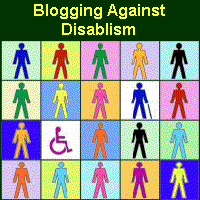
Blogging Against Disablism Day, May 1st 2010Today is the “beginning” of Blogging Against Disablism Day 2010. I put beginning in quotes there not just because the day is done in Australia and the West Coast of Canada is still waking up, but because Diary of a Goldfish, who hosts BADD every year, acknowledges that people with disabilities are not necessarily able to post precisely on the date of a blog swarm – that there is inherent disablism in demanding that disabled people write a post on a specific time table.

Every year since I started participating in BADD, I’ve had many people ask me how they – both as currently non-disabled people, and as people with disabilities – can best participate in BADD if they don’t want to, or can’t, write a post, put up a photo, or create a video or podcast. Here is just a short list of suggestions:

Check out the ever-growing list of BADD posts over at Diary of a Goldfish. Even “just” (there’s no just about your time/energy investment!) reading people’s posts and learning about their experiences contributes a lot to BADD. Blogswarms like this are all about raising awareness, and raising your own awareness is just as important. As well, you may find a whole new set of blogs to add to your blog-reading lists. There are so many bloggers with disabilities out there, fighting the good fight against ableism every day.

Comment on some BADD posts. I know that every time I write something and it gets no comments, I feel like I’ve put effort out for nothing. [This is not a demand for more comments for me! I’m just sayin’.] If you have the time/energy to do so, I would really encourage you to leave comments in support of BADD posts. They don’t have to be lengthy: even just “This post was great, thank you for writing it” can make a difference. If you’re up to writing more, go for it! But just leaving words of support can be a big deal.

Tell people about the awesome posts you’ve read. If you have a blog, link your favourite BADD posts so others can check them out – if not today, then over the next few days, or even weeks. Months. They’re not going anywhere, and although we all hope the prejudices against people with disabilities are going to disappear, that’s probably not going anywhere anytime soon, either. There’s nothing saying you have to only link to BADD posts this week. If you’ve got a twitter account, tweet some links to your followers! The hash-tag for BADD seems to be #badd, but I like to also tag my tweets #disability as well. (This is selfish on my part – I follow the #disability tags on twitter.)

Think about dis/ableism in your every-day life. This one is mostly for the non-disabled people, or for people like me – I always need to remind myself to think outside my box of “what disability looks like”. There are huge swaths of my workplace that someone in a wheelchair can’t get in, and I went to a university last week that claimed it was impossible to put floor announcements in their elevators. Many [not all – I’ve heard very good things about some places, like L’Arche] of the group homes in Canada for people with cognitive impairments are more like prisons than the “home-like” environment they claim to be. The websites for each of the major political parties in Canada are inaccessible to many people with disabilities, and events that are held for “all Canadians” have no captioning, no visual description, and no way for Sign users to participate.

I think BADD is a great opportunity to see just how much is out there about disability on the internet. For disabled people who may be feeling isolated, it’s a great time to see just how many people are out there that struggle with similar issues. For the non-disabled, it’s a great way to start educating yourself about disability issues.

The Blogging Against Disablism 2010 Page will update throughout the day. Here’s just a tiny selection of posts that I’ve had the chance to read, and highly recommend.

Recommended Reading for April 27, 2010

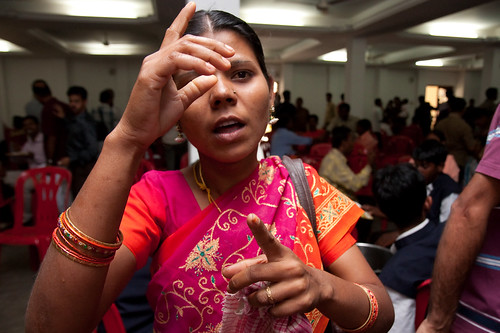
A young Indian woman, wearing a brightly-patterned sari, using Sign.
A young deaf woman talks passionately as lunch is served following the Kerala Sign Language Bible dedication event in Kochi, India. Over 1200 deaf people attended the event, a small representation of the estimated 9 million deaf people in India.
For more: Door International

Where the Disabled are not welcome

I would love it if you would spend a day looking at the various buildings that you enter and consider how easy they are to enter or exit. If there are no barriers to entrance, how wide is the walk way? Is it easy to negotiate without pulling things off of the racks or shelves? Are items set down low so that they are easy to reach? If someone is using a mobility devise, is the isle wide enough to go down with another person, or will the mobility device completely block the way? Is staff easily visible to help with items? Are the bathrooms completely accessible? Is the change room completely accessible?

The Kids are (kinda) alright: crack babies speak out [There’s a video that opens this piece – as I’m compiling these links, I can’t see it, so I can’t tell you what’s in it. Hence I have the note to edit this post before it goes live]

I enjoyed Vargas’ article, but I still have questions surrounding the role of race.

Crack was a drug with a heavy racial identification – while all types of people used it, the most prominent image of a crack user was a black person. Vargas’ article discusses how experts learned from the crack baby hysteria and have not rushed to proclaim dire circumstances for children that are turning up meth exposed. But is the lack of hype due to meth being a white identified drug? Also, the pictorial accompanying the article focuses on Anzelone, and his nuclear family. Was there a difference in recovery and allocation resources by race? If so, how did that impact the lives and fates of these kids?

Following Up On What Neil Gaiman Said

Part of why I am taking the time to lay it out is my second reason for this post. I think it important that we see how celebrity fandom can obscure the work that my original post (and all my work on this blog) is trying to do. That is, pushing everyone to think about HOW they think about American Indians, what they THINK they know about American Indians, and how all of that comes together in the words they write and speak aloud.

Why are iPad Factory Workers killing themselves?

A growing string of worker suicides and attempts has plagued a Chinese factory operated by Foxconn, the China-based tech company that produces, among other products, the new Apple iPad. In the past month, four employees at a single factory have attempted suicide, and 11 workers have killed themselves since 2007. And perhaps even more telling, all four of the most recent attempts have taken place at the factory. What is happening to these workers that is causing so many to turn to suicide?

The Madwoman in the Attic

Unfortunately, the programme finishes on the rather clichéd interpretation that the novels demonstrate how women who didn’t conform ended up being branded mad and locked up – essentially, madness as a form of female repression.

This is the classic feminist criticism of historical ideas about madness and despite there being some truth to it, it is only supportable by ignoring the other side of the coin – the traditional interplay between insanity and masculinity.

News Headlines:

Canada: Manitoba Police use taser on mental health patient

US: Civil Rights Division pushes for Internet Accessibility

Taking a fresh look at brain injury: Having troops in combat has revived interest in concussive effects of bomb blasts

Apple admits using Child Labour [in a plant where people have been disabled by chemicals]

Recommended Reading for April 26, 2010

As I’m writing this, I’m still on my trip, so again – very quick! [The conference has been awesome, y’all. Seriously – I met so many great people and had so many great conversations. And people liked my presentation!]

The Lady Thing I Won’t Talk About, Even With Feminists

So, I have been thinking (ahahaha, I know, right? I NEVER do that). And it was because of the Jezebel post about the MTV True Life episode, which I just watched, on Body Dysmorphic Disorder.

And, you know, it’s MTV, so it’s not the most tasteful or thoughtful show, but: I don’t really want to talk about reality TV. I was thinking about how being feminist and being aware of privilege makes me really struggle with my own BDD.

I was diagnosed four years ago. It’s definitely gotten worse as time as gone by, and exponentially worse after the rape. It’s also not a disorder that stands alone; it ties in to my bipolar disorder, my anxiety problems.

Autistic Teen Charged With Assault, Disorderly Conduct

Via Terri over at Barriers, Brigdes and Books comes news that an autistic teen was charged with assault and disorderly conduct a few weeks ago, after he became physically aggressive when there were four fire drills in one morning at his school. We do not know whether an appropriate behavior intervention plan was in place, as should have been the case.

I’ve Gone and Done It Now

I have written a manifesto. It’s short as manifestos go… and I think fairly low on scary ramblings (edit, edit, edit!!! 🙂

Here it is:

I believe in the Disability Rights Community.

That is to say, I believe that disability is a natural part of the human experience that is often misunderstood by our culture and I believe in the people with disabilities and their allies who recognize that human beings are undiminished by disability. I support these people who strive for respect, recognition and rights.

Arizona’s Immigration Laws

I came here to study at a university. I took a job from approximately 299 Americans who, presumably, could have done it as well as I did. (Interestingly, the other person on the shortlist told me that he believed hiring me was an act of discrimination and that I had “dogged” him.) I have brown skin. I married an American. I was told I was only into him for the visa. (Almost 20 years later, I still worry about whether I have to prove our relationship is genuine.) I use the health care system. I have paid my speeding ticket and been to traffic school. I pay my taxes. I very definitely pay my taxes; I have been audited and found to owe nothing. And a little while ago, I began the process to naturalize myself as a citizen.

Spending a Moment with You

If you live with a disability, I encourage you to speak up about your experiences. Make a YouTube video, start a blog, participate in a message board. And let me know about it.

I look forward to spending a moment with you.

Recommended Reading for April 23, 2010

This is going to be a quick one from me as I’m out of town right now, attending a Graduate Student Conference on Disability Studies, because my life is awesome. I can’t wait to tell everyone all about it, at length.

Disability Blog Carnival 65: Balance is up at The River of Jordan! The posts are, as always, varied and wonderful.

Eyesight to the Blind [Problematic language in title – see Rainbow’s comment]

When my great-aunt says she’ll pray for me, she’s not saying it because there’s something messed up about me that needs fixing. She’s saying it because she prays for the people she loves. The person I encountered today wasn’t saying it to everybody she passed. She probably saw a person using a mobility scooter and thought something like “disabled person = in need of healing”.

What would healing look like for me?

Tributes paid to David Morris

Tributes have been paid to David Morris, much-loved and respected disability campaigner and mayoral adviser, who passed away yesterday (Sunday), aged 51.

Mr Morris, who was on secondment from his role as Senior Policy Advisor on Disability to the Mayor of London, had been working with the London Organising Committee of the Olympic Games (LOCOG) as External Access and Inclusion Coordinator.

Wild Ride for Number 9

In the end, the name was the same atop the wheelchair division of the Boston Marathon yesterday, but for Ernst Van Dyk it hardly was a typical triumph.

The South African won for a record ninth time, but it was his toughest victory yet. Van Dyk had to surge over the final 2 miles to overtake American Krige Schabort to finish in 1:26:53, a mere 3 seconds ahead of Schabort.

An Open Letter to Charles Tan

When I read your essay you seemed to define promoting cultural diversity by “encouraging people to write about other cultures”. Certainly Buck was encouraged and rewarded – she received a Pulitzer in 1932 and a Nobel Prize in 1938 “for her rich and truly epic descriptions of peasant life in China”. If writing about the Other were such a truly prodigious feat, then surely Vikram Seth should be bestowed with more renown for not one, but two books, set entirely in white people western land?

But transcultural traffic is hardly such an egalitarian affair. You say: “That there is a small but growing awareness of the literature of other cultures is, in my opinion, a liberty that only occurred because of humanity’s continued struggle for “enlightenment” but this flies in the face of a vast body of historical evidence that cultural currency has been a tool of capitalist trade and colonial enterprise. Furthermore, by whose standards are you defining awareness of such literature “small”? There are many Indians who will tell you about Rustam and Sohrab, about Laila and Majnu–stories not actually from our subcontinent. And as Fatemeh Keshavarz points out, Iran has a long history of translating books into Persian.

Follow-up on the Clitoraid post earlier this week: Clitoraid responds to their critics, but key questions remain unanswered

Clitoraid have officially responded to questioning of their organisation and the controversial ‘adopt a clitoris’ fundraising scheme (a summary of discussions to date on this topic can be found here).

On Being Well

Not every disability can be healed. I learned long ago that being “incurable” and being well are possible. But don’t go looking for this anomaly in the rule book. In effect what you need to do is break the rules that have long been established for how to think of being well. I am for instance the best blind sailor in my family. Never mind that I’m the only blind sailor in my family. I did in fact teach my sighted wife how to dock a boat. There’s no rule book for this.

Disability as a Game

In the coming months my children will come to know the terms disablest and able-bodied privilege, because it has become clear to me that while they are empathetic of my personal circumstance because they love me, they are not aware that this very same empathy needs to be extended beyond our little family. Not only do the differently abled have a right to take up space (a struggle they have seen first hand), we deserve not to have our lives mocked for the purposes of entertainment or to deliver a cruel retort.

Top 10 Things That Annoy People in Wheelchairs

In a recent poll done by the Christopher & Dana Reeve Foundation, wheelchair users were asked :

What do family, friends, and strangers do to you when you are using your chair that annoys you?

The Virus-Ridden DNA of Aborted Babies

Well, a new group of people has joined this fight. Rather than being autistic-adults, parents of autistics, or researchers, this group has little personal contact with actual autistic people. Instead, it is one group of pro-life people wanting to use autism as proof of why abortion should be outlawed – never mind that it has no basis in fact!

Recommended Reading for April 22, 2010

Warning: Offsite links are not safe spaces. Articles and comments in the links may contain ableist, sexist, and other -ist language and ideas of varying intensity. Opinions expressed in the articles may not reflect the opinions held by the compiler of the post and links are provided as topics of interest and exploration only. I attempt to provide extra warnings for material like extreme violence/rape; however, your triggers/issues may vary, so please read with care.

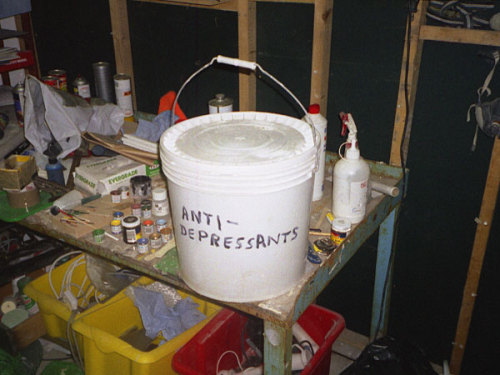
A very messy workbench sits in an equally cluttered room with an unfinished wall. Art supplies are scattered everywhere. In the center is a white plastic bucket which someone has used a marker to label "ANTI-DEPRESSANTS."

Photo by David Shrigley, via Learning Log.

Strict Deadlines, Disabled Veterans and Dismissed Cases

Three years ago, the [United States] Supreme Court said there are some filing deadlines so rigid that no excuse for missing them counts, even if the tardiness was caused by erroneous instructions from a federal judge. The court’s decision concerned a convicted murderer who had beaten a man to death. But now it is being applied to bar claims from disabled veterans who fumble filing procedures and miss deadlines in seeking help from the government. The upshot, according to a dissent in December from three judges on a federal appeals court in Washington, is “a Kafkaesque adjudicatory process in which those veterans who are most deserving of service-connected benefits will frequently be those least likely to obtain them.”

HODASSU: Help Orphans and Disabled Stand a Skill in Uganda

HODASSU vision is to develop a healthy and self-sustaining community that protects the rights of orphans, vulnerable peoples and persons with disability, through economic development, vocational training, education and counseling.

Disabled must figure in Sierra Leone rebuild

People with disabilities must not be left out as Sierra Leone rebuilds after ten years of civil war, say the writers of a new study on living conditions for the country’s disabled. Disability is a major issue in the west African country, where thousands of people had limbs cut off dightinguringthe1991 -2002 fighting which completely devastated the country, its infrastructure, its economy and people. Leonard Cheshire Disability’s report, just out, is one of the first comprehensive studies into disability in Sierra Leone. It is hoped the findings will help the needs of people with disabilities be included in rebuilding the country’s infrastructure and social services. “The disabled community’s voice is generally a voice that is not heard in discussions of development,” said Bentry Kalanga, the organisation’s senior programme manager for Africa. “Up to now disability has not been regarded as a major development issue; it must be highlighted more.”

Disability rights activists [in India] oppose copyright regime

The Indian Copyright Act does not explicitly allow for conversion and distribution of reading material in alternative formats that are accessible to persons with disability. A draft amendment, that was made public in February by the Union Ministry of Human Resource Development, introduces a copyright exception for reproduction or issue of copies in formats “specially designed” for persons with disabilities, such as Braille and sign language. However, this “token exception” leaves out a large section of people affected by cerebral palsy, dyslexia or partial impairment. A sizeable section of the visually impaired is not trained in Braille and relies on audio, and reading material with large fonts and electronic texts. The proposed copyright exception is of no use to this section.

New disability laws [in Scotland] are welcomed as spur to close pay gap and improve business practice

CAPABILITY Scotland has welcomed the introduction of the UK Equality Act, which it claims will help challenge discrimination against disabled people across the country. The disability organisation has offered its backing to the legislation, which will bring together all of the UK’s anti-discrimination rules under one banner and replace the existing Disability Discrimination Act. The act, which will come into force in October will compel companies to publish their pay scales for men and women and require public sector agencies to presume in favour of firms with good equality records when issuing public contracts.  But it also strengthens the duty placed on all service providers – including schools and other public sector organisations – to make reasonable adjustments to their facilities or the way they carry out their activities to enable disabled people to access their services.

Recommended Reading for April 20, 2010

Scott Carney (Mother Jones magazine): Inside India’s Rent-a-Womb Business

Despite the growth in services, surrogacy is not officially regulated in India. There are no binding legal standards for treatment of surrogates, nor has any state or national authority been empowered to police the industry. While clinics have a financial incentive to ensure the health of the fetus, there’s nothing to prevent them from cutting costs by scrimping on surrogate pay and follow-up care, or to ensure they behave responsibly when something goes wrong.

Benedict Carey (New York Times): Seeking Emotional Clues Without Facial Cues

Ms. Bogart has Moebius syndrome, a rare congenital condition named for a 19th-century neurologist that causes facial paralysis. When the people she helped made a sad expression, she continued, “I wasn’t able to return it. I tried to do so with words and tone of voice, but it was no use. Stripped of the facial expression, the emotion just dies there, unshared. It just dies.”

Goldfish at Diary of a Goldfish: Blogging Against Disablism Day (BADD) Will be on May 1st, 2010

Blogging Against Disablism day will be on Saturday, 1st May. This is the day where all around the world, disabled and non-disabled people will blog about their experiences, observations and thoughts about disability discrimination. In this way, we hope to raise awareness of inequality, promote equality and celebrate the progress we’ve made. [Note: Click the link for info on how you can participate in BADD 2010!]

Max Harrold (Montreal Gazette): Filmmaker in wheelchair says red-carpet rejection inspired film

[Filmmaker Sean Marckos] has it all on video: He and a colleague, both in tuxedos and with their tickets in hand, being hustled out of the famous Palais des festivals in Cannes in 2008 and 2009. They were told they could enter only through a rear entrance, away from paparazzi. “They didn’t want me next to the beautiful people like Brad Pitt and Angelina Jolie,” said Marckos, 31, who has muscular dystrophy.

National Center For Lesbian Rights (NCLR): Greene vs. County of Sonoma et al.

One evening, Harold fell down the front steps of their home and was taken to the hospital. Based on their medical directives alone, Clay should have been consulted in Harold’s care from the first moment. Tragically, county and health care workers instead refused to allow Clay to see Harold in the hospital. The county then ultimately went one step further by isolating the couple from each other, placing the men in separate nursing homes.


Recommended Reading for April 19, 2010

A blue-painted brick parking stall with the disability-symbol of a white wheelchair painted on it as well - edited after comment from noracharles
Description: A blue-painted brick wall parking stall with the disability-symbol of a white wheelchair painted on it as well. – edited after comment from noracharles.

Today is the deadline for the Disability Carnival
Check out River of Jordan for more information!

Out of the mouths of babes

Without answering he calls to the guys on the platform a couple floors up. He wants them to move the machine. I can see what a hassle this is. They are going to have to lower the platform, move it a few feet so I can get on my way, move it back so they can be back in position and then raise it back up to where they are working. I felt immediately like this huge bother. But the driver glanced down and saw me and hollered that he’d move the truck.

The platform lowered, it seemed to come down at such a slow pace, I could feel my hair grow as I waited. Joe, who really hates it when we bother people or put people out is standing a few feet ahead looking very perturbed. Once the platform is down, the fellow moves it two or three feet ahead, plenty of room for me to get around. I call out as I’m going around, ‘Sorry to be a bother.’

On growing up with strange sensory reactions, and the difference between passing and being passed off.

This is one reason that I question the entire concept of passing. I rarely spent five minutes around other children before they figured out I was different. Often it was more like five seconds. Kids weren’t generally picking up my intellect or nerdiness (they might pick that up later but not immediately), they were picking up my strangeness. Much of the time they said so quite openly and as we got older they were trying really hard to explain why I was strange. But I was always strange, there was never a point even when I did my best attempt to “behave” that this was ever in question. Even when neuroleptics drastically tamped down on my ability to explore my environment in those ways I could expect to wait seconds before I was pointedly and often out loud judged as some kind of Other. Even among kids in mental institutions where the rate of neuro-atypicality was higher, I only very occasionally connected with anyone and it was always their doing, others just either shunned me or found ways to do harm to me.

Weird thing is even though I heard all about being strange my whole life I always underestimated my strangeness. I rarely connected all the dots in others’ reactions to me. I knew I was different but since I couldn’t imagine how all the things I did looked to others, I assumed I was “normal enough” largely because of that and because I was always around myself and therefore found myself… not boring exactly, but like I was used to me. The same way I never knew my autistic brother stood out that much even though he did (although more in the stiff/nerdy way than the sensory/strange way, we are very different people).

Via Penny in email: groping

This wouldn’t be particularly notable, but today I read in the NY Times Magazine of a study that aims to find out what men’s “real” preferences in women’s body types are by toting around headless mannequins of various dimensions for blind men to grope. Hmm, how many things are wrong with this study?

Via Jonquil: Betty Dodson and Audre Lourde: Can I possibly use the master’s tools to demolish her house? [Post uses blindness as a metaphor, questions of sanity as a metaphor]

Then there is the disturbingly unquestioned position of authority that Betty holds on all things sexual. Reproducing patriarchal systems of hierarchical power, it seems she has reached to far high up the ladder that anyone who dares ask a question is a pariah whose sanity is to be questioned. I had never heard of her before this Clitoraid thing and so it was in naivete that I questioned her ‘expertise’ on the issue of Female Circumcision. Woe unto me for daring.

I have to admit that it is with sadness I wonder out loud if this the cutting edge of North American feminism? Is it that the sum total of feminist thought and mobilizing is about pleasure? We’ve made the entire experience of womanhood all about what is between our legs and not between our ears and in our hearts? That the respect so necessary in building the bridges of sisterhood is to be abandoned because one ‘expert’ must be venerated?

For Want of a Menu Button

The student center building at my university has a couple TV lounges set up for students to use. Through no fault of the student center, the manufacturer of the TVs did not include any sort of ‘menu’ button on the front of the TV itself– so it’s impossible to turn on captions without the remote, for viewers who may need it.

Talking about injury in dance

Equally as salient, for me, is managing the overlap between disability and injury. When I first separated my shoulder, someone sent me a request to participate in a study, the basic question/thesis of which was (whether) disabled dancers get injured more than non. I didn’t participate because I felt the supporting materials showed some bias towards suggesting that disabled dancers were more of a liability. (And, yes, I was feeling pissed off and vulnerable at that time.) I imagine that many of the things injured dancers do to take care of themselves (as if self *were* the injury) are the things I do on a daily basis in an attempt to keep the worst of the symptoms under control. Am I injured? No. But I do live my disability life as if I were. In a weird way, it prepares me for the twists and tweaks of dance injury.

Recommended Reading for April 15, 2010

Hi! As you may have noticed, we’re rotating Recommended Reading between a few contributors now. This is my first one, and it may have a little bit of a different style? I don’t know. Anyway, here it is!

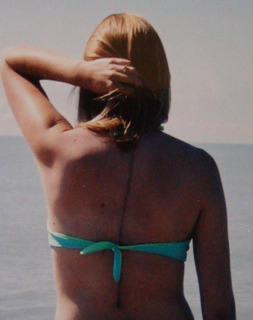
A woman faces the ocean, her back to the camera. An aqua bikini top is tied across her bare back and her arm holds her hair at her neck. A prominent scar runs down her spine.

History Lessons – Scar

My daughter will inherit my scar.  Obviously I know that you can’t inherit a scar, but she’ll likely end up having the same spinal surgery as me in the future. We both have scoliosis. Pretty bad scoliosis. I was diagnosed at eight; she was diagnosed at five. I wore a back brace and she wore one too. … There is no reason to cover it up.

BBC News – Making Light of Disability

Disability is one of those things that makes people feel awkward – there is perhaps a deep-rooted, psychological fear of contamination by association. So what we often do when something makes us feel uneasy is to laugh about it. It’s still well within living memory that TV comedians would poke fun at people from different ethnic groups – but broadcasting executives soon cottoned on to the fact that they risked alienating growing sections of their audience for the sake of a cheap gag.

Wheelchair Dancer – Disability and Race: Who Will Catch You If You Fall? (not new but still recommended)

In the workshop, I found myself in a conversation about disability and race. One of the participants had worked with some black disabled men; she was confused about why they identified more with being disabled than with being black. Didn’t they experience racism every day? Were they blocking out their blackness, disconnecting from their roots? Were they denying the hatred that black men experience on a daily basis? And then I got thinking. There are many ways to put the pieces of the puzzle together; indeed, for academics, “black disability studies” and other race and disability enquiries have recently become a new edge (yeah, I know… it’s problematic…). I would put some of the many pieces together like this…

Blog of Legal Times – Colorado Lawyer Settles Discrimination Suit Over Dog

A Colorado Springs lawyer who refused to allow a veterinarian and her service dog to enter his law office for a scheduled deposition in a civil action has agreed to pay $50,000 to settle a federal discrimination suit. LeHouillier demanded the veterinarian, Joan Murnane, prove her dog, an Australian shepherd, was a certified service dog. According to the suit, LeHouillier was not satisfied after reviewing a letter documenting Murnane’s need for the dog. LeHouillier feared the dog would soil recently installed carpeting, according to the Justice Department complaint.

LA Times – FBI probes LA Housing Department’s actions in apartment project for homeless seniors with disabilities

The FBI is investigating an affordable-housing deal in which Los Angeles officials channeled $26 million to a developer who they knew was under criminal investigation for alleged misuse of public funds, city officials said Thursday. The developer, David Rubin, was indicted last fall in New York for alleged bid-rigging and fraud, charges unconnected to the L.A. project. The $26 million went toward construction of a 92-unit apartment building near downtown L.A. for disabled homeless seniors. It has sat empty since October while its prospective tenants live in shelters or substandard housing.