Category Archives: recommended reading

Recommended Reading for April 13, 2010

Renee Martin: I’m not a Feminist (and there is no but)

Blogs run by traditionally marginalised women do not attract the same attention by the media. When feminists are pulled from the internet for interviews, it is routinely the same white feminist voices representing the broad perspectives that are visible on the internet.

Flora: Guest Post – Heteronormativity and FSD

The vast majority of the medical profession is very heteronormative. If you are a woman, you are assumed to have a relationship with a man. If you don’t have one, you are assumed to want one. If you have one, you are assumed to be having intercourse, or to want to have intercourse eventually (waiting till you’re married etc). If you say you are sexually active, you are assumed to be having intercourse. And that even if you do other things besides intercourse, you still see intercourse as the “highlight,” as the only real important sex act.

evilpuppy at Livejournal: “I Have Always Depended on the Kindness of Strangers”

The attendant standing in the front section of economy was a blonde woman probably in her late 40s-50s and I called her over to explain that I needed her assistance because I wasn’t capable of lifting my luggage due to my disability. To my surprise, the attendant rejected my request while excusing it by saying: “If I helped everyone do that all day then MY back would be killing me by the end of the day!” I asked her how I was supposed to get my luggage stowed and her answer was: “You’ll just have to wait for someone from your row to come back here and ask them to give you a hand.”

Ally: Those are These, and These are…Me

I am one of Those People. I have friends who are Those People. That World, that you seem so quick to reassure me I am not part of? The world where every statement begins with a negative prefix, a non, dis, lacking-in, etc? That world of people who need things done for them, of people who take too long to do anything on their own, and get in everybody’s way, and can’t help but be inept, no one’s blaming them, but god, do we have to humor them? I am part of that world. When you talk about Those People, you are talking about me.

Maria L. La Ganga (Los Angeles Times): Severely disabled, is she still a mom? Battle nears over visitation rights of a woman injured in childbirth [trigger warning for very graphic descriptions of medical trauma]

Abbie’s parents have been named conservators of her estate, which includes a multimillion-dollar malpractice settlement, and are asking a Los Angeles County Superior Court judge to order Dan to let Abbie see her children. Dan has refused all requests, arguing that visitation would be too traumatic at their young age.

Recommended Reading for April 12, 2010

A ramp at the foot of a set of concrete stairs.  It ends on the second step from the bottom, leaving the rest of the stairs to climb
Description: A ramp at the foot of a set of concrete stairs. It ends on the second step from the bottom, leaving the rest of the stairs to climb

Black Bodies

The history of the black body is a long and twisted one. When I say black bodies, I mean the social construction of blackness, our bodies and what they mean. The phenotype of my people has been has so many characteristics ascribed to it, becuase society loves to other bodies that don’t fit it’s standard of what a good body is.

Our bodies were and still are seen as proof that we are less intelligent, inhuman, sexually uncontrollable and a gross deviation from normality. Our hair has been seen as proof of our savage nature, especially hair that dares to defy gravity. Our bodies were put on display in sideshows and in the halls of medicine and even in death we had no safety. For years, medical schools in the north and south used mostly black bodies for research and we had no recourse. Even schools in the north were guilty of this, having bodies shipped to them.

Not a hero, not a tragedy

The astute reader will have spotted that these present a double bind. If I ask for an adjustment or support of some kind, then I’m playing right into the Tragedy discourse — I need very special help, given out of charity, for my pitiful tragic state. If I manage anything interesting or worth commenting on (whether that’s in my own or someone else’s estimation, but note that the two are not necessarily the same), the I am a Hero who overcame adversity actually managed something.

I’ll tell you another secret: I think that’s all really patronizing. Off-the-scale patronizing.

On The Social Construction of Childhood Mental Illness

When I read up on “pediatric bipolar”, most critics use the same logic that went before around every childhood mental illness: “But we didn’t see any of those back in the day.” Now it is quite true that more children these days get a diagnosis of serious mental illness, more children are on psychiatric drugs – 1 in 154 takes an antipsychotic in the U.S. -, and more children receive other services, like special education. I do not believe in the validity of the “pediatric bipolar” concept, because it is nothing like adult bipolar, but that is not the point here. Do these children have a genuine problem, or are we just creating problems so that we can get more children on drugs and in special education?

I believe it’s a little of both, in the sense that, in today’s society, many children who end up on psychiatric drugs and in special education, have genuine problems. However, that does not mean that our society was not structured in a way that reinforces these problems. If our schools cannot take a temperamental child, that child is going to have a genuine problem at school, but that does not mean the child has a mental illness. It might as well mean that the school system has failed the child.

The pain is real, even though you can’t see it

Unless you live with chronic pain, you have no idea what it is like. You don’t just get used to it or learn to tolerate it. You spend your days looking for any kind of relief that you can find. There are times when the pain is so overwhelming it invades your sleep and you cannot process anything but the hurt. It changes who you are and how you relate with people. I sometimes find myself snapping for no other reason than the pain. I have to consciously remind myself that no one did this to me and not to lash out at those I love.

A Small Reminder

And when you throw general disablist bullshit around, what you’re really saying is that you don’t give a fuck about how your behaviour contributes to this. And that your own unexamined privilege is more important than this.

And then you expect me to be polite, suck it up, go deal with it, ’splain to me that your behaviour does in fact *not* contribute to this, when in fact the only reason this is happening, is because in our society disabled people are seen as less worthy, but apparently I’m too stoopid to understand the mechanisms behind my own oppression and someone who never experienced this kind of abuse knows better, which just shows that you do see disabled people as less worthy… aaand – the icing on the cake of FAIL – is to tell me what I should get angry about.

Headlines:

Australia: High-risk teens all but ignored in depression advice

Recommended Reading for April 8, 2010

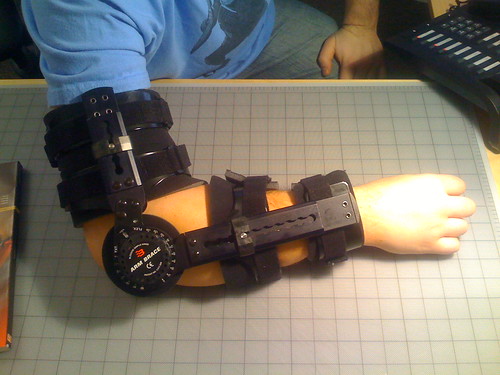
A white person's right arm in a (self-described) terminator-esque arm brace.  It has thick black straps supporting the upper arm, a huge dial on the elbow, and more thick straps on the lower arm

Description: A white person’s right arm in a (self-described) terminator-esque arm brace. It has thick black straps supporting the upper arm, a huge dial on the elbow, and more thick straps on the lower arm

Daily Access Irritations: The Moan Meme

I thought I’d rant a little about the access irritations I encountered today.

Today I’ll complain about inaccessible elements of the environment which nominally increase access. Otherwise known as “access theater,” or access done wrong, it’s particularly infuriating.

Implementation of Low Vision Rehabilitation Advice for People with Intellectual Disabilities

People with intellectual disabilities are at a very high risk of visual impairment, often due to undiagnosed refractive errors and cataracts. Oftentimes, however, these people are being cared for in facilities that do not have knowledge about low vision, and do not know how to detect it. Low vision centers in the Netherlands take a pretty proactive role in screening for visual impairments in people with intellectual disabilities. However, it doesn’t help much if the advice these centers give, for example for glasses or lighting, is not followed up on by the intellectual disability facilities the people live in.

Miscellaneous Thoughts on Parenthood [NBC series]

-Shockingly (or not), the behavioral therapist turns out to be a Magical Therapist who not only helps Max play with another child, but gives soothing advice to his mom–allaying her fears and improving her sex life. All in one afternoon!

It really bothers me to see people who work with autistic people portrayed as saints with no obvious flaws, which is what this therapist character (Gabby) seems to be so far. Because obviously anyone who would choose to work with autistic people must be a saint, by definition. Far too many people actually believe that kind of nonsense, which obscures the very real power which therapists hold over their clients, and the very real potential (and actuality) of abuse. It’s just really, really uncomfortable. Pretty Nice Behavioral Therapist Girl holds power over the children she works with.

Being inclusive vs not being exclusive

This is something I come across once in a while, and have had at least one argument with someone over. A group of people put on some creative project, and someone notices that there’s a lack of representation of X Minority for whatever reason, sometimes noting that they themselves are in the minority. The people organising the project get defensive and say “But we’re not excluding anyone! We are open to everybody! They just need to sign on!”

There is a huge difference between not being exclusive and being inclusive.

In the eye of the beholder

But we have entered into another phase of the understanding of beauty. We are staying, right now, in a huge resort north of Toronto. It’s on the way to the consultation and will cut our driving down by several hours. We decided, what the heck treat ourselves. Into a huge lobby, up to a luxurious room. Wow. Then Joe went into the bathroom and said, breathlessly like he has when listening to Madama Butterfly or contemplating a painting by Turner or finishing a book by Furst or by watching that nude scene in A Single Man … it’s, it’s, beautiful.

One Can’t be a Cutup when one is talking about Cutouts

The guidelines for my suggestions of “ideal cutouts” are simple:

1. All of the ADA style guidelines related to angle and such (not crucial for me with the iBot or most powered chairs, but much more important for scooters that can’t handle angles, manual chairs, or people that might have trouble with the angle);
2. Always have the ramp be at a complete 18090° with the street it is bisecting, with a consistent and equal upward trend until it reaches the top.
3. Keep the direction of the inclination be the same as the direction of travel, without requiring left/right “yaw” adjustment.
4. Have the cutouts as close to the curb as is feasible.
5. Position the cutouts firmly in the crosswalk’s span.
6. Keep the cutouts on opposite sides of the street that assume a lateral connection lined up with each other.
7. When fancy painting/grooves are done, have the paint/groves match both the angle and the direction of the inclination (i.e. if any of the previous two points — especially points 2 and 3 — are not done, do not use the paint/grids as if they were).
8. Remember that Functional > Aesthetically pleasing but impractical > impassible (by which I mean impossible).

Headlines:

US: Appellate court rules [service] dogs ineligible for food stamps

Just to let y’all know, we’re going to be splitting up Recommended Reading duties among FWD contribs for a while, starting tomorrow!

Recommended Reading for April 7, 2010

A red, white and black butterfly is standing on the very edge of a curly bench arm.  Arm-crutches are looped around the bench.

Another short one today – the stuff in my personal life is ongoing. I’m sorry.

The cost of art

As I know that with Palmer’s projects and statements, there are things I might miss because I am able bodied, because I am privileged as Palmer is herself. I know that I have been made to think about the ways I think of disabled bodies and about the history of racial violence and murder in this country. I have been forced to examine myself, to see the ways in which I am no better (or maybe worse) than Palmer. But when the time came and is still coming that opinions about the disabled, about them speaking up for themselves are formed, when people insult and laugh at and ignore and disregard the disabled, accuse them of faking it or belittle them, or use them as tools to be “inspirational” to able people, it will not be Palmer who bears that cost, who gets hit in the face. When it comes time for people to handwave away murder and torture and the history of racial violence in this nation and how the images and words connected with it still hurt for some but are meaningless for others, Palmer will not be hurt by that. Palmer will not pay the price for it. Palmer will surf the wave of controversy and sadly free publicity to interviews and sales and she will laugh all the way to her bank.

Because it comes down to this, as I’ve said before. When the price for art and statements about art came around, Badu paid up, in full, on time, and without hesitation from her own metaphorical coiffers, and it is becoming a steep price. Palmer passed the buck onto those who have already paid so much for the statements and “art” and “irony” of others. The price is steep, but she is not and never will truly be on the hook for it. Because she chose other bodies, other selves to put in the line of fire.

Sometimes the Best Self-Advocacy is Shutting the Fuck Up

I really, really don’t want to write about disability for normal people.

I don’t want to explain that I don’t see people as objects. I don’t want to explain that I’m not just imagining that I have a disability. I don’t want to have to make an analogy where I go, “Some people with cerebral palsy can talk and some can’t, they all have cerebral palsy, and it’s the same with autism spectrum disorders.” (Also, who knows if people will even get that. My dad thinks that the reason CK can walk is that he’s really energetic and determined.)

I have recently been trying to have these conversations with my mom. I don’t know why. I just get told that, for example, I should imagine why someone might kill their kid with a disability. This really upsets me because it’s not that I don’t have compassion for people who do bad things, but constantly reminding me to have compassion for a particular group of people who do bad things seems to imply that what they do is less bad than what other people do.

Normalization Wastes Energy

In contrast, I was two years old and, according to my mom, not talking yet, not looking at her, and with a laundry list of other difficulties that she had not anticipated at the time that I was diagnosed. In addition, the coverage given to the issue of autism was being filled with more and more fear-mongering and talk about early behavioral “interventions.” The way this impacted me mostly involved my parents placing me in some of these programs to ensure that I didn’t end up like Rainman or the difficult autistic children they read about in nonfiction books that were rife with “tragedy” talk. These involved things that helped, such as speech lessons and OT that taught me a little bit of cooking in addition to some sewing and knitting as well as being a time when I could calm down and “recharge.”

However, there were also things that have tainted my life experience forever. Because I was autistic, it was considered justifiable for teachers to twist my head around so that I would make eye contact.

US: Cancer Clusters in Florida Worry Parents

After months of prodding, Florida’s health department began investigating. This year, the agency concluded that The Acreage was the site of a cancer cluster.

The finding was a vindication for some, but what followed infuriated many: A state health official said there was no plan to search for an environmental cause. Residents and elected officials protested, and that position was quickly reversed. But many residents in The Acreage remain suspicious about the state’s commitment to the investigation.

US: Constance McMillien, and “two students with learning difficulites” were sent to a fake prom. McMillen: I Was Sent to Fake Prom

“They had two proms and I was only invited to one of them,” McMillen says. “The one that I went to had seven people there, and everyone went to the other one I wasn’t invited to.”
Last week McMillen asked one of the students organizing the prom for details about the event, and was directed to the country club. “It hurts my feelings,” McMillen says.

Two students with learning difficulties were among the seven people at the country club event, McMillen recalls. “They had the time of their lives,” McMillen says. “That’s the one good thing that come out of this, [these kids] didn’t have to worry about people making fun of them [at their prom].”

‘Breaking Bad’ actor RJ Mitte finds ‘perfect role’ prepared him to become an activist

While winning the role may have been serendipitous for R.J., what he is making out of the opportunity is quite deliberate. It has allowed him to discover himself — not only as an actor but also as an activist for the rights of people with disabilities in the entertainment industry.

He has become a spokesman for I AM PWD (Inclusion in the Arts and Media of Performers With Disabilities), an advocacy campaign sponsored by three entertainment industry unions — Screen Actors Guild, American Federation of Television and Radio Artists and Actors’ Equity Association.

The campaign highlights long-simmering issues regarding people with disabilities in the entertainment industry — access, inclusion and accuracy of portrayal.

Recommended Reading for April 6, 2010

Assistive tech keyboards - three of them, all with large print and brightly contrasted colours

I’m sorry this is short today – something came up in my personal life.

Assumptions: Unfair & Not Unfair

This is an ethics professor discussing the ethics of caring for patients whose injuries were, in our view as physicians, “brought upon themselves”, or for patients whom we don’t necessarily like.

Racist, Sexist, and Homophobic

I posted Monday about the “Writing the Other” panel at Millennicon. Today I wanted to address one of the comments. Jim Van Pelt … described an academic panel in which the moderator opened by saying, “If you are white, male and straight in America, you are also, automatically racist, sexist and homophobic.” Comment link here.

This next part is scary to write. To be clear, I’m not talking about you. I’m not talking about Van Pelt. I’m not talking about anyone except myself, ‘kay?

That moderator is correct. I am a straight white male raised in the U.S. I am also racist. I am sexist. I am homophobic.

How the left enables the right’s racism: The Obama rape comic TRIGGER WARNING

But what really got my side-eye going was AlterNet’s accompanying article to the cartoon, where I originally saw the cartoon. Once again, it’s another progressive dismissal of racism and racists as “something” thought/said/done by “them” over “there.” Of course, the post’s intent (sigh) is calling out the blatantly viciously anti-Black bigotry while offering some sort of “compassion” to those “afflicted” with the “racist condition.” Well, sort of.

However, calling out racism as a “mental illness” both enables the racism and is ableist to those with differing mental and physical capabilities than the “able-bodied.”

Fighting Ableism Fights Sexual Assault TRIGGER WARNING

Women with disabilities are more than twice as likely to be victims of rape or sexual assault than women without disabilities. More than twice as likely than what is already a terrifyingly high probability of being a victim of rape or sexual assault. I myself am a woman with a mental health disability who is also a victim of sexual assault, and seeing this statistic always makes my stomach drop and my muscles tense. But when I think about it, what influences that statistic, it makes perfect sense. Rape and sexual assault are crimes of power and control. Women with disabilities are subject to sets of interlocking, intersecting oppressions on the basis of their gender and their disability status. Both gender-based oppression and disability-based oppression separately accept and even encourage abuse and denigration of people in those groups. So of course it makes sense that sexism and ableism would add to each other, reinforce each other’s power, resulting in the heightened vulnerability to assault reflected in the statistics.

Recommended Reading for April 5, 2010

Woman seated in a chair with brocade throw over the back, holding a crutch in her left hand. She sits facing forward in a fenced yard

Power

The media world hasn’t stopped writing bad articles about disability in general and disability and dance in particular. I will run right over the next person who uses the “inspiring” word. There have been some truly shocking things — things that should call us as moral humans to action — but for some reason, I find myself lacking in outrage and anger. I am so happy that it is Spring. I am on a retreat, in some kind of refuge, relaxing in the city. Mildness is the word of the day.

We leave again on Monday; I have the weekend to finish my laundry, clean my brushes, recheck my chair, and pack (at least I now have a check list). When I was first packing for this trip a couple of weeks ago, I dug out my fleece pants and fleece-lined tights (these things are just awesome). Now, I am thinking about light blouses and cotton yoga pants. The weather has changed and with it my sense of place in the world.

Special Autism Fools Day Link-o-Rama

When T.S. Eliot said that “April is the cruelest month,” he truly got it right. For you Normals (using the word in a humorous context, of course…), it may be hunky dory, what with all the opportunities to make yourselves look and feel charitable by simply giving money to any autism charity organization that advocates for a cure. However, for us autistic people Autism Awareness Month is often aggravating.

Fire in the Frost: Fiesty Olympians Defy the Odds

Despite being born with the use of both legs, many of these bipedal athletes inspire us with their commitment and guts. Having typically learned to walk around the age of one, these amazing Olympians don’t let their lurching two-phase locomotion hold them back. Thought they may look unwieldy to the naive eye, as viewers their movements soon look natural to us. We can see their grace and nimbleness shine through.

Two-legged skiers don’t let their long bulky hindlimbs weigh them down on the slopes; they have learned to use them to the fullest to guide their path down the mountain. In the freestyle aerial competitions, they inspire us as they twirl against the blue Canadian skies, looking almost graceful – unless they fail to keep their dual legs parallel, a particularly common trap for skiers in this event! Sighted skiers seem to remain undistracted by seeing objects near the course while hurtling down the slopes. They handle their unique visual issues well, managing to put aside most distractions and focus on the task at hand. These skiers don’t let their vision stand in their way on the snow!

New Childcare Subsidy Regulations

Last April, when I finished my exams, you gave me 90 days to find a job before I lost my childcare funding. You understood that jobs do not appear out of thin air, they take work to aquire. This year, you decided that I am to lose my childcare space the day the exam period is over.

Now I ask you, Mr. Neo-liberal Policy Maker, how am I supposed to find a job without daycare? You say I can look for work while my children are in school. I accept that premise, but what you don’t answer is what I am supposed to do when I find a job and have already lost my daycare spots? I will have to turn down the job because I won’t be able to go to work without daycare- especially because my son is in kindergarten, and, as such, is not yet in school full-time. It took me 3 years to get through the waiting list at the daycare my children need to be in for me to attend grad school in September because it is the only childcare center in the city that is open later than 6:00 and my classes will run in the evening. That means that if I lose this daycare spot, I may not be able to go to grad school in September. But I’m glad you saved a few dollars.

An Immortal Story: The Immortal Life of Henrietta Lacks

There is so much that this book makes you think about: medical ethics (using cells/doing research on people without consent happened a lot–note the Tuskegee studies, and the question of ownership of bodies), the role of women (along with issues of abuse, equality in the workplace, the role of a mother), education, health insurance (Henrietta’s family is still unable to afford health insurance today) and how all those issues are affected by race and social class (i.e. because Henrietta was a black female she didn’t go to school; lower class people live without health care because they can’t afford it, etc.). In writing about all these subjects, Skloot herself becomes part of this family’s story which adds even more heart to it. She writes about it all with a knowledge of her subject and a compassion for the people she profiles, interviews, and—sometimes—lives with, all while giving well-deserved, belated recognition to the woman behind HeLa.

On Autism Awareness Month

Growing up with autism in my world has taught me a lot about communication…about the power of sound, the meaning behind high pitched wails or low rumbling laughter.

Autism has taught me the precious value of a hug or a kiss…of eye contact or a quick glance…of a tickle and the giggles it inspires.

I have lived my entire life with autism.

For me and mine, autism is…it just is. Sometimes it’s a pain in the ass and sometimes it is the most amazing thing, but autism is a constant thing not limited to months or years or days when walks take place.

If you do nothing else today, read this

Let’s imagine for a moment that you are long into the public mental health system. You have been in the hospital multiple times, in a couple of partial hospitalization programs, and have spent years in sheltered workshops and day programs. You’ve received the Prophecy of Doom, “Too sick for too long to get any better.” You’ve heard plenty of statements beginning with “You can’t, You won’t, and You will never.” You’ve been told endlessly that something is intrinsically (genetically) wrong with you and the only thing that will truly save you is a medication yet to be discovered. You’ve also been told that the most important thing you can do is get on SSI or SSDI in light of the prolonged and persistent nature of your illness. You’ve been told to engage in meaningful activities generally limited to walking, listening to music, and reading. You’ve been told countless times to avoid any stressors which might be associated with more rewarding activities and these stressors will doubtless lead to yet another hospitalization. You’ve been told so many things.

Headlines:

Military plans to test brain-injury therapy

Burger King ad featuring its mascot as crazy offends mental health organizations NOTE: Unless the author has gone ahead and changed it since I posted it, this article is basically making fun of the idea that anyone would think that there’s anything to the criticism.

Via Sweet Machine: Cinemas turn up lights, turn down sound for families touched by autism: AMC and Kerasotes Theaters adjust theaters’ lighting and sound, while letting people with autism and their families clap, dance and sing

Recommended Reading for March 31, 2010

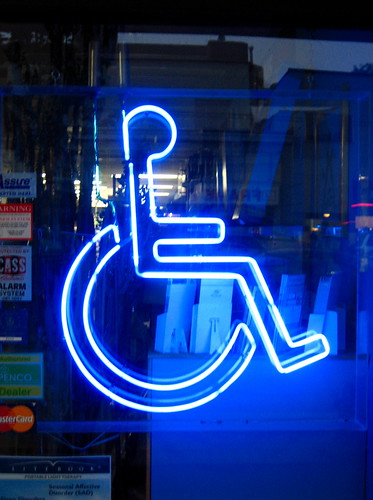
A wheelchair symbol lit up in florescent light

Having an Answer:

Yes ladies and gentleman there are people in the world of rehab and fitness who actually give a hoot about you the person not just you the underlying diagnosis. You just have to find the right people.

And when you do, life just rocks a little bit more.

I hate to write another letter. I am tired of writing letters

If one were a wheelchair user who regularly interacted with a bus drive that demonstrated a lot of irritation at having to work with wheelchair users to get them strapped in to a wheelchair spot, one could likely tell. People are never as subtle as they think they are, especially not in their irritation.

Trans Lit – searching for our reflections

And I think the thing that does bind different trans* identities together – somehow feeling outside one’s assigned gender roles – could allow those interested in trans fiction to enjoy a wide variety of trans protagonists, even if not every protagonist matches every reader’s lived experience.

When all you have is a hammer

Let’s get two really simple things straight.

Overload is not anxiety.

Shutdown is not dissociation.

Overload may cause anxiety sometimes for some people. But it is an experience that is at the heart of things… sensory, perceptual, cognitive, whatever you want to call it. But while emotions can be involved, it really isn’t at the core an emotional experience. Get rid of the emotions and overload and shutdown will still happen for most people.

I think there are two main things at the root of this confusion:

Abilities & Burnout

Besides the basic fluctuation–and serious differences in ability between different areas, including what gets described as dyscalculia–I kept running into problems from this. Especially when I hit adolescence, then later when I hit college. (Then I burned out. Repeatedly. Which made things that much better.) Heck, the gaps and difficulties were obvious enough by the time I was 8 or 9 that one great-aunt, an educator whom I rarely even saw, brought me a huge stack of books on coping while “gifted”. I appreciate this gesture much more now–especially since she was the main person not pretending that I was not having problems coping–but the books didn’t help.

In my particular case, the unexpected skills/ability to show skills pattern got some really nasty interpretations–especially in school–because I was good at testing. (Less so, these days.) The lowest my IQ tested out was 185. I am not mentioning this out of some weird sense of supremacy, but to point out the serious disconnect between some other people’s expectations and what I was ever able to do. It’s apparently easy to project like mad, and build a mental construct of “someone that smart” based on assumptions that you, personally, would never run into a problem that you couldn’t think your way around if sufficiently motivated to do so, were you “that smart”. It’s not much of a leap to then substitute that mental construct for the real human being in front of you, and make up all kinds of weird explanations for why the two do not match. At all.*

Misconceptions about Autistic Abilities & Intelligence

Another misconception involves the idea that a high test score always indicates across-the-board ability. In truth, a single skill might enable a person to do well on a broad range of tasks at a certain age, when that same skill will not help a person as they get older. Amanda mentions in the comments that her IQ score dropped by half between the ages of five and 22. She attributes this to her hyperlexia, which enabled her to score in the 160s at age five, but wasn’t helping her anymore as an adult. Interest in and, hence, familiarity with the test items would also have an effect. For instance, I’m not sure I would still score as high on calculus as I did in childhood, because I had a special interest with it back then and haven’t in many years.

In the news:

USA: Disabled Immigration Detainees Face Deportation

The detainees, mostly apprehended in New York and other Northeastern cities, some right from mental hospitals, have often been moved to Texas without medication or medical records, far from relatives and mental health workers who know their histories. Their mental incompetence is routinely ignored by immigration judges and deportation officers, who are under pressure to handle rising caseloads and meet government quotas.

Marlee Matlin launches YouTube Channel

Marlee Matlin had an idea for a reality show that she hoped would bring some insight into the lives and struggles of deaf people and how they cope. But while reality TV has brought us wife swappers, party girls, aging rock stars and dieting divas, apparently no one was ready for something that real.

So instead, the hearing-impaired actress who won an Academy Award as lead actress for her role in “Children of a Lesser God,” took her show “My Deaf Family” to Google’s YouTube. You can watch it here.

“Deaf and hard of hearing people make up one of the largest minority groups,” she said in an interview through her interpreter, Jack Jason, “and yet there has never been a show, a reality documentary series that features what life is like for them.” Matlin financed the show, which tells the story of a family in Fremont, Calif. All the family members are deaf, except for the oldest son, Jared, and the youngest, Elijah. It is narrated by Jared.

Matlin shopped her pilot to network executives, who purported to “love it.” But none would take the plunge.

Recommended Reading for March 30, 2010

The Summer of Nadia

I remember the doctor talking about my diagnosis that day in the summer of Nadia, and what would likely happen. Terms like “swan-necked fingers” and “hammer toes” were thrown around. I remember he never looked at me as he spoke, though he used my various body parts to demonstrate. Nor did he talk to me; he talked to my parents (a phenomenon I would continue to experience until I was in my teens), trying to prepare them for the future.

No one talked to me. No one asked me how I felt about the whole thing, or how I was supposed to cope with this emotionally. But it was the ’70s. Children, even sick children, were to be seen and not heard.

A Rant, if I May

I have met so many parents that cannot wrap their heads around this. When I explain that while the hearing is fine, that the problem the child likely has is a listening one, they smirk and nod and say to the child, “See! I knew you were just not listening to me!”. And the hurt I see on kids faces really breaks my heart. I want to be their ally. I want to explain to their carers, the people on which their world depends that they do WANT to listen, but they cannot. I want to explain that there are many things they can do to make it easier for their child to listen, to parse that confusing, jumbly, noise their brain is presenting to them – without making it sound like concessions you have to make for a willful and “broken” child. To let them know that needing captions on TV is a valid and sound strategy and that they should encourage their children to assert themselves and ask for what they need from this noisy world of ours in order to make sense of it. Like asking for repeats. Like asking for repeats even if they get teased about being deaf, or get chastised for not paying attention the first time, or any of the other terrible things that happen when you ask for something already once given.

The fuzzy boundaries of accessibility

This is a thing that i’ve been thinking about since a couple of conversations with friends (both multiply-impaired, i.e. both neurodivergent and with physical/mobility impairments) about accessible and inaccessible venues: what are the boundaries of the concept of “accessibility”?

Since moving to a new city a month ago (more on which in an upcoming “personal update” post, if/when i get round to writing it), i’ve decided to firm up my policy of boycotting inaccessible event venues: i don’t want to give money to events or buildings that my friends who have different or additional impairments to me couldn’t get into. However, while this *looks* simple (at a superficial first glance), if you dig even a little deeper, all sorts of ambiguities arise…

Hate Propaganda and ‘Sex’

So, this bill would make it a criminal offence to kill members of a group or deliberately bring about conditions that would cause the groups’ destruction if you did it based on the sex of the people in the group. I should also mention that a bill similar to this has been introduced three times previously, and that this particular issue was mentioned in the latest version of the Pink Book (see p.25).

I am all for adding “sex” to section 318(4). I think it is amazing that it isn’t already there. I also think that since this is a private members bill and is at least the fourth attempt to make this amendment, the chance that it will actually become part of the Code is on the slim side. The Canada Human Rights Act and provincial human rights legislation across the country (I’m not going to link to all of theme here) prohibit discrimination based on sex. If its not OK to pay a woman less or deny her a home because she is a woman, then it seems only reasonable, to me, that it should also be unacceptable to advocate for killing or harming women because they are women.

Questions for a Twenty-something with CP

What advice would you have for parents raising kids with cp?

If your kid has cp they’re no different than any other kid, at least from their perspective. They know nothing else other than life with cp, even if they have siblings. I don’t see myself as someone with cp, at least not at first, and even then it takes someone pointing it out to make me see it. One of the biggest things that bothers me about parents of cp kids is when I hear them say things like, “I wish you could be normal,” or “Now you can be a normal kid.” It really makes my skin crawl. Once, while I was watching something on Discovery Health—I’m a Discovery Health junkie—this kid who was maybe 4 and had cp was having tendon lengthenings. Having had tendon lengthenings myself, I was interested to see the actual procedure done. This kid wasn’t even discharged from the hospital and his mom was crying—I mean bawling—because now he could be like “every normal boy” and I’m thinking…well I won’t tell you exactly what I thought since I’m sure you’d like to keep this at least PG-13! But basically it was, “That’s a lot of pressure to put on a kid who is barely out of an OR” especially since his normal isn’t “everyone’s” normal.

Audiences & “Disability Ghettos”

Shannon wants to talk about how his art and creativity are not tied to his disability. He wants to reinforce the idea that he is not there to fill the disability slot on any program. He is an artist. A performer. And he wants to be — no, should be — taken seriously as such. This is a really hard project. When funding often comes from disability related sources, you get promoted as a “disabled” artist. When disability is the first thing your audience sees, you are interpreted as a disabled artist. Disability has a way of making itself felt. And there’s not much you can do about it.

That said, no one should be going around — journalist or performer (it’s not clear whose phrase it is…the quotes seem to suggest it belongs to Shannon) — talking about disability ghettos.

What’s in a Decade or Why The History of Feminism Matters

And also, well, the past really is more complicated.

To start where Courtney ended: Yes, feminist blogs are very new, and they rock. The only blogs I knew of in the late 1990s were a few people’s personal online diaries. That was it. But by 2000, there were lots of online communities. For me, Salon’s Table Talk filled some of the needs that blogs now meet. I’d just become a mother, and I remember (for instance) lengthy discussions of Andrea Yates’ murder of her children that helped me place her act in a larger, political context of untreated postpartum depression and fundamentalist Christianity. Of course there were trolls on Table Talk, too, but it wasn’t the nightmare that Salon’s letter section is today. So, while blogs were the best invention since wine and cheese, they also built on existing forms of online community.

Recommended Reading for March 29, 2010

Anna’s note: Hi! I’m going to be included a link or two a day for the next couple of weeks that isn’t explicitly related to disability. I will also be increasing the number of links I put up a day – you may have noted that I lean towards 5 as my number – so that there are always at least five links related to disability. I feel that the other links that I will be including are in line with FWD’s mission to approach feminism from an intersectional perspective.

Everything I Needed to Know About Access Activism I Learned in Kindergarten

Or another reason might be that I’m tired of the responsibility for access issue being disproportionately allocated to the very people who are up against the access issues every. Single. Day. I would humbly suggest that every member of every University decision-making body has their own brain and can decide for themselves if they want to care about access, and if they want to become informed about the issues, and if they want to invest their time and energy into pushing those issues at decision-making levels. If non-disabled people on committees never think to ask themselves about disabled access, or never think to speak up about it, why should I think that my voice will be listened to? And what does that say for their commitment to access that they can’t be bothered to do the work themselves and instead decide to offload it onto precisely the people who do not have energy for it because we are too busy navigating an inaccessible campus?

Getting a token disabled person on a committee to keep “holding you to account” about disability or sexism issues is a good way of making it look like you care about equal opporunities when you just don’t care enough. Because if you really cared, you wouldn’t be relying on a disabled person or a woman to be doing your homework for you. You’d be doing your own homework, and holding yourself to account.

More on Classism, and some thoughts on Ableism, within Vegan Movements

Over the past year I’ve been thinking more about the privileging of the able-bodied (& neurotypical) in activist movements — including, but by no means limited to, veganism & animal rights. Often certain types of activism are held up as the pinnacles of commitment & getting shit done: direct action; mammoth demonstrations on the street; confrontational protests; etc. These are more risky for people who do not fit within a certain paradigm. For example, the risk of being dragged away by the cops at a protest may look very different to you if you are: POC; gender nonconforming; undocumented; a person with childcare commitments; female; disabled — not that any of these categories are mutually exclusive, of course!

Rethinking Work: Cooking as labour

Out of the kitchen and into the workforce arguments always had a class (and race) division to them: many women had already been working and didn’t find it particularly liberating. Many of them, often women of color, worked as domestic laborers as well—getting paid, if not very well, to do the same work they then did for free at their own home. Well-off women were already recognizing in their own way that cooking was work, and we still recognize this when we watch cooking shows on TV or go to restaurants, fancy or otherwise.

Now back-in-the-kitchen arguments have their own class dimension. They imply the time to spend in the kitchen as well as the money to buy fancy ingredients. Ethically produced local food tends to be more expensive partly because the people who produce it are being paid decently, so despite the lack of middlemen we pay much more for organic produce from the farm around the corner.

Dear Moby And Miley: Please Shut Up About The Disorders You Don’t Actually Have [I recommend missing the comments]

Your brain is not Sephora. You don’t get to walk in and pick a bunch of “trendy” shit to throw on in order to make yourself look better. And you don’t get to accessorize with the “hip” disorder of the day just to make yourself seem “weird” and “fascinating” to your stupid friends. That’s not how it works. And it’s not fair to those of us who actually do have to deal with such diagnoses, and all the work, medication, and often times difficulties that come along with them, to act as if it’s adorable or hilarious that you’ve declared yourself to have something that you don’t. You’re not helping the cause any, and you certainly aren’t helping to research or de-stigmatize such things by wearing them as some kooky hipster badge of honor. Nor are you helping the public’s perception of bipolar disorder by comparing it to your shitty movie options.

On my usage of “crazy”

When I first started working it out of my vocabulary, my criteria would be to stop and think (1)if I literally meant something was mentally ill or not (easily done by replacing the offending word with “mentally ill” and seeing if the sentence still worked), and (2)if yes, then was I putting that thing into a negative light by describing it that way. For example, if I’m reading a piece of literature and it’s really confusing to me and I throw the book down and exclaim “that’s just crazy!” – am I trying to say that I think the book or the author is mentally ill? And if I *am* trying to say that, am I saying it because I’m annoyed with it, and calling it crazy or mentally ill is a good way to discount it and feel better about not wanting to interact with it anymore?

If that’s the case, if I’m trying to imply that something is mentally ill because that makes it easier for me to throw it away, what am I saying about mental illness and those of us (myself included) who are mentally ill? Wouldn’t it be better for me to throw the book down and say “I really hate this author’s narrative style!” or “This is pretentious bullshit!” or “I can’t figure out the point of this and it makes me mad!”

I am tired of disability stereotypes and tropes

Do you know what I’d love to see? More shows and movies and books with character who just happens to be disabled. That their disability NOT be the focus of the episode but rather just happens to be included within the episode. No more super special episodes/movies/books about a super special person – but just an episode/movie/book with an interesting character who just happens to have a disability. One of the main characters on ER, Dr. Kerry Weaver, who was introduced as accomplished doctor – and that’s what the audiences saw the most because her disability was hardly ever mentioned. I’m sure there are other characters like her around – but I don’t know enough about them to counteract all the other characters I know of. The character portrayals that are bothersome and sometimes hurtful.

Recommended Reading for March 25, 2010

Some reasons to provide transcripts

Transcripts are often framed as an accessibility issue for people who are Deaf or hard of hearing. This is certainly the case; if you post a video or audio clip without a transcript or captions, people who are Deaf or hard of hearing will not be able to access it.

However, there are some other reasons to provide transcripts—reasons which I think should be pretty compelling even to people who don’t care about making their content accessible to Deaf and hard of hearing folks—if you want as many people as possible to be able to engage with your website and your content, you should be providing transcripts and image descriptions.

You don’t need captions and dismissal of needs

That aforementioned disadvantage of being unable to process sounds and dialogue kind of impairs my ability to watch a movie, especially the first time, under “normal” conditions, where the movie is put on and the audience sits down to watch without doing much else. However, in this day and age where we have DVDs with captions “for the hearing impaired,” I can make it so that there are captions to accompany the dialogue. The words on their own are just garbled sounds impossible to process in time because new sounds have to come in, but with words added, there are the characters to explain which words the sounds are supposed to be. They aid my understanding of which sounds go with which words.

True Story

My little boy was written a prescription for Occupational Therapy by his pediatrician for dyspraxia and hypotonia.

My insurance approved the prescription.

After 2 years, they revoked their approval because he has autism and backcharged me $24,000.

Guilt…

I know that this isn’t a helpful reaction, or one that reflects reality well, but my brain doesn’t seem to get the message. I wish it would, but that’ the beauty of mental illness, isn’t it? To have separate truths, coexisting.

That damned social conditioning, always reminding me that I am not the deserving poor, that there are people worse off than me and that I should just suck it up and do better. Other people “win” the battle against mental illness, why can’t I?

And a reminder: Next Carnival of Feminists is coming up on March 31 at Beauty Schooled Project. Deadline for submissions is March 29.

Note: There won’t be a Recommended Reading for Friday, March 26th as Don & I are visiting the Cancer Doctor to find out what’s going on with Radiation.