Category Archives: recommended reading

Recommended Reading for Wednesday, May 26, 2010

T-shirt with GOMPERS showing a tree and several children and an adult walking.  Some of the children are using crutches or wheelchairs.
Description: T-shirt with GOMPERS showing a tree and several children and an adult walking. Some of the children are using crutches or wheelchairs.

By Flickr user Cobalt123, used under a Creative Commons License
Disability Blog Carnival: Tell the Story!

Another awesome collection of posts in this month’s carnival!

Well, at long last here is the Disability Blog Carnival on Story. I am adding posts and such as I go… so visit often, there may be new rides!

Details on the next Carnival.

Rolling Around in My Head will host the June Carnival – June is ‘pride month’ wherein people celebrate LGBT pride – So I thought we’d have a pride carnival, I want people to submit the blog (or even two) that they wrote that they are most proud of. Not the one that got the most comments, but the one that you felt said what you wanted to say, how you wanted to say it and you are proud of it.

Also, Penny is looking for hosts for upcoming Carnivals. Doing Carnivals can be a bit time-consuming, I admit, and can take up energy that you may want to put someplace else, but you can get a lot of help with it, too. When we did the Carnival, lots of folks emailed in links, and Penny was really generous with link-sending as well.

Also in Carnivals: The Eleventh Carnival of Feminist Parenting!

Welcome to the eleventh edition of the newly two-monthly Carnival of Feminist Parenting. It looks like my decision to make it two-monthly – and the hard work of readers plugging it in their own blogs – has paid off, because I’ve had lots of submissions for this edition!

Executive Functioning Blues

Uh-oh. This is not good. A local autism society is requesting that my workplace participate in some sort of autism walk. There is a puzzle piece on the page. There is a breezy suggestion about who should head up the efforts, and the person named is a friend of mine. I check the autism society’s website to see how they have described the event. Although it has been publicized as a Missing Piece March, it seems that it will be more of a festival, with games for kids and information booths. I click through the site, and find no mentions of devastating diseases or burdens on society. Hmmm…the event itself is described as a place where autistic kids can be themselves without being judged. Barely a mention of the existence of adults, and of course no questioning of why autistics can’t be themselves everywhere, but I’ve certainly seen worse. On to the links page.

So Now What?

During my phone call with GDA yesterday, I was ensured that they are always discussing me and which dog(s) would be best. So, they will definitely keep looking for the right dog for me. However, I was also told that they would totally understand if I opted to go to another school, since I’ve been waiting so long. She said they really just want me to have a good guide dog, no matter where it comes from. So, she assured me that it’s okay to re-weigh my options (especially since nobody has any poodle cross breeds right now, which factored into my original decision last summer). And this is actually something that I have been thinking about more and more lately.

Autistic Man Tasered for Unknown Reason

The state of Georgia is getting a bad name with me for its treatment of autistic people. Last Friday, an autistic man was tasered, taken to the ground, and charged with disorderly conduct for a reason that remains unclear.

Academic Conferences: Who Can Afford to Attend?

The money I have spent is on my mind since I heard one scholar at the last conference I attended implore people with a disability to attend conferences. Great advice I thought which was quickly followed by a second thought: who can afford to attend these conferences without institutional backing? When I attend a conference all expenses come out of my pocket including registration. All academic conference are expensive and I draw the line at $200. This line eliminates many conferences I would like to attend and I will admit I make exceptions and spend more once in a while. Am I being cheap as my son would suggest? I think not when one adds in the cost to register, hotel or motel accommodations, food and transportation. For instance the conference I attended last weekend at Union College cost me almost $500. To me, that is an expensive weekend–a work weekend no less.

Headlines:

Canada: Disability group honours Tim Horton’s owners

US: Continuing education with disabilities

Australia: Disability Tax Reform Introduced into Parliament

Recommended Reading for May 25th, 2010

Dorian at Dorianisms: “Men Who Get It”

The danger lies in beginning to assume that you are some kind of Ultimate Authority, and in particular, that you can teach people about their own experiences. That you know better than marginalized people what is happening in their lives, with their marginalization. That you are the Ultimate Arbiter of what is and is not offensive. In short, once you assume you “get it”, it’s very easy to become a mansplainer. Or a straightsplainer or ablesplainer or whateversplainer, as the case may be. The point is that this is really, really, bad. And can pretty directly be traced to the assumption that you “get” something better than, y’know, the people who actually live it.

Diane Shipley, special to the LA Times: My Turn: A Chronic Fatigue Syndrome sufferer reconnects with the world

Embarrassingly for a former English major, I lost words, even simple ones. “You know, those things! They go on feet!” I’d cry, frustrated.

“Shoes?” my mom would ask. “Socks?”

Janani Balasubramanian at Racialicious: Sustainable Food and Privilege: Why is Green always White (and Male and Upper-class)

Still, what could be better than a return to family farms and home-cooking, which many of these gurus champion? The images are powerfully nostalgic and idyllic: cows grazing on sweet alfalfa, kids’ mouths stained red with fresh heirloom tomato juice, and mom in the kitchen rolling out dough for homegrown-apple pie. But this is not an equal-access trip down memory lane.

darryl cunningham at tallguywwrites (LJ): The Facts in the Case of Dr. Andrew Wakefield [Image-heavy]

A fifteen page story about the MMR vaccination controversy.

Recommended reading for Monday, May 24 2010

A service pup in training
Description: An Arizona Golden puppy wearing a Halter that reads “Service Dogs Helping Others Improve Their Lives”

From flickr user Cobolt 123, used under a Creative Commons License.

Teacher duct tapes disabled boy’s arm to wheelchair

Anthony Birden, a 12 year old with shaken baby syndrome, who can only communicate with his right hand, had that hand restrained with duct tape by a teacher in Colorado. Teacher Leslie Garcia said it was the only way she could make him stop doing a gagging movement. The boy’s grandmother says that is the way the child communicates.

The district attorney decided not to charge the teacher. However, the incident continues to be investigated by the Center for People with Disabilities, who believe the act is against state law. After they submit a report, they will follow up with the school. A review by the federal office of civil rights may take place.

Checking Assumptions (at the door!)

Today we have a poll!

I want you to read the scenario described below and then answer the poll questions as you read them. Please answer AS YOU READ, don’t read all the questions before you answer and please don’t read the comments before you answer!

War and Disability in Afghanistan

This article offers insight into day-to-day issues facing ordinary disabled people in different parts of the world. And it manages to avoid the melodrama that peace advocates sometimes invoke when talking about disabilities caused by war.

Even as we fight our own critical battles for civil rights and essential support services, disability rights activists must be aware of the impact of our government’s military actions on people with disabilities across the globe.

Hilary Beaumont has written a three-part article for the Halifax Media Co-Op on Rape: Part 1. Part 2. Part 3.

Via Sharon Wachsler in comments:
The Voices Behind the Disease

I want to give others a chance to use their own voice. I know that while my writing may be useful, everyone’s journey, story, experiences and needs are different. What I experience and what I say may not apply to everyone else. I wanted to help others voice their own account of Lyme and the affect that it has had on their own life, and what they wish that their friends and family would understand. It is my hope, that if I put together the words of more than one Lyme patient, I’ll be able to paint a vivid picture of the disease and its many shapes, forms and effects. We will be able to paint a vivid picture of the disease, not only for Lyme Disease Awareness Month, but for the understanding and support that every Lyme patient needs and deserves.

I posed a question: What is one thing that you wish your family and friends understood about your disease and how it has affected your daily life?

I’d like to share the answers with you.

I’ve been really enjoying some of the stuff coming my way via @disabilitygov on twitter. It’s US-based, but at least some of it is applicable to other countries as well.

Best Practices Guide in Mentoring Youth with Disabilities [link is to description, the guide itself is available in PDF & Word] I’ve only skimmed the 145-page document, but it’s reminded me how much I want to do some Mentoring programs once I settle down in one place.

A guide on best practices and programs for mentoring young people with disabilities, including suggestions on starting or expanding a program to include youth with disabilities

They’re doing a 100 Days to the ADA blog that may also be of interest.

Have you been reading RMJ’s TelevIsm posts at Bitch Blog?

In the News:

Henderson: Finding the right word to describe the disabled is often a struggle

Alberta Must Restore sex-change funding

Recommended Reading for May 18, 2010

Pharaoh Katt at Something More Than Sides: I Dreamed That I Was Normal

I dreamed the world made sense,
That people never tried
To delve into my psyche and redefine my mind.

Gauntlet at Tumblr: Janet Street-Porter shares her thoughts on depression…

I think maybe what we are seeing here, is women who have a powerful voice in the media through their personal fame or newspaper column, sharing their experience in a way that will hopefully help to normalise the experience of mental health problems and help reduce stigma.

telesilla: 3W4DW — Day ???

I don’t need to explain to anyone why I’m on government assistance, because you know what? It’s none of anyone’s damn business.

Brendan Borrell (Los Angeles Times): Pro/Con: Time to reexamine bipolar diagnosis in children?

In a draft of the next edition of the Diagnostic and Statistical Manual of Mental Disorders — the American Psychiatric Association’s bible — a new label, temper dysregulation disorder with dysphoria, is proposed for these behaviors instead. Unlike bipolar disorder, the new label doesn’t specify that the disorder is a lifelong condition.

Not-Quite-Recommended Reading for Saturday, May 15

I’ve got a collection of Canadian news stories that are disability-related, and I don’t want to hold on to them for later.

Calling out bus stops now a human right

Regional council hopes this will fend off a potential prosecution by the Ontario Human Rights Commission. The commission says announcing stops is an immediate need and it’s not good enough for drivers to call stops on request, as they do now. This follows a landmark ruling won by a blind Toronto passenger in 2007.

[The case they’re referring to is Lepofsky vs the Toronto Transit Commission, which I found very interesting when I learned about it. Lepofsky first brought suit against the TTC in 2005, which resulted in the stops on the subway being called. After that case was won, he contacted the TTC and said “So, you’re going to do this on the buses as well, right?” and they said no, so he had to bring suit against them a second time.]

Airline apologizes for forgetting blind teen

The 18-year-old was waiting for flight attendants to escort her to a connecting flight to Florida when she heard the plane door seal shut. Ten minutes later two maintenance staff happened to find her on an unscheduled check of the plane.

She panicked in the plane, calling for help.

After a series of complaints, Cabot received a $250 airline voucher and the promise of an apology. Five weeks after her flight and a series of news stories later, she finally got one.

Why yes United is the airline that treated LJ-user Evilpuppy so shabbily, and then sent her a letter explaining that they’re really sorry, but this situation was at least in part her fault.

Wanted: People with disabilities to work in high-level banking jobs

Patey gives examples of the range of “invisible” disabilities that might qualify, “Someone who has had a heart attack who is no longer able to work at the same level as he did prior to the heart attack or individuals that experience prolonged feelings of anxiety or depression. These are the kinds of folks that we want to reach and interview for these banking jobs.”

[I admit to looking sideways at that article and its particular focus on the “right” type of disability. I haven’t sorted what I think of it at all.]

NEADS has put out their Studying and Pursuing a Science or Technology Career as a Post-Secondary Student with a Disability Guide. Not being a Science or Technology Person, I can’t really speak to it myself, but I know NEADS is an awesome resource for post-secondary students with disabilities across Canada.

From the press release:

While research has been conducted on factors affecting the inclusion of the general student population in science and technology-related programs, very little work has been done to highlight the issues and challenges faced by students and employees with disabilities within this sector. Furthermore, the identification of role models or success stories in science and technology is not encouraged every student and educator, or every employer and employee, facing these issues may well believe that they are the first, ever, to do so. Our new Success in STEM guidebook meets our initial project goals and is a unique and invaluable resource for students, teachers, service providers and employers.

Recommended Reading for May 13, 2010

Jacquelyn Palmer-Boyce lies on her back, wearing a yellow t-shirt and jacket and a yellow bandana on her head, surrounded by dandelions for MCS Awareness Month. ©2010 John Boyce

Photo via The Canary Report, who writes: “Heralding MCS Awareness Month, profile photos radiating the warmth and vibrancy of yellow are popping up throughout our community on Facebook and on our network. Yellow, for those of us with Multiple Chemical Sensitivity, symbolizes the canary in the coal mine, with which we all identify. Our identity as a canary embraces and honors our bodies’ wisdom, and uses our song to alert the world of the menacing dangers of toxic consumer goods and a polluted planet.”

Alexandra Lammers and Eric Hoyle, she in a wedding dress with a festively decorated cane and he in a morning suit exit the church after their wedding.

Photo from The New York Times Vows article about Lammers’ and Hoyle’s wedding. While Lammers was using a cane due to an injury, rather than a disability, it was still nice to see a mobility aid in the New York Times like this.

Disability Scoop – Disability Advocates Reserving Judgment on High Court Nominee

Disability advocates were hesitant to say much about [nominee to the United States Supreme Court Elena] Kagan. Without a judicial record, they said little is known on her positions regarding disability rights law. “I think her hearings are going to be important,” Louis Bossing, senior staff attorney at the Bazelon Center for Mental Health Law, said of Kagan’s upcoming Senate confirmation process. “We’re going to spend time working with the judiciary committee so the senators can ask questions we’ll need to know whether to support or oppose her nomination.”

The New York Times – When Treating One Worker’s Allergy Sets Off Another’s

On the first day Ms. Kysel took Penny, [her allergy-detection service dog] to work, one of her co-workers suffered an asthma attack because she is allergic to dogs. That afternoon Ms. Kysel was stunned when her boss told her that she could no longer take the dog to work, or if she felt she could not report to work without Penny, she could go on indefinite unpaid leave. She was ineligible for unemployment compensation because of the limbo she was put in.

Ghana News Agency – Women with disabilities demand respect from society

Women with disabilities in the Upper East Region has called on society not to see them as liabilities but help empower them so they could take care of themselves. They complained that many people regarded them as a curse to their families and did not want to associate with them especially in issues of marriage. They explained that when they receive marriage proposals the potential groom’s family would usually argue that the disabled woman would join the family with her curse and discourage their son. These concerns were raised at a meeting of the Association of Women Living with Disabilities, held in Bolgatanga, to discuss their situation and find ways to make things better for their members.

MB the MD/MC – on (dis)ableism

I have a lot of people in my family with disabilities, though none of them would consider themselves disabled. In talking with another radical woman of color, it seems that disability is so the “norm” in our communities, it’s often not marked as an identity unto itself. I often wonder about what a release it might be for women of color to see disability as a framework that intersects with race and gender, to not always feel the need to keep fighting, even when it hurts, to let go of the ways that we as cis and trans women of color in particular, have taken up ableism in ways that reproduce harm to ourselves and the communities we “work” so hard and care for. Why does disability mostly look white?

Associated Press –Feds Sue Over Treatment of Disabled in Arkansas

The federal government accused Arkansas in a lawsuit Thursday of leaving people with severe mental or physical disabilities with no choice but to go into state institutions. The Justice Department lawsuit accused Arkansas of a “systemic failure” that places people in institutions when the state should pursue less restrictive avenues for their care. “The state gives individuals with developmental disabilities the draconian choice of receiving services in segregated institutions or receiving no services at all,” the lawsuit states. The federal government accused the state of violating the Americans with Disabilities Act, which guarantees people with developmental disabilities the right to live in the most appropriate setting for their needs. The state has six centers for the developmentally disabled that, in all, care for about 1,100 people.

A faded street sign reading 'CAUTION DEPRESSION AHEAD' is in focus with a blurry background of escalators.

Photo credit unknown, seen at Nowhere Pixie.

Recommended Reading for Wednesday, May 12, 2010

In case of emergency, sprout wings and fly

I am sure we have all seen this one in its many guises, but I thought it was a particularly spectacular example given that nobody of historically recorded human height could have reached this pull cord. It’s about 10 feet up.

Access win? Calling all adventure service dogs

I visited a cafeteria and store at a venue along Hadrian’s Wall. Let us for the moment overlook that they had a gravel path leading to their disabled toilet facility, which then had a step on the door and look at this win for service dogs with a yen for an adrenaline rush.

The Beginning

Things quickly went downhill from there. Without a break in my mania I took LSD. Everything becomes a blur at this point. I ended up in the psych ward and was immediately diagnosed bipolar. They wanted to hold me past the 72 hours they could hold me without a legal hearing. They strongly encouraged me to stay and not go to the hearing. I went to the hearing and appeared before the judge completely lucid in my presentation. I was released. I threw away the medications they had given me.

It’s Easy [Trigger warning for violent imagery]

When you assume that something that’s simple for you is going to be simple for me, you’re making many assumptions about my ability level. Just because I look like you doesn’t mean I am like you. When you belittle the struggle the making a phone call or looking you in the eye is, it’s like a slap in the face. Just because you can’t see the fight doesn’t make it not real.

The views of a Disabled Lib Dem Supporter on a Coalition with the Conservatives

The Tories want to destroy the welfare state and the NHS. As a disabled person reliant on disability benefits and the care system, and pleased to live in a country that offers these things to its citizens, I am terrified that the Tories will leave me destitute and without care or medical support. Please stand up for the welfare state.

Nick Clegg himself has been outspoken on the Tory ‘marriage tax allowance’ policy, which privileges marriage over alternative families, including my own LGBT partnership, and the many single parent families and extended families of all shapes and sizes that make up the UK. Please stand up for alternative families.

Niqab in Quebec: The Misguided Protection of Gender Equality

While reading this deeply engaging work, I was thinking of women wearing the niqab and the recently introduced Bill C-94 in Quebec that allows many government funded institutions to refuse basic services to these women. These include government departments, crown corporations, hospitals, daycares, schools and universities which receive funding from the province. The Bill is being promoted on the premises of gender equality, requirement for integration, and security concerns. Jaques Charest has characterized the Bill as being necessary to “draw the line” in religious accomodation. Quebec Immigration Minister Yolande James further explains, “If you want to integrate into Quebec society, here are our values. We want to see your face.”

The Politics of Book Selection

And it’s not that books by women and non-white and non-heterosexual cis-gendered people haven’t been nominated before. They have. I’ve even nominated them myself. A select few have made the final short list, but for whatever reason, they don’t get picked. I have a theory about why this keeps happening, and it is not that my department is run by smelly old white dudes (the chair is a dude, but his hygiene seems fine, also young, and the co-chair is a lady). I think it’s just risk averseness. These texts keep getting picked because they are “safe.” We live in a world in which the voices and perspectives of non-white/straight/cis/male people just seem, well, inherently more “political” and therefore more likely to piss off the conservative state legislature, students, parents, and confirm that our school and department are, in fact, the stuff of David Horowitz’s fevered nightmares.

Carnivals!

Inaugural Blog Carnival: Challenges of Doing Diversity and Environment

Dance Party!

A range of women’s voices in rock

Recommended reading for May 11, 2010

sqbr at Poking at Thorns (with gloves on): Disability in Speculative Fiction: Monsters, mutants and muggles

Fiction reflects social attitudes, and the social attitudes to disabled people tend to suck. Disabled people are presented as scary, pathetic, exotic, demanding, laughable, etc. But some tropes are popular/unique to SF.

It’s not all bad: speculative fiction allows for powerful allegory, and can also make very interesting explorations/extrapolations of future attitudes/experiences of disability.

Jamer Hunt (Fast Company magazine): Our Bodies, Our Quantified Selves

The data generated by this micro-physics of the everyday has the potential to create unprecedented, massive databases available for projects from a dizzying array of fields. Imagine what researchers studying disease epidemiology might do with this information, or anthropologists exploring changing social patterns within the digital proletariat.

Courtney at From Austin to A&M: Cosplay, race, ability and gender; or, who gets to dress up as whom?

Doing cosplay as a femme!Doctor (or a black Doctor, or a visibly disabled Doctor, etc.) is part necessity (as in, I am in a lady-body, so if I want to cosplay as the Doctor, he would have to be a lady-body-Doctor, like a person in a wheelchair would have to be a wheelchair-user Doctor, or a black person would have to be a black Doctor). But it’s also a way for fans to see themselves in the Doctor, as the unquestioned protagonist of the show. Doctor Who fans can say all they like that DW is progressive enough in its way, but it’s still dated by its insistence that the main character be a white British man.

Lisa Sanders (NYT Magazine): Diagnosis — Pregnant and Pained

She didn’t have a fever, but the racking cough made her body ache all over. Her husband said it sounded as if she were coughing up a lung. Her OB said it was probably a virus. Whatever it was, it didn’t go away.

Switchin’ to Glide: “Independent Women”: Privileged Feminist Ideologies and Ableism

Independence or the pursuit thereof is a pursuit of privilege; the less that one has to depend on networks and relationships the more “successful” that person is. This is a profoundly ableist notion, in the sense that it constructs any sort of dependency as an obstacle to “success,” and because of the way our society is structured, people who are disabled are neccessarily dependent on various support systems.

Recommended Reading for May 10, 2010

I’m sorry this is much later than usual. Today was the beginning of Don’s Radioactive Iodine Treatment, and I’ve not been myself. The folks at the hospital are being awesome, though, so everything should be fine.

Normalizing Ableism (ahahah like it’s not already)

I like this article (it’s from 2005); it’s got some really lovely ideas, about creating your own paths, and educating and design through what people choose and it’s a nice ‘think outside the box’ sort of article.

I just wish it didn’t start with this:

In the park where we play, there are nicely laid out concrete paths, leading from the swings to the picnic tables, from the castle to the soccer field, from the water fountain to the bridge, from here to there, from A to B.

And then there are the real paths, the dirt ones, the ones that shoot out from the concrete to connect where people really go, to memorialize the real actions of children playing, to acknowledge the real patterns of living, of human purpose, of some honest destination.

Forced sterilisation: a western issue too [Comments are a mess, I strongly recommend avoiding them]

A systemic devaluation of disability still exists, which allows the continual questioning of not only reproductive rights, but also the humanity of differently abled people. Because some of the conditions are deemed to be inheritable, sterilisation has historically been considered a viable social option – and though not enforced, many states still have coercive sterilisation laws on the books. The eugenicist approach to the disabled can be evidenced by the 186 deaths at “state facilities for the retarded over 18 months” in Austin, Texas.

It has to be you

I sometimes get a little embarassed for these people who, although they identify as progressive or radical, seem to have just begun grappling with the problem that a given marginalized population is made up of individual people.

Spark of Wisdom: Silence is justice delayed – perhaps even justice reversed

There are many more subtle forces that demand silence. Sometimes every time you try to address a topic, people swoop in to derail and distract. Fans of politicians or institutions will shout you down for daring to speak against their hero. People with their own agendas will demand those of the marginalised be put on hold – perhaps indefinitely. People will decide that equality is a lower priority. People will demand you put your agenda on hold and get behind issues that affect the populace as a whole – which is fine, but the populace as a whole won’t be there when the marginalised issues rise again – if they ever do. No end of people – even within our own orgs – will hit us with tone arguments – telling us to calm down, to stop criticising, to be patient, to, ultimately, shut up and wait to be noticed. Wait until the powers that be have time for you – if they ever do. Accept the crumbs they give you, the gestures, the tokens and shut up and be grateful for them. They will chide us for our impatience, our selfishness. They will insult our fight for justice as “selfish” “whining” and “sensitive.” They will belittle our pain and our losses and our anger.

Why I find your rhetoric about parenting so disturbing [Trigger Warning for disablist language and violent language]

I’m familiar with the argument that what they are truly concerned about is the safety of the children. But this is a fallacy rooted in the myth that only wealthy, neurotypical, able-bodied white couples are “capable” of raising children “properly”. What is usually meant by “properly” is being able to afford the best schools, the finest organic food, a house in a neighborhood with a lovely playground. But swiping motherhood away from women like me is not a solution. Truly, if they were concerned about the welfare of children, more effort would be made towards an end to environmental racism that forces poor women of colour into neighborhoods that are overcrowded, dangerous, and devoid of parks, green spaces and grocery stores. Or an effort to support poor families through reevaluation of wealth distribution in this country. Instead, we get rhetoric about how people like me aren’t fit to have children, based solely on a neurotypical’s notion of who is a good parent.

New Community on LJ: Film & Lit Crit about Disability

Book Reviews!

“The Shuttle” by Frances Hodgson Burnet The book is available free from Girl E-Books. I include it because the book deals with PTSD as caused by a violent relationship.

Carnivals!
Down Under Feminist Carnival has many awesome links to check out.

Headlines:

Canada: Province Cuts Some Birth Control for low-income women

Science Reporting Smell-Test of the Week [About the bad science in the reporting of the “link” between depression and/or drug abuse and abortion]

Recommended Reading for Thursday, May 6

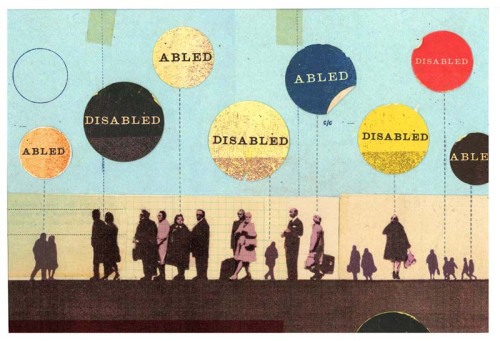
A collage, with black and white newspaper figures at the bottom. Some have bubbles above their heads, some reading 'abled' and some reading 'disabled.'

“Society” by Martin O’Neill, via Laugh or Cry.

the personal hurricanes of kirsty mitchell – the guardian asks why so many women suffer from depression.

hmmm, i’m getting a little tired of articles like this that always seem to be about the same thing. white, middle class, married, slightly older than ‘normal’ mothers talking about how they got depression trying to hold down a city job, run a family, and still look (and i quote) fabulous. the tone is always this one of overwhelming apathy, this ‘but i was only trying to have it all’ whinge, rather than a direct look at the root causes of what’s making them feel that they have to have it all, at once, in the first place.

MarketWatch – MetLife Study Finds Less Than Half of Americans out of Work Because of a Disability Had Income Protection in Place

Three in five individuals who were out of work for at least six months because of a disability did not have disability income protection, according to findings from a new MetLife study released today. The MetLife Study of the Emotional and Financial Impact of Disability also found that among those individuals who did have coverage, only about one-third of their income, on average, was protected.

Journal of Medical Internet Research – Mobile Therapy: Case Study Evaluations of a Cell Phone Application for Emotional Self-Awareness

We developed a mobile phone application with touch screen scales for mood reporting and therapeutic exercises for cognitive reappraisal (ie, examination of maladaptive interpretations) and physical relaxation. The application was deployed in a one-month field study with eight individuals who had reported significant stress during an employee health assessment. Participants were prompted via their mobile phones to report their moods several times a day on a Mood Map—a translation of the circumplex model of emotion—and a series of single-dimension mood scales. Using the prototype, participants could also activate mobile therapies as needed. Five case studies illustrate participants’ use of the mobile phone application to increase self-awareness and to cope with stress.

Disability Scoop – Poll Shows Public Support For Community Living

A Harris Interactive poll released Wednesday indicates that a majority of Americans support legislation that would allow people with disabilities to choose community-based care over nursing homes. The poll commissioned by the self-advocacy group ADAPT and the Coalition for Community Integration, gauged opinions on the Community Choice Act, a bill proposed in Congress that would mandate that states offer people with disabilities the option to use Medicaid funding to pay for community-based rather than institutional care. Findings from the poll indicate that 66 percent of Americans support the legislation without knowing what it would cost. When informed that the measure would likely add no more than $6 to a middle class taxpayer’s bill, 89 percent of respondents were supportive.

More Than Coping – “When Medicine Got It Wrong”: When We Blamed Schizophrenia On The Parents Airing on PBS Beginning This Week

When Medicine Got it Wrong is the groundbreaking story of a small group of loving California families in the 1970s who challenged the commonly-held belief that schizophrenogenic parents caused schizophrenia. Angry at being blamed for an illness they knew was not their fault, mothers and fathers in San Mateo, California started Parents of Adult Schizophrenics (PAS) and began fighting for better understanding and treatment. The story starts in 1974, and centers on two families — the Oliphants and Hoffmans — whose sons developed schizophrenia in their teens. Doctors told the boys that their parents were the cause of their problems. Medical records labeled each child as the “identified patient” in a dysfunctional family structure wherein the parents were more psychologically ill than the family member exhibiting delusional and psychotic symptoms. The cure: separation from the parents. The boys were institutionalized at Napa State Hospital, and the parents were warned that visits would be detrimental to their sons’ chances of recovery. The Oliphants and Hoffmans prompted researchers to question their assumptions about schizophrenia’s etiology. Their passion inspired parents across the country to organize and lobby for research and more appropriate, compassionate care. Their passion paid off: by the end of the 1970s neuroscience was investigating causes outside of family dysfunction and interpersonal relationships. Rapid discoveries in the next decades revolutionized medicine’s understanding of these brain diseases. By the mid-1980s, textbooks dropped the term “schizophrenogenic,” and in the 1990s pharmaceutical companies introduced the first new generation of medication in decades.

Los Angeles Times – When prescribing a drug, doctors have many choices — too many in some cases (h/t notemily)

Even when research has identified the best drug choice, doctors don’t always prescribe it. “Physicians make many decisions that aren’t evidence-based,” says Dr. Michael Hochman, assistant professor of clinical medicine at USC and lead author of the JAMA article. “Every physician decides a bit differently.” Some physicians can’t keep up with all of the new drug information. Others simply prescribe medications out of habit; they may learn to use one drug during their medical training and, if they have good experiences with it, continue to use it for many years. Still others factor a drug’s cost into their decision-making to help their patients save a bit of money. Then there’s the pharmaceutical industry. It can affect the choices of doctors and patients. Many drug companies provide physicians with medication samples, and the availability of these samples can dramatically alter doctors’ prescribing patterns, studies have shown. It can lead physicians, in short, to dispense and prescribe medications that wouldn’t otherwise be their first choice.