Monthly Archives: November 2009

Recommended Reading for November 25

On Living with Pain and Taking Care of One’s Self

I have been managing my chronic pain and taking care of myself for years. But taking care of myself requires the cooperation of other people, and that can be the most difficult challenge to overcome. I cannot take care of myself or be well if others do not take my pain seriously. Just because I was able to do X yesterday does not mean I can do it today. The pain comes and goes. Once it starts I have to let it take its course. But society caters to people who are able-bodied and physically strong. Illness and pain are not compatible with the typical pace of life, and I admit I have anxiety about falling behind.

Living with an invisible disability can be exhausting – not only because chronic, searing pain is energy-draining (in my case), but because it leaves behind no evidence. Communicating with others about my pain often leaves me feeling misunderstood and isolated. Sometimes I want to wear tops that reveal my scar all the time, in order to silently “prove” there’s a *real* reason I just want to lie down, can’t carry that ten pound box, or don’t want to stay out all night partying. I cannot shake the feeling that other people doubt me or believe I use chronic pain as an excuse to get out of doing certain things.

Insurance Company Revokes Depressed Woman’s benefits over Facebook photos

Mental illness is no exception to this rule: people think they know what it looks like, that they can spot a person with a mental illness a mile away, and that if a person doesn’t live up to those expectations, they’re either seeking benefits they “don’t deserve,” or seeking attention. And with regards to depression specifically (as it’s the topic of the original article, and my greatest knowledge base), they tend to think that if someone isn’t spending all of their time crying, frowning, or refusing to get out of bed, they can’t possibly have it.

Your Scooter Means You’re Poor

I have learned that differently abled means poor to many. It means that you are not working. It means that you have no identity or interests. I understand for many being differently abled means poverty because we live in a world that does easily make the accommodations that are necessary to participate in paid work. Knowing that this is the case, why does the stigma attach itself so ferociously? If a person is unable to work because of a lack of accessibility, why do we feel the need to persecute them because of the way our society is designed?

When I tell people that I write, the answer is usually that it makes sense. It does not occur to anyone that I chose this because of a love of writing and sharing ideas. Writing is something that I was interested in from the time that I was a small child. Because I am doing it, it certainly is not real work. Such ideas do not attach themselves to a friend of mine, who makes his living freelancing in this area. Sitting together, people will invariably ask him a multitude of questions, ignoring me completely. It is understood that he chose his work out of love and not convenience.

A Different Kind of Test

More than two dozen seniors at Lincoln University, in Oxford, Pa., are in danger of not being able to graduate this spring — not because they’re under disciplinary probation or haven’t fulfilled the requirements of their majors, but because they were obese as freshmen.

It might sound like a joke, or a violation of individual rights, but James L. DeBoy, chair of Lincoln’s health, physical education and recreation department, said he sees it as his “professional responsibility to be honest and tell students they’re not healthy.”

In the news:

Disability turns laughing matter in Channel 4 comedy show [Headline is really misleading past the first few paragraphs of the article] [Also, oh gosh! People with disabilities don’t all agree on everything! I love that they spelled that out in the article, but it always bothers me that this is considered news.]

Penned by writers from Skins and The Thick of It, the series features six disabled characters marooned on an island, including a blind man, a woman with cherubism and a paraplegic man. Each character is played by a disabled actor with the same disability, and one complains about the number of non-disabled actors portraying disabled people.

Liz Sayce, chief executive of the Royal Association of Disability Rights (Radar), says: “There is likely to be a storm of comment from disabled people and non-disabled people alike over Cast Offs. Some disabled people will find it funny and real – portraying disabled people as adults who swear, drink and have sex. A real break from covering disability with kid gloves, or not covering it at all. Others may well find it offensive.”
Guest Post: Hanging Up the Cane

Lis is a 22-year-old university student from Western Canada. She studies psychology, and is currently working at a school for at-risk inner-city youth. In her free time, she writes fanfiction and participates in the Society for Creative Anachronism.

The first time I held my cane, I cried.

It wasn’t a feeling I expected, to be honest. I’d been fired the week before from a job I enjoyed, for telling my employer I was in too much pain to stand for the entire shift, but things were coming out on my side. I had all my friends and family supporting me, and I’d found enough self-esteem to file a complaint with the provincial Human Rights Commission, alleging discrimination on the basis of disability. It was time, in my mind, to give up beating around the bush.

I’d been raised by parents who lovingly ignored my seemingly minor birth defects, who didn’t want to stigmatize me any further than a Gifted girl in public school could be. They felt that letting me wear normal shoes was the least they could do. When a nagging ache formed in my right knee and hip in my teens, I tried to ignore it and the fact that it wasn’t going away. I was twenty before I went to a podiatrist, who didn’t have to do more than examine my hips and spine when I told him I was in pain before snorting in disbelief and saying, “Yeah, no wonder.”

My right leg is five and a half centimetres shorter than my left, with the discrepancy fairly evenly distributed between my femur and tibia. It’s the kind of thing only the tailors who hem my pants notice, when they call my house anxiously asking me to come in for a second fitting in case they made a mistake.

But I was sick of living in pain, and after I’d been fired for requesting a stool it didn’t feel worth denying my pain anymore to look abled, so I went out to the Mobility Aids aisle of the local London Drugs. A fellow fanfic writer who used a cane had told me what to look for: adjustable, orthopedic, and unrepentant. The one I picked off the rack was a vivid aqua.

Then I cried holding it in my hands, because I couldn’t pretend anymore that I wasn’t disabled.

After that was over, I went down to Stationery for a pack of Sandylion stickers, made my purchase, and sat outside that drugstore wiping the tears from my face and plastering the cane with pink and purple butterflies.

How do I say what that cane meant to me? None of the abled people I’ve met understand it with anything but pity. I’ve always had low self-esteem and what my psychologist later diagnosed as social anxiety, a terror of asking that my needs be met, of attracting unwanted public attention. Now I had a public declaration of my needs, and it was bright blue. The cane did some of my talking for me, so I became able to stutter a request for a seat on the bus, or ask not to walk long distances. I was attracting the sidelong glances and whispers I’d always feared, but all they made me do now was grip my cane a little harder and stare back at them. I knew I was in the right. They knew it, too, because they always glanced away.

How can I explain that after years of living in pain to be what was expected of me, that cane taught me to say I want and I need and I deserve? That it was never something I was bound by; that it gave me the ability to walk further, stand longer, move quicker than I would before? That I missed it when it wasn’t in my hand?

Society marginalizes disabled bodies and takes away their sexual agency, but being visibly disabled helped me find mine. I’d always felt anxious about my body, about being attractive, about being good enough: I always chided myself for not reaching some nebulous ideal. The great lie I had been able to believe when I was abled was that perfection was achievable: that if I only said and did the right things, I’d escape criticism from myself and others. It was in facing criticism and dismissal that I learned I’d been playing a mug’s game. The point wasn’t to make other people happy; my body didn’t and couldn’t exist to meet their standards. The only standard I could meet was mine. I used to be mousy, deliberately homely, as if my unfitted jeans and baggy shirts said, I quit, don’t criticize me for not being sexy. I wasn’t trying anyway. I was able to use the invisbility cloak of disability to begin to experiment with femininity, with ornamentation, without needing to be perfect. I could wear a low-cut shirt, I reasoned, because I’d have my cane. Nobody would look at me anyway.

(Oh, but it surprised me, the first time somebody looked anyway.)

Being disabled meant, for the first time, having the ability to talk about my body and my frustrations with it without judging it as bad. It meant that I, with all my flaws visible and invisible, was still worthy. That I still possessed dignity. That I was still human, no matter whose standards I failed to meet.

I don’t know how to explain any of this. I don’t know how to respond when I walk into work now, freely and unassisted, and have a coworker say, “Hey, you aren’t using your cane! That’s fantastic!”

The orthotic lift I started using a year ago finally stopped hurting, enough that a slight increase in height at the end of September took away the pain in my knee within two weeks, which got rid of my need for the cane. My ambient pain has at least halved. I’m not relying on prescription painkillers to get through my day. I can climb stairs. I’m beginning to hope I can even fence again. After so long living with pain I didn’t think would ever go away, I almost don’t know how I feel. I guess I’m happy. I’m cured, right? I’m enjoying my body again. I definitely don’t miss the pale, persistent ache in the shoulder of my caning arm that no height adjustment could completely banish. I ran to my car last week, just because I can do that now.

My cane still hasn’t moved from its habitual place, on the floor of my car between the seat and the door. I don’t take it out to use it anymore, haven’t touched it for the last two weeks, but I can’t bring myself to hang it up. Sure, part of me’s waiting for the honeymoon to end and the pain to come back at any moment, but that’s not it. That cane has been a friend to me. It’s been part of my voice, my statement about who I am, and a lack of apology about being flawed in public. It’s helped me move, let me go places, allowed me to function. It has been a source of succor to me in my hour of need, and I find it as hard to cast aside now as it was to pick up in the first place.

What I really want to say to the well-meaning people who wish me health and happiness is, it isn’t about the cane. It wasn’t about receiving pity from people in public for being disabled. It wasn’t about the looks or the whispers. I was in pain that disabled me from truly living for years before I picked that thing up. It was never about the cane.

It was about me.

No, Actually, “Eat a Sandwich” is Not “Feminist Activism”…

…and I’m going to tell you why.

Because the policing of women’s bodies, whether you are being cheeky, or saying it to a plastic doll, is not cool. It’s hurtful and not useful, and has no place in feminist discourse. Can we move past that point? Huh? That’s a pretty Kindy thing, IMNSFHO.

‘Kay.

Moving on.

*The rest of this post is going to use some harsh language that describes my experiences/anger/frustration with Anorexia and Bulimia. I am direct and vulgar and sometimes a little flippant with how I describe my past behavior, and that is how I survived it. This may be triggering to some people. I also swear. A lot.*

There is a point when you are struggling* with an eating disorder that you might find yourself thin. Perhaps painfully thin. Maybe dangerously thin. You know this. You are aware. You haven’t avoided solids for this long, or barfed up all of that dinner you were pretending to enjoy without realizing what this means to your body. You might have some misunderstandings about what your body is actually needing…but you pretty much know.

In fact, everyone knows. All anyone can fucking talk about is how good you look now that you are so skinny…but wait…you just passed so good and have moved into too skinny…(because there is never good enough…too fat or too thin you will never be in)

Seriously, girl, eat a damned burger.

Or a bacon sandwich.

Eat something.

Because, you know, it’s that easy.

In fact (shifting voices), the only thing that anyone said to me that wasn’t so fucking insulting that I didn’t want to scream was “I am not going to insult you by saying how much harm you are doing to yourself because you are a smart girl and I know you know, when you are ready, I’ll be here”.

I watched all the shockudrama’s that were meant to scare me because ZOMG my STOMACH could RUPTURE and I was DOING THIS to MYSELF!

*for shame*

I saw Tracy Gold and the mom from Family Ties and countless others on the after school specials during school and I fucking knew.

How could I not? I knew what the result was…that was the damned point.

And I knew I was sick.

I. Didn’t. Care.

And that was scarier than anything…that I felt helpless inside my own body to stop it.

Eat a fucking sandwich.

As if I wouldn’t just throw it back up.

As if that bottle of ipecac wasn’t in my glove box.

As if I wasn’t really good at tearing it into pieces to make you think I was actually eating it only to drop some and crumble some and throw the rest away…

No, I wasn’t embarrassed of letting you hear me pee…the water running was a cover for something else…

Eat a fucking sandwich.

Tumbling around inside my head…as if it never occurred to me to do.

As if I had the power to just eat that fucking sandwich.

The hurt and the denial and the lies…and shit yelling at me just didn’t help…

Because who the fuck carries sugar packets in their purse?

And do you know when that shit started?

When I was a teenager.

We shouldn’t infantilize teenagers by saying “b-b-but they don’t get that this message isn’t aimed at real people”.

Bullshit.

Teenagers are people…with feelings…

And if anyone can tell you about what it feels like to hurt because you sit outside the socially accepted norm of appearance, it is another teenager…

being told to just eat a sandwich isn’t that funny if you are dealing with body issues

and burning yourself with a curling iron because you don’t know what else to do…

Eat. A. Damn. Sandwich.

It’s not funny or witty or clever or great new empowering activism.

It’s awful.

It’s hurtful.

It’s waking up in your own bile.

And it is possibly terrifying the hell out of someone.

Unpack that one.

*I don’t like to use “struggle” any longer when discussing disability. My experience with EDs was a struggle. There is no other word in my vocabulary, which spans a few languages, to explain it. I struggled, fought, and am still not sure I have won this one.

I’d Rather Be Dead

I didn’t think I’d need to do this but it has come up: This post is not a place to discuss the merits of assisted suicide. Many disabled people, including me, find it really unsettling. In the context of able-bodied and neurotypical people telling us our lives aren’t worth living it is especially inappropriate. Comments on the subject will not be published.

Warning: The following includes graphic descriptions of medical unpleasantries.

I could never live like you. I’d rather be dead. You’re so strong. You’re so brave. How do you do it?

I have a chronic pain condition. Most of the time I don’t bother getting into detail because I don’t feel like it but it’s illustrative here, so I’ll share. I live in pain. It pools in my hips and my left knee and my right shoulder and sometimes my legs turn to stone. Every step I walk hurts and I keep getting slower and more labored. (My disability is invisible only in the most technical sense. Fortunately people have lots of practice not seeing disability! So, phew.) Sometimes, like the other night, my hands hurt so much I can’t get the non-child-resistant easy-open top off the bottle of pain meds.

(If my hands hurt so much why do I type? Why not use a voice writer? Because this voice here, this is the voice I write with. This is not the voice I speak with. I would write far less if I had to use my voice to do it. And it’s only pain.)

And then there’s the Weird Shit. (It’s a technical term.) I take antibiotics daily because if I don’t I get a urinary tract infection which leaves me crumpled in the bathtub screaming, gushing blood, graying out, waiting for the big antibiotics to get working. Sure I could go to the emergency room and I have — where they give me the same antibiotics I’d get from calling my urologist’s answering service and pain meds weaker than what I take daily. And I get to deal with having medical professionals react to me being trans* and poor.

A sore throat once turned out to be a fungal infection, another one was a tonsillary abscess, the treatment for which was getting stabbed with a large-bore needle then having the contents of the abcess squished out. It was about as comfortable as it sounds, and it tasted every bit as good. I did not bite the nurse practitioner who was treating me. My general practitioner later looked at me really weird when I expressed concern that my next sore throat (it was just a virus and a runny nose) might be one of these until I explained that I’d actually had these things.

The big one was when a cold — in the space of three weeks — became bronchitis, then pneumonia. If I rolled onto my right side, I felt like I was drowning. If I sat up, I felt dizzy. A chest x-ray showed much of my left lung was wrong. I was admitted to hospital that day, the five doctors that came that night took my wife into the hall and told her the things that could be killing me. There was fluid in the space around my lung. They poked at me and stuck a needle in and drew off three hundred millilitres. I didn’t get appreciably better. They installed a peripherally introduced central catheter so they could give me vein-killing antibiotics like vancomycin and aureomycin. The fluid they’d drawn off, cultured, proved to be sterile. More chest x-rays showed shadowy bits around my heart and more imaging showed fluid buildup there too — between having a lung and a third to breathe with and a heart working under the increased burden, I was understandably tired. Even more understandably when some time during the week I was in hospital, my red blood cell count fell through the floor. They were tracking everything that came out of me so it wasn’t like the blood was going anywhere, it just… vanished. They gave me more blood. Later they got the bright idea of drawing off the fluid around my lung at least and took me down to radiological medicine. I got to sit up for it. They did throw in some lidocaine, which at the time I hadn’t figured out that I could say “Hey I don’t metabolize this like most people I need more time for it to take effect before you start stabbing me with shit” so the ginormous fucking needle they stabbed me in the back with? I felt most of that. Ow. I wasn’t supposed to see it (mustn’t discomfit the patient, even if she finds things comforting that most people don’t), but I got a look at the three-litre vacuum bottle half full of murky green fluid they’d sucked out of me. I felt much better, though that lung felt crinkly like cellophane from having been collapsed so long. It was a teaching hospital, so the place was crawling with med students who all (I heard — the nurses wouldn’t actually let them come near my room for which I am still grateful) made excuses to come read my chart. I was medically interesting. I never did get a diagnosis. A real diagnosis, I mean. I know full well that ‘idiopathic pericarditis’ means ‘the membrane around your heart is inflamed and we don’t know why.’

On a fun side note, while I was in hospital busy being sick with Weird Shit I kept getting calls from work. I was the only person in the company who knew how to do what I did, so I provided user support. From my hospital bed. On morphine, with blood running into my arm. It was kind of impressive, in an appalling way. When I was home (I was out of work almost two months and none of it was remotely vacational — at some point I’ll write about having had a whole week of vacation in the ten years since my diagnosis with this chronic pain condition) they sent someone to bring me a computer so I could do some things, occasionally.

I’ll stop with the Ways Kaninchen Zero Is Very Very Ill now. The point is yeah, there’s a lot going on. Most of us could tell similar stories, or scarier ones.

I cry, often. Even with the meds I’m in a lot of pain all the time. I’m exhausted, all the time. I work thirty to forty hours a week in spite of it (though I’m running up against the limits of that too).

People who don’t live with chronic pain wonder how I do this. How do I live with this much pain? How do I keep going? How have I done this since I was a teenager? (I’m thirty-seven now.) I must be a fucking paragon of moral fortitude, because (I’m told) I’m not even all that bitter about it (though I am, sometimes). I’m happy, when I can get around the depression I’ve carried most of my life too.

I could never live like you. I’d rather be dead. You’re so strong. You’re so brave. How do you do it?

I hear this a lot. It’s actually not a secret, though I think the able-bodied are somewhat afraid of the answers. It’s not even difficult. Most anyone could live my life, probably. I have a good life. My doctors listen to me when I tell them what’s going on with me which is wonderful after so many years of being told I wasn’t in pain because the tests didn’t show anything. I have books, games, computers. Because of the last I have friends and I fall in love about five times a year. (I’ve been working on doing things that scare me and I’m telling people more that I’m infatuated, crushing, in love. And that they don’t have to feel the same way about me at all.) Sometimes I can actually stop writing a story and call it finished.[1]

Here’s how I do it: I want to live. I don’t want to be dead. My life is worth living. It’s not tragic. It’s easy. We’ve all got the means to get acclimated to a new home, new furniture, changes in climate and environment. Having a different bodily environment or neurological environment is just something else to get used to.

The commenters in the Why Are They So Angry At Her? thread have it right, I think. The physio/neurotypical haven’t bothered to consider our lives from any perspective but their own and all they see are limits. They imagine being ill with the flu (which leaves me in bed and miserable and hating it too), or an injury that hurt and impaired their movement but ultimately healed: a sprained joint, a broken bone. (All of which I’ve done also: counting the events where more than one bone broke at a time as one, I’ve broken bones more than ten times though I’m a little fuzzy on exactly how many — broken toes are hard to track.) They recall how miserable being ill or injured was and imagine having a disability (or several) as being ill or injured and thus miserable all the time.

We’re not. Even when depression is part of a constellation of symptoms or a side effect of meds or just something else to live with, we’re not. We’re just living, like everyone. When we hear “I’d rather be dead” it often sounds like “you should be dead.” And with good reason. People with disabilities are killed by those who should care for them. Parents kill their disabled children and the public’s sympathy is with the murderers. Caregivers in institutional facilities kill residents and few people care.

Amanda has written extensively about this at Ballastexistenz, and her Background, to the Foreground post is excellent. Not Dead Yet is dedicated to working against euthanasia and assisted suicide policies that make killing us legal, or at least fuzzy. Lauredhel’s post at Hoyden About Town about Christian Rossiter’s lawsuit to refuse nutrition hits most of the points I try to make when I talk about this issue. It’s despair and isolation that drive us to want to die. The neuro/physiotypical don’t see that part of it.

There are social feedback loops that reinforce these attitudes and keep us isolated. Ignorance and fear and hate go together. Neuro/physiotypical friends and relatives stop inviting us to things after a while. We’ve said we can’t come a number of times: we weren’t up to it for whatever reason that day, the venue wasn’t accessible, we didn’t have transportation. Eventually it becomes habit, justified by unhelpful concern. Whatever place isn’t accessible (it’s too much bother to plan for real utility). Oh, they probably won’t feel up to it (our lives are miseries anyway). Around it goes.

[1] Some of my stories can be found at my story blog, though be warned: nearly all of them involve themes of sex, violence, death, horror.

Recommended Reading for November 24

But Accessibility is Too Expensive

Due to the weather and being forced to stand, the pain was so terrible I was literally weeping silently. I walked into the office and asked to speak to someone in charge. I explained the issue and suggested that they install a platform, which would allow scooter and wheelchair users to watch the game. Like any other parent, I paid for my child to have this experience and it is completely unfair, that I should be forced to suffer, so that I can participate.

The woman gave me a depreciating smile and informed of the cost involved. Of course they will look into it and maybe in the spring they can do something. Isn’t that lovely. You will note, that she made certain to point out that I was asking her to spend money. This is always the excuse given when the disabled demand that accommodations be made so that we can participate. Shame on me for not having a normal body, which can tolerate standing for an hour outside on a cold Ontario fall evening.

Victim Art

I’m not sure what I think. I don’t know whether I would go to see such a performance. I don’t know whether I would call it art. I do think that inviting someone to film you at your most vulnerable moments is a gutsy statement of human vulnerability. And it forces me to think about what I call art.

Usually, I think of art as being the result/product/performance of a skill that is not commonly shared among people. Marcalo asks us to watch a moment of absolute lack of control. Usually, art is in the execution of the extraordinary — a painting, an image, a photograph, the playing of a piece of music — we are asked to watch a moment of incredible consciousness and intention. Marcalo strips that down. The way her body will move in the grip of a seizure may well be extraordinary, but it will also not be intended or conscious. Marcalo’s very idea makes me think. And think and think.

A Teaching Moment (Service Dog Etiquette 2)

I know I’ve mentioned in my first piece on service dog etiquette that many people make all kinds of errors in dealing with a service dog team, but it surprised me how many of them I face in hospitals and doctor’s offices.

The doctor who always stoops to say hello to my dog before he talks to me. (If he wasn’t a hard to replace doctor, I’d have a talk with him about it, but he’s of a specialty where I can’t afford to alienate my doctor)

The nurses who tell me that the dog is just fine where he is, and then struggle to straddle him or reach equipment across him, making all three of us uncomfortable.

The doctors I’m seeing for completely unrelated specialties who ask me what purpose the dog serves.

Common Barriers to [Website] Accessibility

Many web pages on the UIUC campus have the same barriers to accessibility. These can be relatively easy to spot and correct, so check out your pages to see if you have [them]

In the news:
‘Mad’ and proud of it [Note: Comments are a mess.]

Ms. Costa is one of the founders of the Mad Student Society (MSS), a group that has been able to make great strides in getting people to come out of their shells, form friendships, become politically active and feel better about themselves.

The group, made up mostly of students who have experienced the psychiatric system, use a once-a-month two-hour group talk to discuss personal issues and day-to-day difficulties “without fear that you’re going to be charted or pathologized” says Ms. Costa.

For MSS member Joel Zablocki, peer support is about being able to discuss all kinds of subjects with others who are at your level and have gone through similar experiences. “You don’t have the strange power dynamic of a doctor-patient relationship.”

Always feel free to email me with links to posts you think are appropriate for Recommended Reading. If you put FWD/Forward in the subject line, I’ll see it sooner. anna@disabledfeminists.com

Amusing Answers to Clueless Questions

Ever get really bad questions from clueless abled people? Here are some answers that might come in use.

Q: What’s wrong with you?
A: The fact that I hang around with ableists like you.

Q: What’s your disability?
A: My business.

Q: You’re looking so much better, aren’t you?
A: I like to think I’m becoming a better person all the time. Glad it’s showing!

Q: Can they fix you?
A: You mean what can they fix me, like for lunch? I’d like a salad with awesome sauce, if there’s any left over from making me.

Q: [Intensely personal question]
A: Please, let me inquire as to all the intimate details of your life.

Q: So do you have sex?
A: Not with you.

Q: How did you get that way?
A: I’m glad you asked. It’s a long story. [Pick one of the following and go for it!]

  1. Back on the space station in ’89, I had just discovered the existence of…
  2. I was designing carpets for television talk shows at the time…
  3. I ordered a new jacket out of a catalogue actually, but they sent me this instead! It’s funny, really…
  4. While tracking down manufacturers of obscure bathroom tiles, as was my hobby back then…
  5. It was just an ordinary day. I was in bed, dreaming about strawberry milkshakes, when a really big milkshake started to speak to me…

(You might also enjoy Answers I love to/hope to one day give)

[Sort of cross-posted at Zero at the Bone]

Guest Post: Puppies and Pills Part 1

About thetroubleis: Thetroubleis is a 19 year old with bipolar disorder, social anxiety disorder, generalized anxiety disorder and dyspraxia. She’s a WOC who is also a transracial adoptee and pansexual/queer, depending on how she’s feeling that day. She enjoys knitting, video games and is a music geek.

How I came to path of getting a service dog* was a long, strange journey. My experiences are my own and by no means represent the entire service dog community. My country and state laws are most likely different from some readers as well, so I’m only writing from my own perspective.

I’ve been bipolar since I was child along with my other disabilities, so I don’t remember being normal. I’ve always just been me. I am my normal. Although my other illnesses were diagnosed latter, looking back i can see how they impacted my child and now, how they affect my adulthood.

In junior year of high school, I was reading up on dog training, because I thought that might be something I’d want to do as a job. I’ve always like dogs, they don’t judge me and my Samoyed Kesha loved me unconditionally. One day I came across the topic of service dogs and was so amazed by them. I put the thought of them away in my mind until I read across the concept of psychiatric servicee dogs.

At first, I was skeptical. How could I dog help someone like me? I thought that service dogs were only for people with “real” disabilities. My mental illness wasn’t disabling, was it? Just because I couldn’t go out in public alone or deal with crowds didn’t mean I was disabled. Loud noises and lighting hurting and causing melt down was just part of who I was. It took me some time to to come around to the idea.

When I realized all the way in which I dog could help me, I read and read. Anything with even a small mention of service dogs was worth reading to me. I came up with a list of tasks based on my symtoms and things a dog could do the help them. I was ready.

Sadly, service dogs, especially types that are very new are expense. Psychiatric service dog are pretty new on the scene and the one program I had found in my state that trained them had closed. I was crushed. I tried to brush it off, because I didn’t have the money for a dog anyway. That was about to change.

I headed off to my first year of college and did badly after being cut off from my medication for a time, along with personal problems. I was called back home several times, because my parents had decided to sue my former high school for discriminating against me. They choose to settle.

My money problems were solved! Now where was I going to get a dog? I know it was best to buy from a breeder with service dog lines because even though some shelter and rescue dogs work out as service dogs, the chances of them washing out is much higher. I knew I’d have a hard time with my dog washing out, so I wanted to lower that chance as much as possible.

I started hanging out on Dogster.com and met a psychiatric service dog handler named Veronica who shared a disability with me. She was using a pit bull Weimriner mix as a service dog, but the dog was getting older and had to retire. She had picked a Standard Poodle to train as her next service dog and although I wasn’t partial to the breed, I went and checked out the breeder.

He was so nice. His wife friend were both service dog users, so he knew so much. We talked about what I was looking for in a dog and what tasks I wanted done. He said he thought I’d be a great home for one of his puppies and I put down a deposit and waited.

Sadly, with my puppy being in California and me and Maine, it was hard to coordinate a proper short flight for the puppy. He was already going to keep Figaro for a few extra weeks to get him used to the crate, but I ended up not meeting my dear boy until he was 4 months old. We ended up driving all the way to Boston to get him, but it was the best, safest flight for him, so I didn’t mind.

I had to finish up at school before we could commence training, so he went home with my parents, three hours away. When I finally came home, he took right to me. He’s was lovely boy, very intent on pleasing me. Teaching him was pretty easy, even for a novice like me.

I found another service dog school, one that helped owners train their own dogs. We signed right up. They have been an invaluable resource and i couldn’t to all I have without them.

Figaro and I were a team, the very best of friends. I spent that summer just bonding with him and the best thing happened. He started to alert to my panic attacks before they went full blown. I had been hoping he would, but hadn’t expected it. When I realized what was going on, I was ecstatic. He had his other tasks to make him a service dog, but this, the alerting was so helpful. My bipolar disorder is extremely rapid cycling and he started to alert me to that, as well as hair plucking. I hadn’t fully realized what a smart dog he was.

This partnership was the best thing I have ever done for me. I still take my pills and still go to see my doctors, but having a service dog in training is a big help. Although Figaro meets the legal definition of service dog, I only call him such in legal situations because his public access behavior isn’t where I would like it right now. Thus, he isn’t with me in public unless it’s a training exercise. That’s okay though, because I stay home for the most part. It’s nice and I have to admit having something need me is pretty great too. It’s good to not fail at something, to have purpose.

Next time, I’ll be writing about the public and service dog community.

* I’m using the United States of America’s of service dog and the state of Maine’s definition of service dog in this post. The USA’s definition is as follows:

“Service animal means any guide dog, signal dog, or other animal individually trained to do work or perform tasks for the benefit of an individual with a disability, including, but not limited to, guiding individuals with impaired vision, alerting individuals with impaired hearing to intruders or sounds, providing minimal protection or rescue work, pulling a wheelchair, or fetching dropped items.”

The state of Maine’s definition is

“Service animal” means:
A. Any animal that has been determined necessary to mitigate the effects of a physical or mental disability by a physician, psychologist, physician’s assistant, nurse practitioner or licensed social worker; or
B. Any animal individually trained to do work or perform tasks for the benefit of an individual with a physical or mental disability, including, but not limited to, guiding individuals with impaired vision, alerting individuals who are deaf or hard of hearing to intruders or sounds, providing reasonable protection or rescue work, pulling a wheelchair or fetching dropped items.

Recommended Reading for November 23

There was no recommended reading on Friday because I forgot I hadn’t done one for the day after the Carnival. Oops!

Changing the Perception of Braille

I recently watched a Ted talk that focuses on the idea that how we feel about something is totally based on our perception. It seems to me that in ore for us to improve braille literacy, we are going to have to change people’s perceptions. Organizations like the NFB and ACB are already doing things to help change people’s attitudes towards braille, but I think we can go even further.

Many people are choosing to learn sign language because they think it’s cool. So the question is how do we make braille cool? I think we have to start with children and teens. When we’re younger, we tend to me more likely to accept change and set trends. With this in mind, I have a few ideas of how we can make braille cool in the eyes of our children, and if we can do that, then maybe that will translate to the adults in their life.

Blind Need More Access To the Written Word

I love to read, and I’ve been doing it ever since I was able. My wife is also an avid reader. But we are blind, and so are many of our friends. The organization I lead, the National Federation of the Blind of New York, is made up of blind people. Although many of us read everything we can get our hands on, we can’t get our hands on very much to read.

There are services for us, of course. Government entities and nonprofit organizations convert books into Braille, audio or digital form for our use. But only about 5 percent of all books published undergo such a conversion. The largest collection of books in Braille and audio form in the United States has, perhaps, 70,000 circulating titles in its collection. A few more selections are available as commercial audio books, but these are up to three times as expensive as print books.

Service Dog Etiquette Part 1:

I’m sure you’re thinking, how does my petting a service dog undermine his relationship with his person?

Well, it works in two ways. First off, my service dog works for me because he believes I am the most awesome person in the world and that all good things come from me. All petting, all praise, all toys, all games, his soft fluffy bed, all food, all treats – that all comes from me. Secondly, if someone other than me pets him, he starts thinking…oh, people will pet me. If people will pet me, it’s worth paying attention to people rather than my partner. If he pays attention to people rather than to me, I could have a nasty fall (among other things) – one that could injure both of us. Keep in mind when you read this that the average person who works with a service dog is more likely to be hurt, and hurt badly, by a fall. We tend to have service dogs because there is some kind of physical fragility or injury to us already, after all. When you’re dealing with guide dogs, I think the risk is even greater – a distracted guide dog might walk his person into traffic!

When People Say Stupid Shit

I. Cannot. Afford. A. Place. Alone.

My maths are simple. I have an income, which I get from the state until they figure out what sort of job I can handle with my disability. That income is all I have. Anything I might earn by teaching two hours a week (which I do) is subtracted from that income. That means that I cannot raise my income in any way. Unless, of course, I do so illegally, which would be pretty stupid considering the risk of discovery. My income is what it is and cannot be adjusted upwards. At all. Not until I get some help for my disability.

In the news:
Study Unravels Mystery of Dyslexia

New research may provide an answer as to why children with dyslexia often have difficulty hearing someone talk in a noisy room.

Dyslexia is a common, language-based learning disability that makes it difficult to read, spell, and write. It is unrelated to a person’s intelligence. Studies have also shown that patients with dyslexia can have a hard time hearing when there is a lot of background noise, but the reasons for this haven’t been exactly clear.

Now, scientists at Northwestern University say that in dyslexia, the part of the brain that helps perceive speech in a noisy environment is unable to fine-tune or sharpen the incoming signals.

Meet a Contributor: abby jean!

So everyone can get to know our contributors a bit better, we’ve decided to run a series called “Meet a Contributor”. Each Contributor will be interviewed by the others in turn.

Hi! I’m abby jean. I live in sunny Southern California and am an attorney in the public interest field, which means I work primarily on civil rights issues affecting low-income folks, including not only disability rights but also issues around language access, immigration status, and domestic violence. Right now I’m focusing on rights in the welfare system and issues around access to health care.  As you may have noticed, I am usually an all-lowercase girl, but am using these newfangled capital letter thingies in my FWD posts – only to relapse to all lowercase in comments.

The other huge area of my life is music – I used to dj in local dance clubs when I could still handle getting only 3 hours of sleep before going to my lawyer job – so I’ll start with the questions from Chally (What kind of music do you like?) and Annaham (“If you were going to a deserted tropical island and could only bring 5 albums, which would you bring?”) in one lump.

I like a whole lot of different kinds of music, but I favor pretty much anything with female vocalists. I like a lot of indie music, but I also love pop music and listen to a fair amount of hip-hop, even though I sometimes have misgivings about the violent and misogynist content. I’m not a huge fan of opera or ambient electronica or noise metal, but none of that is totally off the table, either. I do, however, have some core artists to whom I go back over and over again – and those are the albums I would bring to a deserted tropical island.

First, I’d bring a magical cd that contains the entire works of Tori Amos from Little Earthquakes to To Venus and Back. I used to follow Tori extremely closely – I had all the b-sides and live recordings and alternate versions and between 1994 and 2003 or so, I saw her in concert about 45 times. While I’m not nearly as invested in her later work, she’ll always be important to me and her music resonates for me in a way few others do. Second, another magical cd with the complete works of PJ Harvey. Her perspectives on femininity, and its power, were extremely influential on my ideas of what it means to be a woman. And especially what it means to be an angry woman, and how to use and channel that rage and energy. Third, another magical cd (you may quibble with these magic cds but you are sending me to a deserted tropical island which is also quite unreasonable) with the complete works of Nine Inch Nails. I’ve been listening to them since Pretty Hate Machine and this year was lucky enough to go to three of the concerns on their final tour. To me, nothing compares to standing with a huge group of people, united by the music, screaming along with the lyrics, with everything so loud and powerful there’s no room for thought or worry or anything but sound. Fourth, I’d go with another magical cd of Le Tigre to pep me up a bit – they’re still strongly feminist and political, but they make me dance and dance and dance. I also adore Kathleen Hanna, formerly of Bikini Kill, and will listen to anything with which she’s even tangentially involved. Finally: Britney Spears. You can’t think all the time.

Meloukhia asked “I can’t help but notice that you follow sports…do you have a favourite sport/team?” Mel noticed my interest in sports because my twitter feed often spits out a series of twits along the lines of “dear dodgers i’m not a team manager or anything but i think it helps to HIT THE DAMN BALL” and other ire when things aren’t going right for my teams. I actually follow sports mainly because of relationships with friends and family – I follow the Dodgers because I live in LA and need to be up on it at work (though nothing could convince me to care about either the Lakers or the NBA as a general concept), I vaguely follow some NFL teams because friends of mine follow them, but most of my sports love is tied up with teams my dad likes. We used to go to baseball games together when I was in middle school, and I’d bring my math homework and we’d calculate the batting average of the players for each at bat. We are also BIG BIG fans of the University of Kansas Jayhawks in NCAA college basketball – there are pictures of me in my crib wearing Jayhawks gear. BEAK EM HAWKS!

AnnaP
asked “If I gave you one million Canadian dollars, and told you that they had to go to charity, but not just one charity, how would you divide up your one million Canadian dollars? It doesn’t have to go to Canadian charities, it’s just that one million US dollars looks like a lot of money, and I only have Canadian money.” I’d like first to question why we allow these Canadians to have dollars of their own. But to address the actual question: I’d give some to Planned Parenthood or another reproductive health rights organization. I’d give some to the American Civil Liberties Union so they can keep doing the essential work of forcing our government to comply with the Constitution. And then I’d give the rest, the majority, to an organization or movement working to provide a right to representation in civil court. In the United States, people charged with crimes are guaranteed an attorney to represent them in court, regardless of their ability to pay. There is no such right in civil court, so people being evicted, trying to get restraining orders, or being charged with enormous debts can only obtain representation if they can pay for it or if they can find a legal aid organization with resources to represent them. In my mind, this guarantees unjust outcomes based on ability to obtain representation rather than the actual merits of a case, making it more likely that low-income folks will be subject to court orders that don’t protect their rights. This access to meaningful justice is an extremely important issue and one I’d very much like to support.

Kaninchenzero asked “Do you agree or disagree with the following statement? Yoshinoya Beef Bowl is one of the top three fast food chains in Southern California. Discuss.” That may be true, but I don’t think I’ve ever actually eaten at a Yoshinoya. My preferred fast food is TACOS. From taquerias, from taco trucks, from the grills they set up in tents along the side of the street late at night. They’re all just a little bit different, the salsas are all different kinds of ‘burn the hell out of your mouth’ spicy, and standing on a sidewalk with a bunch of other people waiting for your tacos to come up is a SoCal rite of passage. (So is trying to eat the tacos while walking without spilling all your onions and cilantro.) For anyone in LA, the best tacos in the entire world are the asada tacos from La Estrella in Highland Park, but I’m always looking for new places I haven’t yet tried and have driven all over the southland in search of rumored deliciousness.

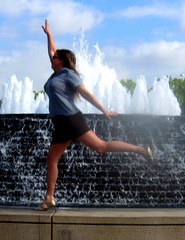
Amandaw asked “Is that your picture? If so, what’s the story???” The photo she’s referring to is this one:

It is indeed me, and ties in to my regular attempts to explore undiscovered corners of the southland (which I call “going on an adventure.”) A while ago, we all went down to Irvine or Anaheim or one of the areas of Orange County just over the border of the county line, to go to the Orange County Barbeque Festival. (If you made me choose between eating tacos or eating BBQ I would have a hard time deciding.) After eating approximately my body weight in pulled pork and ribs, we were driving back home by a circuitous route and found ourselves passing by the Richard Nixon Presidential Library in Yorba Linda – something so amazing it was mandatory that we stop and explore it. It turns out that 4 giggling hipsters was not exactly what the library was expecting, and the pearls-n-suit wearing conservative lady working the lobby was none too pleased. I bought a “Nixon Il Capo” button and a postcard of him shaking hands with Elvis, and then went outside to the marvelous fountain in the parking lot. This photo is me, mid-balletic leap, in front of that fountain.

Lauredhel asked “What art or craft that you’re not accomplished at would you most like to be, and why?” Oooh. Screenprinting, or graffiti, or stenciling, or anything that would let me make street art. I HEART street art for so many reasons. It divorces art from galleries and museums and positions it as something for everyone, regardless of economic class. It’s often political and provocative in a way mainstream media isn’t. And it adds another layer of complexity and interest to the city – I’ve noticed so many amazing things while I’m keeping an eye out for posters or graffiti and feel that helps me engage with the urban environment more actively. I’m a fervent reader of Wooster Collective and other street art blogs, but don’t create any myself.

OuyangDan asked “Do you think the moon is really made of cheese?” And I totally do! (I mean, not really, because that would mean the moon landing was a hoax and I cannot in any way be affiliated with that argument.) There is this totally delicious cheese called burrata, which is basically fresh mozzarella that when it was made into a ball had some cream or other creamy deliciousness inside it, and it tastes like clouds and light and perfection. And it comes in a pale creamy colored lump, exactly like the moon! I discovered this at a restaurant and was amazed that there’s a factory in an industrial warehouse district of a nearby city that makes it by hand and supplies most of the United States with burrata – so of course I had to visit it and buy it direct from the source on another adventure.

Feel free to ask any questions – I reserve the right to not reply or to reply via private email if they’re things I consider personal or private. You can also find me at my tumblr blog, think on this, or on twitter at @abbyjean (entries are protected so you’ll have to ask me for permission).

This is something I avoid thinking about

As a single lady with a disability, I have lots of complicated and tangled thoughts about romantic relationships. While there’s a lot to say there (my therapist can attest to that), it all boils down to my belief about myself (which I want to make very clear is how I think about me, not something I think applies to any other person with a disability in the entire world ever) that my disability makes me too much of a handful, too much work, too much effort, too much pain in the ass, to be worth loving.

This is of course demonstrably untrue – I have friends and family who love me dearly and demonstrate that daily. I have been in romantic relationships in the past as a person with a disability, relationships that ended for reasons not at all related to my disability.  And so most of the time, this fear is a tiny tiny voice in the far back of my head that only comes out when things get especially dark.

But then there are actual studies like this: Men Leave: Separation And Divorce Far More Common When The Wife Is The Patient. Some findings:

A woman is six times more likely to be separated or divorced soon after a diagnosis of cancer or multiple sclerosis than if a man in the relationship is the patient. Researchers were surprised by the difference in separation and divorce rates by gender. The rate when the woman was the patient was 20.8 percent compared to 2.9 percent when the man was the patient. “Female gender was the strongest predictor of separation or divorce in each of the patient groups we studied,” said Marc Chamberlain, M.D., a co-corresponding author and director of the neuro-oncology program at the Seattle Cancer Care Alliance (SCCA).

The study was relatively limited – it examined only patients diagnosed with either multiple sclerosis or significant brain tumors. And it did find that longer marriages were much less likely to result in separation or divorce. But overall, I found this pretty disheartening.