Category Archives: intersectionality

Go educate yourself (please!)

Image description: A shocked-looking cat perches on a chair, staring straight at the camera. Text reads: Concerned cat is just looking out for your best interests when she says that your tone might be alienating well-intentioned potential allies who just need a little polite education.

[Image via Tlönista in this comment thread at Flip Flopping Joy. Description: A shocked-looking cat perches on a chair, staring straight at the camera. Text reads: “Concerned cat is just looking out for your best interests when she says that your tone might be alienating well-intentioned potential allies who just need a little polite education.”]

One unfortunately common response to marginalized people saying that there’s a problem is the “Educate me NOW” demand from “well-intentioned allies” who totally mean well, but they just lack education on these issues and so just can’t understand what the fuss is all about.

I am using the following example not to appropriate from the awesome anti-racist work that Jessica Yee and the fabulous Racialicious crew (and countless bloggers around the web!) do on a daily basis, but rather for two specific reasons: 1.) I have already talked about my personal relationship with this oft-used derailing tactic rather extensively, and could probably talk about it ’til I’m blue in the face; 2.) anti-racist activism and disability activism are not completely separate, independent social justice strains — many of us who are involved in these activist projects are, in fact, fighting similar (though NOT completely analogous) battles. For me, claiming an identity as a feminist disability activist has entailed doing my best to fight racism and white privilege alongside fighting for disability rights. This is because disability and race intersect in many, many ways — sort of like how disability and gender, and race and gender, intersect. In other words, this is not just a disability issue, or a feminist issue,  or a trans* issue, or an anti-racist issue; it affects many of us in the social justice blogosphere, if in differing ways.

The “educate me now because I want to learn, marginalized person!” response played out, yet again, fairly recently in the comments to a post on Bitch authored by Indigenous activist and writer Jessica Yee. [Full disclosure: Some of us here at FWD guest blogged for Bitch as the Transcontinental Disability Choir.] Jessica had written a post on white hipster/hippie appropriation of native dress and why it’s not only ridiculous, but racist. Makes sense, right? (If it doesn’t, you might be at the wrong blog. Or go read this. I don’t know.) Overall, this piece seems like it would fit right in on a website for a magazine that is dedicated to showcasing “feminist response[s] to pop culture.”

And then the comments started rolling in, and so did the “but you have a responsibility to educate people who mean well!” trope:

I’m sure this is in fact extremely annoying. However, you might consider that when people bring that up, they’re not saying, “Hey I’m just like you and I totally understand what you deal with,” they’re trying to make a connection and learn something. Ignorant people are a pain in the neck, but they’re mostly not trying to be ignorant on purpose.

I‘m merely suggesting that if this is a cause you deem worthy of championing, then you should have a prepared source of information for them—be it this blog, book titles, or documentaries. Encourage them to learn more about THEIR history and perhaps you’ll draw a new soldier to your army.

It seems somewhat contradictory to put stickers on your laptop that indicate a Mohawk heritage and then rudely dismiss a stranger who expresses an interest in your advertisement. Perhaps a better way to accomplish your agenda (whatever it is) would be to engage in polite and open-minded conversation with those who mistake your stickers for an invitation.

Thea Lim at Racialicious pretty much nailed it in her recent post on what went down, entitled “Some Basic Racist Ideas and some Rebuttals, & Why We Exist” (which I highly recommend that you read in full, by the way). An excerpt:

This kind of hey-let-me-help-you-achieve-your-goal-by-suggesting-you-be-more-radio-friendly response totally misunderstands (and appears disinterested) in the anti-racist project, because it assumes that anti-racism is all about convincing white people to be nice to people of colour.   In other words, it assumes that anti-racism revolves around white folks.  Like everything else in the world.

Anti-racism and people of colour organizing is not about being friendly, being appealing, or educating white folks. While individual anti-racist activists may take those tacks to achieve their goals, the point of anti-racism is to be for people of colour.

I completely agree with Thea here — and I believe something similar applies to disability activism. That is: Those of us with disabilities are not here to make abled people feel comfortable, to hold their hands as they have a Very Special Learning Experience (most often, it seems, at our expense), or to make them feel good about themselves. I, personally, don’t care how “good” your intentions are, or that you reallllllly wanna learn, or if you think I’m being mean by not dropping everything to educate you when you demand it.  While I definitely don’t want to speak for Jessica, Thea, or any of the Racialicious contributors — or for people of color who do anti-racist work — I suspect that they may feel similarly about white people who come into PoC, WoC or other anti-racist spaces and demand that whoever is doing the activist work must halt whatever discussion is going on and educate them, now, because they are good “liberal” white people and have such good intentions, and you PoC want white people like me as allies, right? And if you don’t drop everything and rush over to educate me, well, you’re just a big meanie who must not want my support after all (such “support” is often conditional, and based upon whether the marginalized person can make the non-marginalized feel comfortable at all times), or you just want an excuse to be racist toward white people! Or some other ridiculous thing.

For me personally, the willingness that I “should” have to help well-meaning folks learn is also an energy issue. I am a person with disabilities, several of which I have written about at length on this website — and one of which is a pain condition subject to flare-ups. Thus, I have to manage my time and energy extremely carefully. Having to explain basic concepts over and over again to strangers on the internet because they’ve deigned to tell me that they “want” to learn — and some of whom may think, by extension, that they are somehow entitled to my time and energy — takes work. Writing takes work; additionally, a lot of bloggers do the blogging and responding to comments thing for free, on their own time.

And sometimes, those of us with conditions that intersect with our ability to do this work end up burnt out, frustrated, or we lose our patience. Though these end results are often nothing personal, they might read like it, and we end up paying the price energy-wise only to have that person who realllllly wanted to learn petultantly respond with something like, “You must not want to educate me, then, if you’re not up to answering all of my questions!” and leaving in a huff. But they reallllly want to learn. . . that is, if someone else does the brunt of the work for them and/or gives them good-ally cookies for just wanting to be educated about all this social justice stuff. Merely wanting is not enough; you have to actually follow through for your good intentions to matter.

There is, thankfully, a solution to this problem: those people who say, or comment, that they realllly want to learn must take responsibility for their own learning. There are several ways that this can be accomplished, among them lurking on blogs for a while before one starts commenting, reading a site’s archives (and most sites have them!), picking up a book (or two), reading some articles online or off. Certainly, there are a lot of things that are privileged about this assertion; of course, not everyone has the time to read about social justice, lurk on blogs, or take similar steps. But what is also privileged is the putting the responsibility for your own 101-type education onto someone else — someone who might not have all of the energy, time and patience that you might.

[A slightly different version of this post has been cross-posted at ham blog.]
BADD: A Screenshot’s Worth A Thousand Words

More for Blogging Against Disablism Day.

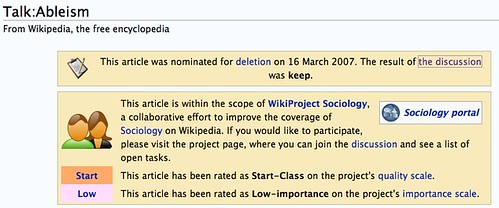
I just poked around the entry for “Ableism” on Wikipedia. On the Talk page, I found a box placing the Ableism article within WikiProject Sociology:

Screenshot: This article has been rated as Low-importance  on the project's importance scale.

“This article has been rated as Low-importance on the project’s importance scale.”

Ableism of low importance within Sociology? Erm, ooookay. Let’s have a closer look at their definition of “Low-importance”:

This article is of little importance to this project, but it covers a highly specific area of knowledge or an obscure piece of trivia.

20%, people. Disabled people form around 20% of the population in Australia and the USA (and similar numbers in similar societies). One in five. Discrimination is huge, it is institutionalised, it is very often legal. Disabled people are some of the most vulnerable, the most underemployed, the most abused, the most excluded, the most neglected, the most murdered people in our cultures.

“Low importance”? “Obscure piece of trivia”?

OK, so let’s have a look at some other big discriminations. Racism and sexism, are they categorised as obscure pieces of trivia too? (On Wikipedia, I wouldn’t be surprised…)

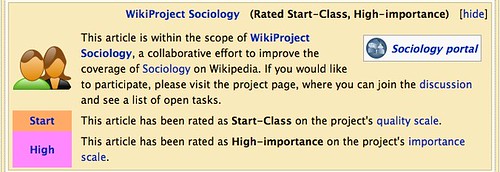
Screenshot: WikiProject Sociology (Rated Start-Class, High-importance)

Sexism is of High Importance. OK. I agree.

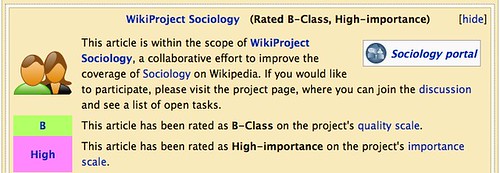
So, racism. I guess the importance of racism within sociology, according to Wikipedians, would be, oh, about similar to that of ableism?

Screenshot: WikiProject Sociology (Rated B-Class, High-importance)

OK, so racism is of High Importance also. OK. I agree with that too.

So why is Ableism of Low Importance? Why does the biggest encyclopedia on earth consider it to be of lesser importance than discrimination against other minorities? Why are sociologists learning and being taught that racism and sexism are The Discriminations, that all others are secondary or tertiary or not really worth bothering about? Why, when a person is both female and PWD, or of colour and PWD, or all three, and/or lesbian, trans, non-citizen, working class, and so on, is ableism automatically ranked as the least important discrimination they’ll encounter? Why are PWD losing this Oppression Olympics, a game we shouldn’t be playing in the first place? (“Intersectionality” hasn’t yet received a rating on the Importance scale at Wikipedia.)

Other topics considered more sociologically important than Ableism (not equal, but more), as far as Wikipedians are concerned, include:

est and The Forum in popular culture

Ralph Larkin

Wilhelm Dilthey

Vixen (comics)

Stay-at-home dad

Weddings in the United States

Truce term

Friendship Paradox

Heterophobia

Babywise

Boomerang Generation

eHarmony

Lavalife

OkCupid

Yahoo! Personals

Fritzl case

List of UFO religions

Greenbelt, Maryland

The Hapa Project

Biosocial criminology

Grand Tour

Speed dating

Blond

Schoolgirl

and Hooters.

BADD: How can I support Blogging Against Disablism Day?

Blogging Against Disablism Day, May 1st 2010Today is the “beginning” of Blogging Against Disablism Day 2010. I put beginning in quotes there not just because the day is done in Australia and the West Coast of Canada is still waking up, but because Diary of a Goldfish, who hosts BADD every year, acknowledges that people with disabilities are not necessarily able to post precisely on the date of a blog swarm – that there is inherent disablism in demanding that disabled people write a post on a specific time table.

Every year since I started participating in BADD, I’ve had many people ask me how they – both as currently non-disabled people, and as people with disabilities – can best participate in BADD if they don’t want to, or can’t, write a post, put up a photo, or create a video or podcast. Here is just a short list of suggestions:

Check out the ever-growing list of BADD posts over at Diary of a Goldfish. Even “just” (there’s no just about your time/energy investment!) reading people’s posts and learning about their experiences contributes a lot to BADD. Blogswarms like this are all about raising awareness, and raising your own awareness is just as important. As well, you may find a whole new set of blogs to add to your blog-reading lists. There are so many bloggers with disabilities out there, fighting the good fight against ableism every day.

Comment on some BADD posts. I know that every time I write something and it gets no comments, I feel like I’ve put effort out for nothing. [This is not a demand for more comments for me! I’m just sayin’.] If you have the time/energy to do so, I would really encourage you to leave comments in support of BADD posts. They don’t have to be lengthy: even just “This post was great, thank you for writing it” can make a difference. If you’re up to writing more, go for it! But just leaving words of support can be a big deal.

Tell people about the awesome posts you’ve read. If you have a blog, link your favourite BADD posts so others can check them out – if not today, then over the next few days, or even weeks. Months. They’re not going anywhere, and although we all hope the prejudices against people with disabilities are going to disappear, that’s probably not going anywhere anytime soon, either. There’s nothing saying you have to only link to BADD posts this week. If you’ve got a twitter account, tweet some links to your followers! The hash-tag for BADD seems to be #badd, but I like to also tag my tweets #disability as well. (This is selfish on my part – I follow the #disability tags on twitter.)

Think about dis/ableism in your every-day life. This one is mostly for the non-disabled people, or for people like me – I always need to remind myself to think outside my box of “what disability looks like”. There are huge swaths of my workplace that someone in a wheelchair can’t get in, and I went to a university last week that claimed it was impossible to put floor announcements in their elevators. Many [not all – I’ve heard very good things about some places, like L’Arche] of the group homes in Canada for people with cognitive impairments are more like prisons than the “home-like” environment they claim to be. The websites for each of the major political parties in Canada are inaccessible to many people with disabilities, and events that are held for “all Canadians” have no captioning, no visual description, and no way for Sign users to participate.

I think BADD is a great opportunity to see just how much is out there about disability on the internet. For disabled people who may be feeling isolated, it’s a great time to see just how many people are out there that struggle with similar issues. For the non-disabled, it’s a great way to start educating yourself about disability issues.

The Blogging Against Disablism 2010 Page will update throughout the day. Here’s just a tiny selection of posts that I’ve had the chance to read, and highly recommend.

This Terrifies Me

Here in the U.S., there’s been a lot of buzz about a new immigration law passed in Arizona (including on meloukhia’s tumblr, where I first saw it). Their state legislature just passed a bill that “makes it a crime to lack proper immigration paperwork and requires police, if they suspect someone is in the country illegally, to determine his or her immigration status. It also bars people from soliciting work as day laborers.”

This is a big change from the current situation. Because immigration is a nationwide issue, the federal government makes the immigration laws. There is a federal Department of Citizenship and Immigration Services that administers applications for immigration status. There is a whole department of Immigration and Customs Enforcement with quasi-police enforcement agents that put people in quasi-jail immigration detention facilities. It’s a whole federal system that runs parallel to the police and sheriffs who work for individual cities and counties.

For a long time, not only were local police not solely responsible for enforcing federal immigration laws, it was a longstanding rule that state and local police did not have the authority to enforce those laws. State and local police actively tried to distinguish themselves from immigration enforcement so that community residents who were immigrants would continue reporting crimes and helping the police with investigations. The split between responsibilities serves an important purpose in protecting overall public safety.

This is why it’s a big deal that this new law would require local police to determine the immigration status of anyone they suspect to be in the country illegally. Given the vague description of what would be an acceptable reason to suspect someone to be undocumented, it’s extremely likely this is going to translate to “check the papers of anyone who is Latina/o.” “A lot of U.S. citizens are going to be swept up in the application of this law for something as simple as having an accent and leaving their wallet at home,” said Alessandra Soler Meetze, president of the American Civil Liberties Union of Arizona.

Certainly a police officer fulfilling their requirements under this new law might in fact discover that someone is undocumented. But this law also gives every police officer carte blanche to insist on immigration paperwork from anyone they want – another tool for harassment and intimidation that will surely be deployed selectively. It warns not only undocumented people, but all immigrants and anyone who might appear to be or resemble an immigrant in any way – stay inside. Disappear. Vanish. We do not want you here and if we see you we will hassle and interrogate and judge you.

This law just used the official voice of the state to tell this whole group of people – most of them people of color, most of them legally present in the U.S. – that they are not wanted.

That message of not being wanted, that directive to become invisible and disappear, that clear desire that a whole group would just go away and stop being a bother. That’s the same feeling I get when reading articles like this one in the Fresno Bee bemoaning an effort to get local businesses to provide accommodations for people with disabilities. Just think of the economic effect on local retailers! They’ve been open for 20 years! How dare the PWDs file lawsuits instead of just asking the proprietor who I’m sure is very nice and would just love to help out voluntarily! The message is the same – having PWDs here is too expensive. Too much work. Something to be given only out of the generosity of those in charge, not demanded. If only the PWDs would just go away our local businesses would be fantastic!

In one instance, popular opinion and the business community are telling PWDs to go away or be invisible. In the other instance, the state government is telling immigrants to go away or be invisible. Both are premised on the acceptance of the idea that it’s ok to look at a minority group of people and reject them, as a group. That’s why I reacted negatively to both those news articles – it is not ok to oppress people as a group. If it’s ok to treat immigrants that way in Arizona, that legitimizes treating PWD that way in Fresno. And this law is such a big step in the wrong direction that it makes me worried about similar erosions for other groups – including PWDs.

Happy Cesar Chavez Day!

Here in California, today is an official State holiday to celebrate the life and work of Cesar Chavez. Chavez worked to promote and enforce the civil rights of farm workers and, with Dolores Huerta, was cofounder of the United Farm Workers of America, or UFW – still one of the United States’ two major union umbrellas. While his work is usually viewed through the lens of organizing for Latinos, there is a significant disability component to his work.

Migrant farm workers are affected by a number of intersecting a complex factors which negatively affect their health and put them at risk of becoming permanently disabled through their work. They are likely to be exposed to harmful chemicals or dangerous work situations and because they often live on the farm under the control of the farm owner, they have little access to health care. This is all complicated by the immigration status – or lack of – of the workers. Here’s a brief overview of the occupational hazards, from the National Center for Farmworker Health:

The agriculture industry is one of the most dangerous occupations in the United States. While farmworkers face workplace hazards similar to those found in other industrial settings, such as working with heavy machinery and hard physical labor, they also face unique occupational hazards including pesticide exposure, skin disorders, infectious diseases, lung problems, hearing and vision disorders, and strained muscles and bones. Lack of access to quality medical care makes these risks even greater for the three million migrant and seasonal farmworkers who work in the fields every year.

In 2007, for every 100,000 agricultural workers in the U.S. there were 25.7 occupational deaths in agriculture. This compares to an average rate of 3.7 deaths for every 100,000 workers in all other industries during this same year. The Centers for Disease Control and Prevention label agriculture the most dangerous industry for young workers in the United States, accounting for 42 percent of all work-related fatalities of young workers between 1992 and 2000. Fifty percent of these victims were younger than 15 years old.

During their daily work, farmworkers are often exposed to pesticides. A 2002 study examined take-home organophosphorus pesticide exposure among agricultural workers and found pesticides in dust samples from 85% of farmworkers’ homes and 87% of farmworkers had pesticides in dust samples in their vehicles. In addition, 88% of farmworker children had organophosphate metabolites in their urine.

Infectious diseases among the farmworker population are caused by poor sanitation and crowded conditions at work and housing sites, including inadequate washing and drinking water. Farmworkers are six times more likely to develop tuberculosis when compared with other workers, and rates of positive TB results between 17% and 50% have been reported throughout the United States.

Because farm labor consists of constant bending, twisting, carrying heavy items, and repetitive motions during long work hours, farmworkers often experience musculoskeletal injuries. Furthermore, workers are often paid piece-rate, which provides an incentive to work at high speed and to skip recommended breaks. From 1999 to 2004, almost 20 percent of farmworkers reported musculoskeletal injuries.

Another complicating factor is the prevalence of child labor on these farms. It is obviously difficult to quantify this phenomenon, but worldwide, approximately 132 million kids between the ages of 5 and 14 work in agriculture. In the United States, somewhere between 300,000 and 800,000 children do agricultural work, sometimes working 12 or even 14 hour days. Environmental pollutants like pesticides have greater effects on children and their growing bodies are often at greater risk of harm from musculoskeletal and other injuries.

The punishing nature of this work is well known and acknowledged by government agencies. The Social Security Administration, which provides cash benefits and medical coverage to individuals it determines are “permanently disabled,” has a special category for “the worn-out worker.” This is a provision specifically for someone with less than a 6th grade education who, after 35+ years of arduous manual labor, can no longer return to that previous employment. The most common example of someone who fits this category is a migrant farm worker – someone who worked in orange orchards, climbing ladders, carrying heavy boxes of fruit, whose body has simply broken down and can no longer sustain that arduous labor.

There are three million workers currently in the fields, including a significant number of children, for whom this is the expected outcome – if they manage to sustain their labor for thirty five years. Cesar Chavez fought for those people and fought to protect them from outcomes and conditions that were, in his time, even worse and more damaging than what I’ve described above. We now must continue his fight.

Si Se Puede!

Yeah, what *about* your free speech “rights”?

Here at FWD, it is not unusual for us to get quite a few comments in mod that question, take issue with, or outright berate our fairly rigorous comments policy and iterations thereof in varying degrees. Many of these comments are some variation of “But what about my right to express my opinion?” or “But…free speech!”

Unsurprisingly, many of the comments that try to take us to task for “prohibiting” free speech are from non-regular (and, in some cases, first-time) commenters. I try to give people — on the internet and off — the benefit of the doubt. Perhaps these folks who try to direct the conversation to their supposed right to say whatever they want “because of the First Amendment” are just unaware that many social justice-focused blogs — especially those written by people who are members of various marginalized and/or traditionally underrepresented groups — have commenting policies, usually for very specific reasons. Perhaps they think that the First Amendment entitles them to say whatever they want without also getting called on it. Perhaps they think that bigoted or hateful speech is okay, since it’s “just” on the internet and therefore cannot be taken seriously or do any “real” damage. Perhaps they think that someone needs to pay Devil’s advocate when talking to (or about) disabled feminists and other people who do not represent (or are not represented by) the majority, and they are reasonable/intellectual enough to do the job!

Here’s the thing: This website is not  run by U.S. government or employees of the U.S. government who are representing their place of work. This is a privately-owned website.  Its contributors, commenters and readers are not all from or living in the U.S. The First Amendment applies, by and large, to the United States government’s attempts to contain and/or regulate things that people say or opinions that they want to express in myriad formats. In other words, “freedom of expression” does not automatically mean that you can bust out with some bigoted crap, and then whine or call foul when the blogger or author chooses not to publish or engage with said bigoted crap, or when someone else (perhaps another commenter) calls you on this crap. Free speech is not equivalent to some sort of magical blogular free-for-all. The “free speech!!11” defense (if you want to call it that) also has the unintentional side effect of privileging US-centric notions of being able to say certain things, apparently without consequence — something that some other countries do not appear to take so lightly (see, for example, British libel laws).

From a more anecdata-ish perspective, I have noticed that many of the people, at least on the internet, who cry “free speech!!1” in defense of their supposed right to say “un-PC” things/play Devil’s advocate/et cetera are people with various kinds of privilege (white, heterosexual, abled, cis, class–to name just a few) who simply do not seem to want to give up — or, sadly even so much as critically examine — one or more of the types of unearned privilege that they have. Put simply, they just want to shut people (who oftentimes aren’t just like them for one reason or another) up using the trump card of free speech. It seems to me that the thought process might go a little something like this: Who cares if there’s a person (or people) on the other side of that computer screen? I have the right to steamroll over their lived experiences, or tell them how wrong they are ’cause “normal” people don’t feel this way, or tell them to suck it up/grow a thicker skin, or that they’re just making things up so they can be angry about stuff, or looking for stuff to get mad about, or seeing things that “aren’t there” (because if I can’t see it, it must not be there!) or use any number of derailing tactics that are not pertinent to the actual discussion at hand, or direct the discussion to my experiences and feelings as a privileged/non-marginalized person and thus re-center my own (and the majority’s) importance in a discussion that is not even about me, because it’s within my FREE SPEECH!!1 rights to do all of this and more!

Boy, that must be really fun, getting to justify making things all about you and your “rights” all of the time in spaces that are run by people who are — gasp! — different than you, and who may not have much of a safe ‘net space anyway, since the entire web is full of people who probably share at least some of your oh-so-contrarian outlook on things (not to mention some of your privilege[s]).

The free-speechers also tend to miss one important thing: If they want to spew uninformed, privilege-encrusted opinions using this excuse, and their comment gets published publicly, it is perfectly within reason for bloggers, writers and other commenters to use their free speech “rights” to respond right back.

We Need to Consider More than Universities

There’s a lot of really good stuff out in the blogoamorphia[1. Sphere, pshyeah.] about sexual assault on uni campuses. The focus is specifically on USian colleges and universities though Rape Culture exists pretty much everywhere with only slight variation. It’s worth reading, if you’re up to reading about sexual assault at all. (I’m not always.)

Predators are good at target selection. All of them. We see this in the uni rapists who repeatedly assault vulnerable young people. And the analysis of these assaults and assailants is valuable. I hope the attention being focused on this issue leads to real change in how sexual assault is treated by colleges and universities because the status quo is disgusting. Victims are made to undergo ‘mediation’ with their assailants in the name of ‘fairness;’ people known to administrations to be serial rapists face only the most cursory of punishments while their victims often leave, faced with an environment that could hardly be more obviously hostile; the government agencies tasked with reducing rape on uni campuses in the US have hardly bothered to appear to do anything at all.

But I’m a little uncomfortable that the focus is on the most privileged, most visible, most likely to be photogenic segment of sexual assault victims. Not that these people don’t need or deserve attention–they do. (And really I’d like there to be much more awareness that the things cis men do to each other are not HILARIOUS PRANKS but are sexual assault and should be treated as such. Cis men, you have a task: Even if you can’t be arsed to end sexual assault of other folk by cis men, you may wish to end assaults on yourselves by cis men. Hop to it.) I just worry that the pattern we see so often where the most privileged people are centered and marginalized people are pushed to the edges will repeat itself. That sexual assault victims whose circumstances differ will have a more difficult time being heard. That there will be a sense of “Well fuck we already had to care about these college [het cis probably currently non-disabled largely white largely middle-to-upper-class] girls getting raped and now you want us to care about you? Sorry, we’re all out of giving a shit.”

Because predators aren’t just at universities and colleges. All those uni students will leave school eventually. Not all predators even go to uni. They will all be looking for targets. Not only will they choose targets that are vulnerable and have a low risk of incurring negative consequences, they will seek out environments where there are large concentrations of their preferred targets. They will search for jobs where they will be in positions of authority over those targets. Predators that prefer children try to get jobs in schools or in religious settings. Predators that prefer disabled people, mentally ill people, or elderly people look for work in hospitals and supportive care facilities. Predators that prefer sex workers become pimps or police.

Part of the problem is going to be that people will be able to relate to the uni predators better. University-age women are often attractive people by accepted standards of beauty. Raping a pretty young cis woman is understandable–the rapist was attracted to her and wanted to fuck her and wanted to cut through all the preliminary bullshit and get right to the fucking. It’s harder for people to imagine wanting to fuck children or older people or disabled people or crazy people or fat people. Who’d find that attractive? (Who would rape you?)

It isn’t about sexual attraction. A predator’s preferred type of victim may not have anything to do with the sort of people xe finds attractive in non-predatory relationships (assuming xe has any) and may be of a different gender from xer orientation. Cis men who identify as straight and prey on children who read as male by ciscentric standards aren’t necessarily lying about their orientation, even to themselves. Predation isn’t about sex despite there being sexual gratification involved. (Though the predator xerself likely doesn’t understand this.) It’s about the predator making xerself feel powerful by stripping xer victims of power. It’s about the predator boosting xer self-confidence by humiliating xer victims. It’s about the predator feeling safer by making someone else afraid. It’s about hate. It’s about entitlement. It’s about controlling the behavior of others. And like all kinds of abuse, it’s about making the victims responsible for the emotions and actions of the predator.

Sex is just the mode of abuse. The choice of victim is about getting away with it.

So how do we not lose track of this? How can we address the issue of rape on university campuses without centering that experience of rape and marginalizing others? How can mainstream anti-rape activists not treat our experiences of rape as Other, as exotic, as something incomprehensible? Because that path leads to paternalism and patronization. It’s not good for us no matter how well-intentioned. It’s the sort of thing that leads to disabled people with ovaries being sterilized without their consent or knowledge at the behest of guardians who simply assume, with ample justification, that they will be raped in institutional care facilities. Since there’s nothing they can do about that (as we all know rape is a force of nature and not an act performed by humans capable of changing their behavior[2. MY SARCASTIC VOICE LET ME SHOW IT YOU.]) they can at least protect those people with ovaries from some of the potential things that could result from said rape. That one of the things they are protecting people with ovaries from is the possibility of bearing a child and being a good and loving parent–which happens even when a child is conceived by an act of rape–doesn’t occur to them. They know best, and they can’t imagine this person they’re placing in an institutional care facility being a good parent.

Cross-posted from my tumblr blog, Rabbit Lord of the Undead.

Black, Hispanic, Poor people wait longer for breast cancer treatment, experience more recurrences

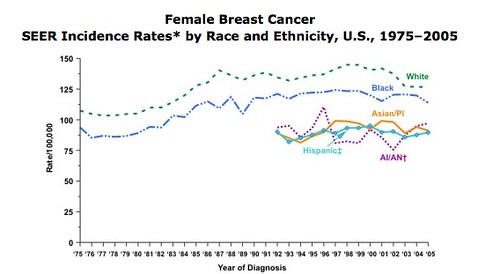
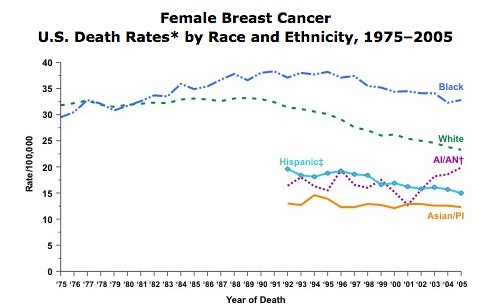
In the USA, Black women have the highest mortality from breast cancer of any other group, despite the rate of diagnosis of breast cancer being highest in White women. Hispanic women have a lower breast cancer diagnosis incidence than either, but mortality rates are disproportionately high in Hispanic women also. Here are the CDC incidence and mortality statistics over time:

“Incidence rate” means how many women out of a given number get the disease each year. The graph below shows how many women out of 100,000 got breast cancer each year during the years 1975–2005. The year 2005 is the most recent year for which numbers have been reported. The breast cancer incidence rate is grouped by race and ethnicity.

For example, you can see that white women had the highest incidence rate for breast cancer. Black women had the second highest incidence of getting breast cancer, followed by American Indian/Alaska Native, Asian/Pacific Islander, and Hispanic women.

Breast ca incidence stats showing White women at highest risk

The graph below shows that in 2005, black women were more likely to die of breast cancer than any other group. White women had the second highest rate of deaths from breast cancer, followed by women who are American Indian/Alaska Native, Hispanic, and Asian/Pacific Islander.

Breast ca mortality stats showing Black women at greatest risk

A number of contributors to this disproportionate mortality have been proposed, including environmental toxin and pesticide exposure, more aggressive tumours, and later diagnosis. Most alarmingly, the mortality gap seems to be widening.

This week’s British Medical Journal (BMJ) has an important article today demonstrating one of the consequences of healthcare racism in the USA:

Impact of interval from breast conserving surgery to radiotherapy on local recurrence in older women with breast cancer: retrospective cohort analysis[1]

The researchers analysed national cancer records for 18,050 US women, aged 65 or older and otherwise non-disabled, who were diagnosed with early stage breast cancer during an eleven year period to 2002, and who received breast conserving surgery and radiotherapy, but not chemotherapy.

30% of the women in this study had to wait more than six weeks after their surgery before they could have radiotherapy. Delays greater than six weeks were associated with a modest but significant increase in local recurrence of the breast cancer.

The study also showed that there was a continuous relationship between radiotherapy delays and local recurrence; the sooner radiotherapy was started, the lower the risk of cancer recurrence, and this relationship was strong. This is concordant with previous studies.

So who was subject to these long, risky delays in treatment?

Sadly, the answer will not surprise you: Black women, Hispanic women, and poor women. Black women were almost 50% more likely to experience a longer than six week gap before radiotherapy treatment, and Hispanic women experienced a 30% increase in risk of delay.

The followup was only five years long in this study, and breast cancer tends to be a cancer that bides its time; the increase in risk (and in consequence mortality) may be greater, even much greater, with longer followup. In addition, as local recurrence risk tends to more common in younger women and this study focused on older women, the effect could be more pronounced in the total population of those with breast cancer. In addition, the study studied mostly White women, as Black women tend to get their cancers younger and have a decreased likelihood of receiving breast-conserving surgery and radiotherapy. In other words, this study was set up in a way that made it, in some ways, particularly difficult to find a significant difference in the effect they were looking at; the fact that they still found one means that the effect is likely to be really quite pronounced.

The accompanying BMJ editorial by Ruth H Jack and Lars Holmberg[2] goes on to suggest one possible model of healthcare delivery that might alleviate these delays:

One good example of how practices can be improved is the Rapid Response Radiotherapy programme in Ontario. This programme has drastically shortened waiting times for patients having palliative radiotherapy by restructuring the referral process so that many patients are treated on the same day as their consultation.9 Countries where disconnected systems are responsible for different aspects of treatment will find it more difficult to ensure that diagnosis, referral, and treatment are not subject to delay.

++++++++++++++++++++++++++++++++++++++++++

[1] Impact of interval from breast conserving surgery to radiotherapy on local recurrence in older women with breast cancer: retrospective cohort analysis
Rinaa S Punglia, Akiko M Saito, Bridget A Neville, Craig C Earle, Jane C Weeks.
BMJ 2010;340:c845; Published 2 March 2010,
doi:10.1136/bmj.c845

[2] Waiting times for radiotherapy after breast cancer
BMJ 2010;340:c1007
Published 2 March 2010,
doi:10.1136/
bmj.c1007

Shame and Blame with African-Americans and Mental Health: Let the Circle Be Unbroken

Recently, U.S. Surgeon General Dr. Regina Benjamin kicked off a national campaign to tackle mental health in the African-American community. Benjamin explained why a focus on African-Americans is needed: “Mental health problems are particularly widespread in the African-American community. In 2004, nearly 12 percent of African Americans ages 18-25 reported serious psychological distress in the past year. Overall, only one-third of Americans with a mental illness or a mental health problem receive care and the percentage of African Americans receiving services (nearly 7 percent) is half that of non-Hispanic whites.”

Programs focusing on addressing underrepresentation of minority groups in mental health care tend to focus on outreach to and education of the underrepresented group (while this post focuses on historical and structural barriers to African-American participation in the mental health system, these larger concepts are likely applicable to other racial and cultural minorities throughout the world.). The theory seems to be that if individuals knew that they might be experiencing mental health systems and understood how the mental health system could treat and benefit them, they’d start accessing it in droves. This kind of outreach and education is clearly an important part of increasing minority representation in mental health care, but the exclusive focus implies that the primary barriers are the attitudes of individuals who would change their minds if they just had more information. This ignores a lot of problems and lets a lot of bad actors off the hook for institutional barriers and exclusions. In the particular instance of African-American engagement in the mental health system, it is these long-standing oppressions and exclusions which are perhaps most to blame.

A primary issue is that African-Americans are more likely to be subject to a number of forces of oppression and discrimination which can increase trauma and vulnerability to mental health disorders. “Owing to a long history of oppression and the cumulative impact of economic hardship, African Americans are significantly overrepresented in the most vulnerable segments of the population. More African Americans than whites or members of other racial and ethnic minority groups are homeless, incarcerated, or are children in foster care or otherwise supervised by the child welfare system. Proportionally, 3.5 times as many African Americans as white Americans are homeless. African Americans are especially likely to be exposed to violence-related trauma, as were the large number of African American soldiers assigned to war zones in Vietnam. Exposure to trauma leads to increased vulnerability to mental disorders.”

To me, that does not suggest that the primary solution is increasing African-American representation in mental health treatment – it suggests that a primary solution would be to address the structural inequalities that are making African-Americans “significantly overrepresented in the most vulnerable segments of the population.” Maybe a program that focuses on homelessness in the African-American population. Maybe addressing the sentencing disparities for crimes involving cocaine and crack cocaine, and how that contributes to disproportionate and longer incarceration of African-Americans. Or how felony disenfranchisement prevents a staggering number of African-Americans (13% of black adult males!) from participating in our democratic political system. Without addressing these ongoing problems, a disproportionate number of African-Americans will continue to experience trauma and increased vulnerability to mental disorders.

A second and key issue is the long history of how the psychiatric profession has treated African-Americans in the United States. Diagnoses and treatments for African-Americans have long been rooted in the structural racism of slavery, with early diagnoses of “Negritude” and “Drapetomia” for slaves who fled their masters and recommended treatment of whipping as therapeutic intervention. In 1895, a Georgia psychiatrist popularized the idea that “structured lives led by slaves served as protective factors against insanity” and that slavery protected African-Americans from freedom that would literally make them insane. In the late 1800s and early 1900s, there were separate “colored” institutions for African-Americans, who received little if any treatment services and were subject to horrific tortures and sexual assaults.

A glance at the current mental health system makes it clear those historical problems have not been eradicated. African-Americans are much more likely to be diagnosed with schizophrenia than with affective (mood) disorders, even when displaying the exact symptoms of a white patient diagnosed with affective disorder. This is true even when the diagnosing clinicians included African-Americans well trained about the bias towards schizophrenia diagnoses. Studies suggest this is because clinicians apply entirely separate decision models when diagnosing African-American patients, likely drawing on stereotypes of paranoia and violence that aren’t actually associated either with African-Americans or people with schizophrenia.

There are also significant knowledge gaps in how psychoactive medications affect African-Americans. There is almost no research on ensuring adequate racial representation in psychopharmalogical research, nor on how to ensure that participating patients from various cultural and racial groups give informed consent. This lack of knowledge is affecting the effectiveness of treatment, as existing research shows that “a greater percentage of African Americans than whites metabolize some antidepressants and antipsychotic medications slowly and might be more sensitive than whites,” and can lead to faster responses and more severe side effects when African-Americans are treated with doses commonly used for whites. Despite this, clinicians in psychiatric emergency services commonly administer “both more and higher doses of oral and injectable antipsychotic medications to African Americans than to whites.”

To me, all of this suggests that the psychiatric profession hasn’t really figured out how to provide psychiatric treatment and care of the African-American population with the African-American individual’s best interests in mind. History speaks to using psychiatry to control, torture, sedate, and oppress African-Americans, even creating fictionalized diagnoses to help support the structures of slavery. Add to all of this the multiple barriers preventing access to mental health care even for those who enthusiastically wish to access it – lack of parity for mental health care, lack of health care coverage at all, societal sigma around mental health – and instead of wondering why there’s underrepresentation of African-Americans in the mental health system, I start wondering why there’s as many as there are.

Clearly, a solution focused only on outreach and education to individual African-Americans is doomed to be unsuccessful, because it overlooks the underlying structural issues making African-Americans particularly vulnerable to mental health problems and the historical reality of their exploitation by the mental health system. Even more troubling, though, is that when the access problem is framed as an issue of education to an individual, it allows the blame to be placed squarely on that individual – even if these other, more serious, structural barriers are ignored. That kind of blame is just another addition to the complex system of forces making African-Americans more vulnerable to mental disorders to begin with.

The perfect trifecta. And by “perfect”, I mean…

Sometimes, I’m almost tempted to believe there’s a special, special place in hell for people like US Republican State Delegate Bob Marshall of Manassas who says:

Disabled children are God’s punishment to women who have aborted their first pregnancy.

Yes, I’ll play that again.

Disabled children are God’s punishment to women who have aborted their first pregnancy.

Whatever happened to the “gift from God” inspirational-crip rhetoric?

And he didn’t shut up there. There’s more.

The number of children who are born subsequent to a first abortion with handicaps has increased dramatically. Why? Because when you abort the first born of any, nature takes its vengeance on the subsequent children.

He and others at the meeting suggest that Planned Parenthood should be renamed “Planned Barrenhood” or “Klan Parenthood”.

I do believe we have a perfect trifecta of menacing misogyny, violent disability hate, and misappropriating the civil rights movement for your bigoted cause. With a side serve of colossal, irredeemable scientific ignorance. And fail sauce.