Category Archives: bodies

Go educate yourself (please!)

Image description: A shocked-looking cat perches on a chair, staring straight at the camera. Text reads: Concerned cat is just looking out for your best interests when she says that your tone might be alienating well-intentioned potential allies who just need a little polite education.

[Image via Tlönista in this comment thread at Flip Flopping Joy. Description: A shocked-looking cat perches on a chair, staring straight at the camera. Text reads: “Concerned cat is just looking out for your best interests when she says that your tone might be alienating well-intentioned potential allies who just need a little polite education.”]

One unfortunately common response to marginalized people saying that there’s a problem is the “Educate me NOW” demand from “well-intentioned allies” who totally mean well, but they just lack education on these issues and so just can’t understand what the fuss is all about.

I am using the following example not to appropriate from the awesome anti-racist work that Jessica Yee and the fabulous Racialicious crew (and countless bloggers around the web!) do on a daily basis, but rather for two specific reasons: 1.) I have already talked about my personal relationship with this oft-used derailing tactic rather extensively, and could probably talk about it ’til I’m blue in the face; 2.) anti-racist activism and disability activism are not completely separate, independent social justice strains — many of us who are involved in these activist projects are, in fact, fighting similar (though NOT completely analogous) battles. For me, claiming an identity as a feminist disability activist has entailed doing my best to fight racism and white privilege alongside fighting for disability rights. This is because disability and race intersect in many, many ways — sort of like how disability and gender, and race and gender, intersect. In other words, this is not just a disability issue, or a feminist issue,  or a trans* issue, or an anti-racist issue; it affects many of us in the social justice blogosphere, if in differing ways.

The “educate me now because I want to learn, marginalized person!” response played out, yet again, fairly recently in the comments to a post on Bitch authored by Indigenous activist and writer Jessica Yee. [Full disclosure: Some of us here at FWD guest blogged for Bitch as the Transcontinental Disability Choir.] Jessica had written a post on white hipster/hippie appropriation of native dress and why it’s not only ridiculous, but racist. Makes sense, right? (If it doesn’t, you might be at the wrong blog. Or go read this. I don’t know.) Overall, this piece seems like it would fit right in on a website for a magazine that is dedicated to showcasing “feminist response[s] to pop culture.”

And then the comments started rolling in, and so did the “but you have a responsibility to educate people who mean well!” trope:

I’m sure this is in fact extremely annoying. However, you might consider that when people bring that up, they’re not saying, “Hey I’m just like you and I totally understand what you deal with,” they’re trying to make a connection and learn something. Ignorant people are a pain in the neck, but they’re mostly not trying to be ignorant on purpose.

I‘m merely suggesting that if this is a cause you deem worthy of championing, then you should have a prepared source of information for them—be it this blog, book titles, or documentaries. Encourage them to learn more about THEIR history and perhaps you’ll draw a new soldier to your army.

It seems somewhat contradictory to put stickers on your laptop that indicate a Mohawk heritage and then rudely dismiss a stranger who expresses an interest in your advertisement. Perhaps a better way to accomplish your agenda (whatever it is) would be to engage in polite and open-minded conversation with those who mistake your stickers for an invitation.

Thea Lim at Racialicious pretty much nailed it in her recent post on what went down, entitled “Some Basic Racist Ideas and some Rebuttals, & Why We Exist” (which I highly recommend that you read in full, by the way). An excerpt:

This kind of hey-let-me-help-you-achieve-your-goal-by-suggesting-you-be-more-radio-friendly response totally misunderstands (and appears disinterested) in the anti-racist project, because it assumes that anti-racism is all about convincing white people to be nice to people of colour.   In other words, it assumes that anti-racism revolves around white folks.  Like everything else in the world.

Anti-racism and people of colour organizing is not about being friendly, being appealing, or educating white folks. While individual anti-racist activists may take those tacks to achieve their goals, the point of anti-racism is to be for people of colour.

I completely agree with Thea here — and I believe something similar applies to disability activism. That is: Those of us with disabilities are not here to make abled people feel comfortable, to hold their hands as they have a Very Special Learning Experience (most often, it seems, at our expense), or to make them feel good about themselves. I, personally, don’t care how “good” your intentions are, or that you reallllllly wanna learn, or if you think I’m being mean by not dropping everything to educate you when you demand it.  While I definitely don’t want to speak for Jessica, Thea, or any of the Racialicious contributors — or for people of color who do anti-racist work — I suspect that they may feel similarly about white people who come into PoC, WoC or other anti-racist spaces and demand that whoever is doing the activist work must halt whatever discussion is going on and educate them, now, because they are good “liberal” white people and have such good intentions, and you PoC want white people like me as allies, right? And if you don’t drop everything and rush over to educate me, well, you’re just a big meanie who must not want my support after all (such “support” is often conditional, and based upon whether the marginalized person can make the non-marginalized feel comfortable at all times), or you just want an excuse to be racist toward white people! Or some other ridiculous thing.

For me personally, the willingness that I “should” have to help well-meaning folks learn is also an energy issue. I am a person with disabilities, several of which I have written about at length on this website — and one of which is a pain condition subject to flare-ups. Thus, I have to manage my time and energy extremely carefully. Having to explain basic concepts over and over again to strangers on the internet because they’ve deigned to tell me that they “want” to learn — and some of whom may think, by extension, that they are somehow entitled to my time and energy — takes work. Writing takes work; additionally, a lot of bloggers do the blogging and responding to comments thing for free, on their own time.

And sometimes, those of us with conditions that intersect with our ability to do this work end up burnt out, frustrated, or we lose our patience. Though these end results are often nothing personal, they might read like it, and we end up paying the price energy-wise only to have that person who realllllly wanted to learn petultantly respond with something like, “You must not want to educate me, then, if you’re not up to answering all of my questions!” and leaving in a huff. But they reallllly want to learn. . . that is, if someone else does the brunt of the work for them and/or gives them good-ally cookies for just wanting to be educated about all this social justice stuff. Merely wanting is not enough; you have to actually follow through for your good intentions to matter.

There is, thankfully, a solution to this problem: those people who say, or comment, that they realllly want to learn must take responsibility for their own learning. There are several ways that this can be accomplished, among them lurking on blogs for a while before one starts commenting, reading a site’s archives (and most sites have them!), picking up a book (or two), reading some articles online or off. Certainly, there are a lot of things that are privileged about this assertion; of course, not everyone has the time to read about social justice, lurk on blogs, or take similar steps. But what is also privileged is the putting the responsibility for your own 101-type education onto someone else — someone who might not have all of the energy, time and patience that you might.

[A slightly different version of this post has been cross-posted at ham blog.]
Guest Post by Sasha Feather: Book Review of The Rejected Body

Editor’s note: We are very pleased to host this post from sasha_feather, who has previously written for FWD: AWP: Crutch. FWD welcomes guest posts: please email guestposting [at] disabledfeminists.com for more information.

Sasha_feather is a science fiction/fantasy fan and anti-oppression activist. She is a contributor to Access Fandom

Book Review of The Rejected Body by Susan Wendell
by sasha_feather

The Rejected Body: Feminist Philosophical Reflections on Disability by Susan Wendell
1996
206 pages
Routledge Publishers

If you are at all interested in Disability Studies (DS), I strongly recommend this book. I felt like I had a kind, clear teacher and friend leading me by the hand through basic and advanced concepts in DS, especially relating to feminism and ethics. It is the most accessible and worthwhile academic text I’ve ever read– I don’t have a good track record for reading non-fiction books or textbooks, and I was riveted to this book. Partly this is because The Rejected Body speaks so directly to my own life experience as a person with a chronic illness. Susan Wendell also has a chronic illness, ME/CFS, which is what led her into DS from Women’s Studies.

In the introduction, the author tells you what she’s going to tell you, talks a bit about her own illness experience and finding disability identity, and–making me fall in love with this book–clarifies her language use by, in part, defining scare quotes and why/how she uses them:

“Throughout the text, I use single quotation marks as scare quotes, that is, to draw the readers attention to concepts I question or to uses about which I have reservations. For example, I use scare quote around ‘The Other’ (a concept discussed in Chapter 3) to indicate that, while the concept is a recognized way of thinking about people who are different from oneself, ‘the Other’ is not a way of referring to people which I accept or take for granted” (Wendell 7).

Like many of us I had often heard both the terms “scare quotes” and “the Other” and never really thought about what either of them meant. This book is full of little moments like that– things that I had taken for granted or that had niggled at my brain, and which the book shines a bright light upon.

In the introduction, Wendell also notes the limitations of the book, mainly that it focuses primarily on physical disabilities, that the author does not attempt to speak for all people, and that she struggles with generalizations and use of language. And that’s just the introduction!

A few of my favorite parts that I would like to highlight:

*The pace of life. As someone with fatigue and pain, Wendell is interested in the pace of life as part of the social construction of disability. Those of us who need to think or move more slowly than others are thus disabled by society. She discusses the social construction of disability in chapter 2.

*The mind, the body, and suffering. I have been thinking about embodiment lately, brain-body duality vs. integration, and chapter 7 (“Feminism, Disability, and Transcendence of the Body”) really gave me some grist for this mill. I am going to re-read this chapter shortly, especially the section on pain. Basically, feminists have argued against mind-body duality for very good reasons: because this concept has been used against women’s bodies. We’ve been invested in “Our Bodies, Ourselves”. But for bodies that are suffering and in pain, there are reasons to want to transcend the body, and there is room within feminist frameworks to develop such an understanding: of being embodied, of having bodily autonomy, and yet still wanting to transcend the body and be less tied to the body’s functions, desires, and pains.

*The illusion of control. For PWD, we know that we often do not have control of our bodies, or at best have limited control, and it is sheer luck that determines what happens, a lot of the time. Will I be in less or more pain today? Will I get some new illness? I have basically no control over these things, and I know it. And yet the society I live in is incredibly invested in the illusion of control to the point where it is part of the mythology of my country and my people. As Wendell points out, this puts me at odds with the people around me, even in casual social situations where people talk about small health problems or things to do with their bodies. It’s a disconnect.

*Having no diagnosis Wendell specifically addresses issues of disability for people with no diagnosis. There are a lot of people in this category, and it sometimes can feel like there is no place for us, no identity, especially within the medical model. The disability community, in my experience, creates a place and identity for those of us without a diagnosis.

There were so many other things that I am probably forgetting. I wanted to underline everything. I read it slowly to give myself time to process everything I was reading, but overall it’s a fairly short and accessible book, just densely packed with great information and ideas. Note that because it’s published by an academic press, it is relatively expensive; I recommend searching World Cat to find copies in libraries near you.

Moderator’s note: Moderation on guest posts is often much slower than “usual” moderation times.

Food.

Earlier this week, Don started his “low-iodine diet” in preparation for exciting radioactive iodine therapy next month. He tells me he’s not allowed to eat milk or milk-products, soy or soy-based products, egg yolks, anything from the sea, iodized table salt, and all restaurant foods.

Food restrictions are pretty common for people with disabilities. A friend of mine discovered her chronic pain and fatigue was influenced, at least in part, by her wheat allergy, and described at length to me the perils of “hidden wheat” in things like Twizzlers, which is a brand of red liquorish available in North America. Another gets flair-ups if she thinks about stepping away from her gluten-free diet. Some people have serious allergies to corn, and must avoid any and all things with corn and high-fructose corn syrup. There are very specific diets required for people on certain types of medications, with certain types of short-term and long-term medical conditions, people with diabetes, and people preparing for types of surgeries. Many people recovering from Cancer treatments, surgery, or eating disorders, as well as people on certain types of medications that cause dramatic weight loss, are pushed (or required) to consume those “nutritional shakes” or other forms of meal replacements.

You know what’s fun for most of the above?

How incredibly expensive all of this stuff is.

So, let me go back to Don. Right now, all of Don’s favourite foods, and everything we’ve had stocked in the freezer, are off-limits. He tried to pick up rice milk so he could have some cereal, but surprise! Most rice milk in Canada is made with salt, except a very specific (expensive) brand that isn’t sold at our grocery store. So, either we need to go to the more expensive store downtown, I need to make rice milk (I have a recipe), or he needs to not have milk with his cereal for the next two weeks. We can’t find any bread we can guarantee is made without salt, so either he goes without bread at all, or someone makes him special salt-free bread. Today, while I was away, I think he ate some special, expensive, peanut-only peanut butter and salt-free rice cakes.

Because I’ve been busier than anyone probably should be, we’ve mostly been relying on very cheap, easy-prep frozen meals that are basically salt with food in between. I’m no less busy, but now Don needs to be eating so-called “real” foods that are time-consuming to prepare, and often very expensive to purchase, especially in comparison to how we normally do the food-thing.

If you’re not on a restricted diet, I recommend checking out some of the “special” foods that people on restricted diets need to purchase. See how expensive gluten-free foods are. Compare prices of cow milk, soy milk, rice milk, and nut milk. See how many things have “corn” in the ingredients list, and try and sort out how expensive it would be to try and eat nothing with corn in it, while still eating enough. Look at some of the stuff on the shelf and try and sort out what has “hidden” wheat in it.

The cost of these items is especially relevant because so many people with disabilities live near, at, or below the poverty line for their respective countries. Don and I are able to afford to spend extra money on this restricted diet because of family support, but this isn’t an option for very many people. If you do not have a restricted diet, imagine trying to afford the foods that allow you to eat without causing flare-ups in your chronic pain condition.

Imagine as well – and this, of course, applies even when one doesn’t have restricted diets – trying to put the energy and time into preparing these foods when dealing with second shift for the sick. Imagine trying to balance it all while some stranger tells you that your, or your kid’s, disability can be magically cured if you put your family on a special, expensive, restrictive, time-consuming diet.

Don and I are incredibly privileged in this. I can take the time and make him rice milk so he doesn’t have to eat dry cereal, and we can afford to run out to the store and buy those pricey egg-whites in a carton things. And this is a restricted diet he needs to be on for a little over two weeks, and then it’s done. So many people with disabilities do not have these options. It’s eat stuff that makes you sick, or don’t eat enough at all.

I wish I had some solution I could offer to this problem, some nice little bow of hope I could tie this post up with. All I have is the knowledge that these restrictive diets aren’t things people are on for fun, but because the alternatives for them are sickness or pain. And yet, the foods people are required to eat are priced like they’re luxuries.

Guest Post from RMJ: Athletes with Disabilities: Arm-Wrestlers as Exceptions and Inspirations

Editor’s note: We are very pleased to host this post from RMJ, and will be featuring some more writing from her, and several other awesome guest posters, soon. FWD welcomes guest posts: please email guestposting [at] disabledfeminists.com for more information.

RMJ is a twentysomething with OCD who grew up in Kansas and currently lives in Virginia. She works in education and loves cooking, cats, and television. She blogs about feminism and stuff at Deeply Problematic. This post also appears at Deeply Problematic

Athletes with physical disabilities (hereafter AWPD) are a problematized group. Their accomplishments are questioned and devalued as less valid or challenging than those of able-privileged athletes. They are not party to the often problematic veneration of athletes in today’s society, nor are they permitted to participate in generalized sporting events.

Arm-wrestling is a sport, though, that seems to both accommodate and welcomes athletes with disabilities into their ranks. There is a specific subset of arm wrestling for athletes with disabilities that seem to be a regular part of official arm-wrestling tournaments. I don’t know much about the sport and I’m not currently physically disabled, so my perspective on this is far from authoritative. But my tentative reaction to this is positive, particularly since athletes with disabilities can and do succeed in general competition.

Larry Feezor is an athlete with disabilities who competed recently in the 3rd Annual U.S. Open Armwrestling Championship. He has used a mobility aid since a motorcycle accident paralyzed him from the waist down. This story from an Oregon television station makes Feezor the focal point of the championship. The story is pretty short and context is important to my analysis, so I’m going to reproduce it here in full:

FLORENCE, Ore. – The Third Annual U.S. Open Arm Wrestling Championship wrapped up in Florence Sunday, as amateur wrestlers took to the ring to battle it out.

One competitor stood out for beating the odds: Larry Feezor.

He has been arm wrestling for 18 years, traveling from Weaverville, Calif., to Oregon to participate in the competition. This sport is his outlet since he became disabled.

“I was involved in a motorcycle accident and a drunk driver ran me off the road,” Feezor tells KVAL. “I hit a bank at about 70 miles per hour, [and] was paralyzed from the chest down.”

Feezor received roaring applause when he beat his first opponent.

On Sunday he arm wrestled some of the strongest competitors at The Three Rivers Casino. And he wasn’t going down without a fight.

“Right after my accident,” Feezor said, “I told my father that I would fight, as hard as I could, for as long as I could.”

Feezor isn’t letting his disability bring him down. As a former athlete, he said his body may not be like it used to be, but his mind is stronger than ever.

“I am out here just like these other guys,” Feezor said. “I just happen to be in a wheelchair.”

Before I break this article down, I should mention its good points. It is wonderful that athletes with disabilities recognized. It’s fantastic that Feezor’s achievements are reported on in a positive fashion. Feezor is ostensibly framed as normative. The newspaper is using Feezor’s words and Feezor’s voice, rather than, say, his father’s.

However. Feezor’s participation is the only aspect of the tournament that’s detailed, and his accomplishments are not well-articulated. The singling-out of Feezor and complete erasure of any other athletes in competition is problematic because it trivializes Feezor’s competition in a sport. It implies that the sport is only notable for the inclusion of a person with disabilities – Feezor is not in a competition, but instead someone to be cooed over and patted on the head simply for participating. He’s not being applauded for his accomplishments, he’s being singled out because he “beats the odds”, whatever that means. If this were an angle in a story that clearly reported on the events of the tournament, it would be significantly less problematic. Feezor would be presented in the context of other athletes, and not just othered because of his disability and his marginalized sport.

An example of this is Joby Matthew, an Indian arm-wrestler, who has underdeveloped legs due to Proximal Femoral Focal Deficiency. Matthew seems to be higher-profile than Feezor, but increased coverage also means increased problems, particularly since it’s from the Daily Mail:

Who needs legs? Meet Joby, the 3ft 5in world champion arm wrestler who can bring down opponents twice his size

Instead of bemoaning what he lacks, Joby Matthew is using what he’s got.

Matthew’s accomplishments are not notable in this article: only his disabilities. I’m not quoting or going through the whole article because the able privilege is so dense. The first line is indicative of the attitude taken in the article: Matthew doesn’t “bemoan”, unlike those other people with disabilities who would surely be champion athletes if they just tried. The construction is an ableist implication that other folks with disabilities are lazy whiners. Throughout the article, every reference to barriers Matthew faced is immediately matched by emphasis on how he overcame this disability. The focus is not on his exceptional effort and achievements, but on the “heartwarming” “good cripple”.

There are a few good aspects of the article. It’s composed largely of quotes from Matthew, and it does make note of his many medals and of his training regiment (though that, of course, is as much focused on what he can’t do as what he can’t.) Matthew’s childhood athleticism is made a major point of focus, particularly his struggles in playing with other children. While I appreciate that the authors focused on quotes from Matthew, the focus on competition with currently able-bodied athletes frames participation in sports against currently able-bodied (CAB) athletes as the standard for athletic accomplishment for AWPD.

While I do not love the article, I loved these pictures of Matthew and am quite impressed with his accomplishments and his goal of climbing Mount Everest. Though the exceptionalist attitude makes the context problematic, these pictures are awesome:

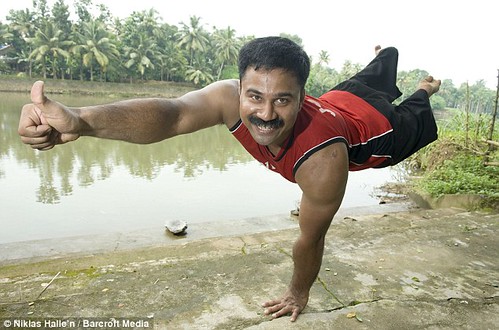
Joby Matthew holds himself up with one hand while giving the thumbs-up with another. He is on the bank of the Periyar river on the outskirts of Ernakulam. He and his fantastic mustache smile broadly at the camera.

Photo: Joby Matthew holds himself up with one hand while giving the thumbs-up with another. He is on the bank of the Periyar river on the outskirts of Ernakulam. He and his fantastic mustache smile broadly at the camera.

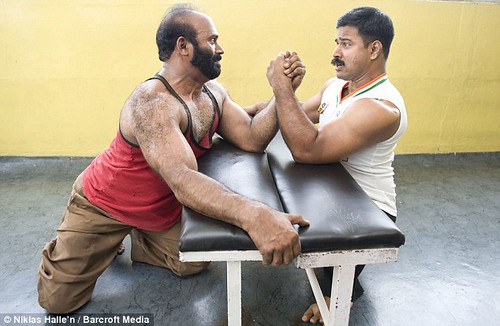
Joby Matthew and an unidentified man arm-wrestle on a weight bench. The unidentified man, who has a beard and fully developed legs, grips the far side of the weight bench.  Both men are grimacing and neither appears to be winning.

Photo: Joby Matthew and an unidentified man arm-wrestle on a weight bench. The unidentified man, who has a beard and fully developed legs, grips the far side of the weight bench. Both men are grimacing and neither appears to be winning.

These photos highlight his exceptional abilities, and while his disability is present and visible, it’s a part of his athleticism. However, there are only two pictures in the eleven-part picture post that actually show him competing. Training and physical strength are interesting and relevant, but this is about sports: as with the article, the focus should be on his achievements as an athlete, not on OMG HOW DOES HE DO THAT? or OMG HE BEATS NORMAL ATHLETES?

The accomplishments of athletes with disabilities face a double bind. In most cases, they are ignored and erased; they are thought to be impossibility and a contradiction. When AWPD are covered in the media, it’s rarely a positive, normed framing of them as accomplished athletes with valid bodies. They are objects instead of curiosity; they are heartwarming inspirations for the currently able-bodied; they are not quite freak shows.

Moderator’s note: Moderation on guest posts is often much slower than “usual” moderation times.

When Accommodations Conflict (Continued)

Reflecting on the extremely thought provoking post by abbyjean earlier, I was walking to breakfast with The Guy (caution, try not to walk while lost in thought, OYD) on a day when I was low on sleep, high on pain, and therefore using my cane. (edit: I just saw my typo! I had a funny visual of me trying to balance on a can! HA!)

Conflicting accommodations do not always mean that the conflict will occur between separate PWDs. For example, on a high pain day, I am in desperate need on my cane due to the intense pain in my hip and legs in general (though, which leg I want to use if for is debatable, even though I favor one hip). When I am that fatigued, however, using the cane is an intense use of my spoons, to the point where if I have too much to do I can’t even bother because it just winds up with me on a chair or bench in tears. Or the cane causes additional pain in my back or shoulders.

There are others that come to mind. My medication provides me with more pain free days, which is a good thing. This is an active choice I made with the advice of my doctor whom I was lucky enough to find at this duty station. The flip of that coin is that I have side effects which means that I can not always drive places, or have the energy (HA!) that I want to do things with my family, to name a few. This might not sound like a huge accommodation, but it makes a great impact on my family life, people who play a huge role in my care.

I know that some people use caffeine to both relieve some pain and migraine effects (I sometimes do) but that this has the crash effect at the end of the day (for me it means my spoons run out faster).

So, gentle readers, what accommodations do you have/use that conflict…uhh…internally? What individual needs to you have that you have to weigh daily?

Why SF’s Proposed Sit/Lie Laws Are a Terrible Idea

In San Francisco currently, there is something of a debate brewing about Mayor Newsom’s proposed sit/lie laws, which would make it illegal for anyone to sit or lie on any public curb or street in San Francisco (with a couple of exceptions).

The intersections with disability here are rather clear. For one thing, there are some intersections between homelessness and disability, because some homeless people are, for example, mentally ill or have disabling physical problems. Do either of these things make them unworthy of compassion, or not human? Of course not, but from the way this proposed ordinance is designed, it is, on a very basic level, criminalizing homelessness even more than it is already criminalized (not to mention socially stigmatized), while taking extra “common sense” steps to avoid citing non-homeless people for an offense. Observe the following response to concerns that SF police would begin to crack down on non-homeless people were the laws to go into effect:

During a heated, five-hour Board of Supervisors public safety committee hearing on the issue Monday, Adachi showed photographs of behavior that would be illegal under Newsom’s proposed law: a well-heeled tourist sitting on her luggage as she waits for a cab, a little boy sitting on a sidewalk clutching his skateboard, and tourists sitting on a curb and gazing up at the sights.

Assistant Police Chief Kevin Cashman said all of those people would be warned first to move and that none of them would probably receive a citation.

“Obviously common sense is going to be part of the training with enforcement of this statute,” he said at the hearing.

Ah, yes, “common sense.” Common sense, apparently, still makes the further stigmatization of homeless people de rigeur. Because apparently, they don’t deserve to sit down in public, unlike “well-heeled” tourists and neighborhood residents. I wonder what the response to a person with disabilities — tourist or not — needing to sit down on a public street might be? Someone waiting for an ambulance? While that is approaching a bit of a slippery slope argument (which I generally like to avoid), it is worth considering, simply because “common sense” will mean different things to different people — those whose job it is to enforce the statute included.

Also interesting is the framing of this ordinance in terms of concern for children. From one of the SF Gate articles:

Newsom, who bought a home in the Haight recently, was convinced to support an ordinance after walking along Haight Street with his infant daughter and seeing someone smoking crack and blocking the entrance of a business.

Certainly, children need to be protected from dangerous situations or potentially dangerous situations, but is an ordinance that criminalizes the poor and homeless — not all of whom are recreational drug users or addicts — really the way to do it?

Additionally, nowhere have I seen any plan to increase the number of homeless shelters or services for homeless people attached to this ordinance. The implicit message behind these proposed sit/lie laws seems clear: It’s too bad you’re homeless, but don’t you dare be homeless on our streets, because it might make our city look bad. Oh, and you certainly shouldn’t expect the city to help you not be homeless — even after it cites you for breaking the sit/lie law.

(Cross-posted to ham blog)

Recommended Reading for April 20, 2010

Scott Carney (Mother Jones magazine): Inside India’s Rent-a-Womb Business

Despite the growth in services, surrogacy is not officially regulated in India. There are no binding legal standards for treatment of surrogates, nor has any state or national authority been empowered to police the industry. While clinics have a financial incentive to ensure the health of the fetus, there’s nothing to prevent them from cutting costs by scrimping on surrogate pay and follow-up care, or to ensure they behave responsibly when something goes wrong.

Benedict Carey (New York Times): Seeking Emotional Clues Without Facial Cues

Ms. Bogart has Moebius syndrome, a rare congenital condition named for a 19th-century neurologist that causes facial paralysis. When the people she helped made a sad expression, she continued, “I wasn’t able to return it. I tried to do so with words and tone of voice, but it was no use. Stripped of the facial expression, the emotion just dies there, unshared. It just dies.”

Goldfish at Diary of a Goldfish: Blogging Against Disablism Day (BADD) Will be on May 1st, 2010

Blogging Against Disablism day will be on Saturday, 1st May. This is the day where all around the world, disabled and non-disabled people will blog about their experiences, observations and thoughts about disability discrimination. In this way, we hope to raise awareness of inequality, promote equality and celebrate the progress we’ve made. [Note: Click the link for info on how you can participate in BADD 2010!]

Max Harrold (Montreal Gazette): Filmmaker in wheelchair says red-carpet rejection inspired film

[Filmmaker Sean Marckos] has it all on video: He and a colleague, both in tuxedos and with their tickets in hand, being hustled out of the famous Palais des festivals in Cannes in 2008 and 2009. They were told they could enter only through a rear entrance, away from paparazzi. “They didn’t want me next to the beautiful people like Brad Pitt and Angelina Jolie,” said Marckos, 31, who has muscular dystrophy.

National Center For Lesbian Rights (NCLR): Greene vs. County of Sonoma et al.

One evening, Harold fell down the front steps of their home and was taken to the hospital. Based on their medical directives alone, Clay should have been consulted in Harold’s care from the first moment. Tragically, county and health care workers instead refused to allow Clay to see Harold in the hospital. The county then ultimately went one step further by isolating the couple from each other, placing the men in separate nursing homes.


Recommended Reading for April 15, 2010

Hi! As you may have noticed, we’re rotating Recommended Reading between a few contributors now. This is my first one, and it may have a little bit of a different style? I don’t know. Anyway, here it is!

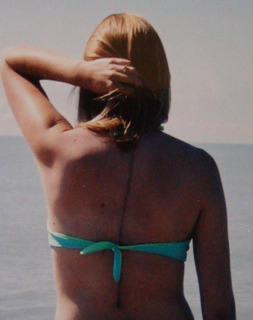
A woman faces the ocean, her back to the camera. An aqua bikini top is tied across her bare back and her arm holds her hair at her neck. A prominent scar runs down her spine.

History Lessons – Scar

My daughter will inherit my scar.  Obviously I know that you can’t inherit a scar, but she’ll likely end up having the same spinal surgery as me in the future. We both have scoliosis. Pretty bad scoliosis. I was diagnosed at eight; she was diagnosed at five. I wore a back brace and she wore one too. … There is no reason to cover it up.

BBC News – Making Light of Disability

Disability is one of those things that makes people feel awkward – there is perhaps a deep-rooted, psychological fear of contamination by association. So what we often do when something makes us feel uneasy is to laugh about it. It’s still well within living memory that TV comedians would poke fun at people from different ethnic groups – but broadcasting executives soon cottoned on to the fact that they risked alienating growing sections of their audience for the sake of a cheap gag.

Wheelchair Dancer – Disability and Race: Who Will Catch You If You Fall? (not new but still recommended)

In the workshop, I found myself in a conversation about disability and race. One of the participants had worked with some black disabled men; she was confused about why they identified more with being disabled than with being black. Didn’t they experience racism every day? Were they blocking out their blackness, disconnecting from their roots? Were they denying the hatred that black men experience on a daily basis? And then I got thinking. There are many ways to put the pieces of the puzzle together; indeed, for academics, “black disability studies” and other race and disability enquiries have recently become a new edge (yeah, I know… it’s problematic…). I would put some of the many pieces together like this…

Blog of Legal Times – Colorado Lawyer Settles Discrimination Suit Over Dog

A Colorado Springs lawyer who refused to allow a veterinarian and her service dog to enter his law office for a scheduled deposition in a civil action has agreed to pay $50,000 to settle a federal discrimination suit. LeHouillier demanded the veterinarian, Joan Murnane, prove her dog, an Australian shepherd, was a certified service dog. According to the suit, LeHouillier was not satisfied after reviewing a letter documenting Murnane’s need for the dog. LeHouillier feared the dog would soil recently installed carpeting, according to the Justice Department complaint.

LA Times – FBI probes LA Housing Department’s actions in apartment project for homeless seniors with disabilities

The FBI is investigating an affordable-housing deal in which Los Angeles officials channeled $26 million to a developer who they knew was under criminal investigation for alleged misuse of public funds, city officials said Thursday. The developer, David Rubin, was indicted last fall in New York for alleged bid-rigging and fraud, charges unconnected to the L.A. project. The $26 million went toward construction of a 92-unit apartment building near downtown L.A. for disabled homeless seniors. It has sat empty since October while its prospective tenants live in shelters or substandard housing.

Disability Representation in Music (Video), You’re Doing It Right: Janelle Monae’s “Tightrope”

This recent music video from singer-songwriter Janelle Monae is a great example of how not to completely screw up representation(s) of disability. Lyrics are located here.

And a description, courtesy of FWD’s own S.E.:

A black title card reads: ‘The Palace of the Dogs Asylum: Dancing has long been forbidden for its subversive effects on the residents and its tendency to lead to illegal magical practices.’

Two people in tuxedos are seen sitting against a white tiled wall. One is reading a book and the other is playing with a small ball, which eventually drifts up and floats in the air. The reader turns to see it and looks surprised.

Cut to an ominous-looking institution with a sign in front reading: ‘The Palace of the Dogs.’ Bright yellow text reading: ‘Monae and Left Foot: Tight Rope’ overlays the image as bouncy music plays.

Cut to a scene of a nurse pushing a cart full of medications. The scene starts with her feet, in sensible white shoes, and slowly pans up. She is moving down a hallway. As she proceeds, a woman (Janelle Monae) in a tuxedo without a jacket, with her hair in an elaborate sculpted pompadour, peers out the door of her room and then ducks back in. As she closes the door, we cut to her in her room, leaning against the door, and she starts singing.

The video cuts back and forth between the nurse moving down the hall, Monae singing and dancing in front of a mirror, and two ominous figures with mirrors for faces draped in black cloaks, seen from a distance. She eventually puts her jacket on and moves out of her room, softshoeing down the hallway, and other people, also in tuxedos, join
her. They storm into a cafeteria, where a band is playing, led by Big Boi, wearing a peacoat, a scarf, and a snappy hat. Monae jumps up onto a table and starts dancing, while people dance all around her.

As everyone dances, the nurse is seen peering around the corner with an angry expression. The scene cuts to the nurse gesticulating at the black-robed figures, who start to glide down the hallways and into the cafeteria. Monae dances right out of the wall, leaving an imprint of her clothes against the bricks, and ends up in a misty forest in what appears to be afternoon light, where she is pursued by the gliding black figures. Leaves cling to their cloaks. Evading them, she walks through a concrete wall, leaving another impression of her clothes behind, and she winds up in the hall again, where she is escorted by the robed figures. The video cuts back and forth between scenes of her
walking down the hall and the scene in the cafeteria, where music still plays and people still dance.

As she walks, a man in an impeccable suit and top hat walks by and tips his hat to her. She goes back into her room while people dance in the hall. The camera closes in on a table covered in papers and a piece of equipment which looks like a typewriter. She types a few keys, and then touches the papers, which turn out to be blueprints marked with ‘The Palace of the Dogs.’ She sits down on her bed,  rests her chin on her hand, and looks into the camera. The music fades and the scene cuts to black.

I really like what Cripchick has to say about this video: “i love the way that this video A.) critiques psychiatric institutions and B.) shows the ways that institutions/society/ableism polices our whole beautiful creative selves because if unleashed, we are powerful/uncontrollable.”

Additionally, I thought the cloaked figures were an interesting representation of the concept of the looking-glass self; another interpretation might be that they represent Bentham’s panopticon, or the sort of menacing, omipresent societal structure in which we must police ourselves constantly in order to be considered “normal.” Those are just two ways of looking at one aspect of this video, however.

What do you all think?

All Those Healthy Eating “Rules” are Just Guesses, Really

File this under “Who Even Knows, Anymore?”

s.e. smith recently posted a photo of a “5 a day” tag that came on some asparagus she bought. She felt, and I agree, that those tags are a form of food policing – instructing people what they “should” eat. The corollary, of course, is that if people do not follow these food guidelines, their unhealthiness is their own fault.  s.e. explored some of the problems with these educational campaigns over at This Ain’t Living, but I want to highlight another problem here.

That problem being, namely, that NOBODY KNOWS WHAT THEY ARE TALKING ABOUT. From a recent article at Scientific American:

The recommendation that people eat at least five servings (about 400 grams) of fruits and veggies each day, espoused by the WHO since 1990, was based on studies that found a link between higher intakes of these foods and lower risks for cancer and other diseases.

Since the 1990s, however, evidence from large studies has been mounting that the protective effects of these foods against cancer in particular might be modest—if it exists at all.

The results are in line with other findings both in the U.S. and abroad that suggest the protective effect of fruits and vegetables is “much smaller than had been believed 10 years ago,” Harvard School of Public Health’s Walter Willett, who wrote an editorial accompanying the study, noted in an e-mail to ScientificAmerican.com. People who eat more fresh fruits and vegetables are also more likely to make other healthful lifestyle choices, such as exercising more and drinking and smoking less, which the researchers noted “may have contributed to a lower cancer risk” overall.

So this “5 a day” rule – which has been adopted as healthy eating dogma all over the world – may not actually be based on much of anything and there’s virtually no evidence to support the assertion that eating more fruits and veggies will automatically lead to better health.

But watch – it will still be used to shame people, and to blame them for their own health problems, regardless of the lack of scientific support. This strongly supports the argument that these healthy eating rules, and other rules about what people “should” do to be healthy, are much less about scientifically proven relationships between eating and health and much more about shaming people for their health problems.

(h/t The Awl for the link, and the suggestion that You Are Going To Get Cancer Anyway, So Have The Steak)