All posts by Anna

Recommended Reading for August 3, 2010

Peek at the Past: Racing Wheelchair (via Katja at BrokenClay)

At the beginning and for many years racing wheelchairs were nothing more than a street wheelchair modified by athletes who spent as much time with a welding torch and wrench in their hands as they did with their hands on the push-rims.

They were forever working on improvements that would give them that bit of advantage. All of that changed dramatically with the introduction of specialized racing wheelchairs and even more so with the introduction of the Halls Wheels Racer.

Trans News

Some links to cool trans stories

Cracked Not Shattered

I never asked for much

Just your understanding

Understanding

That I am not an aberration

Danger of Overhangs to the Blind

One of the most dangerous things that I face as a blind person are obstacles that are either just above my head or right in line with my face. Having a guide dog makes these objects slightly less dangerous if my guide sees them and warns me,, but guides are not always perfect and sometimes they don’t see the obstacle in time. For my guide dog Midge, this is not one of her strong points, but it wasn’t until just recently that this problem ended up causing me injury. On our way home from a walk I ran into a piece of wood that was sticking out into the sidewalk, and it hit my eye. To be fair to my guide dog, the board was being held by one of my neighbors and he neglected to warn me or ensure that I wasn’t in harms way. I could say that this really was human error, but the fact is that my guide should have stopped me before I hit the obstacle.

Picky Eating and Autism

My dear sainted mother probably has many (un)fond memories of getting me to try new foods. Between the ages of 3 and… let’s say very recently *cough* I was an obscenely picky eater. My favourite foods were pizza, pickles, frozen blueberries, and frozen peas, and I would often turn up my nose at the meals my mother cooked, and then, to her exasperation, I would switch my interest to raw flour or kool-aid powder. With that in mind, I think the only thing that this article missed the target on was a chance to mention that pica can also be a sign of autism at an early age. Pica and picky eating for me went hand-in-hand, so I believe it warrants a mention in an article about the connection between food, nourishment, and autism.
The article makes a note on how this can affect the overall health of autistic individuals. Of particular concern seems to be a possible lack of nutrients due to a picky eater’s distaste for certain foods:

Where Ableism Leads TRIGGER WARNING for murder of autistic children

This is the kind of rhetoric that our mainstream autism advocacy organizations give us. Maybe they don’t always put it in such naked terms, but the underlying feeling of entitlement to a “normal” child, and the feelings of victimization upon having an autistic child, is a staple of autism rhetoric. This kind of rhetoric really is dangerous.

Portrayals we love: Melody in Girls With Slingshots

Back in November I did a Guest Post for Bitch about Ways of doing characters with disabilities ‘right’. I think it’s been since November since I’ve had time to consume any media with characters with disabilities (I’m permanently on thesis time now), but I want to go back and talk about the comic I mentioned then, Girls With Slingshots.

As I said then:

I’m not actually a fan of Girls with Slingshots and thus haven’t read the whole run, but I did read the recent wedding-related storyline because it featured two new ‘bit’ characters: Soo Lin, who is blind, and Melody, who is deaf. (Sadly, the strips don’t seem to have a transcript that I can find. I’ve written up a transcript for the relevant strips.) [Soo Lin’s first appearance] [Melody’s first appearance]

What I like about the jokes in this strip are that they’re all over the place. Some are about how clueless people can be about blindness. Some are disability-related humour as told by people with disabilities. I think my favourite is this joke about getting a bad ‘terp. There are others, of course.

The jokes are all based around disability, sure. But the jokes aren’t “ha ha ha, look at the crippled person having difficulties getting around!” And at no point is the humour about a very special lesson for anyone else. Soo Lin and Melody are part of the joke, they aren’t the butt of it.

One thing has changed: Since then I’ve definitely become a fan of Girls With Slingshots, and actually look forward to Mondays because I know I’ll get a new strip. (The weekends are so long.)

Since November, Melody has also become a recurring character, and I totally love how Danielle Corsetto uses her in the strip. Basically, Melody still isn’t a very special lesson in Deafness, she’s a fun and funny character who’s developing a romance with another recurring character, and is gradually being accepted by the others as just another member of the group.

One of the things I am enjoying about the plot line is the growing romance between Melody and Chris. Chris has had a crush on Melody since the wedding arc, and has decided to learn Sign language. While other writers might go with “And then Chris instantly learned Sign so there could be no communication problems, the end”, Corsetto has shown Chris’ learning curve, in all its glory.

Transcript:
Darren and Chris are talking at the local bar. Both are clean-shaven white dudes, probably in their mid-20s.

Panel 1:
Darren: So is that why you’re here? Hoping to catch a glimpse of your beloved?

Chris: I guess. I’ve never seen her here except for that one time, so I don’t know why I’m trying.

Panel 2:
Darren: Aw, that’s romantic. And even if she did show up you could only stare at her creepily because you don’t know Sign Language.

Chris: I’ve been learning!

Panel 3:
Darren: Really? Let’s see this magic.

Chris: [Signing awkwardly] umm… Hello how much does this cost?

Panel 4:
Darren: That will get you slapped.

Chris: I’m only on book one!

Other than Darren pointing out that Chris is still learning (slowly!) Sign, none of the characters in GWS question the possibility of the relationship. The constant match-maker, Jamie, merely encourages him to not keep his feelings a secret [transcript], and Melody’s sister, Maureen, is nothing but thrilled.

As I mentioned before, the humour in people’s interactions with Melody is still focused around the foibles of hearing people who are still getting used to having a Deaf friend, and the assumptions they make about it. In one scene, Chris is horrified to be told that Melody can read lips (I’m not sure if this is true) after he said something embarrassing, and in another a rather drunk Maureen starts shouting for Melody, having forgotten this might not be the best way to get her sister’s attention.

The only flaw – if one can call it that – is that this plot arc is very much about Chris and about his growing as a person in finding a woman he wants to be with. On the other hand, the whole strip is about people growing up and learning about themselves, often through finding romantic relationships, whether or short- or long-term. Characters have tended to be introduced this way (Chris was once a potential romantic partner for Hazel) and then become more fully-fleshed member of the cast.

In short: I really love Melody, and I’m so glad that Corsetto has kept her in the strip. While not everything about GWS is perfect, I’m just happy to see a popular comic strip with a recurring character with a disability. I can’t wait to see where Melody’s story goes.

Commenting note: I am, as I said, on Thesis Time right now, which basically means I’m hardly at all around. If you decide to comment, please keep commenting policies in mind, and I’ll do my best to keep up with them.

Signal Boost: Work Capability Assessment Independent Review

WCA independent review – Call for Evidence launched 27th July

Dear all,

As you may know, the Secretary of State for Work and Pensions has asked me to undertake an independent review of the Work Capability Assessment (WCA). This is an important part of the Employment and Support Allowance claim process, designed to determine which claimants are capable of undertaking work, or work-related activity. My aim is to review the current workings of the assessment, and make recommendations on the future development and efficacy of the WCA.

As part of this process, I have today (27th July 2010) launched a call for evidence to gather information from a wide variety of stakeholders on the WCA. I strongly invite you to contribute to the call for evidence by submitting any information you may have that is relevant to how the WCA is operating. This includes evaluating how the WCA assesses limited capability for work and limited capability for work-related activity. There are a number of questions throughout the document and I would very much welcome your responses to these.

The call for evidence can be found at: http://www.dwp.gov.uk/consultations/.

This e-mail is being sent to a large number of people and organisations who have already been involved in this work or who have expressed an interest. Please do share this e-mail with, or tell us about, anyone you think will want to be involved in this consultation. I apologise if this means you receive this message more than once, but stakeholder views really are important to the process.

The closing date for the call for evidence is 27 August 2010 – please send your responses to wca.evidence@dwp.gsi.gov.uk
(or hard copies to: WCA Independent Review Team, Floor 6, Section B, Caxton House, Tothill Street, London, SW1H 9NA) by then.

Kind regards,

Prof. Malcolm Harrington CBE

Celebrating Us: Notes for an address at the 7th Annual Simply People Celebration

John Rae is a disability rights activist in Toronto, Ontario, Canada, and a member of The Alliance for Equality of Blind Canadians. This speech was delivered by Rae on July 20, 2010 as part of the Simple People celebration, which is in turn part of Toronto’s Disability Pride.

Tonight is for us, and about us! Tonight is a time for us to celebrate our accomplishments and to redouble our efforts to bring about true equality for all persons with disabilities in Canada and around the world.

This year, Canadians with disabilities are celebrating Canada’s ratification of the UN Convention on the Rights of Persons With Disabilities (CRPD). While it may not provide us with a lot of new rights, it sets out in far greater detail than any human rights code or the Charter of Rights and Freedoms ever did what a truly accessible and inclusive Canada can look like, in important areas of life that are critical to our participation in the economic, political and social life of our communities – transportation, employment, education, communications, access to information, etc. The Convention also requires Canada to collect and disseminate data and to submit a comprehensive report to the Secretary-General of the United Nations within two years after ratification and every four years thereafter on measures taken, and civil society is to be directly involved in the development of these reports. This means involving us!

The development of this Convention traveled a unique path. It took the least amount of time of any UN Convention to be concluded, and it involved far more participation from civil society than ever before. That means involvement by us, and many groups representing persons with disabilities participated actively in the negotiations at the UN that resulted in this Convention. There are important lessons to be learned from having this kind of direct participation in developing any new initiative that directly affects our lives.

Last year, the President of the Alliance for Equality of Blind Canadians, Robin East, developed a new way of addressing our needs and aspirations. He coined the new phrase, “rights holders.” We are Rights Holders! What does he mean?

Too often, governments like to lump all of us, consumers, parents, service providers, etc. under the same umbrella of “stakeholders,” and while all of these groups may very well have a “stake” in the outcome of a new piece of legislation, policy or program, we are the ones most affected. We are different, and must see ourselves as “rights holders,” and not just another group of mere stakeholders. What this means is that we must occupy the primary and preeminent place at any table that is discussing anything that directly impacts our quality of life.

You are all familiar with the favourite phrase of the disability rights movement, “Nothing about us without us!” Now that Canada has ratified the UN Convention, it is critical that we rights holders participate as directly in its implementation as we did in its design, to ensure that it makes a tangible difference in the lives of all Canadians with disabilities, to make it become Canada’s national disabilities Act.

By contrast, the much heralded Accessibility for Ontarians With Disabilities Act (AODA) continues to move at a snail’s pace. After over five years, only one of the initial five accessibility standards has been issued as a regulation, though more are expected later this year. It is hard to imagine that Ontario is even close to being on track to achieve full accessibility by the far off date of 2025, and it is hoped that Canada’s ratification of the UN Convention will spur some renewed commitment and action to the AODA.

It is too often argued by representatives from governments and the obligated sectors that they “would like to do the things we wand and need, but these changes will simply cost too much.” We have countered that the real barriers are not cost, but a lack of political will and a question of priorities.

The Ontario Human Rights Code has covered persons with various disabilities since 1982. Governments, the public and private sectors have had over 25 years to make their premises, websites, products and programs fully accessible. How much more time do they need? If they have ignored their responsibilities and dragged their feet over all these years, stop blaming us – stop blaming the victims. It’s simply not our fault.

After the preposterous expenditure of an estimated $1.3 billion (that’s billion) on security for the G-8 and G-20 Summits, and countless millions of dollars on our involvement in the war in Afghanistan, persons with disabilities never want to hear the cost excuse ever again … never again! Resources are not unlimited, but whenever a government really wants to do something, it seems to magically find a way to finance its priorities.

So what am I asking you to do?

1. Write letters to the Editor of your local newspaper, raising disability issues;

2. Ask all candidates for Mayor and Council in the upcoming municipal election about their platforms, and what they commit to do to advance our agenda;

3. Get more involved in the disability rights movement. Join a group like the Alliance for Equality of Blind Canadians (AEBC), Citizens With Disabilities Ontario (CDWO) and sign up to receive updates from the Accessibility for Ontarians With Disabilities Act alliance, or find the consumer organization in your area that best represents your issues and ideas.

In closing, I want to mention just one more point. Many of us who have been on the front lines, in the leadership of our movement for many, many years are getting old and growing tired. We need you to get more involved. We need your energy, skills and new ideas. We cannot expect the system to hand us our rightful place, our history teaches us that it rarely does! Moving our agenda and achieving our goals is up to us. We must make it happen.

Some of you will be familiar with the phrase “Full Participation and Equality.” It’s an excellent phrase. It’s not a new phrase. It was the theme of the International Year of the Disabled Person (IYDP) way back in 1981.

Since then, we have come a part of the way up this road, but we still have far, too far to travel. Today, we seek legislation and new programs that will lead to that elusive goal, but today we must spend far too much of our time preventing the introduction of new barriers.

It’s time governments, the private and public sectors recognized our value, and commit to work with us to realize the IYDP motto.

We want our rights. When do we want them? Now!

Open Post: Helen Keller Mythbusting Blogswarm Day!

Description below

Image: A grey banner divided in three parts. A photo of a young Helen Keller is in the center. On the right, it reads “Political Activist. Radical Thinker. Suffragist. Pacifist. Journalist. Socialist. Who was she?” On the left it reads “Helen Keller Mythbusting Day 2010”

Today is awesome Helen Keller Mythbusting Day!

As I wrote earlier:

A few years ago someone on a feminist site posted a list of the top 100 historic women in the US, and the list included Helen Keller. A commenter mentioned being surprised to find that out, because… well, what did Helen Keller actually do?

The answer to that question is what this Blogswam is all about.

First, I’d like to thank the wonderful, amazing, and totally awesome Jhameia of Intersectionality Dreaming for making our awesome banner while travelling across Canada! Thank you, Jha, you are awesome!

Second, if you post something for Helen Keller Mythbusting Day, please leave a link here in the comments.

If you’d like to participate, but aren’t sure how, check out the Intro Post, which has ideas and links for more information.

Please check back throughout the next few days!

Previous Posts about Helen Keller on FWD:

Feminist Icons
Subverting the Narrative

AWP: “The Disabled”

  • Ableist Word Profile is an ongoing FWD/Forward series in which we explore ableism and the way it manifests in language usage.
  • Here’s what this series is about: Examining word origins, the way in which ableism is unconsciously reinforced, the power that language has.
  • Here’s what this series is not about: Telling people which words they can use to define their own experiences, rejecting reclamatory word usage, telling people which words they can and cannot use.
  • You don’t necessarily have to agree that a particular profiled word or phrase is ableist; we ask you to think about the way in which the language that we use is influenced, both historically and currently, by ableist thought.
  • Please note that this post contains ableist language used for the purpose of discussion and criticism; you can get an idea from the title of the kind of ableist language which is going to be included in the discussion, and if that type of language is upsetting or triggering for you, you may want to skip this post.

A month and a half ago I wrote a fairly angry email to Ms Magazine blog [which you can read here – yes, I sent it to them, no, I never got a response]. While part of my ire was raised by the subject matter and the treatment of people with disabilities as unthinking pawns of the “religious right”, a significant portion was because of the casual use of “the disabled”.

The short form of why this is a problem: People with disabilities/the disabled are not a collective group that all agree on anything. Asking what “the disabled” want or “the disabled” are doing is exactly like asking what “women” want and what “women” are doing. Women are individuals. Some of them are women with disabilities! We don’t all want the same things, but grouping everyone under the same umbrella, as though we are a Collective rather than Individuals With Opinions and Needs is… well, it’s pretty damned ableist, as well as being arrogant, ignorant, and irritating.

Long Version:

We’re still living in a society that makes a lot of casual assumptions about people with disabilities and their experiences. When people start talking about “the disabled” they are generally about to launch into some sort of stereotype – “the disabled are the pawns of the religious right”, for example. This boils down a lot of complicated people – people who have a wide variety of needs, wants, opinions, thoughts, and experiences – into one homogeneous group.

This contributes to the de-humanization of disabled people. “The disabled” aren’t people, they’re a big collective noun who can’t be reasoned with, can’t be talked to, can’t be considered – they’re just to be placated, and dealt with, and put out of our minds as quickly as possible in case they sue us.

Saying “people with disabilities” or “disabled people” may seem like a pretty minor thing. It is, so it shouldn’t be that difficult. The reason for it, though, is that it can be that small reminder: that people with disabilities are people. That disabled people have opinions and thoughts and experiences and needs that are not universal to all people with disabilities. That we are, in fact, people, and it would be nice if we could be treated as such.

Language doesn’t change everything. It isn’t an end in and of itself. But it can be the first step in combating the sort of ableism that makes it okay for many people – including editors and writers for major and minor news sources – to dismiss us as pawns without thought.

See Also: Disability Terminology: A Starter Kit for Nondisabled People and the Media by meloukhia at Feministe.

Recommended Reading for June 17, 2010

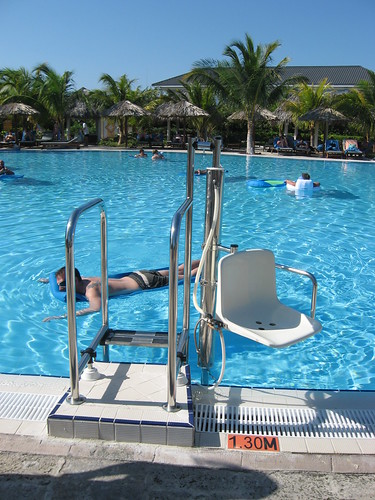
A
A chair designed to assist people into the adult end of the swimming pool.

It’s really warm in Halifax. I wish I had a cool pool to slip in to….

Photo by dblackadder”, used under a Creative Commons License.

How To Fight Ableism: Some Easy Steps

On most of the vectors where I have privilege, if somebody could point me to real, concrete ways I could help with local, immediate effect — that is, not donating to charities, or writing letters to advertisers, or pointing out the prejudices of bloggers or television shows — I would like to think I’d love that information. So I thought it might be valuable to gather together some ways in which able-bodied people can do something about ableism in the world. Then, next time a person is feeling frustrated about ableism, and is thinking about doing some signal boosting of, say, some crappy thing the writers did on the latest episode of Glee, maybe that individual would have the option of committing to spending the same amount of time doing some more concrete fighting of ableism. Not that I’m critiquing the kind of signal boosting that a lot of us do on the blogosphere! But I’m assuming some people would find utility in hearing about other things they could do that might be useful.

Disability and the Curing Thereof

So. Something that struck me about the Cured Disability is that very often, it was framed as a sort of… reward. Or a gift. In some cases, something good character A was doing for character B, sometimes even without asking. And char B was of course OVERJOYED and had no problems with this at all, even when they’d had this disability for a very long time.

And that? Bothered me.

Possibly more than the actual curing itself.

Because, I’m realising, what I want to see is ambivalence, mixed feelings. If you’re going to go there, if you’re going to cure a character, I want to see them have to struggle with what that means for them afterwards. Because disability isn’t objectively always bad, and lack of disability isn’t objectively always good, especially when we’re talking about a character who has been disabled for a long time suddenly losing that. (In fact, this entire post is about people who have been disabled for a while – I’m not familiar with acquiring a new disability but I suspect the same issues wouldn’t apply.)

way simplified story in pictures: ADD/ADHD chemistry

Medication might be a costume, in that sense, something you put on and take off when it doesn’t fit anymore, or it might be something that — like wearing your favorite clothes under an overcoat — isn’t necessarily visible to anyone else but is part of the fundamental you. I think that balance of “is this simply a manner of ‘being'” or “is this ‘being’ in itself” is something we each have to deal with, on our own, but I disagree strongly with the idea that medication makes you not-you. It may alter you to the degree that friends do a double-take at first, but a split-second of not-recognizing doesn’t mean they don’t recognize you at all. It just means they were expecting a uniform on a day you’re wearing flip-flops. The you that’s the true you remains at the core.

However, I certainly don’t have all the answers. I doubt I even have a third of them. I only have what I’ve been through and the questions I’ve raised and tried to address, given that most of my life has consisted of not a single medication ever really working with any degree of success. In most cases, not even that much. Makes for a bitter reaction sometimes, if anyone thinks to compliment me for having the strength to make it through without “relying on drugs”. Really, I’d like to be able to rely on medication, I want to say; doing all the work myself leaves me feeling naked under that overcoat, to totally mix my analogies.

But all the same, what I’ve learned, I’ve learned, and what I’ve got is at your disposal. It’s up to you to pick and choose whatever may also help you in turn.

EHRC calls for disability hate crime evidence

Since then, the EHRC has been doing excellent work in its Formal Inquiry into disability-related harassment in Britain. On Monday, the Commission launched its request for evidence of how public bodies – such as councils, the police, transport operators, and schools – have dealt with issues relating to disability harassment.

If we are to address the issue of this continuing blight, we must understand the scale and scope of its current impact and how people respond to it. Thus, if you have any examples of disability-related harassment that you’re willing to share with the EHRC, or know of a local disabled people’s organisation who could help collate such examples, I urge you to get in touch with the Commission.

Study Blames Childhood Behavior Problems for Victimization to Abuse

Now, in the most recent issue of Child Maltreatment, I came across an interesting study. The study examines whether internalizing and/or externalizing behavior problems in children lead to increased victimization to sexual abuse, caregiver maltreatment, and peer abuse, independent of past victimization and adversity. The results are clear that mainly children with both internalizign and externalizing behaviors are at high risk of all three types of victimization. Elementary school children are especially vulnerable to bullying, while young adolescents are more vulnerable to sexual abuse. Children of all ages are extra vulnerable to caregiver maltreatment.

….

However, I have some problems with some of the language used in the article.

Trans Woman Delphine Ravisé-Giard’s breast size dictated by French civil court

Delphine Ravisé-Giard is a long-serving member of the French Air Force who transitioned in 2007. The Air Force has been respectful and reasonable about her shift in presentation, immediately reflecting her gender accurately and with apparently very little sturm und drang.

But in trying to transition legally, she is facing bigotry and ever-moving goalposts. The civil court handling her legal change is intimately policing her body and demanding that she get specific kinds of surgery. Originally, the court demanded that she get SRS. They have thankfully backed off that, but their new requirements? Not much better.

Vinux: Linux for the Visually Impaired.

Headlines:

U.S.: Blind Students Sue Law Schools Over Online Applications “Three blind students and an advocacy group have sued four California law schools, arguing that their online application system is not accessible to blind students.”

Switzerland: Disability Theme Park Divides Disabled “How easy is it to buy a bus ticket from a machine if you are mentally disabled? How hard is it to cross a busy street if you are visually impaired? The exhibition at the Paradrom is designed to answer such questions. Arndt Schafter is from the organisation which is developing the project.” [There’s a recording of some sort on the site, but I can’t hear it so I can’t tell you what it says. I think it’s the article itself.]

U.S.: Clustering of Group Homes Alarms Neighbours “Some Washington, DC residents are questioning how much is too much after learning that a single section of the city houses over 40 percent of its group homes for those with developmental disabilities.”

Disability in Pop Culture: I know where the Black Stork Comes From

Don and I went to see this great romantic comedy a few summers ago. IMDB tells me we saw it in 2008. It’s called Easy Virtue, and it’s one of those delightful romps where a young upper-class English boy brings home his wild American wife who is older than him, basically to upset his parents. It’s set in 1929 and has all those great things that movies have when they’re set in that time period – jazz music, flapper dresses, British manners, cigarette smoking as sexy and cool, etc, etc etc.

The take-away message was that if you really love someone with Cancer, you’ll kill them if they have to undergo too much chemotherapy.

As this was around the same time as we confirmed Don’s cancer diagnosis, you can imagine that this kinda ruined the awesome movie-going experience for us.

When people tell stories about families like mine – the dude in the wheelchair with omg!cancer, the crazy lady who hides under her desk so nothing can get her – they tend to tell three stories: “Bitter Cripple Who Needs To Be Schooled By Abled-Folks About How Their Life Isn’t Over Yet”, “Overcoming Adversity: A Very Special Lesson”, and “It Sucked, And Then He Died”. The heroes of these stories are almost always the Able-Bodied (and it is very much a “broken body” trope – narratives of madness are different). There never seems to be fictional narratives about the world-famous scientist who just happens to have neuro-muscular dystrophy, or the renowned US historian with the award-winning books who just happens to use a ventilator, or the actor who, after a disabling injury, refuses to become a director and just happens to land a role in a major television series. If these people showed up in fiction, their disability would be the story. Because that’s the story that is told about disability.

Whose life is it anyway?

So I come back to story after movie after very special episode where the person with the disability, the cancer, the catastrophic illness, gets themselves out of everyone’s way by killing themselves or begging others to do it for them. I remember every narrative where disability = evil, where disability = faked, where disability = a lesson, a punishment, a blessing in disguise, a test, a momentary difficulty that is healed when the bitterness goes away, because fictional disability never just is.

This continual fictional narrative of disability as trope is what makes me distrustful of disability in fiction. If I want to watch a show that appeals to me and includes people with disabilities treated realistically, I have to go back to Joe Dawson in Highlander. If I want to watch a fun movie romp, I’m back at Sneakers. If I want to have a long conversation about assistive tech, I’m at X-Men and Star Trek: The Next Generation. If I want to watch something that looks even vaguely like our lives, I’m at Joan of Arcadia. If I want to see a show where someone has some power, a love life, and just happens to have a disability, I’m somewhere in Season 2 of The West Wing.

I don’t want to play Disability Cliché Bingo every time I try and engage with pop culture. I do not want to watch a medical drama because we have enough medical drama, and with three types of narcotic painkillers in the flat I’m not fond of the addiction narrative. I don’t want to watch a show where the creators and show runners cannot type “wheelchair dancer” into YouTube and see what comes up. I cannot stand the idea of watching a show where a secondary character is disabled specifically to punish the main characters. I do not have an interest in US football’s glories.

Tell me stories about the people with disabilities I know: The ones who work hard every year to ensure an internationally renowned con is accessible to people with disabilities, the one who co-founded a successful social networking site, the ones graduating from university this month, starting it next year, struggling through grad school without enough support, parenting their children, advocating for their rights, organizing support in Chicago, running role-playing games, managing businesses, founding a successful feminist website, writing beautiful poetry, publishing academic papers, doing their rounds at the hospital, planning disability-focused conferences, planning tech-focused conferences, cooking dinner, making documentary films, getting through today, planning tomorrow, arguing with their parents, their children, their spouses, their friends, writing blog posts, drinking tea.

We are so much more than this, so much more than tropes, clichés, or tragedies.

Recommended Reading for Wednesday, June 16, 2010

I am having difficulties accepting we are halfway through June.

[Via the gimpgirl community on LJ] Couple Exchange Vows in Central Park

When two partners who receive SSI benefits get married, Medicaid reduces those benefits to 75 percent of the total that both individuals received prior to marrying. As a result, many couples with disabilities, like gay and lesbian couples, seek domestic partnerships or live together without formalizing their commitments.

Activist Danny Roberts, who was unable to attend the ceremony, sent a recording of his opposition to the policy. On it, he told a story about meeting the woman he loves at the Empire State Building observatory at a protest.

“We allow ourselves to be demeaned into begging for what we need to live,” Roberts said about the receipt of Medicaid. “If we comply, we can’t marry the ones we love. It’s not illegal but it is essentially suicide.”

Books for the Blind, Not A Liberal or Conservative Issue

One week ago we at Planet of the Blind wrote a post decrying New Jersey Governor Chris Christie’s budget plan calling for the elimination of the Garden State’s lending library for the blind. The so called “Talking Book” program (which is directed and administered by the United States Library of Congress) has been recording and distributing books for the blind since the great depression and they have done so with remarkable professionalism and devotion. Recorded books for blind and physically disabled readers are not your average commercial audio books. They are recorded and developed in ways that allow blind readers to access the same books you might read in your public library and in effect this service makes it possible for borrowers to read far more printed material than one might find in the audio books section of your local Barnes and Noble. Talking Books represent the nation’s library, and in a very real sense they represent our nation’s conscience.

Yet it was inevitable that we would receive a vituperative comment from a reader who identified himself as being conservative (for so we must presume given his disdain for “liberals” who, he argued, support government waste.)

More Detroit Disability Justice Happenings

They say 20,000+ social justice activists will be traveling to Detroit this week for the Allied Media Conference (17-20), US Social Forum (22-26), and the Hip Hop Congress Conference (26-28). A lot of communities are using this time to organize and people are coming in on every mode of transportation possible: bikes, buses, caravans, planes… It will be the first time (that I know of) that a large number of disability justice folks will be gathering together to be in community with each other, build shared politic, and strategize about how to incorporate this new framework into our lives and our work. It has taken a year of finding resources and planning to make the events below happen, hope you can join us!

Don’t Have Answers

The DSM and the ICD almost go out of their way to pathologise queer people, although there is no longer any diagnosis of Homosexuality. The DSM-IV-TR and the ICD-10 do, however, pathologise trans identities (Gender Identity Disorder, Transsexualism, Dual-Role Transvestism) and asexuality (terminology varies considerably). They also pathologise a number of consenting sexual practices like fetishism, BDSM, making “obscene” telephone calls. And, because there wasn’t enough heteronormative fail already, they also pathologise anxiety due to not knowing if you’re gay or straight (Sexual Maturation Disorder), and having non-long-term relationships (Sexual Relationship Disorder). Notably, there is no disorder of Being An Unmitigated Heterosexist Shit Disorder, so we can safely conclude that heteronormativity is a factor here.

For some time, there has been a campaign to have Gender Identity Disorder (GID) removed from the DSM-V.

[Untitled]

I am terrified of that moment. As most people I know are. I know women that haven’t ever gotten a pap smear, ever once in their entire lives, because of that moment. This is not an unusual terror.

Now that “health care” is going to be available to more of us…I can’t help but wonder. How many of us won’t go to the doctor any damn way–because the doctor and “help” and “health” is predicated on terror? Or a type of test taking? You take the test and you pass! Or, you take the test and you die!

Shiyiya brought my attention to We Are Enabled By Design at the Design Museum in London, UK.

“We are Enabled by Design” is a one day event, looking to reframe the ageing and disability debate by focusing on Design for All.

We believe the world is made up of people who have a range of abilities, with each person having their own personal strengths and qualities. We are passionate about harnessing these strengths to empower people to live as independently as possible. Design for All taps into this by focusing on meeting the needs of as many people as possible, to make either a product or service accessible. By mainstreaming accessibility, this can help to remove any stigma attached, while making people’s lives that bit easier and in turn more manageable. For us, Design for All means accessibility for the masses.

Headlines:

Complaint Box: Assumptions “Maneuvering through New York City as a person with cerebral palsy can be a constant irritation. Just making my way down subway stairs at rush hour, with people breathing down my neck, is holy terror. But it is not the physical strain of steps and crowds that is my main source of anxiety. It is the naïve, inappropriate and sometimes downright mean comments that people make.”

Textbook describing Down Syndrome as “Error” triggers debate “Books used by seventh graders in Bridgewater, Mass. schools describe Down syndrome by saying “the extra chromosome is the result of an error during meiosis.” The section on the chromosomal disorder also uses the term “mental retardation.””

Reminder: We have a Delicious account! If you tag entries “disfem” or “disfeminists”, or “for:feminists”, this will bring items of interest to our attention. Thank you!

Doctor Who: The Doctor and Disability

The title card for the current serial of Doctor Who. It says DOCTOR WHO with a red flame-like background

This post presumes you’ve seen Doctor Who up to and including “The Lodger”, which is episode 11 of the current season. Since I know this episode hasn’t aired everywhere yet, I’m going to put it behind a cut tag. I’m also going to distract you with a picture of a kitten.
A large grey cat pats the top of a TARDIS toy.  The caption reads Good TARDIS *pat*.
A large grey cat pats the top of a TARDIS toy. The caption reads Good TARDIS *pat*.

[I went with the smaller size because otherwise it dominates the page like woah. Anyway, final warning: Here be spoilers.]

Continue reading Doctor Who: The Doctor and Disability