All posts by Anna

Recommended Reading for Monday, June 14

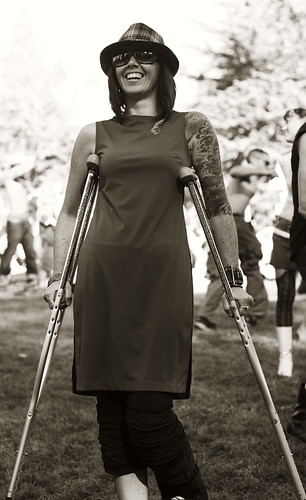
A tall slender woman wearing a slip dress and an awesome hat.  She's got tattoos on one arm, and is using crutches.  She's grinning.
A tall slender woman wearing a slip dress and an awesome hat. She's got tattoos on one arm, and is using crutches. She's grinning.

Reminder! Helen Keller Mythbusting Blogswarm!

Adoption, Race, Disability and the Vaule of People

You see, my parents got a discount on my adoption for two reasons. The first one was that I am black. Black babies weren’t as popular in 1990, so I was in foster care for a while. The other reason they got a discount was due to the fact that I was supposed to be intellectually challenged, and had a few physical issues. Not being a white, healthy infant lowered my price.

I think this says something interesting about whose bodies we value. We don’t value black bodies or disabled bodies. Thus, in order to encourage potential adoptive parent to look at children like me involved lowering my adoption fees, my cost. This feels wrong. I will say that my parents didn’t put any preference for race on their application and there were only a few disabilities they didn’t feel able to handle.

In Which Everything Takes Rather Longer Than I Thought

How this fails to work in Open Source is that Open Source is a community. A reputation economy, as the nerds are so fond of talking about, but also a group of likeminded people who chat and bond and stuff. You know what they bond over, in large part? Women’s bodies. Tits, how much they like them. Bitches and how crazy they are. You know, locker room stuff. Guy culture. The sort of male homosocial bonding that is how guys grease the social gears (in the US, anyway). You know something? People with tits can’t be a part of that conversation! Because they are being talked ABOUT. They are not the ones doing the talking! They are the thing that is being used to prove how well we all get along. This is where women have to decide whether or not they want to try to be “one of the guys” too. Some groups are gracious enough to let their token female do that, as long as she is willing to join in the girl-bashing. Some groups are not that gracious but are still kind enough to let their token female become the hackysack in the girl-bashing party. They’re willing to let her demonstrate her loyalty to the group by putting up with being kicked around! It’s very nice of them. But should she ever try to say that This Shit! It is Not Okay! Well then she is a killjoy, a frigid bitch, ruining everyone’s fun, girls have no SENSE OF HUMOR and guys are SO PUT UPON and ZOMG PC POLICE!!1! What is this world COMING TO when no one can have a FRIENDLY CONVERSATION without someone telling them they are offending puppies or something!

Creating Collective Access – Check it out!

Are you a crip and/or someone with a chronic illness that is going to be in Detroit this summer for the Allied Media Conference and/or the US Social Forum?

We know that for many of us, access is on our minds when it comes to traveling, navigating the city, movement spaces, buildings, sidewalks, public transportation, rides, the air, the bathrooms, the places to stay, the pace, the language,the cost, the crowds, the doors, the people who will be there and so so so much more.

Would you like to be connected to a network of crips and our allies/comrades who are working together to create collective access?

Fact is a feminist issue

When reading a lot of scientific dissection of bad science, I’d get outraged but I’d also want to go further – WHY are these stories being written in the way they are? Why is so much scientific reporting in the mainstream press so piss-poor? A lot of the above writers list deadline-pressures, budget-slashes at national newspapers, lack of specialist journalists etc. But as journalists churn out health and science stories under undeniable pressure, they are all too often also resorting to and replicating tired and lazy stereotypes.

Borderline Personality Disorder: A Feminist Critique

Borderline Personality Disorder – a feminist critique
By Anji Capes | 11 June 2010, 14:32

Among my many diagnoses, I have what is known in the UK as Emotionally Unstable Personality Disorder (Of The Borderline Type), known elsewhere as Borderline Personality Disorder. BPD is described by Wikipedia as “a prolonged disturbance of personality function … characterized by depth and variability of moods.” It manifests in many ways, including rapid cycling mood swings, ‘self-destructive behaviour’, black and white thinking, disassociation and extreme fear of abandonment.

BPD is a serious mental illness and is difficult to diagnose. Unfortunately it is also well-known as being used by psychiatrists and mental health professionals as a way of labelling ‘difficult’ or ‘problem’ patients – I know at least one woman who was threatened with a diagnosis of BPD by a mental health professional because she wouldn’t do as she was told.

Three-quarters of patients diagnosed with BPD are female. I’ve spent some time since my diagnosis wondering why that is, when one would expect the split to be roughly 50/50.

Marches & Training in Sweden

The March for accessibility was conducted in Sweden on Saturday 29 May 2010. Despite bad luck with the weather, almost 3,000 people joined the marches at 31 locations around the country.

Only a few days after the march, the ministry of Integration and Gender Equality announced a proposal that the Swedish discrimination act should include a new provision prohibiting discrimination in the form of lack of accessibility for persons with disabilities. The act is proposed to take effect in 2012. But first, all concerned should have the opportunity to have their say.

European Surf Week For Persons with a Disability, Belgium

There are still some places available for European surf week from 22-28 of August in Willebroek, Belgium. The event is held by the Belgian organisation Recreas and personal assistants are welcome so that you can learn to surf with your personal assistant.

Double Dare

If I could, I would dare them too look in her eyes. There is hurt there. Deep, deep hurt. I would challenge them to look deep in those eyes, oh trust me, I would if I could.

She is reaching out from behind others. Her staff has stopped to speak to me, thank me for my lecture. I had just spoken about the teasing and bullying of people with disabilities. About the pain that that damn word ‘ret@rd’ causes. About the need for people with disabilities to have skills to understand teasing and the need for us all to rise in protest at the use of hateful words used with the intention of hurt.

Headlines:
US: Boy with special needs misses graduation ceremony because of clothing “The Vance County mother of an 11-year-old boy with special needs says her son was forced to miss his fifth-grade graduation because of the clothes he was wearing.”

Canada: CNIB Pondering Human Rights Complaint Over Transit Service “Duncan Williams of the Canadian National Institute for the Blind says his organization has been working with transit officials to improve service for partially sighted or blind riders.” [Halifax, NS]

African Doctor Fights Eye Disease “The physician who leads a Calgary charity’s work in Africa hopes to open the public’s eyes to a nasty, but treatable, disease that’s stealing the eyesight of millions of people in the developing world.”

Bloggy Housekeeping Tasks

I wanted to bring folks’ attention to a few things on the blog!

  1. We’ve recently rolled out a new page, called “Need Help?” In it we list a variety of resources and aid agencies from around the world. The list is incomplete, and focused a great deal on English-language resources. If you are aware of any resources that are not listed, please let me know so I can updated it accordingly.
  2. We’ve also recently set up a delicious account that people can send links to! The account itself is at www.delicious.com/feminists , although it’s mostly going to be used as a way for people to send links to us easily. If you use delicious, anything you tag “disfem” or “disfeminists”, or send “to:feminists” is going to get to us. Suggestions for Recommended Reading, for resources for the “Need Help?” page, or for Further Reading would be great!
  3. If you don’t have a delicious account, don’t hesitate to use recreading AT disabledfeminists DOT com for any link-leaving needs!
  4. As a reminder, we don’t often check the @feminists twitter account for @replies. It’s almost entirely an automated twitter that we log into occasionally. It’s far better to email someone or even leave a comment if you have a concern.

I should note that we don’t link everything that comes to us for our Recommended Reading. This is because there is a lot of stuff out there, and we do try and pull from a variety of places, both in blog-terms and in physical locations. Mostly the aim of Recommended Reading is to show that there are a wide variety of blogs out there that discuss disability and disability-related issues and oppressions, and to keep track of news stories that may be of interest to our readers.

That all said: I hope folks who enjoy the World Cup (*cough* abby jean *cough*) are enjoying the World Cup. I’m going to take myself to the coffee shop so no one tries to tell me about it anymore!

Announcing: Helen Keller Mythbusting Blogswarm!

A banner that has an image of Helen Keller in the center.  On on side it reads: Political Activist.  Radical Thinker.  Suffragist.  Pacifist.  Journalist.  Socialist.  Who was she? On the other side it reads: Helen Keller Mythbusting Day 2010
Image Description: A banner that has an image of Helen Keller in the center. On on side it reads: Political Activist. Radical Thinker. Suffragist. Pacifist. Journalist. Socialist. Who was she? On the other side it reads: Helen Keller Mythbusting Day 2010″

I learned that Second Life and Virtual Helping Hands are hosting a Helen Keller Day on Second Life on June 19th.

Helen Keller Day is a day set aside for information acquisition, education, exploration of employment opportunities, social engagement, and enjoyment of arts and entertainment. There will be vendors, employers, presentations, and pure, unbridled fun.

I think this is awesome. If I played Second Life, I would be all over this.

It did get me thinking a lot about Helen Keller, and the way people talk about her and use her legacy – something I’ve discussed on FWD before, in Feminist Icons and Subverting the Narrative.

A few years ago someone on a feminist site posted a list of the top 100 historic women in the US, and the list included Helen Keller. A commenter mentioned being surprised to find that out, because… well, what did Helen Keller actually do?

The answer to that question is what this Blogswam is all about.

What’s a blogswarm?

On the appointed day (or there abouts) – in this case, June 19 – people post about Helen Keller. Ideally, they’ll link back to a master post (which I will be hosting here on FWD) and leave a link indicating their participation on the master post. Then, people will be able to see lots of posts about Helen Keller in a variety of places from a variety of points of view.

Okay, but I don’t know much about Helen Keller. Are there some resources so I can learn?

Yes!

This is just a very short list. Your local library may have many books. I never resist the chance to push Lies My Teacher Told Me by James A Loewen, which talks about Keller in the first chapter. The American Foundation for the Blind has a selected Bibliography of books by and about Keller, but I have not read them so I have no personal opinion on them.

But there are other women with disabilities connected to Helen Keller’s life, and I don’t think they get enough attention either. Can I write about them as well as or instead of Keller and still participate?

Yes! In fact, I think it’s an important part of the mythbusting about Keller to talk about Anne Sullivan, who was blind for parts of her life, Polly Thomson, who was a companion and aid to both Sullivan and Keller in later years, and Laura Bridgman, who was also deaf & blind and was “famous” before Keller. And this list is pretty US-centric, and entirely white. Bust the myth that the only women with disabilities doing anything of interest in the nineteenth and twentieth centuries were white women from the US! A very short list: Frida Kahlo, Jhamak Ghimire, Ragnhild Kåta, Theresa Ducharme…

I also think that it’s relevant to talk about Keller’s legacy, and how the treatment of her story – in productions like The Miracle Worker and the oft-repeated story of “the hand in the water” – affect perceptions of people with disabilities, especially blind and d/Deaf people, today. Brownfemipower linked to this discussion of Blind Rage and the Legacy of Helen Keller on TheGimpParade, as an example.

I’m really not up to participating, but I want to be supportive. What can I do?

Spread the word! Tell a friend! Read posts! Link others to posts! Bust your own myths, so that the next time someone says something ignorant about Keller or the work she did, you can gently (or not!) correct them.

I want to participate! But I don’t know if I can on June 19th.

Then write something on another day. The reason I suggest doing it all on the same day is because blogswarms will push across the blogosphere and people will notice them all at once. But please don’t feel obligated or that you’ve “failed” if you don’t write something about Mythbusting on the day.

Also, don’t feel you have to write something new. If you’ve previously written something about this and would like it to get some more attention, feel free to link it as well.

So, now what?

Well, on June 19th I’ll post up an open post about Helen Keller Mythbusting Day here on FWD. Folks can drop their links in right away – my goal is to have it open as early on the 19th as possible. Check back throughout the day to see what posts people have written!

I hope to see lots of awesome posts on June 19th!

Recommended Reading for Friday June 11

A woman holds up a sign reading Time to act... NOW!
A woman holds up a sign reading Time to act... NOW! The Disability Action Force on Housing is a grouping of people with disabilities, particularly developmental disabilities, engaged as self-advocates, along with their allies. They hosted a rally to push for action on the housing crisis. It was on the steps of the provincial Legislature of Alberta, in Edmonton, on June 11, 2007.

Photo by Grant Neufeld, used under a Creative Commons License.

Disability Disclosure Online

We have all heard stories about people who have lost their jobs because of pictures that surfaced on the Internet that show their after-hours behavior. A similar, but unfortunate tale is the one of the individual with a disability who is denied employment or resources because of someone’s assumption about that person’s disability which they uncovered on the Internet. Though this is not always the case, it illustrates how imperative it is for all individuals, especially those with disabilities, to decide what, when and how they disclose. You have to be aware of everything you say and do on the Internet. Here are some general guidelines that are important for all online users, including people with disabilities, to keep in mind.

Via @disability on twitter: Interview with Brock Waidmann

Many in the disability community have been calling for Hollywood producers to cast real people with real disabilities in roles where the disability has little or nothing to do with the plot. The people behind the Paul Reiser Show, a series which will soon be broadcast on NBC, will apparently do just that. Twelve year old Brock Waidmann has been cast in the role of Zeke, one of Paul Reiser’s two sons on the show. This interview with Brock Waidmann took place by email over a couple of weeks in June 2010. This is Brock’s first ever interview.

Light Headed, weak-kneed: Both the Man and the Ban

This is why today, Good As You is participating in a blogswarm with AMERICABlog, AKAWilliam.com, Bilerico Project, Blabbeando, Change.org, DailyKos, David Badash, Firedoglake-The Seminal, Joe Mirabella, LGBTPOV, Mike Signorile, OpenLeft and Rod 2.0. We, as a coalition, are asking you to submit public comment in support of revising the discriminatory and medically unwarranted FDA lifetime ban on blood donations from any man who’s had sex with another man (MSM) since the time when the first Star Wars was on the big screen (1977).

What I just told someone who didn’t match current autism stereotypes.

Kanner saw a bunch of people and grouped them together. He observed some things about them. Some of the observations were accurate. Some were more conclusions than true observations. Then he came to conclusions based on both types of observations. Many of his conclusions were false. (Note: Most of Kanner’s patients would today have a high chance of being diagnosed as AS and all but maybe one or two fit at least one definition of high functioning. Several went on to college. There are many modern myths about who these people were.)

The next person came along and put more people into the category of autistic. These people included people who appeared like Kanners patients appeared, people who were like Kanners patients were, people who appeared like Kanners conclusions, and people who were like Kanners conclusions.

US State Dept announces new passport rules for transgender people

“Sexual reassignment surgery is no longer a prerequisite for passport issuance,” [the State Department] said in a statement.

From June 10, “when a passport applicant presents a certification from an attending medical physician that the applicant has undergone appropriate clinical treatment for gender transition, the passport will reflect the new gender,” the statement said.

Law Enforcement Braces For Wave Of Autistic Young Adults [I’m really struggling with this article. It’s an investigative piece about law enforcement and both tasering and shooting of autistics. It tries to balance a few different viewpoints. I’m not sure it does that in a way that’s necessarily effective. There’s reference to “waves” of autistics, and a sense of emergency about this. I don’t want people to go into the article unaware that that is there.]

Indeed, individuals with developmental disabilities such as autism encounter the police on less than ideal terms far more often than does the general population. They are about seven times more likely than others to have “contact” with law enforcement, autism expert Dennis Debbaudt, the author of Autism, Advocates and Law Enforcement Professionals, and Dr. Darla Rothman wrote way back in April 2001, in the FBI Law Enforcement Bulletin.

[Related: Tybee Police ‘apologetic’ for Tasing autistic teen]

Two Years: Reflecting

So many of these conditions need more awareness! So many are poorly understood and under-researched/under-funded. So many involve patients whose experiences are not validated by our society or even their own loved ones (especially true for the “invisible illnesses”). Many patients are accused of exaggerating or of having “psychosomatic” illnesses. I struggle with how to give fair time to each of these illnesses. Which way should I turn? Which illness is facing the most pressing issues? Which illness is having an awareness day/week/month? How can I best help the causes that are dear to me? What is the most efficient use of my time?

Where should I go next when there is so much to do?

Headlines:

New Zealand: Autism a learning preference, not a disability “New Zealand schools should view autism as a learning preference, rather than a difficulty or disability, says UK educationalist Neil Mackay.”

“Automatically labeling autistic students as disabled, rather than recognising and responding to their unique and preferred ways of learning is not only limiting but also damaging. Placing a focus on preference rather than disability enshrines the right to be autistic.”

China: Foxconn to up wages again at suicide-hit China plant

A total of 10 workers have committed suicide at the company’s base in Longhua, southern China this year. They were all young migrant workers, among the millions of people who leave the poor hinterlands of China for the boom towns of the south and east coastal areas.

Another worker died late in May from what his family said was overwork, a claim the company denied.

The string of deaths have focused attention on working conditions in a region experiencing growing labor unrest and have triggered investigations by Apple and other big Foxconn clients, including Dell Inc.

Apple CEO Steve Jobs called recent suicides at the plant troubling but said last week the site was not a sweatshop.

Canada: Restraint technique led to Hyde’s death: lawyer. “The death of a mentally ill Nova Scotia man who fell unconscious after struggling with jail guards was the result of a dangerous restraint technique that stopped his breathing, a lawyer for the man’s family told an inquiry Wednesday.”

Namibia: Are Namibian Women Being Forcibly Sterilised?* “A landmark court case, alleging that HIV-positive women were forcibly sterilised in Namibian state hospitals begins in Windhoek’s High Court on Jun. 1. Human rights groups claim the practice has continued long after the authorities were notified.” [Via bonesarecoralmade]

US: Douglas signs guide dog bill “Gov. James Douglas has signed a bill into law that increases civil and criminal penalties for those whose pets attack guide dogs for the blind.”> [Via Service Dogs: A Way Of Life]

Disability-Centered Writing Wanted!

Redstone Science Fiction is running a contest!

Towards an Accessible Future

Redstone Science Fiction is calling for contest submissions that incorporate the values discussed in the essay The Future Imperfect by Sarah Einstein.

What does a world, or space station, or whatever look like when it has been designed to be accessible to everyone and how would people live together there?

The submissions should portray disability as a simple fact, not as something to be overcome or something to explain why a character is evil. The submissions should also incorporate the portrayal of disability in a world where universal access is a shared cultural value.

Check out all the details!

AND!

Popular Genres and Disability Representation

Romance novel or western, detective serial or horror film, the genre of a text affects how we “read” it, including our understanding of disabled characters. Genre forms may impose constraints upon the creators of texts, such as a particular setting or narrative structure, but they may equally open up new possibilities for representation. In science fiction, for example, new technologies, alien bodies, and alternative environments can challenge understandings of what constitutes disability or impairment. Michael Bérubé speculates that the genre is “as obsessed with disability as it is with space travel and alien contact.” What opportunities (and what constraints) might science fiction present, then, with regards to disability representation? More generally, how do the structures and conventions of genre forms, such as the need for heroine and hero to be united in romance, affect the representation of disability?

This special issue of JLCDS will explore the interplay of genre and disability with a focus on popular genre texts, whether in fiction, film, television, or other media. Submissions might consider representations of disability in particular texts or authors, in specific genres, or in mainstream texts that enter into dialogue with genre; alternatively, they might examine disability theory in relation to genre theory, or the role of fan communities. This list is not exhaustive, so submissions on other topics related to disability and genre are very welcome.

Get all the details!

Recommended Reading for Thursday, June 10, 2010

A sign shaped like West Virginia that reads: West Virginia Schools for the Deaf and Blind Established 1870

Photo by Justin A. Wilcox, used under a Creative Commons License.

[Redacted]

Trigger warning.

I have [redacted]. I am a clinically depressed woman who doesn’t always take her antidepressants or go to the doctor when scheduled or do what she’s supposed to, and I have [redacted]. [Redacted] is one of those things where, if you have it, (according to the local prescriptivists) you need to see a doctor and stay on antidepressants and take care of yourself so that [redacted] doesn’t become [even more redacted]. I’ve heard arguments about [redacted], saying that people with depression coinciding with [redacted] don’t have any rights to their autonomy any longer, that they have, just by having [redacted] have turned in their bodies as forfeit to whomever is deemed as having medical authority over themselves. We are no longer autonomous, because people just don’t trust those with [redacted] to not [even more redacted].

Poverty, Worklessness… and the #DLA

But the report then doesn’t note the factors which lead to these institutional barriers: it appears good enough to note 24% of disabled people have no formal qualifications or that over half are not in work and offer no reasons for this. The effect is to create a suspicion whichs fall on disabled people as not trying hard enough to gain a qualification or get a job – something it is convenient not to correct in order to maintain the overall narrative.

(Similarly, pupils with Special Educational Needs face some of the most significant barriers to educational achievement it is possible to face. However, the only mention of pupils with SEN in the report (in the educational disadvantage section) is to note that 9.2% of pupils with SEN are ‘persistent absentees’, compared with 2.1% of pupils with no SEN.)

Thus, if you want to build a narrative, it is perfectly possible to do so. Taking this approach, at best, the report draws the wrong conclusions based on the evidence available; at worst, it is willfully ignorant.

Audio Tours of Popular UK Destinations Presented By RNIB

On my trips in the past I have participated in guided tours. Some have been better than others, but I think that having a tour with the blind in mind would be the best. There are a lot of visual cues that tour guides rely on. Also, by having the tour be self guided, blind and sighted patrons can take as much time as they need.

Queer Tropes

As many of you know, June is the month of LGBTQ Pride and I couldn’t think of a better time to call out a few tropes that inundate comics and media when it comes LGBTQ characters/themes.

Tropes that if I never see again for the rest of my existence, I’d be eternally grateful.

While this by no means covers every trope/issue/fail, it definitely hits the major ones.

Take thorough notes, I’m gonna move fast, and this will not be pretty.

Too Deaf For The Gym?!

They replied that they needed confirmation from my doctor that as a deaf person it was safe for me to exercise.

I felt annoyed, mildly insulted, and completely inconvenienced, as this means asking one of my friends to call my doctor to request a note, as funnily enough I can’t do this myself.

Victory for Transgender People in Wisconsin Prisons

Prison doctors in Wisconsin, as in some other state prison systems, have for some time provided hormone therapy for some transgender prisoners, since hormones are part of the accepted medical treatment for many transgender people. Back in 2005, after the Wisconsin legislature got wind of this practice, it passed the “Inmate Sex Change Prevention Act,” which barred state prisons from providing hormone therapy or sex reassignment surgery to transgender prisoners. The new law over-rode the medical judgment of prison doctors and cut off hormone treatment. The ACLU, in partnership with Lambda Legal, sued immediately, securing a preliminary ruling that any prisoners already on hormone therapy could continue their treatments. Senior Staff Attorney John Knight, along with ACLU of Wisconsin Legal Director Larry Dupuis and lawyers from Lambda Legal, tried the case in the fall of 2007.

It took a few years to get a decision, but it was worth the wait.

Recommended

Even more curious is the immediate slippage from nobility to “legal incompetence” and “mental institution.” Don’t know what to make of that. Some thoughts. You can be declared “legally incompetent” and not be “confined.” I cannot believe that having spent some time in a residential care facility invalidates (deliberately used) your capacity to be and value as a citizen. And if it doesn’t, why does immigration need to know? USCIS doesn’t ask about all medical conditions requiring residential care…. And what of “legal incompetence?” I have no idea what the implications of this are for immigration. I know a little bit about what it entails in the area of family law and medical self-determination, but immigration? Beats me. Suppose, however, that the answer is yes. That you were declared “legally incompetent” midway through the application process and that at the time of interview, your status was not determinable and that you might never be able to affirm your desire to become a US citizen. Does that invalidate your application? How much does being able to communicate that you still wish to become a citizen affect your application, if, say, you would qualify on all other grounds?

Hugging Problems

Recently I was thinking about hugging and remembering what physical affection was like at the ASD school where I interned last summer.

I remember the last day I was there I asked my favorite kid, R.D., if I could hug him. He said yes, but when I put my arms around him he didn’t put his arms around me. I remember that this was something I did at his age, and it was because I saw hugs as an opportunity to get my whole body squeezed tightly. But I also wonder if, given the culture of the school, R.D. felt that he had the right to say he didn’t want to hug.

Headlines:

UK: Dangerous Psychiatric Patients tracked with GPS: Potentially dangerous psychiatric patients are being fitted with GPS tracking devices to prevent them absconding on day leave.

US: Removing ‘Retardation’ from New York State Agency: For the second time in a year, New York legislators are considering changing the name of one of the only state agencies in the country with “retardation” still in its title.
See Also: Push To Eliminate ‘Mental Retardation’ Contentious In Holdout State

New Zealand: Auckland’s newest all-access playground opens: This unique playground features an inclusive, all-access play space that is accessible to children of varying abilities, including disabled children.

Recommended Reading for Wednesday June 9, 2010

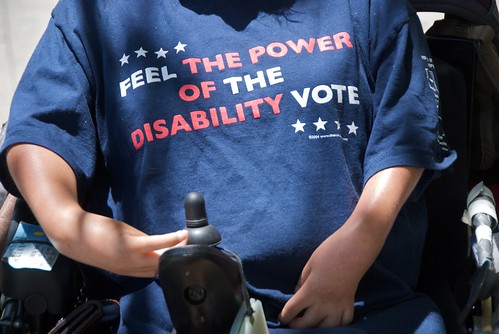
A person who is using a wheelchair and wearing a t-shirt that reads Feel the power of the disability vote

Image: “Feel the power of the disability vote – Protest of California health care budget cuts (2009)” by Steve Rhodes, used under a creative commons license.
Description: Person who is using a wheelchair, wearing a t-shirt that reads “Feel the power of the disability vote”

Don’t forget to submit to this month’s Disability Blog Carnival!

The Media’s Struggle with Disabilities

Restaurants, airlines, and other companies tend to struggle when it comes to dealing with a person with a disability. But one line of work we haven’t touched on yet is the media. And believe me, despite working in the journalism field, the media is not exempt from my disdain!

There are three phrases found in almost every article about a person with a disability. And each of these statements drives me up the wall. Let’s examine them individually.

In Michigan, HIV Positive no longer equals terrorist

For Smith, the fact that Allen was HIV-positive was like he was walking around with ticking time bombs inside of him, waiting to tear down people in his wake. By all accounts, it was a gross misuse and misapplication of the Michigan anti-terrorism law (even the authors of that law eventually criticized Smith for labeling HIV-positive people as terrorists), but for months Smith wouldn’t cave in to demands to drop the charges. He wanted Allen to be charged with bioterrorism, solely for living with HIV.

My Deafness Wishlist

We chatted about technology for a while and this eventually turned into useful apps for my iPhone in terms of my deafness and other things I’d like to make life easier in my Hard-of-Hearing World.

When we were talking though, my mind went quite blank, but now I’ve had a chance to think a little bit more about it, it’s made me resolve to start compiling my Deafness Wishlist – things I want changed or services I’d like to see.

I mean I know I write about them often, but perhaps if I put them all in one place, it’ll make it easier when I bump into VIPs on the bus…

So here we go

Meet the “New” Autism Speaks

But other research projects that Robison has been blogging about strike me as problematic. Take, for instance, this post lauding some new Autism-Speaks grants. Basically, it seems to me more of the same: research pushing for earlier identification, insistence on the centrality of “early intervention,” etc. What does this do for autistic people right now? I note that autistic children are already being identified at earlier and earlier ages. Why is it so vital that we keep pushing the age down? Does it really matter that much if we identify an autistic child at 22 months as opposed to 28 or 29 [months] for instance? I’m not convinced, and the endless repetition of the “early intervention” mantra is not a substitute for actual science which is willing to question supposed “truths.” Nor does this kind of research truly deserve, IMHO, the amount of money it is receiving. Where are the supports for older autistic people, as researchers rush to “identify” earlier and earlier?

Preventing tragic outcomes starts with us

The Province of Nova Scotia spends about 3.5% of its annually recurring health care budget on mental health, and a fraction of that on child and youth mental health services. This is in spite of the knowledge that about 3/4th of all mental disorders arise prior to the age of 25 years and increasing realization that early intervention and effective treatment may prevent substantial long and short term negative outcomes and yes, maybe in this case would have prevented such a tragic outcome.

Headlines:

Namibia: Women Petition Against Forced Sterilisation

“HIV-positive women are holding the healthcare system accountable for the wrongs done to them,” said Veronica Kalambi of the Women’s Health Network.

Kalambi said these alleged violations of women’s rights are in the context of a broader set of violations occurring against women at hospitals and clinics.

“People should have peace of mind that if they are HIV-positive, they can still go to the hospital and be treated with dignity and equality,” said Vicky Noa, who claims that she was sterilised in 2001. She organised the Ondangwa sit-in.

US: Winning Wheelchairs Kids roll to victory in special track meet
It’s a right of passage for so many kids: the end-of-year track meet where schoolmates race against each other. [I think this article is problematic.]

Teenagers face stigma of mental illness

Canada: School Moves Away From Coding Kids Classes integrate all types of students

Tucked in the city’s deep south near 42nd Street and 12th Avenue, it is one of 16 city public schools testing an innovative new program that mixes kids who have special needs into regular classrooms.

The two-year pilot project is part of an attempt to move away from “coding” students according to disability, then allotting funds based on the number of children with special needs.

Canada: No Taser on mentally ill: Lawyer This case is about the death of Howard Hyde in police custody in Halifax, NS. Here is an archive of news stories about the tasering case.

UK: Wheelchair ramble along Y Lôn Goed Gwynedd Council is supporting a joint project which arranges an annual programme of guided countryside walks for the less abled and wheelchair users – again this year the walks will visit some of Wales’ most fantastic locations.

Recommended Reading for Monday, June 7, 2010

A yellow button reading 'people want jobs: employment equity now!
Description: Bright yellow button: Disabled People Want Jobs! Employment Equity Now!

PSA: Opt-Out Required to Prevent Your Yahoo! Mail Contacts From Being Used for Social Network

Earlier this week, Yahoo! announced a plan to try to leverage its Yahoo! Mail users’ contacts into a social network of friends who will receive your Yahoo! Updates. Once the most visited website in the world, Yahoo! now ranks fourth worldwide, reaching about a quarter of all Internet users each day. Like Google Buzz’s ill-fated launch using Gmail contacts, Yahoo! wants to jump start its social networking plans with the hundreds of millions of people who already use its email and messenger services.

While Yahoo! made some effort to avoid the worst aspects of the Facebook and Google Buzz privacy controversies, ultimately the plan conflicts with two principles of the EFF Bill of Privacy Rights for social network users. The program will begin a roll out next week, and Yahoo! users need to opt out if they do not wish to participate.

Prayer will not cure my blindness

In the last two months I have been approached not once, but twice by young men who want to cure my blindness by praying for me. I must first tell you that as a non-believer, this made me very uncomfortable. To be nice I allowed the prayers to take place. Both times the young man was surprised that my blindness had not been miraculously cured.

Princess in the City [Please note comment rules before commenting at Seeking Avalon]

And just as I was beginning to understand the level of boredom and lack of focus that might lead individuals to think getting drunk is an amazing idea – It occurred to me, that Sex and the City is a 21st century fairytale.

To be specific, a 21st Century Fairy Tale for white, cis, het, currently able bodied western, North American, Christian leaning/familiar women.

Should disability be funny?

Should we laugh at disability? I’d like to make myself clear… I believe teasing, taunting and mean spirited gestures have NO place in our world. But is there such thing as “good clean funny”? Sarah Palin was outraged at Family Guy when the character Chris dated a girl with Down Syndrome, but Andrea Friedman, the actress who voiced the girl has Down Syndrome herself and is an advocate for people with disabilities. Friedman said herself she felt a good sense of humor is healthy and that she positively portrayed a person with a disability.

You can’t come in if you are a wheelchair user!

We parked up and had a look about and decide on somewhere to eat, I couldnt find a dropped curb so my OH and the lad went in first and were being show to a table and the chairs were being pulled out for them by a waiter when I entered, the manager told me I couldnt go in because they didnt have room for wheelchairs but Im welcome to sit outside!

I ask him why I couldnt go in, we dont allow wheelchairs he said, I asked why again, we dont have much room , I asked if he knew that was illegal and he said so what and I lost my temper after about 5 minutes of disableist insults, he said my Oh and lad were welcome but unless I could walk to the table I wasnt and either I sat outside or we all do we wernt welcome.

Headlines:

US: L.A. Unified to shutter 200 classes, campus for disabled students: The schoolchildren will be transferred to other classes, sometimes meaning longer commutes to other schools. It’s part of the beleaguered district’s attempts to deal with a $640-million deficit.

The Philippines: DepEd laments failure of House to ratify Special Education Act The Department of Education (DepEd) expressed its disappointment on Saturday after the House of Representatives failed to ratify the Special Education Act of 2010 due to lack of quorum during its last day of session last Friday.

Canada: Margaret Trudeau open about disorders Margaret Trudeau does not seem like someone who suffers from bipolar disorder, as she jokes candidly about dinners at 24 Sussex Dr., and speaks openly about meeting Prime Minister Pierre Trudeau and their life together.

US: E.C. Glass Graduating Senior Sees Past Her Disability Yes, this article is as bad as you think it is. The witty pun is totally because she is blind, and it’s so amazing that a blind person is graduating from high school. But I include it because people don’t really seem to think these articles exist.

Signal Boost: Questionnaire about UN Convention on Rights of Disabled

The European Network on Independent Living (ENIL) launches quick questions to ask what’s happening with the UN Convention:

Do you think the Convention will make a difference in the next 12 months? What do you think could strengthen the Convention? Have you seen any changes by your governments? Have you seen any changes around article 19?

Questionnaire

Plain text copies are also available contact d.pearson@enil.eu

I took the questionnaire. There are 22 questions, two of which want your to type your thoughts. It’s focused on EU countries, and asks about how you feel about your government’s ratification (or not) of the UN Convention.