Category Archives: normality

Assistive Tech & Pop Culture: “Miss Smith, without your glasses you’re beautiful!”

If you ever want to confuse people, tell them glasses are assistive devices that assist people with lower-level vision impairments, and then compare these assistive devices to such things as arm crutches or wheelchairs. In my experience, they’ll often insist that people who wear glasses are normal. (Not like people who use wheelchairs or arm crutches or any other type of assistive tech, no no, those people are disabled. And everyone knows you can tell who has a disability and who doesn’t just by looking at them, right?)

I’ll often introduce people to the idea that our image of what “disabled” looks like is constructed by talking about glasses as assistive tech, just assistive tech that is generally accepted by society. For a lot of people I interact with every day, getting glasses is routine, and you’ll see glasses everywhere on the street – advertisements for fancy glasses frames! and for new types of lenses! Glasses for everyone! (For certain definitions of “everyone”.)

At the same time, media & pop culture still use glasses as “code” – either for This Is Serious Work, or This Person Is A Nerd/Geek (and a particular type at that) or a scientist/doctor, or a Serious Scholar. This is true whether the person uses glasses all the time, or if they just use them for certain things. On Leverage, for example, when “the bruiser” character Eliot puts on his glasses he suddenly becomes totally sexy and I’d totally hit that because I’m shallow it’s usually an indication that his persona for the episode is Egghead/Nerd or Expert on something. Neal, who is a “recovering” con artist, does something similar in White Collar when he’s doing close-up nerdy-type work on his forgeries, or when his persona is “doctor”. I also clearly remember Elle Woods putting on her Serious Glasses and getting into her Serious Clothes for when she wants to be taken seriously as a lawyer in Legally Blonde. Glasses = Smart!

What brings this back to Glasses As Assistive Tech is that glasses are very normalized to people watching the shows, and yet glasses aren’t all the common as just a Thing The Character Wears in the show. I know why this is – glasses cause light-reflections, glasses make it harder to read someone’s expression on the screen, glasses can be dangerous in fight scenes, if they have lenses they can get scratched up and cause more problems, and if you’re not someone who wears glasses all the time I’m betting they’re distracting.

But, of course, movies and television aren’t the only media we consume. Comics, novels, and video games don’t have these problem. You can give every character in a novel glasses if you want, and it doesn’t really matter. And yet, when I was reading romance novels & chick lit all the time, I can only remember one heroine who wore them, and she went through the whole “Oh, but no one will find me pretty! Men don’t make passes at girls who wear glasses!” (And, despite her glasses being a huge thing in this novel, the cover art didn’t show her with them. Not that this is surprising, but still.)

So what does this have to do with anything? Well, glasses are assistive tech that is very normalized, and yet doesn’t appear very often in our media. When it does appear in our media, it’s often a code for something. This person is Smart. This person is Studious. This person in Playing A Role. This person is Eliot and his glasses make him really really hot omg why are there not more episodes of him wearing glasses and being friendly? And if we can’t see this incredibly common type of assistive tech in our media being used as just a Thing That People Wear, it’s no wonder we so rarely see people using assistive tech in our media just because Some People Are Blind or Some People Uses Arm Crutches or whatever.

Commenting Note: Sadly, I am still on Thesis Time, and likely will be until the end of the calendar year. Comment-approval/responding to will be slower-than-usual on account of this.

Recommended Reading for August 10, 2010

Wheelchair Dancer at Feministe: On the Cover [trigger warning for discussion of violence]

Regardless of how disability plays out in Aisha’s world, the vast majority of readers of TIME live in a culture that understands disability as tragedy. As shocking. As among the worst things that can happen to you (bar death). Mainstream American culture thinks it knows disability and knows how to read it. Ms. Bieber has a history of photographing disabled bodies[. . .]But the work she does in the Real Beauty series does not come through in this photograph — perhaps because of the context and placement of the image. Here she (and or the editor) uses Aisha’s disability to trade upon the readership’s sympathies and their horror: this and other unknown kinds of disability are a direct result of the US departure from Afghanistan. This is not about Aisha; it’s about the message of the article.

Cripchick at Cripchick’s blog: tell me who i have to be to get some reciprocity?

don’t feel the way white supremacy creeps into your life and plops itself in the center?

in the last wk, white ppl have:

  • told me how to rearrange my words as to be more approachable.
  • made my need to have ppl of color time about them.
  • asked me invasive medical questions about my body.
  • thanked me over and over for teaching them about oppression.

Cara at The Curvature: Disabled Student Assaulted on School Bus; Bus Driver Watches and Doesn’t Respond [trigger warning for description and discussion of severe bullying]

Most readers here who have ever ridden a school bus will have at some point been on at least one end of bullying and harassment. Many will have at different points throughout their childhoods and adolescences acted as both bullies and victims — myself included among them. Big news stories since I stopped riding a school bus have left me with the impression that little has changed. School buses are places where bullies, harassment, and violence thrive. And as all current or past school bus passengers know, students with disabilities, particularly cognitive or intellectual disabilities, are especially vulnerable.

Daphne Merkin at the New York Times Magazine: My Life in Therapy

This imaginative position would eventually destabilize me, kicking off feelings of rage and despair that would in turn spiral down into a debilitating depression, in which I couldn’t seem to retrieve the pieces of my contemporary life. I don’t know whether this was because of the therapist’s lack of skill, some essential flaw in the psychoanalytic method or some irreparable injury done to me long ago, but the last time I engaged in this style of therapy for an extended period of time with an analyst who kept coaxing me to dredge up more and more painful, ever earlier memories, I ended up in a hospital.

William Davies King at PopMatters: In Defense of Hoarding

To be sure, a special label like compulsive hoarding seems required by many of the heart-rending cases they recount, people neck-deep in the slough of their despond, overwhelmed by more whelm than can be weighed. But sadness and dysfunction are hardly rare or new. What is new is the social imperative to ram open that front door. Bring in the wheelbarrows, the commanding case worker, and the camera—especially the camera, which enlists us all in the drive to evacuate these cloacal dwellings. Reality TV rolls up its sleeves, puts on the rubber gloves, and hoards the evidence while [authors] Frost and Steketee stand alongside the labyrinth, notepad in hand, giving that Skinnerian nod.

Yes, I have a limp, and no, it’s not really any of your business

I have dealt with disability, in various capacities, for my entire life — this started when I was born three months prematurely and was affected by cerebral palsy (left hemiplegia, if anyone really wants to know) as a result.

I know what you might be thinking: You cannot possibly have CP, Annaham! CP is always severe.  It’s always noticeable to people other than the person who has the condition. CP always sticks out, blah blah blah, insert other sundry stereotypes about CP here (because there seem to be a lot of them).

And you’d be partially right, sort of like how my left leg is partially paralyzed. Oh, people notice my limp. Sometimes, they even point it out to me or concernedly ask about it, as if I am too stupid to notice that one of my legs is too short and that my left foot constantly makes a valiant effort to make up that difference:

“Are you okay? You’re limping.”

“You have a limp.”

“What’s wrong with your foot?”

“Why do you have a limp?”

Now, since I have no obligation to a.) respond, b.) educate these potentially well-meaning folks about my condition, or c.) give a shit, I have developed a coping strategy that works best for me, and it is to ignore these people and/or pretend like they might be talking to someone else. Surprisingly, it usually works, particularly when I do not care about seeming rude.

I don’t know what it is about certain bodies and the fact that some people feel entitled to treat said bodies as if they are public property. This body-as-public-property trope is commonly wielded at people with bodies that, through no fault of theirs, don’t fit the expected “norm” and who may be marginalized because of it: women, non-white people, fat people, trans and genderqueer people, people with disabilities, and others. And woe betide you if you fit more than one — or even several — of these non-normative categories, because then people might feel really entitled to comment on your body or its workings (or non-workings), if these things are at all apparent. In my fairly limited experience, it seems as though certain bodies and their parts constitute some sort of threat to an established order (in my case, this would be the abled order in which “normal” legs or feet do not have limps) that needs to be constantly pointed out and then monitored for the person’s “own good,” whether they are fat, disabled, unexpectedly gendered or not-gendered, or otherwise.

It seems vaguely panopticon-ish, and more than a tad creepily paternal: Hey, she has a limp, but she must not know it! We need to tell her for her own good, so that she knows and can maybe work on correcting it. No matter what the person’s intentions are (because these intentions may be sort of twisted “good samaritan” intentions), that’s the subtextual message that I get when somebody decides to inform me about my limp. Regardless of intentions, this sort of monitoring mostly ends up looking creepy and awkward for all involved. Some “good samaritan” may want to focus on my limp and how out-of-place or weird it looks, but just because I am out in public — limp and all — does not make the way that I move around (when I am not in too much pain to move, that is) any random stranger’s business.

AWP: “The Disabled”

  • Ableist Word Profile is an ongoing FWD/Forward series in which we explore ableism and the way it manifests in language usage.
  • Here’s what this series is about: Examining word origins, the way in which ableism is unconsciously reinforced, the power that language has.
  • Here’s what this series is not about: Telling people which words they can use to define their own experiences, rejecting reclamatory word usage, telling people which words they can and cannot use.
  • You don’t necessarily have to agree that a particular profiled word or phrase is ableist; we ask you to think about the way in which the language that we use is influenced, both historically and currently, by ableist thought.
  • Please note that this post contains ableist language used for the purpose of discussion and criticism; you can get an idea from the title of the kind of ableist language which is going to be included in the discussion, and if that type of language is upsetting or triggering for you, you may want to skip this post.

A month and a half ago I wrote a fairly angry email to Ms Magazine blog [which you can read here – yes, I sent it to them, no, I never got a response]. While part of my ire was raised by the subject matter and the treatment of people with disabilities as unthinking pawns of the “religious right”, a significant portion was because of the casual use of “the disabled”.

The short form of why this is a problem: People with disabilities/the disabled are not a collective group that all agree on anything. Asking what “the disabled” want or “the disabled” are doing is exactly like asking what “women” want and what “women” are doing. Women are individuals. Some of them are women with disabilities! We don’t all want the same things, but grouping everyone under the same umbrella, as though we are a Collective rather than Individuals With Opinions and Needs is… well, it’s pretty damned ableist, as well as being arrogant, ignorant, and irritating.

Long Version:

We’re still living in a society that makes a lot of casual assumptions about people with disabilities and their experiences. When people start talking about “the disabled” they are generally about to launch into some sort of stereotype – “the disabled are the pawns of the religious right”, for example. This boils down a lot of complicated people – people who have a wide variety of needs, wants, opinions, thoughts, and experiences – into one homogeneous group.

This contributes to the de-humanization of disabled people. “The disabled” aren’t people, they’re a big collective noun who can’t be reasoned with, can’t be talked to, can’t be considered – they’re just to be placated, and dealt with, and put out of our minds as quickly as possible in case they sue us.

Saying “people with disabilities” or “disabled people” may seem like a pretty minor thing. It is, so it shouldn’t be that difficult. The reason for it, though, is that it can be that small reminder: that people with disabilities are people. That disabled people have opinions and thoughts and experiences and needs that are not universal to all people with disabilities. That we are, in fact, people, and it would be nice if we could be treated as such.

Language doesn’t change everything. It isn’t an end in and of itself. But it can be the first step in combating the sort of ableism that makes it okay for many people – including editors and writers for major and minor news sources – to dismiss us as pawns without thought.

See Also: Disability Terminology: A Starter Kit for Nondisabled People and the Media by meloukhia at Feministe.

Recommended Reading for June 15, 2010

dhobikikutti (DW): This is also needed: A Space In Which To Be Angry

And what I have realised is that there is a sixth component to [personal profile] zvi‘s rules, and that is that complaining about and calling out what you do not like does help, slowly, painfully, get rid of it.

Every time I see friends who make locked posts about fic that Others them, that writes appropriatively and ignorantly and dismissively and condescendingly and fetishistically about their identities, I think — there needs to be a space where this can be said.

damned_colonial (DW): Hurt/comfort and the real world [warning: derailing in comments]

Writing a short ficlet in which someone who has been abused/injured/disabled/etc is “comforted” and feels better seldom bears much relation to the reality of abuse/injury/disability/etc. Which, OK, we write a lot of unrealistic things. The problem with this one is that the idea of hurts being easily cured/comforted is one that also exists in the real world and harms real people. Almost anyone with a real-world, serious “hurt” has had people dismiss and belittle their experience on the assumption that they “should be over it by now” or that “if you just did X” the problem would go away. People are often treated badly or denied care on these grounds.

Pauline W. Chen, M.D. (New York Times): Why Patients Aren’t Getting the Shingles Vaccine

“Shingles vaccination has become a disparity issue,” Dr. Hurley added. “It’s great that this vaccine was developed and could potentially prevent a very severe disease. But we have to have a reimbursement process that coincides with these interventions. Just making these vaccines doesn’t mean that they will have a public health impact.”

Trine Tsouderos (Chicago Tribune/L.A. Times): The push and pull over a chronic fatigue syndrome study

Nine months later, the joyous mood has soured. Five research teams trying to confirm the finding have reported in journals or at conferences that they could not find the retrovirus, known as XMRV, in patients diagnosed with chronic fatigue syndrome, casting grave doubts on the connection.

Kjerstin Johnson at Bitch Magazine’s Sm{art} blog: Riva Lehrer’s body of art

To Lehrer, who has spina bifida, “Disability and art are natural partners. In order to have a good life with a disability, you have to learn to re-invent your world almost hour by hour. You discover ways to re-imagine everything, and how not to take the average answers to everyday questions…”

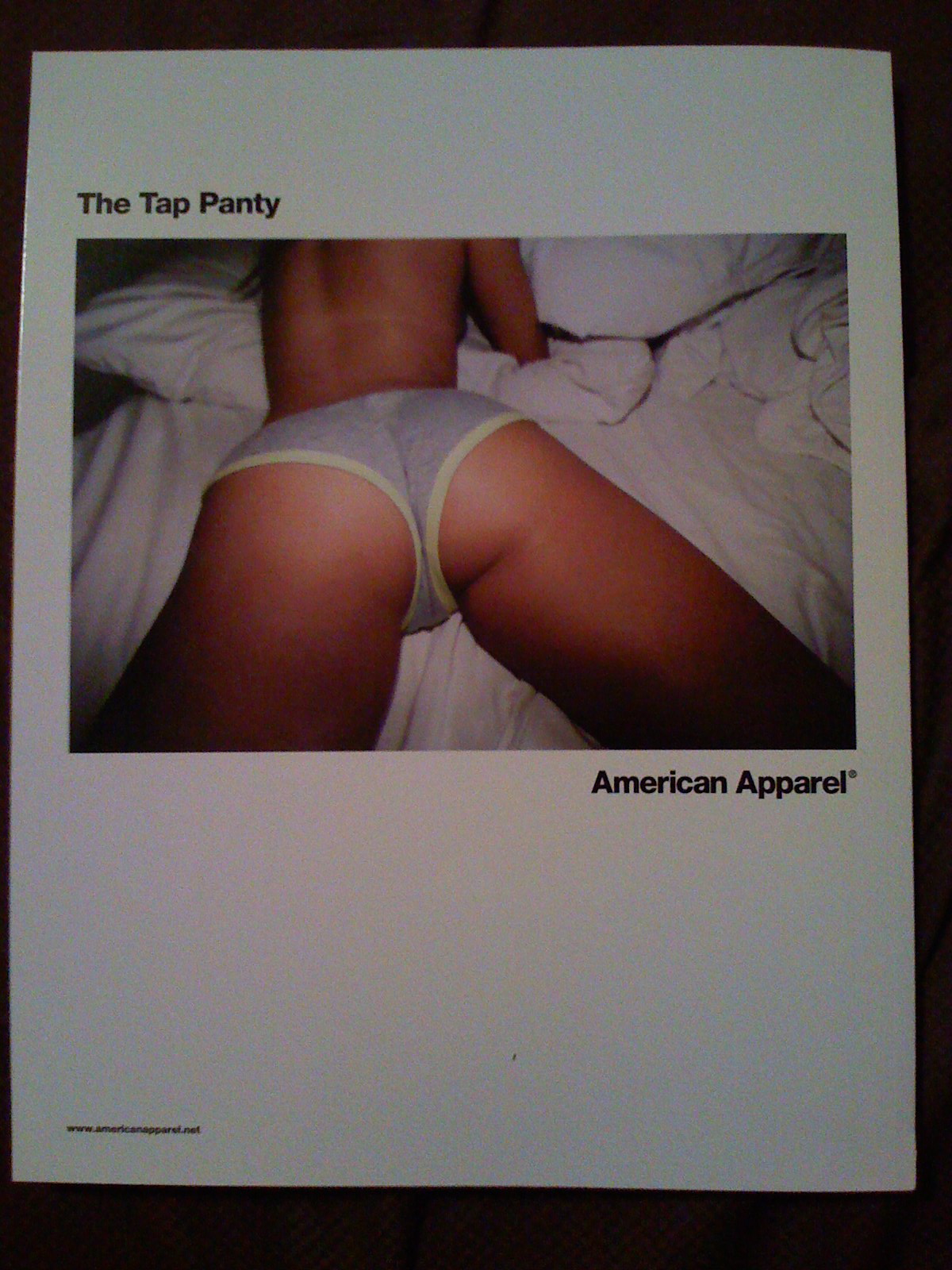
American Apparel, Meet American Able

Oh, American Apparel. For those of you lucky enough to evade their reach, AA is a good company with a lot of problems. They started out selling themselves as the sweatshop-free, made in the USA, source for cotton basics like t-shirts, primarily wholesaling to people who would print and resell the clothes. In 2003, AA got into the retail business and started aggressively developing their brand, largely through their … controversial advertising style and campaigns.

The ads feature “ordinary girls” who tend to be young and thin (they’ve been described as “pre-pubescent“), are mostly white, and are often nude and/or in sexually suggestive poses. It is heavily featured on their website and in their stores, and the store employees are selected to resemble the ad models. I don’t want to post any of the images here, but you can see some examples here, here, and here (NSFW? Potentially? I wasn’t even looking for bad ones – those were the first ones in the Google search.). I live in Los Angeles – where AA is based – and I can walk to at least two AA retail stores from my house. There are billboards and store displays and newspaper ads and posters of AA ads seemingly everywhere I look, and beyond that, I see the same style replicated in other magazines and videos and tv shows and …

So when I saw the photo exhibit “American Able” float across my tumblr dashboard this afternoon, I was really excited. The photographer, Holly Norris, explains the project:

‘American Able’ intends to, through spoof, reveal the ways in which women with disabilities are invisibilized in advertising and mass media. I chose American Apparel not just for their notable style, but also for their claims that many of their models are just ‘every day’ women who are employees, friends and fans of the company. However, these women fit particular body types. Their campaigns are highly sexualized and feature women who are generally thin, and who appear to be able-bodied. Women with disabilities go unrepresented, not only in American Apparel advertising, but also in most of popular culture. Rarely, if ever, are women with disabilities portrayed in anything other than an asexual manner, for ‘disabled’ bodies are largely perceived as ‘undesirable.’ In a society where sexuality is created and performed over and over within popular culture, the invisibility of women with disabilities in many ways denies them the right to sexuality, particularly within a public context.

The photos are amazing! They are spot-on emulations of the AA ad style, but feature Jes Sachse as a model. Sache, who in another amazing photo project explains that her spine was fused as a child, looks enthusiastic, playful, sexy as hell, and very different from AA’s usual TAB models. The photos are all copyrighted so I can’t embed any of them here, but I really strongly encourage you to click through and look at the whole series!

There has been some discussion of whether this art project “works”, in terms of making the intended point of mocking the original ads and portraying a woman with disabilities in a positive and sexualized context. I’m not sure that’s a concern for me – I can’t see these photos gaining enough exposure or distribution to cause any serious harm to PWDs, even if people do feel disgusted or upset at the images. For me, their true power is how they both quickly and precisely underlining the narrowness of the American Apparel view of beauty, while demonstrating that PWDs can be enthusiastically sexual. Ms. Sachse looks like she is having a blast, which also makes me happy.

What do you think?

Social Campaigns Based on Ableism

Via Information Aesthetics, a blog I read because i am obsessed with data visualizations and charts and graphs, I read about a new campaign designed by “eco-design consultancy Giraffe Innovation.” They’ve created a website where a user creates a humanoid form to represent themselves. The site then tracks the person’s environmental impact – things like home energy use and waste creation – and represents their individual environmental impact by modifying the humanoid form that represents them.

It’s when we get to the specifics of how the representative form is modified that I start to get uncomfortable. As the site describes:

The website shows the environmental impact of a person by using humanoid forms with body parts distorted relative to the environmental impact of common activities. Each part of the body is allocated to a different type of environmental burden: the feet correspond to the transport footprint, the hands to home energy, mouth to water, stomach to consumption, bottom to waste and the eyes and head to electrical consumer products.

Here is a sample image demonstrating some of the distortions:

A group of humanoid figures, seemingly sculpted from grey clay. The center figure is a "normal" man. The surrounding figures have distended bellies, exaggerated hands and feet, larger skulls, and protruding lips.

The whole purpose of the website, the underlying assumption that makes this a meaningful exercise to convince people to reduce their environmental impact, is that when people see these “distorted” human forms that represent themselves, they will be so horrified that it will motivate them to reduce their impact so they can again be “normal.”

There’s got to be a way that we can encourage and motivate people to be more environmentally aware without drawing from, relying on, and reinforcing these ideas about “normal” bodies.

The full site for the project is available here.

Guest Post from RMJ: Athletes with Disabilities: Arm-Wrestlers as Exceptions and Inspirations

Editor’s note: We are very pleased to host this post from RMJ, and will be featuring some more writing from her, and several other awesome guest posters, soon. FWD welcomes guest posts: please email guestposting [at] disabledfeminists.com for more information.

RMJ is a twentysomething with OCD who grew up in Kansas and currently lives in Virginia. She works in education and loves cooking, cats, and television. She blogs about feminism and stuff at Deeply Problematic. This post also appears at Deeply Problematic

Athletes with physical disabilities (hereafter AWPD) are a problematized group. Their accomplishments are questioned and devalued as less valid or challenging than those of able-privileged athletes. They are not party to the often problematic veneration of athletes in today’s society, nor are they permitted to participate in generalized sporting events.

Arm-wrestling is a sport, though, that seems to both accommodate and welcomes athletes with disabilities into their ranks. There is a specific subset of arm wrestling for athletes with disabilities that seem to be a regular part of official arm-wrestling tournaments. I don’t know much about the sport and I’m not currently physically disabled, so my perspective on this is far from authoritative. But my tentative reaction to this is positive, particularly since athletes with disabilities can and do succeed in general competition.

Larry Feezor is an athlete with disabilities who competed recently in the 3rd Annual U.S. Open Armwrestling Championship. He has used a mobility aid since a motorcycle accident paralyzed him from the waist down. This story from an Oregon television station makes Feezor the focal point of the championship. The story is pretty short and context is important to my analysis, so I’m going to reproduce it here in full:

FLORENCE, Ore. – The Third Annual U.S. Open Arm Wrestling Championship wrapped up in Florence Sunday, as amateur wrestlers took to the ring to battle it out.

One competitor stood out for beating the odds: Larry Feezor.

He has been arm wrestling for 18 years, traveling from Weaverville, Calif., to Oregon to participate in the competition. This sport is his outlet since he became disabled.

“I was involved in a motorcycle accident and a drunk driver ran me off the road,” Feezor tells KVAL. “I hit a bank at about 70 miles per hour, [and] was paralyzed from the chest down.”

Feezor received roaring applause when he beat his first opponent.

On Sunday he arm wrestled some of the strongest competitors at The Three Rivers Casino. And he wasn’t going down without a fight.

“Right after my accident,” Feezor said, “I told my father that I would fight, as hard as I could, for as long as I could.”

Feezor isn’t letting his disability bring him down. As a former athlete, he said his body may not be like it used to be, but his mind is stronger than ever.

“I am out here just like these other guys,” Feezor said. “I just happen to be in a wheelchair.”

Before I break this article down, I should mention its good points. It is wonderful that athletes with disabilities recognized. It’s fantastic that Feezor’s achievements are reported on in a positive fashion. Feezor is ostensibly framed as normative. The newspaper is using Feezor’s words and Feezor’s voice, rather than, say, his father’s.

However. Feezor’s participation is the only aspect of the tournament that’s detailed, and his accomplishments are not well-articulated. The singling-out of Feezor and complete erasure of any other athletes in competition is problematic because it trivializes Feezor’s competition in a sport. It implies that the sport is only notable for the inclusion of a person with disabilities – Feezor is not in a competition, but instead someone to be cooed over and patted on the head simply for participating. He’s not being applauded for his accomplishments, he’s being singled out because he “beats the odds”, whatever that means. If this were an angle in a story that clearly reported on the events of the tournament, it would be significantly less problematic. Feezor would be presented in the context of other athletes, and not just othered because of his disability and his marginalized sport.

An example of this is Joby Matthew, an Indian arm-wrestler, who has underdeveloped legs due to Proximal Femoral Focal Deficiency. Matthew seems to be higher-profile than Feezor, but increased coverage also means increased problems, particularly since it’s from the Daily Mail:

Who needs legs? Meet Joby, the 3ft 5in world champion arm wrestler who can bring down opponents twice his size

Instead of bemoaning what he lacks, Joby Matthew is using what he’s got.

Matthew’s accomplishments are not notable in this article: only his disabilities. I’m not quoting or going through the whole article because the able privilege is so dense. The first line is indicative of the attitude taken in the article: Matthew doesn’t “bemoan”, unlike those other people with disabilities who would surely be champion athletes if they just tried. The construction is an ableist implication that other folks with disabilities are lazy whiners. Throughout the article, every reference to barriers Matthew faced is immediately matched by emphasis on how he overcame this disability. The focus is not on his exceptional effort and achievements, but on the “heartwarming” “good cripple”.

There are a few good aspects of the article. It’s composed largely of quotes from Matthew, and it does make note of his many medals and of his training regiment (though that, of course, is as much focused on what he can’t do as what he can’t.) Matthew’s childhood athleticism is made a major point of focus, particularly his struggles in playing with other children. While I appreciate that the authors focused on quotes from Matthew, the focus on competition with currently able-bodied athletes frames participation in sports against currently able-bodied (CAB) athletes as the standard for athletic accomplishment for AWPD.

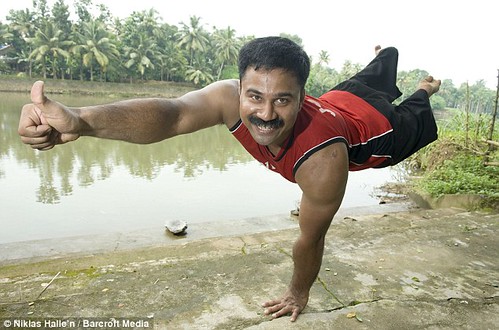
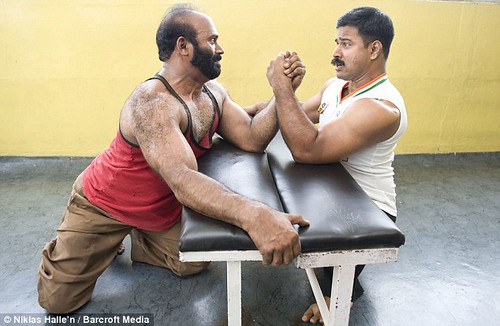
While I do not love the article, I loved these pictures of Matthew and am quite impressed with his accomplishments and his goal of climbing Mount Everest. Though the exceptionalist attitude makes the context problematic, these pictures are awesome:

Joby Matthew holds himself up with one hand while giving the thumbs-up with another. He is on the bank of the Periyar river on the outskirts of Ernakulam. He and his fantastic mustache smile broadly at the camera.

Photo: Joby Matthew holds himself up with one hand while giving the thumbs-up with another. He is on the bank of the Periyar river on the outskirts of Ernakulam. He and his fantastic mustache smile broadly at the camera.

Joby Matthew and an unidentified man arm-wrestle on a weight bench. The unidentified man, who has a beard and fully developed legs, grips the far side of the weight bench.  Both men are grimacing and neither appears to be winning.

Photo: Joby Matthew and an unidentified man arm-wrestle on a weight bench. The unidentified man, who has a beard and fully developed legs, grips the far side of the weight bench. Both men are grimacing and neither appears to be winning.

These photos highlight his exceptional abilities, and while his disability is present and visible, it’s a part of his athleticism. However, there are only two pictures in the eleven-part picture post that actually show him competing. Training and physical strength are interesting and relevant, but this is about sports: as with the article, the focus should be on his achievements as an athlete, not on OMG HOW DOES HE DO THAT? or OMG HE BEATS NORMAL ATHLETES?

The accomplishments of athletes with disabilities face a double bind. In most cases, they are ignored and erased; they are thought to be impossibility and a contradiction. When AWPD are covered in the media, it’s rarely a positive, normed framing of them as accomplished athletes with valid bodies. They are objects instead of curiosity; they are heartwarming inspirations for the currently able-bodied; they are not quite freak shows.

Moderator’s note: Moderation on guest posts is often much slower than “usual” moderation times.

Why SF’s Proposed Sit/Lie Laws Are a Terrible Idea

In San Francisco currently, there is something of a debate brewing about Mayor Newsom’s proposed sit/lie laws, which would make it illegal for anyone to sit or lie on any public curb or street in San Francisco (with a couple of exceptions).

The intersections with disability here are rather clear. For one thing, there are some intersections between homelessness and disability, because some homeless people are, for example, mentally ill or have disabling physical problems. Do either of these things make them unworthy of compassion, or not human? Of course not, but from the way this proposed ordinance is designed, it is, on a very basic level, criminalizing homelessness even more than it is already criminalized (not to mention socially stigmatized), while taking extra “common sense” steps to avoid citing non-homeless people for an offense. Observe the following response to concerns that SF police would begin to crack down on non-homeless people were the laws to go into effect:

During a heated, five-hour Board of Supervisors public safety committee hearing on the issue Monday, Adachi showed photographs of behavior that would be illegal under Newsom’s proposed law: a well-heeled tourist sitting on her luggage as she waits for a cab, a little boy sitting on a sidewalk clutching his skateboard, and tourists sitting on a curb and gazing up at the sights.

Assistant Police Chief Kevin Cashman said all of those people would be warned first to move and that none of them would probably receive a citation.

“Obviously common sense is going to be part of the training with enforcement of this statute,” he said at the hearing.

Ah, yes, “common sense.” Common sense, apparently, still makes the further stigmatization of homeless people de rigeur. Because apparently, they don’t deserve to sit down in public, unlike “well-heeled” tourists and neighborhood residents. I wonder what the response to a person with disabilities — tourist or not — needing to sit down on a public street might be? Someone waiting for an ambulance? While that is approaching a bit of a slippery slope argument (which I generally like to avoid), it is worth considering, simply because “common sense” will mean different things to different people — those whose job it is to enforce the statute included.

Also interesting is the framing of this ordinance in terms of concern for children. From one of the SF Gate articles:

Newsom, who bought a home in the Haight recently, was convinced to support an ordinance after walking along Haight Street with his infant daughter and seeing someone smoking crack and blocking the entrance of a business.

Certainly, children need to be protected from dangerous situations or potentially dangerous situations, but is an ordinance that criminalizes the poor and homeless — not all of whom are recreational drug users or addicts — really the way to do it?

Additionally, nowhere have I seen any plan to increase the number of homeless shelters or services for homeless people attached to this ordinance. The implicit message behind these proposed sit/lie laws seems clear: It’s too bad you’re homeless, but don’t you dare be homeless on our streets, because it might make our city look bad. Oh, and you certainly shouldn’t expect the city to help you not be homeless — even after it cites you for breaking the sit/lie law.

(Cross-posted to ham blog)

On refusing to tell you my name

In one of those things that some people will nod along to and others will be confused by, I deleted a bunch of accounts late Monday and locked up the other ones as tightly as I could.

Why?

Because someone I work with sent my private email address to someone else. The one that a quick search on any search engine leads to me, directly, with all sorts of things that can get me fired from my job or cut my chances of getting employment.

Specifically, I’m “out” online as being “crazy” [1. I like the term crazy. I embrace the term crazy. I tend not to use it too much online because I know that others don’t like it at all. But I’m crazy, and I’m okay with that.]. I’ve spent most of the past year blogging about having a mental health condition – one that I’ve referred to as being considered “dangerous” to have someone with around.

I’ve tried to be really careful about separating work-online identities. “Anna” is not the name on my ID, and it is not what anyone I work with calls me. Googling my government-ID name and my work-related email address gets you either people who obviously aren’t me, or an unused account on one of the “sort your books” sites. But googling my email address, my private one, leads you here. Or to my now-locked journal. Or to my now-deleted tumblr account.

This is one of the reasons why I get angry when people talk dismissively of those who choose to use pseudonyms online. “Oh,” comes the dismissive sniff. “You’re not willing to stand up behind what you’ve said.” Or “If you really believed that, you’d say it behind your ‘real’ name.”

Women like me – and so many other women and men with “hidden” disabilities, women and men who are trans*, people who are non-gender binary, who are bi or lesbian or gay, people who write about their struggles with racism or sexism or homophobia or bullying at work, people who are otherwise marginalized – risk losing their jobs, having their children taken away from them, risk being attacked in their homes or at work, having their children threatened, just for writing about their lives online.

There are all sorts of reasons people are pseudonymous on the internet. This one was mine. It’s not hard to find people with different, but equally pressing – and even more pressing – reasons for being pseudonymous.

I’m hoping I’ve been overly cautious. I’m hoping this person – who spent Monday sending me threatening emails to my work account – doesn’t notice he now has my private email address. I’m hoping that I look silly and stupid in a couple of weeks when nothing comes of this.

But I can’t count on it.

If you don’t see me posting much for a while, now you know why.

Related Reading:
Once More, With Misdirection
An Object Lesson in pseudonymity and internet privacy
On being a no-name blogger using her real name

Note: Any comments on this post are going to be slow to moderate. I won’t be publishing anything that attacks the person I work with, though, since that person is both not here to defend against such comments, and because I do believe it was one of those things where someone did something thoughtless, rather than deliberately malicious. The results are still the same, though.