Category Archives: bodies

Guest Post: Disability and Asexuality

Kaz is a German woman in her twenties, currently doing a maths PhD in the UK. She is on the autistic spectrum, stutters, and has been dealing with clinical depression on and off since her teens; she considers all of these disabilities. She is also aromantic-tending-towards-homoromantic asexual and identifies as queer. She blogged as Zailyn at WP for a while, but can now be found at either Dreamwidth or Livejournal, where she writes about fandom, disability, feminism, asexuality, and sometimes even maths.

Kaz’s note: First of all, this is not a 101-level post on either the asexuality or the disability side of things. However, I’m aware that asexuality isn’t really an issue that is on most people’s radars, so to anyone who doesn’t know much about it I suggest you check out AVEN in general and the Wiki in particular before reading or whenever you run into something that doesn’t seem clear.

Mod Note: Kaz & I talked and I’ve put in some links to terms as they come up.

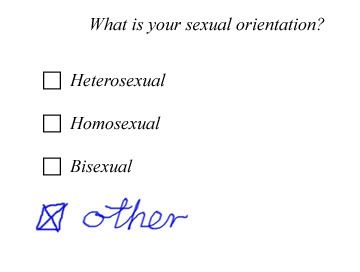
A list.  The header reads: What is your Sexual Orientation?  Typed underneath with check boxes is Heterosexual, Homosexual, Bisexual.  Written in, with a hand-drawn check box, is other.  The check box is filled in next to other

Talking about the intersection of asexuality and disability is pretty difficult, because “asexuality” gets another meaning in disability rights discourse: it’s used to refer to the various stereotypes about disabled people’s sexualities. People do often seem to realise that this is problematic when it’s pointed out to them. However, what not so many people realise off the bat is that it goes beyond just “problematic”.

The stereotypes in question actually consist of a wide variety of things tossed together, some of which are in line with asexuality but many of which seem to have little to do with asexuality or in fact to be entirely opposed to it (I am interested to see how the stereotype of the disabled woman not saying no because she feels lucky anyone wants her is supposed to relate to asexuality, for instance). What they have in common, however, seems to be: denying disabled people their sexual agency and the right to make decisions or have knowledge about their own bodies and sexualities. The stereotypes about disabled people’s sexualities seem quite in line with the common tendency to consider us childlike, helpless and needing to be protected for our own good.

Asexual adults? Are not children. Nor do we (or, at least, should we) lack agency. In fact, the very existence of the asexual movement shows that we are in opposition to a lot of these ideas! We’re organising, we’re campaigning, we’re demanding that our sexual identity should be recognised and considered valid; disabled people are stereotyped to not have a sexual identity at all. (There is a distinction between the lack of a sexual orientation and a sexual orientation incorporating lack of sexual attraction that most people miss, but that is crucially important in this context.) Taking all the stereotypes disabled people get hit with regarding sex and sexuality and claiming that they all boil down to making them like asexual people? Like me? Is something I actually find really offensive.

An example: the desexualisation of disabled people often gets used to justify giving them less extensive sex ed or no sex ed at all compared to abled people. However, saying this is because they’re stereotyped as asexual entirely misses the fact that – asexual people need sex ed too! At the moment, it’s true that a lot of us will probably need it less than most sexual people, but it is still necessary as a large portion of asexuals do end up having sex at some point in their lives. Also, if mainstream comprehensive sex ed ever gets away from the “put the condom on the banana” “tab A slot B” style of sex education and starts talking about things like sexual orientation, explicit consent, how to figure out whether sex is the right decision for you at a certain time, etc. – I’d argue that we need this kind of sex ed more than many sexual people, as being a sexual minority tends to lead to more confusion and needing to figure things out. (There’s a traumatic experience I could have happily avoided if sex ed ran more in this direction.)

Also, using the name of my sexuality for these stereotypes obscures the fact that actually, they have negative effects for me, too. For instance, there is an astounding amount of ableism in the arguments people use to try and invalidate asexuality, ranging from “you should get your hormones checked!” over “that’s a disability, not a sexual orientation” to “you’re just all autistic!” You can imagine how the last one feels to me as an asexual autistic person! Worse, parts of the asexual movement buy into this and will talk about how they’re not autistic, their sexuality is valid – unlike mine, apparently?

…hey, I recognise this argument! But wait a minute, we can’t very well call it stereotyping disabled people as asexual if it’s being used to invalidate the sexualities of asexual people.
Continue reading Guest Post: Disability and Asexuality

The Labor of…

Moderatrix Note: “The Labor of…” is a somewhat intermittent series to re-explore things in daily life taken for granted before living with chronic pain and/or disability.  This is a space to share experiences.

Dressing.

I was never, and am not now a fashionista by any stretch of the imagination or definition of the word.  I have had a wary and ever changing relationship with clothes throughout my life.  I have had phases of my life where I have loved them, like, in college, when various eating disorders whittled me down to a size where everything fit (in a manner of speaking) and I really didn’t have to think about it.  If I liked something I saw I bought it and that was that.  When I woke up I rolled out of bed and wore whatever I grabbed, whether it was going braless in a sweatshirt to my 0750 class, a work uniform I passed out in, something cute I had just picked up last week, or my favorite Guinness t-shirt, which has survived every phase and is hanging on my drying rack right now.  I didn’t have to think or care about any of it.  Hell, I didn’t even do laundry a lot of the time…I just bought new underwear and work shirts if I needed them.

I had phases where I hated clothes, for instance, when I was pregnant, and not one damned thing ever fit or was comfortable.  Maternity clothes are a cruel joke, and those jeans with the stretchy thing in the front are some deamon’s plaything, if you ask me, although no one did.  I did, however, find great amusement in maternity underwear, though I seldom actually used it (I preferred my non-maternity duds), but I digress…  The colors, the cuts, the materials, everything was wrong…and in the end I had one pair of pants and a pair of blue jean overalls that fit and I survived in those.  Somehow I escaped the whole experience with a great Kid and a few stretch marks that I would show you if you asked, but ask me about maternity pantyhose…and I will ramble on for about twenty minutes about how they are made of pure evil.  Did I mention that I hated being pregnant?

I had a phase for about four years where clothes mattered dearly, as in, the creases and cut and hems all had to be perfect, and I took immense pride in my appearance and great personal pains to maintain it.  I call that my Military phase, because it was, literally.  The difference between a Good Sailor and a Hot Shit Sailor who got noticed was hir uniform, and I had mine down, all six standard issue Navy uniforms (this was before the new roll out of NWUs).  I was too poor to afford the dry cleaning that all my peers used and it worked to my advantage.  I spent great swathes of time carefully creasing my shirts and trousers and steaming my skirts.  I hand sewed my own rank patches on the sleeves because I trusted my work, and soon my friends were asking me to do the same.  My gig-lines were perfect and my boots and dress shoes mirror shined every wear.  I kept my combination cover in the box to keep it clean and well shaped and kept a spare dome for it in my glove box wrapped in plastic just in case (along w/ a neckerchief, and a shoe shine kit).  I had nail clippers in my purse for stray threads and a sewing kit for loose buttons.  Since most of my male superiors didn’t know female uniform and hair standards I made it my pet project, and I had a reputation at my “A” school for knowing my shit come inspection time.  My massively thick hair was always secured well withing regulations so that at any time any female sailor could see my example, and the “kids” fresh from boot were sent my way for guidance.

That thing, I held dearly until my body turned on m, and my health made it impossible for me to maintain that.  As the pain grew I was unable to maintain my physical standards, and my uniform standards became more difficult to keep up with.

Now, dressing is a laborious effort, but for an entirely different reason.  Practicality demands that I think about each and every garment that touches my person.  Is this cut going to pull on my shoulders and give my neck a strain and trigger a migraine?  Is this sports bra going to do the same?  If I go without one will it hurt my back too much?  I have to examine the seams along the toes of my socks to determine if I should wear them inside out, or if it is OK to wear them the “right way”, so that the seam doesn’t hurt my toes (a trick I learned from my diabetic grandfather).  I have to consider the weight of pants on my shins for high pain days, and the tightness of undergarments around my joints.  Even my wedding bands sometimes have to be set aside when my fingers are hurting.  My feet have always been wide, but even the widest shoes will still rub my feet raw on longer walks which makes buying shoes difficult (and sometimes expensive), since my beloved Crocs and Birkenstocks aren’t always practical for all weather.

Fabric is a concern as well.  I tend to break out in rashes at odd times, and for no medical reason we can determine, so I have to make sure that the fabric isn’t harsh on my skin today, and sometimes I have to change my clothes two or three times before I figure out what I can tolerate.  Oh, yeah, and did I mention how many spoons it takes to get dressed just once?  Sometimes getting dressed for public consumption means that my only activity for the day was getting cleaned up and dressed for said occasion.  Sometimes that means that I might have to choose between the shower or getting dressed at all.

How I wash the clothes matters.  The detergent and fabric softer need to be gentle, and at any time my skin will decide it doesn’t like the one I am using, again, for no medical reason we can find.  I have circulated through as many “free and clear” as I can find, hitting all the “natual” ones in the way.

Getting dressed has moved beyond practical for me.  The formerly simple act of covering my body somehow became a great labor, one more thing to take my time and my spoons.  Not exactly a fun thing to admit for the fashionably inept, who would rather just pull on the first thing she grabs, and who never really understood why “you can’t wear those shoes to the bar” *shurgs*.

Getting It Wrong: Rate Your Students and Ableism

[Possible trigger warning for upsetting and ableist language]

As some of you may know, I am a graduate student getting my Master’s Degree in Women and Gender Studies. I currently have vague career aspirations of getting my PhD or at least remaining in academia in some capacity; my academic interests primarily have to do with feminist disability theory and the body.

I was an undergrad when I discovered Rate Your Students, a blog for college professors and TAs to rant, with anonymity, about the wonderful world of academia–including its apparent hordes of clueless undergrads. I can’t quite remember how I stumbled upon it, but I found it very refreshing. I was probably what the RYS denizens would call a “special snowflake”, or “snowflake” for short–that is, an overeager student who is convinced of zie’s own specialness (however, my low self-esteem may negate such a categorization)–but I found the site a welcome break from dealing with fellow undergrads at my school, many of whom, I felt, fit the “snowflake” categorization perfectly.

Given my disability and resulting limited energy, during this time I was  privately contemptuous of those whom I percieved to be slacking and getting away with it, particularly when I was assigned to work with them on group projects or in discussion cohorts. Inevitably, I would be the one who led the group in discussion–even when I had been the only one to have done the reading–or the one who would do most of the “group” project planning and resulting work. I do not say this to toot my own horn; this information is meant to be context for the reasons that I started reading RYS in the first place.

After this week’s posts on accommodation(s) for students with disabilities, however, I am seriously rethinking my earlier enthusiasm for the site. One professor sent a query to the other readers of the site:

How do you teach a student…who clearly has severe intellectual developmental issues? How do you make sure the other students aren’t held back? What if your course is a small seminar course, not a large course? You have to spend a lot of one-on-one time with one at the expense of several. Why doesn’t the university provide resources for you and this student?

Am I bad teacher for not knowing how to deal with this? Or for not wanting to?

The responses are a motley bunch (the [+] markers denote different responses from different folks), ranging from the awesome to the somewhat reasonable to the awful:

Anyway, I don’t think too much of students who come to me with a letter demanding time-and-a-half on tests. Nor do I pity the poor fucktards when I think of their asking a future boss for time-and-a-half on a project. There are some students who are truly disabled, and truly need accommodations. But ADD is a sad joke. It puts us at the beck and call of every spoiled tool whose parents can find a quack to label the kid as ADD.

I am an academic. I am also a person with disabilities. I know, furthermore, that “difficult” students exist, and in some cases, universities do not provide clear policies for faculty when dealing with students with disabilities. Professors, however, are not usually assigned to be the disability police, and with good reason (see above). From the glut of postings on this topic, the message that I am getting–as a person with multiple disabilities, both physical and other–is that I do not belong in the academy. People with severe emotional or mental health issues, apparently, do not belong in the academy because they freak out the “normal” folks. Furthermore, if I choose to disclose my disability to faculty, I may be subject to disbelief and doubt, due to their past experiences with disabled students. Hell, someone might even rant about me on RYS if I piss them off enough!

I respect the fact that RYS is a site for professors to anonymously vent; all of us need those spaces. Some of us, however, are both hopeful professors and people with disabilities.  Privileged displays of ableism like the above are asking some of us to side against our own, which many of us cannot do.

Quiz: Representations of Disabled Bodies in Logos

disabledlogo

Most disability logos just consist of the usual stick-figure-in-the-wheelchair logo, or a derivation thereof.

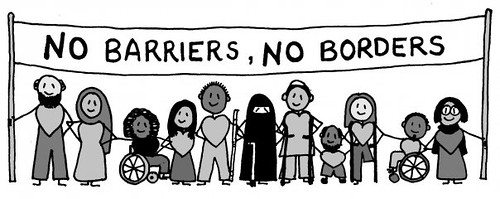
After spotting this logo for No Barriers No Borders, I went looking for others. And I got to thinking about the representations of disabled bodies in logos.

row of variously-dressed smiling cartoon people under NBNB banner, standing, sitting in wheelchair, with cane or crutches

I set aside those images dealing with sport, and those not including any representation of a PWD’s whole body. Here are a few typical samples of what I was left with. I haven’t cherry-picked; I mostly just grabbed from the first few pages of a Google Images search.

My question to you is:

What do all of these logos have in common?

Continue reading Quiz: Representations of Disabled Bodies in Logos

Invisible Illness and Disability Bingo 1.0

Author’s note: This is a revised version of a bingo card that I made some time ago.

While I don’t feel like I should be required to justify the lowermost right square, there was some confusion and pretty ooky pushback when I posted version 1 on my own blog. I’ll explain that square anyway, for CMA purposes: I am aware that pot works for many people with chronic pain, and personally have no issue if people other than myself use it. I’m an advocate of finding what works for you; whether it’s a pill, plant, pilates-esque routine, or something else, your course of pain management should be your choice.

What I am referring to with this bingo card — as a whole — is the commonplace, rather irritating tendency of some able-bodied people to suggest — without knowing about the medical history of (or, indeed, much about) the person they are “trying to help” — remedies or treatments that may be totally inappropriate for that person, due to various (personal) reasons. In short, what works for you may not work for me, and vice versa; how I wish I could have articulated this to the folks who have “helpfully suggested” that I smoke pot or obtain other illegal “meds” to help with my pain!

Okay, explanatory note/rant over. Onto the bingo card! I hope you all have your chips ready.

Special thanks to Ouyang for suggesting the “Diet and Exercise!!1” free space.

annaham-iibv1

Text translation: card has white text on a black background. Title (in white) reads, “annaham presents: Invisible Illness Bingo 1.0,” followed by “Now With Straighter Lines” in red:

First Row, Square #1: All that’s keeping you from being healthy is a positive attitude!

First Row, Square #2: My ex/friend/co-worker had that, but he/she was just a hypochondriac.

First Row, Square #3: Maybe if you lost weight/found a man/read The Secret, your problems would be solved.

First Row, Square #4: Why can’t you just suck it up, get out of bed, and find a job like the rest of us?

Second Row, Square #1: Lucky! You get to stay in bed all day.

Second Row, Square #2 (middle square): Free Space/DIET AND EXERCISE!!!11

Second Row, Square #3: You don’t look sick/you’re just complaining too much

Third Row, Square #1: Obviously, you get something out of being sick. Otherwise, you’d get better!

Third Row, Square #2: If I haven’t heard of it, then it doesn’t exist.

Third Row, Square #3: But I went through hard times too, and I got through it. Let’s talk about what a great person I am.

Third Row, Square #4: You have it so much better than some people! Think of the starving children in Africa…

Fourth Row, Square #1: Let go and let God/Power of prayer/God is punishing you

Fourth Row, Square #2: You just want an excuse to be lazy and have people pity you.

Fourth Row, Square #3: Why haven’t you tried crystals/vitamins/other dubious “cure”? IT REALLY WORKS!!!

Fourth Row, Square #4: Smoke pot/take illegal drugs. It will totally take care of your pain, man!

Also posted at Ham.Blog

How to Be a Good Doctor

Update: It was pointed out, correctly, that part of this post contained a statement that made a generalization based on age. That statement has been removed and the post updated with this message. It’s not feminist, and it doesn’t belong here. I’m sorry.

I actually had a really good experience with a physician recently. Like outstanding. With a specialist even — an endocrinologist, so if anyone in the northeast Texas general area needs one, I can recommend him without hesitation. I was kind of nervous; I’d seen an endo before when I was starting my transition but stopped because he was a really huge jerk. (My GP wasn’t entirely comfortable with writing scripts for hormone replacement but has been willing to for a while now. She’s also recommended and trans- and queer-friendly.)

Accessibility was poor to okay: I could have done with a chair by the reception window while waiting for them to copy my ID and insurance card. To get from the curb cut by the reseved parking to the front door, one has to go down the sidewalk across the front of the patio to where the ramp up the patio is. At least three cars were parked so that their noses stuck out over the sidewalk. If you couldn’t squish down to 18″/46cm wide, you couldn’t get through there. The doors were all unpowered and the front doors were on the heavy side. I didn’t see Braille signs at all. There was, blessedly, no music and no TV in the waiting rooms. The exam room was freezing; fortunately for me I’m tall and the ceiling was low and I was able to close the air conditioning vent but that’s not a widely available option. There were wide spaces around the furniture in the waiting room that looked like they’d easily accommodate wheels and other assistive devices. Some of the furniture was squishy but some wasn’t and the non-squishy furniture had arms to push up with.

They got to me right about when my scheduled appointment was. They weighed me, measured my height — 202lbs/91.5kg and 5’11 3/4″ (yes, they really measured me to the quarter inch ((sheesh)) and yeah I’m that tall — people comment constantly on how nice it must be which it kind of is except when I’m trying to buy clothes: for all that they love models my height designers apparently don’t believe women don’t come my size and shop at Target)/182cm — with my boots off, and they did bring me a chair for getting them on and off without my having to ask for one.

We waited in the exam room less than ten minutes. Maybe five. The office had mailed me a new patient packet with all the usual stuff to fill out (and the usual uninclusiveness of gender- and sex-variant people on the form, sigh *tick* F). The doctor apparently had spent the five minutes reading and absorbing it because he came in and introduced himself and greeted the wife and me as Mrs. and Mrs. Brown. It felt really good because NO ONE DOES THIS even the people who know we are legally married. Holy shit. The wife explained that I had an autism spectrum disorder and was not having a good day communication-wise. Also that even though I was not talking much today I was plenty smart (which is a construction I’m unfond of) and could understand doctor jargon (this I’m fine with — it’s a skill, not a definition of a person). He told us that on Mondays he had a resident following him around and would we mind if he joined us for the exam?

I’ve had doctors ask this badly before. Often it’s with said resident already present so refusal is an explicit personal rejection and difficult for even a lot of neurotypical folks, never mind those of us with moderate to severe social anxieties. This doctor asked it with the resident on the other side of a closed door. It really actually felt like I could have said no and it would have been okay.

He liked that I had typed up a list of all my surgeries and meds, the dosages, the schedules for taking them, and what they’re for — it’s a long list, twelve prescription meds total — and expressed sympathy that I needed them all. Even though my wife was helping me communicate, he mostly spoke with and to me. Once when he was looking at his notes he missed that I was nodding in response to his question and he apologized for not watching to see my response. When he was working out what labs to order, he noticed what insurance we had and apologized that we couldn’t use the lab in his office but would have to go to the one (not far away) that our insurance company had a contract with or we’d have to pay for the lab work. A DOCTOR. I’ve never run into one that noticed this stuff before, never mind knew what to do with our insurance company.

In short he seemed to be respectful of all the ways I was different: physically impaired, neurologically variant, queer, trans, everything. And genuinely respectful, too, not in that fake-ass “I don’t see the ways people are different from me” bullshit. [Age-based generalization removed by the author.] It was a really nice part of what’s been a string of mostly crappy days.

I’d really rather not have anything endocrinologically jacked up (and given the pattern of other Stuff that has been tested for, I’m not expecting that anything will be very wrong here either). But if I have to have something like that, I’m glad I know who to go to. ‘cos expertise is one thing. Respect like this — on the first time seeing me, on one of my bad days? — is rare. I wish I could drag all the bad doctors I’ve been to and gritted my teeth through seeing to make them watch this young man do brilliantly with a patient who is admittedly not exactly the most conformative person ever and yell “See? This is how you do it! This is how you make all your patients feel like you care about them.”

Cross-posted at Impermanent Records.

Law & Order: “Dignity”, Worth, and the Medical Model of Disability

As a feminist, I am pro-choice. Abortion should be safe, legal, and accessible.

As a feminist, I look at more than whether single, individual women have access to abortion. There is a much broader reproductive justice framework that must be scrutinised, critiqued and repaired so that all women have access to informed, supported reproductive choices.

Women who have been denied informed, supported reproductive choices in the past include more than the wealthy, non-disabled white women who dominate pro-choice conversations. Marginalised groups are as likely to be fighting for their right to reproduce as their right not to – people of colour, trans people, lesbians, and of course women with disabilities, who have been denied sex education and forcibly subjected to contraception and sterilisation for centuries.

To that list of marginalised groups, of people who are often denied truly informed and supported choices, we can perhaps add – people pregnant with fetuses who may have a prenatal diagnosis of a disability.

As a feminist, I believe that we can have the abortion-rights conversation without marginalising, othering, and disparaging people with disabilities. I believe we can talk about abortion within that broader framework of reproductive justice, and that we can confront the ableism that creeps into some abortion-rights conversations head-on. This takes effort; we must think clearly, write carefully, read closely.

Yes, some forced-birthers will try to appropriate our words for their own ends. We need to remember that they are responsible for their own misreadings and misrepresentations, not us. We need to not let their twisted, misogynist agendas control what we say. They must not stop us from speaking out.

Law & Order, “Dignity”

So, guess what I did today? I swallowed my intense dislike of popular TV crimeporn show Law & Order, and watched episode 20×05, “Dignity”, in which a bloke murders a doctor who provides abortion services, to “save” his daughter’s fetus, diagnosed prenatally with Ehlers Danlos syndrome.

Before we start, a little background on Ehlers Danlos syndrome (EDS). EDS is not one condition; it is a heterogeneous group of conditions caused by differences in genes coding for collagen proteins. Collagen is a key ingredient in all connective tissue, including skin and ligaments. The commonest EDS types manifest primarily as joint hypermobility or as very elastic skin. EDS often goes undiagnosed until adulthood, or completely undiagnosed throughout life.

There is a very, very rare variety of EDS called dermatosparaxis which involvs fragile, floppy skin and easy bruising; there have been ten published case reports of this variety worldwide. Within that group, the severity is still heterogeneous – check out this blog Sense and Disability, by a woman with dermatosparaxis who has studied at Oxford and backpacked through Europe.

Let’s have a look at the episode. I’m not going to go into a detailed recap; you can check one out here at All Things Law & Order: “Law & Order “Dignity” Recap & Review”. The case is a ripped-from-the-headlines story with many details closely resembling the terroristic murder of Dr George Tiller, one of a half-handful of late term abortion providers in the USA. The show adds a number of details that appear designed to showcase forced-birther ideas, such as the invented detail that the slain doctor had in the past murdered a live newborn. The murderer’s defence argument centres around the idea that he is trying to save a fetus from the abortion that his daughter has scheduled.

The fetus in question has apparently been diagnosed with Ehlers Danlos syndrome (EDS). At first, oddly, we’re told that it has “Fragile Skin Disease”, which typically refers to a completely different set of keratin-related conditions, epidermolysis bullosa. The show does not elaborate on how the EDS was supposedly detected (prenatal gene testing is not routine), or the fact that EDS is heterogeneous and that people with EDS vary widely in phenotype, or, well, any other facts, really. We just get this:

[clips, transcripts and a lot more discussion are below the cut]

Continue reading Law & Order: “Dignity”, Worth, and the Medical Model of Disability

Disability and Sexuality 101, or, Do disabled people have sex?

Of course! That is, some of us do, but there’s nothing about disability that means we don’t ever have sex. As with any other group in society, some of us are sexual and some of us are asexual. Some of us are celibate, some of us are in steady sexual relationships, some of us like a one night stand. Which is to say, we’re far from being a sexual monolith! (… as it were.)

The reason PWD aren’t considered as sexual – particularly “visibly” disabled PWD – is that the idea of “the perfect body” as the only sexual body dominates popular discourse. Additionally, we have the stereotypes of PWD as pathetic or stoic, far removed from the sexual. Not to mention the fact that disabled people tend to be shoved away from the general public. This idea is not due to some inherent aspect of disability that negates sexuality, it’s just bigotry. The lack of recognition for PWDs’ sexuality has meant, less so in recent years, that a lot of PWD aren’t given appropriate sex education. Without proper sex ed, it’s harder to take charge of one’s own sexual life and body. This lack of information has its role in enabling the high rates of abuse against PWD. There is a lot of horrific policing of the bodies and sexuality of disabled women in particular, as you’ll read about on this blog in less 101-type discussions.

When those PWD who are sexual are seen as such, it’s often to the exclusion of many modes of sexuality. Remember, disabled people, like non-disabled people, have all sorts of sexualities that can change throughout life. We can be queer and straight, poly and mono, kinky and vanilla (which is not to say that all of those are exclusively sexual identities, either). Not everyone is into or can have PIV intercourse, and all kinds of sexual activity are as legitimate as the participants consider them to be. And, of course, implicit in the question ‘Do disabled people have sex?’ is the question ‘Do disabled people have partnered sex?’ As such, that’s the question I’ve been answering, but it’s best not to forget that masturbation is fun, too!

There’s another myth that PWD only have sex with other PWD. This is based on the assumption that no one “normal” would want to have sex with someone who doesn’t fit into rigid norms. Sex isn’t just for young, white, abled, straight couples, no matter what TV tells you. Of course, the idea that sex with disabled people isn’t ideal means that it’s sometimes harder for disabled people to find sexual partners. To which I say, people with that kind of bigoted attitude are missing out on some really great sex.

Disability often influences a person’s sex life, as it does many other aspects of life. (Not to mention framing disability as this overarching barrier to sex obscures the fact that, you know, other factors have their role in how and if a person is sexual.) Pain or fatigue or physical features, for instance, can have an impact, but that doesn’t mean PWD are never sexual. Because there are so many different types of disability – and some people have multiple disabilities – there are lots of different changes PWD and their partners might make to make sex possible, easier or just more fun. This could include clear communication when a partner has an anxiety disorder, assessing which positions are most comfortable with a particular body shape, adapting sex toys for people with limited motor control and a whole range of things.

Disabled people’s sexualities exist, and are quite as varied and wonderful as those of non-disabled people.

Depending on narcotics

IMG_0172I take six medications. Five of them — the antiepileptic, the antidepressant, the non-narcotic pain killer, the muscle relaxer, and the oral contraceptive — are covered through a mail-order service. I receive a 90-day supply in my mail box every three months. No hassle. If a prescription runs out, my doctor is notified electronically, he then sends the new script electronically, and everything proceeds as normal with absolutely no additional step required of me. The only thing I do is click on the check-out button on the web site every three months. That’s it. No calling. No physical piece of paper to pick up. No wait at a retail pharmacy. Just a click and several days’ wait.

There’s one other medication I take. That medication serves the exact same purpose as all five others: it relieves my pain so that I can get on with my daily functions. I take it regularly, just like all five others. I have been taking it regularly for over five years now for the same reason. But this medication is not covered by the mail order service, because it is not considered a “maintenance medication” — despite that it fills the exact same maintenance role all five others fill, just by a different mechanism.

So for this medication, I am only allowed a 30-day supply at a time, and no refills — a brand new script each fill, which requires my doctor’s input each time. I have to call my doctor no sooner than the exact day it was filled last month, unless it falls on a weekend in which case I might get away with calling up to 2 days early. Then I have to call back a couple days later to see if the script has been written. If it has, it is printed out, and I have to physically walk in to the office, stand in line to see a receptionist, have them take a copy of the script with my photo ID, sign and date the copy, and walk out with the script. Then I have to physically take it into a retail pharmacy, wait in line, hand it to the pharmacy technician, then wait the required time for it to be filled. If there are no problems with my insurance, I then must physically present myself and pay for the prescription. Then I can walk out the door with my medication.

(And this is the process with a doctor who’s relatively friendly about the matter.)

It is quite a different process and one overflowing with “veto points” — points at which any party involved can cause any sort of problem and stop the whole process up. Maybe my doctor is on vacation and won’t be back for two weeks. He is the only one in my clinic who will write this script. I can’t call earlier in anticipation of his absence; they will not write the script before the last runs out. In that case, I’m stuck until he comes back. Maybe the system spits out some sort of error, like the one I received today: I was told the script must be written by my original prescriber. Which is this doctor. So now they have to go back and ask for the script all over again, and he isn’t in til tomorrow, and it’s not guaranteed to go through smoothly then. There have been other errors.

Maybe the insurance says no. For any number of reasons; I’ve dealt with prior authorization errors, quantity limit errors, errors because my insurance has suddenly decided to list me as living in an assisted-living home and cannot fill a prescription if I am. Maybe the pharmacy hits a snag, like the time they would not fill a written prescription until 2 a.m. that night because the insurance company said so, even if we paid out of pocket without billing the insurance.

And I’m going to keep running into these issues, and I will run into new errors every few months. I may have solved the last problem, but there’s always something new to pop up. I can never rely on this medication being filled on-time. It simply does not happen the majority of the time. No matter how diligent I am, how patient I am, how clearly and politely I explain myself — or how despondent I get, how emotional I get when telling them but I cannot work without this medication, and I don’t have leave on this job, and I can’t afford to be fired for missing work. Or whatever other pickle I’m in at the moment. It doesn’t matter. I do everything right and there will still be regular problems in getting my medication filled on time.

I’m sure, by now, you’ve figured out that this particular medication is a narcotic pain killer — hydrocodone (generic for Vicodin). I take it for chronic pain. I have been taking it for over five years this way, with the doses varying between one-and-a-half per day and three per day. And the only medical trouble I have ever had on it is when there was an excessive delay in refill during a bad pain flare and I got to go through the withdrawal for two weeks. (And I can tell you from experience: hydrocodone withdrawal is nothing compared to Effexor withdrawal.)

Narcotic pain killers can be a valid option for chronic pain patients. They fill a void left by other treatments which still aren’t effective enough to address our symptoms, which can easily be disabling. As you can see, I take plenty of other medications. But if I want to be able to get up and do something, I still need the pain relief the hydrocodone provides. So I take it. Because I like to be able to get up and do things. Like make the bed in the morning and feed the cats and make myself lunch and possibly run errands. Or — you know — work. Those silly sorts of things.

Here’s the thing, though. In both common culture and the medical industry, chronic pain patients who take these medications to be able to perform everyday, ordinary tasks that currently-able people take for granted — like bathing or showering or washing dishes or dropping their kids off at school — are still constructed as an addict just looking to get high.

You could almost kind of expect that for the narcotics. Most people do not understand the distinction between addiction and dependence. (Which is, basically, the distinction between taking a medication for a medical purpose so that you can go on living your everyday life, vs. taking a medication when you have no medical need so that you can escape from your everyday life.) This distinction exists for a reason; developing a tolerance for a medication is not a bad thing in and of itself, and must be weighed against the benefits that medications brings to the person.

Addiction calls to mind, though, a life being torn down. Addiction calls to mind a person who is seeing the detriment of a drug outweighing the benefit. A person whose life is falling apart because of the drug.

A chronic pain patient taking a narcotic pain killer under the close supervision and guidance of a knowledgeable doctor is exactly the opposite: sie is a person whose life is coming back together because of the drug.

But this image is not easily shaken in people’s minds. And so the chronic pain patient is reimagined as the addict. Hir behaviors are twisted to fit the common conception of the addict. If sie ever lets out a drop of disappointment at having problems with accessing this medication which is helping to put hir life back together — that is seen as drug-seeking behavior. And if sie lets out any sort of relief at the feeling sie experiences after taking the pill and having the crushing weight lifted from hir muscles — that is seen as “getting a high.” Heaven forbid sie show any emotion beyond just relief — like perhaps pleasure or happiness — at being able to perform everyday functions again. And any moodiness or other undesirable behavior can be easily attributed to hir “addiction.”

What’s strange, I notice, is that this reimagining is applied not only to chronic pain patients who take narcotics — but to any chronic pain patients who takes any pain relieving drug.

Take, for example, the anti-epileptic I take. It is not a narcotic. It cannot be abused — that is, if you do not have a neurological pain disorder, it will not do anything for you. You can’t use it to get high, get low, or get anything — except a couple hundred dollars poorer every month.

The only way this pill does anything for you is if you have some sort of nerve problem. And even then, the effect isn’t a “high.” Rather, it levels your pain threshhold — brings it closer to “normal.” No artificial mood effects, no giddiness, no lift. Just level.

And I still see this medication treated very similarly. Patients who take it are described in the same terms you would describe a drug addict.

And it’s just one of many. Any drug that relieves pain for a person with chronic pain will be painted in the same strokes.

At issue, here, is the conventional wisdom that our pain is imagined, that it has no real basis, or even then that it isn’t as bad as we make it out to be. That is the belief that feeds this twisted construction.

Because if you are imagining your pain, there is nothing legitimate you could be getting out of that drug. And if you aren’t getting anything legitimate out of it, but you’re still taking it — and getting upset when you don’t have it — well, that’s classic addict behavior, isn’t it?

If our pain were recognized as real and legitimate — if those messed-up-in-so-many-ways Lyrica commercials didn’t start out with “My fibromyalgia pain is real!” — this wouldn’t happen as much. Because if our pain is real and legitimate, then it is real and legitimate to seek relief for it.

(Of course, that assumes that pharmaceuticals are accepted as a real and legitimate way to relieve that pain.)

But people are going to have trouble with that. They don’t want to accept our pain. They don’t want to admit that it is real. They want to keep believing that it must be imagined. Because then, they can comfort themselves, in that murky area beneath our conscious thought, that they would never end up in our situation. They could never end up with any sort of medical condition. And if they did, well, they know how to do everything right, so they would never be affected by it.

This is why they scoff at our assertions that our experiences are real. This is why our conditions are jokes to a great many people. This is why “fibromyalgia is bullshit” has been the leading search term to my blog. This is why they seek so desperately to deny that these drugs — any drug — could be having a legitimate effect on us. This is why they treat us like addicts. Because they can see how we might reasonably be having real pain, and they can see how these drugs might reasonably be legitimately relieving it, and they can see how we might reasonably be upset if we are consistently denied access to the one thing that allows us to live our lives the way we want to.

And if all that is reasonable, then — shit — they could wind up in the same place someday. And none of their can-do bootstrap individual determination could magically get them out of it.

Addicts we are, then.
You don’t have to be normal.

(Originally posted April 2008 in two parts at three rivers fog.)

this is new to me. this idea that i should love my body. not hate it.

it’s funny, because i was about to say “this isn’t a post about body image.” but it is, isn’t it?

let’s cut to the point. i’m not talking about beauty standards.

i’m talking about my body. this physical thing.

i need to stop hating that physical thing.

it works differently. it doesn’t work like your body.

but that doesn’t make it bad.

this is hard to grasp. i don’t like this idea.

but maybe it’s better that i respect my body, and how it functions, than malign it, and Other it, and see myself as working against it.

maybe i need to see my body as that physical thing that is trying to help me be everything i want to be.

maybe i need to understand that i just have to interact differently with my body to accomplish that.

and that is not bad. that doesn’t make me Less Than. that doesn’t even make me different — or it shouldn’t, anyway.

maybe the problem is that i have been so indoctrinated into this culture that i can’t even see myself as just being – it’s always how different i am from the “normal” “healthy” body.

you know what, dammit, my body is “healthy.” my body is damn well fucking “normal” for me. when i understand how to work with it? i live a pretty damn nice life.

but the culture i live in doesn’t allow for that view. the culture i live in says that my body is not only different, but different in a bad way, because it doesn’t let me live my life like a normal person does.

fuck that.

i have a lot to work on, here.

revelation: i wouldn’t have such a hard fucking time learning how to work with my body if my culture hadn’t taught me to expect to be The Norm. if my culture hadn’t taught me that if you look like you’re fully-abled, then you must be. if my culture hadn’t taught me that if it doesn’t show up in the bloodwork or the ultrasound then it doesn’t exist. if my culture hadn’t taught me that my pain is simply pathology. if my culture hadn’t taught me about welfare queens and “milking the system.” if my culture hadn’t taught me that disability is both scary and pathetic.

…maybe i just need to understand that this is how my body works and damn it all, there shouldn’t be anything wrong with that — the fact that there is anything “wrong” is a sign of a fucked up culture — not of a fucked up body.

***

…the person who believes ‘I will be real when I am normal’ will always be almost a person, but will never make it all the way.

Eugene Marcos (via, via)

We have been told all our lives that to be accepted, to be successful, to be a whole person, we have to be “normal.”

And so we strive to change ourselves such that we resemble normalcy.

But it is a rare bird that can adapt itself to living in the water — or fish that can adapt itself to fly.[1. I hesitated with this metaphor. I was afraid of the implications. The usual stuff, that pwd are of an entirely different species, that pwd are animals, that pwd are at base un-understandable and therefore nobody should even try. (”We are nearer still when we know we don’t have to understand somebody to know he is real.”) But at the same time, I don’t want to shy away from the implication that we are not all the same. That is what we are pushing to accept. Everyone approaches the world in hir own way, and that is ok, and we don’t all have to come from the same place to be able to travel together.]

Respect your body and your mind. They operate how they operate, and there is no need to change that, not for anyone’s sake. It is not a deficiency. It does not make you lesser. It is not deviancy. It is what you are, and it is good for you.

People on the outside will be uncomfortable with the implications of such a weird and different body (mind) being a good thing, because we have all been indoctrinated into the cult of dominance, where what dominates is Good and Right, and anything that is not the same is Bad and Wrong. It manifests itself in so many different ways even for the same differences. But that is the root of it.

To outsiders, the idea that what you are is definitionally good, because it is good for you, a different person, is disturbing. To outsiders, it says that then, what they are must be bad. And those who think that way will therefore reject you as a person, differences and all.

But there is a different way. There is a way built, fundamentally, on respect. On allowing one another to be what we are, and finding joy in what results. On knowing that when a person falters trying to live in this society, it should not be chalked up to the fact that they are different, but to the fact that society has failed to plan for anything but the dominant, and will then fail in trying to accommodate anything else.

It rests on, again, seeing a person and thinking not: burden, but: potential.

On seeing that person, and recognizing them as a person.

We should all be prepared to accommodate differences, even when it means a change or an extra effort. We should be prepared for this, because we expect as much already from those we are failing to accommodate. We already expect them to change their very being to be able to accommodate how we operate. So we should not protest when we are called upon to open our minds, to change how we think, to change what we do. After all, at least we are not being asked to change what we are.