Category Archives: bodies

Not So Silent

As I’m typing this, it’s the wee hours of the morning of December 6th. Today marks the 20th year since the Montreal Massacre, when Marc Lepin walked into the Ecole Polytechnique and murdered 14 women, blaming feminism for ruining his life. (He also injured 10 other women, and 4 men, before turning the gun on himself.)

Over the past 20 years, I’ve probably attended 14 memorials for the Massacre. The ones I’m most familiar with were the ones held at the first university I attended. There, we would gather in a solemn circle lit only by candles. 14 young women would each read the name of one of the dead, and blow out their candle, and we would mourn.

Last year I attended Halifax’s first “Not So Silent Vigil”. Instead of focusing on the murders in Montreal, this vigil was for all the women in Canada who have been victims of domestic violence. Speakers, singers, dancers, and even a hilarious feminist comedienne took on the subject of violence and sexism. There was a moment of silence, in memory of our dead. There was a moment of screaming, for the women who cannot or will not scream.

We have this memorial for gender-based violence every year. In recent years, national vigils have begun to remind us of dead and missing First Nations women (Sisters in Spirit Vigil [PDF]) There are vigils around the world for trans* men and women. We are beginning, slowly, to talk about how these different identities mean that some women’s deaths count, while others don’t merit more than page B3 in the local news.

The Not-So-Silent Vigil (last year) was a group project where many women representing many groups in Halifax came together and created a dramatic and moving experience. I found it to be inclusive of First Nations women and Africa-Nova Scotian women, although others may have different opinions.

It was until I was walking home with Don that I realised that there had been no mention of women with disabilities.

I don’t fault the people behind the Vigil for this. They did a lot of hard work to bring together the groups that they did, and I have no idea if more people will be involved this year, if women with disabilities will be included. (If not this year, then I should get myself involved for next year – I think the women who do this work every year take on a great deal, and I wouldn’t want to ask them to do more than they already are.)

But I also wonder – would it be controversial for me to ask for a moment of silence and screaming for Tracy Latimer? Every time her murderer, her father, comes up for parole, the newspapers take the opportunity to argue whether or not it was morally wrong for him to murder Tracy. People argue that he should be released, because it’s not like he’ll kill again. Disabled children don’t come along every day, after all.

I don’t know, I don’t know. It’s really hard for me to write about this. I don’t want to risk being told that the murder of women with disabilities is a special interest that shouldn’t be brought up at this memorial. But at the same time, I have no reason to believe that I would be told that (except that I’ve been told that in the past, about other memorials to violence against women, but not by this group). Is it appropriative to want to name our names, to remind everyone that violence against us is sometimes considered okay, because our lives are considered less worthy?

Katie-Lynn Baker was starved to death by her mother. Her murderer argued that she could tell Katie-Lynn, who had Rett Syndrome (a form of autism) and couldn’t speak, wanted to die, so she just stopped feeding the 10 year old girl. Her murderer was never even charged with a crime.

Chelsea Craig was fed a lethal dose of medication by her mother, who was found not criminally responsible due to mental illness. The accused claimed she murdered Chelsea because she didn’t want to leave Chelsea alone with her father.

The murderer of Charles-Antoine Blais drowned him in the tub because his autism was too much for her. After her year of community service, she became a spokesperson for an Autism foundation in Montreal. He was 6 years old.

We don’t talk about these names, these deaths, very often. Tracy’s comes up whenever her murderer is up for parole, but I had a hard time finding information about the other names, about Chelsea and Katie-Lynn and Charles-Antoine. We don’t seem to have a national memorial, a day to honour the children who are murdered for being disabled, the women who are raped for being institutionalized, the beating and torture of cripples done out of boredom. We don’t recite the names of our dead.

Should we? Should I incite controversy and recite the names today? Should I shout them during our moment of screaming, for myself if no one else? Should I approach the women who have worked so hard on this vigil and ask to be a part of it, so next year I can recite the names of every woman with disabilities murdered in Canada in the next 12 months?

Is silence ever the right answer?

Today we remember our dead, killed for being women and daring to attend Engineering School, and I recite these names, like a rosary, every year.

Geneviève Bergeron
Hélène Colgan
Nathalie Croteau
Barbara Daigneault
Anne-Marie Edward
Maud Haviernick
Maryse Laganière
Maryse Leclair
Anne-Marie Lemay
Sonia Pelletier
Michèle Richard
Annie St-Arneault
Annie Turcotte
Barbara Klucznik-Widajewicz

I hope you will all forgive me, but this has taken 2 1/2 hours to write, and I have no idea if I’ll be able to discuss it.

Disability 101: Treatment Suggestions and Why They Are Not a Good Idea

I suggested a treatment/”cure” to a PWD for her/his/zie’s condition, and they ignored my suggestion/did not throw themselves at my feet with gratitude/got upset. Why? I was only trying to help!

Many people who do not live with chronic health issues, perhaps in a spirit of wanting to help those they know who are in pain, disabled, chronically ill, or affected by a neurological or mental health condition, may suggest different treatments or ways that they believe the person with the condition, illness or disability should use to “get better.” Many PWDs and chronically ill people, however, have experienced this exact process before, and often to the point where such “well-meaning” pieces of advice get…well, annoying; a stranger, acquaintance, co-worker or relative might suggest something that has been suggested many times before. Such “well-meaning” suggestions may imply some very different things to the PWD, chronically ill person, person with a mental health condition, or non-neurotypical person, namely:

…that they cannot be trusted to manage their own health, disability/disabilities, or course of treatment. Many people with disabilities and chronic illnesses have found treatments that improve their quality of life. Even with these treatments, they will probably still remain disabled/ill or still have their condition; the treatments that they have worked so hard to find, additionally,  most likely work for them. It is not your job, whether you are a friend, relative or other person concerned for the PWD’s “well being,” to bombard them with suggestions for different treatments, or push them to “just try” treatments (some of which may even be questionable in their effectiveness). There is a long history of people with mental health conditions, the non-neurotypical, persons with disabilities and chronically ill people being forced into undergoing treatments, into hospitals, and even into institutions by able-bodied people who presume that those with the health problems are not pursuing the “right” kind of treatment, and that this must be corrected—even at the expense of the individual’s humanity. Unless you are a professional, doctor or other specialist working with the person who has one of these conditions, and/or unless the treatment that they are undergoing is actively damaging their health, it is probably best to keep your recommendations about what course of treatment that you think the individual should be undergoing to yourself.

…that you are frustrated by the individual’s inability to “get better.” You may not say or even think this outright, but in some cases, actions speak louder than words.

…that you want to be given cookies/be thrown a parade/told you are fantastic for suggesting something that, in actuality, has probably been suggested to the individual many times before. In its more severe forms, this tendency is known as the “savior” or White Knight complex. Here’s the problem: Disability, chronic illness, mental health conditions, non-neurotypicality and pain, for the most part, are not things that can be cured. They can be dealt with, but it is oftentimes up to the person with the condition—-with appropriate support from family and friends-—to decide which treatments he/she/zie would like to pursue. Though you might like to, you cannot be the affected person’s able-bodied savoir. It is not the job of PWDs/chronically ill people to make you–an able-bodied person–feel better about yourself, whether by following your every treatment-related suggestion, or being uber-thankful whenever you deign to offer well-meaning advice that is related to their condition(s).

In addition, finding the right treatment(s) to improve quality-of-life can be a long, tiring, and agonizing process for many persons with disabilities, chronic illnesses, health conditions, mental health conditions, and neurological conditions. For many, starting an entirely new treatment for their condition(s) would, on some level, entail starting all over again; since getting to the point to where they are able to function and where their quality of life has been improved takes a long time, do you think that many non-able people would want to start from square one again to “just try” a treatment that’s been suggested, offhand, by a “concerned” person in their lives, that might not even work for them—-or that, in some cases, may make them worse? Because of each individual’s limitations when it comes to things such as time, finances, energy, tolerance/intolerance of additional discomfort or pain, or medication/treatment side effects, starting over with a “new” treatment might actually be a huge inconvenience for some people with disabilities, chronic health conditions, non-neurotypicality, or mental health conditions.

An earlier version of this piece was posted at Faces of Fibro on July 6, 2009.

Guest Post: Disability and Aging

by Laurie Toby Edison and Debbie Notkin
Body Impolitic

Laurie: I blog with Debbie Notkin at “Body Impolitic” where we talk about body image issues in the broadest sense. I’m the mother of two daughters and I live in the Mission in San Francisco. I’ve published two books of my photographs: Women En Large: Images of Fat Nudes (edited and text by Debbie Notkin) and Familiar Men: A Book of Nudes (edited by Debbie Notkin, text by Debbie Notkin and Richard F. Dutcher).

Debbie: Along with my work with Laurie, I’ve has been an in-house and consulting editor of science fiction and fantasy at Tor Books. I help organize WisCon, the world’s first feminist science fiction convention,and I’m chair of the motherboard of the James Tiptree, Jr. Award, supporting science fiction and fantasy that explore and expand gender. My day job is as a contracts manager for a nonfiction publishing company.

We were very pleased to be invited to blog about the intersection between aging and disability, in part because we think it’s a smaller intersection than is generally perceived.

We are 67 and 58, respectively, and both of us are able-bodied, and active. Not because “70 is the new 50” but because our bodies work just fine.

The stereotypical intersection between aging and disability is the cultural expectation that they are the same thing. Whether people are saying “After 40, it’s patch, patch, patch” or just looking surprised if a woman over 50 lifts a 50-pound box, the common assumption is that age and disability are irretrievably linked, just as youth and ability are perceived to be irretrievably linked. While 75-year-old marathon runners and charmingly fragile disabled teenagers both show up as role models, old people who walk to the grocery store and people in their young 20s who are frequently unable to leave their homes because of chronic pain are equally invisible.

Living in our bodies is a day-by-day, minute-by-minute experience. In our experience, and the experience of our friends who are our ages or older, aging does entail additional maintenance time and energy. More small things about our bodies need attention than they did 25 years ago. We go to doctors more often. We have more routine tests. We have excellent memories, but we lose words more often than we used to.

These things, however, are not disabilities. Conflating age and disability is not only dishonest about the realities of aging, it is also disrespectful of the realities of disability. We can both go where we want to go, and get in to the buildings or transit vehicles when we get there. Neither of us is in the kind of pain (physical or mental) that keeps us from living able-bodied lives. To describe our minor aging issues as disabling would be to undercut and undervalue the real disabilities that people live with every day.

At the same time, the stigma of aging (which is partially fear of death and partially the culture’s definition that beauty must be youthful) puts a disturbing spin on diseases and conditions which are associated with aging. If someone over 60 has mild to moderate arthritis, almost everyone (including her) will view it as evidence of her body’s degeneration and eventual demise, while if someone under 40 has mild to moderate arthritis, it will be just something she has to live with, and not evidence that she’s falling apart. This distinction is so endemic in the culture that one of the major medical problems with aging is that people expect their aches and pains to be permanent, and thus don’t address them. One reason people disguise some of the things that happen to them as they age, just people who can sometimes disguise their disabilities, is that we are treated so differently in the world if we tell the truth about our bodies.

As fat activists, we’ve known for years that a fat person should always ask a doctor “What do you advise your thin patients with this condition?” Similarly, an older person should always ask a doctor, “What do you advise your young patients with this condition?”

Do disabled people experience the flip side of this stigma? Not being disabled ourselves, we can’t speak to that, but readers of this blog surely can. We’d like to know: Does being disabled sometimes get transformed into being treated as if you were aging? And if so, how does that work?

***

It comes down to rejecting stereotypes: the two stereotypes of aging are the ever-increasing decrepitude and incapacity on the one hand and the cheerful, active grandparents in the Depends commercials on the other hand. Like stereotypes of disability, or of women, or of people of color, these are not true. The truth is much more layered, complicated, and different for every individual.

Guest Post: Hanging Up the Cane

Lis is a 22-year-old university student from Western Canada. She studies psychology, and is currently working at a school for at-risk inner-city youth. In her free time, she writes fanfiction and participates in the Society for Creative Anachronism.

The first time I held my cane, I cried.

It wasn’t a feeling I expected, to be honest. I’d been fired the week before from a job I enjoyed, for telling my employer I was in too much pain to stand for the entire shift, but things were coming out on my side. I had all my friends and family supporting me, and I’d found enough self-esteem to file a complaint with the provincial Human Rights Commission, alleging discrimination on the basis of disability. It was time, in my mind, to give up beating around the bush.

I’d been raised by parents who lovingly ignored my seemingly minor birth defects, who didn’t want to stigmatize me any further than a Gifted girl in public school could be. They felt that letting me wear normal shoes was the least they could do. When a nagging ache formed in my right knee and hip in my teens, I tried to ignore it and the fact that it wasn’t going away. I was twenty before I went to a podiatrist, who didn’t have to do more than examine my hips and spine when I told him I was in pain before snorting in disbelief and saying, “Yeah, no wonder.”

My right leg is five and a half centimetres shorter than my left, with the discrepancy fairly evenly distributed between my femur and tibia. It’s the kind of thing only the tailors who hem my pants notice, when they call my house anxiously asking me to come in for a second fitting in case they made a mistake.

But I was sick of living in pain, and after I’d been fired for requesting a stool it didn’t feel worth denying my pain anymore to look abled, so I went out to the Mobility Aids aisle of the local London Drugs. A fellow fanfic writer who used a cane had told me what to look for: adjustable, orthopedic, and unrepentant. The one I picked off the rack was a vivid aqua.

Then I cried holding it in my hands, because I couldn’t pretend anymore that I wasn’t disabled.

After that was over, I went down to Stationery for a pack of Sandylion stickers, made my purchase, and sat outside that drugstore wiping the tears from my face and plastering the cane with pink and purple butterflies.

How do I say what that cane meant to me? None of the abled people I’ve met understand it with anything but pity. I’ve always had low self-esteem and what my psychologist later diagnosed as social anxiety, a terror of asking that my needs be met, of attracting unwanted public attention. Now I had a public declaration of my needs, and it was bright blue. The cane did some of my talking for me, so I became able to stutter a request for a seat on the bus, or ask not to walk long distances. I was attracting the sidelong glances and whispers I’d always feared, but all they made me do now was grip my cane a little harder and stare back at them. I knew I was in the right. They knew it, too, because they always glanced away.

How can I explain that after years of living in pain to be what was expected of me, that cane taught me to say I want and I need and I deserve? That it was never something I was bound by; that it gave me the ability to walk further, stand longer, move quicker than I would before? That I missed it when it wasn’t in my hand?

Society marginalizes disabled bodies and takes away their sexual agency, but being visibly disabled helped me find mine. I’d always felt anxious about my body, about being attractive, about being good enough: I always chided myself for not reaching some nebulous ideal. The great lie I had been able to believe when I was abled was that perfection was achievable: that if I only said and did the right things, I’d escape criticism from myself and others. It was in facing criticism and dismissal that I learned I’d been playing a mug’s game. The point wasn’t to make other people happy; my body didn’t and couldn’t exist to meet their standards. The only standard I could meet was mine. I used to be mousy, deliberately homely, as if my unfitted jeans and baggy shirts said, I quit, don’t criticize me for not being sexy. I wasn’t trying anyway. I was able to use the invisbility cloak of disability to begin to experiment with femininity, with ornamentation, without needing to be perfect. I could wear a low-cut shirt, I reasoned, because I’d have my cane. Nobody would look at me anyway.

(Oh, but it surprised me, the first time somebody looked anyway.)

Being disabled meant, for the first time, having the ability to talk about my body and my frustrations with it without judging it as bad. It meant that I, with all my flaws visible and invisible, was still worthy. That I still possessed dignity. That I was still human, no matter whose standards I failed to meet.

I don’t know how to explain any of this. I don’t know how to respond when I walk into work now, freely and unassisted, and have a coworker say, “Hey, you aren’t using your cane! That’s fantastic!”

The orthotic lift I started using a year ago finally stopped hurting, enough that a slight increase in height at the end of September took away the pain in my knee within two weeks, which got rid of my need for the cane. My ambient pain has at least halved. I’m not relying on prescription painkillers to get through my day. I can climb stairs. I’m beginning to hope I can even fence again. After so long living with pain I didn’t think would ever go away, I almost don’t know how I feel. I guess I’m happy. I’m cured, right? I’m enjoying my body again. I definitely don’t miss the pale, persistent ache in the shoulder of my caning arm that no height adjustment could completely banish. I ran to my car last week, just because I can do that now.

My cane still hasn’t moved from its habitual place, on the floor of my car between the seat and the door. I don’t take it out to use it anymore, haven’t touched it for the last two weeks, but I can’t bring myself to hang it up. Sure, part of me’s waiting for the honeymoon to end and the pain to come back at any moment, but that’s not it. That cane has been a friend to me. It’s been part of my voice, my statement about who I am, and a lack of apology about being flawed in public. It’s helped me move, let me go places, allowed me to function. It has been a source of succor to me in my hour of need, and I find it as hard to cast aside now as it was to pick up in the first place.

What I really want to say to the well-meaning people who wish me health and happiness is, it isn’t about the cane. It wasn’t about receiving pity from people in public for being disabled. It wasn’t about the looks or the whispers. I was in pain that disabled me from truly living for years before I picked that thing up. It was never about the cane.

It was about me.

No, Actually, “Eat a Sandwich” is Not “Feminist Activism”…

…and I’m going to tell you why.

Because the policing of women’s bodies, whether you are being cheeky, or saying it to a plastic doll, is not cool. It’s hurtful and not useful, and has no place in feminist discourse. Can we move past that point? Huh? That’s a pretty Kindy thing, IMNSFHO.

‘Kay.

Moving on.

*The rest of this post is going to use some harsh language that describes my experiences/anger/frustration with Anorexia and Bulimia. I am direct and vulgar and sometimes a little flippant with how I describe my past behavior, and that is how I survived it. This may be triggering to some people. I also swear. A lot.*

There is a point when you are struggling* with an eating disorder that you might find yourself thin. Perhaps painfully thin. Maybe dangerously thin. You know this. You are aware. You haven’t avoided solids for this long, or barfed up all of that dinner you were pretending to enjoy without realizing what this means to your body. You might have some misunderstandings about what your body is actually needing…but you pretty much know.

In fact, everyone knows. All anyone can fucking talk about is how good you look now that you are so skinny…but wait…you just passed so good and have moved into too skinny…(because there is never good enough…too fat or too thin you will never be in)

Seriously, girl, eat a damned burger.

Or a bacon sandwich.

Eat something.

Because, you know, it’s that easy.

In fact (shifting voices), the only thing that anyone said to me that wasn’t so fucking insulting that I didn’t want to scream was “I am not going to insult you by saying how much harm you are doing to yourself because you are a smart girl and I know you know, when you are ready, I’ll be here”.

I watched all the shockudrama’s that were meant to scare me because ZOMG my STOMACH could RUPTURE and I was DOING THIS to MYSELF!

*for shame*

I saw Tracy Gold and the mom from Family Ties and countless others on the after school specials during school and I fucking knew.

How could I not? I knew what the result was…that was the damned point.

And I knew I was sick.

I. Didn’t. Care.

And that was scarier than anything…that I felt helpless inside my own body to stop it.

Eat a fucking sandwich.

As if I wouldn’t just throw it back up.

As if that bottle of ipecac wasn’t in my glove box.

As if I wasn’t really good at tearing it into pieces to make you think I was actually eating it only to drop some and crumble some and throw the rest away…

No, I wasn’t embarrassed of letting you hear me pee…the water running was a cover for something else…

Eat a fucking sandwich.

Tumbling around inside my head…as if it never occurred to me to do.

As if I had the power to just eat that fucking sandwich.

The hurt and the denial and the lies…and shit yelling at me just didn’t help…

Because who the fuck carries sugar packets in their purse?

And do you know when that shit started?

When I was a teenager.

We shouldn’t infantilize teenagers by saying “b-b-but they don’t get that this message isn’t aimed at real people”.

Bullshit.

Teenagers are people…with feelings…

And if anyone can tell you about what it feels like to hurt because you sit outside the socially accepted norm of appearance, it is another teenager…

being told to just eat a sandwich isn’t that funny if you are dealing with body issues

and burning yourself with a curling iron because you don’t know what else to do…

Eat. A. Damn. Sandwich.

It’s not funny or witty or clever or great new empowering activism.

It’s awful.

It’s hurtful.

It’s waking up in your own bile.

And it is possibly terrifying the hell out of someone.

Unpack that one.

*I don’t like to use “struggle” any longer when discussing disability. My experience with EDs was a struggle. There is no other word in my vocabulary, which spans a few languages, to explain it. I struggled, fought, and am still not sure I have won this one.

Disability 101: What is Able-Bodied or Abled Privilege?

What is able-bodied or abled privilege?

The term able-bodied/abled privilege refers to the numerous benefits—-some hidden, many not—-that many societies and cultures accord to able-bodied and/or abled people. Despite many folks’ paying lip service to notions of equality for PWDs, the chronically ill, people with psychiatric conditions, and those with chronic health conditions, abled privilege still exists, and there are still a lot of people who are resistant to the idea of a truly equitable, accessible society. Able-bodied and abled privilege is often hard for non-disabled people to spot; yet, in the words of the famous Palmolive dish soap ad, [YouTube link] most of us are “soaking in it.”

Many cultures have social expectations, structures, cultural mores, and institutions that are set up to accommodate able-bodied and/or abled people with the most ease; this is, of course, problematic for those who do not fit the standard of “able-bodied,” or “fully able,” whether in whole or part. Able-bodied or abled privilege also encompasses things like not having to worry about one’s energy level and/or pain level on any given day, the possible negative reactions of others to one’s needs due to his/her/zie’s disability or chronic condition, being stared at or questioned about (with varying degrees of invasiveness) his/her/zie’s disability or condition by strangers, her/his/zie’s ability to move for long distances or on a variety of surfaces without inconvenience/discomfort/pain and at a pace considered “appropriate” by others, being able to make decisions about the course of one’s medical, psychiatric, or other type of treatment without being questioned by others as to whether he/she/zie is making “the right choice” or can make a “rational” decision about his/her/zie’s own treatment-related choices, or being ignored by able-bodied people when one needs assistance in public; these kinds of able privilege masquerade as “the norm” for those without disabilities. For more examples, see Rio’s update on Peggy McIntosh’s famous article “White Privilege: Unpacking the Invisible Knapsack” [link goes to Amptoons].

An earlier version of this post was originally posted at Faces of Fibro on May 6, 2009.

Why are they so angry at her?

Last week, Oprah did a segment on her show following up with Charla Nash, the woman who was viciously attacked by her friend’s pet chimpanzee in February 2009. The attack left Nash with significant and pervasive injuries to her hands and head, especially her face. After significant treatment and reconstruction, both her eyes were removed, she has only one thumb and no other fingers on either hand, and eats by taking liquids through a straw.

I did not watch the show – my feelings about all this are the press coverage is only to get a shot of her reconstructed face and show pictures of the “freak,” and I didn’t want to be a part of it – but I heard lots of reactions to the show in the media, on blogs, on twitter.

The primary reaction seemed to be anger. So many people said “if I lost my sight and my hands and my face looked like that, I would rather be dead.” And Nash is very clear that she would not rather be dead. She spends lots of time with her 17 year old daughter. From the Oprah site: “When Briana visits her mother, Charla says they just enjoy being together. ‘We lay next to each other and we hold each other and we talk about things—what she does at school or with her friends.'” She continues to push herself to recover, walking every day whether or not she feels good.

The reactions I heard would touch on her time with her daughter, her efforts to continue to heal, and dismiss them entirely. “You know, I love my kids and I’d want to see them grow up, but even still, I’d just rather be dead.” Despite being presented with the woman herself saying she was happy to be alive and happy to have survived, they ignored her, imposing their own ableist assumptions about living as a person with a disability and how awful they thought that would be.

They were angry at her for wanting to live, because it contradicted their thoughts about whether a person with a disability could live a fulfilling and happy life. They were angry at her even in the same breath as bemoaning how awful the attack was, how unfortunate for her that the injuries were so extensive. They were angry at her for thinking she was the same person, thinking she had a right to continue existing, for not giving up and going away to die.

I’m sorry that Charla Nash has to be the subject of this “freak” show. I’m sorry that she has to be the recipient of this anger. But I also want to put her face, put her story, on billboards nationwide, to say “fuck you” to everyone who wants her to go away and disappear.

Ableist Word Profile: Wheelchair Bound

Welcome to Ableist Word Profile, a (probably intermittent) series in which staffers will profile various ableist words, talk about how they are used, and talk about how to stop using them. Ableism is not feminism, so it’s important to talk about how to eradicate ableist language from our vocabularies. This post is marked 101, which means that the comments section is open to 101 questions and discussion. Please note that this post contains ableist language used for the purpose of discussion and criticism; you can get an idea from the title of the kind of ableist language which is going to be included in the discussion, and if that type of language is upsetting or triggering for you, you may want to skip this post.

I considered making this entire post “People don’t like being told they’re wheelchair bound. Stop doing it. Try ‘wheelchair user’ instead. Thank you.”

Then I remembered how often that argument is rejected. [My favourite: But I don’t like the terms that people with disabilities prefer, and I’m way more important!]

[I used to make really flippant comments about how no one is actually bound to their wheelchair, in order to make people think about what their words meant. Then I started reading reports of people being bound to their wheelchairs and, in extreme cases, left to die. Flippant comments are less funny after that.]

Shackling language like “wheelchair bound” is problematic because it leaves the average listener with the idea, again, that wheelchairs are a tragedy. You’re stuck in one, and it’s horrible, and you can’t do anything or go anywhere and it’s so very very sad, and isn’t their life such a tragedy. Just because of being bound to that wheelchair.

The thing is, a wheelchair is the exact opposite of a tragedy. As the blogger at Accessibility Net in New Zealand put it:

I then explain: I’m not wheelchair bound. I’m not tied to the wheelchair. To use the term “wheelchair bound” implies *limitations*. When in fact, the wheelchair is a tool of freedom. It’s without that wheelchair that I am seriously limited.

So each time I am told I am wheelchair bound, the implied message I get is “you’re in a wheelchair, you’re limited”. Yeah, I’m in a wheelchair, it gives me wings!

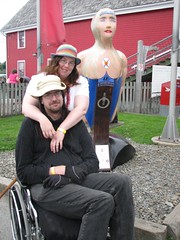
A white woman (Anna), sunburned and tired looking, stands behind a white man (Don), also sunburned and tired looking, in a manual wheelchair.  They are posed in front of a wooden figurehead of a mermaidThis certainly mirrors the experience Don had when getting his sexy sexy wheelchair of awesome. He went from not being able to get out of the house more than once a week, if that, to being able to not only go out several times a week, but doing it with only limited pain. The wheelchair opened up the possibility of our enjoying this strange, hilly city we moved to. [That’s us in the picture, after two days of handling the hills in historic downtown Lunenburg. Usually he uses an electric wheelchair, but we rented the manual for the trip. I vividly remember how exhausting getting up those hills were, which I think is obvious if you look at both our faces.]

Wheelchair user also reminds us who is (or should be) in charge of the chair. The person using the chair should be directing it, even if they’re not able to control it themselves. [This is a great post by Wheelchair Dancer about how to push a wheelchair. Learn it, live it, love it, folks.] When we talk about people who are using wheelchairs as though they have some agency, we’re reminding ourselves and others that they should have that agency.

Thirdly, wheelchair user is inclusive of people who are either full- or part-time wheelchair users. There are people who only have to use a wheelchair during high pain days, or in the winter, or after an accident, or for only six months, etc. “Wheelchair bound” always has an air of permanence to it, while wheelchair user can be both permanent or temporary, and using terms like full- or part- time wheelchair user reinforces the idea that folks who only use wheelchairs for certain activities aren’t faking a disability.

I hope this much longer version of my originally-planned post still gets at my basic argument: People don’t like being told they’re wheelchair bound. Stop doing it. Try ‘wheelchair user’ instead. Thank you.

Guest Post: Sex and Scoliosis

This is a Guest Post by Atlasien. It was originally published here.

I’m a multiracial Asian-American woman, Southerner, third-culture kid and mommyblogger. I’ve been living in the Atlanta area for more than a decade now. I mainly blog about race and foster care adoption. My husband and I have a 7-year-old son that we adopted as an older child. I enjoy this blog, and I’ve learned a lot of important stuff about disability issues by reading here.

What does scoliosis have to do with sex?

There are a lot of connections. I guess I’ll need to start by explaining scoliosis. It’s a common disorder, but one that is often very misunderstood by the general public, as well as many non-orthopedic doctors. Most people vaguely remember a scoliosis check from their school days. Sometimes the kids are lined up in a row, and told to take off their shirts and bend over while a medical professional inspects them from the back. The experience is obviously rather humiliating and tends to cause a lot of nervous laughter.

Scoliosis — a sideways, left-right asymmetry of the spine — is the most common form of spinal deformity. It can also be accompanied by other forms of spinal deformity, like kyphosis (AKA hunchback) and extreme lordosis (AKA swayback). It sometimes comes as a package deal along with disorders of connective tissue, or with cerebral palsy and spinal bifida. In those cases, scoliosis is often diagnosed at a very early age.

The other kind of scoliosis, the much more common kind, seems to come out of nowhere. It’s known as adolescent idiopathic scoliosis or AIS. “Idiopathic” is from the same Greek root as “idiot” and basically means “we have no idea what causes it.” Though recent research has shown that it’s actually genetic, and they’ve even tracked down the genetic location (but only if you’re white, which is bizarre, because there isn’t any significant racial/ethnic difference in prevalence rate). Someone with this kind of scoliosis (usually a girl, as the incidence of more serious curves among women is 7-10 times that of men) is born with a normal-looking spine. Before puberty, the spine begins to bend and curve. Maybe it stays there… maybe it gets worse through puberty. Then maybe it stays there, or maybe it gets a lot worse close to menopause. Without major surgery, it’s essentially a one way road. In scoliosis vocabulary, when curves get worse, it’s called “progression”. “Progression” is bad. Arresting progression is good.

According to this NIH resource, “Of every 1,000 children, 3 to 5 develop spinal curves that are considered large enough to need treatment.” If you adjust for sex, the rate climbs up to almost 1% of all girls. I don’t know of any source that says actually how many girls receive treatment of which types. Treatment means to watch, take lots of x-rays, determine progression, and if it looks like progression is, well, progressing, to brace. Or in very serious cases, go directly to spinal fusion.

A pre-teen girl, front and back view, with her face obscured.  She has a metal brace that has one rod running up the front to a metal collar, and two rods in the back.  There is a fiberglass girdle across the abdomen and down to the hips.  There is a strap hooking to both sides of the metal rod in the front.  Descriptive text provided by Don.

That’s the “Milwaukee” variant of brace. It’s the kind I had. It’s made from hard plastic and steel. It’s expensive, ugly, frightening, and extremely uncomfortable. The family nickname for my brace was “The Iron Maiden”. You can climb into it and strap it on and off, and adjustments of the screws will accommodate changing body shape during puberty. I think you’re supposed to wear it until a few years past puberty, when your spine growth finally halts. The brace is an old form of treatment and it’s shown to be moderately effective at arresting progression.

Three images of the back of a young woman.  In each, there is an obvious curvature of her spine.  It's an S-style curve.  The middle portion of her back, around the shoulder blades, is off-set to the right, while the shoulders and hips line up relatively evenly.  Descriptive text by Don.

Many girls experience horror and anger when they find out what bracing is going to mean for their lives, and that it won’t even fix them, it will just probably keep them from getting any worse.

It was easier for me to accept my fate. First of all, my mother also has idiopathic scoliosis, and her curve was fairly serious. Hers is comparable to the woman pictured above. She had not been treated as a girl, and her scoliosis had slowly progressed as she went into middle age. She eventually had a spinal fusion — two long steel rods screwed into her spine — and was in the hospital for two weeks. So I had a strong motivation to make sure my curve didn’t progress as far as my mother’s. She was also a positive role model for me. I saw her as an active, glamorous woman who refused to be limited by scoliosis. I tried to adopt the same stoic attitude toward my own scoliosis. Second of all, my orthopedist said it was OK to only wear my brace 12 hours a day, which meant I slept in it, but I didn’t have to wear it to school. I think he may have subscribed to the philosophy that although the brace should really be worn 23 hours a day, there’s so much social stigma attached to it that many girls rebel, and won’t wear it at all, whereas a private bracing regimen has more likelihood of consistent follow-through.

I don’t know if it would have made school any worse. I’ve written before about the extensive racist abuse, and sexualized racist abuse, I got in late elementary and middle school.

I was harassed so much in the locker room my first year of middle school that I refused to change my clothes at all. P.E. was a living nightmare full of verbal attacks and physical threats from larger girls. I spent much of my time desperately thinking of ways I could get a medical excuse. Unfortunately, aside from my scoliosis, I was healthy as a horse. I refused to participate in activities anyway, and sat with the asthma-sidelined section. I’m still bitter about this experience because it taught me to associate healthy athleticism with emotional trauma and racist bullying. Maybe if I’d had my brace on, I could have gotten my coveted medical excuse.

It was something I never, ever thought of at the time, though. The orthopedist’s word was the word of law. And the brace was something to be hidden. I think this is a common tendency among brace-wearers. Girls that age don’t want to be seen in a brace. For photos, they’ll take off the brace. If they’re told to wear it to school, they’re mocked and stared at. At the time, I considered myself very lucky that I was able to hide my brace from other kids my age.

I don’t know much about disability theory and disablism, but I’ve been reading through blogs about it, and it’s very interesting in relation to scoliosis. I don’t identify as a disabled person/person with disabilities, and I don’t think many other people with idiopathic scoliosis do. But many of us have also gone through an intensely emotional adolescent period where we’re viewed as disabled.

One of the hallmarks of disablism is that it strips away sexuality. The prejudice against disabled people includes thinking they are not supposed to exist sexually, have sexual desire or be desired.

Being braced means going through puberty strapped and screwed in to a weird exoskeleton that incarnates the negation and emprisonment of your sexuality. Your breasts and hips are starting to grow. They might start to bump painfully against the brace. So you have to visit the doctor — often an older man — who adjusts your screws to accommodate your new growth.

The brace seems anti-sexual, but it also has positive sexual connotations. The light at the end of the dark tunnel is that the brace will “keep you normal”. You’ll get through puberty and enter into sexually desirable womanhood without too much spinal deformity… the brace will preserve you. The brace probably becomes the most significant physical object in your life, for good and for evil.

I certainly didn’t receive any counseling about my scoliosis. I don’t know if it’s common today to have counseling as part of the bracing process. If it’s not, it should be. Girls who have gone through bracing feel like it’s them, alone, against the world. Although it’s quite a common experience, by medical and social tradition, the disorder is isolated and hidden.

This study showed that bracing doesn’t affect self-image much. However, it also takes places in Sweden, where school environment I’m sure is quite different than in the U.S. This other U.S. study tells a somewhat different story: “Scoliosis was an independent risk factor for suicidal thought, worry and concern over body development, and peer interactions after adjustment. CONCLUSION: Scoliosis is a significant risk factor for psychosocial issues and health-compromising behavior. Gender differences exist in male and female adolescents with scoliosis.”

After bracing, scoliosis, and deformities of the spine in general, become almost invisible. It’s extremely rare to have a spinal deformity so pronounced that anyone can tell by looking at you when you have clothes on. People with idiopathic scoliosis “pass”. People have known me for years, even decades, without knowing I had scoliosis. Then one day they’ll see me in a bathing suit — and not even the first time they saw me in a bathing suit, but maybe the first time they really focused on my back — and they’ll burst out with something like, “OH MY GOD DID YOU KNOW SOMETHING IS REALLY WRONG WITH YOUR SPINE!!

Once it stops being invisible, it’s all of a sudden very, very visible. I guess it’s sort of like shaking hands with someone and suddenly realizing they have six fingers.

If I’m not experiencing any back pain, I rarely think about my scoliosis, although I sometimes worry about my future. Pregnancy is not a risk factor for progression, but menopause is. Right now, my thoracic curve is 36 degrees. If it gets past 40, I might need spinal fusion surgery. This is a mostly safe procedure, but it’s still really scary, and involves weeks in the hospital. Click on the following link if you’ve seen enough David Cronenberg movies that you think you can handle it (link to nightmarish spinal fusion surgery image). Spinal fusion partially reverses the curve, arrests or slows down further progression and relieves chronic pain. You’re still reasonably flexible afterwards, but there are potential complications, and I’m not considering surgery at this stage. If I refused surgery, and my curve happened to progress further, I would start to have more pain and diminished lung capacity. Past 60 degrees, I might start to experience severe and constant pain in my back and/or ribs, and my internal organs would get squeezed together and I might start to have breathing problems. Past 80 degrees I might have lung AND heart problems.

But I don’t stay up night worrying about the risks of progression. Many people have more uncertainty about their medical future than I do. For example, if I had diabetes, I might worry about having a foot amputation.

Since I grew up with scoliosis, it’s taken me a while to understand how it looks from the outside. Aesthetically speaking: not good. We’re conditioned to associate left-right symmetry with health and general well-being. People with moderate scoliosis, like me, often look symmetrical from the front, but asymmetrical from the back, and I suppose that seems eerie and perhaps even deceptive and sneaky. There’s a lot of really negative associations in popular culture (e.g. Hunchback of Notre Dame). When mean-spirited people do “retard” imitations they’ll often hunch up one shoulder and stagger in order to simulate a deformed spine.

I don’t talk about scoliosis casually because a) I don’t have any major health problems because of it, so there’s not that much to talk about b) I’m afraid of it being used against me. I’ll put it on medical history forms when I know I can be assured of privacy. It was used against me recently when I applied for private disability insurance. I thought it would be a good idea to have a separate private policy in case I lost my job for any reason. I did a ton of research, spent a lot of time talking with the salesman, and ended up with a quote that specifically excluded anything going wrong with my reproductive system AND my back. I changed my mind and decided it wasn’t worth buying since so much of my body was apparently un-insurable. They excluded my ENTIRE BACK. Hypothetically speaking, if I got in a minor car accident, and as a result developed the exact same kind of back problems that anyone without scoliosis would develop, nothing would be covered. What a terrible deal. No thanks!

The health implications of my scoliosis are not that extreme, and I don’t need any accommodations to perform any major life activities, which is why I don’t consider myself disabled.

– I have foot pain in my arch if I don’t wear comfortable shoes. I can wear platforms, but I can’t wear high heels.
– I have to be a bit careful doing things like yoga and pilates.
– I have to stay reasonably active in order to be 100% pain-free. When I get too sedentary, I start having back pain and rib pain. If I ever had an illness that forced me to rest all the time, I’d be in big trouble. Exercise and stretching are highly effective for scoliosis back pain. Other options I would consider to control pain if it ever got worse include drugs, physical therapy and adult braces. There are a gazillion alternative health “cures” for scoliosis back pain suffering, but they strike me as being of very dubious efficacy.
– I have to watch my posture
– I have to watch my weight. Excess weight leads to back pain. Being underweight might be even worse, because being underweight is connected to bone density loss, and people with scoliosis have lower than average bone density anyway.

None of these problems are really unique to scoliosis. Plenty of able-bodied and disabled people have back pain or foot pain.

This link from Eurospine.org sums it up: “Progression of scoliosis can involve an aesthetic problem and lead to functional problems. Respiratory disorders may develop in large curves greater than 80 [degrees]. Nonetheless, the mortality rates and vital prognosis in individuals with scoliosis are comparable to those of the general population.”

It’s the “aesthetic problem” of scoliosis that’s unique. Like I mentioned before, left-right symmetry is wound up with definitions of health and beauty across many different cultures. People like me are aware of this on a subconscious or barely conscious level. 99.99% of the time I forget that I don’t fit that symmetrical standard. Every so often I’m reminded, and it feels a bit painful. There are subtle psychological effects. Vague feelings of being a secret curved impostor in a straight-backed world. Times when I feel like my spine is an enemy working against me… times when it hurts to breathe and the pain makes me feel angry at my spreading rib bones, and I wish I could reach inside of myself and squeeze them back into place. Sometimes I’m bitter about the inches of height I lost to scoliosis.

Back to sex. Even without bracing, there’s still a sexual paradox when it comes to scoliosis. Have you ever seen a picture of a woman with scoliosis and/or kyphosis that was not anonymous, depersonalized, clinical, grim and depressing? Like the photos I included above? Scoliosis is profoundly unsexy.

On the other hand, when women pose provocatively, they often throw one hip to the side and put one shoulder forward.Why is that pose sexy? Maybe it makes us look femininely defenseless and vulnerable, as opposed to a masculine, stick straight pose. That’s going along with a typical sexist definition of “femininity”. There’s another less sexist possibility… the pose is also highlighting the flexibility of the spine. So in that sense, the woman is showing off her body’s capacity by bending in a certain way.

There’s a comic book artist, Rob Liefeld, who was (in)famous starting in the 1980s for drawing unrealistic women. The conventions of drawing women are in comics are easy to criticize, but Liefeld’s stuff is… well…I guess you’d have to see the spinal curvature to believe it.

Iconic Rob Leifeld drawing of a super heroine.  She's posing facing right, turning her head over her shoulder.  She has an impossibly-narrow abdomen, and spine curvature similar to severe lordosis, an inner curve of the spine.  She is not wearing very much clothing.  Description by Don.

That’s supposed to be sexy. For the audience of predominantly young men who made Liefeld very popular, it must have been sexy. This is a funny analysis of the above drawing by a group of women comic book artists:

Take note of Avengelyne’s waist and how it is thinner than her head. Minus the hair. Note how it hangs beneath her ribcage like a suspension bridge, rather than actually supporting the top of her body. (Her torso must be kept afloat by those helium breasts.) Note the scoliosis gone grossly untreated. Note the little leather bags which wouldn’t fit around a normal person’s wrist. Especially note that the artist put her in the most obvious POSE to exaggerate the spine: a profile shot with negative space between her back and arm. That’s correct – our intrepid heroine’s spine would appear yanked. Avengelyne is a SWAYback™.

The humor is partly at my expense. But I can’t help laughing. It’s a highly sexualized image, but not one that I identify with in any way.

But here’s a poster image I ran across that uses stupid sexist humor to make fun of a real woman, and I don’t find it funny at all.

A woman is facing straight on the camera, with her weight obviously all on one side.  She's curved her body to look like an S.  Text reads: Scoliosis: Making an otherwise beautiful girl look pitiful.  Image is from Motivated Photos.com, description by Anna

It really illuminates the double standard that women are subjected to. You’re supposed to be sexy so that you please men. But if it looks like you’re trying TOO hard, men (and other women) will make fun of you. If you don’t wear makeup, you’re a [insert homophobic slur]. Wear too much makeup, you’re a [insert transgender-phobic slur]. Curve your back, look sexy. Curve it too much, it looks like you’re deformed. Argh!

Thanks to my brief readings of disability theory, I realize that making fun of people with spinal deformities isn’t something I should just accept as the natural order of things, especially because this humor is connected to moral judgments of disability. That is, the idea that physical body difference reflects some kind of moral failing. When it comes to scoliosis, I think the general public halfway believes that scoliosis is the fault of the person’s family. There’s a myth that giving young kids backpacks that are too heavy will make their spines curve (totally not true). When people are adults, “she should have had that corrected” is sometimes an assumption. A lot of people don’t realize that the only sure way to even partly reverse a curve is spinal fusion, which also leaves a giant seam-scar running up your back. Another judgment is that a person with scoliosis must be poor. It’s true that I’m very lucky I had access to bracing; if I wasn’t born into a middle-class family in a rich country, my curve would be a lot worse by now. So there are major class differences in scoliosis, but ultimately, we’re all in different positions on the same boat because there is no way to permanently and completely reverse adult scoliosis.

Thanks to flickr, I did actually find some images of scoliosis that I think are beautiful and help affirm positive self-image and sexuality. I wish I’d found a greater variety of body types, but these images are great to start off with. Some are post spinal fusion.

First, here’s the typical clinical picture. It shows everything that’s wrong with the body.

A woman is facing away from the camera, with arrows pointing to various parts of body to describe them.  Head not centered over body.  One shoulder (right) higher.  One shoulder blade (right) higher and possibly more prominent.  Spine obviously curved (to the left).  One hip (left) more prominent.  Unequal gaps between the (left) arm and the trunk.  Description by Anna

Now here are the flickr pictures. They show the open possibility and vitality of a body with scoliosis.

Man with scoliosis facing away from the camera.  Someone has drawn his spine on his back with make up.
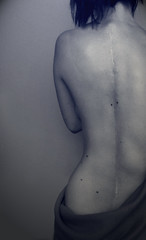
black and white photo of a woman facing away from the camera, wearing only a towel or blanket.  Her spine is curved, and her scars are visible.

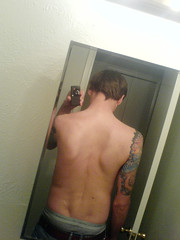
man facing away from camera.  The photo is in a mirror.  One can see both his scoliosis scars from surgery and his elaborate arm tattoo.

woman facing away from the camera.  She is caught in the middle of dropping an apple behind her back, both arms curved behind her.

woman facing away from the camera.  The image is otherwise in black and white, except for her vivid red hair and lips.  She is wearing a black dress with part of the back cut out.  It clearly shows the curve of her spine.

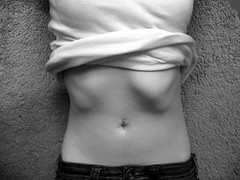
photo is in black and white of a woman's lower torso, with a pronounced rib-cage and a pierced belly button

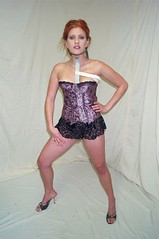
woman facing straight on the camera.  She is wearing both a brace, as described above, and a purple corset.

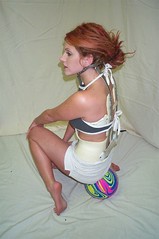
woman facing left from camera, with back facing camera.  She's wearing an back brace, and balancing on a small ball.

It’s heartening to see a bunch of pictures like that. There are more photos at this link.

When I walk, my right hip swivels a bit higher and wider than my left hip. I’ve had people tell me it looks sexy. I’ve had people ask if I’ve hurt my foot. Neither reaction bothers me anymore. The way I walk is just the way I walk. It gets me where I need to go.

Acknowledgements for this post: thanks to Thorn for commenting about this issue, and mentioning how it negatively affected your adoption homestudy due to ignorance on the part of the social worker. Also thanks to Deesha Philyaw on Twitter for mentioning the Judy Blume book about a girl who goes through bracing: Deenie. I wish I’d gotten a chance to read that book when I was a girl, and it sounds really interesting.
Power and Responsibility

An earlier version of this post was published in July, 2009.

When I mention that Don has a homecare worker, and explain what that job is, I often get this question:

“Why don’t you do all that stuff for him?”

This touches on something that I’ve referred to a few times, and that’s the idea that it’s totally okay (admirable, even!) that services for people with disabilities be offered by volunteers. It gets into a lot of complicated stuff.

For example, Don’s homecare worker does things like makes sure he is clean-shaven once a week, washes his hair carefully, and does some of the stuff he needs done for his back, which suffers from a lot of sitting/lying related issues, like heat rashes and sores. She’s there for about an hour or so.

What she does for Don is a huge deal in terms of his personal hygiene. All those little things that allow him to be “acceptable” to our neighbours take energy, such as having clean hair and a neatly trimmed beard. Before homecare, Don would often go weeks, if not months, without a proper shave, and look very scruffy and unkempt. But it would be a decision for him – does he shave today, or does he make a meal? There wasn’t enough energy or concentration to do both.

The question of why I don’t do these things has a few assumptions under it. First, it implies that, because I’m his spouse, I should be in the caretaker role. I should be making sure all his personal hygiene needs are taken care of. There’s a power imbalance there that makes me uncomfortable. It puts me in role as adult, and Don in role of child, and this is just not acceptable.

The other thing is part of why this volunteer thing bothers me. Don’s personal level of comfort should not depend on my energy levels. It shouldn’t depend on my mood. It shouldn’t depend on whether or not I’m angry at him today, or I’m too busy, or if I’m home.

Right now, it depends on whether the woman who is paid to come to our home and do these things shows up. If she calls in sick, there is someone else who will come in. I know she has a degree in nursing, focusing on homecare for people with disabilities. I know she’s a professional, who has been taught the issues around disability and privacy, around personal autonomy, and around sexuality and disability. I know the process we will go through if either she or Don does something sexually inappropriate. I know the appeals process if she threatens him or he threatens her. I know what will happen to Don’s care in those situations. More importantly, Don knows what will happen in those situations. He has personal autonomy.

Don’s health needs shouldn’t be dependent on me in any way, because that’s not safe for Don.

In my experience, Feminism tends to have discussions about caregiving focusing around the fact that caregiving roles fall predominately on women, and lead to things like “the second shift”, or caregiver fatigue, or even directly impact women’s abilities in the workplace. (“I can’t work late because I need to get home now.”) I think this is an important thing to discuss, but I don’t think it’s the only part of the caregiving equation. I think we, as feminists, need to also talk about the power inbalance that comes in when one is a caregiver for a spouse or parent that has a disability.

As well, we rarely talk about what happens when the role of caregiver falls on women with disabilities? What happens to that allotment of spoons then? What view do we have of women with disabilities if their children aren’t “properly” cared for? If some other loved one isn’t getting everything they need? What happens to the caregiver/second shift issues then?

I think feminist discussions about caregiving and responsibility need to broaden out to include these complicated issues.