Category Archives: mental health

Integrating Primary and Mental Health Care

The increased integration of mental health care into primary care is one of my pet issues. Currently, primary care providers (PCPs), also called general practitioners, provide over half of mental health treatment in the United States – which results in up to 50% of mental health problems going unindentified, undiagnosed, and untreated through the primary care system. This is a wasted opportunity, as PCPs have significant opportunities to identify behavioral health problems early and provide interventions and treatments to prevent further deterioration.

This indicates a significant split between the physical health care and mental health care systems, where people are expected to go to their PCP for physical health issues and to self-refer to a mental health care clinic or specialist for mental health treatment. This is problematic for a whole host of reasons – primary among them the simple fact that this system simply isn’t working – even though the prevalence of mental disorders in primary care is somewhat higher than the overall population, PCPs are ineffective at identifying those people and providing them with treatment. Expecting people to identify themselves as experiencing a mental disorder, overcoming societal stigma to seek diagnosis and treatment, and assuming they have the ability to access mental health services through a fragmented and poorly financed system erects barriers to treatment that are likely insurmountable to someone experiencing an untreated mental health problem. Unsurprisingly, these barriers are likely more pronounced for already vulnerable populations such as the elderly and low-income minorities.

There are a lot of benefits to better integration of mental health care into the PCP’s role. The PCP is usually the patient’s first contact with the health care system and an individual is much more likely to know how to access care from a PCP than from an unintegrated mental health system. Patients are often more willing to attend appointments with and follow up with their PCPs because of the removal of stigma from receiving treatment. Other patients may not have meaningful access to a separate or nonintegrated mental health system, either due to financial barriers, long waiting lists, or other barriers.

The most significant problem, in my view, is the expectation that an individual should be able to determine they are experiencing a mental health problem. Given that the majority of PCPs, who have medical degrees and extensive training, fail to identify and diagnose mental health issues, expecting untrained laypeople to do so – while they are experiencing the mental health problem – is beyond absurd. It is even more absurd given that many mental health issues have a physical component. Depression results in fatigue and appetite changes, as does mania. The physical experience of a panic attack is often interpreted as a heart attack. Auditory or visual hallucinations could easily be interpreted as problems with the sensory organs themselves. This is sometimes heightened by an individual’s cultural context, as many Asian cultures describe the experience of depression almost exclusively in physical terms. Expecting an affected individual to untangle the complicated interplay of physical and mental effects and diagnose themselves with a mental health problem prior to seeking treatment is bound to fail.

Another argument in favor of integration is the huge overlap between physical and mental health problems. Estimates of this comorbidity vary wildly, but range somewhere from 20% to 80% of primary care patients (useful data, no?). Having a patient access two separate mental health care systems for their treatment ensures fragmented treatments that may contradict each other and are certainly not coordinated for maximum effect. Better integration would ensure treatments for physical and mental health issues complemented each other and treated the patient as a whole person.

This seems like an uncontroversial and common sense suggestion. It was embraced by the United States Surgeon General in 2001 and by the World Health Organization in 2008, but has seen little progress or momentum since then. Some local treatment systems are taking steps towards integration, such as these trainings done by the British Columbia health system, but there have been few steps towards addressing this issue in the larger health system.

Tasting Fear

[This here is a warning that the author has written a post about, amongst other things, being depressed and suicidal. For this reason there is a clicky thing. Use it in whatever health you got. Also please note that with respect to my wife and our marriage you are getting exactly one perspective–mine–and everything is filtered through my experiences of abuse. This is not an objective reporting of events.]

Y’all who’ve been following this adventure know I’ve been fucked up for a while now. It’s been next to impossible to get any work done–it took me until five-thirty this morning to get caught up on my inbox. Today I got to explain why I should keep my job. On the phone. I don’t know as I was very convincing. Being highly ambivalent about wanting to keep it at all isn’t helpful with the convincing. Nor the panic that comes with phones, the stammering dysphasia aphasia that is so heavily influenced by stress.

Maybe I’ll get to keep it through the end of the month. I keep telling myself I should be at my desk now working.

I’m in bed with the notebook and I haven’t gotten dressed. I woke up six hours ago. Continue reading Tasting Fear

Photos from Mental Health Institutions in Indonesia

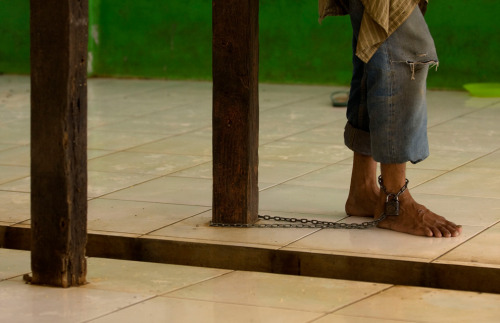
The Big Picture, one of my very favorite photo blogs, in which the Boston Globe collects a set of stunning photos on a single topic or theme, recently had a series on Indonesia. Two of the photos especially caught my eye, as they depicted scenes from mental health institutions in the country.

In a room with vivid green walls and white tiled floor, a person is seen from the knees down is chained to a wooden pole with a metal link chain. The person is barefoot, wearing dingy jeans with a tear in the knee.

The leg of a patient is chained to a post at the Galuh foundation for people with mental health conditions on February 10, 2010 in Bekasi, Indonesia. Belief in black magic is commonplace in Indonesia, where there is much ignorance over mental health issues, with traditional healers instead consulted for apparent sufferers. 2007 figures suggested that 4.6% of the nation suffered from serious mental disorders in a country whose population now stands at around 230 million, with only around 700 psychiatrists across 48 psychiatric hospitals available to help treat those affected. (Ulet Ifansasti/Getty Images) #

A shirtless boy, thin with protruding ribs, turns his head to the side as he is sprayed with a water hose. Behind him are walls of broken concrete.

A patient named Yoyo is bathed at the Galuh foundation for mental patients in East Bekasi near Jakarta on February 11, 2010 in Bekasi, Indonesia. With limited mental heatlth care available in Indonesia, sufferers usually turn to black magic and are taken to “dukuns” or healers who are believed to have magical powers. (Ulet Ifansasti/Getty Images) #

Judge Orders New York to Move Mentally Ill Out of Adult Homes

From the New York Times:

New York State must begin moving thousands of people with mental illness into their own apartments or small homes and out of large, institutional adult homes that keep them segregated from society, a federal judge ordered on Monday. The decision, by Judge Nicholas G. Garaufis of Federal District Court in Brooklyn, followed his ruling in September that the conditions at more than two dozen privately run adult homes in New York City violated the Americans With Disabilities Act by leaving approximately 4,300 mentally ill residents isolated in warehouselike conditions.

The remedial plan offered by Judge Garaufis, drawn from a proposal presented by advocates for the mentally ill that was backed by the Justice Department, calls on New York to develop at least 1,500 units of so-called supported housing a year for the next three years in New York City. That would give nearly all residents the opportunity to move out of adult homes.

The Americans with Disabilities Act gives PWDs the right to live in the least restrictive housing possible – in this case, moving from adult homes into independent supportive living units. This is a great development for those previously forced to live in the abusive conditions of the group homes.

This lawsuit was filed after a series of articles in the NY Times about the horrific and abusive conditions present in group homes for adults with mental disabilities. It is unclear whether these changes would have taken place had the newspaper not devoted the time and resources to their year-long investigation of these conditions and problems.

A Conversation in the Lunch Room

I was sitting in the lunch room at work with a group of co-workers, flipping through the newspapers. I came to an article on the suicide of Marie Osmond’s son, which led to the whole table discussing the incident. And it was immediately underlined for me how little most people know about mental illness and depression. Here’s a brief list of some of the questions and statements that came up during the discussion, the entirety of which I spent shrinking into myself and trying to be invisible:

  • “Is depression even a real disease?”
  • “People who commit suicide don’t really want to die – evolution wouldn’t let us have suicidal tendencies because it goes against survival.”
  • “It must be because his mom had mental health problems too.” Someone inquired if depression was hereditary and the original speaker replied “No, but being around depressed people can turn you into a depressed person.”
  • “I once knew a bipolar. She married my cousin and my mom got so mad, like you should never marry a bipolar because it’s not a good idea for them to have kids.”

Finally, a young man told a long story about his ex-girlfriend, who had experienced major depression, and how it affected her and the serious limitations it caused her. It was a great illustration of the reality of depression and the changes it can cause in day to day life. It was unfortunately concluded with a “so that’s why you can’t be in a relationship with those people, it’s just too hard.”

We’ve got a long way to go, y’all.

I Can’t Handle Celebrity Suicides

There’s been a couple of recent high-profile celebrity suicides.  Earlier this month, celebrated fashion designed Alexander McQueen hanged himself in his London home at the age of 40. Then this week, actor Andrew Koenig was found dead from suicide in Vancouver after being missing for several days.  These are just the most recent – there’s also David Foster Wallace, Spaulding Gray, Kurt Cobain, Ian Curtis, back to Diane Arbus, Anne Sexton, Sylvia Plath.

Of course, there are a lot of people who commit suicide who don’t make international headlines and don’t get websites doing slideshow retrospectives of their careers and bodies of work. But I don’t always know about those – it’s only the celebrities or the dramatic suicides (burning down a house while inside it to avoid foreclosure, for example) that come to my attention through the media. And every single time it happens, it stops me in my tracks.

These events remind me that the monster of depression can always get you. No matter how creative and inspired you are. No matter how much admiration and respect you earn from the fashion industry, the music industry, the world at large. No matter how privileged and rich you are. No matter how well known your struggles with depression are, no matter how many friends and strangers love and support you, no matter ho many people feel your loss. No matter how many years you’ve spent running from the monster. It can always catch you. It can always kill you. You are never and can never be safe.

I follow the twitters and blogs of a lot of alternative comedy people and the past week has been filled with concern about Koenig’s disappearance and ferverent please for help in finding him and making sure he was ok. This is even more notable from the comedy crowd who tweet only silly and humorous things and have essentially broken character to express their concern and love for Koenig. While I realize I can’t tell whether Koenig had actual love and support in his life just from reading a tweet from Doug Benson, I can see that there was a network of people who were really worried about him and who seem deeply affected by his loss.

If I committed suicide, it wouldn’t make any headlines. I’ve done a lot of work of which I’m very proud, but it wouldn’t be reviewed and featured on the Huffington Post. And certainly a generation of people wouldn’t have vivid memories of where they were when they heard about my death, as exists for Cobain. (I was in a car with my dad on Folsom Ave. in Boulder, C0lorado, driving south, when I heard it announced on the radio.) So the fact that the monster overtook these celebrities makes me feel even more vulnerable to succumbing.

Everything they did, everything they had, it didn’t help them. Couldn’t save them. What chance do I have?

Shame and Blame with African-Americans and Mental Health: Let the Circle Be Unbroken

Recently, U.S. Surgeon General Dr. Regina Benjamin kicked off a national campaign to tackle mental health in the African-American community. Benjamin explained why a focus on African-Americans is needed: “Mental health problems are particularly widespread in the African-American community. In 2004, nearly 12 percent of African Americans ages 18-25 reported serious psychological distress in the past year. Overall, only one-third of Americans with a mental illness or a mental health problem receive care and the percentage of African Americans receiving services (nearly 7 percent) is half that of non-Hispanic whites.”

Programs focusing on addressing underrepresentation of minority groups in mental health care tend to focus on outreach to and education of the underrepresented group (while this post focuses on historical and structural barriers to African-American participation in the mental health system, these larger concepts are likely applicable to other racial and cultural minorities throughout the world.). The theory seems to be that if individuals knew that they might be experiencing mental health systems and understood how the mental health system could treat and benefit them, they’d start accessing it in droves. This kind of outreach and education is clearly an important part of increasing minority representation in mental health care, but the exclusive focus implies that the primary barriers are the attitudes of individuals who would change their minds if they just had more information. This ignores a lot of problems and lets a lot of bad actors off the hook for institutional barriers and exclusions. In the particular instance of African-American engagement in the mental health system, it is these long-standing oppressions and exclusions which are perhaps most to blame.

A primary issue is that African-Americans are more likely to be subject to a number of forces of oppression and discrimination which can increase trauma and vulnerability to mental health disorders. “Owing to a long history of oppression and the cumulative impact of economic hardship, African Americans are significantly overrepresented in the most vulnerable segments of the population. More African Americans than whites or members of other racial and ethnic minority groups are homeless, incarcerated, or are children in foster care or otherwise supervised by the child welfare system. Proportionally, 3.5 times as many African Americans as white Americans are homeless. African Americans are especially likely to be exposed to violence-related trauma, as were the large number of African American soldiers assigned to war zones in Vietnam. Exposure to trauma leads to increased vulnerability to mental disorders.”

To me, that does not suggest that the primary solution is increasing African-American representation in mental health treatment – it suggests that a primary solution would be to address the structural inequalities that are making African-Americans “significantly overrepresented in the most vulnerable segments of the population.” Maybe a program that focuses on homelessness in the African-American population. Maybe addressing the sentencing disparities for crimes involving cocaine and crack cocaine, and how that contributes to disproportionate and longer incarceration of African-Americans. Or how felony disenfranchisement prevents a staggering number of African-Americans (13% of black adult males!) from participating in our democratic political system. Without addressing these ongoing problems, a disproportionate number of African-Americans will continue to experience trauma and increased vulnerability to mental disorders.

A second and key issue is the long history of how the psychiatric profession has treated African-Americans in the United States. Diagnoses and treatments for African-Americans have long been rooted in the structural racism of slavery, with early diagnoses of “Negritude” and “Drapetomia” for slaves who fled their masters and recommended treatment of whipping as therapeutic intervention. In 1895, a Georgia psychiatrist popularized the idea that “structured lives led by slaves served as protective factors against insanity” and that slavery protected African-Americans from freedom that would literally make them insane. In the late 1800s and early 1900s, there were separate “colored” institutions for African-Americans, who received little if any treatment services and were subject to horrific tortures and sexual assaults.

A glance at the current mental health system makes it clear those historical problems have not been eradicated. African-Americans are much more likely to be diagnosed with schizophrenia than with affective (mood) disorders, even when displaying the exact symptoms of a white patient diagnosed with affective disorder. This is true even when the diagnosing clinicians included African-Americans well trained about the bias towards schizophrenia diagnoses. Studies suggest this is because clinicians apply entirely separate decision models when diagnosing African-American patients, likely drawing on stereotypes of paranoia and violence that aren’t actually associated either with African-Americans or people with schizophrenia.

There are also significant knowledge gaps in how psychoactive medications affect African-Americans. There is almost no research on ensuring adequate racial representation in psychopharmalogical research, nor on how to ensure that participating patients from various cultural and racial groups give informed consent. This lack of knowledge is affecting the effectiveness of treatment, as existing research shows that “a greater percentage of African Americans than whites metabolize some antidepressants and antipsychotic medications slowly and might be more sensitive than whites,” and can lead to faster responses and more severe side effects when African-Americans are treated with doses commonly used for whites. Despite this, clinicians in psychiatric emergency services commonly administer “both more and higher doses of oral and injectable antipsychotic medications to African Americans than to whites.”

To me, all of this suggests that the psychiatric profession hasn’t really figured out how to provide psychiatric treatment and care of the African-American population with the African-American individual’s best interests in mind. History speaks to using psychiatry to control, torture, sedate, and oppress African-Americans, even creating fictionalized diagnoses to help support the structures of slavery. Add to all of this the multiple barriers preventing access to mental health care even for those who enthusiastically wish to access it – lack of parity for mental health care, lack of health care coverage at all, societal sigma around mental health – and instead of wondering why there’s underrepresentation of African-Americans in the mental health system, I start wondering why there’s as many as there are.

Clearly, a solution focused only on outreach and education to individual African-Americans is doomed to be unsuccessful, because it overlooks the underlying structural issues making African-Americans particularly vulnerable to mental health problems and the historical reality of their exploitation by the mental health system. Even more troubling, though, is that when the access problem is framed as an issue of education to an individual, it allows the blame to be placed squarely on that individual – even if these other, more serious, structural barriers are ignored. That kind of blame is just another addition to the complex system of forces making African-Americans more vulnerable to mental disorders to begin with.

For Cereal, Jessica at Jezebel? PTSD after obstetric assault is “hysterical”?

[WARNING: descriptions of obstetric rape and PTSD]

At Jezebel, Jessica writes: Is Having A Baby A Traumatic Event?

A new survey says that 9% of postpartum women suffer from post traumatic stress disorder. You know, the same disorder that Iraq vets and plane crash survivors get. Something does not compute here,[…]

Have we become so precious and hyper-conscious that something women have been doing for time immemorial is now ranked alongside war as a painful event?[…]

Certainly, having a bowling ball of a baby shooting out your vag isn’t a picnic for anyone, but the hysteria surrounding something so matter-of-fact is troubling.

“Hysteria”. Yes, “hysteria”. She went there. She used the prime misogynist slam against women, blaming wandering uteruses. Unbefuckingllievable.

I’m only surprised there wasn’t a “princess” or a “delicate flower” thrown in there too. Or maybe a few accusations of insurance fraud, hm? That would just put the icing on the hateful cake.

Get back to me when you’ve been stripped, dehumanised, isolated, forcibly starved, and strapped to a table for 12 or more hours during the hardest work of your life. Get back to me when you’ve been subjected to a series of non-emergency procedures on your body with neither consent nor medical justification. Get back to me when you’ve been imprisoned in hospital.

Get back to me when you’ve been held down by two or three people while someone – or more than one someone – pushes their fingers into your vagina while you say “No”. Get back to me when you’ve been screaming “NOOOO! STOP!!!” and been ignored while someone cuts your body open and shoves metal forceps into you. Get back to me when you’ve been strapped to a table and operated on and had your protestations about the anaesthetic not working being ignored. Get back to me when you’re left bleeding and vomiting on a table, without access to help, wondering if you’re bleeding to death, and you’ve had your newborn baby taken away from you without explanation or good reason except an over-the-shoulder “we don’t have enough staff right now”.

Get back to me when you’ve spent months of your life – the months you thought would be a joyful, perhaps sleep-deprived, milky daze – having violent flashbacks and nightmares. Shambling through the day barely able to function, unable to bond with your newborn. Bursting into tears and panic attacks many times a day. Avoiding public places lest you suddenly start sobbing and need to run. Not able to have anyone touch you.

Get back to me when you’re hunched in a corner, unable to work, unable to care for yourself, unable to speak, and all anyone can say to you is “All that matters is a live baby”.

I hope you never experience these things. Because they can be horrifying, life-changing, deeply traumatic events. The only promise I can make you is that I won’t call you “precious” or “hysterical” if you’re ever in this terrible position.

Medical assault is assault. Obstetric rape is rape. Trauma is trauma. Some people who have experienced these things get PTSD.

And it’s not up to you, or anyone else, to instruct them that they haven’t – especially in explicitly woman-hating terms.

You don’t get to judge.

No, no, no, no, no.

For Cereal, Cute Overload?

A periodic feature in which we highlight some of the more ableist posts and comments in the blogosphere – the things that made us throw up our hands and ask “FOR CEREAL???”

I’m late on this one, but that doesn’t make me any less upset. Cute Overload is one of the best and most regular suppliers of the cuteness I so often need to take the edge off the day, but it’s becoming increasingly problematic. They have a continuing series called Cats n Racks, featuring photos of kittens placed in cleavage, usually cutting off the woman’s head. Recently the site posted a picture of a extremely wrinkled puppy with lots of excess skin and compared it to Eleanor Roosevelt (described here at Filthy Grandeur). She also points out a recent photo of a wallaby titled “The New Slave Girl, She Intrigues Me,” captioned with what sounds an awful lot like a rape fantasy.

Not content to settle for racist and sexist, the site went for a hat trick and added ableist to their list! In their post reviewing the ten most popular posts of 2009, number five is a photo of a bunny with a long forelock brushed over one eye, called “Emo Bun.”

a small grey bunny looking to the side, with a long forelock of fur falling over one blue eye.

The text reads “On June 18, Stephanie N. took a minute from cutting herself to send us this awesome shot, an emotional bunneh.” The alt-text for the photo of the bunny reads “No Mom I was NOT cutting myself!”

FOR CEREAL, CUTE OVERLOAD? I’ve written at length about my issues with the term “emo” elsewhere, but beyond that, the multiple references to cutting are 100% non-negotiably inappropriate. Having an undeniably cute bunny whine about cutting minimizes and dismisses the very real pain of people who do self-injure. It implies that self-injury is a choice as superficial and changeable as a trendy hairstyle and that it’s done to fit into a trend. It’s not funny. And it’s certainly not cute.

Do you REALLY trust women?

For the purposes of this post, I would like to remind everyone that the range of disability includes people who are mentally ill, paralyzed, Blind, Deaf, permanently injured, autistic, physically disfigured, with compromised immune systems or disordered speech or chronic pain or cognitive impairments, and many, many others. Disabilities may be fatal or not, may be degenerative or not, may be apparent or not. Being painful, fatal, stigmatized, or poorly understood does not mean that life is not worth living, and I will not tolerate any attempts to enforce a hierarchy of disability; there is no category of Especially Bad Disability that destroys any chance of worthy life.

A blue-purple sunburst in the background, white letters reading "TRUST WOMEN: Blog for Choice Day 2010"

Blog for Choice Day 2010

Have you ever participated in the stigmatizing of pregnncy, childbirth and childrearing when the parent, child, or both have, or could have or obtain, disabilities?

Have you ever participated in the cultural narratives that say:

  • Older women should not have children because their children are more likely to have a disability
  • Women with disabilities should avoid having children because their children might also have a disability, and it would be wrong, unjust and cruel to give birth to a child that is not in perfect health
  • Women with disabilities should avoid having children because only temporarily-abled women can properly parent a child, or being a mother with a disability would somehow deprive the child of necessary experiences or put a burden on the child
  • Women with disabilities should avoid having children because they are more likely to be poor and need public assistance, and their children would also be more likely to use public assistance in the future, resulting in a drain on temporarily-abled taxpayers
  • Women with disabilities would be selfish to have children, and to do so would contribute to environmental destruction, economic decline, and even degradation of the human species, and they and their children would be less valuable members of society because of their lack of perfect health
  • It would be a tragedy to have a disabled child, disabled children are less desirable than temporarily-abled children
  • Life with a disability is inherently worse than life without one; life without a disability is the baseline by which all life should be measured, so of course to have a disability would be a negative and would make a person’s life worse
  • Disabled children are a burden on their temporarily abled parents, more so than any other child would be, and this is because of the child’s disability rather than because of the lack of support and affirmation throughout all levels of society for PWD and their loved ones
  • Of course it is more desirable for a child to be perfectly healthy than to have some sort of medical imperfection, and those medical imperfections are a big stress and hassle on the temporarily abled people around the child, and there is something wrong with the child for failing to meet an impossible standard of perfection
  • Health and ability are objective concepts and our current cultural wisdom on them are completely right and the medical industry that puts them forth is infallible; our ideas about health and ability are the only right way to look at things and can be universally applied
  • To violate those cultural ideas means that you are inherently flawed
  • The answer to all of this is to go to excessive lengths to avoid ever having, or being around someone who has, health problems, up to and including letting the least healthy die off or be terminated before they can live at all

You know what? I’ll bet you’ve all done it. Even the most radical disability activist has participated in some of these cultural tropes at some point in their lives.

But I’ll bet the vast majority of people “blogging for choice” would never think of disability as related to “choice” issues, and if they did, it would be for the right of temporarily-abled higher-class white Western women to terminate a pregnancy that has a more-than-minute chance of resulting in a less-than-perfectly-healthy child.

This is why the “choice” framework fails. It fails all of us, but it particularly fails those of us who fail to meet society’s idea of the optimal person: the pale, thin, beautiful, and financially comfortable picture of perfect health. The person who never relies on others (no!), is “self-sufficient,” and isn’t likely to end up a burden on the important people.

The rest of us can “choose” to stop existing.

Do you really trust women? Or are you perfectly willing to override their choices if you feel they threaten your comfortable position in society?

And you expect me to think you’re any better for my rights and needs than pro-lifers, why?

(Cross-posted at three rivers fog.)

Edit, Saturday 1/23: I am being very strict in moderating this thread. The primary response from people who do not identify as disabled seems to be “Well, I respect your choice, even though it is clearly cruel and bad/makes me ‘uncomfortable’/is the ‘wrong’ choice.” That is exactly the opposite of what this post is saying. If that is what you got out of this post, you have a LOT of stepping back, listening, and learning left to do.

I’m not asking you to be nice enough not to forcibly prevent us from ever having children, or anyone from ever having disabled children, even as you eagerly stigmatized disabled motherhood/childhood; I am asking you to genuinely examine the deep-rooted prejudices you have been taught and challenge your thinking on childbearing/rearing and disability. I am asking you to question why you have these ideas about disability, and whether they are appropriate to hold as a person committed to social justice. Including for women.

Because, here’s a hint: a lot of us women have disabilities, and all of us were children once, and some of us will have children of our own. And we are still women. Are you really protecting women’s freedom? Or are you merely preserving the temporarily-abled supremacist structure of society, with temporarily abled women as a convenient proxy?

I ask you to consider these prompts, to attempt to truly challenge your assumptions about disability and parenthood. If you aren’t willing to do that, please don’t drop in to explain why disabled women are “Doin It Rong.” Check your privilege. Thanks.