Category Archives: media and pop culture

Guest Post from RMJ: Athletes with Disabilities: Arm-Wrestlers as Exceptions and Inspirations

Editor’s note: We are very pleased to host this post from RMJ, and will be featuring some more writing from her, and several other awesome guest posters, soon. FWD welcomes guest posts: please email guestposting [at] disabledfeminists.com for more information.

RMJ is a twentysomething with OCD who grew up in Kansas and currently lives in Virginia. She works in education and loves cooking, cats, and television. She blogs about feminism and stuff at Deeply Problematic. This post also appears at Deeply Problematic

Athletes with physical disabilities (hereafter AWPD) are a problematized group. Their accomplishments are questioned and devalued as less valid or challenging than those of able-privileged athletes. They are not party to the often problematic veneration of athletes in today’s society, nor are they permitted to participate in generalized sporting events.

Arm-wrestling is a sport, though, that seems to both accommodate and welcomes athletes with disabilities into their ranks. There is a specific subset of arm wrestling for athletes with disabilities that seem to be a regular part of official arm-wrestling tournaments. I don’t know much about the sport and I’m not currently physically disabled, so my perspective on this is far from authoritative. But my tentative reaction to this is positive, particularly since athletes with disabilities can and do succeed in general competition.

Larry Feezor is an athlete with disabilities who competed recently in the 3rd Annual U.S. Open Armwrestling Championship. He has used a mobility aid since a motorcycle accident paralyzed him from the waist down. This story from an Oregon television station makes Feezor the focal point of the championship. The story is pretty short and context is important to my analysis, so I’m going to reproduce it here in full:

FLORENCE, Ore. – The Third Annual U.S. Open Arm Wrestling Championship wrapped up in Florence Sunday, as amateur wrestlers took to the ring to battle it out.

One competitor stood out for beating the odds: Larry Feezor.

He has been arm wrestling for 18 years, traveling from Weaverville, Calif., to Oregon to participate in the competition. This sport is his outlet since he became disabled.

“I was involved in a motorcycle accident and a drunk driver ran me off the road,” Feezor tells KVAL. “I hit a bank at about 70 miles per hour, [and] was paralyzed from the chest down.”

Feezor received roaring applause when he beat his first opponent.

On Sunday he arm wrestled some of the strongest competitors at The Three Rivers Casino. And he wasn’t going down without a fight.

“Right after my accident,” Feezor said, “I told my father that I would fight, as hard as I could, for as long as I could.”

Feezor isn’t letting his disability bring him down. As a former athlete, he said his body may not be like it used to be, but his mind is stronger than ever.

“I am out here just like these other guys,” Feezor said. “I just happen to be in a wheelchair.”

Before I break this article down, I should mention its good points. It is wonderful that athletes with disabilities recognized. It’s fantastic that Feezor’s achievements are reported on in a positive fashion. Feezor is ostensibly framed as normative. The newspaper is using Feezor’s words and Feezor’s voice, rather than, say, his father’s.

However. Feezor’s participation is the only aspect of the tournament that’s detailed, and his accomplishments are not well-articulated. The singling-out of Feezor and complete erasure of any other athletes in competition is problematic because it trivializes Feezor’s competition in a sport. It implies that the sport is only notable for the inclusion of a person with disabilities – Feezor is not in a competition, but instead someone to be cooed over and patted on the head simply for participating. He’s not being applauded for his accomplishments, he’s being singled out because he “beats the odds”, whatever that means. If this were an angle in a story that clearly reported on the events of the tournament, it would be significantly less problematic. Feezor would be presented in the context of other athletes, and not just othered because of his disability and his marginalized sport.

An example of this is Joby Matthew, an Indian arm-wrestler, who has underdeveloped legs due to Proximal Femoral Focal Deficiency. Matthew seems to be higher-profile than Feezor, but increased coverage also means increased problems, particularly since it’s from the Daily Mail:

Who needs legs? Meet Joby, the 3ft 5in world champion arm wrestler who can bring down opponents twice his size

Instead of bemoaning what he lacks, Joby Matthew is using what he’s got.

Matthew’s accomplishments are not notable in this article: only his disabilities. I’m not quoting or going through the whole article because the able privilege is so dense. The first line is indicative of the attitude taken in the article: Matthew doesn’t “bemoan”, unlike those other people with disabilities who would surely be champion athletes if they just tried. The construction is an ableist implication that other folks with disabilities are lazy whiners. Throughout the article, every reference to barriers Matthew faced is immediately matched by emphasis on how he overcame this disability. The focus is not on his exceptional effort and achievements, but on the “heartwarming” “good cripple”.

There are a few good aspects of the article. It’s composed largely of quotes from Matthew, and it does make note of his many medals and of his training regiment (though that, of course, is as much focused on what he can’t do as what he can’t.) Matthew’s childhood athleticism is made a major point of focus, particularly his struggles in playing with other children. While I appreciate that the authors focused on quotes from Matthew, the focus on competition with currently able-bodied athletes frames participation in sports against currently able-bodied (CAB) athletes as the standard for athletic accomplishment for AWPD.

While I do not love the article, I loved these pictures of Matthew and am quite impressed with his accomplishments and his goal of climbing Mount Everest. Though the exceptionalist attitude makes the context problematic, these pictures are awesome:
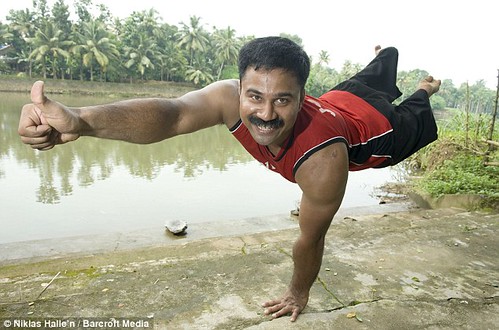
Joby Matthew holds himself up with one hand while giving the thumbs-up with another. He is on the bank of the Periyar river on the outskirts of Ernakulam. He and his fantastic mustache smile broadly at the camera.
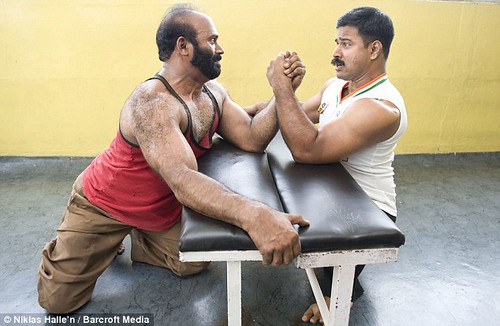
Photo: Joby Matthew holds himself up with one hand while giving the thumbs-up with another. He is on the bank of the Periyar river on the outskirts of Ernakulam. He and his fantastic mustache smile broadly at the camera.

Joby Matthew and an unidentified man arm-wrestle on a weight bench. The unidentified man, who has a beard and fully developed legs, grips the far side of the weight bench.  Both men are grimacing and neither appears to be winning.

Photo: Joby Matthew and an unidentified man arm-wrestle on a weight bench. The unidentified man, who has a beard and fully developed legs, grips the far side of the weight bench. Both men are grimacing and neither appears to be winning.

These photos highlight his exceptional abilities, and while his disability is present and visible, it’s a part of his athleticism. However, there are only two pictures in the eleven-part picture post that actually show him competing. Training and physical strength are interesting and relevant, but this is about sports: as with the article, the focus should be on his achievements as an athlete, not on OMG HOW DOES HE DO THAT? or OMG HE BEATS NORMAL ATHLETES?

The accomplishments of athletes with disabilities face a double bind. In most cases, they are ignored and erased; they are thought to be impossibility and a contradiction. When AWPD are covered in the media, it’s rarely a positive, normed framing of them as accomplished athletes with valid bodies. They are objects instead of curiosity; they are heartwarming inspirations for the currently able-bodied; they are not quite freak shows.

Moderator’s note: Moderation on guest posts is often much slower than “usual” moderation times.

Percy Jackson and the Olympians: The Lightning Thief — The Special Thing About You

Percy Jackson, a pale young man in a grey t-shirt and jacket holds a lightening bolt in his hands in a New York City Background.Every now and then a movie comes out and I get super excited about it because it sparks something form my childhood or youth that I love.

Percy Jackson and the Olympians did that. I loved Greek mythology in High School (even if I went a little cross-eyed reading The Odyssey and The Illiad). Hollywood is trying to make mythology cool again, and I was stoked about that.

I so wanted to see this movie…and because I think I live under a rock sometimes, I hadn’t heard it was a book series *scribbles a wish list*.

And then we went to the theater.

***Spoilers Ahead. Turn Back Now!***

Last Chance to Avoid Spoilers! Continue reading Percy Jackson and the Olympians: The Lightning Thief — The Special Thing About You

Dr. Drew – Stop Policing Other People!

Dr. Drew enrages me. The way his whole empire is built on callous exploitation of the pain, suffering, and need of others makes me very suspicious of his motives and goals in treating people. But even more than that, his eagerness to observe people through tabloid reporting and unsubstantiated rumors and then make unfounded assumptions about whether they’re experiencing substance addiction or abuse issues and/or mental health issues is, frankly, repugnant.

He’s been targeting Lindsay Lohan recently, and has said some absolutely outrageous and unacceptable things about her in recent days. I saw this reported by the Onion AV Club and they respond so nicely I’m just going to quote them:

Dr. Drew Pinksy, of Celebrity Rehab With Dr. Drew, Sex Rehab With Dr. Drew, and Dr. Drew’s Ol’ Fashioned Healing Vapors & Hair Tonic, is obviously a great doctor. He can diagnose life-threatening drug addiction just by listening to unsubstantiated rumors. He knows which cameramen will help the most in each individual addict’s recovery. And he is great at uncovering and broadcasting an addict’s childhood trauma—which is the only reason anyone becomes addicted to anything ever.

In fact, Dr. Drew is such a great doctor, he diagnosed then officially cured Lindsay Lohan via an interview with the always reliable gossip website RadarOnline.

First, Dr. Drew detailed his recommended course of therapy for Lohan:

“If she were my daughter, I would pack her car full with illegal substances, send her on her way, call the police, and make sure she was arrested. I would  make sure she was not allowed to get out of jail. I would then go to the judge and make sure she was ordered to a minimum of a three year sobriety program.”

I’m sure Dr. Drew already emailed this interview to the head of development at VH1, because in addition to being a terrific treatment plan for an addict (and also a morally sound thing to do), Dr. Drew’s Celebrity Frame-Up & Jail For Addicts Featuring Dr. Drew would also make a great reality show.

But after pitching his new show/course of therapy for Lindsay Lohan, he added this:

“I would say it’s less than a 1% chance of her making the decision to go to rehab. I have said this many times before, I believe that Lindsay will make a wonderful sober person, someday, if she survives this. I absolutely wish no harm to her, but I just have a feeling that something awful is going to happen to her, like she is going to lose a limb. I hope Lindsay gets help before something terrible happens.”

Something terrible like having a celebrity doctor diagnose you on a gossip site, or tell you what you need to do, or plant drugs in your car then call the cops on you?

It is easy to imagine the same kind of “logic” and “help” being applied to someone with a mental illness. Dr. Drew might suggest calling the police and saying that an individual had threatened suicide – even plant a weapon or suicide note on them to be sure the police would take them in for psychiatric commitment. He would publicly judge and shame that person for not seeking what Dr. Drew considers to be appropriate and beneficial treatment and imply that if his proposed treatment plan isn’t followed, any harm that befalls the person is their own fault.

This is not ok. It is dangerous, and is unfounded judgments and shaming. And it is utterly inappropriate and unacceptable from a medical doctor.

Recommended Reading for April 15, 2010

Hi! As you may have noticed, we’re rotating Recommended Reading between a few contributors now. This is my first one, and it may have a little bit of a different style? I don’t know. Anyway, here it is!

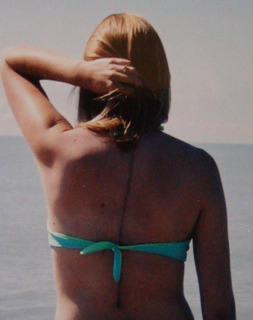
A woman faces the ocean, her back to the camera. An aqua bikini top is tied across her bare back and her arm holds her hair at her neck. A prominent scar runs down her spine.

History Lessons – Scar

My daughter will inherit my scar.  Obviously I know that you can’t inherit a scar, but she’ll likely end up having the same spinal surgery as me in the future. We both have scoliosis. Pretty bad scoliosis. I was diagnosed at eight; she was diagnosed at five. I wore a back brace and she wore one too. … There is no reason to cover it up.

BBC News – Making Light of Disability

Disability is one of those things that makes people feel awkward – there is perhaps a deep-rooted, psychological fear of contamination by association. So what we often do when something makes us feel uneasy is to laugh about it. It’s still well within living memory that TV comedians would poke fun at people from different ethnic groups – but broadcasting executives soon cottoned on to the fact that they risked alienating growing sections of their audience for the sake of a cheap gag.

Wheelchair Dancer – Disability and Race: Who Will Catch You If You Fall? (not new but still recommended)

In the workshop, I found myself in a conversation about disability and race. One of the participants had worked with some black disabled men; she was confused about why they identified more with being disabled than with being black. Didn’t they experience racism every day? Were they blocking out their blackness, disconnecting from their roots? Were they denying the hatred that black men experience on a daily basis? And then I got thinking. There are many ways to put the pieces of the puzzle together; indeed, for academics, “black disability studies” and other race and disability enquiries have recently become a new edge (yeah, I know… it’s problematic…). I would put some of the many pieces together like this…

Blog of Legal Times – Colorado Lawyer Settles Discrimination Suit Over Dog

A Colorado Springs lawyer who refused to allow a veterinarian and her service dog to enter his law office for a scheduled deposition in a civil action has agreed to pay $50,000 to settle a federal discrimination suit. LeHouillier demanded the veterinarian, Joan Murnane, prove her dog, an Australian shepherd, was a certified service dog. According to the suit, LeHouillier was not satisfied after reviewing a letter documenting Murnane’s need for the dog. LeHouillier feared the dog would soil recently installed carpeting, according to the Justice Department complaint.

LA Times – FBI probes LA Housing Department’s actions in apartment project for homeless seniors with disabilities

The FBI is investigating an affordable-housing deal in which Los Angeles officials channeled $26 million to a developer who they knew was under criminal investigation for alleged misuse of public funds, city officials said Thursday. The developer, David Rubin, was indicted last fall in New York for alleged bid-rigging and fraud, charges unconnected to the L.A. project. The $26 million went toward construction of a 92-unit apartment building near downtown L.A. for disabled homeless seniors. It has sat empty since October while its prospective tenants live in shelters or substandard housing.

Disability Representation in Music (Video), You’re Doing It Right: Janelle Monae’s “Tightrope”

This recent music video from singer-songwriter Janelle Monae is a great example of how not to completely screw up representation(s) of disability. Lyrics are located here.

And a description, courtesy of FWD’s own S.E.:

A black title card reads: ‘The Palace of the Dogs Asylum: Dancing has long been forbidden for its subversive effects on the residents and its tendency to lead to illegal magical practices.’

Two people in tuxedos are seen sitting against a white tiled wall. One is reading a book and the other is playing with a small ball, which eventually drifts up and floats in the air. The reader turns to see it and looks surprised.

Cut to an ominous-looking institution with a sign in front reading: ‘The Palace of the Dogs.’ Bright yellow text reading: ‘Monae and Left Foot: Tight Rope’ overlays the image as bouncy music plays.

Cut to a scene of a nurse pushing a cart full of medications. The scene starts with her feet, in sensible white shoes, and slowly pans up. She is moving down a hallway. As she proceeds, a woman (Janelle Monae) in a tuxedo without a jacket, with her hair in an elaborate sculpted pompadour, peers out the door of her room and then ducks back in. As she closes the door, we cut to her in her room, leaning against the door, and she starts singing.

The video cuts back and forth between the nurse moving down the hall, Monae singing and dancing in front of a mirror, and two ominous figures with mirrors for faces draped in black cloaks, seen from a distance. She eventually puts her jacket on and moves out of her room, softshoeing down the hallway, and other people, also in tuxedos, join
her. They storm into a cafeteria, where a band is playing, led by Big Boi, wearing a peacoat, a scarf, and a snappy hat. Monae jumps up onto a table and starts dancing, while people dance all around her.

As everyone dances, the nurse is seen peering around the corner with an angry expression. The scene cuts to the nurse gesticulating at the black-robed figures, who start to glide down the hallways and into the cafeteria. Monae dances right out of the wall, leaving an imprint of her clothes against the bricks, and ends up in a misty forest in what appears to be afternoon light, where she is pursued by the gliding black figures. Leaves cling to their cloaks. Evading them, she walks through a concrete wall, leaving another impression of her clothes behind, and she winds up in the hall again, where she is escorted by the robed figures. The video cuts back and forth between scenes of her
walking down the hall and the scene in the cafeteria, where music still plays and people still dance.

As she walks, a man in an impeccable suit and top hat walks by and tips his hat to her. She goes back into her room while people dance in the hall. The camera closes in on a table covered in papers and a piece of equipment which looks like a typewriter. She types a few keys, and then touches the papers, which turn out to be blueprints marked with ‘The Palace of the Dogs.’ She sits down on her bed,  rests her chin on her hand, and looks into the camera. The music fades and the scene cuts to black.

I really like what Cripchick has to say about this video: “i love the way that this video A.) critiques psychiatric institutions and B.) shows the ways that institutions/society/ableism polices our whole beautiful creative selves because if unleashed, we are powerful/uncontrollable.”

Additionally, I thought the cloaked figures were an interesting representation of the concept of the looking-glass self; another interpretation might be that they represent Bentham’s panopticon, or the sort of menacing, omipresent societal structure in which we must police ourselves constantly in order to be considered “normal.” Those are just two ways of looking at one aspect of this video, however.

What do you all think?

The Importance of Being Bellatrix Lestrange

Bellatrix Lestrange, as portrayed by Helena Bonham Carter, a pale woman with a mop of dark, thick curly hair lightly tinged with strands of grey, smirking devilishly in a black dress with white embroidery, pointing her wand at her own face.It is odd the way that The Guy and I have these conversations…or maybe it is a sign that we watch our Harry Potter movies too much, but one night while viewing HPatHBP for appoximately the nonillionth time I turned to him during the Unbreakable Vow scene at Spinner’s End, and began the following thought train (all quotes should be presumed to be “air quotes”):

Me: You know, all of Snape and Dumbledore’s plans would have been shot if anyone at all would have listened to Bellatrix.

The Guy: No kidding! She never trusted Snape. Look at how she taunts him!

Me: It’s because everyone dismisses her as just being “insane”, you know.

The Guy: Because she was in Azkaban, you know, and it has “driven her mad”, so she obviously doesn’t know what she is talking about.

Me: Obviously.

See, I am not in anyway advocating for Team Voldemort or something. There is a great discussion on racism that can be had about the antics of the Death Eaters (and the dynamics of having that point made from a primarily White PoV) in another post, but more interestingly to me right now in this particular post is that Bellatrix was completely right in her mistrust of Severus Snape and his position beside Lord Voldemort. Her feelings go much deeper than mere jealousy (but why shouldn’t she be jealous, since she alone stood proudly, unafraid of the consequences of supporting Voldemort when others did not?) to a practical mistrust of someone who seemed to benefit all to much from a convenient and literal get out of jail free card.

We know that Bellatrix was described as having a personality that bordered on displaying psychopathic tendencies* (from a lay perspective), in that she showed little to no conscience. We know that her cold and callousness was often played up if for no other reason than to reinforce that Bellatrix was someone who was a little unbalanced. Her pride in being a “pure blood” was over the top to a “normal” person, and we are to presume that no rational person would behave the way that she would. So, no rational person would honestly believe that anyone would dare betray the Dark Lord. She goads people with baby talk and laughs at inappropriate times which all adds to the image of the mentally unstable woman who just can’t be taken seriously, but is tolerated for whatever reasons (in Bellatrix’ case, it is more than likely her undeniable talent and power. Even Death Eaters can’t look that gift horse in the mouth, mental illness or no!).

I am not a doctor, nor anyone qualified to make medical opinions about the fictional personality of Bellatrix Lestrange, but I do know that often in real life people who have mental illness, to any degree, are in fact taken less seriously than those who do not. They are dismissed in everyday goings on, dismissed when it comes to their own medical care, told they shouldn’t have children, told they are not suitable parents if they do already, and when they leave the room you had best believe that people snicker that “poor crazy Bellatrix is raving again”… The importance of Bellatrix Lestrange is that she represents real people…real women who exist — whether intentional on the part of J.K. Rowling or no — who have valid concerns in the world, and who can not get their voices heard because their mental illness (or any disability) creates a barrier between what they say and what others are willing to hear.

So J.K. was free to write this character, whose madness and temper were often mirrored in her own cousin, Sirius Black (interesting, no?), who could go on and on at will about Severus and how he was not to be trusted, how he was really going to betray the Dark Lord. Severus was able to rest easy through her rantings, knowing full well that no one was going to believe her, that his triple agent status was going to remain unscathed, because, after all, who would ever believe a crazy person, right? Voldemort might have been better served had someone actually listened to her.

But no one did.

Interesting, that.

I mean, I guess it is a good thing, both for Harry himself, and for the sales of books five through seven or so and the corresponding movies, since the story might have stopped cold had any of that happened. Something to consider, I suppose.

Oh, how I do love discussing Harry Potter.

*These descriptions I take mostly from the Harry Potter wiki.

Photo: The Harry Potter wiki

Cross Posted at random babble…

Let me tell you all about my disability super powers

I first learned about panic attacks as a disability in the Mercedes Lackey novel Children of the Night. The main character, Diana Tregarde, has crippling panic attacks in the aftermath of a major attack on her. The panic attacks are so bad that she feels she is reliving the moment, and even blacks out from panic. They come on her without warning, when anyone says something that brings the night of her attack to mind.

Over the course of one (exhausting) evening, her vampire lover teaches her to turn the energy generated by these panic attacks into a magical shield of light that affects vampires and protects her. This shield, of course, helps save the day.

And, of course everyone “knows” that blind people develop extra-sensory hearing abilities to “compensate” for their blindness. I remember an episode of M*A*S*H* – a US show set during the Korean war, a dramedy that focuses on the doctors in a medical unit stationed there – in which Dr Hawkeye Pierce is temporarily blinded, and within a few days is able to hear the choppers bringing in the wounded before anyone else. Because that’s just how it works, right? (He also manages to smell a problem his fellow doctor is having in the OR – a perforated bowel. It’s realistic, I think, that someone of Hawkeye’s experience would be able to do that, but it’s strongly implied his temporary blindness is what enabled him to do so.)

It’s even better in “Blind Date”, an episode of Angel where the “vampire with a soul” has to battle a blind assassin. She, of course, is acquitted of her crimes because no one believes a blind woman can commit crimes. But within the episode she can “see outside the normal range of human sight”, and apparently can hear people’s heartbeats.

Of course she can.

The number of times I see a person with a disability in pop culture with some form of super-power versus the number of times I’ve seen someone with a disability portrayed somewhat realistically is… Well, there isn’t really a lot of the latter, and there sure is a lot of the former. There are so many of the former that TV Tropes has a page, with many sub-pages, for Disability Superpower. [See Also: TV Tropes on Inspirationally Disadvantaged]

Depending on the day of the week, I see these stories in one of three ways: Either the creator is thinking “I really want to include disability in my storyline, but I don’t think disabled people are interesting on their own. I better come up with something to make them more interesting to the storyline.” Or “You know what’s Special? Disability! Let’s do a disability special, and make that person have special powers!”.

(The third way is “Damn it, I’m irritated as all get out. Why am I even watching this?” Which is why I’ve never seen past the the radar-rain scene in Daredevil.)

I get frustrated with these stories not because there’s something deeply wrong with Disability Superpowers, but because there’s very little to counter-balance them in pop culture. It feels like, outside of the news (where people with disabilities are either tragedies or Very Special Lessons), television, books, and movies go for Super Powered, Special Lessons, or Not At All.

This is why we keep talking about it.

Finally, a Dear Prudence column that isn’t rage-inducing!

In the most recent Dear Prudence live chat on Slate, a reader asked the following:

Negativity: I have had a bad couple of years—intermittent employment,
moved twice, lost a sibling. I’m a pretty positive person, but I’m
having trouble keeping my chin up, since that mainly results in me
taking it on the chin.

I have a friend who asked if I was feeling a little down, and when I
admitted it (something that is hard for me), she basically said it was
my fault, and my negative energy was attracting negative events. I
would not find happiness or get my old lucky life back until I could
learn to accept what fate was trying to teach me.

I don’t know what’s worse, her idea of comfort or the idea that she’s
right. She didn’t used to be crazy, but this New Age stuff has been
her reaction to being unemployed and living on credit cards. What
should I have said?

I could do without the mental-illness shaming (“She didn’t used to be crazy…”), but does this sound familiar to anyone who’s had to endure similar “well-meaning” advice from people who think you can — and should — just “buck up?” And oh my god, SCARY NEGATIVE ENERGY! I’ve covered the fallacies of The Secret and related pablum before here on FWD, so let’s take a look at advice columnist Emily Yoffe’s response:

Emily Yoffe: The Secret and other garbage of that ilk suggests people
abandon friends with problems so that they don’t get “infected” by
their negativity. So you could have said you understand her new set of
beliefs mean you two have to keep your distance and that you wish her
all the best.

I actually think the disease metaphor works well in showing just how ridiculous the notion of an “infection” of negative energy really is. To sum up: The flu is something you can get “infected” with, and it’s not fun. As for negative “energy,”  — if “positive thinking” works so well in combatting anything that’s not sunshine and rainbows and unicorns pooping glitter, why do positive thinkers and Secret devotees insist on dumping people who don’t fit their exact super happy worldview? Either the super POSITIVITY!!11 worldview is incredibly fragile and therefore must never be questioned, or there’s some major cognitive dissonance going on — perhaps both?

Glee: Poster Children for DisabilityFail

You saw last week’s Glee promotional poster, posted here by s. e. smith. In that poster, Sue the cheerleading coach sprays spray paint across the Glee club – hitting most of the singers in the chest or abdomen, but spraying Artie, who uses a wheelchair, across the eyes.

Here’s the latest:

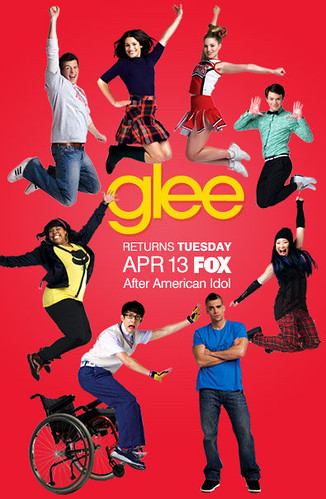
glee poster with singers jumping for joy against a red background. Artie, instead of jumping, is falling out of his wheelchair.

Look at those singers! They’re so happy! They’re jumping for joy! They’re smiling! Life is good! Well, except for Puck, who chooses to stand with his arms crossed, looking cool. That’s his version of happy. And, oh, except for Artie. Who can’t jump, because, LOL, he’s totally confined to a wheelchair, y’see. So he’s falling out of his chair. Looking terrified. What fun!

Worst of all? Fox loved this branding so much – they made three versions.

Continue reading Glee: Poster Children for DisabilityFail

Making “Invisible Women” even more invisible

One the arguments about why it is difficult to center the voices of women with disabilities seems to be that there just aren’t that many of us writing. Or maybe we don’t write in an easy-to-understand way. Or maybe we don’t write in a way that’s clear to people are currently non-disabled. Or maybe there just aren’t that many of us writing, so finding a good example of writing by women with disabilities to highlight is just very difficult.

Or so I’ve been told.

Certainly it’s something we at FWD have run into in argument after discussion. Reaching out to those with disability and inviting them to speak for themselves is hard. Our response has been, of course, to start this blog, but also to try and highlight the voices and experiences of others. We’ve had guest posters, of course, and have a weekday “recommended reading” selections that seeks out posts about disability written mostly by people with disabilities in their own voices. We have a lengthy blog roll that is just a tiny sliver of the disability-focused blogosphere. And by no means are any of these comprehensive. Every year I read Blog Against Disablism Day and am taken aback by the depth and breadth and variety of posts on the topic. We write, we talk, we sing, we sign, we compose poetry, we dance, and we express ourselves, all there in our own voices.

Heck, you’re all probably aware of some of the important rallying-cries of people with disabilities. “Nothing about us without us“, say, or “Autism Speaks doesn’t speak for me“.

I mention all this because I was surprised to read “Invisible Women” at the Human Rights Watch blog, originally published at the Huffington Post. It was written by Joseph Amon, who is the director of the health division at Human Rights Watch.

It’s an interesting article, and I do recommend reading it all. Here is the part of it that made me think, today, of the number of times people with disabilities are rendered invisible by social justice movements:

Women with disabilities are made further invisible because few statistics are collected that describe their numbers, and decision-making bodies in both the public and private sectors rarely include women with disabilities or consult with them. This makes it difficult to identify the key challenges women with disabilities face, or to advocate for targeted programs to address those challenges. Even when data about disability are collected, these figures are often not disaggregated by gender. Without a place at the table, women with disabilities cannot make their voices heard or their concerns addressed.

Until recently, women and girls with disabilities have largely been invisible even within the disability movement and women’s movement. The issues facing women with disabilities have not been priorities for either community. But that is starting to change.

You know what also renders us invisible?

Not allowing or inviting us to speak about our own oppression.

So many opportunities to allow women with disabilities – these invisible women – to talk about their experiences.

So many opportunities squandered.

Related: My experience at a disability-focused all-candidate’s debate during the provincial elections where the organizers refused to allow people with disabilities to ask questions because it would be “too difficult” for the candidates. The candidates were there to highlight their Party’s concerns and plans for people with disabilities.