Ableist Word Profile is an ongoing FWD/Forward series in which we explore ableism and the way it manifests in language usage.
Here’s what this series is about: Examining word origins, the way in which ableism is unconsciously reinforced, the power that language has.
Here’s what this series is not about: Telling people which words they can use to define their own experiences, rejecting reclamatory word usage, telling people which words they can and cannot use.
You don’t necessarily have to agree that a particular profiled word or phrase is ableist; we ask you to think about the way in which the language that we use is influenced, both historically and currently, by ableist thought.
Please note that this post contains ableist language used for the purpose of discussion and criticism; you can get an idea from the title of the kind of ableist language which is going to be included in the discussion, and if that type of language is upsetting or triggering for you, you may want to skip this post.
A month and a half ago I wrote a fairly angry email to Ms Magazine blog [which you can read here – yes, I sent it to them, no, I never got a response]. While part of my ire was raised by the subject matter and the treatment of people with disabilities as unthinking pawns of the “religious right”, a significant portion was because of the casual use of “the disabled”.
The short form of why this is a problem: People with disabilities/the disabled are not a collective group that all agree on anything. Asking what “the disabled” want or “the disabled” are doing is exactly like asking what “women” want and what “women” are doing. Women are individuals. Some of them are women with disabilities! We don’t all want the same things, but grouping everyone under the same umbrella, as though we are a Collective rather than Individuals With Opinions and Needs is… well, it’s pretty damned ableist, as well as being arrogant, ignorant, and irritating.
Long Version:
We’re still living in a society that makes a lot of casual assumptions about people with disabilities and their experiences. When people start talking about “the disabled” they are generally about to launch into some sort of stereotype – “the disabled are the pawns of the religious right”, for example. This boils down a lot of complicated people – people who have a wide variety of needs, wants, opinions, thoughts, and experiences – into one homogeneous group.
This contributes to the de-humanization of disabled people. “The disabled” aren’t people, they’re a big collective noun who can’t be reasoned with, can’t be talked to, can’t be considered – they’re just to be placated, and dealt with, and put out of our minds as quickly as possible in case they sue us.
Saying “people with disabilities” or “disabled people” may seem like a pretty minor thing. It is, so it shouldn’t be that difficult. The reason for it, though, is that it can be that small reminder: that people with disabilities are people. That disabled people have opinions and thoughts and experiences and needs that are not universal to all people with disabilities. That we are, in fact, people, and it would be nice if we could be treated as such.
Language doesn’t change everything. It isn’t an end in and of itself. But it can be the first step in combating the sort of ableism that makes it okay for many people – including editors and writers for major and minor news sources – to dismiss us as pawns without thought.
Don and I went to see this great romantic comedy a few summers ago. IMDB tells me we saw it in 2008. It’s called Easy Virtue, and it’s one of those delightful romps where a young upper-class English boy brings home his wild American wife who is older than him, basically to upset his parents. It’s set in 1929 and has all those great things that movies have when they’re set in that time period – jazz music, flapper dresses, British manners, cigarette smoking as sexy and cool, etc, etc etc.
The take-away message was that if you really love someone with Cancer, you’ll kill them if they have to undergo too much chemotherapy.
As this was around the same time as we confirmed Don’s cancer diagnosis, you can imagine that this kinda ruined the awesome movie-going experience for us.
So I come back to story after movie after very special episode where the person with the disability, the cancer, the catastrophic illness, gets themselves out of everyone’s way by killing themselves or begging others to do it for them. I remember every narrative where disability = evil, where disability = faked, where disability = a lesson, a punishment, a blessing in disguise, a test, a momentary difficulty that is healed when the bitterness goes away, because fictional disability never just is.
This continual fictional narrative of disability as trope is what makes me distrustful of disability in fiction. If I want to watch a show that appeals to me and includes people with disabilities treated realistically, I have to go back to Joe Dawson in Highlander. If I want to watch a fun movie romp, I’m back at Sneakers. If I want to have a long conversation about assistive tech, I’m at X-Men and Star Trek: The Next Generation. If I want to watch something that looks even vaguely like our lives, I’m at Joan of Arcadia. If I want to see a show where someone has some power, a love life, and just happens to have a disability, I’m somewhere in Season 2 of The West Wing.
Tell me stories about the people with disabilities I know: The ones who work hard every year to ensure an internationally renowned con is accessible to people with disabilities, the one who co-founded a successful social networking site, the ones graduating from university this month, starting it next year, struggling through grad school without enough support, parenting their children, advocating for their rights, organizing support in Chicago, running role-playing games, managing businesses, founding a successful feminist website, writing beautiful poetry, publishing academic papers, doing their rounds at the hospital, planning disability-focused conferences, planning tech-focused conferences, cooking dinner, making documentary films, getting through today, planning tomorrow, arguing with their parents, their children, their spouses, their friends, writing blog posts, drinking tea.
We are so much more than this, so much more than tropes, clichés, or tragedies.
[Trigger Warning for descriptions of violent thoughts of self harm]
Oh, by now, faithful readers, you know where we are about to go. We are about to go on a little journey into my mind, the scary place that it is, where I open the floor to discussion about the ways that, once again! Stars and Stripes has managed to get so much so wrong. Because tonight, gentle readers, as I clutch the place that might be close to where my duodendum is and sip my Korean Red Ginsing tea, which the lady at the market told me might help my indigestion, I am reminded once again that I am my mental health are nothing but a metaphor to be co-opted at someone’s convenience!
Let me give you a little background here, because the only online version I can scrape up is this e-version of the print edition, and while WAVE found no accessibility issues with it, I am not going to guarantee that it will be accessible to everyone or accommodating of everyone’s needs. It is, however, a way around their habit of not putting all of their content in their online version (and also allows deployed troops to access the daily paper as well). The front page has the story’s picture, of a white male soldier in Army Green uniform: a light green collared shirt, black tie, green jacket with various awards and pins, a black belt, a black beret, holding a rifle with a bayonet affixed to it. The text on the photo says “Model soldiers [break] Every detail counts when you’re trying to join the storied Old Guard”. The actual article starts on page 4 if you are so inclined to read.
The Old Guard is a ceremonial guard that headquartered out of Fort Meyer, VA, and performs most of its duties in Arlington National Cemetary, similar to the Navy’s Ceremonial Guard, in that they perform many military funerals daily with the cleanest of precision. Their military bearing is expected to be above and beyond that of any other in their branch of service. Their uniforms are expected to be ridiculously perfect, with exquisite attention to the finest aspects of the details, not missing a single loose thread or even a speck of lint. A scuff on your shoe could set you back a week in training. They stand grueling hours at “attention” (The Navy’s Ceremonial Guard does this while holding the business end of the rifle and keeping the butt parallel to the ground for hours, I do not know about the Army’s Old Guard. Full disclosure: I once and briefly dated a guy from the Ceremonial Guard). Everything you know about military bearing is wrong when you arrive for duty, and it is re-taught to “look better”, including the way you turn, march, stand, dress, and press your uniforms (you are even issued special dress white uniforms that are made to withstand the repeated ironing in the Navy Ceremonial Guard).
Do you see what I did there?
I was able to give you some brief background on the very strict regulations of the Old Guard and the Ceremonial Guard without using ableist language. I didn’t once have to compare soldiers or sailors who are required to iron their uniforms exactly right, or who are trained to notice when their medals are one sixteenth of an inch off from the proper dress line to someone who actually obsesses over things like drinking bleach or shoving cork screws in her eyes. Or what it would feel like to jump from a fifth floor balcony.
Because these, my gentle readers, are actual obsessions. They actually intrude on your thoughts and disturb your life, and are really very upsetting, I can assure you. They make you do things, like pull out your hair, burn yourself with a curling iron, wash your hands again and again, and pick at the little imperfections on your skin. Yes sometimes you even iron your uniform again and again and again because you just can’t get it right and double creases are the End of The Universe as We Know It, but it might be because you are certain that if you stop then you are going to iron your hand, not because your Leading Petty Officer is going to chew you out (or your whole division, I mean, does the article expect me to believe that the entire Old Guard has Obsessive Compulsive Disorder? Because that is not on the application!) but maybe because you recently thought that you might do something very harmful to someone you loved if you stopped holding that iron very tightly. Even if your LPO has put the fear of Cthulhu in you.
Being part of an elite military unit who is honored to be charged with memorializing the fallen and handing flags to their loved ones* or escorting the President or guarding the Tomb of the Unknown Soldier is a pretty powerful thing, I am sure. The end result of the intense training, of the weeks and weeks of repeated inspections and physical demands, might very well leave some people with OC tendencies or maybe even OCD outright I suppose — I am not a doctor I don’t know and I don’t pretend to know every experience — but it isn’t the same as living with a condition that sometimes (OK, often) inhibits your day to day ability to live, interact, and (here’s the important one) do your job because you are busy carrying out compulsions to get the damned obsessions out of your head.
Yeah, getting worked up over a uniform inspection? I bet it’s exactly like that!
Only, I’ve been there and done that and bought the cheap t-shirt (hell, I’ve been the OC girl who has had to prepare for uniform inspections!).
It isn’t anything like that at all.
*I want to also point out that the article, for those of you who aren’t able/don’t want to read it via the e-reader the requirements for Old Guard: Must be 5’10 or taller, must have combat experience, blah blabbitty blah. Nothing like another exclusionary Old Boys Club for the military, so they can sit around and pat each other on the backs about how Awesome! they all are. I might note, out of some Branch Pride that the Navy Ceremonial Guard frequently wins the Joint Service competitions and they have *gasp* women in their guard.
Oh, and those people receiving flags? Always widows. Always. Way to erase anyone else who might be a surviving loved one of a fallen troop, there S&S, Army, and anyone else involve. UGH!
Redstone Science Fiction is calling for contest submissions that incorporate the values discussed in the essay The Future Imperfect by Sarah Einstein.
What does a world, or space station, or whatever look like when it has been designed to be accessible to everyone and how would people live together there?
The submissions should portray disability as a simple fact, not as something to be overcome or something to explain why a character is evil. The submissions should also incorporate the portrayal of disability in a world where universal access is a shared cultural value.
Romance novel or western, detective serial or horror film, the genre of a text affects how we “read” it, including our understanding of disabled characters. Genre forms may impose constraints upon the creators of texts, such as a particular setting or narrative structure, but they may equally open up new possibilities for representation. In science fiction, for example, new technologies, alien bodies, and alternative environments can challenge understandings of what constitutes disability or impairment. Michael Bérubé speculates that the genre is “as obsessed with disability as it is with space travel and alien contact.” What opportunities (and what constraints) might science fiction present, then, with regards to disability representation? More generally, how do the structures and conventions of genre forms, such as the need for heroine and hero to be united in romance, affect the representation of disability?
This special issue of JLCDS will explore the interplay of genre and disability with a focus on popular genre texts, whether in fiction, film, television, or other media. Submissions might consider representations of disability in particular texts or authors, in specific genres, or in mainstream texts that enter into dialogue with genre; alternatively, they might examine disability theory in relation to genre theory, or the role of fan communities. This list is not exhaustive, so submissions on other topics related to disability and genre are very welcome.
I love looking at pictures of cute animals on the internet. Cats, dogs, monkeys, dolphins, turtles, otters – whatever. And I find that skimming through a few LOLcat macros during the workday can do wonders to perk up my mood or give me a smile before diving back into work. Which is part of why I get so annoyed when the LOLcat sites do something offensive or wrong – this is supposed to be my fun time, not my get-my-rage-on time! I have a whole other folder of RSS feeds for rage time!
So I got mighty cranky when I saw this at I Has a Hotdog, the spinoff site from I Can Haz Cheeseburger that has LOLdog macros:
A group of identical white pomeranians, with the caption "Multiple Personality Disorder: you're doin it right."
Ok, FOR CEREAL??? This is not only offensive, it doesn’t even make sense. A person with Multiple Personality Disorder (MPD), which is more commonly and more accurately termed Dissociative Identity Disorder (DID), does not manifest in multiple identical bodies. The whole point is that there is one body/mind that manifests multiple, distinct identities or personalities, called alter egos. A person who could split themselves into multiple identical bodies, all with distinct identities, is not a person with MPD or DID, but instead is some kind of magical self-cloning person who should probably be off fighting crime in Gotham City.
This underlined for me how DID is a go-to joke, a punchline often used in contexts or situations that make absolutely no sense to anyone who actually understands what DID is. It’s a lazy way to make a joke about a “bizarre” or “outlandish” mental illness without even taking time to understand the diagnosis being thrown around so cavalierly. For me, it reads as a shorthand “hahaha saying the name of a mental illness is funny isn’t that funny??”
I can’t imagine how this use of DID as shorthand for “exotic and hilarious mental illness” must affect people who actually experience DID. Given that the second google link when I searched for “multiple personality disorder” is to a site discussing whether MPD or DID actually exist or whether they are made-up movie illnesses, I imagine there’s an extraordinary stigma experienced by people with DID and an overwhelming tendency to doubt and discount their experiences at best, and to mock and ridicule them at worst. These kind of “jokes” only add to those issues. And they should not be tolerated.
Writing this last post has taken me a very long time, both because of my anger at the way autistics are talked about rather than talked to, or with, or given the opportunity to talk for themselves; and because I keep going over what I have to say here and wondering what makes me think I’m qualified to say it.
Actually, let’s just go back to the final sentence: “And though her son may never have had autism, Jenny insists, “I’ll continue to be the voice” of the disorder.”
The way I see it, one of two things is true:
1. Jenny McCarthy cured her son of Autism.
2. Evan never had autism in the first place, but may have had another syndrome, or have been developmentally delayed and “caught up”.
In either case, Jenny McCarthy is not currently the mother of an autistic child.
Tell me – why is Jenny McCarthy the “spokesperson” for “the disorder”? According to her no one in her personal life has it.
Not even delving into the bit where it’s incredibly different to be speaking for and about those who live with autistics and those who actually are autistic, I’m not entire certain what insight McCarthy is offering anyone. The idea that autism is like your child’s soul going away? That the best metaphor for autism is a bus accident? She describes a diagnosis of autism as the worst thing that could happen, and she’s going around and doing the talk shows and is the “spokesperson for the disorder?” How does that even make any sense?
That’s why this post has taken me so long to finish. Every time I start it, I wonder why the hell I’m writing it, instead of pointing people towards the writing of actual autistics.
[Here is a tiny sample:
Autiebibliography! [“This is a list (as complete as I could make it) of every piece of autobiographical writing ever published in book form by an autistic writer.”]
Just a tiny tiny sample. Each one has a blogroll. There are lots of autistic bloggers, including kaninchenzero and s.e. smith here at FWD. This tiny sample is just meant to be that. I encourage people to leave more links, including to their own blog, in the comments.]
The Times article argues that Jenny McCarthy peddles hope.
Well, here’s my hope: That in the future, autistics will be invited to speak for themselves.
Spoilers for Grey’s Anatomy, up and including to episode 6×21, How Insensitive.
Grey’s Anatomy, a sudsy USAn medical drama based around a Seattle surgical team, is one of those showers which I can love or hate. On the one hand, they have a cast of fabulous and complicated women – Miranda Bailey! Cristina Yang! Callie Torres! Arizona Robbins! It not only passes the Bechdel test in every episode, but the people of colour Bechdelesque test in most episodes – and, which is considerably more rare on popular television, the women of colour variant.
Disability, however, it’s not so good on. There’s a main character (Owen Hunt) with PTSD who is portrayed in fairly interesting and complex ways (though he’s a white man whose PTSD was acquired entirely “conventionally”, in battle), but as a show which is focused on experimental and heroic cures of ‘broken’ folk, there are also major issues. And the fat hate. Oh my, the fat hate.
The most recent episode swung wildly from a scene I absolutely loved, to a scene that was so full of ableism that I was barely able to get through it. So I thought I’d share.
Background: a disabled, very fat man, Bobby Corso, has been brought in to hospital with abdominal pain for investigation. Bailey has attempted to offer “sensitivity” training to the residents, who are pretty much failing across the board. The residents are sitting eating lunch together; the woman who comes in is Mrs Corso (do we even learn her first name?), who is pregnant.
Transcript:
Yang: Let’s say [picks up a skinny chip] this is the wife.
Meredith Grey (looking horrified): No! Don’t do that.
Yang: And this… is him! [picks up large hamburger, bursts out laughing]
Karev: So I won’t be eating that now.
Yang: She’s gotta be on top.
[Lexie Grey smiles.]
Karev: She’s gonna get altitude sickness. [bursts out laughing]
[Mrs Corso, a slim blonde white women, is walking past. She stops and looks at the gang.]
Mrs Corso: It’s alright. I get it. [approaches table] You’re trying to figure out how my husband and I managed to get a baby in here. [Gestures to abdomen, smiles.] There are some logistics involved. Do you want me to tell you?
[Lexie and Meredith look abashed.]
Mrs Corso: [still smiling] But first! How about you tell me how you like to do it with your husband? Or your girlfriend? Any favourite positions? Or kinks! [wide smile] Let’s talk about that! Because I know you all must have a freakshow of your own goin’ on! Who wants to go first?
[Yang and Karev look abashed.]
Mrs Corso: No. Nobody? OK. [more serious] Well it’s probably none of my damn business anyway. [long look. Walks away. All the residents look abashed.]
[Cut to Bobby Corso lying in a hospital bed. Ex-chief surgeon Dr Richard Webber is standing with Mirand Bailey by his bedside.]
Webber: The fat under your skin has become necrotic. Has – has died. And the infection is eating through your skin.
Corso: Huh [wry semi-laugh]. I suppose it had to come to that. I’ve eaten everything else.
Webber: The operation is extremely risky. You have a higher than normal chance that a surgical complication could kill you.
[Karev enters the room.]
Corso: If I don’t have the surgery – I die? [Webber and Bailey look serious.] How long will I have, do you think?
Webber: Mr Corso, you want the surgery. You want to try –
Bailey: You have a baby on the way. Think about that.
Corso: Who do you think I’m thinking about? You dream of having a kid. [sentimental piano/strings music starts up in the background] You picture yourself playing ball with him. You picture her standing on your feet while you dance around with her, you know? You don’t picture them bringing you food and [disgusted look] cleaning you up. I can’t walk four steps to go to the bathroom. You tell me – who deserves that guy as a father?
[Bailey and Webber look at each other, as if to say, ‘He has a point.’]
Corso: I just wanna be gone before the kid has a chance to know who I am. Don’t – tell my wife about this, ok? Just tell her it’s too risky. Let me go home.
[Mrs Corso enters.]
Bobby Corso: Hey, peanut.
Mrs Corso: What’s going on?
This video clip starts off great. Someone is finally speaking up and telling this rude, obnoxious residents exactly what is and isn’t their business when it comes to their patients’ behaviour and bodies. She’s rocking my world!
But then, it all comes crashing down, with the treatment of Bobby Corso’s disability. I felt like his little speech reflected the ideas of the writers: If you can’t walk and dance, if you can’t independently wash your own body, no child ‘deserves’ you as a parent, and you don’t deserve to be a parent. Especially when your disability is, in society’s fucked-up opinion, your own damn fault. It’s only sensible to think that you’d be better off dead, that your children would be better off never knowing you. The tragedy is not your acute infection and your possible impending death, but your very existence. Doctors understand this, though they may go through the motions of challenging it (in paternalistic ways that include telling you what you ‘want’).
There’s a further rage-inducing scene where Mrs Corso scolds Karev, saying “You don’t know that inside all that is the same man I’ve always known”. I think the writers are making it clear, again, that like so many people in our culture, they don’t see fat people and disabled people as full humans at all. They want to believe that there’s a “real person inside”, meaning a thin abled person; while the actual person, the actual body, is a facade that can be dismissed and pushed aside in disgust. Disabled bodies are not real. Not authentic. They don’t really count, and we’d rather not think about them. The only way some people can value PWD as humans beings is to pretend that “beneath” their disability, there is some other person that doesn’t make the person with the abled gaze feel uncomfortable. With this cognitive sleight-of-hand, abled folk get to pretend that they’re oh-so-terribly accepting and magnanimous, while lovingly maintaining the care and feeding of their disgust and hatred of the disabled body.
Later in the show Karev abandons his sensitivity training and yells at Corso, calling him selfish for planning to “leave a 700-pound mess for your wife to clean up”. Corso has surgery and survives the operation, in which he is serendipitously found to have a perforated diverticular abscess on his bowel; his presenting abdominal pain had been misdiagnosed as being due to his subcutaneous infection. He pledges, with the badgering of his doctors, to diet. The take-home message? The only way someone who can’t walk or clean themselves could reasonably be a parent is if they go to strenuous efforts to cure themselves, and succeed, first.
An aside-ish sort of a question: Can anyone think of any TV shows or movies (or books, if you like) which pass a disability Bechdelesque test?
1. It has to have at least two people with disabilities in it
2. Who talk to each other
3. About something besides an abled person.
Or please feel free to discuss the clip and the issues raised in it.
People seemed to like the first edition of this series! So here are some more music videos set in psychiatric hospitals! In the last post, all of the videos used the mental hospital setting as a visual demonstration of the depth and intensity of love, depicting institutionalization as a result of loving someone a whole lot. These videos do not do that.
One video that especially doesn’t do that is Green Day’s ‘Basket Case’
Visually, the video seems similar to the previous ones. The band plays in the common room of a mental hospital in which they are patients. There is no padded room, but several people are being wheeled around passively as if they are catatonic or sedated. Later in the video, both staff and patients appear wearing masks from Terry Gilliam’s Brazil. So what is different? The song itself (lyrics here), which is about lead singer Billie Joe Armstrong’s struggles with anxiety and panic attacks. So while in the same setting, instead of declaring his love for someone, he is saying:
Sometimes I give myself the creeps
Sometimes my mind plays tricks on me
It all keeps adding up
I think I’m cracking up
Am I just paranoid?
Am I just stoned?
On the opposite end of the spectrum, there’s Eminem with the video for “The Real Slim Shady.”
There’s a lot going on in this video and I really don’t want to describe or discuss very much of it at all, because it is offensive up and down and across and diagonally in 17 different ways. (Wikipedia has a very detailed description of the video and an explanation of all the references and insults in the lyrics and the video.) Let’s focus just on the portions set in the mental hospital, where Eminem and other patients, in scrubs or hospital gowns, fidget and wander in a waiting room while Kathy Griffin and another nurse try to control them and hand out their medications. It is just as cliched as the other videos’ portrayals of hospitals, but seems to be played for laughs. And the message of the song and the video are that Eminem is so much better than other celebrities and musicians, so much more clever and original and “real,” that he’s been institutionalized to control him for speaking truth to power. This message could be read as a good reminder of the use of institutions to control and punish people both with and without disabilities for being political and advocating for their rights! Like happened just recently! However, the whole rest of the song and the video is so puerile and hateful that the comparison itself is offensive.
Ugh. I dislike Eminem very much.
Let’s move on and look at a video that is utterly ridiculous and is a tie-in to a movie that is also utterly ridiculous – Limp Bizkit and ‘Behind Blue Eyes,’ from the Halle Berry movie Gothika:
I have a really hard time doing any kind of critical analysis of this video due to the aforementioned ridiculousness factor. The song (lyrics here), which was originally written and performed by The Who, can be read as expressing the lived experience of mental illness? Maybe? But the video – which starts with Limp Bizkit lead singer Fred Durst as a patient in a phsyciatric hospital and Halle Berry as a doctor, and then they kiss, and then they have magically switched bodies? souls? something? So now Berry is the patient and Durst is the doctor! Gothika the movie featured Berry as a doctor in a psychiatric institution who became possessed by a ghost and murdered her husband and then was a patient in the institution but only because of ghostly possession, not because she had a mental illness or anything. But even putting all of that ridiculousness aside – and that is a boatload of incomprehensible creative choices – Fred Durst’s efforts to engage in “acting” when he becomes the doctor and leaves Berry in her padded cell make me laugh so hard it’s impossible for me to focus on anything else in the video.
I have a few more videos for a part 3, but if you know of any I’ve missed, please let me know in comments!
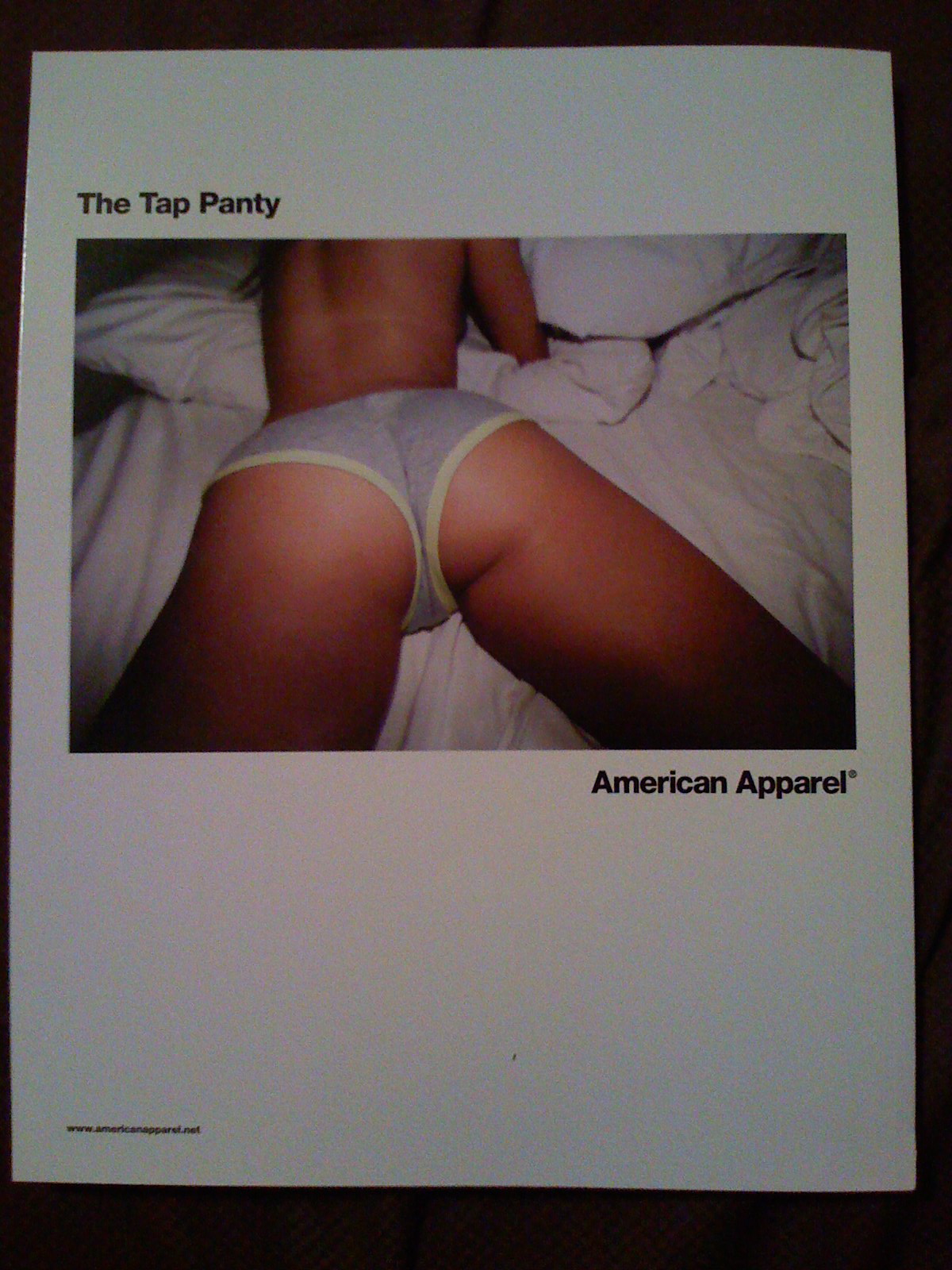
Oh, American Apparel. For those of you lucky enough to evade their reach, AA is a good company with a lot of problems. They started out selling themselves as the sweatshop-free, made in the USA, source for cotton basics like t-shirts, primarily wholesaling to people who would print and resell the clothes. In 2003, AA got into the retail business and started aggressively developing their brand, largely through their … controversial advertising style and campaigns.
The ads feature “ordinary girls” who tend to be young and thin (they’ve been described as “pre-pubescent“), are mostly white, and are often nude and/or in sexually suggestive poses. It is heavily featured on their website and in their stores, and the store employees are selected to resemble the ad models. I don’t want to post any of the images here, but you can see some examples here, here, and here (NSFW? Potentially? I wasn’t even looking for bad ones – those were the first ones in the Google search.). I live in Los Angeles – where AA is based – and I can walk to at least two AA retail stores from my house. There are billboards and store displays and newspaper ads and posters of AA ads seemingly everywhere I look, and beyond that, I see the same style replicated in other magazines and videos and tv shows and …
So when I saw the photo exhibit “American Able” float across my tumblr dashboard this afternoon, I was really excited. The photographer, Holly Norris, explains the project:
‘American Able’ intends to, through spoof, reveal the ways in which women with disabilities are invisibilized in advertising and mass media. I chose American Apparel not just for their notable style, but also for their claims that many of their models are just ‘every day’ women who are employees, friends and fans of the company. However, these women fit particular body types. Their campaigns are highly sexualized and feature women who are generally thin, and who appear to be able-bodied. Women with disabilities go unrepresented, not only in American Apparel advertising, but also in most of popular culture. Rarely, if ever, are women with disabilities portrayed in anything other than an asexual manner, for ‘disabled’ bodies are largely perceived as ‘undesirable.’ In a society where sexuality is created and performed over and over within popular culture, the invisibility of women with disabilities in many ways denies them the right to sexuality, particularly within a public context.
The photos are amazing! They are spot-on emulations of the AA ad style, but feature Jes Sachse as a model. Sache, who in another amazing photo project explains that her spine was fused as a child, looks enthusiastic, playful, sexy as hell, and very different from AA’s usual TAB models. The photos are all copyrighted so I can’t embed any of them here, but I really strongly encourage you to click through and look at the whole series!
There has been some discussion of whether this art project “works”, in terms of making the intended point of mocking the original ads and portraying a woman with disabilities in a positive and sexualized context. I’m not sure that’s a concern for me – I can’t see these photos gaining enough exposure or distribution to cause any serious harm to PWDs, even if people do feel disgusted or upset at the images. For me, their true power is how they both quickly and precisely underlining the narrowness of the American Apparel view of beauty, while demonstrating that PWDs can be enthusiastically sexual. Ms. Sachse looks like she is having a blast, which also makes me happy.
After reading Anna’s recent post on Janelle Monae’s ‘Tightrope’ video and how it “is a great example of how not to completely screw up representation(s) of disability,” I started remembering other music videos set in psychiatric hospitals. And then I started watching all these music videos!
One of the earliest I remember is Melissa Etheridge’s ‘Come to My Window.’
In the video (lyrics here), Juliette Lewis is in a bare room with a cot-like bed and a barred window. She wears a white tank top and white srub pants and has a white bandage around her left wrist. She paces, climbs, cries, scrawls on the walls and the floor. Intercut are shots of Etheridge, singing with an acoustic guitar and an old fashioned microphone. At times, the song stops and Lewis speaks/screams the lyrics in the bare room. At the end of the video the bandage comes off Lewis’ wrist and there is no cut or scar.
I feel kind of neutral about that one – I think the ending can be read either as “she was never crazy the whole time!” or as “she’s healing and going to be ok!” and both are somewhat problematic. But neither is it overtly offensive. For that, you have to look for N’Sync’s video for “I Drive Myself Crazy” (I bet you can guess where they’re going with this…)
The video (lyrics here) has segments of each of the band members with their girlfriends and then breaking up with them – inter cut with scenes of them in a psychiatric hospital, acting as stereotypically “crazy” as is possible. (Although wearing satin pajamas, inexplicably.) Clearly meant by the band to be a lighthearted and humorous video, the “joke” is that losing the girlfriend has been so traumatic that the band members have been rendered “crazy.”
Another video featuring psychiatric commitment as a result of losing a romantic partner is Missy Elliot’s “Teary Eyed.”
In the video (lyrics here), Missy Elliot breaks up with a boyfriend, follows him to a building where he is with a new girlfriend, and slashes the tires on his car, causing a horrible accident that kills him. She is sentenced in a court and goes to jail and then presumably to an institution for the “criminally insane.” There are several scenes in a stereotypical padded room, where Missy and sometimes backup dancers wear and dance in straitjackets. While this video certainly brings more seriousness to the subject, it’s hard to argue that it’s portrayal of people with mental illness was any more positive or accurate.
A video I have much more mixed emotions about is Bjork’s video for Violently Happy:
The song (lyrics here) is about the wild and overwhelming emotional exuberance that can go along with love and has long been a favorite of mine. But the video – featuring Bjork and other dancers shown individually in a stark padded room – seems to depict that emotion through the imagery of a psych hospital. I’m not entirely sure how to read this video – is it mocking or endorsing equating of the flush of love with psychiatric disorder? Why is everyone cutting or shaving their hair? – but overall it leaves me with a vaguely icky feeling. (Precise language, I know.)
I had to take a little break after watching those four. All of which depicted almost cartoonishly stereotypical “mental institutions,” with bare cots, padded rooms, and straitjackets. All of them drew parallels between psychiatric hospitalization and jail – the room in Ethridge’s video was bare like a jail cell with bars on the wall, the N’Sync boys were kept in line by guards, and both Bjork and Missy Elliot were straitjacketed in padded cells, Elliot having been sentenced there for her crimes. But none of this directly relates to any actual mental illnesses or disabilities. Instead, the videos co-opt the symbols and accessories to illustrate the extremity and depth of the singer’s emotions. And in all the videos it’s the same emotion being felt so extremely and deeply – love.
Thus concludes Part 1 of Psychiatric Hospitals and Music Videos! Check out Part 2 to see if these patterns continue!