Tag Archives: ableism

Less Than / More Than – My complicated thoughts on reproductive rights & feminist discussions

When I’m not being a student, I typically get temp jobs working in a variety of offices. Once things get settled, and folks realise I am married, they often start asking about kids. “Do you have kids? No? When are you having kids? It’s not too late, you know!”

This may seem like an opening for a post about being child-free, but it’s not.

I often put these questions off with flippancy or a shrug or just saying we’re not interested in having kids. In my experience, this will often have people leave the issue be.

Sometimes, though, people will hound and hound and hound.

“Oh, it’s different when they’re yours. But what about Don, what does he think of all of this? What about your parents? What about– what about– what about?” [1. Everything in quotation marks in this post is a paraphrase.]

Do you want to know the secret way of getting people to never again ask why you’re not having children?

At some point, drop into a conversation that your husband’s disability is genetic.

Without fail, that has stopped every single person who has asked and asked and asked about children, even when the “genetic” bomb isn’t dropped in a conversation about having children.

One of the reasons why the focus of abortion! abortion! abortion! whenever talking about reproductive rights really bothers me (and a lot of others) is because of the assumption that people like Don & I shouldn’t have children (because – oh no! – the child likely will have Marfan’s just like Don! And everyone knows people like Don are a burden on the system/have miserable lives/are never happy/can never be married/are all the same/should be stopped/are just an example for the rest of us). When people focus on reproductive rights only involving abortion, they neglect that, for people like us, the pushback is to not have children. Don’t burden the system. Think of the children – and don’t have any.

I’ve seen similar conversations play out around the feminist blogosphere. [1. I have decided not to link to specific examples, because it’s a general attitude I’m talking about here. And also, who wants to start a blog-war? Not I, said the Anna.] When older women have children, there is always a sudden upswing in “BUT THE CHILD MIGHT HAVE A DISABILITY!” (Yes, the child might. And the child might fall out of a tree and land wrong. Or the child might grow up to be the next Stephen Harper and prorogue Canadian government. WHO KNOWS!) “Think of the children!”

The same fears are reflected when discussing women with disabilities having children (with bonus “but how will she care for the child?”), or when parents forcibly sterilize their disabled daughters.

This pains me, perhaps especially as someone who doesn’t want children. It pains many other women who, for a variety of reasons, are discouraged or outright prevented from having children they want. That, in North America, these women are overwhelmingly women of colour, lower class, disabled, queer – that they’re often women who have been institutionalised in some way, be it a “medical” institution or a “criminal” one – is not a coincidence.

In my experience, marginalized voices who speak out about this disparity between on-line feminist discussions of abortion and on-line feminist discussions from a broader reproductive justice framework [1. FREE Halifax: Feminists for Reproductive Justice & Equality. We meet every other Tuesday for teach-ins & movies about Reproductive Justice. Look for us on Facebook.] are often shouted down, or ignored. We’re told our issues are “special circumstances”, or “pet projects” or “in the minority” or “don’t apply to as many people” or … Well, basically everything feminists in general are told when they talk about issues that are “special circumstances” that don’t apply to enough people (read: men) to count.

Frankly, I end up not knowing where to go from here. Do we, who are limited on spoons or forks or energy or time, keep trying to push for more mainstream feminist discussion on these issues? Do we form our own spaces, our own groups, and have our own discussions? Do we write blog posts that seem to dwindle down, rather than lead us all into the future?

I don’t know. I know and respect people who have made each of those choices, and still others that I haven’t mentioned. But I don’t know what the right one is.

Maybe they all are.
Quoted: Karl Michalak, “Face Value” (excerpt)

Everything healed up
but in a very strange way
Years later
when it was very obvious
that something was very wrong with my face
everyone
said one or more of the following:

It’s the Lord’s will.
Just learn to live with it.
It’s all in your imagination.
Don’t be so self-centered.
Shut up and do your homework.
Other people are worse off than you.

[Full text available in the 2004 anthology Queer Crips: Disabled Gay Men and Their Stories, edited by Bob Guter and John R. Kilacky.]

Does Outright Speculation Make This Disabled Feminist Angry?

Answer: Yes.

Let’s talk about this piece-of-crap article recently published on that oh-so-“liberal” news n’ culture site, Salon.com. I’m prefacing this post with a warning for ableist language and concepts on the part of the article’s author, Rahul K. Parikh, M.D. The article begins as follows:

There was a time when a celebrity’s sudden death almost invariably meant illegal drugs…[a]nd so it seems with Brittany Murphy, the bubbly and bright actress who died of cardiac arrest at 32.

Yes, it seems. Point is, we don’t know much yet. There are other health-related issues or conditions that can lead to cardiac arrest, but is this acknowledged? Of course not! Parikh continues:

The coroner’s notes allegedly claim a pharmacopia in Murphy’s bathroom cabinet: Topamax (for seizures or migraines), methylprednisolone (a steroid), fluoxetine (an antidepressant), Klonopin (for anxiety), carbamazepine (for seizures or bipolar disorder), Ativan (for anxiety), Vicoprofen (pain reliever), propranolol (for hypertension, migraines or anxiety), Biaxin (an antibiotic), and hydrocodone (a narcotic pain reliever). Gone are the days of shameful crack pipes and empty gin bottles.

OH MY GOD, EVERYBODY PANIC.

Murphy’s medications, like those of [Heath] Ledger and Anna Nicole Smith, are on the shelves of your local drugstore, available with a simple trip to the doctor — or doctors — whom you merely need to convince that you need the stuff. Did one doctor prescribe her those meds? Did 10? We don’t yet know. But as a doctor myself, I just kept wondering (and not for the first time): What if doctors were more like librarians? Would Brittany Murphy still be alive?

Cue scary music! THE DANGER IS ON THE SHELVES OF YOUR LOCAL DRUGSTORE. Nevermind that people with chronic pain conditions and disabilities have to jump through numerous, often ridiculous hoops just to get, say, a month’s supply of medications that help them function and/or live life to the fullest extent possible. As one of these people, I am of the opinion that Parikh is being rather disingenuous here; these drugs, at least for us “average” folk with chronic pain issues, are usually not easy to obtain.

After nattering about how the medical field should follow the example of public libraries when it comes to monitoring people and their books meds, he continues:

One of the many negative consequences of such fragmentation is how ridiculously easy it can be to get drugs. Most doctors know patients who have desperately angled to get a prescription they don’t need, usually highly addictive pain medicines like Percocet or OxyContin. This is what we call “doctor shopping,” hopping from one physician to the next until they find someone willing to write a script. When the supply dries up, they go to another doctor, and then another. One 53-year-old man in California visited 183 doctors and 47 pharmacies in one year to support his addiction to painkillers.

Hey, nice use of anecdata there! What on earth does one 53 year-old guy in California have to do with Brittany Murphy’s situation? As for “most doctors” knowing a patient who has “angled” for meds they “don’t need” (who makes that judgement, I wonder?): cry me a goddamn river. The endless Helen Lovejoy-gasping about ADDICTION!!1 in fact makes it incredibly hard for some of us who need these medications to obtain them, and no amount of 1984-esque War is Peace anecdata–from someone, no less, who is supposed to help people in pain as part of his chosen occupation–is going to change that.

In short, the experiences of people with chronic pain are going be different than those of an able-bodied doctor, but nowhere is this acknowledged in this article–nor is it mentioned in many larger conversations about  painkillers and (possible) ADDICTION!!11.

Most of us who need these medications do not have the energy to doctor-shop. I do not wish to deny that painkiller addiction is a serious problem; it is, for some. Sadly, these sorts of “conversations” on the specter of supposedly widespread PAINKILLER ADDICTION!!!1–much like those focusing on the OBESITY CRISIS!!11–tend to focus entirely too much attention on extreme cases and anecdata, leaving out those who need these medications for legitimate medical reasons, and, I might add, some of whom spend a great portion of time proving said legitimacy in order to show that they are not addicts or doctor-shoppers.

But if “preventing” ADDICTION!11 in able-bodied people via endless hand-wringing about who “really” needs these drugs versus who doesn’t is the number one priority here, that is a problem. Yet again, the needs of those who are judged by society as most “important” or productive or fitting into able-bodied society are taken seriously, and the needs of those who do not fit this mold–because they need painkillers for actual pain and are therefore bad/unproductive/just a bunch of whiners–are ignored, or worse, actively shamed and castigated for things or circumstances that they cannot control.

And, as OuyangDan pointed out so eloquently on this very blog, there are a lot of things that we don’t know about Brittany Murphy’s death. Using her death as a poorly-researched, almost totally speculative “example” of the dangers of painkiller ADDICTION!!11 is not only tasteless, but it distracts from how ridiculously the concerns about painkillers, “legitimacy” and the specter of addiction are often framed by (mostly privileged) people who do not deal with these things in their daily lives.

Less infuriating: Many of the commenters seem to agree that this article and its “speculation” went too far, which is unusual for Salon commenters, as most of them tend to exemplify the worst of privileged white “liberalism” on a regular basis (as you would expect, this includes loads of abled privilege and the anecdata to back up their uninformed opinions).

On Speculation and Boundaries…

Brittany Murphy died today.

It took exactly five seconds for the speculation to start up about why she would die of cardiac arrest at the tender age of 32, and not quite double that for the snarky comments to seep out of the woodwork. Because certainly if she had an existing heart condition we all would have known about it, since we have that right to her privacy.

What we have, much like the public consumption we have of celebrities, especially women, is a perceived right to make snap judgments about their lives and their health.

Brittany Murphy’s death is tragic on its own merits. She was talented and only 32.

And if there is any truth to the speculation, then she was sick. If she was indeed sick, then we, despite what we think, do not have a right to flaunt that illness about. She was ill, and she lost. And to me, that means something, on a human, and mortal level. There but for the grace and all of that. When I read the comments that speculate about what illnesses she certainly had or what addictions would be necessary to cause this premature death it is like nails on a chalkboard while chewing tinfoil whilst walking on broken glass but not the fun Annie Lennox version with adorably mistreated Hugh Laurie. If there is any truth to it then she was one of us. She was possibly like me and she lost. That scares me at my core. That was one of us in there and instead of having a moment to appreciate the gravity of that we are ripping her apart and we don’t even know. We Don’t Fucking Know.

Also, last I checked it is bad form to speak ill of the dead. But I suppose I am still an idealistic, silly girl to expect people to treat other people with human dignity. I have spent too much time in social justice for that.

If not, then her death was simply a tragic and random happenstance.

If any information is released, we have to wait for it and presume that it is the truth, and if not, we have to go on with what we have.

And either way, it isn’t our business, really.

She died, and that itself is enough. It should be. She gave us entertainment and amusement. She did what she loved with her life.

We should give her a modicum of respect in death.

May she rest in peace.

Book Review: Bright-Sided: How Positive Thinking Has Undermined America by Barbara Ehrenreich

A word of caution: This review is going to be quite short, as I have been struggling with “getting words out” for the past few days. Regardless, I think this is an important book, and might be of interest to my fellow FWD-ers (bloggers and commenters!).

I touched upon the whole positive thinking movement (and why it offends me) at this very blog a while back; I’ve long had problems with the “Just think POSITIVE!” suggestion and attendant movement, and one piece that really got to the root of things, at least for me, was Ehrenreich’s 2001 essay, “Welcome to Cancerland,” which is about how positive thinking–bejewelled and be-ribboned with a heaping helping of traditional femininity and stereotypes about women, and particularly women who have survived breast cancer–has, for lack of a better word, swallowed the breast cancer “awareness” movement. [The essay is available at her website.] A revised version of the essay appears as the opening chapter to Bright-Sided, and Ehrenreich adds just enough salient facts to make reading the newer version worthwhile and not at all confusing to non-sciencey types like myself. (Ehrenreich has a PhD in Cell Biology.)

That said, the remainder of Bright-Sided proved to be a fast, engaging read. In fact, I wish it had been longer, and one chapter that could have used an expansion was the closing chapter on positive thinking’s effect on the recent U.S. economic crash. The book is also extremely U.S.-centric, but since positive thinking is one of those things that seems to have really taken flight in the North American consciousness, this is not particularly surprising. Unfortunately, with the exception of the breast cancer chapter, Ehrenreich does not specifically cover disability and/or chronic illness issues as they relate to the positive thinking movement. However, her book as a whole may have been designed to be rather “general” since the positive thinking movement impacts many people (for better or worse), not just those with disabilities. This generality is both a strength and a weakness, and I think Ehrenreich’s writing saves her points from being too non-specific.

I will leave you with a quote that stuck with me, from the book’s second chapter:

But in the world of positive thinking other people are not there to be nurtured or to provide unwelcome reality checks. They are only to nourish, praise and affirm. Harsh as this dictum sounds, many ordinary people adopt it as their creed, displaying wall plaques or bumper stickers showing the word “Whining” with a cancel sign through it. There seems to be a massive empathy deficit, which people respond to by withdrawing their own. No one has the time or patience for anyone else’s problems…When the gurus advise dropping “negative” people, they are also issuing a warning: smile and be agreeable, go with the flow–or prepare to be ostracized. (56-57)

Disability 101: What is Able-Bodied or Abled Privilege?

What is able-bodied or abled privilege?

The term able-bodied/abled privilege refers to the numerous benefits—-some hidden, many not—-that many societies and cultures accord to able-bodied and/or abled people. Despite many folks’ paying lip service to notions of equality for PWDs, the chronically ill, people with psychiatric conditions, and those with chronic health conditions, abled privilege still exists, and there are still a lot of people who are resistant to the idea of a truly equitable, accessible society. Able-bodied and abled privilege is often hard for non-disabled people to spot; yet, in the words of the famous Palmolive dish soap ad, [YouTube link] most of us are “soaking in it.”

Many cultures have social expectations, structures, cultural mores, and institutions that are set up to accommodate able-bodied and/or abled people with the most ease; this is, of course, problematic for those who do not fit the standard of “able-bodied,” or “fully able,” whether in whole or part. Able-bodied or abled privilege also encompasses things like not having to worry about one’s energy level and/or pain level on any given day, the possible negative reactions of others to one’s needs due to his/her/zie’s disability or chronic condition, being stared at or questioned about (with varying degrees of invasiveness) his/her/zie’s disability or condition by strangers, her/his/zie’s ability to move for long distances or on a variety of surfaces without inconvenience/discomfort/pain and at a pace considered “appropriate” by others, being able to make decisions about the course of one’s medical, psychiatric, or other type of treatment without being questioned by others as to whether he/she/zie is making “the right choice” or can make a “rational” decision about his/her/zie’s own treatment-related choices, or being ignored by able-bodied people when one needs assistance in public; these kinds of able privilege masquerade as “the norm” for those without disabilities. For more examples, see Rio’s update on Peggy McIntosh’s famous article “White Privilege: Unpacking the Invisible Knapsack” [link goes to Amptoons].

An earlier version of this post was originally posted at Faces of Fibro on May 6, 2009.

A brief PSA on language

So many people have complained that it is asking too much of abled people to stop using words they consider trivial: crazy, insane, lunatic, idiot, moron, dumb, blind, etc.

I beg to differ.

You know what is really damn easy? Erasing these words from your vocabulary. All you have to do is stop saying them.

You know what is really hard?

Confronting people on their use of same language.

We aren’t even asking you to do the hard work. We aren’t asking you to tell other people to stop using that language. We aren’t asking you to confront other people on their use of that language. We aren’t asking you to explain why it is problematic, to answer people’s questions, to deal with their redirection tactics, or to handle the attacks on and harassment of the people negatively affected by that language that such confrontations always seem to draw.

You don’t have to take the brunt of it. You don’t have to deal with the negative consequences. You don’t have to face employment discrimination, street harassment, caretaker abuse, and other people’s general cluelessness about our lives. You get to sit tight in your privilege, enjoying it without even realizing you’re doing it.

All you have to do is cut a few words out of your speaking and/or writing vocabulary. That’s it.

We’re the ones who are putting our safety on the line trying to change the cultural system that oppresses us.

Two seconds to reconsidering what you’re really trying to say? Easy.

Changing other people’s deep-seated attitudes? Really damn hard.

How do you think we feel when you complain that two seconds is just tooooo haaaaard for you to take on?

(Cross-posted at three rivers fog.)

“Bad Cripple”

Last month, I went to a non-partisan Campaign School, where women learned the nuts and bolts of running a winning campaign for political office in Canada. We all said a bit about ourselves, and I stood up and introduced myself as a Disability Rights Activist.

I spent the rest of the weekend being told how “Bad Cripples” are ruining the system for everyone else, and how every problem that I discussed, from how low disability-support payments were to how difficult it is to get around the city with a wheelchair, was caused by That Person.

You know That Person. The one Everyone Knows who doesn’t have a real disability. They could work – of course they could! – they’re just in it to scam the system. This One is bad because whatever he claims about his disability, it’s obviously exaggerated because no one could be in that much pain. That One is bad because she decided to move to another province where the disability support payments are better – obviously she’s just in it for the money.

Regardless of where someone fell in the political spectrum, they felt it very important that I knew that it wasn’t the government’s lack of support for people with disabilities and their families, it wasn’t the surplus of societal barriers, it wasn’t even their own individual fears of disability that caused any financial distress. It’s those Bad Cripples who scam the system and totally ruin it for the Good, Deserving Ones.

People tell me anecdotes about Their Friend (or a Friend of a Friend) who totally confessed to scamming the system, or they tell me about how Their Friend isn’t really disabled, and they can tell, because of X, Y, or Z.

I’m going to confess something to you: According to the way a lot of people define “Bad Cripples”, Don and I are really Bad Cripples.

I’ll start out with the comments. Both of us have very bleak senses of humour, and both of us (me especially) say some of the most awful things. These include things like “I just married him for the disability cheques,” “Damn it, I should have lied and told everyone your Cancer spread so I could get extra time to finish my assignments,” “Oh, Don fakes not being able to talk very loudly so he doesn’t have to deal with the Student Loan people”, and even “Oh, the wheelchair’s just for show.”

You might be thinking “That’s obviously you joking around, Anna! No one really thinks you’re serious.”

Yes, yes they do. All the time. I’ve been talked to by professors about my joking comments about Don’s Cancer, and asked not to make them in front of other students. I’ve gotten really angry @replies on twitter about some of them. I have an email I can’t quite get myself to delete that’s all about how I’m a horrible wife who’s just using Don for his money.

I have no doubt that people have said, either to you or someone you know, something that sounds like they’re just gaming the system, including a breezy “Oh, I’m just gaming the system.” But you have no idea if they’re serious or not, or what their circumstances are, or how much pressure they’re under, internally or externally, to “pass for normal”.

The second reason people think of “fakers” is the “I know stories of people who don’t have real disabilities and they get all this financial support!”

Here’s the thing: I don’t have an obligation to tell you what my ability status is.

My ability status is between me and my doctor. I have made the choice to share it with a few friends, and my husband. I don’t have to tell you. I don’t have to tell my teachers. I don’t have to tell the pharmacist, the person who’s demanding I justify my tax-status, or my landlord. I have not discussed it with Student Accessibility Services on campus. I have not disclosed to the people on any of the committee meetings I’m on. I didn’t tell anyone at Campaign School.

Because it is none of their business.

I do not owe it to you, or anyone else, to explain why we’re raking in those big disability cheques.

I also want you to consider that you don’t always know what disability will look like.

You can’t tell by looking at my friend with the mental health condition that she tried to climb out a third floor window and jump because she couldn’t take the idea of another day at her job, but you can probably tell she isn’t working right now while she recovers from the experience. You can’t tell by looking at my friend that she was bullied so badly at work that she has panic attacks whenever she thinks of stepping foot in the neighbourhood of her former workplace. Until Don got his cane, and then his wheelchair, lots of people wanted to know why he wasn’t working – aren’t people who have mobility issues always in wheelchairs?

I know people who tell me “Bad Cripple” stories are trying to be helpful. They want me to know that they understand how difficult it is, and that if it weren’t for all those Bad, Faking Cripples out there, Don and I wouldn’t be living entirely off the largess of his family and my scholarship money. (The government expects that I should take out student loans to pay for Don’s medication that he needs to live. Oh goody – overwhelming debt in exchange for a husband who lives! Thanks, Nova Scotia! You continue to be awesome. Yes, the big disability cheques comment was a joke.) What I think they don’t want to do is question why it is so difficult. Bad Cripple stories give us someone – a conveniently faceless group that Doesn’t Include Us – to blame.

I think a lot of people are going to rush to tell me stories about how this all may be true, but they totally know of this person who is totally lying about being disabled. Please consider whether or not that anecdote will contribute to a conversation, or just remind people with disabilities that they’re viewed with suspicion and have to prove their status to you.

Ableist Word Profile: Wheelchair Bound

Welcome to Ableist Word Profile, a (probably intermittent) series in which staffers will profile various ableist words, talk about how they are used, and talk about how to stop using them. Ableism is not feminism, so it’s important to talk about how to eradicate ableist language from our vocabularies. This post is marked 101, which means that the comments section is open to 101 questions and discussion. Please note that this post contains ableist language used for the purpose of discussion and criticism; you can get an idea from the title of the kind of ableist language which is going to be included in the discussion, and if that type of language is upsetting or triggering for you, you may want to skip this post.

I considered making this entire post “People don’t like being told they’re wheelchair bound. Stop doing it. Try ‘wheelchair user’ instead. Thank you.”

Then I remembered how often that argument is rejected. [My favourite: But I don’t like the terms that people with disabilities prefer, and I’m way more important!]

[I used to make really flippant comments about how no one is actually bound to their wheelchair, in order to make people think about what their words meant. Then I started reading reports of people being bound to their wheelchairs and, in extreme cases, left to die. Flippant comments are less funny after that.]

Shackling language like “wheelchair bound” is problematic because it leaves the average listener with the idea, again, that wheelchairs are a tragedy. You’re stuck in one, and it’s horrible, and you can’t do anything or go anywhere and it’s so very very sad, and isn’t their life such a tragedy. Just because of being bound to that wheelchair.

The thing is, a wheelchair is the exact opposite of a tragedy. As the blogger at Accessibility Net in New Zealand put it:

I then explain: I’m not wheelchair bound. I’m not tied to the wheelchair. To use the term “wheelchair bound” implies *limitations*. When in fact, the wheelchair is a tool of freedom. It’s without that wheelchair that I am seriously limited.

So each time I am told I am wheelchair bound, the implied message I get is “you’re in a wheelchair, you’re limited”. Yeah, I’m in a wheelchair, it gives me wings!

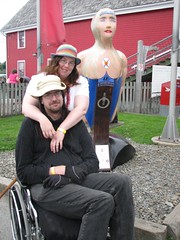
A white woman (Anna), sunburned and tired looking, stands behind a white man (Don), also sunburned and tired looking, in a manual wheelchair.  They are posed in front of a wooden figurehead of a mermaidThis certainly mirrors the experience Don had when getting his sexy sexy wheelchair of awesome. He went from not being able to get out of the house more than once a week, if that, to being able to not only go out several times a week, but doing it with only limited pain. The wheelchair opened up the possibility of our enjoying this strange, hilly city we moved to. [That’s us in the picture, after two days of handling the hills in historic downtown Lunenburg. Usually he uses an electric wheelchair, but we rented the manual for the trip. I vividly remember how exhausting getting up those hills were, which I think is obvious if you look at both our faces.]

Wheelchair user also reminds us who is (or should be) in charge of the chair. The person using the chair should be directing it, even if they’re not able to control it themselves. [This is a great post by Wheelchair Dancer about how to push a wheelchair. Learn it, live it, love it, folks.] When we talk about people who are using wheelchairs as though they have some agency, we’re reminding ourselves and others that they should have that agency.

Thirdly, wheelchair user is inclusive of people who are either full- or part-time wheelchair users. There are people who only have to use a wheelchair during high pain days, or in the winter, or after an accident, or for only six months, etc. “Wheelchair bound” always has an air of permanence to it, while wheelchair user can be both permanent or temporary, and using terms like full- or part- time wheelchair user reinforces the idea that folks who only use wheelchairs for certain activities aren’t faking a disability.

I hope this much longer version of my originally-planned post still gets at my basic argument: People don’t like being told they’re wheelchair bound. Stop doing it. Try ‘wheelchair user’ instead. Thank you.