Category Archives: social attitudes

A brief PSA on language

So many people have complained that it is asking too much of abled people to stop using words they consider trivial: crazy, insane, lunatic, idiot, moron, dumb, blind, etc.

I beg to differ.

You know what is really damn easy? Erasing these words from your vocabulary. All you have to do is stop saying them.

You know what is really hard?

Confronting people on their use of same language.

We aren’t even asking you to do the hard work. We aren’t asking you to tell other people to stop using that language. We aren’t asking you to confront other people on their use of that language. We aren’t asking you to explain why it is problematic, to answer people’s questions, to deal with their redirection tactics, or to handle the attacks on and harassment of the people negatively affected by that language that such confrontations always seem to draw.

You don’t have to take the brunt of it. You don’t have to deal with the negative consequences. You don’t have to face employment discrimination, street harassment, caretaker abuse, and other people’s general cluelessness about our lives. You get to sit tight in your privilege, enjoying it without even realizing you’re doing it.

All you have to do is cut a few words out of your speaking and/or writing vocabulary. That’s it.

We’re the ones who are putting our safety on the line trying to change the cultural system that oppresses us.

Two seconds to reconsidering what you’re really trying to say? Easy.

Changing other people’s deep-seated attitudes? Really damn hard.

How do you think we feel when you complain that two seconds is just tooooo haaaaard for you to take on?

(Cross-posted at three rivers fog.)

Guest Post: Learning to Write About Disability

Mouthyb is an MFA student, majoring in nonfiction. She teaches first year students writing and second year students creative writing. In February of 2010, she will apply to PhD programs to study the effect of class discrimination in the college classroom. She is too excited to spit at the thought of a longitudinal study of the ways poor students are sloughed from the academy, so that she can put together a series of pedagogical suggestions. Someday, mouthyb plans to put together an entire department designed to study the intersectionalities of class, but she will never leave the classroom if she can help it because that’s where the good stuff happens.

This is my first post for FWD, although I occasionally hang out at Shakesville and other feminist blogs. When I received an email invitation to write for this blog, I sat down to plan out a set of entries on the sexualization of disabled and poor women’s bodies and promptly discovered something new to me. I’ve spent the last four years writing about child abuse, domestic violence, about being a sex worker, being queer and poly, about class and academia. I’ve turned those pieces in to workshop and sat through hostile and cruel critiques, and gone back and done it again because I honestly believe that these stories need to be told.

But writing about my own disabilities is scarier for me than any coming out I’ve done before because of the way disability is viewed. I went through 5 drafts in 3 days and kept banging my head against the walls. Which told me that this is what I needed to write first.

When I mention CPTSD, my disability, I get cast by the people around me in ways I find frightening. Even people I would otherwise think of as nice people, people who I work with daily, who have had a chance to see me working productively, seem to draw back from me—as if my disability makes me so different that they can have little in common with me. I become suspicious, because the way we are cast in society means that we are viewed as defective. I am viewed as unable to distinguish reality because my problem is mental. And therefore I am capable of anything.

And capable of nothing.

That’s what scares me the most about talking about disability. It’s being reduced to someone who is so broken that they are capable of nothing. And that’s exactly why I mean to talk about it. Because, like the other stories I write, talking about disability is a way to reclaim that agency. To demand and demonstrate that my disability does not mean that I am reduced to damage.

“Bad Cripple”

Last month, I went to a non-partisan Campaign School, where women learned the nuts and bolts of running a winning campaign for political office in Canada. We all said a bit about ourselves, and I stood up and introduced myself as a Disability Rights Activist.

I spent the rest of the weekend being told how “Bad Cripples” are ruining the system for everyone else, and how every problem that I discussed, from how low disability-support payments were to how difficult it is to get around the city with a wheelchair, was caused by That Person.

You know That Person. The one Everyone Knows who doesn’t have a real disability. They could work – of course they could! – they’re just in it to scam the system. This One is bad because whatever he claims about his disability, it’s obviously exaggerated because no one could be in that much pain. That One is bad because she decided to move to another province where the disability support payments are better – obviously she’s just in it for the money.

Regardless of where someone fell in the political spectrum, they felt it very important that I knew that it wasn’t the government’s lack of support for people with disabilities and their families, it wasn’t the surplus of societal barriers, it wasn’t even their own individual fears of disability that caused any financial distress. It’s those Bad Cripples who scam the system and totally ruin it for the Good, Deserving Ones.

People tell me anecdotes about Their Friend (or a Friend of a Friend) who totally confessed to scamming the system, or they tell me about how Their Friend isn’t really disabled, and they can tell, because of X, Y, or Z.

I’m going to confess something to you: According to the way a lot of people define “Bad Cripples”, Don and I are really Bad Cripples.

I’ll start out with the comments. Both of us have very bleak senses of humour, and both of us (me especially) say some of the most awful things. These include things like “I just married him for the disability cheques,” “Damn it, I should have lied and told everyone your Cancer spread so I could get extra time to finish my assignments,” “Oh, Don fakes not being able to talk very loudly so he doesn’t have to deal with the Student Loan people”, and even “Oh, the wheelchair’s just for show.”

You might be thinking “That’s obviously you joking around, Anna! No one really thinks you’re serious.”

Yes, yes they do. All the time. I’ve been talked to by professors about my joking comments about Don’s Cancer, and asked not to make them in front of other students. I’ve gotten really angry @replies on twitter about some of them. I have an email I can’t quite get myself to delete that’s all about how I’m a horrible wife who’s just using Don for his money.

I have no doubt that people have said, either to you or someone you know, something that sounds like they’re just gaming the system, including a breezy “Oh, I’m just gaming the system.” But you have no idea if they’re serious or not, or what their circumstances are, or how much pressure they’re under, internally or externally, to “pass for normal”.

The second reason people think of “fakers” is the “I know stories of people who don’t have real disabilities and they get all this financial support!”

Here’s the thing: I don’t have an obligation to tell you what my ability status is.

My ability status is between me and my doctor. I have made the choice to share it with a few friends, and my husband. I don’t have to tell you. I don’t have to tell my teachers. I don’t have to tell the pharmacist, the person who’s demanding I justify my tax-status, or my landlord. I have not discussed it with Student Accessibility Services on campus. I have not disclosed to the people on any of the committee meetings I’m on. I didn’t tell anyone at Campaign School.

Because it is none of their business.

I do not owe it to you, or anyone else, to explain why we’re raking in those big disability cheques.

I also want you to consider that you don’t always know what disability will look like.

You can’t tell by looking at my friend with the mental health condition that she tried to climb out a third floor window and jump because she couldn’t take the idea of another day at her job, but you can probably tell she isn’t working right now while she recovers from the experience. You can’t tell by looking at my friend that she was bullied so badly at work that she has panic attacks whenever she thinks of stepping foot in the neighbourhood of her former workplace. Until Don got his cane, and then his wheelchair, lots of people wanted to know why he wasn’t working – aren’t people who have mobility issues always in wheelchairs?

I know people who tell me “Bad Cripple” stories are trying to be helpful. They want me to know that they understand how difficult it is, and that if it weren’t for all those Bad, Faking Cripples out there, Don and I wouldn’t be living entirely off the largess of his family and my scholarship money. (The government expects that I should take out student loans to pay for Don’s medication that he needs to live. Oh goody – overwhelming debt in exchange for a husband who lives! Thanks, Nova Scotia! You continue to be awesome. Yes, the big disability cheques comment was a joke.) What I think they don’t want to do is question why it is so difficult. Bad Cripple stories give us someone – a conveniently faceless group that Doesn’t Include Us – to blame.

I think a lot of people are going to rush to tell me stories about how this all may be true, but they totally know of this person who is totally lying about being disabled. Please consider whether or not that anecdote will contribute to a conversation, or just remind people with disabilities that they’re viewed with suspicion and have to prove their status to you.

Ableist Word Profile: Wheelchair Bound

Welcome to Ableist Word Profile, a (probably intermittent) series in which staffers will profile various ableist words, talk about how they are used, and talk about how to stop using them. Ableism is not feminism, so it’s important to talk about how to eradicate ableist language from our vocabularies. This post is marked 101, which means that the comments section is open to 101 questions and discussion. Please note that this post contains ableist language used for the purpose of discussion and criticism; you can get an idea from the title of the kind of ableist language which is going to be included in the discussion, and if that type of language is upsetting or triggering for you, you may want to skip this post.

I considered making this entire post “People don’t like being told they’re wheelchair bound. Stop doing it. Try ‘wheelchair user’ instead. Thank you.”

Then I remembered how often that argument is rejected. [My favourite: But I don’t like the terms that people with disabilities prefer, and I’m way more important!]

[I used to make really flippant comments about how no one is actually bound to their wheelchair, in order to make people think about what their words meant. Then I started reading reports of people being bound to their wheelchairs and, in extreme cases, left to die. Flippant comments are less funny after that.]

Shackling language like “wheelchair bound” is problematic because it leaves the average listener with the idea, again, that wheelchairs are a tragedy. You’re stuck in one, and it’s horrible, and you can’t do anything or go anywhere and it’s so very very sad, and isn’t their life such a tragedy. Just because of being bound to that wheelchair.

The thing is, a wheelchair is the exact opposite of a tragedy. As the blogger at Accessibility Net in New Zealand put it:

I then explain: I’m not wheelchair bound. I’m not tied to the wheelchair. To use the term “wheelchair bound” implies *limitations*. When in fact, the wheelchair is a tool of freedom. It’s without that wheelchair that I am seriously limited.

So each time I am told I am wheelchair bound, the implied message I get is “you’re in a wheelchair, you’re limited”. Yeah, I’m in a wheelchair, it gives me wings!

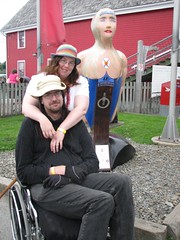
A white woman (Anna), sunburned and tired looking, stands behind a white man (Don), also sunburned and tired looking, in a manual wheelchair.  They are posed in front of a wooden figurehead of a mermaidThis certainly mirrors the experience Don had when getting his sexy sexy wheelchair of awesome. He went from not being able to get out of the house more than once a week, if that, to being able to not only go out several times a week, but doing it with only limited pain. The wheelchair opened up the possibility of our enjoying this strange, hilly city we moved to. [That’s us in the picture, after two days of handling the hills in historic downtown Lunenburg. Usually he uses an electric wheelchair, but we rented the manual for the trip. I vividly remember how exhausting getting up those hills were, which I think is obvious if you look at both our faces.]

Wheelchair user also reminds us who is (or should be) in charge of the chair. The person using the chair should be directing it, even if they’re not able to control it themselves. [This is a great post by Wheelchair Dancer about how to push a wheelchair. Learn it, live it, love it, folks.] When we talk about people who are using wheelchairs as though they have some agency, we’re reminding ourselves and others that they should have that agency.

Thirdly, wheelchair user is inclusive of people who are either full- or part-time wheelchair users. There are people who only have to use a wheelchair during high pain days, or in the winter, or after an accident, or for only six months, etc. “Wheelchair bound” always has an air of permanence to it, while wheelchair user can be both permanent or temporary, and using terms like full- or part- time wheelchair user reinforces the idea that folks who only use wheelchairs for certain activities aren’t faking a disability.

I hope this much longer version of my originally-planned post still gets at my basic argument: People don’t like being told they’re wheelchair bound. Stop doing it. Try ‘wheelchair user’ instead. Thank you.

Jordan’s Principle

This post was originally published in July 2009 as part of International Blog Against Racism Week

One of the things that we talk about here, on occasion, is how lucky we are that Don is a white man with a disability living in Canada. Things become more complicated in my post-racial utopia of a country when someone of a different race is born with a disability.

Take, for example, the case of Jordan River Anderson, a First Nations boy from Norway House Cree Nation in Manitoba. Jordan was born with “complex health needs” (this is code for Carey Fineman Ziter Syndrome, a rare muscular disorder) and spent the first two years of his life in hospital. At that point, his doctors agreed that he could go home and live with his family, although he would need continuing care.

If Jordan hadn’t been First Nations, he would have gone home, and his care would have been paid for by the provincial government as part of his health care costs. However, as a First Nations child, the cost of Jordan’s care became an argument between the provincial and federal government. Neither wanted to pay for it, so Jordan stayed in hospital.

He died at age 5, having never been home.

First Nations advocates came together and wrote Jordan’s Principle:

Under this principle, where a jurisdictional dispute arises between two government parties (provincial/territorial or federal) or between two departments or ministries of the same government, regarding payment for services for a Status Indian child which are otherwise available to other Canadian children, the government or ministry/department of first contact must pay for the services without delay or disruption. The paying government party can then refer the matter to jurisdictional dispute mechanisms. In this way, the needs of the child get met first while still allowing for the jurisdictional dispute to be resolved.

This was adopted unanimously by the Canadian Government in December, 2007.

In principle.

Special Needs Kids May Be Forced Into Foster Care (May, 2008):

Government infighting has families in a northern Manitoba community in anguish about how to best care for their children.

The Norway House Cree Nation has told the families of children with special needs that they may be forced to give up their children because the First Nation can no longer pay for their care, and federal and provincial governments can’t agree on who should pay.

Charlene Ducharme works with the Kinosao Sipi Minisowin Agency, a social agency on the reserve, and said she has yet to see Jordan’s Principle in action. She said the children of Norway House deserve the same care that other Manitoba children get.

“Our premier said Manitoba would be the first one to implement Jordan’s Principle… we’re still waiting.”

Late in 2008, the Manitoba Government also adopted Jordan’s Principle.

However, in reality, very little has changed. According to a UNICEF report issued this year, in honour of the 20th Anniversary of the Convention of the Rights of the Child, First Nations, Metis, and Inuit children in Canada still suffer in comparison to other children:

1 in 4 First Nations children lives in poverty compared to 1 in 9 Canadian children on average.

In cities of more than 100,000 people, approximately 50 per cent of Aboriginal children under the age of 15 live in low-income housing, compared to 21 per cent of non-Aboriginal children.

In contrast to the national infant mortality rate of 5 infant deaths per 1,000 live births, the rate is 8 per 1, 000 among First Nations and 16 per 1,000 in Nunavut (where 85 per cent of the population is Inuit).

Only 63 per cent of First Nations children on selected reserves accessed a doctor in 2001; 46 per cent of Inuit children and 77 per cent Métis children did so, compared to 85 per cent of Canadian children on average.

Between 33 and 45 per cent of Inuit, Métis and First Nations children (on and off reserve) report chronic illness.

On-reserve First Nations child immunization rates are 20 per cent lower than in the general population, leading to higher rates of vaccine-preventable diseases.

38: The percentage of deaths attributable to suicide for First Nations youth aged 10 to 19. In 1999, the suicide rate among First Nations was 2.1 times higher than the overall Canadian rate. The rate of suicide for Inuit is 11 times higher than the overall rate of the Canadian population.

[Source] [Report Summary, WARNING: PDF]

Canada’s ranking on the Human Development Index, which is used by the United Nations to measure a country’s achievement in health, knowledge, and a decent standard of living is third. Evaluating the living conditions of First Nations, Inuit, and Metis people alone, their ranking is 68th.

My country prides itself on being “better” than the U.S. on issues of race.

Jordan died 800 km from home because he was First Nations. First Nations children in my country are not getting the care they need, the care available to other children, because they are First Nations.

This is not an improvement.

[International Blog Against Racism Week]

Your Chilling Fact For The Day

Originally published July 2009

The PALS also indicates that Canadian women, 15 year of age and older, experience a higher prevalence of disability at 15.2 percent, than Canadian men at 13.4 percent. In 2006, 19.5 percent of Ontario adult women reported having a disability compared with 16.6 percent of men (Statistics Canada, 2006). Women with disabilities are significantly more likely to experience abuse than non-disabled women. It is estimated that women with disabilities are 1.5 to 10 times more likely to experience violence than non-disabled women, depending on whether they are living in the community or an institution (Public Health Agency of Canada, online).

[From: We Are Visible: Ten Years Later WARNING: PDF]

So.

How many emergency shelters are you aware of that are fully accessible, have a ‘terp available in some way for Deaf women, or provide their information in Braille? Have grip bars in the bathrooms? Have accessible toilets?

How many have funding for all of this?

The last women’s shelter I volunteered in had a disabled-parking zone in front, but that’s all I recall. What about you?

Guest Post: Sex and Scoliosis

This is a Guest Post by Atlasien. It was originally published here.

I’m a multiracial Asian-American woman, Southerner, third-culture kid and mommyblogger. I’ve been living in the Atlanta area for more than a decade now. I mainly blog about race and foster care adoption. My husband and I have a 7-year-old son that we adopted as an older child. I enjoy this blog, and I’ve learned a lot of important stuff about disability issues by reading here.

What does scoliosis have to do with sex?

There are a lot of connections. I guess I’ll need to start by explaining scoliosis. It’s a common disorder, but one that is often very misunderstood by the general public, as well as many non-orthopedic doctors. Most people vaguely remember a scoliosis check from their school days. Sometimes the kids are lined up in a row, and told to take off their shirts and bend over while a medical professional inspects them from the back. The experience is obviously rather humiliating and tends to cause a lot of nervous laughter.

Scoliosis — a sideways, left-right asymmetry of the spine — is the most common form of spinal deformity. It can also be accompanied by other forms of spinal deformity, like kyphosis (AKA hunchback) and extreme lordosis (AKA swayback). It sometimes comes as a package deal along with disorders of connective tissue, or with cerebral palsy and spinal bifida. In those cases, scoliosis is often diagnosed at a very early age.

The other kind of scoliosis, the much more common kind, seems to come out of nowhere. It’s known as adolescent idiopathic scoliosis or AIS. “Idiopathic” is from the same Greek root as “idiot” and basically means “we have no idea what causes it.” Though recent research has shown that it’s actually genetic, and they’ve even tracked down the genetic location (but only if you’re white, which is bizarre, because there isn’t any significant racial/ethnic difference in prevalence rate). Someone with this kind of scoliosis (usually a girl, as the incidence of more serious curves among women is 7-10 times that of men) is born with a normal-looking spine. Before puberty, the spine begins to bend and curve. Maybe it stays there… maybe it gets worse through puberty. Then maybe it stays there, or maybe it gets a lot worse close to menopause. Without major surgery, it’s essentially a one way road. In scoliosis vocabulary, when curves get worse, it’s called “progression”. “Progression” is bad. Arresting progression is good.

According to this NIH resource, “Of every 1,000 children, 3 to 5 develop spinal curves that are considered large enough to need treatment.” If you adjust for sex, the rate climbs up to almost 1% of all girls. I don’t know of any source that says actually how many girls receive treatment of which types. Treatment means to watch, take lots of x-rays, determine progression, and if it looks like progression is, well, progressing, to brace. Or in very serious cases, go directly to spinal fusion.

A pre-teen girl, front and back view, with her face obscured.  She has a metal brace that has one rod running up the front to a metal collar, and two rods in the back.  There is a fiberglass girdle across the abdomen and down to the hips.  There is a strap hooking to both sides of the metal rod in the front.  Descriptive text provided by Don.

That’s the “Milwaukee” variant of brace. It’s the kind I had. It’s made from hard plastic and steel. It’s expensive, ugly, frightening, and extremely uncomfortable. The family nickname for my brace was “The Iron Maiden”. You can climb into it and strap it on and off, and adjustments of the screws will accommodate changing body shape during puberty. I think you’re supposed to wear it until a few years past puberty, when your spine growth finally halts. The brace is an old form of treatment and it’s shown to be moderately effective at arresting progression.

Three images of the back of a young woman.  In each, there is an obvious curvature of her spine.  It's an S-style curve.  The middle portion of her back, around the shoulder blades, is off-set to the right, while the shoulders and hips line up relatively evenly.  Descriptive text by Don.

Many girls experience horror and anger when they find out what bracing is going to mean for their lives, and that it won’t even fix them, it will just probably keep them from getting any worse.

It was easier for me to accept my fate. First of all, my mother also has idiopathic scoliosis, and her curve was fairly serious. Hers is comparable to the woman pictured above. She had not been treated as a girl, and her scoliosis had slowly progressed as she went into middle age. She eventually had a spinal fusion — two long steel rods screwed into her spine — and was in the hospital for two weeks. So I had a strong motivation to make sure my curve didn’t progress as far as my mother’s. She was also a positive role model for me. I saw her as an active, glamorous woman who refused to be limited by scoliosis. I tried to adopt the same stoic attitude toward my own scoliosis. Second of all, my orthopedist said it was OK to only wear my brace 12 hours a day, which meant I slept in it, but I didn’t have to wear it to school. I think he may have subscribed to the philosophy that although the brace should really be worn 23 hours a day, there’s so much social stigma attached to it that many girls rebel, and won’t wear it at all, whereas a private bracing regimen has more likelihood of consistent follow-through.

I don’t know if it would have made school any worse. I’ve written before about the extensive racist abuse, and sexualized racist abuse, I got in late elementary and middle school.

I was harassed so much in the locker room my first year of middle school that I refused to change my clothes at all. P.E. was a living nightmare full of verbal attacks and physical threats from larger girls. I spent much of my time desperately thinking of ways I could get a medical excuse. Unfortunately, aside from my scoliosis, I was healthy as a horse. I refused to participate in activities anyway, and sat with the asthma-sidelined section. I’m still bitter about this experience because it taught me to associate healthy athleticism with emotional trauma and racist bullying. Maybe if I’d had my brace on, I could have gotten my coveted medical excuse.

It was something I never, ever thought of at the time, though. The orthopedist’s word was the word of law. And the brace was something to be hidden. I think this is a common tendency among brace-wearers. Girls that age don’t want to be seen in a brace. For photos, they’ll take off the brace. If they’re told to wear it to school, they’re mocked and stared at. At the time, I considered myself very lucky that I was able to hide my brace from other kids my age.

I don’t know much about disability theory and disablism, but I’ve been reading through blogs about it, and it’s very interesting in relation to scoliosis. I don’t identify as a disabled person/person with disabilities, and I don’t think many other people with idiopathic scoliosis do. But many of us have also gone through an intensely emotional adolescent period where we’re viewed as disabled.

One of the hallmarks of disablism is that it strips away sexuality. The prejudice against disabled people includes thinking they are not supposed to exist sexually, have sexual desire or be desired.

Being braced means going through puberty strapped and screwed in to a weird exoskeleton that incarnates the negation and emprisonment of your sexuality. Your breasts and hips are starting to grow. They might start to bump painfully against the brace. So you have to visit the doctor — often an older man — who adjusts your screws to accommodate your new growth.

The brace seems anti-sexual, but it also has positive sexual connotations. The light at the end of the dark tunnel is that the brace will “keep you normal”. You’ll get through puberty and enter into sexually desirable womanhood without too much spinal deformity… the brace will preserve you. The brace probably becomes the most significant physical object in your life, for good and for evil.

I certainly didn’t receive any counseling about my scoliosis. I don’t know if it’s common today to have counseling as part of the bracing process. If it’s not, it should be. Girls who have gone through bracing feel like it’s them, alone, against the world. Although it’s quite a common experience, by medical and social tradition, the disorder is isolated and hidden.

This study showed that bracing doesn’t affect self-image much. However, it also takes places in Sweden, where school environment I’m sure is quite different than in the U.S. This other U.S. study tells a somewhat different story: “Scoliosis was an independent risk factor for suicidal thought, worry and concern over body development, and peer interactions after adjustment. CONCLUSION: Scoliosis is a significant risk factor for psychosocial issues and health-compromising behavior. Gender differences exist in male and female adolescents with scoliosis.”

After bracing, scoliosis, and deformities of the spine in general, become almost invisible. It’s extremely rare to have a spinal deformity so pronounced that anyone can tell by looking at you when you have clothes on. People with idiopathic scoliosis “pass”. People have known me for years, even decades, without knowing I had scoliosis. Then one day they’ll see me in a bathing suit — and not even the first time they saw me in a bathing suit, but maybe the first time they really focused on my back — and they’ll burst out with something like, “OH MY GOD DID YOU KNOW SOMETHING IS REALLY WRONG WITH YOUR SPINE!!

Once it stops being invisible, it’s all of a sudden very, very visible. I guess it’s sort of like shaking hands with someone and suddenly realizing they have six fingers.

If I’m not experiencing any back pain, I rarely think about my scoliosis, although I sometimes worry about my future. Pregnancy is not a risk factor for progression, but menopause is. Right now, my thoracic curve is 36 degrees. If it gets past 40, I might need spinal fusion surgery. This is a mostly safe procedure, but it’s still really scary, and involves weeks in the hospital. Click on the following link if you’ve seen enough David Cronenberg movies that you think you can handle it (link to nightmarish spinal fusion surgery image). Spinal fusion partially reverses the curve, arrests or slows down further progression and relieves chronic pain. You’re still reasonably flexible afterwards, but there are potential complications, and I’m not considering surgery at this stage. If I refused surgery, and my curve happened to progress further, I would start to have more pain and diminished lung capacity. Past 60 degrees, I might start to experience severe and constant pain in my back and/or ribs, and my internal organs would get squeezed together and I might start to have breathing problems. Past 80 degrees I might have lung AND heart problems.

But I don’t stay up night worrying about the risks of progression. Many people have more uncertainty about their medical future than I do. For example, if I had diabetes, I might worry about having a foot amputation.

Since I grew up with scoliosis, it’s taken me a while to understand how it looks from the outside. Aesthetically speaking: not good. We’re conditioned to associate left-right symmetry with health and general well-being. People with moderate scoliosis, like me, often look symmetrical from the front, but asymmetrical from the back, and I suppose that seems eerie and perhaps even deceptive and sneaky. There’s a lot of really negative associations in popular culture (e.g. Hunchback of Notre Dame). When mean-spirited people do “retard” imitations they’ll often hunch up one shoulder and stagger in order to simulate a deformed spine.

I don’t talk about scoliosis casually because a) I don’t have any major health problems because of it, so there’s not that much to talk about b) I’m afraid of it being used against me. I’ll put it on medical history forms when I know I can be assured of privacy. It was used against me recently when I applied for private disability insurance. I thought it would be a good idea to have a separate private policy in case I lost my job for any reason. I did a ton of research, spent a lot of time talking with the salesman, and ended up with a quote that specifically excluded anything going wrong with my reproductive system AND my back. I changed my mind and decided it wasn’t worth buying since so much of my body was apparently un-insurable. They excluded my ENTIRE BACK. Hypothetically speaking, if I got in a minor car accident, and as a result developed the exact same kind of back problems that anyone without scoliosis would develop, nothing would be covered. What a terrible deal. No thanks!

The health implications of my scoliosis are not that extreme, and I don’t need any accommodations to perform any major life activities, which is why I don’t consider myself disabled.

– I have foot pain in my arch if I don’t wear comfortable shoes. I can wear platforms, but I can’t wear high heels.
– I have to be a bit careful doing things like yoga and pilates.
– I have to stay reasonably active in order to be 100% pain-free. When I get too sedentary, I start having back pain and rib pain. If I ever had an illness that forced me to rest all the time, I’d be in big trouble. Exercise and stretching are highly effective for scoliosis back pain. Other options I would consider to control pain if it ever got worse include drugs, physical therapy and adult braces. There are a gazillion alternative health “cures” for scoliosis back pain suffering, but they strike me as being of very dubious efficacy.
– I have to watch my posture
– I have to watch my weight. Excess weight leads to back pain. Being underweight might be even worse, because being underweight is connected to bone density loss, and people with scoliosis have lower than average bone density anyway.

None of these problems are really unique to scoliosis. Plenty of able-bodied and disabled people have back pain or foot pain.

This link from Eurospine.org sums it up: “Progression of scoliosis can involve an aesthetic problem and lead to functional problems. Respiratory disorders may develop in large curves greater than 80 [degrees]. Nonetheless, the mortality rates and vital prognosis in individuals with scoliosis are comparable to those of the general population.”

It’s the “aesthetic problem” of scoliosis that’s unique. Like I mentioned before, left-right symmetry is wound up with definitions of health and beauty across many different cultures. People like me are aware of this on a subconscious or barely conscious level. 99.99% of the time I forget that I don’t fit that symmetrical standard. Every so often I’m reminded, and it feels a bit painful. There are subtle psychological effects. Vague feelings of being a secret curved impostor in a straight-backed world. Times when I feel like my spine is an enemy working against me… times when it hurts to breathe and the pain makes me feel angry at my spreading rib bones, and I wish I could reach inside of myself and squeeze them back into place. Sometimes I’m bitter about the inches of height I lost to scoliosis.

Back to sex. Even without bracing, there’s still a sexual paradox when it comes to scoliosis. Have you ever seen a picture of a woman with scoliosis and/or kyphosis that was not anonymous, depersonalized, clinical, grim and depressing? Like the photos I included above? Scoliosis is profoundly unsexy.

On the other hand, when women pose provocatively, they often throw one hip to the side and put one shoulder forward.Why is that pose sexy? Maybe it makes us look femininely defenseless and vulnerable, as opposed to a masculine, stick straight pose. That’s going along with a typical sexist definition of “femininity”. There’s another less sexist possibility… the pose is also highlighting the flexibility of the spine. So in that sense, the woman is showing off her body’s capacity by bending in a certain way.

There’s a comic book artist, Rob Liefeld, who was (in)famous starting in the 1980s for drawing unrealistic women. The conventions of drawing women are in comics are easy to criticize, but Liefeld’s stuff is… well…I guess you’d have to see the spinal curvature to believe it.

Iconic Rob Leifeld drawing of a super heroine.  She's posing facing right, turning her head over her shoulder.  She has an impossibly-narrow abdomen, and spine curvature similar to severe lordosis, an inner curve of the spine.  She is not wearing very much clothing.  Description by Don.

That’s supposed to be sexy. For the audience of predominantly young men who made Liefeld very popular, it must have been sexy. This is a funny analysis of the above drawing by a group of women comic book artists:

Take note of Avengelyne’s waist and how it is thinner than her head. Minus the hair. Note how it hangs beneath her ribcage like a suspension bridge, rather than actually supporting the top of her body. (Her torso must be kept afloat by those helium breasts.) Note the scoliosis gone grossly untreated. Note the little leather bags which wouldn’t fit around a normal person’s wrist. Especially note that the artist put her in the most obvious POSE to exaggerate the spine: a profile shot with negative space between her back and arm. That’s correct – our intrepid heroine’s spine would appear yanked. Avengelyne is a SWAYback™.

The humor is partly at my expense. But I can’t help laughing. It’s a highly sexualized image, but not one that I identify with in any way.

But here’s a poster image I ran across that uses stupid sexist humor to make fun of a real woman, and I don’t find it funny at all.

A woman is facing straight on the camera, with her weight obviously all on one side.  She's curved her body to look like an S.  Text reads: Scoliosis: Making an otherwise beautiful girl look pitiful.  Image is from Motivated Photos.com, description by Anna

It really illuminates the double standard that women are subjected to. You’re supposed to be sexy so that you please men. But if it looks like you’re trying TOO hard, men (and other women) will make fun of you. If you don’t wear makeup, you’re a [insert homophobic slur]. Wear too much makeup, you’re a [insert transgender-phobic slur]. Curve your back, look sexy. Curve it too much, it looks like you’re deformed. Argh!

Thanks to my brief readings of disability theory, I realize that making fun of people with spinal deformities isn’t something I should just accept as the natural order of things, especially because this humor is connected to moral judgments of disability. That is, the idea that physical body difference reflects some kind of moral failing. When it comes to scoliosis, I think the general public halfway believes that scoliosis is the fault of the person’s family. There’s a myth that giving young kids backpacks that are too heavy will make their spines curve (totally not true). When people are adults, “she should have had that corrected” is sometimes an assumption. A lot of people don’t realize that the only sure way to even partly reverse a curve is spinal fusion, which also leaves a giant seam-scar running up your back. Another judgment is that a person with scoliosis must be poor. It’s true that I’m very lucky I had access to bracing; if I wasn’t born into a middle-class family in a rich country, my curve would be a lot worse by now. So there are major class differences in scoliosis, but ultimately, we’re all in different positions on the same boat because there is no way to permanently and completely reverse adult scoliosis.

Thanks to flickr, I did actually find some images of scoliosis that I think are beautiful and help affirm positive self-image and sexuality. I wish I’d found a greater variety of body types, but these images are great to start off with. Some are post spinal fusion.

First, here’s the typical clinical picture. It shows everything that’s wrong with the body.

A woman is facing away from the camera, with arrows pointing to various parts of body to describe them.  Head not centered over body.  One shoulder (right) higher.  One shoulder blade (right) higher and possibly more prominent.  Spine obviously curved (to the left).  One hip (left) more prominent.  Unequal gaps between the (left) arm and the trunk.  Description by Anna

Now here are the flickr pictures. They show the open possibility and vitality of a body with scoliosis.

Man with scoliosis facing away from the camera.  Someone has drawn his spine on his back with make up.
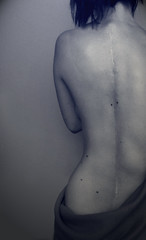
black and white photo of a woman facing away from the camera, wearing only a towel or blanket.  Her spine is curved, and her scars are visible.

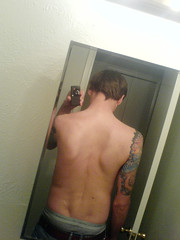
man facing away from camera.  The photo is in a mirror.  One can see both his scoliosis scars from surgery and his elaborate arm tattoo.

woman facing away from the camera.  She is caught in the middle of dropping an apple behind her back, both arms curved behind her.

woman facing away from the camera.  The image is otherwise in black and white, except for her vivid red hair and lips.  She is wearing a black dress with part of the back cut out.  It clearly shows the curve of her spine.

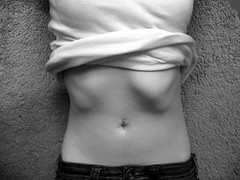
photo is in black and white of a woman's lower torso, with a pronounced rib-cage and a pierced belly button

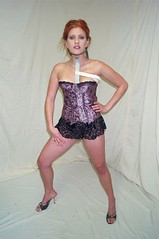
woman facing straight on the camera.  She is wearing both a brace, as described above, and a purple corset.

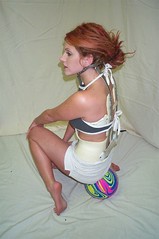
woman facing left from camera, with back facing camera.  She's wearing an back brace, and balancing on a small ball.

It’s heartening to see a bunch of pictures like that. There are more photos at this link.

When I walk, my right hip swivels a bit higher and wider than my left hip. I’ve had people tell me it looks sexy. I’ve had people ask if I’ve hurt my foot. Neither reaction bothers me anymore. The way I walk is just the way I walk. It gets me where I need to go.

Acknowledgements for this post: thanks to Thorn for commenting about this issue, and mentioning how it negatively affected your adoption homestudy due to ignorance on the part of the social worker. Also thanks to Deesha Philyaw on Twitter for mentioning the Judy Blume book about a girl who goes through bracing: Deenie. I wish I’d gotten a chance to read that book when I was a girl, and it sounds really interesting.
Power and Responsibility

An earlier version of this post was published in July, 2009.

When I mention that Don has a homecare worker, and explain what that job is, I often get this question:

“Why don’t you do all that stuff for him?”

This touches on something that I’ve referred to a few times, and that’s the idea that it’s totally okay (admirable, even!) that services for people with disabilities be offered by volunteers. It gets into a lot of complicated stuff.

For example, Don’s homecare worker does things like makes sure he is clean-shaven once a week, washes his hair carefully, and does some of the stuff he needs done for his back, which suffers from a lot of sitting/lying related issues, like heat rashes and sores. She’s there for about an hour or so.

What she does for Don is a huge deal in terms of his personal hygiene. All those little things that allow him to be “acceptable” to our neighbours take energy, such as having clean hair and a neatly trimmed beard. Before homecare, Don would often go weeks, if not months, without a proper shave, and look very scruffy and unkempt. But it would be a decision for him – does he shave today, or does he make a meal? There wasn’t enough energy or concentration to do both.

The question of why I don’t do these things has a few assumptions under it. First, it implies that, because I’m his spouse, I should be in the caretaker role. I should be making sure all his personal hygiene needs are taken care of. There’s a power imbalance there that makes me uncomfortable. It puts me in role as adult, and Don in role of child, and this is just not acceptable.

The other thing is part of why this volunteer thing bothers me. Don’s personal level of comfort should not depend on my energy levels. It shouldn’t depend on my mood. It shouldn’t depend on whether or not I’m angry at him today, or I’m too busy, or if I’m home.

Right now, it depends on whether the woman who is paid to come to our home and do these things shows up. If she calls in sick, there is someone else who will come in. I know she has a degree in nursing, focusing on homecare for people with disabilities. I know she’s a professional, who has been taught the issues around disability and privacy, around personal autonomy, and around sexuality and disability. I know the process we will go through if either she or Don does something sexually inappropriate. I know the appeals process if she threatens him or he threatens her. I know what will happen to Don’s care in those situations. More importantly, Don knows what will happen in those situations. He has personal autonomy.

Don’s health needs shouldn’t be dependent on me in any way, because that’s not safe for Don.

In my experience, Feminism tends to have discussions about caregiving focusing around the fact that caregiving roles fall predominately on women, and lead to things like “the second shift”, or caregiver fatigue, or even directly impact women’s abilities in the workplace. (“I can’t work late because I need to get home now.”) I think this is an important thing to discuss, but I don’t think it’s the only part of the caregiving equation. I think we, as feminists, need to also talk about the power inbalance that comes in when one is a caregiver for a spouse or parent that has a disability.

As well, we rarely talk about what happens when the role of caregiver falls on women with disabilities? What happens to that allotment of spoons then? What view do we have of women with disabilities if their children aren’t “properly” cared for? If some other loved one isn’t getting everything they need? What happens to the caregiver/second shift issues then?

I think feminist discussions about caregiving and responsibility need to broaden out to include these complicated issues.

Campaigning: A (brief) Guide for Inclusion

Before Don told our political party of choice to go take a long walk off a short pier*, I used to be That Girl at Riding Association meetings, at committee meetings, and at rallies.

[You might be thinking “Why would your husband telling a political party to get lost mean you wouldn’t be part of them anymore?” Don told them to go away and they stopped calling and emailing me too. Which is why I don’t deal with them anymore. If you’re going to claim to be representative of women in Canada and then stop interacting with me because my husband told you off, then I guess my money and my time can go elsewhere.]

Anyway, That Girl. That Girl, who would say things like “When you mumble and look down when talking, it’s very hard for people who have hearing loss to understand what you’re saying.” That Girl, who would say “This website is horrible on accessibility issues. Can you suggest your webmaster develop a text-only version? And stop using PDFs instead of web pages!” That Girl, who still emails every political party in Canada once a month to ask for transcripts of their YouTube Videos. That Girl, who has only once seen a transcript, and has never received a response.

One of the problems with being That Girl, who points out problems with accessibility a lot, is people start assuming I’ll become their expert on All Issues About This, and, instead of paying someone to deal with such issues, will just demand a lot of my free time and efforts into making them look better. (They also figure it will shut me up. I’m not good at that.)

I don’t mind too much with groups I’m a part of that don’t really have much money and are run entirely by volunteers or overworked staffers. I find these groups are both interested in what I have to say, and grateful for what (limited) aid I can give them. However, political parties have money. They also have power and prestige, even if they’re not currently running the country or the province. In Nova Scotia, they can work with the Nova Scotia League for Equal Opportunity and get actual experts to discuss with them actual ways of making their campaigns, their offices, their rallies, and their literature as accessible as possible.

But, since that’s not possible for everyone, let me give you some free (and lengthy) advice on how to make your campaign (however you define campaign) more accessible for people with disabilities. This advice has been influenced and improved by talking to the folks who run the Nova Scotia League for Equal Opportunity, and I can’t thank them enough for sending a representative to the Campaign School I recently attended.

Clearly, not every person with a disability is going to have difficulties accessing your campaign information. As well, this advice will not magically ensure that your work is available for everyone. We’re talking broad generalities here, but at least we’re talking something. And even though I am That Girl who will snap at you that your rally isn’t accessible if you don’t have an interpreter for the Deaf, I’m also That Girl who will notice that you’ve done something, and tell other people about it.

But, the biggest thing you can do, if you’re really trying to reach and include people with disabilities, is broaden your understanding of what disability means. We are not all men in wheelchairs and women who are blind.

Continue reading Campaigning: A (brief) Guide for Inclusion

Guest Post: Disability and Asexuality

Kaz is a German woman in her twenties, currently doing a maths PhD in the UK. She is on the autistic spectrum, stutters, and has been dealing with clinical depression on and off since her teens; she considers all of these disabilities. She is also aromantic-tending-towards-homoromantic asexual and identifies as queer. She blogged as Zailyn at WP for a while, but can now be found at either Dreamwidth or Livejournal, where she writes about fandom, disability, feminism, asexuality, and sometimes even maths.

Kaz’s note: First of all, this is not a 101-level post on either the asexuality or the disability side of things. However, I’m aware that asexuality isn’t really an issue that is on most people’s radars, so to anyone who doesn’t know much about it I suggest you check out AVEN in general and the Wiki in particular before reading or whenever you run into something that doesn’t seem clear.

Mod Note: Kaz & I talked and I’ve put in some links to terms as they come up.

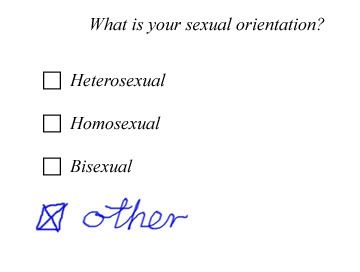
A list.  The header reads: What is your Sexual Orientation?  Typed underneath with check boxes is Heterosexual, Homosexual, Bisexual.  Written in, with a hand-drawn check box, is other.  The check box is filled in next to other

Talking about the intersection of asexuality and disability is pretty difficult, because “asexuality” gets another meaning in disability rights discourse: it’s used to refer to the various stereotypes about disabled people’s sexualities. People do often seem to realise that this is problematic when it’s pointed out to them. However, what not so many people realise off the bat is that it goes beyond just “problematic”.

The stereotypes in question actually consist of a wide variety of things tossed together, some of which are in line with asexuality but many of which seem to have little to do with asexuality or in fact to be entirely opposed to it (I am interested to see how the stereotype of the disabled woman not saying no because she feels lucky anyone wants her is supposed to relate to asexuality, for instance). What they have in common, however, seems to be: denying disabled people their sexual agency and the right to make decisions or have knowledge about their own bodies and sexualities. The stereotypes about disabled people’s sexualities seem quite in line with the common tendency to consider us childlike, helpless and needing to be protected for our own good.

Asexual adults? Are not children. Nor do we (or, at least, should we) lack agency. In fact, the very existence of the asexual movement shows that we are in opposition to a lot of these ideas! We’re organising, we’re campaigning, we’re demanding that our sexual identity should be recognised and considered valid; disabled people are stereotyped to not have a sexual identity at all. (There is a distinction between the lack of a sexual orientation and a sexual orientation incorporating lack of sexual attraction that most people miss, but that is crucially important in this context.) Taking all the stereotypes disabled people get hit with regarding sex and sexuality and claiming that they all boil down to making them like asexual people? Like me? Is something I actually find really offensive.

An example: the desexualisation of disabled people often gets used to justify giving them less extensive sex ed or no sex ed at all compared to abled people. However, saying this is because they’re stereotyped as asexual entirely misses the fact that – asexual people need sex ed too! At the moment, it’s true that a lot of us will probably need it less than most sexual people, but it is still necessary as a large portion of asexuals do end up having sex at some point in their lives. Also, if mainstream comprehensive sex ed ever gets away from the “put the condom on the banana” “tab A slot B” style of sex education and starts talking about things like sexual orientation, explicit consent, how to figure out whether sex is the right decision for you at a certain time, etc. – I’d argue that we need this kind of sex ed more than many sexual people, as being a sexual minority tends to lead to more confusion and needing to figure things out. (There’s a traumatic experience I could have happily avoided if sex ed ran more in this direction.)

Also, using the name of my sexuality for these stereotypes obscures the fact that actually, they have negative effects for me, too. For instance, there is an astounding amount of ableism in the arguments people use to try and invalidate asexuality, ranging from “you should get your hormones checked!” over “that’s a disability, not a sexual orientation” to “you’re just all autistic!” You can imagine how the last one feels to me as an asexual autistic person! Worse, parts of the asexual movement buy into this and will talk about how they’re not autistic, their sexuality is valid – unlike mine, apparently?

…hey, I recognise this argument! But wait a minute, we can’t very well call it stereotyping disabled people as asexual if it’s being used to invalidate the sexualities of asexual people.
Continue reading Guest Post: Disability and Asexuality