Category Archives: intersectionality

Dear Imprudence: Thank You for (Proving) Your Service!

Slate Magazine’s Dear Prudie got one right this week, with a letter from a woman who’s husband is a U.S. military veteran, who recently lost his leg “due to a medical condition that was unrelated to his time in the military”. According to the letter writer, her husband has adjusted well to his recent amputation, however, it is the passers-by who seem to not be able to just let it go. She writes:

[O]ften strangers will pause to talk to him while we are in public, and these well-meaning individuals will ask whether he is a veteran. When my husband answers yes, it is inevitably assumed that he was injured in Iraq, and he is often thanked for his sacrifice for our country. One elderly gentleman hugged him with tears in his eyes! While my husband is a veteran and technically qualifies for the warm gesture, it seems deceitful to allow these people to believe he suffered a grave injury in Iraq. We don’t want to share my husband’s complicated medical history with strangers, but we don’t want to discourage people from giving thanks to vets in the future. What should we do?

Prudie’s response is pretty solid, in my opinion here. People with disabilities face nosy questions all the time. Everyone from children who can’t help but be unabashedly honest to grown-ups of the well-intentioned and otherwise variety. People with visible disabilities are constantly questioned about the whats, the hows and the whys of their conditions, as if they are under some obligation to share private pieces of their personal medical information. PWDs with invisible conditions are scrutinized by even their close friends when their health varies from day to day.

Veterans also face a barrage of these questions even when they are able-bodied, from people wanting to know about their service, where they’ve been, even if they have killed someone (hint: you should NEVER ask a veteran this question). Sometimes this line of questioning ends in tears and hugs and thank yous because people are grateful and some even want to share common experiences. Sometimes this creates tense situations. One place where I was stationed in California this actually resulted in people throwing their drinks on sailors and calling us “baby killers”, resulting in a lockdown on how and when we were allowed to leave the base or our houses.

The place where this intersects creates a wholly unique situation. Like Prudie says, people see a person of about the right age with a disability and presume that this person must be a combat-wounded veteran. Cue the questions and thank-yous, and demands for, once again, medical information that is none of their business. All based on presumption.

I agree with Prudie here. “Didn’t” and her husband are under no obligation to correct these people, no matter how well intentioned they may be in their demands for information or genuine their appreciation of his service. It is an invasion of his privacy, of their privacy, and it should be enough to appreciate the sacrifice that they made as a family (however much of that time was spent together) and he himself for his time spent in service, because it is a sacrifice of time and life. If these strangers want to assume that his loss of leg is related, then that is on them, but there is no litmus test of injury or illness that is required in order for your service to be appreciated.

Being patient and understanding that some of these people mean well is one thing, and it reflects well on Didn’t and her husband if they are willing to do so, and thank them for their gratitude. But when it goes beyond a thanks and violates their comfort levels they should feel no guilt over drawing a line and letting them know that they would rather not discuss it.

Recommended Reading for June 1, 2010

fiction_theory (LJ): The internet IS real life

The problem with impeaching someone’s anti-racism based on attendance at a specific march or even public rallies and protests in general is that it assumes that a) attending such events is a more real, valid, and important means of expressing anti-racism than any other means, specifically online and b) that attendance is a feasible option for everyone.

Marching at a rally or attending a protest is all well and good, but it’s not something that is an option for everyone. It’s quite ablist to ask such a question as though the privilege of being able to attend excludes the antiracist work of those who use other venues.

Mattilda at Nobody Passes: Closer

Somewhere between sleep and awake, a new day and last night and tomorrow, like they’re all in a circle around me but I’m somewhere in bed where I can almost read the sentences except they blur away from me, and I keep thinking maybe sleep, maybe this is more sleep except I don’t know if I want more sleep.

thefourthvine (DW): [Meta]: The Audience

I will not bring up my disability, because I don’t talk about it here, except to say that if that part of me appears in a story, it will be as either a clever gimmick (and a chance for a main character to grow as a person) or a sob story (and a chance for a main character to grow as a person). (No, there will never be a main character just like me. Most of the time I think that’s normal, and then I look at, say, SF and think standard-issue straight white guys must have a whole different experience on this issue. How weird would it be, to have basically all mainstream media written for you like that?)

Ian Sample (at The Guardian online): Bone marrow transplants cure mental illness — in mice

The team, led by a Nobel prizewinning geneticist, found that experimental transplants in mice cured them of a disorder in which they groom themselves so excessively they develop bare patches of skin. The condition is similar to a disorder in which people pull their hair out, called trichotillomania.

lustwithwings at sexgenderbody: Do I Owe Everything I am to The Internet?

Despite their lack of a body, my friends are still quite active in the world of Social Networking which acts on the physical world in much the same way things on our mind do. The contents of the Internet affect the physical world through many of the same processes as the contents of a mind, yet the contents of the Internet as a public mind can affect many more minds, and many more bodies than a private mind.

It’s Always More Complicated: The “Justified” Abortion

[Trigger warning for “disabled child = burden” narrative.]

Last night I was reading several pro-choice tumblrs, one of which had linked to “The Choice“.

What makes us human? When is a life worth living? Worth ending? How much suffering is bearable? Is avoiding suffering brave or is it cowardice? When is abortion justified?

Should Fred be born, my wife would never return to work. My daughters would always come second. Some basic research online and asking friends in health roles showed a high chance of divorce before my son was a teenager, the stress of care literally tearing our family apart. Every news article we read showed little or no government support, with charities closing their doors. The doctors were encouraging about support; the real life carers we spoke to, not so much.

I’d never support killing a born child on any grounds. Yet here I was, suggesting death for a child almost born. I may not be a good man, but I’m a husband and a father. Had we not known, I’d be living with Fred’s condition today; but we take the tests so we can act on the information received.

So, let a bad man say the words that will condemn me: Fred’s life would have been less than human. It would have been filled with love, yes, but mostly loneliness, confusion, pain and frustration. The risk to my marriage and the welfare of my daughters was too much. I chose to minimise suffering. For my wife, for my daughters, for myself and most of all for Fred, I chose abortion. It was a choice of love.

I have complex reactions to this that are not really easy to talk about, but the one thing I do want to make clear:

Abortions do not need to be justified.

I know there are strong political and advocacy reasons why stories like these – the so-called “justified” abortion – are told whenever people talk about abortion and the law. They are “good” abortion stories, with the happy family, the desperately wanted child, the “horrors” for everyone had the abortion not been performed.

I struggle with these sorts of stories because I don’t know a way to talk about them. I want to talk about the way that disability is discussed in them – always, always, as horrible, as tearing families apart. And yet, these are people’s lives. I don’t think in any way they made a “wrong” or “bad” choice, or a “brave” one, either. They made the “right” choice, in that it was the “right” choice for their family, and I fear that talking about the language used is abusive. You’ve shared your painful story, your very personal story, and I want to now talk about disability and how it’s used to score points in the so-called abortion debate.

And yet, I desperately do.

I deeply resent the way anti-choice advocates point at people with disabilities and talk about how they’ll all be eliminated if we allow abortion-on-demand. The sheer amount of hate directed at Don when he goes to pro-choice rallies by the anti-choice contingent, because they see him as a traitor to their cause, is amazing to me.[1. Of course, they direct more at any pregnant pro-choice women – there’s a video clip from Toronto last year with someone telling a pregnant woman “I hope your child kills you”.]

I don’t see these same people at protests and demonstrations about making Halifax an accessible city. I don’t see them at demonstrations about improving health care options. I don’t see them doing anything for people with disabilities except using them as pawns, and I loathe them for it.

And yet, many pro-choice advocates also use people with disabilities as pawns in these so-called debates. They hold up stories of fetal abnormalities as “justified abortion”, as the acceptable test-case, the one they know the general public is likely to agree with. I see no analysis, no discussion, of the ableist nature of this narrative. It’s an acceptable justified abortion because the fetus was abnormal, and who wants a broken child that’s going to ruin everyone’s life?

All abortions are justified.

It troubles me so much that it’s only the “abnormal” fetuses that are okay to use as abortion stories.

[Originally published on my tumblr]

[Note: Things we are not going to do in this thread: Debate whether or not abortion is “okay”. Publish shaming comments towards women who have abortions. Talk about people with disabilities as burdens. Discuss individual actions as though they occur in a complete vacuum and are not influenced by societal attitudes and pressures.]

Recommended Reading for I Can’t Believe May is Almost Over!

I mean, where does the time go?!

A dark body protrudes from the left, with many thin tendrils along it, showing orangey red.

Second-harmonic generation microscopy image of a primary cultured Aplysia neuron stained with the membrane dye DHPESBP. The signal is modulated by membrane potential and was found to be capable of recording action potentials with 0.6 µm and 0.833 msec spatiotemporal resolution. The high-resolution and deep tissue imaging capability of this nonlinear microscopy technique should prove valuable to future electrophysiology studies. (Journal of Neuroscience) [Not entirely sure what all that means, but I find the brain endlessly beautiful and fascinating.]

Diary of a Schizophrenic – Little Girl

I am writing this to you because I want you to remember.  I want you to remember that you love unicorns and crystals, pinned butterflies and christmas beetles, love hearts and sea shells, sequins and puppy dogs. You feel special you have your ears pierced even though you are only six and you already know Santa isn’t real.  You love fairies but don’t tell many people because you are tough and like playing with the boys. You can catch and throw a ball and love to dance.  Dressing up will always be your favourite even when you’re big. Even though somewhere deep in side, you are sad, you love a lot and you see beauty everywhere.  You are smart and quick and can already talk the tail off a donkey.  You question everything and most people do not realise your careful quiet soul. One day, when you are older, you are going to lose your mind.

Pulse Media – For Enlightened White Guys [a useful set of tips for anyone participating in a group in which they have privilege]

5a. Count how many times you put your ideas out to the group.
5
b. Count how many times you support other’s ideas for the group.
6
. Practice supporting people by asking them to expand on ideas and dig more deeply before you decide to support the idea or not.
7
a. Think about whose work and contribution to the group gets recognized.
7b. Practice recognizing more people for the work they do and try to do it more often.

Boston Herald – Disability Group Faults Massachusetts on Water Crisis

An advocacy group for the disabled today filed a federal civil rights complaint with the Department of Justice over the state’s handling of a drinking water crisis earlier this month. The complaint made by the Disability Policy Consortium says the state wasn’t prepared to adequately respond to the needs of disabled and elderly people when a water main break left nearly 2 million eastern Massachusetts residents under an order to boil their water for several days.

All Africa – Nigeria: Yuguda Makes Case for Children With Disabilities

FIRST Lady of Bauchi State, Hajiya Abiodun Isa Yuguda and Founder, Challenge Your Disability Initiative, CYDI, yesterday at 2nd Vanguard Children’s Conference, called on corporate organisations across the country to learn to include children with disabilities in their programmes as part of efforts to show love and care to such group in the society. Addressing the children at summit held as part of exercise to mark this year’s Children’s Day celebration, Mrs Yuguda said children with disabilities should not be left out in programmes, particularly, programmes that would help shape their lives as future leaders.

AP – Spike in Disability Claims Clogs Overloaded System

Nearly 2 million people are waiting to find out if they qualify for Social Security disability benefits. It will be a long wait for most, even if they eventually win their cases. The Social Security system is so overwhelmed by applications for disability benefits that many people are waiting more than two years for their first payment. In Ohio, Michigan, Minnesota and other states, the wait can be even longer.

Penhurst Asylum Archives. No excerpt, just a recommendation to browse the astonishing range of original source documents available at this archive of Penhurst State School and Hospital, which was surrounded by and eventually closed in response to allegations of abuse and neglect. A lawsuit after the facility closed led to a Supreme Court decision establishing that people who are involuntarily confined are entitled to “reasonably safe confinement.” The site is a testament to those who were subject to conditions that nobody could call reasonably safe. There’s some interviews and personal accounts, papers documenting problems at the hospital, and even redacted patient reports.

AWP: Why writing about Language Isn’t Enough

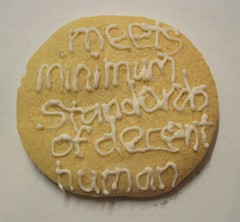
A cookie.  In icing it reads Meets Minimum Standards of Decent Human
Description: A cookie. In icing it reads Meets Minimum Standards of Decent Human. By sajbrfems, used under a Creative Commons License.

This is Part 2 of a 2-part series about Ableism & Language. Part 1: Why I Write About Ableist Language.

In social justice blogging circles, especially feminist-focused ones, it’s not unusual to have conversations about language, and why language matters. Those conversations can vary from explaining why it’s problematic to call women & girls “females”, why using “he” and “mankind” to be a generic non-gendered term is sexist, reclaiming – or not – of words like “bitch”, and what it means to refer to “undocumented immigrants” rather than “illegals”.

These conversations often focus on how sexist or racist language is a symptom of a problem that needs to be addressed. We can talk about how calling women bitches is a sign of sexism, or referring to people as “illegals” is dehumanizing to immigrants. And yet, when trying to have discussions about ableist language, we’re back to the silo of disability. Instead of talking about ableist language as part of the manifestation of the disdain and abuse of people with disabilities, it’s treated as isolated – the problem, instead of a symptom of the problem.

Ableism is not simply a language problem.

Ableism manifests in the social justice blogosphere in so many different ways. They can vary from just not thinking about disability at all when writing about social justice issues to shrugging off critiques from disability-focused bloggers as being “too sensitive”. It can be ignoring posts about disability-focused issues or only linking to non-disabled people writing about disability-issues instead of to disabled bloggers. It can be as apparent as declining to acknowledge disability exists to as “subtle” (to some) as declining to make your blog template accessible to screen readers.

There are also choices that social justice bloggers make about how we educate ourselves, and whose voices we highlight, who we approach about their writing, and who we ask to be mediators. If we’re not reading disability-focused blogs, then we’re not learning about disability-focused issues – and, in turn, we’re not highlighting those voices, bringing attention to those issues, or thinking about that analysis when writing our own posts.

Thirdly, ableism manifests in whose voices we trust. For all that I’m very happy to provide people with book lists, I’m a bit suspicious of people who decline lists of disability-focused bloggers they could be reading as well. Why does someone’s voice have to go through the publishing-sphere (and usually through academia for the books you’re going to get from me) before it counts as worth-reading?

I get why people talk about language, and I agree that language is important. But I’m not giving cookies out for publicly declaring your ally-status by saying you won’t (or will try not to) use ableist language anymore. That’s a great first step. Now move on.

[Thank you to s.e. smith for helping me clarify my ideas.]

Ableist Word Profile: Why I write about ableist language

  • Ableist Word Profile is an ongoing FWD/Forward series in which we explore ableism and the way it manifests in language usage.
  • Here’s what this series is about: Examining word origins, the way in which ableism is unconsciously reinforced, the power that language has.
  • Here’s what this series is not about: Telling people which words they can use to define their own experiences, rejecting reclamatory word usage, telling people which words they can and cannot use.
  • You don’t necessarily have to agree that a particular profiled word or phrase is ableist; we ask you to think about the way in which the language that we use is influenced, both historically and currently, by ableist thought.
  • Please note that this post contains ableist language used for the purpose of discussion and criticism; you can get an idea from the title of the kind of ableist language which is going to be included in the discussion, and if that type of language is upsetting or triggering for you, you may want to skip this post

This is Part 1 of a two-part series on Ableist Language Discussions in the Blogosphere.

There’s a lot of chatter that goes on ’round the Social Justice Blogosphere about Ableist Language: what is it? what do you mean? those words don’t mean that! how can you say that? what does that mean? why are you bringing this up? don’t you have more important things to talk about? Intentions intentions intentions! It makes my head hurt.

I talk about ableist language for a variety of reasons. The most obvious, I think, is to challenge ableist ideas that center the experiences of non-disabled people. When someone proudly assures me that words like “lame” and “dumb” and “r#tarded” are never used to describe actual people with disabilities, I’m fairly certain I’m talking to one of the currently non-disabled. Currently non-disabled readers, I’m here to tell you: those words, and any similar words you think are “archaic” and not used anymore, are used all the time, as taunts and insults towards people with disabilities, and in some cases as official diagnoses. Some of them are also used in reclamatory ways by some disabled people, but certainly not all.

But it’s more than that. Part of why I challenge ableist ideas and ableist language is because I would like more Social Justice bloggers to think “Oh, yeah. People with disabilities also read social justice blogs! I should remember that more often when I’m writing.” [I also like to challenge it in other places, which is why I occasionally go through spaces like Wikipedia & TVTropes and re-write every instance of “wheelchair bound“.]

There’s a strong tendency to assume that disability-related issues are somehow a separate thing, as though there’s a Disability Silo and things like reproductive justice, racism, heterosexism, anti-immigration, transphobia, classism, and misogyny, etc, don’t actually enter into that silo. As though no one with a disability is interested in reading about these topics, or is affected by them in any way, or is an activist on the topic, or wants to be more of one.

When someone writes something like “Wow, those anti-immigrant people are r#tarded idiots!” [I made this example up] or giggles about seeing Dick Cheney “wheelchair bound” because “it couldn’t happen to a more deserving person!” [I did not make this example up], I bring up the ableism, and my activity in the disability rights movement, as a way of reminding them that we’re here. We’re reading. We’re participating. And it’s more than a little-bit alienating to see social justice bloggers using our experiences and oppressions as their go-to for “insulting people we don’t agree with”.

But at the same time, I don’t think talking about ableist language – no matter how well-intended – is enough. It’s a step. But that’s all it is.

I will write more about that tomorrow.

Recommended Reading for Thursday May 20 2010

An image of a beach with blue sky, dotted with clouds. A figure sits in the sand by the waves. In the foreground, a wheelchair sits on the sand.

“….” by mataikan, seen at binary canvas.

Ghana News Agency – Mental Health System on the verge of collapse

Dr Akwasi Osei, Chief Psychiatrist of the Ghana Health Service, on Monday said the mental health system would soon collapse if the Mental Health Bill was not passed to correct the abuses and injustices in mental care. He said it was unfortunate that the Bill, drafted in 2004 and completed 2006, was still lingering at the Ministry of Health. Speaking at a workshop on the State of the Mental Health Bill and the United Nations Convention on the Rights of Persons with Disabilities, (UNCRP) for media practitioners, in Accra, he stressed that there was the need for the law to protect the rights and interest of patients and to overhaul the entire mental health system.

Guernica – Jonathan M. Metzl: In Medical Records, a Story of the Racialization of Schizophrenia

Ionia held these men using little-known loopholes in deinstitutionalization amendments that stipulated that the hospital would continue to receive or contain patients deemed too violent for state correctional institutions, or who posed “dangerousness to the community” even after most other patients were set free. The word negro appeared on the upper right corner of the face page in eight out of every ten of these charts. And schizophrenia, paranoid type was overwhelmingly the most common diagnosis applied to these men, these institutionalized black bodies that deinstitutionalization left behind.

the personal hurricanes of kirsty mitchell – quote from siri hustvedt, the shaking woman

the DSM does not tell stories. It contains no cases of actual patients or even fictional ones. Etiology, the study of the cause of illness, isn’t part of the volume. Its mission is to be purely descriptive, to collect symptoms under headings that will help a physician diagnose patients. there is a companion DM-IV casebook, but notably, these narratives about real doctors and patients are gathered in their own volume, seperate from the diagnostic tome.The fact is that all patients have stories, and those stories are necessarily part of the meaning of their illnesses. This may be even more true for psychiatric patients, whose stories are often so enmeshed with the sickness that one can’t be untangled without the other.

Toronto Sun – Family denied residency because of disability

A French family denied permanent residence in Canada because one of the kids has cerebral palsy may have to leave the country following a federal court decision Tuesday. David Barlagne has been working in Montreal since July, 2005. He applied for permanent residence status for his family but was turned down because of the extra costs of putting his daughter Rachel, who has cerebral palsy, through elementary and secondary school. Under Canadian law, immigration officials have no choice but to deny applicants whose health condition could cause excessive demand on social services. Barlagne appealed but the federal court upheld the original decision.

Caltics – Don’t Fall For Arnold’s Wedge [California governor Arnold Schwarzenegger recently issued a proposed state budged with drastic cuts to essential programs for low income Californians and Californians with disabilities.]

Now it must be said that it’s not just the poor who will suffer under this budget. But the budget cuts are quite obviously calculated to hit those Californians without a voice, who are seen as marginal, whose funding can be cut with the least public outcry. The elderly who will lose some or all of their IHSS benefits and the children who will lose health care services are not necessarily “poor”; those cuts will hit the middle-class as well. We can’t fall for Arnold’s wedge. Arnold is shifting tactics because he’s scared of us – scared of the public reaction against three years of austerity. Now is the time to ramp up the attack on that austerity, to move beyond tired old Reaganite claims that there’s some difference between the needs of the middle-class and the needs of the poor. Many middle-class families have benefited from the very safety net programs Arnold now proposes to cut or eliminate, and many more middle-class families benefit – at their jobs and businesses – from less fortunate families having at least some state assistance.

Recommended Reading for May 13, 2010

Jacquelyn Palmer-Boyce lies on her back, wearing a yellow t-shirt and jacket and a yellow bandana on her head, surrounded by dandelions for MCS Awareness Month. ©2010 John Boyce

Photo via The Canary Report, who writes: “Heralding MCS Awareness Month, profile photos radiating the warmth and vibrancy of yellow are popping up throughout our community on Facebook and on our network. Yellow, for those of us with Multiple Chemical Sensitivity, symbolizes the canary in the coal mine, with which we all identify. Our identity as a canary embraces and honors our bodies’ wisdom, and uses our song to alert the world of the menacing dangers of toxic consumer goods and a polluted planet.”

Alexandra Lammers and Eric Hoyle, she in a wedding dress with a festively decorated cane and he in a morning suit exit the church after their wedding.

Photo from The New York Times Vows article about Lammers’ and Hoyle’s wedding. While Lammers was using a cane due to an injury, rather than a disability, it was still nice to see a mobility aid in the New York Times like this.

Disability Scoop – Disability Advocates Reserving Judgment on High Court Nominee

Disability advocates were hesitant to say much about [nominee to the United States Supreme Court Elena] Kagan. Without a judicial record, they said little is known on her positions regarding disability rights law. “I think her hearings are going to be important,” Louis Bossing, senior staff attorney at the Bazelon Center for Mental Health Law, said of Kagan’s upcoming Senate confirmation process. “We’re going to spend time working with the judiciary committee so the senators can ask questions we’ll need to know whether to support or oppose her nomination.”

The New York Times – When Treating One Worker’s Allergy Sets Off Another’s

On the first day Ms. Kysel took Penny, [her allergy-detection service dog] to work, one of her co-workers suffered an asthma attack because she is allergic to dogs. That afternoon Ms. Kysel was stunned when her boss told her that she could no longer take the dog to work, or if she felt she could not report to work without Penny, she could go on indefinite unpaid leave. She was ineligible for unemployment compensation because of the limbo she was put in.

Ghana News Agency – Women with disabilities demand respect from society

Women with disabilities in the Upper East Region has called on society not to see them as liabilities but help empower them so they could take care of themselves. They complained that many people regarded them as a curse to their families and did not want to associate with them especially in issues of marriage. They explained that when they receive marriage proposals the potential groom’s family would usually argue that the disabled woman would join the family with her curse and discourage their son. These concerns were raised at a meeting of the Association of Women Living with Disabilities, held in Bolgatanga, to discuss their situation and find ways to make things better for their members.

MB the MD/MC – on (dis)ableism

I have a lot of people in my family with disabilities, though none of them would consider themselves disabled. In talking with another radical woman of color, it seems that disability is so the “norm” in our communities, it’s often not marked as an identity unto itself. I often wonder about what a release it might be for women of color to see disability as a framework that intersects with race and gender, to not always feel the need to keep fighting, even when it hurts, to let go of the ways that we as cis and trans women of color in particular, have taken up ableism in ways that reproduce harm to ourselves and the communities we “work” so hard and care for. Why does disability mostly look white?

Associated Press –Feds Sue Over Treatment of Disabled in Arkansas

The federal government accused Arkansas in a lawsuit Thursday of leaving people with severe mental or physical disabilities with no choice but to go into state institutions. The Justice Department lawsuit accused Arkansas of a “systemic failure” that places people in institutions when the state should pursue less restrictive avenues for their care. “The state gives individuals with developmental disabilities the draconian choice of receiving services in segregated institutions or receiving no services at all,” the lawsuit states. The federal government accused the state of violating the Americans with Disabilities Act, which guarantees people with developmental disabilities the right to live in the most appropriate setting for their needs. The state has six centers for the developmentally disabled that, in all, care for about 1,100 people.

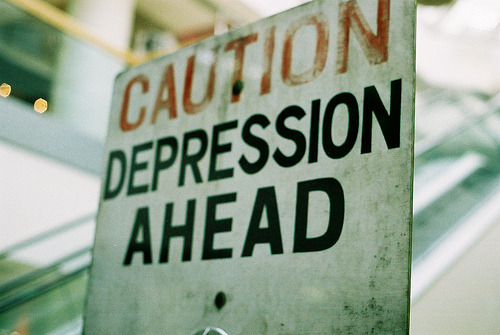
A faded street sign reading 'CAUTION DEPRESSION AHEAD' is in focus with a blurry background of escalators.

Photo credit unknown, seen at Nowhere Pixie.

An Open Letter to Ms Magazine Blog

Dear Ms Magazine Blog:

My name is Anna. I’m what some people in North America would call a person with a disability, and some people in the UK would call a disabled person. My husband, many of my friends, all of my co-bloggers, and a large number of our commenters are also people with disabilities/disabled people.

Your blogger, Carol King, would instead refer to us as “the disabled”, and as pawns of the religious right. In her blog post Kevorkian and the Right to Choose , she wrote:

The “right-to-lifers” enlisted the disabled in their cause when they cautioned that allowing people to choose to die would soon become their “duty to die.”

I’m pretty angry about that. Not offended, Ms Magazine, angry. You see, I’m really tired of “the disabled” being treated like we’re unthinking masses. I’m especially tired of the feminist movement – you know, one that allegedly wants equal rights for all people, including women with disabilities – doing this. It makes me angry because I’m a feminist as well as a woman as well as a person with a disability as well as someone who is not the pawn of anyone, thank you very much.

Some people with disabilities support the right to die. Others do not. Others do in some cases and not in others. Each of us has come to the conclusions we have because we are reasoning individuals. Gosh, some of us are even feminists who use a feminist lens to come to our decisions, regardless of which of the many places on that particular spectrum of opinion we find ourselves.

People with disabilities deserve better treatment than you have given them. We are not a throw-away line so you can score some sort of points. We are people, and I’m appalled that a feminist blog like Ms would publish something that would treat us as otherwise.

Frankly, I am so fucking tired of this shit. I’m tired of smiling while feminist organisations treat people with disabilities like they’re afterthoughts and problems to be solved. Like we’re just pawns in politics, like we need to be appeased but never spoken to or considered, like we’re too angry or not angry enough, like we have to push this fucking rock of dis/ableism uphill while you – our “sisters” – stand by and politely look away.

Do you remember Beijing, Ms Magazine? You’ve talked about it a lot lately. You know what I know about Beijing? I know the accessibility tent was inaccessible to people with disabilities. [transcript follows]

“We will achieve our rights and the respect we deserve as women with disabilities.” “Because the issues of women with disabilities have often been excluded, the goal this year was to make sure the concerns of disabled women were addressed.” Oh, hell, just watch the whole damned thing – it’s subtitled – and see the commitment feminists made to women with disabilities. Ask yourself, seriously, Ms Magazine, why your new blog has decided not to talk much about women with disabilities. “No woman who attends this conference should be able to leave Beijing without thinking about the rights of women with disabilities.” Do you?

You know what? If that’s something you can’t do, let me sum it up:

Nothing about us without us.

You wanna talk “about” “the disabled”? How about talking to us? How about letting us talk for ourselves?

How about treating us – people with disabilities – the way you would like women like yourselves to be treated? As though we have some understanding of our own experiences, our own opinions, our own thoughts. As though our thoughts do not belong to anyone but ourselves?

As though we are thinking beings?

Again, my name is Anna. I, like you, am a woman, and I am also a person with a disability. And we deserve better from you.

Sincerely,

Anna.

Please note: This thread is meant to be about the continued marginalization of people with disabilities in the Feminist Movement. I won’t be approving any comments about Kevorkian or related discussions.
Continue reading An Open Letter to Ms Magazine Blog

BADD: Why I Write

(This was originally posted as a BADD contribution at my tumblr.)

I spend a lot of time blogging about and against ableism, about being a person with a mental illness, about the way policies and cultural attitudes and assumptions act to disadvantage people with disabilities. But for some reason, I was having a lot of trouble coming up with a topic for[BADD] . I got some good suggestions – issues of ableist language (and I’ve written in the past about the words ‘retarded’ and ‘hysterical’ and their ableist roots and effects), issues about the enormous intersection between poverty and disability (poverty leads to bad health outcomes and disability often leads to poverty, making a self-reinforcing cycle), and disability tropes in pop culture (I don’t watch family guy but have talked about 90210!).

I thought of some other topics I could address – why I see today’s immigration protests and related activism as a disability-related issues and the importance of intersectionality issues in meaningful social justice work, or even an info piece on how PWDs should take steps to prepare for emergencies such as natural disasters. but I didn’t feel excited about any of those.

So I’m going to go back to the beginning, and talk a little about why I identify as a person with a disability, why I talk about disability issues, why I’m a contributor to a blog about feminist and disabilities, why I spend so much time and emotional energy on these topics. (Which are, frankly, often personally distressing, what with all the info about how I’m going to die poor and alone.)

I write because I want things to change. I’m not always sure the writing helps me individually – it is hard to focus on these issues, to perpetually remind myself of the limitations caused by my disabilities, of the societal attitudes that assume that I am lazy and worthless and dangerous to be around, of the innumerable policies and laws that reinforce and ensure the unequal status of PWDs. And while I see the value of creating a space where other PWDs can discuss their personal circumstances and struggle and receive support instead of judgment and blame, the internet is a big enough place that I think that role is being filled, well, by lots of blogs and LiveJournal/Dreamwidth communities.

I write because I want people – both PWDs and TABs – to recognize the larger cultural and political forces that create and maintain societies that use disability as a punchline, as an insult, as a reason to keep people unemployed, poor, disempowered, and sometimes leading directly to their deaths. I want PWDs in the US, Canada, UK, Australia, and other “first world” countries to understand that lobbying their governments to abandon use of land mines can directly affect the prevalence of disabilities in poorer countries like Cambodia (thanks to s.e. smith for that great post!). I want people to think about how recovery efforts in disaster-affected areas like Haiti need to include specific focus and attention on the unique and disproportionate needs of PWDs.

But for me, it’s not enough to just help people understand. I desperately want them to act. To get involved in the political process to advocate for the rights and needs of PWDs. To get involved in social justice issues as a whole, because issues affecting immigrants are going to fall heavy on immigrants with disabilities. To tease out how a national policy can and will affect PWDs in other, poorer, countries. To vote, to talk to their elected representatives, to encourage others to act.

I believe that change is possible. And I blog to facilitate, encourage, and promote that change.