Monthly Archives: December 2009

Anything is possible, except an end to these sorts of stories

This wonderful headline came into my email yesterday.

Calgarian In Line For Berth At Vancouver Games; Triumph shows anything possible

This is a disability-centric blog, so yes, you can assume it’s about disability, and not class, or age, or immigration status, or ethnicity, or race. Those sorts of “overcoming adversity” stories get written all the time, as well, and are equally offensive, for many of the same reasons I’m about to lay out here.

I hate these stories.

I hate them because of who they’re written for. They’re not written so that blind children in Canada can be all “Hey! We’ve got a great athlete going into the Olympics, and he’s blind, just like me! Maybe I can be a world-class athlete, too!” (Because the Paralympians, who are also world-class athletes, don’t get much attention. [1. From reading the article, it seems like that’s the actual stereotype that Brian McKeever was hoping to overcome – that Paralympians aren’t real athletes. Sadly, that is not the actual focus of the report. It’s primarily about how amazing! it is that he might qualify for the Real Olympics. It even ends with this: “To me, it’s no surprise that he’s going to get a spot on the Olympic team,” Goldsack said. “You forget after a while that he has vision problems. He’s just one of the guys.” Well, yes, of course he’s one of the guys – he’s not one of the elephants, after all. Sheesh.]) They’re not written so that blind adults can feel a bit of smug pride about having one of their own in the Olympic games to cheer for.

No no no, that would be silly. Everyone knows blind people don’t read the newspapers, and blind kids don’t learn about the Olympics! They’re all too busy leading sad lonely lives of darkness and misery! The only people who read newspapers are Nice Non-Disabled Folks who just need a feel good story about adversity.

Basically, framing this story as “overcoming adversity” rather than “Awesome Olympic Athlete (who is also blind!)” feeds into the SuperCrip story. When the only stories that your average non-disabled person reads about “the disabled” is this narrative, well– Annaham talked a bit about this in her post about SuperCrips over at Bitch:

Supercrip’s main function is to serve as inspiring to the majority while reinforcing the things that make this majority feel awesome about itself. In short: Supercrip provides a way for non-disabled folks to be “inspired” by persons with disabilities without actually questioning—or making changes to—how persons with disabilities are treated in society.

It also, of course, reinforces the stereotype that people with disabilities just need to try harder because anything is possible! Which we will now tell you by comparing all disabled people to an Olympic-caliber athlete!

Hey, able-bodied folks. Why the heck are you not overcoming adversity and becoming an Olympic-caliber athlete? It’s so easy, right? If you just “realize most of your limitations in life are self-imposed”, you, too can do anything!

Chatterday! Open Thread.

candy canes made of soap, standing in a cup, along with a cupful of spiral soap lollipops in various coloursThis is our weekly Chatterday! open thread. Use this open thread to talk amongst yourselves: feel free to share a link, have a vent, or spread some joy.

What have you been reading or watching lately (remembering spoiler warnings)? What are you proud of this week? What’s made your teeth itch? What’s going on in your part of the world? Feel free to add your own images. (Anna insists that these should only be of ponies, but I insist that very small primates, camelids, critters from the weasel family, smooching giraffes, and cupcakes are also acceptable.) Just whack in a bare link to a webpage, please – admin needs to deal with the HTML code side of things.

Today’s chatterday backcloth of Soapy Candy Canes comes via The Soap Queen. She has a recipe, with photo instructions, for making these little soapy canes out of melt and pour soap base. (Check out the rest of the blog; there is some amazing melt n pour soapcrafting on there!)

Recommended Reading for December 25

Warning: Offsite links are not safe spaces. Articles and comments in the links may contain ableist, sexist, and other -ist language of varying intensity.

* Bev at Asperger Square 8: How the Grinch Tried to Steal Autistic Self-Advocacy

Each autistic person deserved life a lot…
But the Grinch, who lived outside of Reason,
Thought NOT!
The Grinch hated autism, every season
He liked to chelate cats and give dogs HBOT.

He thought all he could with his tiny green head
About how to prove they’d be better off dead
Until it occurred to him how to derail
Every self-advocate, make them all FAIL. […]

* Liz Spikol at The Trouble with Spikol: Human Rights Violations at Psychiatric “Hospital”

If you haven’t heard of investigative reporter Anas Aremeyaw Anas, that’s a shame. I hadn’t heard of him either until Joe sent me a link to his latest expose on an inpatient facility in Accra, Ghana.

* Kenguru: The Car You Have All Been Waiting For (via Uppity Crip)

The first ever electrically powered vehicle designed especially for wheelchair users will become available in the UK soon.

– Driven directly from a wheelchair – access is via the rear-opening tailgate and steering is by motorbike style handlebar (joystick option will be available in time). Your own wheelchair is secured within the car by an interlocking device

– The current design allows parking rear end to the pavement for easy access and it is an ideal solution to drivers who only undertake journeys to local shops and services

– Because of its weight the Kenguru is classified as a scooter and therefore only a scooter driver’s licence is required to drive Kenguru

A little yellow car is parked rear end to pavement. A person in a wheelchair is entering the car via the rear ramp.

* The West: Wasps put sting in wheelchair sports

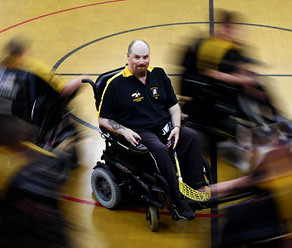
Adam Hart is a battle-hardened veteran of his sport. The 34-year-old is in training to represent WA in the National Electric Wheelchair Sports competition – for the 19th time.

A bearded man in an electric wheelchair on a court, holding a hockey stick in his hand. People in wheelchairs are whizzing around him, blurred from movement.

* High Gloss Blue: This Is GOOD Design: An Accessible Treehouse

Located around the corner from Atlanta in Rutledge, Georgia, every summer Camp Twin Lakes welcomes kids with special illnesses, disabilities, and other challenges that would exclude them from partaking in this most celebrated summer ritual elsewhere.

A wooden camp house in amongst the trees. There are ramped entrances, and a spiral slide out the other side.

Recommended Reading for December 24

Warning: Offsite links are not safe spaces. Articles and comments in the links may contain ableist, sexist, and other -ist language of varying intensity.

* Arachne Jericho at Tor.com: Post-Traumatic Stress Disorder in Fiction, Part 1, Part 2, Part 3, and Part 4

A survey of the tropes, stereotypes and more realistic portrayals of PTSD on the page and screen, from The West Wing to Lord of the Rings.

* haddayr at no_pity: “I don’t really expect much of YOU . . .

“I sometimes use a wheelchair,” I told her, and I started to explain that some people with osteoporosis who seem fine are in danger of falling, and some people with emphysema need scooters, etc., but she interrupted me.

“Well,” she said. “You have MS. I don’t expect much of YOU.”

And then, when she saw the look on my face and after I said: “Well, I certainly expect much of myself,” she said: “I don’t want to be politically incorrect!”

* Asahi.com: EDITORIAL: People with disabilities

The government established a policymaking committee where more than half of all the members will be people with disabilities. The committee is headed by Prime Minister Yukio Hatoyama.

The committee’s first job is to consider comprehensive new welfare legislation to replace the Services and Supports for Persons with Disabilities Act, which the Hatoyama administration has pledged to rescind at an early date. The law, which came into force in 2006, has proved very unpopular among people with disabilities. That’s because of the requirement that people with disabilities should, in principle, pay 10 percent of the costs of the welfare services they receive.

* Steve Carter at Examiner.com: Disability discrimination claims are up by 10%, EEOC expects continued increase [see also law.com: EEOC Will Get $23 Million to Reduce 70,000-Case Backlog]:

The number of disability discrimination claims filed with the U.S. Equal Employment Opportunity Commission increased more than 10 percent last year, and that number is expected to grow in 2010, thanks to the ADA Amendments Act. […] The commission said the Lilly Ledbetter Fair Pay Act also brought more charges. […] The Genetic Information Nondiscrimination Act, which became effective in November, is also likely to increase the number of complaints filed next year, as is the possible passage of the Employment Nondiscrimination Act, which would prohibit discrimination on the basis of sexual orientation and gender identity.

* AdelaideNow: Disabled children forced to wait ‘years’ for essential equipment

Novita Children’s Services states there are already 400 children waiting for 700 pieces of equipment and a support group says some parents are in “total despair” over the growing problem.

The average waiting time for children is 40 weeks, but varies depending on the type of equipment.

* The Age: New building rules to improve accessibility

All new homes would be built with features designed to make them more accessible to the elderly and those with disabilities, under proposed building rules for Victoria.

The changes would include a clear path from the street to an entry, wider doorways and halls, a toilet suitable for people with limited mobility and reinforced bathroom walls for grab rails.

* AFP/Google: TV presenter sorry for calling Boyle ‘retarded’

On Monday Television New Zealand upheld complaints against Henry and the broadcaster said he never intended to offend people with disabilities.

“I am sorry that some people have taken what I said in a way that I never intended,” Henry said.

In the original broadcast, Henry quoted from a magazine article which said Boyle was “starved of oxygen at birth” and suffered an intellectual disability. “If you look at her carefully, you can make it out,” Henry told viewers.

* Voxy.co.nz: Banking Services For Older And Disabled People Improved

The main areas covered by the guidelines are:

improving access to banking services including initiatives such as low tables and teller counters, user-friendly ATMs, meeting spaces and queuing aisles able to be used by wheelchairs, power assisted entry doors, layout and signage suitable for customers who are partially sighted staff, training to cover disability awareness including spotting signs of financial abuse, express tellers and queuing by numbers, observing international W3C web accessibility best practice standards, and easy to read information in alternative formats, including easy read, large print, Braille, DVD, including NZ Sign Language, and audio.

The voluntary guidelines will be reviewed in three years.

One Sided

Ten years ago I joined a club.

You don’t have to say anything about it. It is something I have (mostly) come to terms with. I only bring it up to give a little context.

I have a father out there in Meat World somewhere. I differentiate for a reason, and no, I Don’t Want to Talk About It. We have met twice ever. Once I stayed with him, my former step-mother and two half brothers for a few weeks. Over the twenty years since then we have had few enough phone conversations, emails, and letters that I can count them on my fingers. I don’t need all of them. At least one hand’s worth are those initiated by me. Every now and again he would pop up in my life and make some n00bish attempt at contact with me. It never lasted.

Somewhere along the line I decided that I am worth more than a one-sided relationship. I don’t have the spoons or the emotional strength to give to something that is that unstable. I recently wrote him, laying out the terms I required of him if he wished to have any more contact with me or my family, and that if they were acceptable that he would write to me right away.

I wrote that letter a year and a half ago before we moved from Hawai’i.

I probably don’t have to say that I didn’t receive a reply.

It pained me for a while, until I realized why I made that decision.

I bring him up to make a point.

Because I need to focus my spoons on relationships that give as much as they take. I need to make sure that the relationships that I am working at putting my valuable spoons into are giving back to me. I deserve to be valued as much as I value. I deserve to know that the person whom I am spending my precious spoons on gives a fuck that those spoons have value and that a gesture like a phone call, email, mailed letter or card are not just something that I do offhandedly. Those gestures take time and physical resources on my part.

And I deserve to be a part of a relationship where the other party recognizes that, and can be arsed to give a little of that back.

Sure, I am not always the best at correspondence, but email, Facebook, and a few other electronic mediums have given me back a bit of that. I have managed to make contact with people that I love and care about, I have managed to forge new friendships, rekindle old ones, and build bonds that I need. And those people, who care anything about me have shown me that they can do the same. Those who don’t use these mediums call or write, and I feel appreciated or loved. I feel as if my spoons matter. I have even managed to connect with a sister that I didn’t know until recently, and it has meant something that I can’t describe. That is saying something for someone who works as a freelance writer, and who talks as a nervous habit.

I have made the conscious decision to conserve my spoons by moving past relationships that are one sided, and trying to recognize when I need to leave ones that I have grown out of, even if the other parties don’t recognize it, or won’t say so to me. By choosing not to spend my life resource on something that isn’t symbiotic, so to speak. I need to know that I am appreciated, and that my time and energy is acknowledged. I need the people who claim to care about me to acknowledge that my resources are limited, and that my energy is precious to me and my family. That a phone call, letter, card, email, or other means of my reaching out isn’t just a fun thing, but a tap on my limitations.

To some it might sound selfish.

But maybe, just maybe, it is time that I include a little selfishness just for me so that I can save those resources for the people that can be arsed to say “I acknowledge and appreciate you”.

We all deserve that.

Thoughts?

Recommended Reading for December 23

Warning: Offsite links are not safe spaces. Articles and comments in the links may contain ableist, sexist, and other -ist language of varying intensity.

* Janine at StroppyBlog: Legal Step Forward on Disability Rights

The delicious irony in this particular case, the employer concerned was a firm of solicitors, who appeared to think they should not be excessively punished for mistreating an employee with a disabled kid.

Mrs Coleman, a legal secretary, gave birth in 2002 to a disabled son who required specialist care. She claimed that her employer refused to allow her to return to her previous job when she came back from maternity leave; refused to allow her to work flexibly; and subjected her to abusive and insulting comments about her child.

* amandaw at Three Rivers Blog: I have one question for you.

Where have you been for all the women stuck in nursing homes and institutions and all the women who are managing to live independently who will have their services taken back from them and be forced to move into nursing homes and modern institutions?

Because this is just as urgent an issue. And just as timely: it is being considered in the current health-care reform package. This one. This same one with Stupak (or analog). This same one you are fighting to improve for the sake of women.

Where have you been for years on the Community Choice Act?

* Rebecca at The GFCF Cookbook: Every celiac’s nightmare

News spread quickly: there was a gluten-free bread vendor, Great Specialty Products, with a table at the fair. His name was Paul Seelig, and he baked his loaves one small batch at a time in his Amish kitchen with all fresh ingredients delivered from his family farm in Ohio. His table was full of samples that were met with rave reviews by celiacs and non-celiacs alike. The bread was so good. It tasted just like real bread. It was crusty and soft and chewy, just like a good loaf of bread should be. […]

We jokingly began to call Paul “The Bread Alchemist.” We ordered two more times within a two week period, eager to try everything he sold.

And when Malachy, our little celiac, broke out in a strange rash two days after our first order, we didn’t make the connection. We thought he had chickenpox. We continued to buy and eat the bread, and the rash spread all over his body. Our pediatrician was mystified. Bug bites? A viral rash? Nothing made sense.

We weren’t the only ones in the community getting sick. […]

Paul was re-packaging Tribeca Oven’s bread and selling it as gluten-free Great Specialty Products bread.

IN THE NEWS: Special Travel Edition!

* The Consumerist: Man In Wheelchair Unimpressed With Greyhound

Along with being ignored and forgotten on the buses during many rest stops, I experienced wheelchair lifts which were barely operational that briefly trapped my chair, doors that would not close unless the driver banged on part of the frame with a hammer, and finally, a wheelchair lift door which would not open, which trapped me on the bus for over 12 hours. That required a mechanic and support personnel to fix at a station. Oh yes, and one driver who strapped down my chair when I boarded, who refused to release my chair at rest stops, since I “should have had an attendant” and “it wasn’t his job”. From my position, I wasn’t able to reach the release buttons, and was stuck.

* Sydney Morning Herald: Airline ‘erred’ on aid dog

Tiger Airways has admitted it blundered, again, after it told a disabled woman she couldn’t fly on the airline because it does not carry medical-alert dogs.

The disabled woman complained to the Human Rights Commission after she was told the only assistance dogs the airline allowed were seeing-eye dogs – a stance that is at odds with the airline’s own policy published on its website.

Disability Discrimination Commissioner Graeme Innes warned that airlines faced government regulation if they did not establish plans covering disabled travellers’ needs.

* wcbstv: Disabled Man’s Ordeal Leads To Bus Matron’s Arrest

Rivera didn’t arrive home Wednesday night. His special needs bus, ironically named Outstanding Transport, should have dropped him in East Harlem, but investigators found him almost a day later — miles away in a Brooklyn bus yard. Sources tell CBS 2 HD Rivera was strapped in his seat directly behind the driver’s seat. […] The source said Hockaday admitted to knowing that Rivera was still on the bus when it was locked up on one of the coldest nights of the year. Her rationale for leaving? She apparently didn’t want to be late for church.


* The Star: Company helps blind travellers

For me, an experienced traveller who is blind, this was my 26th country, my first time on South America, and I was excited about the places I was about to visit. […]

Liz Frankland, one of my fellow participants observed: “There are plenty of sighted people who find it strange that a blind person would want to travel anywhere, but they seem to overlook the pleasure and excitement of being indifferent places thanks to the atmosphere.

“It can be quite exhilarating being in a busy city like Lima, just to be there. Looking around and drinking in the noise and scents of a market, particularly in somewhere so different as Peru, is really interesting, especially when there is food we never see at home.”

Talking down disability while talking down to young people

Contains spoilers for A Darkling Plain, so be warned!

I’ve just finished up Philip Reeve’s Hungry Cities books. They’re really good, and I’d recommend them to any young adults reading, or anyone else who is into YA. Mortal Engines, Predator’s Gold, Infernal Devices and A Darkling Plain are full of complex female characters in a well-realised world, engaging with lots of ethical meatiness. The story is essentially about a future time in which there are mobile cities that move around finding smaller cities to “eat” for resources. Anti-Tractionists, meanwhile, live in static settlements and fight against the Municipal Darwinists. I have a few problems with the books, but I’ll keep it brief and address the rather irritating disability fail that starts off in Infernal Devices and runs through A Darkling Plain.

General Naga is the head of the Green Storm, which is the dominant Anti-Tractionist force for a good portion of the series. He has sustained war injuries and now an exoskeleton-type device allows him to move around. It’s emphasised that he’s a good and honourable man, gracious to all and working for peace. Well, up until he thinks Lady Naga has been working for the other side, at which point he is violent towards her, imprisons her and turns back to war. Almost inevitably, there is disability fail. To focus on the last book, (because that contains most of the references to General Naga, and because that’s the only one I have to hand!) alarm bells were ringing for me on page 35. Here is what goes through the mind of young Anti-Tractionist Theo Ngoni as he converses with General Naga’s wife, Lady Naga (aka Dr Oenone Zero):

‘He had seen Naga; a fierce warrior who clanked around inside a motorized metal exoskeleton to compensate for his lost right arm and crippled legs. He could not imagine that Dr Zero had been in love with him. It must have been fear, or lust for power, that had made her say yes.’

At this point, I thought, of course not. It’s going to turn out that she really loves him and married him for who he is, and this is just to set up breaking down that perception of unlovableness, right? Wrong. ‘She did not love him. She was just grateful for his protection, and glad that the leadership of the Great Storm had passed into the hands of a decent man. That was why she had been unable to say no when he asked her to be his wife.’ Naturally, a woman marrying for security. Part of my mind says that plays into the complexity of the relationships in these books, and it’s good to read something written for young people in which the happily ever afters aren’t really. Another part is thinking about how this sort of thing happens over and over again in popular culture, you know, where a disabled character isn’t being loved despite their being disabled or something.

And it goes on much like that, really, with lots of references to the crippled man! with his unrequited love! and he’s ‘half a man, wrapped up in clanking armour,’ according to one character, did we mention?

General Naga sacrifices himself in the end for the greater good, which frees young, unblemished Lady Naga from her horrid situation (tripping the sarcasm detector there). This “the cripple must die” dynamic that comes up so much in popular culture is really troubling, because its prevalence is just another betrayal of the societal view that disability is totes the worst thing ever and how can you live like that and why won’t you die and stop messing up my pretty world?! At the same time, he dies a hero, saving the people of London, following an illustrious career. Which is not exactly nice, but something.

What stories like this do is assume an abled readership. At least, I hope so, because consciously putting all this stuff onto young disabled people is a bit much. If a good part of writing fantasy/SF/spec for young people is to assist them in escaping and building up their imaginations and experiences, where are disabled youth to live out fantasy lives? Disabled youth are quite as deserving of an imaginative playground in which to develop their minds and thought as anyone else. In fact, I think it’s particularly vital that people so marginalised in the world be given opportunities to work at rich internal lives. What stories like this do is present full worlds and characters, contrasted with a bundle of cliches making up the one stock disabled character, and in doing so put disabled readers in their place: not deserving of anything more than that, and aren’t you glad you got represented at all? (Hello Doctor Who!) Which is not to mention that one dimensional characters represent another way of talking down to younger people. Younger people are quite capable of relating to characters outside of tired stock character types.

And at the end of the day, I find that these representations take me out of a story and just distract me. It’s poor storytelling, often inconsistent with the quality of the writing otherwise. It’s insulting to the audience, disabled and abled, young and old and in between.

[Cross-posted at Zero at the Bone]

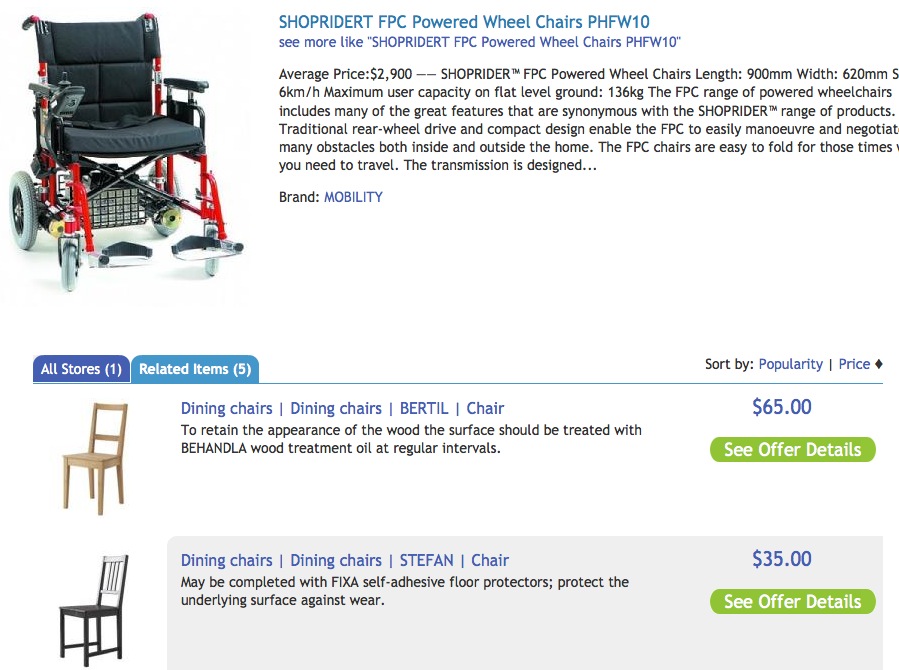
Suggestive Sell

from Shopwiki:

Shoprider electric wheelchair at comparison-shopping store. Related Items tab suggests wooden dining chairs.

The top part of the image is the search result box, showing an electric wheelchair priced at $2900. The bottom part of the image is the “Related Items” tab, which shows a choice of inexpensive dining-room chairs. (If you scroll down on the original page, you will also find stools and benches.)

From IRC:

[lauredhel] Oh, those wheelchair users, what hobbies do they – oh.

[lauredhel] But they like to SIT, right? How about CHAIRS?

[meloukhia] Can always use more CHAIRS!

Guest Post: Puppies and Pills Part 2

About thetroubleis: Thetroubleis is a 19 year old with bipolar disorder, social anxiety disorder, generalized anxiety disorder and dyspraxia. She’s a WOC who is also a transracial adoptee and pansexual/queer, depending on how she’s feeling that day. She enjoys knitting, video games and is a music geek.

Puppies and Pills Part 1.

I’m back, did you miss me? I’d like to talk a little bit about the service dog community and public perception of service dogs and I’m hoping this will be interesting to more people them just me. Your comments and questions are appreciated.

All of my experience with the service dog community is online, which makes things a bit different than they would be if I was interacting in person. Any statements I make are huge generalizations, so please, take them will a grain of salt. This isn’t make to pick on anyone person or any particular community.

The online service dog community can be a bit abrasive, in part because of the worry about fakers. There are cases of people coming in and learning the lingo and the lay to pass a pet dog or an emotional support animal off as a service dog. While I recognize this is a problem, I do think that we could cut people a little slack. I see a lot of the aggressive questioning being directed at people interested in a service dogs for psychiatric issues, because of confusion people have about the difference between a psychiatric service dog and an emotional support animal.

However, the online service dog community is also very helpful. They are willing to point people at programs or trainers that suit their needs and help people with financial difficulties come up with ideas for funding. The community is ready to help with writing campaigns at a sign of injustice and isn’t afraid to take mistaken or bigoted people to task, even if they write for well respected newspapers. If someone’s service dog gets sick they are always there with support and help finding ways to get treatment if money becomes an issue. The people in the service dog community care and they care passionately.

If you can’t meet teams in your area the online service dog community is invaluable and I’d say they are great even if you can. It’s great to have people who get it, even if we disagree on some issues. It’s great to have others who can understand what it’s like to have an access issue, or what it’s like to take a dog to the zoo.

This actually brings me to my next point, access for service dog handlers and the public. It’s a joyful topic, full of good times and understanding and caring business owners.

Okay, I lied. The general public’s understanding of service dogs or in some cases that there is anything beyond guides is very low. It makes sense that more people know of guide dogs, as they are did start the first service dog schools and hold their dogs to a very high standard. I must say that the constant questioning of whether I am blind is most annoying, not because I’m insulted, but because what my disability is or isn’t is not up for public consumption. When one adds in American society’s feelings towards mental illness, I rarely feel disclosure is in my best interest. Some in the service dog community itself are still against the idea of service dogs for people with mental illness, so I expect even less acceptance of the general population.

One thing that gets to me is how few business owners know the law. Right now I’m covered under Maine state law, but I do think that a business owner should at least know the ADA [Americans with Disabilities Act} at this point. It has been nearly 20 years, after all. So, I take pamphlets with me, even when I don’t have Figaro, to tell businesses about their rights and responsibilities. I figure if I keep this up, it should cut down on access issues, not only for me, but for all teams.

One thing I wish people understood is that petting a service dog can put the handler in danger. Yes, our dogs are trained to ignore you, but even the best dog breaks training. I love Figaro, but I wish people would talk to me not him and accept that maybe I don’t feel like talking that day. Drive by petting is one of my peeves, because by the time I process it, people tend to be too far away for me to scold or educate. I understand that people love dogs, but just as you shouldn’t go around grabbing a person’s wheelchair, you shouldn’t touch my dog without my permission. He’s not a public petting zoo.

People have attacked service dogs, kicked them, spat on them, set their dogs on them. This is unacceptable. Beyond the fact that a service dog may be someone’s independence, it’s also a living creature worthy of respect. Our dogs are not abused slaves and honestly, I think most service dogs have a better life than most pet dogs. What pup wouldn’t want to travel with their person and help them out, all the while seeing new things and people?

I try to believe that people are mostly good, if misguided, and therefore I’m going to keep educating. I hope that someday access issues will be far and few between and more people who could benefit from a service dog could have the partnership I’m able to have.

This is my next to last post in this series and next time, I’d like to talk a bit about cost of a service dog and ways to get a service dog.

An emotional support animal (ESA) is a US legal term for a pet which provides therapeutic benefit to its owner through companionship and affection. Emotional support animals are not specially trained to ameliorate disability as psychiatric service dogs are. They require only as much training as an ordinary pet requires in order to live peacefully among humans without being a nuisance or a danger to others.