Tag Archives: ableism

I’m not here for your inspiration

I think I upset one of the newer employees at my favourite tea shop today. Most of the staff are used to my cynical reactions to newspaper discussions of how inspiiiiiiiiiiring people with disabilities are at this point.

But let me begin at the beginning.

Actually, no, let me begin with something important, since recent events have told me one cannot be too careful.

There is a certain way news media prefers to talk about people with disabilities. They like to tell our stories in a way that’s “inspiring”, that’s about making non-disabled people feel better about stuff. “Oh, look at how brave that person is, being all alive and stuff despite having a disability! I would rather be dead! That person/their parents/their loved ones are so brave and inspiring! I will now put issues of accessibility and disability out of my mind, because I have been inspired!”

These stories aren’t really about people with disabilities. They’re about making currently non-disabled people feel they know something, that they’ve been touched, that their lives could be suffering and badness, but look how lucky we all are. Look at the plucky crippled person, and be inspired. [This is, of course, why Helen Keller is reduced to “hand in water” stories.]

There are, of course, reasons why people with disabilities and their families participate in these stories, and I certainly don’t blame them. I know if someone offered to interview… wait, I’ve been interviewed a few times now about disability, and I did leap at the chance. I don’t think that people who are interviewed for these stories are doing anything wrong. They’re talking about their lives, and describing their experiences. No, it’s the way that these things are spun, the words being used by the reporters to fill in the gaps, that is the problem.

The tendency is so very very wide spread that Haddayr (with the help of Codeman) made a bingo card for us all:
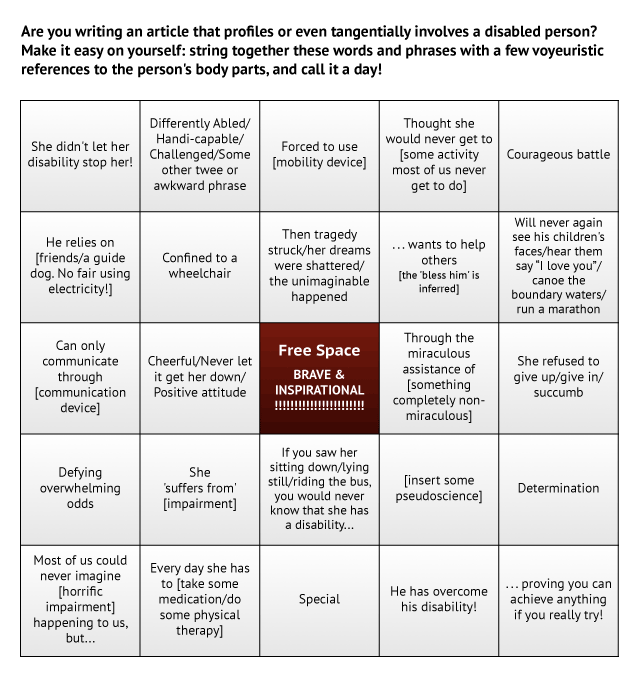
Description follows

Description written by Haddayr:
Are you writing an article that profiles or even tangentially involves a disabled person? Make it easy on yourself: string together these words and phrases with a few voyeuristic references to the person’s body parts, and call it a day!

She didn’t let her disability stop her!
Differently Abled/Handi-capable/Challenged/Some other twee or awkward phrase
Forced to use [mobility device]
Thought she would never get to [some activity most of us never get to do]
Courageous battle
He relies on [friends/a guide dog. No fair using electricity!]
Confined to a wheelchair
Then tragedy struck/her dreams were shattered/the unimaginable happened
. . . wants to help others [the ‘bless him’ is inferred]
Will never again see his childrens’ faces/hear them say ‘I love you’ canoe the boundary waters/run a marathon
Can only communicate through [communication device]
Cheerful/ Never let it get her down/ Positive attitude
Free Space:
BRAVE & INSPIRATIONAL!!!!!!!!!!!!!!!!!!!!!!!
Through the miraculous assistance of [something completely non-miraculous]
She refused to give up/give in/succumb
Defying overwhelming odds
She ‘suffers from’ [impairment]
If you saw her sitting down/lying still/riding the bus, you would never know that she has a disability…
[insert some pseudoscience]
Determination
Most of us could never imagine [horrific impairment] happening to us, but…
Every day she has to [take some medication/do some physical therapy]
Special
He has overcome his disability!
. . . proving you can achieve anything if you really try!

So, let’s go back to my story.

I haven’t been following anything to do with the Olympics for reasons I won’t go into here, but I knew exactly what was going on when I glanced at Saturday’s Globe & Mail and saw this splashed across the front:

A Different Victory: When Alex Bilodeau’s brother cheered his gold, the triumph went more than one way. The skier and the painter find inspiration in each other – and neither one accepts limits. Ian Brown travels to the intimate heart of a family.

“Oh gosh!” I said to Don, in my overly chirpy sarcastic voice. “It’s going to be an inspiring crip story, I just know it! Quick, let us purchase this fine newspaper so we can be inspired!”

Poor dude behind the counter proceeded to tell me how inspiiiiiiiirng he found “the brother of the guy who won gold”, to which my response was… less so. “Inspiring crip stories irritate the fuck out of me.”

You know what would inspire me, gentle readers? Curb cuts being cleared of snow so Don & I could get across the street without having to go three blocks out of way first. But I guess when you’re a bitter, cynical, angry person who just hates fun, that’s what you get.

Sadly for all of us, Ian Brown’s articles don’t seem to appear on the Globe & Mail’s website (except perhaps behind the paywall), so I can’t let you read the inspiriiiiiiing story of Frédéric Bilodeau, but I can show you a BINGO card that Don & I filled out while we read it.
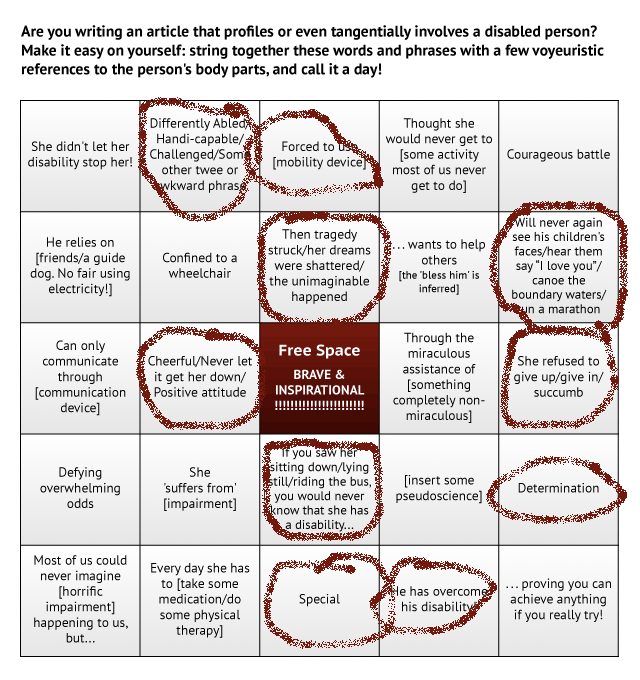
Description follows

Description: As above, but with the following squares circled:
Differently Abled/Handi-capable/Challenged/Some other twee or awkward phrase
Forced to use [mobility device]
Then tragedy struck/her dreams were shattered/the unimaginable happened
Will never again see his childrens’ faces/hear them say ‘I love you’ canoe the boundary waters/run a marathon
Cheerful/ Never let it get her down/ Positive attitude
Free Space: BRAVE & INSPIRATIONAL!!!!!!!!!!!!!!!!!!!!!!!
She refused to give up/give in/succumb
If you saw her sitting down/lying still/riding the bus, you would never know that she has a disability…
Determination
Special
He has overcome his disability!

Of course, what Frédéric Bilodeau’s story has actually managed to inspire is awesome comments at the Globe & Mail like this one:

Proud for so many reasons

Alexandre Bilodeau has provided something more than his magnificent gold performance (Gold Comes Home – Feb. 15). He has provided an example of the role that individuals with a disability play inspiring us as they overcome their challenges.

Thank you, Alex and Frédéric.

Brian Smith, Toronto

Mr Smith, with all due respect, we are not here to be your thrice-damned inspirations thank you very much. Be inspired! Lobby the Canadian government to provide funding for all universities to be fully accessible to people with disabilities! That would help lots of people with disabilities overcome their challenges!

The point of this post isn’t “here I am, talking about an article you can’t read, and being as sarcastic as possible, aren’t I witty?”. It’s actually to talk seriously about the way disabled people are written about. We’re allowed to be inspiring stories of overcoming adversity – and often those stories focus on the difficulties our loved ones have, and how hard it can be to have a disabled person in your life – or we can be a passive victim of crime. That’s it.

If new media actually presented people with disabilities as we actually are… well, that, gentle readers, would be actual news.

ETA: facesofcathy found that Ian Brown’s article’s up over at CTV. (Why? I don’t know.) Check it out: The Bilodeaus: Elusive truths from an unforgettable family. I haven’t done a side-by-side comparison of the text (I think the headings are different?) but it look pretty close.

Check out the comments if you like to headdesk over how inspiiiiiiiired people find these types of stories.

Dear Imprudence: A “Tired Wife” Strikes Back?

The hits just keep on comin’, thanks to Slate. Earlier this month in Dear Prudence, we got to read this winner:

Dear Prudence:
My husband had a stroke 18 months ago. At first he was unable to speak and his right side was paralyzed. He regained his speech and, with a lot of work, got full use of his arm and leg. But the stroke made it impossible for him to practice his profession, and he continues to have short-term memory problems. He’s home on extended leave. My problem is that he is obsessed with what he has lost and how bad things are. When I come home from work—I have to keep us fed and housed—all I hear about is what a terrible state he’s in. I’ve tried various things: We’ve gone to a counselor, his doctor has given him anti-depressants, I’ve encouraged him to go back to his hobbies. I try to plan things that will be enjoyable for him. Nothing is working. He won’t take up his hobbies or socialize, and he dwells so completely on the negative that even his closest friends are getting weary. It seems to me that he should be grateful he survived and regained so much. I am so exhausted by his negativity that sometimes I just wish I could leave him, but I would never do that. Is this the way it’s going to be forever? –Tired Wife

First, something tangential: Is this not THE perfect mishmash of weird disability-related hangups from an abled person plus some lovely Feminine Mystique-era gender(ed) expectations? It’s like it was made for a takedown on this site.

Moving on: On one hand, I can certainly see why this woman is frustrated. Adjusting to newly-acquired disability can be an extremely difficult process — not only for the person with the disability, but for their relatives and loved ones as well. However, there are a ton of stereotypes made explicit in this woman’s letter, not least of which is the “he’s just so NEGATIVE!” and the related expectation that her actions and her efforts will somehow make him become a happy, compliant Good Cripple. I have to wonder, has she stopped to consider that adjustment to disability is a long process? Or that having to go on leave from one’s job due to a newly acquired disability might, in fact, be extremely taxing on one’s self-image? Apparently not — all that matters is that he show proper gratitude (and non-“negativity”!) for all of her efforts, and not trouble her with his “dwell[ing] completely on the negative.” I am sure that many of us would find it hard to be “grateful,” too, if we had someone treating us this way due to our disability (or disabilities). Once again, a disabled person’s feelings and experiences are steamrolled over in favor of those of a person who is not disabled, and this is apparently acceptable because they are in a relationship.

The gender question, too, is worth a look; while it’s pretty common knowledge that women, on average, do much more “caretaking” work inside the home than men (at least in the U.S.), there are a few things that stick out, mostly based on what the letter writer does not mention. Was she primarily responsible for managing her husband’s schedule and social life before his stroke? If “nothing is working,” has she spoken with him about it? Please understand that I am not trying to blame her for larger sexist patterns of who tends to do the home-related care-taking and who does not; it does, however, seem odd that she has not (as far as we know) attempted to speak with her husband about this — his “negativity” nonwithstanding.

The sense that I get from this letter, overall, is that this woman has spent a huge amount of time and energy trying to fulfill the role of the “perfect” wife, and now that her husband cannot fulfill the complimentary “perfect husband”/breadwinner role, her resentment is close to bubbling over. Add to this much of mainstream white, abled feminism’s emphasis on “independence” — which seems to exist in a magical land where no one is (or should be) dependent on anyone else — it is not terribly surprising that she feels that her only option would be to leave her “negative,” disabled partner. That these seemingly opposing tendencies could show up in one letter is not surprising, either.

So, what do you think, commenters?

Question Time: Intersections

Question Time is a series in which we open up the floor to you, commenters. We invite you to share as you feel comfortable.

How does ableism intersect with any other oppressions you experience? We’ve covered gender in the past, and now I’m wondering how disability interacts with other issues in your life. For example, maybe people think your queerness is fake because you’ve a mental illness. What can you think of?

The Cult of Busy: Introductory Thoughts

The first time I noticed the correlation between “busy” and “important” was when a friend of mine boasted of her first “cardiac incident” at the age of 27. She was a very important person, after all. So important that she had to be on call 24 hours a day for her workplace, had to arrange everything around the schedule of her workplace, and rushed back to work after being released from the hospital, in case anything had happened that needed only her to fix. [1. This wasn’t actually true, just how she perceived things. When she was fired several months later and the place she worked at was better for it, she was the only one surprised.]

Since I judge my worth the same way, I don’t really blame her. The Cult of Busy tells us that worthwhile people have full daytimers, with every minute packed. Want to do lunch with friends? I’ll have to plan that week in advance. Coffee date? Only if I can fit it in between my full-time job and my hours of volunteering. And I simply can’t agree to anything else right now, have I told you how busy and overwhelmed I am with all my important things to do?

There are things I think are wrong with this pace of life for everyone (including me, but as I said, I totally buy into it), but it’s especially difficult when it comes to people with disabilities. When you value someone’s worth as a human being on how much they can squeeze into a day, what value do you place on someone who cannot do all of that? And what value do you place on people who attempt to do enough to keep up with everyone else, but fail?

We value certain things in Western Society, and one of those things is How Important You Are, and how we judge that importance is how busy you are – how in demand you are – how many people want to know what you have to say.

One of the ways this manifests is around Work (by which I mean paid labour outside of the home – the issues of unpaid labour within the home are a bit different, and we all know that unpaid homemaking is very undervalued, and people have some odd ideas about home offices and small business run out of them, and then we get into volunteering and– well, I mean paid labour outside the home for now). “What do you do?” means “What is your job?”, and if you can’t work full-time because of a disability, well. Well. That’s so sad. What do you do all day, after all? (How important can you be? What will I talk to you about if I can’t talk to you about your job? Gosh, you must be lazy. It must be nice to sit around all day!)

And then things get internalized. “I don’t have a job. I’m not contributing. I’m not important. I better make myself small and inoffensive in some way so that no one thinks I’m a burden. I don’t really have a lot of worth as a person because I’m not contributing.”

The Cult of Busy reinforces a lot of abliest ideas about who is important, and who is not, which means that the people with disabilities who can’t do It All (whatever It All is) are by default not important. They don’t count. They don’t need to be considered in how you build a business, say, because they’re never going to work for you and never going to spend money there because they aren’t important. They’re not worth including in your campaign about social justice issues because they don’t work so they don’t really contribute and even if they did, no one cares about what they have to say anyway because they aren’t important. If they were important, they’d be Busy. And Busy means something very specific: As many hours of the day filled with Stuff To Do as possible.

I want to write a lot about the Cult of Busy, in a variety of ways. How The Cult of Busy feeds into the idea that people who work less than 40 (or 60 or 80) hours a week are “getting away with something” and “not actually committed to their jobs”. How if you’re not working you “should” be volunteering, because otherwise you’re doing “nothing” with your day. How we disdain people who “just sit around all day”. How people like me end up confusing “busy” with “important and meaningful” to the point where we make ourselves ill doing too many things and being torn in too many directions.

Be busy. Be more. Be better.

[Be exhausted. Be unwell. Be harmed.]

A Difference in Perspective: Experiencing Avatar Exceeds the Marketing

We recently took a family excursion to the theatre in Seoul to see Avatar (and we can discuss our decision to take The Kid to see it another time, as in, not at all). I thought I would suck it up and see it as a service to the rest of the team here at FWD so that I could write an honest review from the perspective of someone who has been sheltered from the marketing of the movie. You can thank my language barrier and the reluctance of Hulu to stream in our country. Wev. As you may know, the marketing of the movie and views put forth by some of the actors kicked out some seriously ableist themes. After reading this transcript of the interview with the lead actor I was prepared to not like the movie at all because of the Bad Cripple message that I got from that video, the caricature of the disgruntled former Marine, and a lot of the other tropes that were chucked out there in a lot of the reviews. In fairness, I tried to not read a lot of them so that I would come into this review with a clear mind.

I was completely prepared to hate this movie.

I pretty much surprised myself and enjoyed some parts of it. Or the parts that I feel were realistically portrayed.

That is not to say that most of this movie was a big pile of fail from a feminist perspective.

To be fair off the top: This movie is pretty fucking racist. But guess what?

This is not the first time this story has been told with this theme, so I consider myself kind of inoculated to it at this point. By the time I had seen Dances With Wolves, Pocahantas, The Last Samurai, Fern Gully, and several others I am sure could come up on a more comprehensive list, I was used to having the “White Guy meets Native Group of people (and is either supposed to betray them or not), becomes accepted into their culture, and then falls in love with Native Woman or Culture (or both), and ultimately becomes the savior of Native People” movie shoved at me every Award season. Understand me when I say that I am not OK with the implications of this; I am simply becoming numb to the experience and how ingrained it has become.

Here I go. Oh, and: EXTREME SPOILER WARNING!

LAST CHANCE TO TURN BACK FOR SPOILERS

SPOILERS!

Despite what I believed going in, Jake Sully was not a disgruntled Marine who believed that he had to get his legs back in order to be a normal human being. He wasn’t seeking the Avatar as a vehicle to deliver this to him; I found his desire to be in the Avatar directly linked to his desire to be with the Na’ Vi people in general, as he had fallen in love with them and the Cheif’s daughter (if this sounds cheesy, don’t blame me. I think Cameron drank some bad milk before writing some of the dialogue). There is one scene where Jake first enters his brother’s Avatar that he excitedly runs about the garden and experiences using legs again… curling his toes in the dirt. I am not a wheelchair user, nor an actor pretending to be one, so I don’t know what it would be like to live in either of these situations. I can imagine that being a veteran, and having your worth tied to your abled body must be an experience that changes the way you view disability.

Jake Sully’s desire for getting his “real legs” back is directly linked to his feelings of self worth as a Marine, and the actual caricature, the Marine Colonel Quaritch, does nothing to make him feel differently, but rather offers to cut red tape with the VA (who apparently is still a shit pile of failure years in the future) in exchange for Sully’s promise to sabotage the Na’ Vi from inside. Jake isn’t the brainy super genius that his twin brother was, who was able to help pioneer the Avatar technology. Sully was only valuable for the parts of his body that the government needed. Before it was his legs that could carry him into combat, and now that those were no longer doing that, I got the feeling that Sully was struggling with what he was supposed to do now. Then, in a brilliant plot device, his amazingly intelligent and never appearing in this film twin brother, conveniently died leaving him to be called up because he has the correct DNA to sync with the avatar. The reality of Jake Sully’s life isn’t that he is an ableist jerk… rather, he has only ever been as good as what his body has to offer to the government. This is reinforced by Doctor Augustine, when she uses a constant barrage of insults against Sully’s mental acumen. He doesn’t measure up to what his twin was capable of.

Jake Sully, is, again, told he is not good enough by the able bodied world.

I don’t view these as the same thing. This isn’t a disgruntled Marine. This is a society that hasn’t learned how to accept a person outside of the standard, and doesn’t yet know how to accept them into their perfect world. Society doesn’t know what to do with a Jake Sully because it doesn’t want to…and why should it? It will just cast him off and get more fresh, able bodies to replace him. He isn’t their problem any more, right?

So, it is easy to paint this movie as ableist. I was ready to cast it aside as such, probably because I already hold James Cameron as a misogynistic douche nozzle and a racist ass hat to boot. I want him to fail at this too. But what he has done here actually impressed me a little (even if the actor’s own words betrayed the sentiment). He managed to show the real pain of a veteran, separated from the only thing that has ever given him a connection to anything useful. He has shown a disabled person living in the actual world…and sadly it still exists in the future.

The rest of the movie, despite being fucking gorgeous, is a pile of tropes waiting to spring forth. Despite decent performances from actors and actresses that I adore (Zoe Saldana, Giovanni Ribisi, and Sigorney Weaver), it was cliche. You want bad ass military chick who loves to blow shit up? We got that! (she dies) We have a chief’s daughter who falls incredibly in love with the mysterious outsider! We have the White Guy pretty much slaying the dragon (almost in a literal sense), and the hot warrior chick rides off behind him on its back. I almost choked on my popcorn when I saw him waving a machine gun around in the jungle as he led the natives to battle. How about the tree hugging White woman who wants to preserve the culture of the Natives because they can’t protect themselves (she dies).

All the CG in the world can’t cover up a bunch of “been there, done that” bullshit.

I leave you to your own thoughts.

Discuss.

Do you REALLY trust women?

For the purposes of this post, I would like to remind everyone that the range of disability includes people who are mentally ill, paralyzed, Blind, Deaf, permanently injured, autistic, physically disfigured, with compromised immune systems or disordered speech or chronic pain or cognitive impairments, and many, many others. Disabilities may be fatal or not, may be degenerative or not, may be apparent or not. Being painful, fatal, stigmatized, or poorly understood does not mean that life is not worth living, and I will not tolerate any attempts to enforce a hierarchy of disability; there is no category of Especially Bad Disability that destroys any chance of worthy life.

A blue-purple sunburst in the background, white letters reading "TRUST WOMEN: Blog for Choice Day 2010"

Blog for Choice Day 2010

Have you ever participated in the stigmatizing of pregnncy, childbirth and childrearing when the parent, child, or both have, or could have or obtain, disabilities?

Have you ever participated in the cultural narratives that say:

  • Older women should not have children because their children are more likely to have a disability
  • Women with disabilities should avoid having children because their children might also have a disability, and it would be wrong, unjust and cruel to give birth to a child that is not in perfect health
  • Women with disabilities should avoid having children because only temporarily-abled women can properly parent a child, or being a mother with a disability would somehow deprive the child of necessary experiences or put a burden on the child
  • Women with disabilities should avoid having children because they are more likely to be poor and need public assistance, and their children would also be more likely to use public assistance in the future, resulting in a drain on temporarily-abled taxpayers
  • Women with disabilities would be selfish to have children, and to do so would contribute to environmental destruction, economic decline, and even degradation of the human species, and they and their children would be less valuable members of society because of their lack of perfect health
  • It would be a tragedy to have a disabled child, disabled children are less desirable than temporarily-abled children
  • Life with a disability is inherently worse than life without one; life without a disability is the baseline by which all life should be measured, so of course to have a disability would be a negative and would make a person’s life worse
  • Disabled children are a burden on their temporarily abled parents, more so than any other child would be, and this is because of the child’s disability rather than because of the lack of support and affirmation throughout all levels of society for PWD and their loved ones
  • Of course it is more desirable for a child to be perfectly healthy than to have some sort of medical imperfection, and those medical imperfections are a big stress and hassle on the temporarily abled people around the child, and there is something wrong with the child for failing to meet an impossible standard of perfection
  • Health and ability are objective concepts and our current cultural wisdom on them are completely right and the medical industry that puts them forth is infallible; our ideas about health and ability are the only right way to look at things and can be universally applied
  • To violate those cultural ideas means that you are inherently flawed
  • The answer to all of this is to go to excessive lengths to avoid ever having, or being around someone who has, health problems, up to and including letting the least healthy die off or be terminated before they can live at all

You know what? I’ll bet you’ve all done it. Even the most radical disability activist has participated in some of these cultural tropes at some point in their lives.

But I’ll bet the vast majority of people “blogging for choice” would never think of disability as related to “choice” issues, and if they did, it would be for the right of temporarily-abled higher-class white Western women to terminate a pregnancy that has a more-than-minute chance of resulting in a less-than-perfectly-healthy child.

This is why the “choice” framework fails. It fails all of us, but it particularly fails those of us who fail to meet society’s idea of the optimal person: the pale, thin, beautiful, and financially comfortable picture of perfect health. The person who never relies on others (no!), is “self-sufficient,” and isn’t likely to end up a burden on the important people.

The rest of us can “choose” to stop existing.

Do you really trust women? Or are you perfectly willing to override their choices if you feel they threaten your comfortable position in society?

And you expect me to think you’re any better for my rights and needs than pro-lifers, why?

(Cross-posted at three rivers fog.)

Edit, Saturday 1/23: I am being very strict in moderating this thread. The primary response from people who do not identify as disabled seems to be “Well, I respect your choice, even though it is clearly cruel and bad/makes me ‘uncomfortable’/is the ‘wrong’ choice.” That is exactly the opposite of what this post is saying. If that is what you got out of this post, you have a LOT of stepping back, listening, and learning left to do.

I’m not asking you to be nice enough not to forcibly prevent us from ever having children, or anyone from ever having disabled children, even as you eagerly stigmatized disabled motherhood/childhood; I am asking you to genuinely examine the deep-rooted prejudices you have been taught and challenge your thinking on childbearing/rearing and disability. I am asking you to question why you have these ideas about disability, and whether they are appropriate to hold as a person committed to social justice. Including for women.

Because, here’s a hint: a lot of us women have disabilities, and all of us were children once, and some of us will have children of our own. And we are still women. Are you really protecting women’s freedom? Or are you merely preserving the temporarily-abled supremacist structure of society, with temporarily abled women as a convenient proxy?

I ask you to consider these prompts, to attempt to truly challenge your assumptions about disability and parenthood. If you aren’t willing to do that, please don’t drop in to explain why disabled women are “Doin It Rong.” Check your privilege. Thanks.

Seven reactions to reviews of Rachel Axler’s “Smudge”

On-stage scene from the play. A man and woman stand looking into a pram, the woman with a many-limbed plush toy. The pram has a wild series of tubes and wires snaking out of it.

I’ve been shaking my head over the press for Rachel Axler’s new hipster-ableist play, Smudge. Here’s a lightning tour, with my response

s at the end. Emphases are mine.

In ‘Smudge,’ Baby’s disabled, and mom’s not much better, from Newsday:

Most couples look at the sonogram of their impending baby to see whether it’s a boy or a girl. But when Colby and her husband, Nick, scrutinize the picture of the life in her womb for an answer to the “what is it?” question, they are appalled to realize that they mean it. Literally.

Rachel Axler’s “Smudge,” the very dark 90-minute comedy at the Women’s Project, aims to be part horror movie, part domestic relationship drama. Their baby, a girl, arrives unbearably deformed, with no limbs and one big eye. Nick (Greg Keller) bonds with the unseen character in the pram encircled with tubes, and names her Cassandra. Colby (Cassie Beck, in another of her achingly honest performances) attempts to protect herself from the agony through brutal humor, maniacally snipping the arms off baby clothes and taunting the “smudge” until “it” miraculously responds. Or does it? […]

BOTTOM LINE The unthinkable, faced with wit but not enough depth

More, from Variety:

Title comes from the first word that comes to mind when Colby (Cassie Beck) gets a glimpse of her infant daughter, grotesquely described as having no arms or legs, an undeveloped skeletal structure and only one (beautiful, luminous blue-green) eye in her misshapen head.

More, from Time Out New York:

She is nearly indescribably deformed: a purple-grey mass of flesh and hair, with a single, disconcertingly beautiful Caribbean Sea–colored eye. Her horrified mother, Colby (Beck), describes the child as looking “Sort of like a jellyfish. Sort of like something that’s been erased.”

More, from SF Examiner:

Continue reading Seven reactions to reviews of Rachel Axler’s “Smudge”

The Space Between…

Jennifer Hawkins, a white woman, poses nude with her arms purposefully placed, on the cover of Marie Claire magazine.This post originally posted at random babble… on 06 January 2010

The policing of other women’s bodies is never OK from a feminist standpoint. I can’t stress that point enough. It doesn’t serve any productive purpose in feminist discourse.

It is mostly an understood concept among people outside of the mainstream of feminism. Those who are able to work their theory around the concepts of white, straight, cis, upper-middle class, educated, able-bodied privilege.

Yet, a concept that still slips into the space between understanding is the difference between criticizing someone who comes from a place of thin privilege and tearing someone down for a body that is not like your own.

This article at Bitch, to me, was the latter.

It doesn’t seem like so long ago that I was a size 0. And yet, looking at myself now it feels so far away. That is something I am coming to grips with even today. But my mind remembers it all so well. How can nothing be something? And even at nothing I felt all my flaws. I covered in my towel so I didn’t have to glimpse myself in the mirror and be disgusted by what I saw. I still do that now! I refused to own a scale, afraid of what I would see (I still do that now!)…because it would send me into fits of fear and rage and crying…because no matter how much I threw up and refused to eat I could not weigh what all the charts said someone of my height and weight should…and my thighs jiggled and my belly bulged and my arms — while muscular from kitchen work — wiggled. Even though I was actually nothing. My clothing size was nothing.[1. Why are women’s sizes arbitrary numbers? Why can’t they be waist measurements? That would be more consistent?]

Jennifer Hawkins has thin privilege. Yes. She most certainly does. But when I was struggling I had two kinds of people to look at in magazines and on television: overly photoshopped women who were too perfect, and purposefully imperfect women meant to make me hate myself so that I would work to not be like them. There was no campaign of women of any size coming out to say “we are imperfect, but here we are“.

I will grant this: The Bitch piece does criticize the way that Jennifer Hawkins’ flaws have been the main focus of her nude cover. That is not the conversation that this cover should be invoking in feminist circles. But if she is talking about how hard this was for her, that is not something we should be criticizing. Dismissing her hesitancy, her own insecurities just because she is thin and has a different body type than someone else… that is not feminist either. When has it ever been OK for us to dismiss another woman’s experiences?

Why can’t we, as feminists, understand that?

She no longer has the protection of her Photoshop Deflector Shields, so she is in a vulnerable place, but her thin privilege doesn’t put her in the same place as all the fatties of the world who are crying in clothing stores because shirts are not made for their bodies. I get that. I think Kelsey Wallace at Bitch, for whom I just did a mostly lovely guest blogging stint w/ some of the FWD/Forward team, even gets that despite what I am garnering from her post.

Jennifer Hawkins is not the same as me. She does not know what it is like to walk into a doctor’s office and have hir assume that the pain or illness is caused by my weight before they know anything about me. She does not know the pain of the stares when I have trouble walking somewhere, as if it is definitely because I am a fattie. Or how clothes are made for people like her and not for me…or how society is made to make me feel like I am a big worthless pile of shit whose only chance at redemption is to adopt a “Lifestyle Change” for just sixty bucks a month or whatever.

But while we are throwing stones at Hawkins and scolding her for making us all feel like crap, let’s remember that she is entitled to feel like crap too. And other women who look like her, who aren’t models, who might feel like crap about themselves, they are allowed to feel that way too if they want too. Because some of them might be trying to recover or hold on or what the fuck ever. Maybe they are healthy, and have been told to Eat a Sandwich[2. Yes. I linked to them. I want people to see how awful that thread is, and how flippantly and dismissively that is defended, even when it is pointed out to the mod to be harmful. As in, she doesn’t care that some people find it harmful.], as if it funny or hip, but they can’t gain weight or can’t eat that much for whatever reason.

Or, maybe we, women of any size, are allowed to love our bodies and just be fucking happy, no matter what, and these women on these covers should show us that at any size we can all be beautiful (and maybe we will see more variance soon…but I am a silly, idealistic girl[3. I can’t back this up. I am not.]).

We can criticize thin privilege without policing other women’s bodies.

Just sayin’…

Lines in the Sand: Daly, Showalter and Tactics of Exclusion

The second-wave radical feminist theologian and professor Mary Daly died earlier this month, and there has been a veritable outpouring of eulogies from various feminist blogs.

Few of these eulogies have acknowledged Daly’s transphobia and racism.

I do not deny that Daly was an important figure in second-wave feminism, but to mourn her passing without a nod to her work’s more problematic aspects, or explorations of these aspects, are, to put it mildly, not good. In particular, the intense, hateful transphobia found in some of her writing, and her issues with unexamined white privilege and racism — which both QueenEmily at Questioning Transphobia and Sungold at Kittywampus cover very well in recent posts — strikes many as both deeply disturbing and an old pattern that has, and continues to, rear its grotesque head in certain segments of contemporary feminism. I include myself among those who are deeply troubled by Daly’s transphobic sentiments and her questionable record when it came to examining the entrenched racism and issues surrounding white privilege in the second-wave feminist movement.

I should probably mention at this point that I do not mean to appropriate or co-opt the struggles of trans* folks in any way, although my cis privilege will most likely be unintentionally reflected at points in this piece. Though the struggles of trans* people, trans feminists and PWDs and disabled feminists are not the exact same, some exclusionary tactics of certain cisgendered feminists and those of abled feminists sometimes take similar forms, especially within the mainstream feminist movement. The oppression of trans* folks and PWDs in cis, abled culture intersect in a number of ways; this post, however, barely scratches that surface. I believe that the many issues present in Daly’s work–as well as the reaction to her death around the blogosphere–can serve as just one entry point to discussions of the similarities in oppression(s) that trans* people and PWDs face. There are also clear differences, among them the fact Daly used language that can only be called genocidal, while many other feminists of her generation did not advocate such an extreme path when it came to keeping certain individuals out of feminism. I will be focusing on feminism’s exclusion of trans* and PWDs as reflected in the work of two very influential second-wave feminists here, but there is, of course, much more to these stories.

Daly’s penchant for exclusion and outright hatred (particularly of trans* individuals) couched in oddly phrased academic rhetoric unfortunately brings to mind another famous second-waver’s similar issues with people (particularly women) with disabilities. Princeton scholar Elaine Showalter — best known for bringing feminist literary theory to the fore in the academy at a time when such a discipline was, for the most part, inconceivable — dismissed disabling conditions like Chronic Fatigue Syndrome, Gulf War Syndrome and mental health issues such as Dissociative Identity Disorder (referred to in the text as Multiple Personality Disorder) in her 1997 book Hystories.

In Hystories, Showalter attempted to debunk “modern media epidemics” such as the aforementioned disabilities as well as more traditionally disproven phenomena such as alien abduction and satanic ritual abuse. In the book’s chapter on Chronic Fatigue, Showalter rather disingenuously declared that she did not want to “disparage the suffering” of people with such conditions only a few pages before she called CFS an extension of Western “fin de siecle [end of the century] anxiety.” She followed this stunning assertion with the claim that the Western news media was primarily responsible for making CFS into an escalating “psychogenic epidemic” (117, 131).

Like Daly’s severe opinion of trans* people as dupes of the medical industry (which Kittywampus cites in her post), Showalter also seemed to be taken with the idea that people with CFS are somehow being duped into thinking that they are ill because of the media focus on their condition. She wrote that many CFS patients and their defenders are “hostile to psychiatric or social explanations” of the condition, and that many of them react in a way that is not friendly to the labeling of CFS as “psychiatric” (128). However, the reactions of these same patients make sense if considered from a non-abled perspective. Showalter also seemed completely mystified by these “hostile” reactions. If CFS is just a manifestation of “fin seicle anxiety,” as she contended (adding that “emotions have tremendous power over the body”) she seemed to push the conclusion — without any scientific or medical proof — that many people with CFS have somehow been brainwashed into believing they have it; thus, the media-driven “hysterical epidemic” has worked.

Nowhere are feminists with Chronic Fatigue Syndrome or related conditions consulted; the not-so-feminist implication here is that feminists with Chronic Fatigue Syndrome either do not exist or are just victims of a “hysterical” media-led epidemic and therefore cannot be “real” feminists. This is similar to how trans* feminists were erased, excluded and castigated by Daly as somehow not “real” women or feminists, and as benefiting from patriarchy in a way that “real” women and feminists could not. To put it crudely: This is exclusionary bullcrap, and it does not do trans* people, people with disabilities, feminists who fit either (or both) of these categories, or the feminist movement as a whole any favors whatsoever.

Exclusion is not radical. It has never been radical. It is, in fact, extraordinarily status-quo. No one should be able to arbitrarily pick and choose who “belongs” in the feminist movement and who does not, especially if those who are being excluded because of their gender identity, sexual identity or disability actively identify as feminist. Feminism should be for a wide variety of people; exclusion, however, is something that is not — and has never been — very  feminist.

Author’s note: I will be moderating this thread with an iron fist; please have the courtesy to not try to tell me how Daly really was an ally to trans* folks, or how Showalter didn’t mean what she said about CFS *that* way, or that either author’s influence on the feminist movement somehow excuses their hatred and bigotry. Thank you.

[Cross-posted to Ham.Blog]

Why I don’t think it’s funny to use Limbaugh’s drug abuse as a punchline.

Short background: Rush Limbaugh (link goes to Wikipedia article) is a US conservative radio talk show host who has risen to prominence in the US by inciting “controversy” after “controversy” with hateful rhetoric. He also went through an ordeal some time back for addiction to prescription painkillers, an incident that the US left likes to use against him. Recently he was rushed to the hospital again, which has spurred a new round of derision from US liberals.

Rush Limbaugh isn’t exactly a sympathetic character. His politics are vile and he makes a career out of escalating white male resentment into white male supremacy. And that causes real harm to real people who don’t meet the requirements to be part of Limbaugh’s He-Man Woman-Haterz Club.

How did he end up abusing prescription painkillers? I don’t know. Was he taking them for legitimate pain due to injury, surgery or a medical condition, and the usage got out of hand? Was he consciously using it as a recreational drug? I have to say I am still somewhat bitter about people who use the stuff I need to be able to get on with my daily life as a quick and easy “high,” ultimately making it harder to access needed medication. (But that is argument from emotion, mostly; I would posit that the real problem is a medical field and larger culture which does not take seriously the needs and concerns of chronic pain patients and is eager to punish people who step outside accepted boundaries.)

But even if he was just out for a high, I still feel unease when I see people use that angle to criticize him.

Because, here’s the thing… the same narrative that you are using to condemn this despicable figure is the narrative that is used to condemn me.

You are feeding, growing, reinforcing the same narrative that codes me as an abuser, that makes me out to be a good-for-nothing low-life, that makes it difficult for me to access the medication I need to be able to live my normal daily life.

When you laugh, joke, or rant about Limbaugh’s abuse of narcotics, you are lifting a page from the book of people who would call me a malingerer and interpret my behavior (frustration at barriers to access, agitation and self-advocacy to try to gain access) as signs of addiction. People who would, in the same breath, chastise me for “making it harder for the real sufferers.” (See why my bitterness about recreational use isn’t actually serving the right purpose, in the end?)

Maybe you don’t really think this way. But maybe the people laughing at your joke do.

And maybe, you just made them feel a little bit safer in their scaremongering about “addiction” and deliberate attempts to make life harder for us.

Scoffing at Limbaugh’s hypocrisy is one thing — but when your scoffing takes the form of a very common, quite harmful cultural prejudice — even when you don’t mean it to — it has real effects on real people’s lives. Sort of like that casual incitement that we hate Limbaugh for.

(Cross-posted at three rivers fog.)