Category Archives: media and pop culture

Stigma Kills: A Concrete Example

Often when bloggers or activists push back against ableist language and stereotypes in the media, especially pop culture, someone will respond with an argument that there are more important disability issues to address and that the topic at hand is mostly irrelevant to disability rights as a whole. This has happened with each of the posts in the Ableist Word Profile series, it’s happened with discussion about ableist tropes in pop culture, it’s happened when critiquing the vast overrepresentation of criminal behavior in news coverage of people with mental illness.

I believe these things matter very much. Perhaps not individually – if I slip and use the word “lame” pejoratively, it does not automatically cause a person with a disability to die instantly. But each individual instance adds up to become a trend, to become a larger understanding and expectation of how things are. And if those understandings and expectations aren’t accurate, it can have dramatically horrific results.

This is because a lot of our ongoing decisionmaking is done automatically, unconsciously. This is because we are constantly presented with such a vast amount of information that if we stopped to consciously evaluate everything, we’d never be able to do anything at all. When I see an object with keys labeled with letters and laid out in the QWERTY design, I recognize it as a keyboard an assume I use it to manually input written data into a computer or typewriter or phone or other device. This saves me the trouble of figuring out each and every time what this object is, what it is for, how I am supposed to interact with it, and what end result I can expect. I do this instantly, even though it is immensely complicated – it has been extraordinarily difficult to program a computer to identify, say, a keyboard from a photo or video, regardless of lighting, angle, and lots of other variables that the brain can process almost instantly.

There are similar examples for evaluating other sensory input. When I touch something, I know instantly and without consciously considering it whether the object is solid or liquid, dry or wet. I have no idea how I make that evaluation and instructing someone else on making that judgment would be immensely difficult for me – but when my foot touches a wet patch of carpet en route to the bathroom in the middle of the night, I pull my foot back lightning fast to avoid what is surely cat puke. If I feel myself losing balance, I put out a hand to catch myself without consciously deciding to, because my classification of my sensations as “losing balance” was done entirely unconsciously.

How does stigma fit into this? Well, a stereotype is an unconscious cognitive shortcut – instead of examining an individual person or situation, we apply a stereotype to make assumptions. While a stereotype is usually seen as a negative thing, they serve an important purpose by allowing us to make educated guesses. For example, when I go into a fast food restaurant, I know to go to the counter and give my order to someone behind the counter, usually wearing a uniform. While this has held true at the places I’ve visited in the past, if I go to an new fast food restaurant that I haven’t visited before, I will assume that I use the same procedure. That’s a useful assumption that saves me the time and energy of approaching each situation as brand new and unrelated.

There are times when stereotypes can be harmful and damaging, as we well know. The stigma against PWDs is an assumption applied to all PWDs simply because they are PWDs, assuming they have a set of presumed characteristics, motivations, and beliefs. It is a stereotype composed of all the understandings and expectations of PWDs conveyed by all the little things – the word choices of the people you talk to, that one character in that on tv show, that story you saw on the news last night. And although the specifics fade away, most people are left with vague, unconscious associations. Again, some of these associations are essentially value-neutral, as how I generally associate red with “stop” and green with “go” from traffic lights and signs. But people can also have unconscious associations around more complex and problematic issues, like race, gender, and disability status.

Social psychologists from Harvard developed a computer-based test to measure the existence of implicit associations and stereotypes – the Implicit Association Test (IAT). The IAT asks users to rapidly categorize words to the left or right of the screen. From the IAT FAQ:

The IAT asks you to pair two concepts (e.g., young and good, or elderly and good). The more closely associated the two concepts are, the easier it is to respond to them as a single unit. So, if young and good are strongly associated, it should be easier to respond faster when you are asked to give the same response (i.e. the ‘E’ or ‘I’ key [to indicate left or right]) to these two. If elderly and good are not so strongly associated, it should be harder to respond fast when they are paired. This gives a measure of how strongly associated the two types of concepts are. The more associated, the more rapidly you should be able to respond. The IAT is one method for measuring implicit or automatic attitudes and is featured on this website. There are other methods, using different procedures, that have been investigated in laboratory studies.

I’ve taken a number of IATs before (because I’m dorky about cognitive science and this kind of stuff) and believe that they have correctly identified in me some negative unconscious associations. For example, I unconsciously associated women with home and family and men with business. Consciously, I strongly disagree with that association! So when I do consciously consider my assumptions about those associations, I override and reject my unconscious associations.

When researching this post, I took the IAT that measures unconscious associations around disability. (I can’t link directly to that test, but it can be found in the IAT demonstrations available here.) Taking the test, I found that I have a slight automatic preference for abled people over PWDs. This doesn’t mean that when I act, speak, or even think about these issues I exhibit that preference. It doesn’t mean that I “really” prefer TABs to PWDs. It means that I have been sufficiently inundated by messages that associate TABs with “good” and PWDs with “bad” that I have a slight unconscious tendency to apply that association, a tendency almost instantaneously overruled by my conscious thought. So it is an association that exists only for the tiniest of moments until it is extinguished by cognition.

How can those tiny moments, almost too small to measure, even matter? Well, as Chally recently posted about, a Los Angeles police officer shot and killed an unarmed man with an unspecific cognitive disability autism [1. ETA since his family disclosed that he had autism in numerous public interviews.]. The officer fired as the man reached towards his waistband after failing to respond to verbal commands from the police. From the LA Times article linked in the post:

[LAPD Officers] Corrales and Diego believed “he [the PWD] was arming himself” and fired, Assistant Chief Earl Paysinger said at an afternoon news conference.

The officers made decisions in a fraction of a second,” he added.

In a fraction of a second.

Just long enough for the unconscious association to spark but not long enough for conscious thought to override it.

Just long enough for stigma to kill.

Aware of what exactly?

Cross-posted at Zero at the Bone and Feministe.

Well, it’s Disability Awareness Month in Indiana, USA. Sound Bend, IN, network WSBT are raising awareness with a story about Sarah Schelstraete, who has Down Syndrome. It’s called Sarah’s Story: Hard at work despite disabilities. One thousand points if you can anticipate from the title what my major problem with the article was.

Now, impairments can make particular kinds of work, or work at all, difficult for people with disabilities, particularly when accommodations – be they ramps or particular lighting or a chair or whatever – are not provided. Leaving aside any accommodations Ms Schelstraete might utilise (it’s irrelevant and really none of our business) there’s no indication as to what impact her impairment might have that would make it hard for her to work at her job as the article title suggests. In fact, the article doesn’t tell us what her job actually is, but moving right along. Now, I’m not saying she definitely doesn’t have challenges related to her impairment, but rather that I have a problem with a particular narrative that this article taps into. This is a narrative that erases Ms Schelstraete’s individual situation, whatever that might be, in favour of conveying disability as something the poor dears must overcome! in their tear-inducing (to abled people) efforts! to live a normal life! which includes paid work!

Perhaps it is that push to gloss everything over that skews the narrative here, but let’s take a gander at the actual information the article provides. Ms Schelstraete is clearly a ‘dependable employee,’ as her supervisor Donna Martis says. She does her job well; interviewees are enthused about her being good at her job. There is not really a need, it would seem, to say that she is doing a good job in spite of her being disabled. She is good at her job. And she is disabled. Just like she is good at her job and a woman, good at her job and a daughter, good at her job and a resident of Indiana, good at her job and, I don’t know, maybe she likes detective shows or cupcakes or whatever. But time and again when disabled people are featured in the media, there’s a kind of shock that “those people” could achieve anything of worth – worth defined according to ableist standards around paid work, of course.

As such, I have a problem with wording like this in the article:

‘Martis said Sarah is a valuable employee who knows how to do her work, and requires little supervision.’

Or how about this?

‘Like any hard-working employee, Sarah knows one big benefit of having a job is making money. She often uses her paycheck to buy DVDs and CDs.’

Yep, just like everybody else – yet her competence must be uniquely examined and confirmed by all these people, despite her having been employed by the same laboratories for seventeen years. This is yet another example of the media trope in which PWD are achieving! through! the hardship! Would you like to know what a hardship is? For many PWD, sometimes more than our impairments themselves? Putting up with that condescending bullshit and fighting to be approached as actual people who should be approached with respect. Because handing out “well done!” stickers has nowhere near of the same value as does being treated like a person with things to offer.

These kinds of awareness-raising stories do little more than give abled readers/viewers/listeners a lift, a feel good story they can tuck away out of mind when they’re done. It’s easier for PWD to be a one-dimensional story, those people put there to light up abled people’s worlds with inspiration, prompting a whispered gratefulness that they’re not one of them. How about we raise some awareness of the social oppression attached to being disabled? Awareness ought to be raised about how many disabled people are out of work because, as Ms Schelstraete’s employment consultant Stacey Simcox says, many ‘don’t give someone the chance because they already have the mindset that they’re not going to be able to do the job even with the support’. About how disabled people so often are treated as though they’re being done a favour by being employed at all. About how work can be a struggle or impossible because of workplace bullying. Because of refusal to provide decent wages. Because employers won’t grant equitable working conditions or accommodations.

And let’s raise awareness about the valuation of work. There’s a nasty thread that runs through these kind of stories that holds disabled people to be societal leeches, a drain on resources. This kind of thinking defines human worth in terms of money, as though people are only good for how much money they contribute and how little they take from welfare or healthcare programs and such. It’s the kind of argument used against poor people who need that assistance, it’s the kind of argument that has led to women’s unpaid work in the home being so devalued. It’s thinking that tries to shame those who utilise thoroughly deserved government assistance, as though it doesn’t exist for a reason.

I am continually astounded by negative reinforcement of difference, but barely ever really surprised. You’d think efforts to raise awareness would require being aware.

Quick Hit — 4D Plexes

Movie poster from the Korean realease of Avatar, showing a white man on the left and his blue faced Avatar on the right, with fantasy creatures imposed in the bottom foreground. Bottom has Korean writing for title "Avatar".Our local theater in South Korea has one of the first and only 4D Plexes in the world (and it is currently showing Avatar, so I could possibly be entertained and annoyed and over-stimulated all at once! Whee!).

“The way the company finally cornered that elusive fourth dimension is by engaging all five senses: moving seats, wind, water sprinkling, lasers, and synthetic smells are all used in time with the movie.”

What are your thoughts/feelings on this so-called break through in the movie going experience? Does the thought of a moving seat and being accosted with sprinkling water and scent sound like an enhanced movie experience for you? Does it seem like it would just provide another barrier to your enjoyment?

Personally I picture myself using my popcorn bucket for something other than its intended purpose…

Have at it in comments.

Singing in Sign

One of the things that drove me up the wall about a certain popular television show that I’m not going to talk about was the scene with the “Deaf Choir”. I put “Deaf Choir” in scare quotes here because, while the members of the choir showed in that show were Deaf, that didn’t look much like any of the Deaf singing that I’ve seen.

But hey – don’t take my word for it.

Auslan is the language of the deaf community in Australia. Here’s a video of a deaf woman signing “Madly Truly Deeply” by Savage Garden (lyrics below video).

Lyrics:

I’ll be your dream / I’ll be your wish / I’ll be your fantasy.
I’ll be your hope / I’ll be your love / Be everything that you need.
I love you more with every breath / Truly madly deeply do

I will be strong I will be faithful /’Cos I’m counting on a new beginning.
A reason for living.
A deeper meaning.

I want to stand with you on a mountain. / I want to bathe with you in the sea. / I want to lay like this forever. / Until the sky falls down on me

And when the stars are shining brightly / In the velvet sky,
I’ll make a wish / Send it to heaven / Then make you want to cry..
The tears of joy / For all the pleasure and the certainty.
That we’re surrounded / By the comfort and protection of
The highest power.
In lonely hours.
The tears devour you.

I want to stand with you on a mountain, I want to bathe with you in the sea. I want to lay like this forever, Until the sky falls down on me

Oh can’t you see it baby? You don’t have to close your eyes
‘Cos it’s standing right before you. All that you need will surely come.

I’ll be your dream / I’ll be your wish / I’ll be your fantasy.
I’ll be your hope / I’ll be your love / Be everything that you need.
I’ll love you more with every breath / Truly madly deeply do

American Sign Language is used throughout the US & Canada (although Canada also has Quebec Sign Language (LSQ: (langue des signes Quebecoise) & Maritime Sign Language).

This video features a variety of people Signing Michael & Janet Jackson’s Scream. The video is subtitled, and lyrics follow:

lyrics:

[Michael]
Tired of injustice / Tired of the schemes/ The lies are disgusting
directed at me.
Kicking me down/ I got to get up / As jacked as it sounds
The whole system sucks

[Janet]
Peek in the shadow / I Come into the light / You tell me I’m wrong
Then you better prove you’re right
You’re sellin’ out souls but / I care about mine/ I’ve got to get stronger
And I won’t give up the fight

[Michael]
With such confusions don’t it make you wanna scream
You’re bash abusin’ victimize within the scheme
(Janet)
You try to cope with every lie they scrutinize
[Both]
Somebody please have mercy / ‘Cause I just can’t take it
Stop pressurin’ me / Just stop pressurin’ me/ Stop pressurin’ me
Make me wanna scream
Stop pressurin’ me / Just stop pressurin’ me/ Stop pressurin’ me
Make me wanna scream

[Michael]
Tired of you tellin’ the story your way / It’s causin’ confusion / You think it’s okay

[Janet]
You Keep changin’ the rules / While I keep playin’ the game / I can’t take it much longer / I think I might go insane

[Michael]
With such confusions, don’t it make you wanna scream / Your bash abusin’ victimize within’ the scheme
(Janet)
You find your pleasure scandalizin’ every lie
[Both]
Oh father, please have mercy ’cause I just can’t take it
Stop pressurin’ me / Just stop pressurin’ me / Stop pressurin’ me
Make me wanna scream
Stop pressurin’ me / Just stop pressurin’ me
Stop fuckin’ with me / Make me wanna scream

[Janet]
“Oh my God, can’t believe what I saw / As I turned on the TV, the city
I was disgusted by all the injustice / All the injustice”
[Michael]
“All the injustice”

[News Man]
“A man has been brutally beaten to death by Police after being wrongly identified as a robbery suspect. The man was an 18 year old black male…”

[Michael]
With such collusions don’t it make you wanna scream / Your bash abusin’ victimize within the scheme
[Janet]
You try to cope with every lie they scrutinize
[Both]
Oh brother please have mercy ‘Cause I just can’t take it / Stop pressurin’ me
Just stop pressurin’ me / Stop pressurin’ me/ Make me wanna scream
Stop pressurin’ me / Just stop pressurin’ me / Stop pressurin’ me
Make me wanna scream / Stop pressurin’ me
Just stop pressurin’ me / Stop pressurin’ me / Make me wanna scream
Stop pressurin’ me / Just stop pressurin’ me / Stop pressurin’ me
Make me wanna scream / Stop your pressure!

(lyrics from Elyrics)

British Sign Language is used throughout the UK. I first learned about it by watching Paddy Ladd’s vids.

This guy is Signing Lady GaGa’s Poker Face (subtitles, lyrics follow):

Lyrics:

Mum mum mum mah / Mum mum mum mah

I wanna hold em’ like they do in Texas please / Fold em’ let em’ hit me raise it baby stay with me (I love it)/ LoveGame intuition play the cards with Spades to start/ And after he’s been hooked I’ll play the one that’s on his heart

Oh, oh, oh, oh, ohhhh, oh-oh-e-oh-oh-oh / I’ll get him hot, show him what I’ve got
Oh, oh, oh, oh, ohhhh, oh-oh-e-oh-oh-oh, / I’ll get him hot, show him what I’ve got

Can’t read my, Can’t read my / No he can’t read my poker face
(she’s got me like nobody)
Can’t read my, Can’t read my / No he can’t read my poker face
(she’s got me like nobody)

P-p-p-poker face, p-p-poker face / (Mum mum mum mah)

I wanna roll with him a hard pair we will be / A little gambling is fun when you’re with me (I love it)
Russian Roulette is not the same without a gun / And baby when it’s love if its not rough it isn’t fun, fun
Oh, oh, oh, oh, ohhhh, oh-oh-e-oh-oh-oh / I’ll get him hot, show him what I’ve got / Oh, oh, oh, oh, ohhhh, oh-oh-e-oh-oh-oh,
I’ll get him hot, show him what I’ve got

Can’t read my, Can’t read my / No he can’t read my poker face
(she’s got me like nobody)
Can’t read my / Can’t read my / No he can’t read my poker face
(she’s got me like nobody)

P-p-p-poker face, p-p-poker face (Mum mum mum mah)

I won’t tell you that I love you / Kiss or hug you / Cause I’m bluffin’ with my muffin / I’m not lying I’m just stunnin’ with my love-glue-gunning / Just like a chick in the casino / Take your bank before I pay you out / I promise this, promise this / Check this hand cause I’m marvelous

Can’t read my, Can’t read my / No he can’t read my poker face
(she’s got me like nobody)
Can’t read my / Can’t read my / No he can’t read my poker face
(she’s got me like nobody)

Can’t read my, Can’t read my / No he can’t read my poker face
(she’s got me like nobody)
Can’t read my, Can’t read my / No he can’t read my poker face
(she’s got me like nobody)

Can’t read my, Can’t read my / No he can’t read my poker face
(she’s got me like nobody)
Can’t read my, Can’t read my / No he can’t read my poker face
(she’s got me like nobody)

P-p-p-poker face, p-p-poker face / (Mum mum mum mah)

P-p-p-poker face, p-p-poker face / (Mum mum mum mah)

P-p-p-poker face, p-p-poker face / (Mum mum mum mah)

(Lyrics from azlyrics)

I Can’t Handle Celebrity Suicides

There’s been a couple of recent high-profile celebrity suicides.  Earlier this month, celebrated fashion designed Alexander McQueen hanged himself in his London home at the age of 40. Then this week, actor Andrew Koenig was found dead from suicide in Vancouver after being missing for several days.  These are just the most recent – there’s also David Foster Wallace, Spaulding Gray, Kurt Cobain, Ian Curtis, back to Diane Arbus, Anne Sexton, Sylvia Plath.

Of course, there are a lot of people who commit suicide who don’t make international headlines and don’t get websites doing slideshow retrospectives of their careers and bodies of work. But I don’t always know about those – it’s only the celebrities or the dramatic suicides (burning down a house while inside it to avoid foreclosure, for example) that come to my attention through the media. And every single time it happens, it stops me in my tracks.

These events remind me that the monster of depression can always get you. No matter how creative and inspired you are. No matter how much admiration and respect you earn from the fashion industry, the music industry, the world at large. No matter how privileged and rich you are. No matter how well known your struggles with depression are, no matter how many friends and strangers love and support you, no matter ho many people feel your loss. No matter how many years you’ve spent running from the monster. It can always catch you. It can always kill you. You are never and can never be safe.

I follow the twitters and blogs of a lot of alternative comedy people and the past week has been filled with concern about Koenig’s disappearance and ferverent please for help in finding him and making sure he was ok. This is even more notable from the comedy crowd who tweet only silly and humorous things and have essentially broken character to express their concern and love for Koenig. While I realize I can’t tell whether Koenig had actual love and support in his life just from reading a tweet from Doug Benson, I can see that there was a network of people who were really worried about him and who seem deeply affected by his loss.

If I committed suicide, it wouldn’t make any headlines. I’ve done a lot of work of which I’m very proud, but it wouldn’t be reviewed and featured on the Huffington Post. And certainly a generation of people wouldn’t have vivid memories of where they were when they heard about my death, as exists for Cobain. (I was in a car with my dad on Folsom Ave. in Boulder, C0lorado, driving south, when I heard it announced on the radio.) So the fact that the monster overtook these celebrities makes me feel even more vulnerable to succumbing.

Everything they did, everything they had, it didn’t help them. Couldn’t save them. What chance do I have?

I’m not here for your inspiration

I think I upset one of the newer employees at my favourite tea shop today. Most of the staff are used to my cynical reactions to newspaper discussions of how inspiiiiiiiiiiring people with disabilities are at this point.

But let me begin at the beginning.

Actually, no, let me begin with something important, since recent events have told me one cannot be too careful.

There is a certain way news media prefers to talk about people with disabilities. They like to tell our stories in a way that’s “inspiring”, that’s about making non-disabled people feel better about stuff. “Oh, look at how brave that person is, being all alive and stuff despite having a disability! I would rather be dead! That person/their parents/their loved ones are so brave and inspiring! I will now put issues of accessibility and disability out of my mind, because I have been inspired!”

These stories aren’t really about people with disabilities. They’re about making currently non-disabled people feel they know something, that they’ve been touched, that their lives could be suffering and badness, but look how lucky we all are. Look at the plucky crippled person, and be inspired. [This is, of course, why Helen Keller is reduced to “hand in water” stories.]

There are, of course, reasons why people with disabilities and their families participate in these stories, and I certainly don’t blame them. I know if someone offered to interview… wait, I’ve been interviewed a few times now about disability, and I did leap at the chance. I don’t think that people who are interviewed for these stories are doing anything wrong. They’re talking about their lives, and describing their experiences. No, it’s the way that these things are spun, the words being used by the reporters to fill in the gaps, that is the problem.

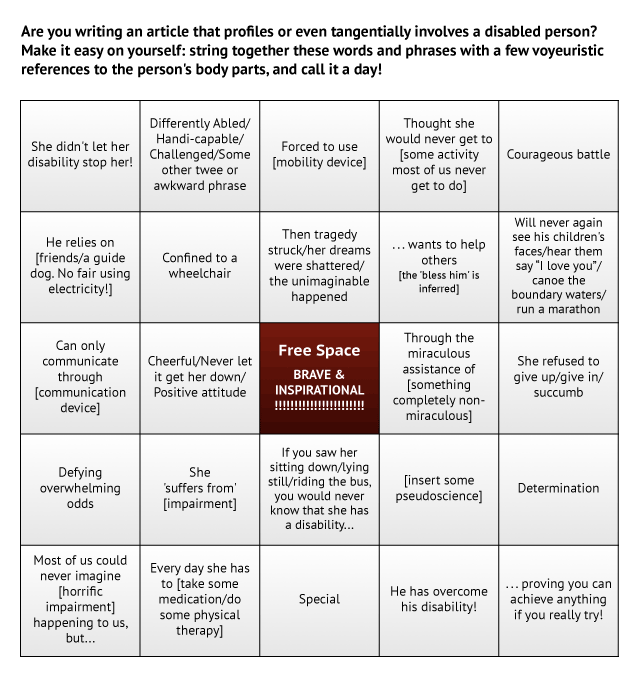
The tendency is so very very wide spread that Haddayr (with the help of Codeman) made a bingo card for us all:

Description follows

Description written by Haddayr:
Are you writing an article that profiles or even tangentially involves a disabled person? Make it easy on yourself: string together these words and phrases with a few voyeuristic references to the person’s body parts, and call it a day!

She didn’t let her disability stop her!
Differently Abled/Handi-capable/Challenged/Some other twee or awkward phrase
Forced to use [mobility device]
Thought she would never get to [some activity most of us never get to do]
Courageous battle
He relies on [friends/a guide dog. No fair using electricity!]
Confined to a wheelchair
Then tragedy struck/her dreams were shattered/the unimaginable happened
. . . wants to help others [the ‘bless him’ is inferred]
Will never again see his childrens’ faces/hear them say ‘I love you’ canoe the boundary waters/run a marathon
Can only communicate through [communication device]
Cheerful/ Never let it get her down/ Positive attitude
Free Space:
BRAVE & INSPIRATIONAL!!!!!!!!!!!!!!!!!!!!!!!
Through the miraculous assistance of [something completely non-miraculous]
She refused to give up/give in/succumb
Defying overwhelming odds
She ‘suffers from’ [impairment]
If you saw her sitting down/lying still/riding the bus, you would never know that she has a disability…
[insert some pseudoscience]
Determination
Most of us could never imagine [horrific impairment] happening to us, but…
Every day she has to [take some medication/do some physical therapy]
Special
He has overcome his disability!
. . . proving you can achieve anything if you really try!

So, let’s go back to my story.

I haven’t been following anything to do with the Olympics for reasons I won’t go into here, but I knew exactly what was going on when I glanced at Saturday’s Globe & Mail and saw this splashed across the front:

A Different Victory: When Alex Bilodeau’s brother cheered his gold, the triumph went more than one way. The skier and the painter find inspiration in each other – and neither one accepts limits. Ian Brown travels to the intimate heart of a family.

“Oh gosh!” I said to Don, in my overly chirpy sarcastic voice. “It’s going to be an inspiring crip story, I just know it! Quick, let us purchase this fine newspaper so we can be inspired!”

Poor dude behind the counter proceeded to tell me how inspiiiiiiiirng he found “the brother of the guy who won gold”, to which my response was… less so. “Inspiring crip stories irritate the fuck out of me.”

You know what would inspire me, gentle readers? Curb cuts being cleared of snow so Don & I could get across the street without having to go three blocks out of way first. But I guess when you’re a bitter, cynical, angry person who just hates fun, that’s what you get.

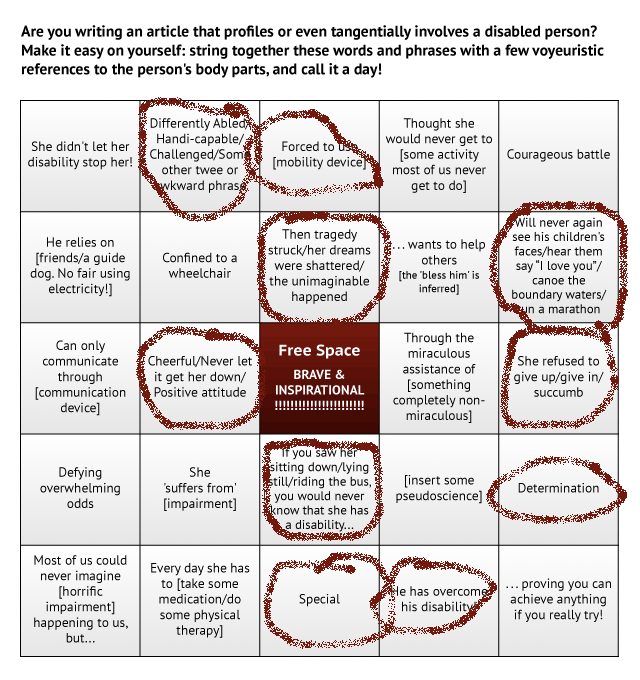
Sadly for all of us, Ian Brown’s articles don’t seem to appear on the Globe & Mail’s website (except perhaps behind the paywall), so I can’t let you read the inspiriiiiiiing story of Frédéric Bilodeau, but I can show you a BINGO card that Don & I filled out while we read it.

Description follows

Description: As above, but with the following squares circled:
Differently Abled/Handi-capable/Challenged/Some other twee or awkward phrase
Forced to use [mobility device]
Then tragedy struck/her dreams were shattered/the unimaginable happened
Will never again see his childrens’ faces/hear them say ‘I love you’ canoe the boundary waters/run a marathon
Cheerful/ Never let it get her down/ Positive attitude
Free Space: BRAVE & INSPIRATIONAL!!!!!!!!!!!!!!!!!!!!!!!
She refused to give up/give in/succumb
If you saw her sitting down/lying still/riding the bus, you would never know that she has a disability…
Determination
Special
He has overcome his disability!

Of course, what Frédéric Bilodeau’s story has actually managed to inspire is awesome comments at the Globe & Mail like this one:

Proud for so many reasons

Alexandre Bilodeau has provided something more than his magnificent gold performance (Gold Comes Home – Feb. 15). He has provided an example of the role that individuals with a disability play inspiring us as they overcome their challenges.

Thank you, Alex and Frédéric.

Brian Smith, Toronto

Mr Smith, with all due respect, we are not here to be your thrice-damned inspirations thank you very much. Be inspired! Lobby the Canadian government to provide funding for all universities to be fully accessible to people with disabilities! That would help lots of people with disabilities overcome their challenges!

The point of this post isn’t “here I am, talking about an article you can’t read, and being as sarcastic as possible, aren’t I witty?”. It’s actually to talk seriously about the way disabled people are written about. We’re allowed to be inspiring stories of overcoming adversity – and often those stories focus on the difficulties our loved ones have, and how hard it can be to have a disabled person in your life – or we can be a passive victim of crime. That’s it.

If new media actually presented people with disabilities as we actually are… well, that, gentle readers, would be actual news.

ETA: facesofcathy found that Ian Brown’s article’s up over at CTV. (Why? I don’t know.) Check it out: The Bilodeaus: Elusive truths from an unforgettable family. I haven’t done a side-by-side comparison of the text (I think the headings are different?) but it look pretty close.

Check out the comments if you like to headdesk over how inspiiiiiiiired people find these types of stories.

Who Killed Civil Discourse? Evelyn Evelyn, Marginalization, and Internet Discussion

Hello. I am Annaham (yes, I have a name). I am the person who posted a critique of Evelyn Evelyn on this website, which kicked off something of an internet controversy. For those who’ve just joined us, I made a post about Amanda Palmer and Jason Webley’s side project Evelyn Evelyn, Lauredhel made another post soon after, and things got a little out-of-control, to say the least. Because my post was part of this whole storm of various substances — both gross and not — I feel some responsibility to share my reaction to what’s gone down thus far.

I’d like to take a moment to talk about some basic principles of anti-oppression activism and social justice work that intersect with the work we do here at FWD, as some very specific structural issues and contexts are absolutely relevant in this discussion. Often, marginalized people are encouraged and expected to be sensitive and accommodating to the attitudes and prejudices of the dominant culture and to those of less-marginalized (ie: more privileged) people. However, this sensitivity and accommodation usually does not run both ways. Marginalized people, if they criticize something that (for example) leaves them out or makes them feel awful, are often told that they are being overly sensitive or overemotional, that they just misunderstand intent, that they are exaggerating, or that their tone is not polite enough. They are then expected to modify their behavior — and their self-expression —  to fit with the norms and values of those who are more privileged.

What the less-privileged have to say is usually not accorded much importance, critical thought, or respect, and yet they are supposed to prioritize, be patient with, and generally assign more importance to views, values and norms that are not their own. People in marginalized communities are often expected to educate the more privileged majority. They may be expected to patiently explain basic concepts, sometimes repeatedly. And if those with more privilege decide that they do not agree (with the less-privileged group’s tone, focus, or any number of other things other than the actual argument that is being made), those with less privilege are told, with varying degrees of subtlety, to shut the fuck up.

All the while, the perspectives, attitudes, norms and values of those with more privilege are made neutral. The power dynamics are rendered invisible, because that’s just the way things are, so there’s no point in trying to change any of it. Why are you so angry?  You’re just looking for things to get mad about. You just like being offended. Why can’t you focus on other/more important things? It wasn’t meant that way. You need to hold your tongue until you’ve done x, y and z. Quit taking it personally. You’re ruining everyone’s good time. Stop trying to make everyone pay attention to your pet issue, because it doesn’t affect anyone other than you. Your demands are unreasonable. Stop complaining. Shut up.

And when things don’t go entirely smoothly (which happens often), those not in a position of privilege are often blamed for it: Well, what did you expect, using that tone? You’re the one who brought it up; you’re the one who rocked the boat.

Unfortunately, these tactics are extremely common when it comes folks’ objections against many sorts of media and pop culture critique and/or backlash against critical engagement with cultural works. In other words: These are not new patterns.

I am definitely not saying that everyone has to agree with the critiques that I and others have made regarding Evelyn Evelyn; I am not suggesting that ideological lockstep is a worthy end-goal. What I am saying is that the humanity of marginalized people — those who have traditionally been left out, and who are often on the receiving end of justifications for said exclusion(s) — is not up for debate. The humanity of the participants in this discussion — that of the creators/artists, fans, and those of us who have come forward with critiques — is similarly not up for debate. What I posted, and what I am posting here, was (and is) my take on the matter. I do not, nor do I want to, claim to speak for all PWDs, or all disabled feminists, or all fans of AfP and/or Jason Webley who are also disabled or feminists, or both. We all have our different takes on Evelyn Evelyn and how things have unfolded, and I think it is a good sign that so much discussion has come from this.

As I have stated here on FWD and elsewhere, I am a fan of AfP and have been for a number of years. Many of the people who have raised concerns about Evelyn Evelyn are fans, potential fans, or former fans (and there have been solid points raised by non-fans, too). Dreamwidth’s Anti-Oppression Linkspam community has, at present, four roundups collecting posts on the matter from around the web.  I suspect that many of us who have posted on the Evelyn Evelyn project with a critical eye are not raising these concerns simply to bug or irritate Amanda and Jason, or their fans. However, there are quite a few people who seem eager to dismiss those of us with legitimate concerns as “haters” who just don’t understand art. The hostile messages from “haters” that Amanda has received are not legitimate critiques. These are personal attacks, not arguments of substance.

I almost feel like it should go without saying that I do not support people making these attacks on Amanda, but just to make it very clear: I am very much against people using this controversy — and the complex issues raised — as a bandwagon upon which they can leap to make personal attacks and/or comments about Amanda’s personal life or who she is. Unfortunately for those of us who have been trying to bring attention to Evelyn Evelyn-related issues and seriously discuss them, the “haters” are distracting from these same issues (and are apparently effective at it). I have also heard that people are making threats of physical violence against Amanda. That is not okay. It is never, ever acceptable to make threats of violence against anyone, regardless of your disagreement. That is basic human decency. It is truly disheartening to me, and to the other FWD contributors, that some are using this very difficult situation as an excuse to make horrific threats. We fiercely condemn these attacks.

One of the comments I received was from someone who, as far as I can tell, thought that my post seemed “insincere,” with a bonus implication that I was and am making other PWDs look bad “in the eyes of the abled.” Comments of this sort are often aimed at members of marginalized groups who are expected speak for everyone in their group when confronted; it basically boils down to “You are making other [disabled people] look bad.” I have to wonder why this same thing was not said to the AfP fans who found it necessary to show up here to derail, break out tone arguments,  tell me and my fellow contributors that we are crazy and/or should shut up, and who dismissed us on Twitter as just bitching about the project. It’s interesting, and rather telling, that some fans have used these tactics against me, my fellow FWD contributors, and other people who have critiqued the project, but could not (or did not want to) step back and consider their own behavior.

We were, in various other places around the web, called “retarded,” “angry bloggers,” had the legitimacy of our contributors’ disabilities questioned, and (trigger warning) threatened with rape (link goes to a screencap of a comment left on Amanda’s blog) — among many, many other things. In the comments thread to my original post, I was told that I need to focus on more important issues, that I was blowing things out of proportion, that I was censoring people and/or trampling on their free speech rights by laying out guidelines that specifically told potential commenters  to not leave derailing comments,  and that intent should excuse offensiveness. Eventually, I lost my patience.

There were also quite a few personal-attack comments left in the moderation queue; for obvious reasons, these were not published. These attacking comments were a significant part of why I closed comments on the post, though I did not explain that in my final comment. My decision was not about “censoring” what anyone had to say, or infringing upon “free speech” rights (this is a private website — one that has contributors, commenters and readers who are not only from the U.S.), or only about the fact that I lost my patience after having explained certain concepts over and over again; I and my fellow contributors simply could not deal with the personal attacks, threats, and violent language being left in the mod queue anymore.

Here is just a sampling of some of these unpublished comments from the mod queue (possible trigger warning):

“What’s the matter with you?”

“cant handle it? then just fucking die!”

“fuck u die slow nigga!”

“ONOEZ SOMEONE WANTED TO SMACK SOMEONE SUCH VIOLENCE!!! Typical retarded comment on an idiotic, stupid, moronic, weak, and lame blog. Fucking oversensitive twits.”

I think there is something analogous here to some of the more hateful comments that Amanda received on Twitter and elsewhere, but that is a bit of a tangent.

Going through the mod queue for that post was not an experience that I would want anyone to have. I could talk about the fact that it got to the point where it exhausted me to look at the comments; about the extreme anxiety and emotional hurt I felt while reading some of the comments that attacked me as an individual and/or questioned my mental health status; about how it feels to notice that your physical pain level — already there as a result of a chronic pain condition — goes up a few notches as you read criticism(s) directed not at your argument, but at you. I have a feeling that were I to discuss this in depth, some would likely construe it as “ANGRY BLOGGER BLAMES AMANDA PALMER FANS FOR HER OWN PAIN” or accuse me of using my disability as an excuse for being “too sensitive.” I get more than enough of that outside of the blogosphere.

I need a break from having attempted to be civil and polite and explain very basic concepts to a select few people who have no interest in substantially engaging with me or with others who have raised concerns about Evelyn Evelyn.  Simply put, I need some time to recharge my politeness batteries, as well as my hope that some people — and I include many of Amanda’s fans in this category  — do want to listen, learn and discuss without derailing or attacking. I wish I could address every critique that’s come our way, but I am pretty worn out (and I suspect that many of you — disabled and not — know the feeling).

In the interest of full disclosure, I should mention that Jason and I have been communicating via e-mail — he emailed me shortly after my other post went live — and discussing many of these issues in more detail; for that, and for his willingness to engage, listen, and consider the critiques that have come up, I thank him.

I wish Amanda and Jason success with their endeavors; I do not wish to shut either of them up or, worse, endorse that Evelyn Evelyn not go forward at all. There is, as I have said, quite a bit of difference between critiquing a portion of someone’s work and wanting to shut them up or silence them; I have aimed for the former. I ask, however, that they engage critically with and take seriously the numerous points that have been brought up, both about (trigger warnings apply to the first two links) specific aspects of the project and the response to critiques so far. Taking on such huge issues will doubtlessly be a difficult and ongoing process. Of course, Amanda and Jason will probably interpret all of this in different ways. What happens next does not have to be “perfect” — nor 100% Annaham-approved (because that would be unrealistic and silly), but it would be fantastic for these two very talented musicians and performers to bridge the gaps between their good intentions and what actually shows up onstage and on the album.

What are the ultimate lessons here? What can people on all sides of this discussion take away? Right now, I don’t know, and for the moment, that is okay with me. I still believe that better things are possible. I refuse to give up that hope.

[Special thanks to meloukhia for ou’s help in putting together links and other material for this post.]

Please read and abide by our comments policy.

“Saying conjoined twins are disabled is insulting!”: Evelyn Evelyn, redux

[Cross-posted to Hoyden About Town]

Something that has really struck me about the conversations around Evelyn Evelyn is the reaction that “Conjoined twins don’t have a disability! To say they do is insulting!”

Not all commenters make the link between the two statements – some stop at the first – so I’ll take these two separately.

A little background: Evelyn Evelyn is Amanda Palmer and Jason Webley’s new ‘art project’, presented as fact but understood as fiction, in which they “discover” poor struggling musically-gifted conjoined twin orphan women, save them from their child porn and circus-exploitation past, and help them – in a long drawn-out process, due to the women’s traumatic fallout and difficulty relating – produce their first record. Palmer and Webley dress up as the twins to perform on stage, co-operating to play accordion, ukelele, and sing. They can barely restrain their sniggers while they interview about this oh-so-hilarious and edgy topic. More in the Further Reading.

“Conjoined twins don’t have a disability!”

So, a note on normalcy. The idea that some people would shout in defence “But conjoined twins don’t have a disability!” took me by surprise. I wonder how these people are defining “disability” in their heads, if they’ve ever thought about the subject – do they picture a hunched figure, withdrawn, unable to work, self-care or socialise? Do they picture someone undergoing huge medical procedures, someone with prostheses or other visible aids? What is the image in their heads?

Because disability can be all of these things, and none of these things. Disability isn’t a checklist, or a fixed point. Disability – and normalcy – are socially constructed. Disability is the interaction between a characteristic or a group of characteristics often called “impairments”, and a world that recognises people with these characteristics as abnormal.

Disability is considered a tragedy, a fate to be avoided at all costs. Disabled people are those that society defines as “abnormal”. Disabled bodies are the ones that don’t fit in typical boxes. Disabled people are people that the physical and social environment doesn’t accommodate. Disabled people are considered defective, deformed, faulty, frightening, feeble, freakish, dangerous, fascinating. Disabled people are stigmatised, laughed at, looked down upon, marginalised, Othered. Disabled people are medicalised. Disabled people are defined in terms of how currently-nondisabled people view them.

Disabled bodies are those that are subject to the able-bodied stare.

It is obvious with the most cursory of glances that in our society, conjoined twins are disabled. Society does not accommodate them. They are medicalised from fetushood. They are spectacle. Their operations are videoed and broadcast across the world. They are displayed, tested, stared at, discussed, and mocked, purely because of the shape and layout of their bodies. They are the subject of comedy fiction and “inspiring” tragedy nonfiction.

How can people simultaneously look at this project as funny and edgy and worth paying money to stare at, while considering conjoined twins to be “not disabled”? Why are their bodies so hilarious, then? Why is it so funny when Palmer and Webley cripdrag-up in that modified dress? Why do they snigger and smirk as they talk about “the twins” and their tragic tale? They do this – you do this – because you do see these bodies as Other. Fascinating, bizarre, freakish. Fodder.

People with disabilities resist these definitions, resist being marginalised, Othered, stared at, compulsorily medicalised. (Just as we try to resist, where possible, being beaten, abused, raped, exploited, exhibited, forcibly sterilised.) We laugh at ourselves plenty. We reclaim terms like “crip” and “gimp” and “crazy”. This does not grant able-bodied people free rein to mock us, to play schoolyard imitative games, to use child porn survivors as a little bit of “colour” for their projects.

There is a lot more to be said on the social construction of normalcy. I strongly recommend Lennard Davis’ Enforcing Normalcy . For more reading, check out this booklist at Hoyden About Town, our booklist here at Disabled Feminists, and our blogroll.

“To say that conjoined twins have a disability is insulting!”

This one’s quicker and easier to debunk. No, it’s not insulting. It’s as simple as that. It’s not an insult because being disabled is not an inferior state. Saying that someone is disabled is no more insulting than saying “Lauredhel’s a woman” or “Barack Obama is black”.

Being disabled just is.

~~~

Further reading on the Evelyn Evelyn conversation:

Annaham’s post here at FWD, Evelyn Evelyn: Ableism Ableism?

Amanda Palmer’s blog: The Whole Story Behind “Evelyn Evelyn” [WARNING: invented story about child sexual abuse and exploitation; the other links discuss this also]

Amanda Palmer’s blog: Evelyn Evelyn Drama Drama

Jason Webley: Blog #1 – Evelyn

Amanda Palmer’s twitter, in which she remarks “setting aside 846 emails and removing the disabled feminists from her mental periphery, @amandapalmer sat down to plan her next record.”, and follows up “pain is inevitable. suffering is optional.”

SPIN magazine: Meet Amanda Palmer Proteges Evelyn Evelyn

Sady at Tiger Beatdown: AMANDA PALMER WANTS TO SHOCK YOU. Just Don’t Get Upset About It, ‘Kay?

TVTropes: Rape Is The New Dead Parents

The linkspam roundups: First, Second, Third (and possibly more as time goes on)

Evelyn Evelyn: Ableism Ableism?

Let’s get something out of the way: I say this out of love and respect. I say this as a fellow artist (albeit an unknown one). I also very much doubt that the people involved in this project have created it with any bad intentions. That said, however, intentions don’t equal a free pass for an end result, particularly if the end result is problematic.

I am conflicted, to put it mildly, about this latest project in which singer and pianist Amanda Palmer has involved herself (full disclosure: I am a fan of Palmer’s music). For those who need a refresher, she and fellow musician Jason Webley are performing together as Evelyn Evelyn, a fictional set of conjoined twins and former circus performers with an elaborate past who reside in (of course!) Walla Walla, Washington. The group’s upcoming self-titled album seems to be getting quite a bit of press in the indie world. Part of the press release reads as follows:

Rather than being limited by their unique physical condition, the Evelyn sisters prove that two heads are indeed better than one. Audiences will marvel at the twins as they dexterously perform their original compositions on piano, guitar, ukulele, accordion and even drums.

Ah, yes! It’s the “overcoming disability” trope, with a heaping side of totally unexpected and not-at-all-stereotypical circus-freakdom. Might Evelyn Evelyn be musical Supercrips?

And then:

Unsatisfied with the grind of circus life, at the age of nineteen the twins decided to explore a solo career. It was then that they were discovered by Amanda Palmer and Jason Webley, who heard the twins’ music on MySpace. Webley and Palmer encouraged the twins and offered to help them record a proper album.

The album will be accompanied by a full US and European tour and – later this year – a graphic novel about the twins’ inspiring life, illustrated by Cynthia von Buhler and published by Dark Horse Press.

The stereotypes about disability here are pretty well-worn: according to this (fictional) backstory, the twins were “discovered by” and need “help” from two abled individuals, Palmer and Webley, to realize their musical potential. Add to this their “inspiring” origin story — which is fodder for a graphic novel tie-in — and you’ve got yourself one hell of a three-ring circus of disability stereotypes.

Thus far, it looks like Evelyn Evelyn’s primary aim is to be “inspiring” to abled folks (and to be a bit of creative fun for Palmer and Webley). The three songs currently available on MySpace only serve to continue this trope; “A Campaign of Shock and Awe,” in particular, casts the twins as “the 8th wonder of the natural world.” Good to know that even fictional people with disabilities are not exempt from being cast as “wonders” from which non-disabled people can draw inspiration and “marvel” at. Sound familiar? Add in a dash of hipster ableism and you’ve got something that looks positively transgressive, especially in comparison to the rest of the music industry.

Unfortunately, Evelyn Evelyn seems like a project that is far from actually being transgressive, even given the initial appearance of said transgression (because what’s more shocking and weird than conjoined twins, at least according to abled culture?). The project, as far as I can tell, makes no reference to the ways in which actual people with disabilities are treated in Western culture; this probably seems like a tall order for any musical project, but there is a chasm of difference between at least acknowledging that there are people like this (in this case, conjoined twins) who do exist and that they probably are affected by ableism, and outright appropriation of this uniqueness in the name of art. Certainly, Evelyn Evelyn is fictional, and while Palmer and Webley are not required to make any sort of political statement, the seeming lack of awareness that there are actual conjoined twins and that they do not only exist for abled artists’ dressing-up-and-performing purposes is rather troubling.

The larger cultural context of treatment of real people with disabilities, too, is conveniently forgotten (see the lyrics to “A Campaign of Shock and Awe”); the twins seem to exist in a world that is completely free of ableism (in forms subtle and not), harsh social treatment of PWDs by abled people, and pernicious, damaging stereotypes. This is particularly disappointing given that Palmer has written some great, quite un-stereotypical songs about PWDs and people with mental health conditions (one of which I wrote about in a blog post for Bitch Magazine).

I am a person with disabilities. I am a music fan. I am (sort of) an artist — one who mostly does graphic work about the disabilities of non-fictional people. However, Evelyn Evelyn, as a multimedia project, seems designed to keep people like me — real people with disabilities — out; this is not a new thing, considering the attitudes that folks in our culture hold about people with disabilities and their acceptable social roles. There are other, more creative ways to portray people with disabilities that don’t rely on facile stereotypes or on the ways that PWDs are already represented in popular culture. Representing Evelyn Evelyn as variously inspiring, freakish, weird and a “wonder” just reinforces existing stereotypes about PWDs, while ignoring the cultural context in which the project was conceived; while Evelyn Evelyn may be artistic and, at first glance, “different,” the attitudes beneath the project’s surface seem awfully mainstream.

Special commenting note: First-time commenters, please read and abide by our comments policy. Kindly refrain from commenting if your argument consists of any of the following: “You just don’t get it,” “You do not understand art,” “You are taking this too seriously,” “Evelyn Evelyn is not real, therefore the stereotypes about disability examined here do not matter,”  “Justify your experience and/or disability to me, NOW,” “Why are you criticizing Amanda Palmer? She is brilliant; how dare you!” I am familiar with all of these arguments — please be aware that they will probably not add anything to the discussion because they are classic derailing tactics, and I will most likely decline to publish comments that utilize the above arguments.

Similarly, this is not a thread in which to discuss how much you like or dislike Palmer or Webley’s music in general; comments to the effect of “Her/his music sucks and here’s why” will not be allowed, as they are also derailing.

Gender, health, and societal obligation

Kate Harding, writing at Broadsheet:

“If you ask us,” say Glamour editor Cindi Leive and Arianna Huffington, “the next feminist issue is sleep.” Personally, I never would have thought to ask those two what the next feminist issue is, but they make a pretty good case. “Americans are increasingly sleep-deprived, and the sleepiest people are, you guessed it, women. Single working women and working moms with young kids are especially drowsy: They tend to clock in an hour and a half shy of the roughly 7.5-hour minimum the human body needs to function happily and healthfully.” The negative effects of chronic sleep deprivation are well-documented, but that doesn’t inspire enough people to prioritize rest, and women often end up in a vicious cycle of sacrificing sleep in order to do extra work and make sure their domestic duties are fulfilled, causing all of the above to suffer. “Work decisions, relationship challenges, any life situation that requires you to know your own mind — they all require the judgment, problem-solving and creativity that only a rested brain is capable of and are all handled best when you bring to them the creativity and judgment that are enhanced by sleep.”

So many obligations are heaped on the shoulders of women, and it is pretty much impossible to fulfill all of them even if you completely neglect your own needs. Of course, trying to tend to your own needs means even fewer of those obligations fulfilled, and there are cries and admonishment of selfishness and failure and responsibility to others waiting for you should you assert your right to self-care, because by asserting the right to take time and energy exclusively for yourself, you are stealing time and energy that belongs to others.

Sleep is a contested act in American society (perhaps in others too, but I can only speak to the US): getting little of it becomes a point of pride; getting a lot of it is a symbol of laziness, selfishness, sloth, dirtiness, carelessness. People are expected to perform amazing tasks on as little sleep as possible, which is completely counterintuitive, because most people are going to perform worse with insufficient sleep — consider it a generalized manifestation of the supercrip phenomenon: exactly the people who are least supported/enabled to do something are the ones who are expected to do it better than normal people.

Better sleep would surely benefit many of us, but why?

According to Leive and Huffington, the main benefits realized are in service of others; the main beneficiaries are the people around you. Or, if you see the benefits, they are benefits that stem from an obligation to others, any self-benefit remaining firmly subordinate to the “greater good” of one’s family, colleagues and community members.

We should be well familiar with the concept of women as public property. Women’s bodies, women’s time, women’s possessions, women’s decisionmaking capacity, women’s self-determination — just about anything a woman possesses, though she doesn’t really possess. Rather, she is allowed use of something that is under her care but not her ownership: it belongs instead to the people around her.

Feminists are familiar with the idea that our society considers female reproductive organs to be public property. A woman’s vagina should be available for all comers (men), and simultaneously be unavailable so as not to waste its value to its eventual sole owner (a man). A woman’s uterus is to be used for the good of the human species/civilized society: the right kind of women are to reproduce as much as possible, so that their kind remain the dominant group in both pure numbers and in overall power. (On the other hand, the other kinds of women are called upon to perform the rough, menial work necessary to uphold modern society, while not polluting the human species by reproducing themselves.)

But honestly, public ownership of women extends so much further than their reproductive systems.

No woman is allowed to assume ownership of any part her physical self, her time or purpose: it is still an “indulgence” for a woman to eat anything more substantial than a leaf of lettuce, still “sinful” to enjoy less than 100 calories of overprocessed puddings and crackers. It is still somehow selfish to take a long bath or to sit and rest for an hour’s time, still slothful to refrain from moving, working, pushing, rushing every single moment of every day.

Women’s work, in general, is under-valued and un(der)paid — and it is uncompensated precisely because women’s time, their energy, their effort, do not actually belong to the women themselves, but rather to the rest of the world. It is theirs to use whenever, however, and however much they wish, and isn’t it ridiculous to suggest they should pay for the use of something that belongs to them in the first place?

This is all part and parcel of living in a patriarchy, a predictable result when society relies upon a person’s gender to determine hir position in society, the things sie will do, the roles sie will play, the direction hir life will take. But gender is not the only variant in play here. In fact, I believe that gender is actually secondary here to another factor — it is merely one avenue of manifestation for our cultural construction of health.

Surely you have heard of the theory that gender is not an inherent trait, but a performance. This theory is definitely not without flaws, but I bring it up in hopes that it provides a familiar framework for a discussion on the social construction of health.

Health, you see, is not merely an inherent trait. Health, instead, emcompasses a variety of factors, including a person’s intrinsic qualities but also the environment in which they operate and their everyday behaviors.

Health is not just what a person is. Health is also what a person does. And what drives a person to do something is not wholly internal, but rather is largely influenced by external factors.

Gender, for instance, is both an internal sense of being and something we do for other people, something we do because we want other people to think about us, react to us, in certain ways. And the things we do, and the expected reactions to them, are different depending on which culture we are operating in — dependent on where we live, on our ethnicity, on our class background, on any number of other things. What it means to wear certain types of clothing is different in different cultures. What it means to speak a certain way is different in different cultures. And so on.

This framework is — I hope — useful for understanding what health actually is.

The form “health” takes is different depending on the expectations of the culture you live in.

The ultimate importance of that so-defined “health” is different depending on the expectations of the culture you live in.

The role “health” plays in the culture, what “health” means in that culture, the way the people of that culture interact or engage with that idea of “health,” are different depending on the expectations of the culture you live in.

What you do to achieve “health” is different depending on the expectations of the culture you live in.

How your health affects your position in life, your economic opportunities, the support that is offered for you to live the kind of life you desire, are all different depending on the expectations of the culture you live in.

(And yes, all of this is just as true in a culture that makes use of the scientific method and sees itself as cool and rational. What is investigated, and how, and how the results are interpreted, and what lessons are drawn from those results, and how those lessons are applied in everyday life — all these things must grow out of the culture they happen in! )

Health, then, is not merely a personal state, but rather a cultural fulfillment. Health (of whatever kind) is expected of you, expected by the people around you. Your health is not your own, but instead belongs to your family, your community and your wider culture. You must achieve and maintain (whatever kind of) health, not because it benefits you personally, but because you will have deeply failed your fellow members of society if you don’t.

And this is what underlies the problematic aspect of Leive and Huffington’s statements. They are not suggesting that the sleep deficit for women is a problem because the woman herself feels fatigue or cognitive dysfunction. They are suggesting that the sleep deficit for women is a problem because the woman cannot fulfill the expectations of health — and the performance of duties that rely on that state of health — that society has for her. They are suggesting that the sleep deficit for women is a problem because then that woman personally fails her family, community and country.

Here, then, her lack of sleep lays bare her duty to society based on particular qualities she holds. But the disparity between her duty and her male peer’s duty would not exist if all of us did not have a duty to society to achieve and maintain a certain kind of health.

And Leive and Huffington, purporting to be advocating on women’s behalf, do nothing but reinforce the same system that screws women disproportionately when they center a woman’s obligations to the people around her over the personal experience of the woman herself.

And here, I hope, feminists will understand what disability activists mean when we talk about the supposed obligation of mentally ill people to submit to (certain kinds of) treatment for the sake of the rest of society — or what fat acceptance activists mean when we talk about the supposed obligation of all people to be as thin as possible for the sake of the rest of society — and so on.

Eating “healthy” (as determined by mainstream cultural wisdom, largely controlled by wealthy white temporarily-abled folk) is not done solely for oneself. Neither is “exercise” (of course, what counts as physical-activity-that-improves-health is controlled by the same people who control what counts as food-that-improves-health). Participation in the paid workforce is not done solely for oneself — we are, in part, fulfilling the obligation of “responsibility” (which is a component of the health performance, because when health is lacking, the ability to work declines — so work, then, is a demonstration that you are fulfilling your health obligation).

When a person neglects to fill a health-related obligation, there is someone there to remind them of the cost to the rest of society. We’ve all heard figures on the cost of obesity, the cost of heart problems, the cost of low employment rates, the cost of suboptimal nutrition, the cost of insufficient sexual education, the cost of lost sleep… wait, that sounds familiar. Anyway, the cost might be in dollar figures, might be in time lost, might be in persons participating in x activity, or might be more intangible: work decisions, relationship challenges, judgment, problem-solving, creativity… wait a second, didn’t we just hear that? Oh yeah.

And that’s what’s wrong with this angle. Ladies, you are hurting your families! You are failing your communities! You’re dragging all of society down with you! When all you have to do is get an extra hour of sleep — seriously, how selfish are you, staying up to get the dishes clean after your kids have gone to bed so that they’ll have clean bowls to eat cereal out of in the morning?

Except that the entire reason women are getting less sleep than they need is because they’re busy fulfilling their obligations to the rest of the world. The entire reason women are getting less sleep than they need is because they’re required to be well enough to handle multiple shifts, every single day, for their entire adult lives. The entire reason women are getting less sleep than they need is because they’re required to get up at stupid o’clock every morning to handle all the things they’re required to do before going to work (including the obligations to project an image of “health” — to look and smell fresh and clean, to be sufficiently hair-free, to wear attractive clothing, to possibly spend time putting on a face full of makeup and making her hair look presentable — all which are wrapped up in appearing healthy to the people around you), and when they get home from work they still have to do the laundry and make the dinner and wash the dishes and pick up the floor and wipe down the kitchen and bathroom counters and possibly wrangle kids or partners all the while —

— and then they are getting chided by self-proclaimed women’s advocates because they spend too much time doing things for other people, and not enough time doing things for oneself… for… other people…

And it’s impossible to separate the demands of womanhood from the demands of ability. It’s difficult to differentiate the hierarchy of value imposed on people of different genders from the hierarchy of value imposed on people of differing abilities.

I’m sure you get, by now, how women get completely and utterly screwed in this situation. But I invite you to imagine, then, how disabled people get completely and utterly screwed by this situation — and then I invite you to imagine how a system that did not value people differently due to their differing abilities would also remove a lot of the pressure that is currently dumped on women.

A system of equal access, opportunity, value, for people of all types of abilities, would be radically better for people currently oppressed under this gender-based system.

And when you reinforce the ability-based system of oppression, you make things worse for the women living under it.

… just sayin’.

(Cross-posted at three rivers fog.)