Warning: Offsite links are not safe spaces. Articles and comments in the links may contain ableist, sexist, and other -ist language and ideas of varying intensity. Opinions expressed in the articles may not reflect the opinions held by the compiler of the post. I attempt to provide extra warnings for material like extreme violence/rape; however, your triggers/issues may vary, so please read with care.
NYT Arts Beat: ‘Family Guy’ Voice Actor Says Palin ‘Does Not Have a Sense of Humor’
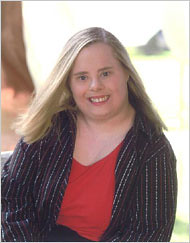
Image: Andrea Fay Friedman, who has Down syndrome, was a voice actor in a recent episode of “Family Guy” criticized by Sarah Palin.
One person who supports the “Family Guy” staff is Andrea Fay Friedman, the 39-year-old actor and public speaker who played Ellen in that episode. Like the character, Ms. Friedman also has Down syndrome.
In an e-mail message sent on Thursday to The New York Times, Ms. Friedman wrote:
” I guess former Governor Palin does not have a sense of humor. I thought the line “I am the daughter of the former governor of Alaska” was very funny. I think the word is “sarcasm.””
ninjanurse at Kmareka.com: Talking Back to Sarah Palin
You may agree with her or not, but it’s good to remember that people with Down Syndrome are not God’s innocent angels sent here to teach us something about life, but actual people who have their own lives to live. Trig Palin will grow up, and I hope he will have a good life. Sarah Palin better hope she doesn’t pick up the NYT some day and see a best-seller called, ‘Drafted–My Life on the Campaign Trail When Mommy Went Rogue’, or ‘Going Rough–Missed Naps and Noisy Crowds in Days that Made History’. At least it’s not ‘Vice-President, Dearest’ –not yet.
Ally G. at The disABILITY Enlightenment Project: disABILITY Simulations
I know I came out of that exercise feeling frustrated and discombobulated. Also oftentimes people will come out of those simulation activities thinking to themselves “gosh, I’m glad I am not stuck in a wheelchair all day” or “I feel sorry for people who are blind.”
Feelings of pity or “glad that’s not me…” are not the aim of disability rights advocates.
Marie Claire/Yahoo!7: The Battle for Care that’s Pulling Families Apart
When news broke that Australia’s only boarding school for disabled kids was set to close, it exposed once more the heartbreaking lack of support for their families. […]
The issue made headlines last November, when reports surfaced that Kingsdene Special School in NSW – the only weekday boarding school for sev-erely disabled children in Australia – may close due to the charity Anglicare having to withdraw financial support. Parents expressed their fear that if the school shuts, they may have to make the same heart-rending decision as Anita to abandon their child to DoCS.
New York Times: Countless Lost Limbs Alter Life in Haiti’s Ruins
More than a month after the earthquake, thousands of new amputees are facing the stark reality of living with disabilities in a shattered country whose terrain and culture have never been hospitable to the disabled.
Some remain in hospital tents swarming with flies; others have moved to makeshift post-surgical centers; and those who healed quickly, like Ms. Jean, have been discharged to the streets, where they now live. All need continuing care in a nation with no rehabilitation hospital, few physical therapists, no central prosthesis factory since the quake and a skeletal supply of crutches, canes and wheelchairs gradually being reinforced by donations.
“The situation for newly disabled persons is very delicate,” said Michel Péan, Haiti’s secretary of state for the integration of the disabled. “They urgently need not only medical care but food and a place to live. Also, we cannot forget those disabled before the disaster who, because of their handicap, are having trouble getting access to humanitarian aid.
Ewa Hess, Hennric Jokeit at Eurozine: Neurocapitalism [Perhaps we need a new warning category for “obfuscation”… ~L.]
It may seem uncanny just how closely the narrow path to scientific supremacy over the brain runs to the broad highway along which capitalism has been speeding for over 150 years. The relationship remains dynamic, yet what links capitalism with neuroscience is not so much strict regulation as a complex syndrome of systemic flaws.
 Cowra Guardian:
  Tiffiny at Disaboom: