All posts by Anna

Recommended Reading for October 26

Linkblurt: We Are Immobilised

A disabled college student is having trouble getting around campus, after someone stole his motorized wheelchair. […] Horus had locked it up and left it charging overnight. When he returned to campus, it was gone – all that was left was the charger. […] Horus’ wheelchair cost about $5,000 and that means whoever stole it faces grand theft charges.

“It’s really difficult for me to replace it. To replace it, it would take me like a year,” Horus said.

Health Care is an anti-racist issue [US]:

See, I’m one of the 25 million Americans who are underinsured. I have health insurance — pay $350/month for it — as part of a new policy that I switched to back in January when I quit my 9 to 5 to become a freelancer/fulltime writer for awhile. I’m pretty healthy and only in my thirties, but I have a family history of fibroids (like 50% of black women). So every year when I get my annual physical, I also get an ultrasound to check for those. This year the test showed small fibroids — too small to worry about, really, not even requiring treatment, though I need to keep an eye on them in case they grow. No biggie, I thought; my doctor’s efforts at preventative care had done what they were supposed to do, and detected a potential problem early enough that I can fix it easily if necessary. Health care at its best.

When two whole cakes ain’t enough arsenal…

I was leaning against a sign that read “Bus Stops Here” and jamming to some Dresden Dolls, my trusty guide dog sitting politely at my left leg. He laid down impatiently as the minute hands ticked and still no bus in sight. Then, out of what most docs wouldn’t call peripheral vision I spotted a figure stooping for a pet-by.

What is a pet-by, you ask? It’s when a knowing pedestrian sneaks in a pet or smooch or otherwise grossly boundaries-crossing form of affection at an unsuspecting service animal. Not to be mistaken with human grabbings or other forms of harassment but nonetheless devious and irritating for both animal and human handler.

Without missing a beat and sans usual snark I said loud enough for passerby to hear that “that was a shitty thing to do.” There, I said it. That was a shitty thing for person to do. Ask first, respect my answer, move on. Clearly knowing petting wasn’t allowed, ze sneaked on by, hoping I wouldn’t notice. Too bad my dog alerts me, not liking unknown human touch too much.

Where Neurodiversity Meets Feminist Theory: Part I, Part II, Part III:

Another area I see feminism and disability-rights perspectives reinforcing each other is on the question of caregiving. This might not seem like an obvious choice, since you often see feminists and disabled self-advocates at odds over this issue: when disabled people assert our right to adequate care in our own homes (or wherever we choose), feminists argue that we are also claiming entitlement to the underpaid or unpaid labor of women. (See the feminist blogswarm over Ashley X for ample evidence of this conflict).

But when you think about it, modern industrial capitalist society’s way of dealing with children, disabled people, elderly adults and every other group that needs help with daily tasks is exactly what you’d expect from a society in which women are invisible second-class citizens. When women are not valued as highly as men, women’s work is not regarded as real work, and obligations that fall under the umbrella of “women’s work” (say, care for the old, the sick and the disabled) will be more likely to be dismissed as “family responsibilities” in which government meddling is unwarranted.

Post-Trauma.net is “here to help you access information about Post-Traumatic Stress Disorder and related mental health information.” They have a list of resources available.
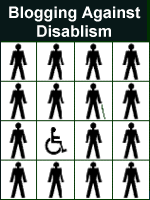
Umbrella Terms

My pet peeve: Labeling “othered” groups as though everyone who falls under that umbrella term has the same needs to achieve full inclusion in society.

For obvious reasons, I’m going to focus on the umbrella of people with disabilities/disabled people right now, but these thoughts have been heavily influenced by reading posts from GLTB activists about trans* inclusion (or lack thereof) and blog carnivals like the Asian Women’s Carnival and International Blog Against Racism Week.

Over the summer, while I was in the process of ranting to Don about my disappointment with our current government’s inclusion of people with disabilities, I was stopped on the street and invited to a talk. “Is it fully accessible?”, I asked.

“Oh yes,” responded the person inviting us. “We have a wheelchair ramp.”

“Do you have material available in braille? Do you have a Sign interpreter?”

“No.”

“Well then,” I snapped. “I guess you aren’t fully accessible, are you?”

(As I said, I was just ranting about this when we were interrupted with this invitation, so it was already on my mind. People need to pick better times to interrupt me. I’d like to think that normally I’d be more polite.)

There’s a certain hierarchy of accessibility that “everyone” knows about. If you have a ramp, you’re good! That this doesn’t address the needs of any number of disabled people is irrelevant – the main image of people with disabilities is that person (usually white and male) in a wheelchair.

So, in the effort to be inclusive without thinking thoroughly about what disability means, and who is included when making accommodations, we end up with situations like this one, from the comments on a post on disability at Feministe:

Willow:

Fire alarms. So it’s great and all when fire alarms have bright flashing lights in addition to the blaring sound, so people with hearing loss (like my dad) will know if the alarm goes off and be able to evacuate, right? Yeah, well, it so happens that I have photosensitive epilepsy, and the light on pretty much every alarm cycles on a frequency that triggers my seizures. So if the alarm goes off, not only do I have a seizure, which sucks in the first place, but I also cannot evacuate the building because I am either (a) unconscious and convulsing or (b) in “zombie mode” and unable to navigate the world safely.

I always feel so, so guilty about advocating for accommodations for people with epilepsy that will make the place unsafe for people with other disabilities…but at the same time, I have EXACTLY THE SAME RIGHT to be able to be there and/or be safe there. It seems as though some types of disabled people–deaf, blind, and/or in a wheelchair, in particular–are privileged over others. I lived on campus as an undergraduate, and when the school installed a new fire alarm system that included flashing lights, I was told that they would have someone “come check on me” whenever the alarm went off. Excuse me? You can’t have someone come check on the zero deaf students in the building but the three of us with photosensitive epilepsy have to wait until the fire department shows up? Not to mention the risks that come with having a seizure in the first place (such as, for example, death)?

Thoughtless accommodations, but gosh darn it, we’re “accessible”.

I know next to nothing about epilepsy, and my knowledge of deafness is limited, so I have no idea what sorts of accommodations would balance both the need for a flashing alarm and the need not to cause seizures in people. But that’s not my point. The point is that full inclusiveness, rather than going for the “easy” solution, would actually consider those needs and work them both in. It would be working with people with disabilities to design safety systems that would accommodate everyone. (Deaf people can also have epilepsy, after all.)

Grouping “othered” populations under this umbrella term allows the “general” population to decide “Oh, I’ve included a ramp, I’ve got a flashing light, and there’s braille on my elevator buttons, I’m set.” But we don’t all have those needs.

We’ve been grouped together as having the same needs both because it’s easier for the “general” population to decide they’ve “done enough”, and because we have greater strength in both self- and group-advocating when we band together. But, just like when other “othered” groups band together, things get left out, put aside, maybe next yeared.

I’m still mulling all of this over. My main activism-related issues are The Big Ones – my city is full of “just one steps” and has a serious lack of Sign Language interpreters. But right now, I’m sitting in a room with fluorescent lighting (severe migraine trigger). It looks like the fire alarm is of the flashing-light type. The door is pretty darn heavy. I haven’t seen a single TTY- pay phone on campus. And probably several other things that I’ve missed.

It’s almost like the easiest, umbrella-term solution isn’t the best one.

I’m still thinking about a lot of this stuff – I certainly don’t have all the answers. Feel free to get into it in the comments. (My schedule is such that I won’t be able to respond to anything until evening my time at the earliest, although other moderators will be approving comments for me.)

Recommended Reading for October 23

Reminder! The next Disability Blog Carnival is coming up on the weekend. Get your posts in to Liz! Tell your friends!

In the blogs:

ADAPT in Atlantica, kicking ass and taking names [LONG] [US]

Their goals are, free people from being incarcerated in nursing homes, and kept in there against their will. They back the Money Follows the Person program, which means a person’s benefits are under their control rather than under the control of doctors, social workers, and assisted living facilities (who are a powerful medical-industrial complex much like the prison-industrial complex: powerful lobbyists with a lot of money at stake.) Right now ADAPT also supports the Community Choice Act, a bill which you can see and follow directly with OpenCongress.org.

I don’t think of you as Black, disabled:

I mean, seriously. That’s so naive and so painful. You are my friend. Come ON. I mean, I didn’t whiten up or lose the wheels. And it isn’t like other people don’t notice my differences, either…. They exist. We both know they exist. When we go out together you notice that I am treated differently from you; we both guess that race is the likely factor; it makes no sense to say that. What on earth are you saying? When we go out together and we’ve spent the past hour or so trying to deal with access questions — to your house, to the store, to the restaurant. What are you saying? And what the hell do you mean?

The best I can figure is that you are trying not to say something like, “In my eyes, your difference is not a barrier to our continued friendship.” Or perhaps it’s, “You don’t seem to have the usual pathologies of people with your condition, race, etc. We can continue to be friends.” Or perhaps it’s, “I’m big enough to handle whatever problems your difference brings.” But it could also be, “I don’t think in terms of these categories; it is a point of pride with me that I am not racist/ableist…” Hopefully, it is a miscommunication for, “We aren’t the same, and I like you just as you are.”

Small Victories:

I saw something in this past Sunday’s Kansas City Star that gave me a tiny bit of hope, both for our culture in general and the ongoing atrocity that is the Judge Rotenberg Center in particular: the Thayer Learning Center*, a boot-camp-style institution for “troubled teens,” which has accumulated a fairly long list of complaints of abuse and neglect of its inmates since its opening in 2002, has closed, and been sold to a Cheyenne Indian educator named Lakota John, who plans to open a new, very different kind of school on the old Thayer grounds.

The new school will be geared toward Native American young people of all tribes, with emphases on sustainable agriculture (using traditional, Native American farming methods), outdoor skills, and Native American culture, art and spirituality.

[Blog] Woman Arrested for Assault While Having a Seizure:

It should go without saying that paramedics have the right to do their job without being assaulted, and to call for help if they are assaulted. But it should also go without saying that having a seizure and struggling against (allegedly heavy-handed) care while in a state of confusion do not count as assault. And I find it difficult to imagine any circumstances under which it could possibly be okay for police to arrest someone currently in a state of medical emergency, and then not obtain medical care for her for nine hours.

Kourtney Wilson is a black woman, and it seems extremely unlikely that race had nothing to do with this case, and that a middle-class white woman would have endured the same treatment. Wilson indicates the same belief herself about racial and class bias, and her roommate Tiffini Williams suggests, “They come to the hood, see a girl on the floor, and they think she’s on drugs.” The idea sounds extremely plausible, and while it’s appalling that anyone would endure such treatment if their medical condition was the result of drug use, I don’t doubt that it’s a common occurrence.

All this week was Disability History Week in New York. I’m slowly generating a post on this (my thesis is in this area), but feel free to talk in the comments about your favourite thing that you think comes under the umbrella of “disability history”.

Lauredhel has a described-image up that’s Disability Week Fail at its finest.

Lastly, I’m using my big megaphone: Come help us generate a list of YA/Children’s lit with a character with a disability at my Dreamwidth account.

Recommended Reading for October 22, 2009

In the blogs:

Chronic pain management is not addiction

For me, addiction is an issue because it does run in my family, I do have mental health issues which can lead to substance abuse/addiction, and I find I actually do have the “addictive personality” in some ways. I also need regular, and somewhat large, doses of narcotic meds just to be able to function at the low levels I am able to – and frankly, to stay alive because the pain I would be in without the help would absolutely lead me to suicide.

This does not make me an addict. It makes me physically dependent on a medication for survival due to a medical problem. You know who else that description fits? Some people with diabetes who need insulin to stay alive, some people with heart disease who need medication to stay alive, some people who have had organ transplants who need medication for their organs to keep functioning, and the list goes on forever. These people are not considered to be addicts. And neither am I.

What’s the Deal With Disability? is a new forum for people with disabilities to discuss their interactions with the public.

SAD

It turns out that among the other endless list of depressive, mentally draining, physically exhausting, unable to think clearly, scatterbrained SHIT going on in my body–I also have SAD, or seasonal affective disorder.

I’ve been thinking for years about getting that magic light that everybody in the North talks about getting right when winter starts–but–just never got around to it. This year I’ve felt a lot better though, I’ve been getting various types of treatment for various bullshitty horrible things (depression, hypothyroidism, ADD, blah blah blah. UGH!) and I made it through the summer feeling relatively normal. So when early Fall hit…then September…then October started with it’s bullshitty cloudy days that last for weeks at a time…I really felt it hard.

In the news:

Via Unusual Music: Woman suffering from seizure arrested for assault:

Imagine calling 911 for medical assistance and winding up in jail. That’s what happened to a South Side grad student who says, instead of providing treatment, paramedics had her arrested. CBS 2’s Derrick Blakley reports.

Kourtney Wilson, 23, was charged with assaulting three paramedics. But Kourtney says that’s impossible because she was in the midst of a seizure. And she says, what she deserved was treatment, not a trip to jail

Recommended Reading for October 20, 2009

In the blogs:

Sins Invalid IV: Possibly NSFW:

Sins Invalid is a force to be reckoned with. Make no mistake about that. I’ve been to 3 of the 4 shows, some of them more than once. I can tell you: Sins is a force to be reckoned with.

Sins describes itself as a “performance project on disability and sexuality that incubates and celebrates artists with disabilities, centralizing artists of color and queer and gender-variant artists as communities who have been historically marginalized from social discourse.”…

To get at these questions, I want to impose a perhaps artificial distinction between disabled sexuality and crip sexuality. I may come back to that in a separate post, but, for the moment, it is just a division that allows me to get at some important ideas; it is not a philosophical position to which I am committed.

Learning to be a mother not possible for the learning disabled:

The Mirror tells us of a mother who is facing having her baby taken away from her after it is born. Yes, that’s right, the mother isn’t even a proper mother yet and already social workers have decided that she is unable to properly care for the child. Why? Because she has learning disabilities. You know what? So do I. Learning disabilities do not mean someone is unable to care for a child. They mean that someone needs assistance with learning, not that they’re unable to learn.

The fact that social workers have pre-determined that a mother-to-be isn’t qualified to be a mother because of her disability smacks of the legacy of eugenics. Eugenics was the late 19th, early 20th Century movement that was based on an interpretation of Darwinism to “improve the races”. One of the things that resulted from this movement was the forced sterilisation of people, mostly women, who were regarded as “imbeciles” on the theory that imbeciles beget imbeciles. Interestingly, imbeciles were only found among those that society had deemed as unworthy, such as working-class prostitutes or children in orphanages.

In the news:

Wheelchair-bound man left halfway up Mount Snowdon [Lauredhel wrote about this story yesterday]:

A WHEELCHAIR-bound man suffered mild exposure after being abandoned halfway up a mountain by a group of charity climbers who gave up carrying him.

The 31-year-old man was left sitting on the steep and rocky Llanberis Path by the rest of his party of six, who were martial artists on a charity climb of Mount Snowdon in North Wales, the TimesOnline reports.

“The poor bloke was sitting there in his wheelchair for quite a while,” climber Dave Morrell, who witnessed the incident, told the TimesOnline.

Disabled Woman Stranded in Flat for Six Weeks:

The 77-year-old is crippled by osteoarthritis and cannot walk more than a few yards. She relies on a mobility scooter to get around.

But she was left stranded in her flat while a lift was replaced at the complex.

She couldn’t even get her scooter out of the building to visit local shops and had to rely on her daughter, Celia Roussel, to carry out day-to-day errands.

Worse was to follow because, after the lift was repaired, she was told that the scooter could not be used in it because of a problem with “weight distribution”.

Disorder Inspires Teachable Moments:

” ‘Tricho’ is Greek for hair, and ’tillo’ means pulling,” she says, referring to information and pictures on poster boards that her mother, Liz Murphy, holds and flips when cued.

Hats are the linchpin for Brogan’s outfits because they help her deal with her trichotillomania, a compulsive hair-pulling and skin-picking disorder. Brogan doesn’t struggle with skin picking, but she started absentmindedly pulling out her hair, one strand at a time, primarily in the crown and on the left side of her head, when she was in middle school.

Now she travels to middle schools to educate students about the neurobiological-behavioral disorder. She visits cosmetology schools, too, because getting a haircut can be sensitive for someone with “trich,” as the disorder is often called.

Oh hey, Google started a blog that links up all their accessible web-design stuff. I get a bit frowny at “it’s not just for PWD”, as though a large percentage of the population (35% of people over 35 in my province) isn’t a good enough reason to do something, but I suspect that’s just trying to sell it to people who are resistant to that idea.

From the Comments

I wanted to take a bit of time to highlight some awesome comments that you may have missed on last week’s posts. I originally intended to go through all the posts last week and pull up interesting comment discussions, but so much interesting comment discussion has gone down that I’m just going to highlight a few from the earliest part of the week.

In response to our introductory post Welcome to FWD/Forward, Rosa started a conversation about the different ways that disability is talked about in North America vs the United Kingdom:

You use the term someone “with” a disability, I don’t know if this is different in the US but in the UK the disability movement have rejected this term in favour of a “disabled” person. The reasoning behind this is the social model of disabilities understanding that someone is not “disabled” by their impairment but rather by societies reaction to that impairment – thus they do not “have” a disability but are “disabled” by society and the goal is to remove those disabling barriers. So I just wondered what the reasoning behind your use of “with” is?

Chally, Amanadaw, and Oyuang Dan discuss that point in response.

In response to Annaham’s post Defining Disability, Rachel asked about temporarily able-bodied:

I hope this is not an inappropriate question, as I am still learning about these issues, but I wondered about the part of the definition above in which “Disability, additionally, is a term that refers to a long-term or lifelong condition.” Given the preference for “temporarily able-bodied” as the descriptor for those who are currently without disability, can people not be temporarily disabled as well?

Amandaw responded to that in the comments.

In response to abbyjean’s How Do We Understand This Experience?, many commenters responded with their own understanding of their disability, including this from Meg Thornton:

Part of me knows it’s all neurotransmitters and chemicals in the brain. But then again, so is sight, hearing and everything else which makes up the complexity of life. So I’ll keep thinking of Charlie trying for his commission when I get those little thoughts which say “don’t forget, you could always kill yourself” in the middle of things now and then, since it’s easier to just tell Charlie I’m not interested than it is to try and decode all the complex thought patterns which got me to where I am.

Really, all the comments on that post are great.

The comments in Lauredhel’s post Telegram to TABS on Spoon Theory get into another interesting discussion about language, both inclusive and exclusive. A.W. wrote:

For language and spoon theory, I do and don’t have a problem with tab. It fits very, very well for the judging of actions and the conservation of resources when dealing with bodily illness/pain. But deciding on actions and juggling resources also fit for severe depression and other mental illnesses, say, ptsd. (which I’m tempted to post about, but not sure it would go anywhere. Managing triggers (and how much of them you can reliably handle) is a pain in the ass). It’s over and under and – through -, and you can’t get away from it. For me the doling out of spoons when dealing with my mind is incredibly similar to when I’m dealing with body problems. An able mind is just as important. And no, lack of sleep from a kid at 2 am for the third night in a row isn’t the same dynamic. I’ve dealt with those things too, it isn’t even remotely the similar. Perhaps dropping the body bit and shortening it to ‘temporarily able’ would work.

Thank you so much to everyone who’s been participating in the comment threads, giving us feedback, and discussing ideas they’ve developed around or related to our posts. My schedule is such that it’s hard to keep up with comments as they’re happening, but it was great going back through earlier posts and seeing what people had been saying!

Television: Bloody Torchwood

This post is part of a series about representations of disability in movies, television shows, and books. They contain spoilers.

[Originally published as part of Blog Against Disablism Day, May 2009]

Blogging Against Disablism Day, May 1st 2009If you haven’t seen Torchwood, I’m not entirely sure how to describe it. It’s a Doctor Who spinoff where Captain Jack Harkness and his band of misfits battle to keep the Earth safe from aliens arriving in Cardiff, Wales. There is a Rift in Time and Space that is the Plot Device when needed – aliens pop out of it and, sometimes, people get sucked into it.

It’s also a show where sex and flirtation are part of the plot. Episodes have revolved entirely around sex, such as the one with “sex pollen”, but sexuality, flirtations, and explicit sexual relationships – both same sex and opposite sex – have all been main or side plots. One throw-away line that’s often quoted ’round the fandom is recurring guest star (and ex-lover of Jack’s) Captain John Hart’s comments about how attractive he finds a poodle.

But of course no one in Torchwood would ever flirt with someone with a disability. They’ve never had the chance – no one with a visible disability has ever been on the show.

Oh wait! I tell a lie! Of course someone who has a disability and is deformed has been on the show! I totally forgot. Let me tell you about it.

In Adrift, an episode in late Season 2, Gwen Cooper realises that several people have gone missing in Cardiff, and slowly starts to piece together that they’ve been “taken by the Rift”. The episode focuses on the story of one mother, Nikki Bevan, whose son had gone missing seven months earlier. It shows her grief, and her obsession with finding out what happened to her son. She’s loving and emotionally invested in the search, in contrast to the growing hardness of viewer-standin Gwen.

I’ll skip a lot of summary, which you can read at Wikipedia should you wish.
Continue reading Television: Bloody Torchwood

Recommended Reading for October 19, 2009

In the Blogs:

Them and Us

A lot of people have caught on that they need to provide access for the disabled when they build something, but apparently access is only needed for Them.

You know, Them. There’s Them, and then there’s Us. They might be disabled, but We aren’t, and never will be.

Accessible restroom? Oh, no, because the restroom is only for employees, and none of our employees is disabled (or ever will be).

Elevator to the second floor? Oh, no, because the public doesn’t need to go to the second floor, and nobody who works there is disabled (or ever will be).

Access to the stage? Oh, no. There’s access for the audience (Them), but the actors and singers and stagehands (Us) aren’t disabled (and never will be).

[This really resonates with me, especially after Campaign School this weekend. Although they did address issues of making accessible campaign literature and ensuring your office was accessible, everything was spoken of as though no one with a disability would be part of a campaign, either as a volunteer, employee, or candidate. Them, and Us.]

Marginalized folks shouldn’t always have to be “the bigger persons”

But, you know, it’s not just people of color who are constantly expected to show extraordinary compassion when faced with bias. It is women, gays, lesbians and the transgendered. It is the disabled, the obese, immigrants and the poor. Ask any marginalized person and it is a safe bet that they have been told “have a sense a humor,” “don’t be so PC,” “that’s just how so-and-so was raised,” “here’s a great teaching moment, “you have to understand some people won’t be comfortable with x, y, z,” “he didn’t really mean it.”

Via Unusual Music: College Mental Health: A Different Diagnosis:

Students interviewed for this story reported that mental health seems like a low priority on campus. Alexa at New York’s Westchester Community College notes, “Mental health seems to be something that people really keep to themselves.” She describes her community college’s scarce resources as consisting of one social worker and a two-by-three inch bulletin board in the upstairs of the student center. “I only realized it was there while waiting for three hours in the hallway to register for classes.”

Access to services — such as individual and group therapy, consultation and referrals, support groups, medication monitoring and crisis hotlines — varies from school to school. However, most college campuses would benefit from improvement and expansion of their mental health facilities and services. Students are generally granted a few free counseling sessions, but due to increasing financial restrictions, the number of sessions can be scant — as few as five visits per student.

At two of my previous universities, you were limited to less than 10 sessions over a year. I believe my current one has unlimited sessions, but you must call the office between 9:00 a.m. and 9:15 a.m. for a same-day appointment. There is no booking in advance.

In Our Own Words: Fighting for our DLA [UK] [Older post] [DLA = Disability Living Allowance]

DLA was established, after years of research, because the costs of living as a disabled person in a barrier-filled world organized by and for non-disabled people were considered to be so high. The estimated costs of disability that came out of this research were far, far higher than what is actually now given to DLA claimants. It was also emphasised that DLA should not be means-tested, because the costs of disability are high whether a person is extremely poor or generally has enough to live on.

Also, FrolicNaked did three posts about NPR’s American health care discussion. Post 1, Post 2, Post 3.

My new favourite website: Wave: Web Accessibility Evaluation Tool. How does your website measure up?

Recommended Reading for October 16, 2009

Becoming Disabled On the Job

In the months after I was hired at my first adult job — the thing I had studied for, for over ten years — my immediate supervisor informed me from behind his desk that they had hired a thoroughbred. I looked down at my mixed race hands. Oblivious, he continued, “We just have to see if you can run.” At the very beginning of my second year on the job, my disablement process started. “I see that our thoroughbred has gone lame.” In my third year on the job, when my legs were an utter mess and I was stumbling around on two canes, I sat in his office away from the desk on a comfy chair. I felt like this was no longer a professional talking to; I was a visitor on the soft chair. We were both silent for a while, reflecting (so I like to think) on the wreck that I had become.

Does XKRV cause CFS?

A bunch of people have linked me to articles about research documenting the presence of the XMRV retrovirus in CFS patients. Most of the articles are flat out stating that this will probably lead to a test and/or cure for CFS.

I wish these articles (especially ones aimed at a non-scientific audience) would clearly distinguish between correlation and causation.

How not to buy a wheelchair

6. Head to Colonial Medical Supplies. Because, to repeat the point, you have been assured by no less of an authority than Cigna that products purchased with a prescription at Colonial Medical Supplies will be covered by Cigna.

7. Be informed, kindly and regretfully, by a sales agent at Colonial Medical Supplies that in point of fact, they do not have an account with Cigna and that products, including wheelchairs, purchased at Colonial Medical Supplies, with or without a prescription, will not be covered by Cigna, and that in actual fact Cigna has never paid for any supplies purchased at Colonial Medical Supplies. “They keep sending people to us,” the agent says. “I don’t know why.”

Recommended Reading for October 15, 2009

Another busy day for me, so again, this is quick! (I’m coming to you from the past!)

In the blogs:

Reminder! Liz Henry is hosting the Disability Blog Carnival! Submit your links to be included!

Getting her privileged little way:

I was out yesterday with my sister, mother and nephew in Walmart. They walked away for a moment and while I was alone looking at something on a shelf , a woman pushing a large cart came toward me sideways. Instead of asking me to move, she banged the cart into the side of my wheelchair.

I’ve seen this type of rude and boorish behavior before. I was in her way and she is – well – able bodied. Never mind that there were half a dozen other people – also able bodied- who could have moved out of her way. She saw the wheelchair and I was the one in her way.

Two Hospitals to Address Access to Care for Patients with Disabilities [US]

Under a new agreement between the hospitals and the advocacy groups, the hospitals will survey and remove physical/architectural barriers to care, purchase accessible medical devices and equipment (including mammography equipment), review and modify hospital policies, provide appropriate training to staff. The hospitals must regularly report to patients and their advocates on the progress they are making. According to the Globe, advocates hope that the changes to be made at these facilities will serve as an example for hospitals across the country.

Seriously, I have ranted more than one in my own space about wheelchair inaccessibility in hospitals. My biggest pet-peeve is inaccessible waiting rooms. Don’s is people demanding he stand (that wheelchair is not for show), and then baby talking to him. Fun times.

The Etiquette of Menstrual Concealment Preserves Pain as well as Secrecy:

Kate Seear’s newly published study about the diagnostic delay in treating endometriosis finds that menstrual etiquette rules and the culture of concealment are among the most profound causes of the delay between the first experience of menstrual pain and the diagnosis of endometriosis, which then opens avenues for relief through either surgery or medical treatment. The delay is non-trivial: research estimates an average delay of 8 years in the UK and 11 years in the US. Reasons for the delay include minimizing of menstrual pain by doctors, family members, and others, and women’s inability to distinguish between ‘normal’ menstrual pain and abnormal pain, and, Seear argues, the social sanctioning women experience when they talk about menstruation in general or menstrual pain in particular.

I was thrilled to learn that the Disability Studies Lecture Series at Temple U will be available on line in both text and audio.

I’m not just concerned, I’m utterly appalled:

A trial is set to begin in Northern Victoria, in which 30 Australian Aboriginal participants will undergo gastric banding. Because you know, banding has worked for the ‘white population’ so let’s experiment on the blacks and see if it works for them too. And that is practically a direct quote. I shit you not

In the news:

Via UnusualMusic: A Fatal Cultural Gap: Depression Among Minorities

Major depressive disorder is a common disease, occurring in approximately three out of every 20 people in the United States.

However, members of minority communities, especially first-generation immigrants, often express their illness in a manner that is different from their white counterparts, which makes it more difficult to diagnose depression in them, said Dr. Russell Lim, who teaches cultural psychiatry at UC Davis School of Medicine.

“We (who are trained in Western medical schools) are defining depression though our cultural lenses,” said U.S.-born Lim. “A cultural psychiatrist, on the other hand, looks for less specific signs” than those outlined in medical textbooks.