All posts by Anna

An Open Letter to Ms Magazine Blog

Dear Ms Magazine Blog:

My name is Anna. I’m what some people in North America would call a person with a disability, and some people in the UK would call a disabled person. My husband, many of my friends, all of my co-bloggers, and a large number of our commenters are also people with disabilities/disabled people.

Your blogger, Carol King, would instead refer to us as “the disabled”, and as pawns of the religious right. In her blog post Kevorkian and the Right to Choose , she wrote:

The “right-to-lifers” enlisted the disabled in their cause when they cautioned that allowing people to choose to die would soon become their “duty to die.”

I’m pretty angry about that. Not offended, Ms Magazine, angry. You see, I’m really tired of “the disabled” being treated like we’re unthinking masses. I’m especially tired of the feminist movement – you know, one that allegedly wants equal rights for all people, including women with disabilities – doing this. It makes me angry because I’m a feminist as well as a woman as well as a person with a disability as well as someone who is not the pawn of anyone, thank you very much.

Some people with disabilities support the right to die. Others do not. Others do in some cases and not in others. Each of us has come to the conclusions we have because we are reasoning individuals. Gosh, some of us are even feminists who use a feminist lens to come to our decisions, regardless of which of the many places on that particular spectrum of opinion we find ourselves.

People with disabilities deserve better treatment than you have given them. We are not a throw-away line so you can score some sort of points. We are people, and I’m appalled that a feminist blog like Ms would publish something that would treat us as otherwise.

Frankly, I am so fucking tired of this shit. I’m tired of smiling while feminist organisations treat people with disabilities like they’re afterthoughts and problems to be solved. Like we’re just pawns in politics, like we need to be appeased but never spoken to or considered, like we’re too angry or not angry enough, like we have to push this fucking rock of dis/ableism uphill while you – our “sisters” – stand by and politely look away.

Do you remember Beijing, Ms Magazine? You’ve talked about it a lot lately. You know what I know about Beijing? I know the accessibility tent was inaccessible to people with disabilities. [transcript follows]

“We will achieve our rights and the respect we deserve as women with disabilities.” “Because the issues of women with disabilities have often been excluded, the goal this year was to make sure the concerns of disabled women were addressed.” Oh, hell, just watch the whole damned thing – it’s subtitled – and see the commitment feminists made to women with disabilities. Ask yourself, seriously, Ms Magazine, why your new blog has decided not to talk much about women with disabilities. “No woman who attends this conference should be able to leave Beijing without thinking about the rights of women with disabilities.” Do you?

You know what? If that’s something you can’t do, let me sum it up:

Nothing about us without us.

You wanna talk “about” “the disabled”? How about talking to us? How about letting us talk for ourselves?

How about treating us – people with disabilities – the way you would like women like yourselves to be treated? As though we have some understanding of our own experiences, our own opinions, our own thoughts. As though our thoughts do not belong to anyone but ourselves?

As though we are thinking beings?

Again, my name is Anna. I, like you, am a woman, and I am also a person with a disability. And we deserve better from you.

Sincerely,

Anna.

Please note: This thread is meant to be about the continued marginalization of people with disabilities in the Feminist Movement. I won’t be approving any comments about Kevorkian or related discussions.
Continue reading An Open Letter to Ms Magazine Blog

Signal Boost: Disenfranchisement at its Worst

Jady Lady describes her experience as a blind vote in today’s election in the UK

It was only whilst walking home with my partner that we compared notes. It appeared that my template had been placed fairly close to the left hand edge of the form, and my partner’s had been nearer the middle of the form. We phoned a friend and asked where the boxes appear on the ballot paper and were told that they are down the right hand side.

It would therefore appear that both our bballot papers are spoilt and we haven’t had a vote in this very important election.

If I never campaign for anything else in my life, I’m determined to get my voice heard on this one.

If you read this, I would urge you, please circulate it as widely as possible. I want as many people to realise how open to error the voting system is for blind people.

Our right to independence relies wholly on a sighted person to line the template up for us, and we have no way of checking that the vote has been cast properly.

I wonder how many other blind people’s ballot papers have been unknowingly spoilt today?

Read the whole thing.

Signal Boost: Feminism and Mental Health – Call for Submissions

Feminism and Mental Health – Call for Submissions – Deadline: June 1, 2010

Call for Submissions:

The lived experience(s) of mental health in feminist communities

Call for submissions from people of any gender who identify with feminism and have lived experiences of a psychiatric diagnosis.

Our upcoming anthology, Feminist’s Navigate Mental Health (working title), will explore the complexities of navigating mental health and how a feminist identity may (or may not) shape those experiences, thoughts and feelings.

Submissions are welcomed in the form of personal short stories.

The submissions received will shape the outcome of the book. The final
manuscript will be submitted to relevant independent publishers.

Possible themes may include (but are not limited to):
o Coping – what works and what doesn’t
o Any positive aspects of your mental health that are commonly considered deficits
o Treatment preferences and past experiences
o Medication
o Personal/lived understandings of your diagnosis (acceptance or rejection)
o Stigma/tension around mental health issues in the feminist community
o Feminism and well-being/strength/empowerment
o Feminism and distress

Guidelines:
o Remember to take care of yourself while writing about topics that may be distressing;
o Good writing skills are great, but not mandatory! We will work with you to edit your piece;
o Submissions should be saved in .doc or .rtf, size 12 font, Arial or Times New Roman, and double spaced;
o 500 to 4000 words
o Include contact information and a brief biography;
o Only email submissions will be accepted;
o Submission deadline is June 1st, 2010.

Who we are
The women behind this project are Jenna MacKay and Alicia Merchant. Jenna is a psychiatric survivor and community activist who is particularly interested in violence and mental health. Alicia is a freelance writer and contributing editor for various magazines and has been published in CR Magazine, thirdspace and the Globe & Mail. Both self-identify as feminist, are interested in critical perspectives of health and live in Toronto. This project is not affiliated with any institution or organization.

Comments, concerns, questions and submissions should be directed to:

fnmhsubmissions@gmail.com

Canadian Signal Boost: NEADS’ 2010 Conference Call for Speakers

[National Educational Association of Disabled Students]

NEADS’ 2010 National Conference “Learning Today – Leading Tomorrow” invites expressions of interest to speak at this conference to be held November 12-14, 2010 in Winnipeg, Manitoba. The event provides the only Canadian opportunity of its kind to share and exchange best practices and expertise on education, accessibility, and employment for post-secondary students and graduates with disabilities.

A wide variety of submissions are encouraged in the topic areas outlined below. The list is suggestive of the types of submissions for consideration, but by no means restrictive to these specific areas. Reviewers will be looking for proposals in the general domains of education, employment, accessibility, and disability issues.

Session presentations are 15 to 20 minutes in length and are scheduled as part of workshops on Saturday, November 13 and Sunday, November 14. By submitting, speakers agree that their presentation may be scheduled at any time, on any of these days, at the discretion of the conference planning committee.

Submissions are due by Friday, June 4, 2010

Submit your Expressions of interest Online

Recommended Reading for May 5, 2010

A tree with signs showing wheelchairs with arrows pointing left and forward
Description: A tree with signs showing wheelchairs with arrows pointing left and forward.

Chally is interviewed by BitchMagazine! There is audio, and a transcript!

My full-length interview with Chally, who talks about her love of sci-fi, why it’s problematic to have feminist “icons,” her experience as a teen in social justice movement, and of course, the internet.

Disability in Speculative Fiction: Monsters, Mutants, and Muggles

Fiction reflects social attitudes, and the social attitudes to disabled people tend to suck. Disabled people are presented as scary, pathetic, exotic, demanding, laughable, etc.

But some tropes are popular/unique to SF.

It’s not all bad: speculative fiction allows for powerful allegory, and can also make very interesting explorations/extrapolations of future attitudes/experiences of disability.

Elton John’s letter to Ryan White, 20 years after his death from AIDS

When the media heralded you as an “innocent victim” because you had contracted AIDS through a blood transfusion, you rejected that label and stood in solidarity with thousands of HIV-positive women and men. You reminded America that all victims of AIDS are innocent.

When you became a celebrity, you embraced the opportunity to educate the nation about the AIDS epidemic, even though your only wish was to live an ordinary life.

Ryan, I wish you could know how much the world has changed since 1990, and how much you changed it.

Is being an ordinary human possible?

How and why I wonder are people with no knowledge of disability so stupid. In large part I blame the mainstream media. Sob stories about disability abound. Here I refer to the heart breaking story about an ordinary person that is struck down by a disability and their life is destroyed. The reader counts his or her blessings and moves on with their day. The message however is clear, disability is bad and can run your life. The other extreme reference to disability is one I have learned to detest because I am too often put in this category–the super cripple! There was a long article in the New York Times that took the super cripple to a new and bizarre extreme. The story was a hybrid–the person portrayed, Dayniah Manderson, was a super cripple but doomed by their disability at the same time. Here I am referring to the NYT story “Bent Not Broken” by Kassie Bracken and Erik Olson (April 30) that was accompanied by a ten minute video. By the time I was done reading this story I was livid. Maudlin in the extreme, lines such as “From the time she wakes up until the hour she is lifted into bed, each moment can be a reminder of what does not fit–a spirit that does not fit a body, a body that does not fit a wheelchair, a wheelchair that does not fit a world” were painful to read. Worse yet her friend and doctor, Roberta Shapiro, who “counseled” Manderson and secured life saving surgery for her dramatically states “I couldn’t live inside her body”.

Incarcerated Girls and the HPV Vaccine [United States]

Studies show that incarcerated girls are less likely to have health insurance and more likely to live in poverty than their peers in the mainstream population. These young women are often in the exact vulnerable positions described by Szabo and others.

Writing My Own

I learned the names of Immanuel Kant, Rosseau, and Sir Thomas More in secondary school. I cannot name similar modern philosophers from Asia. They are not taught, which led me to think they were not as important, not as good. In first year of university, my Introduction to Philosophy class textbook featured exclusively white men. A fine sampling of the thought that has shaped the Western-dominated modern world.

So when I wrote, I wrote characters and stories informed by what I consumed. They were cheap knock-offs of medieval romance novels, Forgotten Realms stories, and Disney movies. I only ever wrote a single character who was Malaysian, and she was my secret Mary Sue and had adventures that took her into otherworldly realms, never truly part of the Malaysian landscape.

The Life Expectancy of People with Down Syndrome

For most of history, then, the life expectancy of people with Down was very low. But, with advances in knowledge and access to health care, life expectancy has risen dramatically… especially for white people.

Canadians! Bill C-11, altering the Refugee system: signal-boosting to Canadians

“The government has recently introduced Bill C-11, legislation that would dramatically change the current legislation around Immigration and Refugee Protection. There are a number of problems with this legislation, which appears to have been drafted without input from key stakeholders. The Refugee Lawyers Association, Canadian Council of Refugees, Amnesty International, and the Canadian Bar Association all hold the position that this Bill should be referred to the House of Commons Standing Committee on Citizenship and Immigration BEFORE A SECOND READING. This provides the best opportunity to make amendments to the Bill.

I have contacted my MP (by email) and am forwarding a “model” letter in case you wish to contact your MP. The letter (put out by the Canadian Council for Refugees) outlines some of the main problems with the legislation, which will make it much more difficult for refugees to get a fair hearing in Canada. If you have the time and agree with the issues below, please contact your MP as well.

Recommended Reading for May 3, 2010

“My Deaf Family” (And My Hearing Life)

Once I started kindergarten, I stopped signing, like I had been in the hearing impaired program and I started living completely in the hearing world. The choice was mine. It was instinctual. With all due respect to the Deaf community, my six year-old self knew I had to learn how to “pass” as hearing in order to survive in this world. It hasn’t been easy and I have often felt like I haven’t belonged in either world, the hearing or the Deaf. I am not completely hearing and I don’t sign any more.

But I made my choice and I lived with it. There’s a lot I haven’t heard, a lot I’ve missed out on. When I go to weddings or parties, I hear almost nothing. Everything becomes white noise. I usually don’t hear things over a loudspeaker, especially if there’s background noise. (Dear airlines, subway operators and any other crowded places, this means you.) Auditoriums and convention centers usually have horrible acoustics, with a million places for microphone sound waves to bounce all over the place.

Stop me if you’ve heard this one already

Change is generational is academic for “wait for people to die” because the assumption is there is no other way, and I’m pretty sure there are statistics to back this up and therefore it must be true.

To codify, to embrace, the idea that it’s easier to die than change says a lot, and none of it comforting, about how little potential we see in ourselves, how rigid we think we are, trapped in some kind of evolutionary psychology/sociological hell where progress is dependent on those who know perfectly well that all they have to do is be loud enough, rigid enough, difficult enough that they can hold up movement simply by standing still, because the casualties will never be their own.

No Country for Strangers

I will not say: no foreigners allowed. That is a rather horrible thing to say considering an overwhelming tendency here to welcome foreigners with open arms and bend over backwards for them, at the cost of discriminating against our fellow Filipinos. It is a statement that assumes we have the power to say such a thing and enforce such a rule when we, well, don’t. “No foreigners allowed” is a fantasy — a short-sighted, narrow-minded, twisted fantasy, but a fantasy nonetheless.

Instead I will say: this is no country for strangers. This is not a people that can be known by observation alone, without the risk of actual engagement. This is no land where you can set yourself apart and then delude yourself with claims that comprehension naturally comes with high-minded goals and noble intentions to enlighten a system whose only fundamental flaw is ignorance of your ways. This is not a place that needs more foreigners coming in to visit, then taking away with them their misconceptions and their privileged judgments — because we have been misrepresented enough, not just in the international community but also amongst ourselves, and false categorizations and claims about who we are and where we came from and where we should go are unneeded and shouldn’t be welcomed.

For your tool kit! Contacting Organizations about Inaccessible Websites

Overview:
Steps to help you report websites with accessibility problems are described on this page:

  • Identify key contacts
  • Describe the problem
  • Follow-up as needed

Additional tips include:

  • Consider what approach will get the results you want
  • Keep records of all communications for possible follow-up
  • Encourage others to also provide feedback to the organization
  • Use the sample emails provided below

Find of the Day: Newsy.com

Until lo and behold, my eyes drifted downward from the video. And there below, was a tab saying “transcript.”

So, if you like using video content for news-related items, I’d say this is a site to check out. Because this, right here, is a hell of a lot more than major news orgs can usually be bothered to do.

Women’s Media Center is looking for writers.

BADD: How can I support Blogging Against Disablism Day?

Blogging Against Disablism Day, May 1st 2010Today is the “beginning” of Blogging Against Disablism Day 2010. I put beginning in quotes there not just because the day is done in Australia and the West Coast of Canada is still waking up, but because Diary of a Goldfish, who hosts BADD every year, acknowledges that people with disabilities are not necessarily able to post precisely on the date of a blog swarm – that there is inherent disablism in demanding that disabled people write a post on a specific time table.

Every year since I started participating in BADD, I’ve had many people ask me how they – both as currently non-disabled people, and as people with disabilities – can best participate in BADD if they don’t want to, or can’t, write a post, put up a photo, or create a video or podcast. Here is just a short list of suggestions:

Check out the ever-growing list of BADD posts over at Diary of a Goldfish. Even “just” (there’s no just about your time/energy investment!) reading people’s posts and learning about their experiences contributes a lot to BADD. Blogswarms like this are all about raising awareness, and raising your own awareness is just as important. As well, you may find a whole new set of blogs to add to your blog-reading lists. There are so many bloggers with disabilities out there, fighting the good fight against ableism every day.

Comment on some BADD posts. I know that every time I write something and it gets no comments, I feel like I’ve put effort out for nothing. [This is not a demand for more comments for me! I’m just sayin’.] If you have the time/energy to do so, I would really encourage you to leave comments in support of BADD posts. They don’t have to be lengthy: even just “This post was great, thank you for writing it” can make a difference. If you’re up to writing more, go for it! But just leaving words of support can be a big deal.

Tell people about the awesome posts you’ve read. If you have a blog, link your favourite BADD posts so others can check them out – if not today, then over the next few days, or even weeks. Months. They’re not going anywhere, and although we all hope the prejudices against people with disabilities are going to disappear, that’s probably not going anywhere anytime soon, either. There’s nothing saying you have to only link to BADD posts this week. If you’ve got a twitter account, tweet some links to your followers! The hash-tag for BADD seems to be #badd, but I like to also tag my tweets #disability as well. (This is selfish on my part – I follow the #disability tags on twitter.)

Think about dis/ableism in your every-day life. This one is mostly for the non-disabled people, or for people like me – I always need to remind myself to think outside my box of “what disability looks like”. There are huge swaths of my workplace that someone in a wheelchair can’t get in, and I went to a university last week that claimed it was impossible to put floor announcements in their elevators. Many [not all – I’ve heard very good things about some places, like L’Arche] of the group homes in Canada for people with cognitive impairments are more like prisons than the “home-like” environment they claim to be. The websites for each of the major political parties in Canada are inaccessible to many people with disabilities, and events that are held for “all Canadians” have no captioning, no visual description, and no way for Sign users to participate.

I think BADD is a great opportunity to see just how much is out there about disability on the internet. For disabled people who may be feeling isolated, it’s a great time to see just how many people are out there that struggle with similar issues. For the non-disabled, it’s a great way to start educating yourself about disability issues.

The Blogging Against Disablism 2010 Page will update throughout the day. Here’s just a tiny selection of posts that I’ve had the chance to read, and highly recommend.

Harry Wieder, LGBT rights, transportation, and disabilities advocate, killed

I’m very sorry to learn of the death of Harry Wielder, a community activist in NY around LGBT rights, transportation, and disability. This article at Gothamist has more [WARNING: Comments are a mess]:

Weider, 57, described himself on his Facebook page as a “disabled, gay, Jewish, leftist, middle aged dwarf who ambulates with crutches.”

Wieder first came to prominence in the 1980s with the activist group Act-Up. He was profiled in Betty Adelsen’s 2005 book, The Lives of Dwarfs: Their Journey from Public Curiosity Toward Social Liberation, and also written about by Jimmy Breslin for Newsday, who captured his “combative, roguish nature and his penchant for truth.”

Wielder died after being hit by a taxi when crossing the road to his car.

De’VIA

As I repeatedly told anyone who would listen to me, last weekend I went to a conference in Toronto. While there, I visited Toronto’s Deaf Culture Centre. [1. Little-d deafness is the “medical” condition of not being able to hear, or hearing very little. Big-d Deafness is being a member of a cultural & linguistic minority that uses Sign Language. In English Canada, this is typically American Sign Language, although there are other Sign Languages used here.]

One of the exhibits at the Deaf Culture Centre was about De’VIA – Deaf View Image Art – which “specifically reflects Deaf experience and Deaf Culture.”

I’m still learning about De’VIA, as my particular studies are in nineteenth century d/Deafness. What I like about what I’ve seen is looking at art that is not only explicitly political, but is explicitly about being Deaf. In Toronto, the current exhibit is paintings of Sign Language.

As a Hearing person, I don’t want to talk too much about Deaf artists and De’VIA. Instead, for people not familiar with it, I’d like to show you some very iconic De’VIA images, and then direct you to some websites where Deaf Artists are writing about their work.

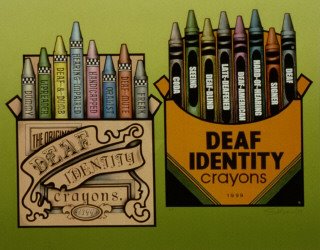
This first piece is by Ann Silver, called Deaf Identity Crayons: Then and Now.

A description follows this image
The image is of two crayon boxes. One is done in sepia tones, with “Deaf Identity Crayons” written across in an ‘old-time’ script. The crayons each have a label: Dummy; Lip Reader; Deaf & Dumb; Handicapped; Oralist; Deaf-Mute; Freak. The second box looks like the iconic Crayola-crayon box, with “Deaf Identity Crayons” written across the front. The crayons are CODA; Seeing; Deaf-Blind; Late-Deafened; Deaf American; Hard of Hearing; Signer; Deaf.

(Oralism is the techniques used to teach Deaf people to talk. CODA is Children of Deaf Adults.)

Silver’s biography is available on the Deaf Art website, but I especially love her description of her art:

My language of art has, over the years, metamorphosed from pictorial grammar to creativity and critical thinking. I turn to art (1) as an artistic expression of the Deaf Experience—i.e., culture, language, identity and heritage; (2) as a Zen meditation and an aesthetic recreation of the contemplative state in which it allows my thoughts to drift by without grasping at them; (3) as an emergency back-up whenever the English language gives me semantic anxiety; 94) as an academic study vis-à-vis Deaf Studies; and (5) as a visual weapon to deal with polemical issues and concerns such as stereotyping, inaccessibility, paternalism, inequality and discrimination on the basis of hearing status (a.k.a. audism)

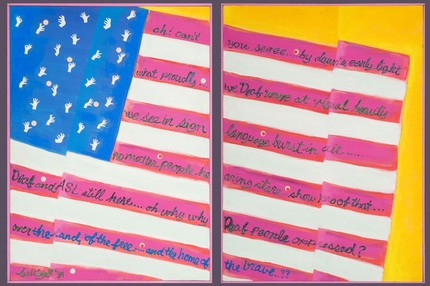
Another very popular piece is this one, by Betty G. Miller, called The ASL Flag:

Description follows
Description: This is a diptych, and the two canvasses come together to show a waving flag much like the United States flag. Instead of stars again the blue square, it shows 28 white hands Signing. Between the red and white stripes of the flat, it has the following:
Oh can’t you seeee…. by dawn’s early light
what proudly…. we Deaf wave at visual beauty
we see in sign language burst in air…
no matter people hearing stare…
show proof that… Deaf and ASL still here…
oh why Deaf people opressed?
over the land of the free…. and the home of the brave…??

Again, I like Betty’s bio, but I will highlight this portion:

When asked to explain the values behind her work, Dr. Miller replied:

“Much of my work depicts the Deaf experience expressed in the most appropriate form of communication: visual art. I present the suppression, and the beauty, of Deaf Culture and American Sign Language as I see it, both in the past, and in the present. Oppression of Deaf people by hearing is actually cultural, educational, and political. Another aspect of my work shows the beauty of Deaf culture. I hope this work, and the understanding that may arise from this visual expression, will help bridge the gap between the Deaf world, and the hearing world.”

You can see images of Betty’s work, and perhaps buy a t-shirt or similar article with images on it, at Betty Gee’s cafe-press store.

I won’t say too much else here, except to link to discussions about De’VIA elsewhere.

Betty Gee’s website
Deaf Art, Deaf Artists
Deaf Culture – Deaf Art on About.Com
Deaf History Through Art – De’VIA revisited after 15 years!
Deaf Art.org

Crowd Sourcing Counter-Arguments: You’re Easily Offended and People with Disabilities Can’t Act Anyway

Gentle Commenters & Readers of FWD:

I am tired. I am so completely and utterly out of spoons today I cannot even tell you. And thus, I turn to you, gentle folk, and ask for your assistance.

One of the more popular places to leave drive-by comments on FWD is And if this keeps up, there won’t be any, a post which is about the difficulties that performers with disabilities have in getting jobs, compared to the Oscar Bait that is non-disabled people playing the same role. At the time, I referred to it as “Crip Drag”, although having been gently corrected on that, I would now call it “Crip Face”.

The drive-by comments are usually all variations of the one that I have just approved there. I won’t copy the whole thing, but here is a small section of it:

So when your ultimate goal is to make a good film or play, and you’re taking into account physical characteristics, PR, talent, experience, chemistry (both in the role and with the other performers), and myriad other incidental considerations, and THEN you say you’re only going to choose from the very, very small pool of disabled actors, the end result is you’re going to get an actor far less suitable to the role than if you just chose for the good of the performance.

If you have the time/energy/inclination to do so, please join in the comments there to counter these arguments. I ask because I hope, sincerely, that if there is a discussion right there that takes on this oft-repeated belief that disabled people are just not able to act or perform in any way, or that what we are is “easily offended” rather than pointing out a problematic form of discrimination, maybe drive-by comments repeating it over and over will stop.

My only request in this is that commenters be polite. I know: tone shouldn’t matter. And I think anyone who isn’t willing to listen simply because You’re Too Angry is probably not anyone who is going to listen when you’re being polite. But, please do so, for me, because I’m tired, and angry is not something I can deal with today.

Again, here is the comment in full.

Your attention to this matter is greatly appreciated.

With affection,
Anna