All posts by abby jean

Happy Cesar Chavez Day!

Here in California, today is an official State holiday to celebrate the life and work of Cesar Chavez. Chavez worked to promote and enforce the civil rights of farm workers and, with Dolores Huerta, was cofounder of the United Farm Workers of America, or UFW – still one of the United States’ two major union umbrellas. While his work is usually viewed through the lens of organizing for Latinos, there is a significant disability component to his work.

Migrant farm workers are affected by a number of intersecting a complex factors which negatively affect their health and put them at risk of becoming permanently disabled through their work. They are likely to be exposed to harmful chemicals or dangerous work situations and because they often live on the farm under the control of the farm owner, they have little access to health care. This is all complicated by the immigration status – or lack of – of the workers. Here’s a brief overview of the occupational hazards, from the National Center for Farmworker Health:

The agriculture industry is one of the most dangerous occupations in the United States. While farmworkers face workplace hazards similar to those found in other industrial settings, such as working with heavy machinery and hard physical labor, they also face unique occupational hazards including pesticide exposure, skin disorders, infectious diseases, lung problems, hearing and vision disorders, and strained muscles and bones. Lack of access to quality medical care makes these risks even greater for the three million migrant and seasonal farmworkers who work in the fields every year.

In 2007, for every 100,000 agricultural workers in the U.S. there were 25.7 occupational deaths in agriculture. This compares to an average rate of 3.7 deaths for every 100,000 workers in all other industries during this same year. The Centers for Disease Control and Prevention label agriculture the most dangerous industry for young workers in the United States, accounting for 42 percent of all work-related fatalities of young workers between 1992 and 2000. Fifty percent of these victims were younger than 15 years old.

During their daily work, farmworkers are often exposed to pesticides. A 2002 study examined take-home organophosphorus pesticide exposure among agricultural workers and found pesticides in dust samples from 85% of farmworkers’ homes and 87% of farmworkers had pesticides in dust samples in their vehicles. In addition, 88% of farmworker children had organophosphate metabolites in their urine.

Infectious diseases among the farmworker population are caused by poor sanitation and crowded conditions at work and housing sites, including inadequate washing and drinking water. Farmworkers are six times more likely to develop tuberculosis when compared with other workers, and rates of positive TB results between 17% and 50% have been reported throughout the United States.

Because farm labor consists of constant bending, twisting, carrying heavy items, and repetitive motions during long work hours, farmworkers often experience musculoskeletal injuries. Furthermore, workers are often paid piece-rate, which provides an incentive to work at high speed and to skip recommended breaks. From 1999 to 2004, almost 20 percent of farmworkers reported musculoskeletal injuries.

Another complicating factor is the prevalence of child labor on these farms. It is obviously difficult to quantify this phenomenon, but worldwide, approximately 132 million kids between the ages of 5 and 14 work in agriculture. In the United States, somewhere between 300,000 and 800,000 children do agricultural work, sometimes working 12 or even 14 hour days. Environmental pollutants like pesticides have greater effects on children and their growing bodies are often at greater risk of harm from musculoskeletal and other injuries.

The punishing nature of this work is well known and acknowledged by government agencies. The Social Security Administration, which provides cash benefits and medical coverage to individuals it determines are “permanently disabled,” has a special category for “the worn-out worker.” This is a provision specifically for someone with less than a 6th grade education who, after 35+ years of arduous manual labor, can no longer return to that previous employment. The most common example of someone who fits this category is a migrant farm worker – someone who worked in orange orchards, climbing ladders, carrying heavy boxes of fruit, whose body has simply broken down and can no longer sustain that arduous labor.

There are three million workers currently in the fields, including a significant number of children, for whom this is the expected outcome – if they manage to sustain their labor for thirty five years. Cesar Chavez fought for those people and fought to protect them from outcomes and conditions that were, in his time, even worse and more damaging than what I’ve described above. We now must continue his fight.

Si Se Puede!
Stigma Kills: A Concrete Example

Often when bloggers or activists push back against ableist language and stereotypes in the media, especially pop culture, someone will respond with an argument that there are more important disability issues to address and that the topic at hand is mostly irrelevant to disability rights as a whole. This has happened with each of the posts in the Ableist Word Profile series, it’s happened with discussion about ableist tropes in pop culture, it’s happened when critiquing the vast overrepresentation of criminal behavior in news coverage of people with mental illness.

I believe these things matter very much. Perhaps not individually – if I slip and use the word “lame” pejoratively, it does not automatically cause a person with a disability to die instantly. But each individual instance adds up to become a trend, to become a larger understanding and expectation of how things are. And if those understandings and expectations aren’t accurate, it can have dramatically horrific results.

This is because a lot of our ongoing decisionmaking is done automatically, unconsciously. This is because we are constantly presented with such a vast amount of information that if we stopped to consciously evaluate everything, we’d never be able to do anything at all. When I see an object with keys labeled with letters and laid out in the QWERTY design, I recognize it as a keyboard an assume I use it to manually input written data into a computer or typewriter or phone or other device. This saves me the trouble of figuring out each and every time what this object is, what it is for, how I am supposed to interact with it, and what end result I can expect. I do this instantly, even though it is immensely complicated – it has been extraordinarily difficult to program a computer to identify, say, a keyboard from a photo or video, regardless of lighting, angle, and lots of other variables that the brain can process almost instantly.

There are similar examples for evaluating other sensory input. When I touch something, I know instantly and without consciously considering it whether the object is solid or liquid, dry or wet. I have no idea how I make that evaluation and instructing someone else on making that judgment would be immensely difficult for me – but when my foot touches a wet patch of carpet en route to the bathroom in the middle of the night, I pull my foot back lightning fast to avoid what is surely cat puke. If I feel myself losing balance, I put out a hand to catch myself without consciously deciding to, because my classification of my sensations as “losing balance” was done entirely unconsciously.

How does stigma fit into this? Well, a stereotype is an unconscious cognitive shortcut – instead of examining an individual person or situation, we apply a stereotype to make assumptions. While a stereotype is usually seen as a negative thing, they serve an important purpose by allowing us to make educated guesses. For example, when I go into a fast food restaurant, I know to go to the counter and give my order to someone behind the counter, usually wearing a uniform. While this has held true at the places I’ve visited in the past, if I go to an new fast food restaurant that I haven’t visited before, I will assume that I use the same procedure. That’s a useful assumption that saves me the time and energy of approaching each situation as brand new and unrelated.

There are times when stereotypes can be harmful and damaging, as we well know. The stigma against PWDs is an assumption applied to all PWDs simply because they are PWDs, assuming they have a set of presumed characteristics, motivations, and beliefs. It is a stereotype composed of all the understandings and expectations of PWDs conveyed by all the little things – the word choices of the people you talk to, that one character in that on tv show, that story you saw on the news last night. And although the specifics fade away, most people are left with vague, unconscious associations. Again, some of these associations are essentially value-neutral, as how I generally associate red with “stop” and green with “go” from traffic lights and signs. But people can also have unconscious associations around more complex and problematic issues, like race, gender, and disability status.

Social psychologists from Harvard developed a computer-based test to measure the existence of implicit associations and stereotypes – the Implicit Association Test (IAT). The IAT asks users to rapidly categorize words to the left or right of the screen. From the IAT FAQ:

The IAT asks you to pair two concepts (e.g., young and good, or elderly and good). The more closely associated the two concepts are, the easier it is to respond to them as a single unit. So, if young and good are strongly associated, it should be easier to respond faster when you are asked to give the same response (i.e. the ‘E’ or ‘I’ key [to indicate left or right]) to these two. If elderly and good are not so strongly associated, it should be harder to respond fast when they are paired. This gives a measure of how strongly associated the two types of concepts are. The more associated, the more rapidly you should be able to respond. The IAT is one method for measuring implicit or automatic attitudes and is featured on this website. There are other methods, using different procedures, that have been investigated in laboratory studies.

I’ve taken a number of IATs before (because I’m dorky about cognitive science and this kind of stuff) and believe that they have correctly identified in me some negative unconscious associations. For example, I unconsciously associated women with home and family and men with business. Consciously, I strongly disagree with that association! So when I do consciously consider my assumptions about those associations, I override and reject my unconscious associations.

When researching this post, I took the IAT that measures unconscious associations around disability. (I can’t link directly to that test, but it can be found in the IAT demonstrations available here.) Taking the test, I found that I have a slight automatic preference for abled people over PWDs. This doesn’t mean that when I act, speak, or even think about these issues I exhibit that preference. It doesn’t mean that I “really” prefer TABs to PWDs. It means that I have been sufficiently inundated by messages that associate TABs with “good” and PWDs with “bad” that I have a slight unconscious tendency to apply that association, a tendency almost instantaneously overruled by my conscious thought. So it is an association that exists only for the tiniest of moments until it is extinguished by cognition.

How can those tiny moments, almost too small to measure, even matter? Well, as Chally recently posted about, a Los Angeles police officer shot and killed an unarmed man with an unspecific cognitive disability autism [1. ETA since his family disclosed that he had autism in numerous public interviews.]. The officer fired as the man reached towards his waistband after failing to respond to verbal commands from the police. From the LA Times article linked in the post:

[LAPD Officers] Corrales and Diego believed “he [the PWD] was arming himself” and fired, Assistant Chief Earl Paysinger said at an afternoon news conference.

The officers made decisions in a fraction of a second,” he added.

In a fraction of a second.

Just long enough for the unconscious association to spark but not long enough for conscious thought to override it.

Just long enough for stigma to kill.

Mental Health Care in Post-Quake Haiti

An excerpt from a New York Times article – click through for the whole piece.

Inside this city’s earthquake-cracked psychiatric hospital, a schizophrenic man lay naked on a concrete floor, caked in dust. Other patients, padlocked in tiny concrete cells, clutched the bars and howled for attention. Feces clotted the gutter outside a ward where urine pooled under metal cots without mattresses.

Walking through the dilapidated public hospital, Dr. Franklin Normil, the acting director, who has worked there for five months without pay, shook his head in despair.

“I want you to bear witness,” he told a reporter. “Clearly, mental health has never been a priority in this country. We have the desire and the ability, but they do not give us the means to be professional and humane.”

As disasters often do in poor countries, Haiti’s earthquake has exposed the extreme inadequacies of its mental health services just at the moment when they are most needed. Appalled by the Mars and Kline Psychiatric Center, the country’s only hospital for acute mental illness, foreign psychiatrists here have vowed to help the Haitian government create a mental health care system that is more than just an underfinanced institution in the capital city.

Integrating Primary and Mental Health Care

The increased integration of mental health care into primary care is one of my pet issues. Currently, primary care providers (PCPs), also called general practitioners, provide over half of mental health treatment in the United States – which results in up to 50% of mental health problems going unindentified, undiagnosed, and untreated through the primary care system. This is a wasted opportunity, as PCPs have significant opportunities to identify behavioral health problems early and provide interventions and treatments to prevent further deterioration.

This indicates a significant split between the physical health care and mental health care systems, where people are expected to go to their PCP for physical health issues and to self-refer to a mental health care clinic or specialist for mental health treatment. This is problematic for a whole host of reasons – primary among them the simple fact that this system simply isn’t working – even though the prevalence of mental disorders in primary care is somewhat higher than the overall population, PCPs are ineffective at identifying those people and providing them with treatment. Expecting people to identify themselves as experiencing a mental disorder, overcoming societal stigma to seek diagnosis and treatment, and assuming they have the ability to access mental health services through a fragmented and poorly financed system erects barriers to treatment that are likely insurmountable to someone experiencing an untreated mental health problem. Unsurprisingly, these barriers are likely more pronounced for already vulnerable populations such as the elderly and low-income minorities.

There are a lot of benefits to better integration of mental health care into the PCP’s role. The PCP is usually the patient’s first contact with the health care system and an individual is much more likely to know how to access care from a PCP than from an unintegrated mental health system. Patients are often more willing to attend appointments with and follow up with their PCPs because of the removal of stigma from receiving treatment. Other patients may not have meaningful access to a separate or nonintegrated mental health system, either due to financial barriers, long waiting lists, or other barriers.

The most significant problem, in my view, is the expectation that an individual should be able to determine they are experiencing a mental health problem. Given that the majority of PCPs, who have medical degrees and extensive training, fail to identify and diagnose mental health issues, expecting untrained laypeople to do so – while they are experiencing the mental health problem – is beyond absurd. It is even more absurd given that many mental health issues have a physical component. Depression results in fatigue and appetite changes, as does mania. The physical experience of a panic attack is often interpreted as a heart attack. Auditory or visual hallucinations could easily be interpreted as problems with the sensory organs themselves. This is sometimes heightened by an individual’s cultural context, as many Asian cultures describe the experience of depression almost exclusively in physical terms. Expecting an affected individual to untangle the complicated interplay of physical and mental effects and diagnose themselves with a mental health problem prior to seeking treatment is bound to fail.

Another argument in favor of integration is the huge overlap between physical and mental health problems. Estimates of this comorbidity vary wildly, but range somewhere from 20% to 80% of primary care patients (useful data, no?). Having a patient access two separate mental health care systems for their treatment ensures fragmented treatments that may contradict each other and are certainly not coordinated for maximum effect. Better integration would ensure treatments for physical and mental health issues complemented each other and treated the patient as a whole person.

This seems like an uncontroversial and common sense suggestion. It was embraced by the United States Surgeon General in 2001 and by the World Health Organization in 2008, but has seen little progress or momentum since then. Some local treatment systems are taking steps towards integration, such as these trainings done by the British Columbia health system, but there have been few steps towards addressing this issue in the larger health system.

The Community First Choice Option

So it looks like here in the United States, after what seems like a full century of arguing and revising and protesting and name calling, our legislature may actually pass a health care reform bill today. This is far from an unqualified victory – the bill is a very mixed bag from a number of viewpoints, and PWDs have both reasons to be happy and reasons to be upset. In other words, there’s not one “right” way to look at the bill from a disability rights perspective and people can still be committed to disability advocacy whether they love or hate this bill. (You’ll notice I cagily haven’t taken a position on the overall bill.)

There is one aspect of it that is very exciting, though, and has been the result of strong advocacy from ADAPT and the National Council on Independent Living: the Community First Choice Option. The CFC Option would give states the option to request federal funding to provide in-home assistance and support to PWDs. The goal of these programs is to facilitate PWDs staying in a community-based setting – living independently, with a partner, family, or other arrangement – rather than moving to a full-time care institution such as a nursing home.

PWDs would be able to access a variety of types of assistance, as ADAPT describes:

Services under this option would include services to assist individuals with activities of daily living (ADLs), instrumental activities of daily living (IADLs), and health-related tasks through hands-on assistance, supervision, or cueing. ADLs include eating, toileting, grooming, dressing, bathing, and transferring. IADLs include meal planning and preparation; managing finances; shopping for food, clothing, and other essential items; performing essential household chores; communicating by phone and other media; and traveling around and participating in the community. Health-related tasks are defined as those tasks that can be delegated or assigned by licensed health-care professionals under state law to be performed by an attendant. Services also include assistance in learning the skills necessary for the individual to accomplish these tasks him/herself; back-up systems; and voluntary training on selection and management of attendants. Certain expenditures would be excluded, including room and board; services provided under IDEA and the Rehabilitation Act; assistive technology devices and services; durable medical equipment; and home modifications.

There is a similar program, In-Home Supportive Services (IHSS) currently existing in California that is based primarily on state funds that has proved a win for both PWDs and for state budgets. The benefits for PWDs are clear – they are allowed the dignity and independence of a community-based setting rather than needing to move to an institution for support. It has also benefited the state, however, because the average yearly cost per IHSS consumer is $10,000, compared to the $60,000-80,000 it would cost to institutionalize that person. Since Medicaid, the state and federally funded health insurance program for low-income folks, would bear the bulk of the cost of institutionalization, IHSS provides a significant cost savings. These are programs that do the right and moral thing by allowing a PWD to remain in the community while saving the state money at the same time – a win-win. For yet another win, family members of the PWD can sometimes be paid to serve as a caregiver, increasing income to the household to ameliorate the poverty disproportionately experienced by PWDs and their families.

Here are a couple of stories from IHSS consumers about how the program affects their lives:

Jill has had back surgery and 3 knee surgeries and is unable to stand for more than 20 minutes at a time. Her 11-year-old daughter has ADHD and needs to be watched at all times. The combination of dealing with knee and back pain, migraines one to three times a week and caring for her daughter Courtney leaves Jill unable to take care of certain household needs such as cooking and cleaning her home. Without IHSS services Child Protective Services might have placed her daughter Courtney in foster care.

Christie Ritter: On October 1st, 2002, I was stopped at a traffic light. It was my day off from being a respiratory care therapist in a hospital. I worked neonatal and pediatric specialty. I was sitting at the light, waiting for it to turn green, heard some screeching tires. Next thing you know, I have a car coming through my driver’s side door. Broke my neck and my lights went out. So when I woke up, found out my neck was broken and I’m a quadriplegic.
Jahad:
Ritter has some movement in her arms and legs, but she can’t grip or hold things and she can’t hold herself up well enough to walk. Ritter fought for in-home care. And with therapy and assistance, she holds down a full time job and lives in her own home.

There are problems even with this portion of the bill – the availability of the optional federal funding has been delayed a year, and individual states can still opt not to administer the program. It is, however, a good and positive step in the right direction.

Bake Sales for Chemo

I recently read a story of a woman forced to have fundraisers to cover her chemo treatment after she was excluded from purchasing insurance coverage because of a separate pre-existing conditions:

Iowan grandmother Deb Robben  shopped the insurance market, looking for a company that would cover her. Unfortunately, after a lengthy search, she was unable to find a single insurer that was willing to offer her coverage; the companies denied her coverage because they considered the benign cysts in her breasts to be a pre-existing condition.

Last December, Robben was diagnosed with colon cancer. Because she has been unable to obtain insurance, she has had to pay the costs for treatment out-of-pocket. For chemotherapy treatment alone, Robben expects to pay almost $2,000 a month. “She’s only two months into chemo and already she’s at $50,000. Oh my, what is another four months going to bring,” says Melissa Gradischnig Nelson, a friend of Robben.

In desperation, Robben’s friends and family have turned to local fundraisers to try to pay for her treatment. Over the weekend, they held a $5-a-plate pasta dinner in the hope of putting “a dent” in Robben’s massive health care bills. Local news station WHO-TV recently interviewed Robben, who told them, “It’s kind of hard when you can’t get insurance. To say, lady you’re going to die or figure out how to come up with the money. It’s not right.”

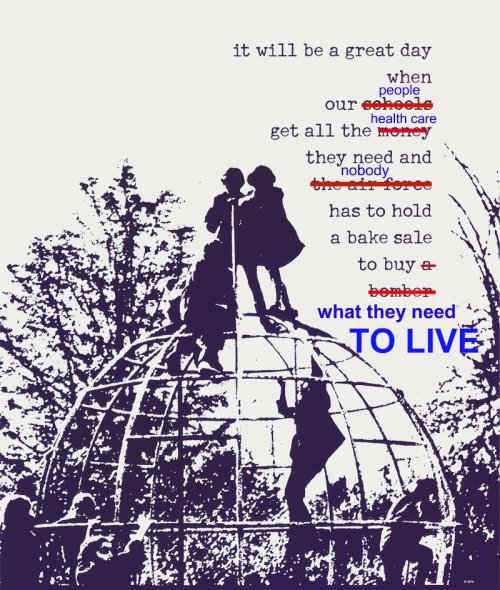
This reminded me of the bumper stickers I used to see with the slogan “It will be a great day when our schools get all the money they need and the air force has to have a bake sale to buy a bomber.” So I’ve modified it to reflect our modern times:

Graphic image of children on jungle gym with slogan about bake sales and bombers, modified to read "it will be a great day when people get all the health care they need and nobody has to hold a bake sale to get what they need to live."

Photos from Mental Health Institutions in Indonesia

The Big Picture, one of my very favorite photo blogs, in which the Boston Globe collects a set of stunning photos on a single topic or theme, recently had a series on Indonesia. Two of the photos especially caught my eye, as they depicted scenes from mental health institutions in the country.

In a room with vivid green walls and white tiled floor, a person is seen from the knees down is chained to a wooden pole with a metal link chain. The person is barefoot, wearing dingy jeans with a tear in the knee.

The leg of a patient is chained to a post at the Galuh foundation for people with mental health conditions on February 10, 2010 in Bekasi, Indonesia. Belief in black magic is commonplace in Indonesia, where there is much ignorance over mental health issues, with traditional healers instead consulted for apparent sufferers. 2007 figures suggested that 4.6% of the nation suffered from serious mental disorders in a country whose population now stands at around 230 million, with only around 700 psychiatrists across 48 psychiatric hospitals available to help treat those affected. (Ulet Ifansasti/Getty Images) #

A shirtless boy, thin with protruding ribs, turns his head to the side as he is sprayed with a water hose. Behind him are walls of broken concrete.

A patient named Yoyo is bathed at the Galuh foundation for mental patients in East Bekasi near Jakarta on February 11, 2010 in Bekasi, Indonesia. With limited mental heatlth care available in Indonesia, sufferers usually turn to black magic and are taken to “dukuns” or healers who are believed to have magical powers. (Ulet Ifansasti/Getty Images) #

Judge Orders New York to Move Mentally Ill Out of Adult Homes

From the New York Times:

New York State must begin moving thousands of people with mental illness into their own apartments or small homes and out of large, institutional adult homes that keep them segregated from society, a federal judge ordered on Monday. The decision, by Judge Nicholas G. Garaufis of Federal District Court in Brooklyn, followed his ruling in September that the conditions at more than two dozen privately run adult homes in New York City violated the Americans With Disabilities Act by leaving approximately 4,300 mentally ill residents isolated in warehouselike conditions.

The remedial plan offered by Judge Garaufis, drawn from a proposal presented by advocates for the mentally ill that was backed by the Justice Department, calls on New York to develop at least 1,500 units of so-called supported housing a year for the next three years in New York City. That would give nearly all residents the opportunity to move out of adult homes.

The Americans with Disabilities Act gives PWDs the right to live in the least restrictive housing possible – in this case, moving from adult homes into independent supportive living units. This is a great development for those previously forced to live in the abusive conditions of the group homes.

This lawsuit was filed after a series of articles in the NY Times about the horrific and abusive conditions present in group homes for adults with mental disabilities. It is unclear whether these changes would have taken place had the newspaper not devoted the time and resources to their year-long investigation of these conditions and problems.

A Conversation in the Lunch Room

I was sitting in the lunch room at work with a group of co-workers, flipping through the newspapers. I came to an article on the suicide of Marie Osmond’s son, which led to the whole table discussing the incident. And it was immediately underlined for me how little most people know about mental illness and depression. Here’s a brief list of some of the questions and statements that came up during the discussion, the entirety of which I spent shrinking into myself and trying to be invisible:

  • “Is depression even a real disease?”
  • “People who commit suicide don’t really want to die – evolution wouldn’t let us have suicidal tendencies because it goes against survival.”
  • “It must be because his mom had mental health problems too.” Someone inquired if depression was hereditary and the original speaker replied “No, but being around depressed people can turn you into a depressed person.”
  • “I once knew a bipolar. She married my cousin and my mom got so mad, like you should never marry a bipolar because it’s not a good idea for them to have kids.”

Finally, a young man told a long story about his ex-girlfriend, who had experienced major depression, and how it affected her and the serious limitations it caused her. It was a great illustration of the reality of depression and the changes it can cause in day to day life. It was unfortunately concluded with a “so that’s why you can’t be in a relationship with those people, it’s just too hard.”

We’ve got a long way to go, y’all.

How to Frame the Accommodations Debate

The concept of accommodations for employees with disabilities is one that exists all over the world. The basic principle of these laws is that an employee with a disability is entitled to changes to accommodate specific needs created by their disability in order to work. These can be changes in policies (changing a policy prohibiting eating at employee desks to allow an employee with diabetes to manage his blood sugar) or procedures (issuing company announcements both orally at staff meetings and by written memo to accommodate an employee with auditory processing difficulties), or even maintaining a scent-free or florescent light-free workplace, providing ergonomic modifications to workspaces, and beyond.

There are a lot of negative attitudes and assumptions surrounding workplace accommodations. It is often assumed that the employee with a disability (EWD for short) and their employer are in an adversarial position – the employee is asking for something they want but that the employer does not want to give. Providing the accommodation is seen almost universally as a loss for the employer, because providing it will cost them, either by purchasing new equipment or in administrative costs and hassle for changing existing policies and procedures. In the United States, it is often made very clear to employees that accommodations are provided solely because the Americans with Disabilities Act (ADA) requires employers to cooperate, not because the employer wants to assist with accommodations or believes it will improve the overall workplace in any meaningful way.

The cost of the accommodation, whether direct or indirect, is often seen as offsetting the worth or value of the EWD and limiting the benefit the employer can derive from an individual employee. More broadly, this is seen as discouraging employers from hiring EWDs in order to prevent the need for these accommodations. This means that accommodations are often seen as “special treatment,” for EWDs, requiring a whole set of special procedures by which EWDs can request accommodations and have them evaluated and special staff to learn the ADA and evaluate accommodations and …

Another feature of accommodations for EWDs is that although they are supposed to be individualized and tailored to the specific needs and responsibilities of an individual employee, employers often think of providing specific, pre-determined accommodations based on the type of disability the EWD has. For example, employers often consider themselves to have fulfilled their accommodation duties for people with physical disabilities if the workplace is wheelchair accessible and the parking lot has a handicapped parking space. Any additional requests from accommodation are likely met with bewilderment by the employer – “we already took care of all of the accommodation issues!”

It was with all of that in my mind that I read this recent article from ABCNews, with the headline “Employees Healthier When Boss Is Flexible.” The article discussed the benefits of flexible work schedules for employees without disabilities:

“Flexible working initiatives which equip the worker with more choice or control, such as self-scheduling of work hours or gradual or phased retirement, are likely to have positive effects on health and well being,” Clare Bambra of Durham University in the U.K., told MedPage Today. “Control at work is good for health,” Bambra said. Overall, the researchers found that situations that gave the employee more control over scheduling have positive effects on health and well being, particularly with regard to blood pressure, sleep, and mental health. A third study found significant decreases in systolic blood pressure and heart rate for workers with flexible scheduling, Bambra said. Conversely, Bambra and colleagues found that mandatory overtime and fixed-term contracts had absolutely no positive effects on health outcomes.

Although the article did not analogize these flexible work schedules under employee control to the principle of accommodations and disability was not explicitly mentioned in the article, I couldn’t help but connect the two. The idea of allowing an employee to control their own work schedule based on her own needs is exactly the principle behind accommodations – tailoring the work requirements and environment to the individual and specific needs of the employee, rather than requiring everyone to comply with universal policies set by the employer. It’s also implied that these flexible policies benefit the employer by creating healthier and happier employees who are, in turn, more productive at work.

This made me wonder if it would be helpful to adopt this framing for accommodations arguments, as in “see, assisting employees to accommodate their individualized needs results in better outcomes for both employees and employers!” Framing the argument that way addresses a lot of the negative issues around accommodations discussed above: the employee and the employer are working together rather than against each other; providing this flexibility is seen as a benefit to, not a loss for, the employer; this maximizes the work, worth and value of the employee rather than offsetting it; accommodations are good business practice rather than special treatment imposed by law; the individualized nature of accommodations is emphasized and changes must be dictated by the employee’s view of their own needs.

There is a potential drawback to this framing, however – it does not explicitly mention or focus on PWDs. I see this as potentially harmful given that the need for accommodations for PWDs is created by the historic and continuing othering of and discrimination against PWDs. (See amanda and wiki on the social model of disability for more about this.) Advancing the principle of accommodations for employees without explicitly focusing on PWDs removes a lot of the disability-based stigma from the discussion, but also removes the historical context that has created a need for accommodations. Similarly, framing the issue as a smart business practice than a civil rights issue removes the discussion of “special” rights or treatment, but removes focus from the fact that PWDs deserve these rights to counteract oppression based on their disability status.

This framing technique also dilutes the concept of what an accommodation is and extends it to all employees, whether or not they have disabilities. This could be dangerous, as it would allow employers to think about accommodations in terms of overall economic benefit – this might encourage them to deny specific accommodation requests that would be considered too costly for the company, or insufficiently beneficial to the overall bottom line. While that may be unwise for employers, given studies like this, it would not be illegal and would not be a civil rights issue for employees without disabilities. For EWDs, however, denying accommodations is a civil rights issue, because accommodations are required to allow EWDs equal access to employment benefits in light of the barriers that exist because of historic and continuing oppression and discrimination against PWDs on the basis of their disabilities. Expanding the focus of accommodations to all employees de-emphasizes the rights-based aspect of accommodations for PWDs to the point of invisibility.

I’m not sure whether the benefits or costs of this framing of the accommodations argument are stronger. What do you think? Have I ommitted any advantages of using this framing? Any disadvantages? Which framing – current rights-based arguments or these non-PWD centered business arguments – do you think is best?