Monthly Archives: November 2009

Your Chilling Fact For The Day

Originally published July 2009

The PALS also indicates that Canadian women, 15 year of age and older, experience a higher prevalence of disability at 15.2 percent, than Canadian men at 13.4 percent. In 2006, 19.5 percent of Ontario adult women reported having a disability compared with 16.6 percent of men (Statistics Canada, 2006). Women with disabilities are significantly more likely to experience abuse than non-disabled women. It is estimated that women with disabilities are 1.5 to 10 times more likely to experience violence than non-disabled women, depending on whether they are living in the community or an institution (Public Health Agency of Canada, online).

[From: We Are Visible: Ten Years Later WARNING: PDF]

So.

How many emergency shelters are you aware of that are fully accessible, have a ‘terp available in some way for Deaf women, or provide their information in Braille? Have grip bars in the bathrooms? Have accessible toilets?

How many have funding for all of this?

The last women’s shelter I volunteered in had a disabled-parking zone in front, but that’s all I recall. What about you?

Guest Post: Sex and Scoliosis

This is a Guest Post by Atlasien. It was originally published here.

I’m a multiracial Asian-American woman, Southerner, third-culture kid and mommyblogger. I’ve been living in the Atlanta area for more than a decade now. I mainly blog about race and foster care adoption. My husband and I have a 7-year-old son that we adopted as an older child. I enjoy this blog, and I’ve learned a lot of important stuff about disability issues by reading here.

What does scoliosis have to do with sex?

There are a lot of connections. I guess I’ll need to start by explaining scoliosis. It’s a common disorder, but one that is often very misunderstood by the general public, as well as many non-orthopedic doctors. Most people vaguely remember a scoliosis check from their school days. Sometimes the kids are lined up in a row, and told to take off their shirts and bend over while a medical professional inspects them from the back. The experience is obviously rather humiliating and tends to cause a lot of nervous laughter.

Scoliosis — a sideways, left-right asymmetry of the spine — is the most common form of spinal deformity. It can also be accompanied by other forms of spinal deformity, like kyphosis (AKA hunchback) and extreme lordosis (AKA swayback). It sometimes comes as a package deal along with disorders of connective tissue, or with cerebral palsy and spinal bifida. In those cases, scoliosis is often diagnosed at a very early age.

The other kind of scoliosis, the much more common kind, seems to come out of nowhere. It’s known as adolescent idiopathic scoliosis or AIS. “Idiopathic” is from the same Greek root as “idiot” and basically means “we have no idea what causes it.” Though recent research has shown that it’s actually genetic, and they’ve even tracked down the genetic location (but only if you’re white, which is bizarre, because there isn’t any significant racial/ethnic difference in prevalence rate). Someone with this kind of scoliosis (usually a girl, as the incidence of more serious curves among women is 7-10 times that of men) is born with a normal-looking spine. Before puberty, the spine begins to bend and curve. Maybe it stays there… maybe it gets worse through puberty. Then maybe it stays there, or maybe it gets a lot worse close to menopause. Without major surgery, it’s essentially a one way road. In scoliosis vocabulary, when curves get worse, it’s called “progression”. “Progression” is bad. Arresting progression is good.

According to this NIH resource, “Of every 1,000 children, 3 to 5 develop spinal curves that are considered large enough to need treatment.” If you adjust for sex, the rate climbs up to almost 1% of all girls. I don’t know of any source that says actually how many girls receive treatment of which types. Treatment means to watch, take lots of x-rays, determine progression, and if it looks like progression is, well, progressing, to brace. Or in very serious cases, go directly to spinal fusion.

A pre-teen girl, front and back view, with her face obscured.  She has a metal brace that has one rod running up the front to a metal collar, and two rods in the back.  There is a fiberglass girdle across the abdomen and down to the hips.  There is a strap hooking to both sides of the metal rod in the front.  Descriptive text provided by Don.

That’s the “Milwaukee” variant of brace. It’s the kind I had. It’s made from hard plastic and steel. It’s expensive, ugly, frightening, and extremely uncomfortable. The family nickname for my brace was “The Iron Maiden”. You can climb into it and strap it on and off, and adjustments of the screws will accommodate changing body shape during puberty. I think you’re supposed to wear it until a few years past puberty, when your spine growth finally halts. The brace is an old form of treatment and it’s shown to be moderately effective at arresting progression.

Three images of the back of a young woman.  In each, there is an obvious curvature of her spine.  It's an S-style curve.  The middle portion of her back, around the shoulder blades, is off-set to the right, while the shoulders and hips line up relatively evenly.  Descriptive text by Don.

Many girls experience horror and anger when they find out what bracing is going to mean for their lives, and that it won’t even fix them, it will just probably keep them from getting any worse.

It was easier for me to accept my fate. First of all, my mother also has idiopathic scoliosis, and her curve was fairly serious. Hers is comparable to the woman pictured above. She had not been treated as a girl, and her scoliosis had slowly progressed as she went into middle age. She eventually had a spinal fusion — two long steel rods screwed into her spine — and was in the hospital for two weeks. So I had a strong motivation to make sure my curve didn’t progress as far as my mother’s. She was also a positive role model for me. I saw her as an active, glamorous woman who refused to be limited by scoliosis. I tried to adopt the same stoic attitude toward my own scoliosis. Second of all, my orthopedist said it was OK to only wear my brace 12 hours a day, which meant I slept in it, but I didn’t have to wear it to school. I think he may have subscribed to the philosophy that although the brace should really be worn 23 hours a day, there’s so much social stigma attached to it that many girls rebel, and won’t wear it at all, whereas a private bracing regimen has more likelihood of consistent follow-through.

I don’t know if it would have made school any worse. I’ve written before about the extensive racist abuse, and sexualized racist abuse, I got in late elementary and middle school.

I was harassed so much in the locker room my first year of middle school that I refused to change my clothes at all. P.E. was a living nightmare full of verbal attacks and physical threats from larger girls. I spent much of my time desperately thinking of ways I could get a medical excuse. Unfortunately, aside from my scoliosis, I was healthy as a horse. I refused to participate in activities anyway, and sat with the asthma-sidelined section. I’m still bitter about this experience because it taught me to associate healthy athleticism with emotional trauma and racist bullying. Maybe if I’d had my brace on, I could have gotten my coveted medical excuse.

It was something I never, ever thought of at the time, though. The orthopedist’s word was the word of law. And the brace was something to be hidden. I think this is a common tendency among brace-wearers. Girls that age don’t want to be seen in a brace. For photos, they’ll take off the brace. If they’re told to wear it to school, they’re mocked and stared at. At the time, I considered myself very lucky that I was able to hide my brace from other kids my age.

I don’t know much about disability theory and disablism, but I’ve been reading through blogs about it, and it’s very interesting in relation to scoliosis. I don’t identify as a disabled person/person with disabilities, and I don’t think many other people with idiopathic scoliosis do. But many of us have also gone through an intensely emotional adolescent period where we’re viewed as disabled.

One of the hallmarks of disablism is that it strips away sexuality. The prejudice against disabled people includes thinking they are not supposed to exist sexually, have sexual desire or be desired.

Being braced means going through puberty strapped and screwed in to a weird exoskeleton that incarnates the negation and emprisonment of your sexuality. Your breasts and hips are starting to grow. They might start to bump painfully against the brace. So you have to visit the doctor — often an older man — who adjusts your screws to accommodate your new growth.

The brace seems anti-sexual, but it also has positive sexual connotations. The light at the end of the dark tunnel is that the brace will “keep you normal”. You’ll get through puberty and enter into sexually desirable womanhood without too much spinal deformity… the brace will preserve you. The brace probably becomes the most significant physical object in your life, for good and for evil.

I certainly didn’t receive any counseling about my scoliosis. I don’t know if it’s common today to have counseling as part of the bracing process. If it’s not, it should be. Girls who have gone through bracing feel like it’s them, alone, against the world. Although it’s quite a common experience, by medical and social tradition, the disorder is isolated and hidden.

This study showed that bracing doesn’t affect self-image much. However, it also takes places in Sweden, where school environment I’m sure is quite different than in the U.S. This other U.S. study tells a somewhat different story: “Scoliosis was an independent risk factor for suicidal thought, worry and concern over body development, and peer interactions after adjustment. CONCLUSION: Scoliosis is a significant risk factor for psychosocial issues and health-compromising behavior. Gender differences exist in male and female adolescents with scoliosis.”

After bracing, scoliosis, and deformities of the spine in general, become almost invisible. It’s extremely rare to have a spinal deformity so pronounced that anyone can tell by looking at you when you have clothes on. People with idiopathic scoliosis “pass”. People have known me for years, even decades, without knowing I had scoliosis. Then one day they’ll see me in a bathing suit — and not even the first time they saw me in a bathing suit, but maybe the first time they really focused on my back — and they’ll burst out with something like, “OH MY GOD DID YOU KNOW SOMETHING IS REALLY WRONG WITH YOUR SPINE!!

Once it stops being invisible, it’s all of a sudden very, very visible. I guess it’s sort of like shaking hands with someone and suddenly realizing they have six fingers.

If I’m not experiencing any back pain, I rarely think about my scoliosis, although I sometimes worry about my future. Pregnancy is not a risk factor for progression, but menopause is. Right now, my thoracic curve is 36 degrees. If it gets past 40, I might need spinal fusion surgery. This is a mostly safe procedure, but it’s still really scary, and involves weeks in the hospital. Click on the following link if you’ve seen enough David Cronenberg movies that you think you can handle it (link to nightmarish spinal fusion surgery image). Spinal fusion partially reverses the curve, arrests or slows down further progression and relieves chronic pain. You’re still reasonably flexible afterwards, but there are potential complications, and I’m not considering surgery at this stage. If I refused surgery, and my curve happened to progress further, I would start to have more pain and diminished lung capacity. Past 60 degrees, I might start to experience severe and constant pain in my back and/or ribs, and my internal organs would get squeezed together and I might start to have breathing problems. Past 80 degrees I might have lung AND heart problems.

But I don’t stay up night worrying about the risks of progression. Many people have more uncertainty about their medical future than I do. For example, if I had diabetes, I might worry about having a foot amputation.

Since I grew up with scoliosis, it’s taken me a while to understand how it looks from the outside. Aesthetically speaking: not good. We’re conditioned to associate left-right symmetry with health and general well-being. People with moderate scoliosis, like me, often look symmetrical from the front, but asymmetrical from the back, and I suppose that seems eerie and perhaps even deceptive and sneaky. There’s a lot of really negative associations in popular culture (e.g. Hunchback of Notre Dame). When mean-spirited people do “retard” imitations they’ll often hunch up one shoulder and stagger in order to simulate a deformed spine.

I don’t talk about scoliosis casually because a) I don’t have any major health problems because of it, so there’s not that much to talk about b) I’m afraid of it being used against me. I’ll put it on medical history forms when I know I can be assured of privacy. It was used against me recently when I applied for private disability insurance. I thought it would be a good idea to have a separate private policy in case I lost my job for any reason. I did a ton of research, spent a lot of time talking with the salesman, and ended up with a quote that specifically excluded anything going wrong with my reproductive system AND my back. I changed my mind and decided it wasn’t worth buying since so much of my body was apparently un-insurable. They excluded my ENTIRE BACK. Hypothetically speaking, if I got in a minor car accident, and as a result developed the exact same kind of back problems that anyone without scoliosis would develop, nothing would be covered. What a terrible deal. No thanks!

The health implications of my scoliosis are not that extreme, and I don’t need any accommodations to perform any major life activities, which is why I don’t consider myself disabled.

– I have foot pain in my arch if I don’t wear comfortable shoes. I can wear platforms, but I can’t wear high heels.
– I have to be a bit careful doing things like yoga and pilates.
– I have to stay reasonably active in order to be 100% pain-free. When I get too sedentary, I start having back pain and rib pain. If I ever had an illness that forced me to rest all the time, I’d be in big trouble. Exercise and stretching are highly effective for scoliosis back pain. Other options I would consider to control pain if it ever got worse include drugs, physical therapy and adult braces. There are a gazillion alternative health “cures” for scoliosis back pain suffering, but they strike me as being of very dubious efficacy.
– I have to watch my posture
– I have to watch my weight. Excess weight leads to back pain. Being underweight might be even worse, because being underweight is connected to bone density loss, and people with scoliosis have lower than average bone density anyway.

None of these problems are really unique to scoliosis. Plenty of able-bodied and disabled people have back pain or foot pain.

This link from Eurospine.org sums it up: “Progression of scoliosis can involve an aesthetic problem and lead to functional problems. Respiratory disorders may develop in large curves greater than 80 [degrees]. Nonetheless, the mortality rates and vital prognosis in individuals with scoliosis are comparable to those of the general population.”

It’s the “aesthetic problem” of scoliosis that’s unique. Like I mentioned before, left-right symmetry is wound up with definitions of health and beauty across many different cultures. People like me are aware of this on a subconscious or barely conscious level. 99.99% of the time I forget that I don’t fit that symmetrical standard. Every so often I’m reminded, and it feels a bit painful. There are subtle psychological effects. Vague feelings of being a secret curved impostor in a straight-backed world. Times when I feel like my spine is an enemy working against me… times when it hurts to breathe and the pain makes me feel angry at my spreading rib bones, and I wish I could reach inside of myself and squeeze them back into place. Sometimes I’m bitter about the inches of height I lost to scoliosis.

Back to sex. Even without bracing, there’s still a sexual paradox when it comes to scoliosis. Have you ever seen a picture of a woman with scoliosis and/or kyphosis that was not anonymous, depersonalized, clinical, grim and depressing? Like the photos I included above? Scoliosis is profoundly unsexy.

On the other hand, when women pose provocatively, they often throw one hip to the side and put one shoulder forward.Why is that pose sexy? Maybe it makes us look femininely defenseless and vulnerable, as opposed to a masculine, stick straight pose. That’s going along with a typical sexist definition of “femininity”. There’s another less sexist possibility… the pose is also highlighting the flexibility of the spine. So in that sense, the woman is showing off her body’s capacity by bending in a certain way.

There’s a comic book artist, Rob Liefeld, who was (in)famous starting in the 1980s for drawing unrealistic women. The conventions of drawing women are in comics are easy to criticize, but Liefeld’s stuff is… well…I guess you’d have to see the spinal curvature to believe it.

Iconic Rob Leifeld drawing of a super heroine.  She's posing facing right, turning her head over her shoulder.  She has an impossibly-narrow abdomen, and spine curvature similar to severe lordosis, an inner curve of the spine.  She is not wearing very much clothing.  Description by Don.

That’s supposed to be sexy. For the audience of predominantly young men who made Liefeld very popular, it must have been sexy. This is a funny analysis of the above drawing by a group of women comic book artists:

Take note of Avengelyne’s waist and how it is thinner than her head. Minus the hair. Note how it hangs beneath her ribcage like a suspension bridge, rather than actually supporting the top of her body. (Her torso must be kept afloat by those helium breasts.) Note the scoliosis gone grossly untreated. Note the little leather bags which wouldn’t fit around a normal person’s wrist. Especially note that the artist put her in the most obvious POSE to exaggerate the spine: a profile shot with negative space between her back and arm. That’s correct – our intrepid heroine’s spine would appear yanked. Avengelyne is a SWAYback™.

The humor is partly at my expense. But I can’t help laughing. It’s a highly sexualized image, but not one that I identify with in any way.

But here’s a poster image I ran across that uses stupid sexist humor to make fun of a real woman, and I don’t find it funny at all.

A woman is facing straight on the camera, with her weight obviously all on one side.  She's curved her body to look like an S.  Text reads: Scoliosis: Making an otherwise beautiful girl look pitiful.  Image is from Motivated Photos.com, description by Anna

It really illuminates the double standard that women are subjected to. You’re supposed to be sexy so that you please men. But if it looks like you’re trying TOO hard, men (and other women) will make fun of you. If you don’t wear makeup, you’re a [insert homophobic slur]. Wear too much makeup, you’re a [insert transgender-phobic slur]. Curve your back, look sexy. Curve it too much, it looks like you’re deformed. Argh!

Thanks to my brief readings of disability theory, I realize that making fun of people with spinal deformities isn’t something I should just accept as the natural order of things, especially because this humor is connected to moral judgments of disability. That is, the idea that physical body difference reflects some kind of moral failing. When it comes to scoliosis, I think the general public halfway believes that scoliosis is the fault of the person’s family. There’s a myth that giving young kids backpacks that are too heavy will make their spines curve (totally not true). When people are adults, “she should have had that corrected” is sometimes an assumption. A lot of people don’t realize that the only sure way to even partly reverse a curve is spinal fusion, which also leaves a giant seam-scar running up your back. Another judgment is that a person with scoliosis must be poor. It’s true that I’m very lucky I had access to bracing; if I wasn’t born into a middle-class family in a rich country, my curve would be a lot worse by now. So there are major class differences in scoliosis, but ultimately, we’re all in different positions on the same boat because there is no way to permanently and completely reverse adult scoliosis.

Thanks to flickr, I did actually find some images of scoliosis that I think are beautiful and help affirm positive self-image and sexuality. I wish I’d found a greater variety of body types, but these images are great to start off with. Some are post spinal fusion.

First, here’s the typical clinical picture. It shows everything that’s wrong with the body.

A woman is facing away from the camera, with arrows pointing to various parts of body to describe them.  Head not centered over body.  One shoulder (right) higher.  One shoulder blade (right) higher and possibly more prominent.  Spine obviously curved (to the left).  One hip (left) more prominent.  Unequal gaps between the (left) arm and the trunk.  Description by Anna

Now here are the flickr pictures. They show the open possibility and vitality of a body with scoliosis.

Man with scoliosis facing away from the camera.  Someone has drawn his spine on his back with make up.
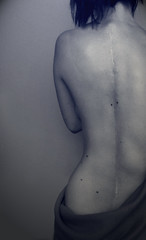
black and white photo of a woman facing away from the camera, wearing only a towel or blanket.  Her spine is curved, and her scars are visible.

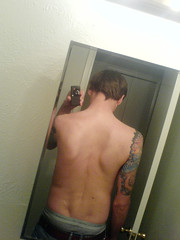
man facing away from camera.  The photo is in a mirror.  One can see both his scoliosis scars from surgery and his elaborate arm tattoo.

woman facing away from the camera.  She is caught in the middle of dropping an apple behind her back, both arms curved behind her.

woman facing away from the camera.  The image is otherwise in black and white, except for her vivid red hair and lips.  She is wearing a black dress with part of the back cut out.  It clearly shows the curve of her spine.

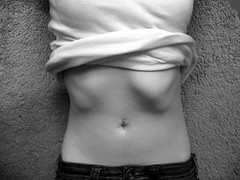
photo is in black and white of a woman's lower torso, with a pronounced rib-cage and a pierced belly button

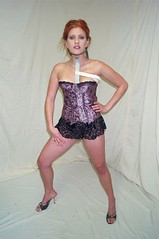
woman facing straight on the camera.  She is wearing both a brace, as described above, and a purple corset.

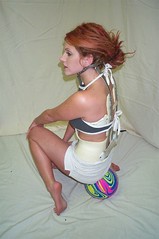
woman facing left from camera, with back facing camera.  She's wearing an back brace, and balancing on a small ball.

It’s heartening to see a bunch of pictures like that. There are more photos at this link.

When I walk, my right hip swivels a bit higher and wider than my left hip. I’ve had people tell me it looks sexy. I’ve had people ask if I’ve hurt my foot. Neither reaction bothers me anymore. The way I walk is just the way I walk. It gets me where I need to go.

Acknowledgements for this post: thanks to Thorn for commenting about this issue, and mentioning how it negatively affected your adoption homestudy due to ignorance on the part of the social worker. Also thanks to Deesha Philyaw on Twitter for mentioning the Judy Blume book about a girl who goes through bracing: Deenie. I wish I’d gotten a chance to read that book when I was a girl, and it sounds really interesting.

Chatterday! Open Thread.

pygmyrabbit
This is our weekly Chatterday! open thread. Use this open thread to talk amongst yourselves: feel free to share a link, have a vent, or spread some joy.

What have you been reading or watching lately (remembering spoiler warnings)? What are you proud of this week? What’s made your teeth itch? What’s going on in your part of the world?

Today’s chatterday backcloth comes via Zooborns, and it’s the world’s smallest rabbit. This rare Columbia Basin Pygmy Rabbits lives at the Oregon Zoo, where they’re breeding them like… well, yes.

Feel free to add your own images. (Anna insists that these should only be of ponies, but I insist that very small primates, camelids, critters from the weasel family, and smooching giraffes are also acceptable.) Just whack in a bare link to a webpage, please – admin needs to deal with the HTML code side of things.

Recommended Reading for November 13

Mental Health and Promiscuity

However, even in this environment there is one area that has always troubled me and that revolves around the concept of promiscuity as diagnositic criteria.

My first and biggest problem with this is that I have NEVER heard this brought up as a symptom of mental illness when discussing a male. It is always something that is brought up about a female. I can’t help but assume that this is linked to the belief that “excessive” sexual activity is normal for a man and not a symptom of mental illness while no “healthy” woman would engage in or enjoy casual or alternative styles of sex. I also think it is linked to the belief that women are the only ones that have sex with other people due to low self esteem or possibly in a reckless manner because they have some self-destruct tendencies. See, sex is damaging to women, they can’t just enjoy casual encounters or engage in sex purely for self-satisfaction: they must be wounded in some way or they must be wrongly searching for the intimacy they so desire.

Reasonable Accommodation

I find myself caught between disabilities.

One of my most promising paths forward health-wise right now is finding a low-impact, non-repetitive form of exercise. Since I have done yoga in the past, I have been searching for a yoga studio. But since I’m in the western suburbs of St. Louis… there just isn’t much here. The most promising place, that offers classes that fit into my schedule, that is likely to be understanding and accomodating of my back issues, is Bikram.

Now I did Bikram a few years ago and loved it – unfortunately, over the course of a couple of months the humidity in the room (Bikram is “hot” yoga, done in a room that’s about 90 degrees) started making my hearing aids go wonky, so I stopped.

You Can Make Fun Of Us But You Can’t Give Us A Chance

The character was dressed in a blue latex suit that covered his head, and he was constantly babbling like an idiot and drooling on himself. I admit that I found the Handiman skits to be hilarious when when they first premiered. The disabled community had been non-existent in Hollywood up until then, and it continues to be non-existent today, so it was good to see some representation, and me not knowing how much of a negative image it was at the time, appreciated the recognition.

I was in my junior year in high school when Handiman made his debut. Ever since I was mainstreamed back in the fifth grade, I have always caught hell because of my disability. I remember being teased many a-day throughout grade school, high school and even college. Handiman perpetuated the stereotypes that people had about people with disabilities. Even to this day, the techniques have changed, but I pretty much know when people are trying to belittle me. Children aren’t as cunning or crafty to hide their emotions, so they would usually laugh or make “retarded-stupid” comments about me.

The Usefulness Factor

Sometimes you can maintain a career from your own home, such as on the computer or as a consultant on the phone. Sometimes you just need to stop and re-think the whole idea of being useful. The question of “why am I here?” seems to become magnified when you become confined to a small physical space with others doing all the things you used to do for yourself.

But that does not mean you have become useless. It is very easy to fall into the trap of believing that, especially when people say things like, “it must be so nice to be home all the time and do nothing!” It is not particularly nice to have no impressive answer when people ask what you do all day, but if you are able to ignore that and realize that everyone is on this earth for a reason, you are on your way to finding a new sense of purpose. Maybe not a financial one, but perhaps a spiritual one, which is even more important.

In the news:
Francesca Martinez: A Wobbly Girl Battles Against The Last Taboo [Although I disagree with the idea that disability is the “last taboo”]

Francesca Martinez’s victim is squirming. Trapped under the scrutiny of the comedian and fellow members of the audience at her show in Edinburgh, he is clearly wishing for the proverbial hole to open up. “What are you bad at?” asks Martinez. “Football,” comes the sheepish reply. “Were you born like that?” she enquires, head tilted in sympathy, “Couldn’t your mum have had a test when she was pregnant?” Turning to the man’s girlfriend, she simpers: “You are so brave. Well done… Does it mean he can’t have sex?”

Martinez’s humour bears a political sting. As one of a tiny number of disabled performers who have made it into the mainstream, she is not about to waste opportunities to ram home a message. Born with cerebral palsy, the 31-year-old refuses to accept the label of her condition, preferring to describe herself as “wobbly”.

Power and Responsibility

An earlier version of this post was published in July, 2009.

When I mention that Don has a homecare worker, and explain what that job is, I often get this question:

“Why don’t you do all that stuff for him?”

This touches on something that I’ve referred to a few times, and that’s the idea that it’s totally okay (admirable, even!) that services for people with disabilities be offered by volunteers. It gets into a lot of complicated stuff.

For example, Don’s homecare worker does things like makes sure he is clean-shaven once a week, washes his hair carefully, and does some of the stuff he needs done for his back, which suffers from a lot of sitting/lying related issues, like heat rashes and sores. She’s there for about an hour or so.

What she does for Don is a huge deal in terms of his personal hygiene. All those little things that allow him to be “acceptable” to our neighbours take energy, such as having clean hair and a neatly trimmed beard. Before homecare, Don would often go weeks, if not months, without a proper shave, and look very scruffy and unkempt. But it would be a decision for him – does he shave today, or does he make a meal? There wasn’t enough energy or concentration to do both.

The question of why I don’t do these things has a few assumptions under it. First, it implies that, because I’m his spouse, I should be in the caretaker role. I should be making sure all his personal hygiene needs are taken care of. There’s a power imbalance there that makes me uncomfortable. It puts me in role as adult, and Don in role of child, and this is just not acceptable.

The other thing is part of why this volunteer thing bothers me. Don’s personal level of comfort should not depend on my energy levels. It shouldn’t depend on my mood. It shouldn’t depend on whether or not I’m angry at him today, or I’m too busy, or if I’m home.

Right now, it depends on whether the woman who is paid to come to our home and do these things shows up. If she calls in sick, there is someone else who will come in. I know she has a degree in nursing, focusing on homecare for people with disabilities. I know she’s a professional, who has been taught the issues around disability and privacy, around personal autonomy, and around sexuality and disability. I know the process we will go through if either she or Don does something sexually inappropriate. I know the appeals process if she threatens him or he threatens her. I know what will happen to Don’s care in those situations. More importantly, Don knows what will happen in those situations. He has personal autonomy.

Don’s health needs shouldn’t be dependent on me in any way, because that’s not safe for Don.

In my experience, Feminism tends to have discussions about caregiving focusing around the fact that caregiving roles fall predominately on women, and lead to things like “the second shift”, or caregiver fatigue, or even directly impact women’s abilities in the workplace. (“I can’t work late because I need to get home now.”) I think this is an important thing to discuss, but I don’t think it’s the only part of the caregiving equation. I think we, as feminists, need to also talk about the power inbalance that comes in when one is a caregiver for a spouse or parent that has a disability.

As well, we rarely talk about what happens when the role of caregiver falls on women with disabilities? What happens to that allotment of spoons then? What view do we have of women with disabilities if their children aren’t “properly” cared for? If some other loved one isn’t getting everything they need? What happens to the caregiver/second shift issues then?

I think feminist discussions about caregiving and responsibility need to broaden out to include these complicated issues.

Getting Through College with a Mental Disability

We’ve been talking a lot about how university faculty and staff individually respond to students with disabilities, as well as attitudes from universities as a whole towards identifying students with potential mental health problems. I’ve noticed a lot of stories in the comments on those posts about the struggles individual readers had when navigating the university system, so wanted to share my own story and my perspectives about what made it possible for me to get through and graduate from university despite the onset of my bipolar during my freshman year. I can tell you in two words what made the difference for me: class privilege. I believe that without the money and other associated trappings of upper-middle class status I got from my parents, I would not have finished school and likely would have become homeless and unable to access meaningful mental health care. Which in turn would have certainly resulted in my death by suicide. I think it’s important to look at how and why class made such a significant difference in my experience those years, to identify policies and mechanisms that need to be adapted so that all students, regardless of class status, have the opportunity to finish their educations.

Although I had experienced some relatively mild depression during my senior year of high school, it wasn’t until my freshman year of college that I started to experience significant symptoms. I had moved thousands of miles from home to go to school in a city where I had no friends or family. The only person I knew on campus was my high school boyfriend, who I was still dating at the time. Things started going downhill for me:  I started staying in bed more often, sometimes for entire days, I stopped going to class,  but most often, I thought of death. I had an almost endless range of plans and procedures that I didn’t carry out because all of them seemed to require too much effort. I discovered self-harm, which I thought I’d invented. And I was terrified at how easy it seemed to be to get potential weapons, to cause myself harm.

At that point, I went to the student counseling center. When the day of my appointment finally came, the woman, a master’s student, took out a set of Native American tarot cards. I still remember how shocked I was.  I got up and left, demanded a new counselor, and came back a few weeks later for my return appointment – again with a master’s student, who wanted only to talk about my parents. I have some pretty obvious sources of psychological trauma – past sexual assault, then-current psychological abuse from my boyfriend – and my parents are not one of them. At least that student could hear how seriously dangerous my current depression was and gave me some samples of anti-depressants to take. Those pills triggered my undiagnosed mania and sent me into a two-day spin of increasing self-harm and lying to people in the dorm to get ahold of knives or razors or anything with a blade, culminating in a psychotic break when I tried to jump out the 3rd story window of my friend’s dorm room because I knew I could fly and wanted to test it out.

That landed me in the psych unit of the nearby community hospital. The hospitalization g0t my meds straight and got me on a mood stabilizer and got me set up with some tranquilizers for breakthrough hypomania or anxiety, so I was much more stable than I had been on the meds prescribed to me by the university health center. But a week after I was released, my roommate and best friend was hospitalized after a suicide attempt and sitting in the waiting room with her to be admitted triggered me badly enough that a few days later I self-admitted because I was scared of doing myself serious self-harm. And that’s when things went seriously sour with the university.

The university did not want me to return to the dorms after leaving the hospital, ostensibly because my behavior might frighten, upset, or otherwise disturb other dorm residents. The RA had also reported scabs on my arms (from self-harm) as suspected heroin use, so I had to disclose my self-harm to dispell that. (Although I’m not sure which would have been preferable from the university’s standpoint). If I’d been expelled from the dorm system at that point, I would have had to drop out of school as there was absolutely no way I was able to maintain an independent residence. Alternately, I could have couch-surfed.

So my parents threatened to sue the university for discrimination on the basis of mental disability. This required a whole lot of privilege – comfort with the judicial system, awareness of civil rights protections, financial ability to hire an attorney, willingness to disagree with the authority of the university. And although they hired an attorney and paid a fat retainer, the university caved before they actually had to file a suit. They agreed that I could return to the dorm system, but moved me to a new dorm across campus where I knew nobody and my roommate had had a double room to herself and greatly resented my arrival.

After I returned to school, my parents chose to pay for my ongoing mental health care out of pocket so I didn’t have to rely on the student counseling service for treatment. They paid for a private psychiatrist and a therapist who I saw twice a week – at what must have been astronomical cost to them. I know they are still involved in some collections disputes with the hospital, some 15 years after my hospitalization.

That’s a lot of personal story, but I think there are some really important points to examine. First, at no time during any of this was I ever in academic trouble nor did I need or request any academic accommodations (part of my problem was defining myself as someone who did well in school so I didn’t allow myself to waver academically, including being released from the hospital in the morning and taking a final that afternoon). Discussions about accommodating students often (reasonably) focus on academic accommodations, and I think there’s an assumption that any student having significant problems would be identified through the academic context before they needed housing or other accommodations. I am still not aware of how or if the office of students with disabilities would handle this kind of issue or whether they advocate on the student’s behalf. But accommodations in dorm life are just as crucial for students with disabilities as academic accommodations, especially when they live on campus and have no other real alternatives.

I often the housing concerns framed as a concern for other students – being around someone with a significant mental illness might traumatize them. And I agree that finding me dead in a bathroom would have traumatized someone. But my self-harm and my mania did not seem to me to be any more potentially traumatizing for other students than my dormmates who would go to the communal bathroom to throw up after every meal, those who were using hard drugs like cocaine, or even those who would binge drink until passing out naked on the stairway, none of whom ever suffered any potential housing consequences. To say nothing of my then-boyfriend, who was then causing me active and ongoing psychological trauma through his emotional abuse and who got to stay in the dorm with all our mutual friends after I was shipped across campus. That I was the only student looked at by the university and potentially subject to penalties – and identified as potentially problematic because I sought lifesaving and appropriate care – speaks volumes about how students with mental disabilities are seen by administrators.

My second point of contention is the degree to which the university actively contributed to my mental health problems before penalizing me for them. The manic episode which triggered my initial hospitalization was a direct result of the anti-depressants they prescribed for me. And I wouldn’t have been such a disaster and in need of immediate and emergency medication if my treatment hadn’t been delayed by over a month because of the first unhelpful counselor. Despite this, their only proposed solution was to get rid of me entirely – which seems to provide a disincentive for the school to provide effective counseling services. If the school pushes students into crisis, it can then remove them from school and campus. So why try to effectively treat someone?

The final point is the one I started with – it was solely due to my class privilege and the unwavering support of my privileged parents that I was able to fight the university to remain in the dorms and finish school. It was also due to them that I could access meaningful mental health care and treatment that allowed me to keep going in school. And it is stupid as hell that my luck in being born into such privilege was the determining factor in whether I moved forward or dropped out. Unfortunately, until the overall approach of universities towards dealing with students like me is drastically overhauled – to see us not as a threat to other students but a valuable part of the student community, to support us rather than trying to eliminate us out of fear – privilege is going to continue to be one of the most relevant factors.

I’m still thinking about how to best move forward on these issues. I have not done a great job of following up with my own university, primarily because I never want to speak to or be involved with them in any way ever again. But it seems like these issues must affect a sizable number of college students and contribute to the systemic problems that make it more difficult for people with mental disabilities to obtain higher education. I remember my time in college as a terrifying and desperate effort not to get kicked out – surely we can do better for the next generation of students.

Recommended Reading for November 12

Private Practice Takes a Bold Stance against Decent Behaviour

There’s a new doctor at Naomi’s practice, Dr. Fife, a genetic engineer who uses a wheelchair who pressures Naomi into agreeing to select for an embryo for two patients with dwarfism to allow them to created a baby who also has dwarfism. Naomi is reluctant but agrees until she learns that these embryos will also give the future baby a 40% chance of developing some kind of cancer (which Lauredhel over on FWD points out, is the baseline cancer risk for the US population).

18th Down Under Feminist Carnival

This Carnival has an optional caring theme, thanks to Australian Carers’ Week (which was October 18 to October 24). The theme for this year was “Anyone, Anytime, Across Australia”, which I modified to “Anyone, Anytime” for the purposes of the DUFC.

Denmark Strips Away Right To Privacy from Blind Voters

On Wednesday I read that one of my blind friend’s in Utah just experience voting by himself for the first time thanks to his voting machine having built in text to speech. On that same day, I also read that the blind in Denmark not only don’t get to vote by themselves, they have to have a council member present when they’re voting. This rule was supposedly implemented to make sure that the sighted helper wasn’t pressuring the blind voter to vote in a particular way, but what it really does is just strip that voter of their right to privacy.

On being “Crazy”

Crazy is something altogether different. Crazy is delusion, psychosis, mania, schizophrenia. Insanity, in the depths of society’s psyche, is jabbering in tongues rocking back and forth in a padded room. It can’t be trusted. It is the serial killer, the mother who kills her children, the man who laughs while committing the most vile crimes – this is what “crazy” conjures up in the minds of the general public.

This terror, this nightmare looming in the dark places of our collective consciousness is harmful. Incredibly so. It means that people who are not neurotypical are stuck with the paradoxical choice of lying or being mistrusted. Perhaps more importantly, it makes us less likely to seek help when it is needed. It took me years to admit, even to myself, that my brain was fundamentally different than most. Because I didn’t want to be crazy.

In the news:
Vatican post office issues stamps with raised dots to honour inventor of Braille system

The Vatican post office says it has issued its first Braille stamps to commemorate the 200th anniversary of the birth of Louis Braille, the French creator of the writing and reading system for the blind.

The stamps feature a portrait of Braille and his system’s raised dots that spell out Braille, Vatican City State and the price.

Don’t forget, we’re also doing some guest blogging at Bitch Magazine! Check out meloukhia’s introductory post about disability! (Yes, I do write up recommended reading in advance.)

Keiko Fukuda: Be Strong, Be Gentle, Be Beautiful

Olde-tyme Hoydenizens may remember that I wrote about Keiko Fukuda back in 2007, in the Friday Hoyden feature. Fukuda is probably the most knowledgeable and accomplished judoka alive, the last living student of Jigoro Kano, the founder of judo.

Geekfeminism has an update on Fukuda Sensei, with a snippet of film from documentary “Be Strong, Be Gentle, Be Beautiful“. Ju-do means, very roughly translated, “gentle way”; judo’s key principle is to use minimal movements to turn the attacker’s strength back against her. The film’s name derives from an attempt to explain the essence of “ju” – “soft, gentle, flexible, adaptable”. Filmmakers Flying Carp are currently fundraising to complete the film.

In this excerpt, Fukuda talks about how she was ‘frozen’ at fifth dan (fifth degree black belt), for no other reason than that she was a woman. She was finally promoted to ninth dan at the age of 8893. She talks, emotionally, about having had to choose between marriage and judo. Fukuda still teaches judo in San Francisco at the age of 96, clearly much loved and much respected, and there is rather delightful film of her dispensing wisdom and rising from her wheelchair to demonstrate an armlock on a much larger student.

Transcript/description to follow now available, courtesy of Quixotess!

Continue reading Keiko Fukuda: Be Strong, Be Gentle, Be Beautiful

Campaigning: A (brief) Guide for Inclusion

Before Don told our political party of choice to go take a long walk off a short pier*, I used to be That Girl at Riding Association meetings, at committee meetings, and at rallies.

[You might be thinking “Why would your husband telling a political party to get lost mean you wouldn’t be part of them anymore?” Don told them to go away and they stopped calling and emailing me too. Which is why I don’t deal with them anymore. If you’re going to claim to be representative of women in Canada and then stop interacting with me because my husband told you off, then I guess my money and my time can go elsewhere.]

Anyway, That Girl. That Girl, who would say things like “When you mumble and look down when talking, it’s very hard for people who have hearing loss to understand what you’re saying.” That Girl, who would say “This website is horrible on accessibility issues. Can you suggest your webmaster develop a text-only version? And stop using PDFs instead of web pages!” That Girl, who still emails every political party in Canada once a month to ask for transcripts of their YouTube Videos. That Girl, who has only once seen a transcript, and has never received a response.

One of the problems with being That Girl, who points out problems with accessibility a lot, is people start assuming I’ll become their expert on All Issues About This, and, instead of paying someone to deal with such issues, will just demand a lot of my free time and efforts into making them look better. (They also figure it will shut me up. I’m not good at that.)

I don’t mind too much with groups I’m a part of that don’t really have much money and are run entirely by volunteers or overworked staffers. I find these groups are both interested in what I have to say, and grateful for what (limited) aid I can give them. However, political parties have money. They also have power and prestige, even if they’re not currently running the country or the province. In Nova Scotia, they can work with the Nova Scotia League for Equal Opportunity and get actual experts to discuss with them actual ways of making their campaigns, their offices, their rallies, and their literature as accessible as possible.

But, since that’s not possible for everyone, let me give you some free (and lengthy) advice on how to make your campaign (however you define campaign) more accessible for people with disabilities. This advice has been influenced and improved by talking to the folks who run the Nova Scotia League for Equal Opportunity, and I can’t thank them enough for sending a representative to the Campaign School I recently attended.

Clearly, not every person with a disability is going to have difficulties accessing your campaign information. As well, this advice will not magically ensure that your work is available for everyone. We’re talking broad generalities here, but at least we’re talking something. And even though I am That Girl who will snap at you that your rally isn’t accessible if you don’t have an interpreter for the Deaf, I’m also That Girl who will notice that you’ve done something, and tell other people about it.

But, the biggest thing you can do, if you’re really trying to reach and include people with disabilities, is broaden your understanding of what disability means. We are not all men in wheelchairs and women who are blind.

Continue reading Campaigning: A (brief) Guide for Inclusion

Cast in Bronze

Yeah, I know that this guy’s uniform is jacked up. I know you can’t wear your collar standing up like that no matter how cold it is, and that your pockets are decorative only. Were I doing an inspection, The Lone Sailor here would probably not pass. He would be called to re-inspect later.

But I marched past a replica of this statue every day for some of the longest weeks of my life. He was a proud symbol of everything we hoped to achieve, and everything that everyone before us had achieved. It was an image we had hoped to live up to. A symbol of what it meant to be a Sailor. To wear even the lowest uniform and to even be graced the swab the decks was to be a proud member of the United States Navy, and that alone was worth singing “Anchors Aweigh” with a hoarse throat.

The Lone Sailor statue is cast from the hulls of ships long past, giving it the truth behind that sentiment. Lives lost and watery graves. Also, strength of the future. A symbol of strength that will endure the weather, a hint that from here on we would be perpetual, like the water that carries our ships.

Being a Sailor meant more to me than I ever expected, and no matter what happened since, it is something I will always carry with me. It was a part of me, and it continues to be, like that damned statue w/ his jacked up collar and his damned hands in his damned pockets. I have pride in that part of my life, no matter how it ended, no matter how it was cut short. No matter how the career I wanted was yanked out from under me and no matter how I feel betrayed by the very body that carried me through those days of training and “snow watch” at Great Lakes, I was a Sailor, it is a part of me that I treasure. It is a strength that can not be taken from me.

I hope that you get a chance to pay a thankful word to a Veteran today (or tomorrow depending on where you are). Whether a thank-you for what they have done, are doing, or will do (because, Active Duty are Veterans too), remember that their service meant something to them in some manner also. It wasn’t just a pay check or a call to duty. In some way it became a part of that person. It wasn’t just a uniform we put on or stamped dog tags. It was a part of our person. Something we will always carry, but not like a weapon or a line. It changed us. In our very inner most being, it changed us, hardened us and gave us the strength of dozens of ships to endure, even if it isn’t obvious to one who hasn’t served.

You don’t take that off.

It is cast on us, like bronze.

Cross posted at random babble…