Category Archives: representations

Where About Us But Without Us Leads

On 1 June 2010, E. Fuller Torrey MD wrote an op-ed column for the New York Times, “Make Kendra’s Law Permanent.” Dr Torrey is the founder of the Treatment Advocacy Center (TAC), a nonprofit group whose sole purpose is to lobby states for the passage of so-called assisted outpatient treatment (AOT) laws like Kendra’s Law in New York and Laura’s Law in California. The New York law is named after Kendra Webdale, who was killed by Andrew Goldstein in 1999.

Dr Torrey and TAC will tell you Mr Goldstein had untreated schizophrenia. They’ll tell you people like him are dangerous, they’ll tell you people like Mr Goldstein are often so sick they don’t understand they’re ill and need treatment, and they’ll tell you they know best. They won’t tell you that Mr Goldstein had been seeking treatment desperately and been turned away repeatedly.[1. Source: Time Magazine, “Will the Real Andrew Goldstein Take the Stand?”] Continue reading Where About Us But Without Us Leads

Ableist Word Profile: Crazy (to describe political viewpoints or positions)

  • Ableist Word Profile is an ongoing FWD/Forward series in which we explore ableism and the way it manifests in language usage.
  • Here’s what this series is about: Examining word origins, the way in which ableism is unconsciously reinforced, the power that language has.
  • Here’s what this series is not about: Telling people which words they can use to define their own experiences, rejecting reclamatory word usage, telling people which words they can and cannot use.
  • You don’t necessarily have to agree that a particular profiled word or phrase is ableist; we ask you to think about the way in which the language that we use is influenced, both historically and currently, by ableist thought.
  • Please note that this post contains ableist language used for the purpose of discussion and criticism; you can get an idea from the title of the kind of ableist language which is going to be included in the discussion, and if that type of language is upsetting or triggering for you, you may want to skip this post.

We just ran an ableist word profile on the word “crazy,” written by the lovely guest poster RMJ, who discussed how the term is used in a variety of contexts and situations. This follow up is sparked by what I’ve seen as a recent resurgence here in the United States in use of the term in a political context, to describe or characterize an individual with a particular set of political views. Every time I see it, it grates on me, and I thought it was worth a focused discussion here at FWD.

Before I begin, I should make clear that I personally identify as “crazy” sometimes. Not always, but when the depression gets overwhelming and I can tell my thoughts are getting tangled, or especially when I’m in the grips of a manic episode. (More accurately, I identify as a “crazy bitch,” but that’s neither here nor there.) I’ve also been consistently described by others as “crazy,” in contexts ranging from affectionate to outright hostile and dismissive. So when I see this term tossed around in the media, it feels personal to me.

And it’s been tossed around a whole lot lately, largely by traditionally liberal or progressive media outlets. I first started seeing it show up at Talking Points Memo, Josh Marshall’s blog that combines “breaking news, investigative reporting and smart analysis.” Marshall doesn’t mention it on the site, but it also contains a big heaping spoonful of ableism with that political analysis. Here are some recent examples:

This is just a sampling of the posts with headlines including the term “crazy” and is not at all comprehensive. Even within this sample, we can see that the term is used to describe viewpoints with which TPM does not agree (like revising history textbooks or arguing, like Gaffney, that the Pentagon logo indicates a secret plan to subject the United States to Shariah law) and thinks are biased, bigoted, racist, or otherwise offensive (such as the protests about Obama speaking to schoolchildren or the racial laws in Arizona).  None of the posts, though, engage or critique those viewpoints or speakers in a substantive way – simply describing them as “crazy” is seen as self-evident and no further discussion is needed to demonstrate these views or people should be excluded from reasonable political discussion.

There’s been an even more recent explosion of use of the term to describe Rand Paul and Paul’s views, after he won a Republican congressional primary in Kentucky.[1. An earlier version of this post had stated, in error, that Dr Paul won the Republican congressional primary in Virginia. Thanks, Katie, for the catch.] Paul favors the free market and freedom of private business, to the extent that he seems to believe that anti-discrimination laws are an unreasonable restriction on businesses. Now I am no fan of Mr. Paul – and wrote about my problems with him previously on FWD – but that doesn’t mean I approve of political cartoons like this:

A political cartoon portrays Rand Paul as the Mad Hatter from Alice in Wonderland. Added to the original Tenniel illustration are a 'Don't Tread on Me' flag, a Rand Paul button, and an I Heart BP button.

To my mind, characterizing Rand as “mad” or “crazy” and not saying anything further is a lazy way to dismiss him and his ideology without actually having to engage with it. There is a lot to say about Rand’s ideas: how prioritizing private business over human rights preserves existing institutional structures that will continue to perpetuate racism, sexism, ableism, and other oppression if not checked by a larger force like the government; how the line between private and public realms is a lot fuzzier and less distinct than Paul implies it to be; that the Gulf of Mexico oil spill and BP’s seemingly inadequate safety protections and near complete inability to effectively respond are strong indications that business will prioritize profits over public goods like environmental safety; how an attitude of business before anything else will influence Rand’s views on everything from the minimum wage to immigration policy to climate control to internet neutrality. Those are all important discussions to have, discussions where we can’t assume that everyone in the audience will come down on the same side, but calling him “crazy” or “mad” and leaving it at that elides all of those complicated issues. Even more strongly, it implies that those discussions are not even worth having because it is so evident that the views or person being dismissed are wrong and absurd and laughable.

In Newsweek, Conor Friesdorf made an interesting observation about the policies and people who are dismissed as “crazy”:

Forced to name the “craziest” policy favored by American politicians, I’d say the multibillion-dollar war on drugs, which no one thinks is winnable. Asked about the most “extreme,” I’d cite the invasion of Iraq, a war of choice that has cost many billions of dollars and countless innocent lives. The “kookiest” policy is arguably farm subsidies for corn, sugar, and tobacco—products that people ought to consume less, not more.

These are contentious judgments. I hardly expect the news media to denigrate the policies I’ve named, nor do I expect their Republican and Democratic supporters to be labeled crazy, kooky, or extreme. These disparaging descriptors are never applied to America’s policy establishment, even when it is proved ruinously wrong, whereas politicians who don’t fit the mainstream Democratic or Republican mode, such as libertarians, are mocked almost reflexively in these terms, if they are covered at all.

What I conclude from that is that the media doesn’t consistently use “crazy” and other ableist terms to refer to absurd policies or those that lack rational support, but instead reserves those terms for people outside of mainstream politics. Which in turn implies that the term is used primarily to further marginalize and dismiss people who don’t fit expectations of what a politician is or what are common or popular political arguments. To me, this is even more evidence that the implicit subtext of terming a person or policy “crazy” is “shut up and go away, or start blending in better.” Which, again, is exactly the message leveled at people with mental illness when they’re called “crazy” or “loony” or “unhinged” or any number of synonyms.

This selective usage is even more reason the term “crazy” shouldn’t be used in the political context – partly because it’s a lazy out for commentators who refuse to engage with the actual policy issues or political ideas being proposed on a substantive level, and partly because it fiercely underlines and reinforces marginalization and dismissal of people with mental illness. It reminds me that when people call me “crazy,” what they really mean is “stop existing in my consciousness – either disappear or become normal.” To see progressive writers and organizations rely on the marginalization of people with mental illness to score easy points against unpopular politicians is upsetting not only because of their perpetuation of ableism, but also because it puts me in the extremely uncomfortable position of defending people like Palin and Paul against this kind of criticism.

For Cereal, Internet?: I Has A Hotdog edition

I love looking at pictures of cute animals on the internet. Cats, dogs, monkeys, dolphins, turtles, otters – whatever. And I find that skimming through a few LOLcat macros during the workday can do wonders to perk up my mood or give me a smile before diving back into work. Which is part of why I get so annoyed when the LOLcat sites do something offensive or wrong – this is supposed to be my fun time, not my get-my-rage-on time! I have a whole other folder of RSS feeds for rage time!

So I got mighty cranky when I saw this at I Has a Hotdog, the spinoff site from I Can Haz Cheeseburger that has LOLdog macros:

A group of identical white pomeranians, with the caption "Multiple Personality Disorder: you're doin it right."

Ok, FOR CEREAL??? This is not only offensive, it doesn’t even make sense. A person with Multiple Personality Disorder (MPD), which is more commonly and more accurately termed Dissociative Identity Disorder (DID), does not manifest in multiple identical bodies. The whole point is that there is one body/mind that manifests multiple, distinct identities or personalities, called alter egos. A person who could split themselves into multiple identical bodies, all with distinct identities, is not a person with MPD or DID, but instead is some kind of magical self-cloning person who should probably be off fighting crime in Gotham City.

This underlined for me how DID is a go-to joke, a punchline often used in contexts or situations that make absolutely no sense to anyone who actually understands what DID is. It’s a lazy way to make a joke about a “bizarre” or “outlandish” mental illness without even taking time to understand the diagnosis being thrown around so cavalierly. For me, it reads as a shorthand “hahaha saying the name of a mental illness is funny isn’t that funny??”

I can’t imagine how this use of DID as shorthand for “exotic and hilarious mental illness” must affect people who actually experience DID. Given that the second google link when I searched for “multiple personality disorder” is to a site discussing whether MPD or DID actually exist or whether they are made-up movie illnesses, I imagine there’s an extraordinary stigma experienced by people with DID and an overwhelming tendency to doubt and discount their experiences at best, and to mock and ridicule them at worst. These kind of “jokes” only add to those issues. And they should not be tolerated.

Jenny McCarthy & Autism Part III: Spokesperson

This is the third and final part of my discussion about Jenny McCarthy. Part I was If We Shame Parents Enough Maybe Autism Can Be Cured, and Part II was Let’s All Be Normal (Acting).

Writing this last post has taken me a very long time, both because of my anger at the way autistics are talked about rather than talked to, or with, or given the opportunity to talk for themselves; and because I keep going over what I have to say here and wondering what makes me think I’m qualified to say it.

I’d like to go back for a moment to the article that started me on this: Jenny McCarthy says her son Evan never had autism.

Actually, let’s just go back to the final sentence: “And though her son may never have had autism, Jenny insists, “I’ll continue to be the voice” of the disorder.”

The way I see it, one of two things is true:

1. Jenny McCarthy cured her son of Autism.
2. Evan never had autism in the first place, but may have had another syndrome, or have been developmentally delayed and “caught up”.

In either case, Jenny McCarthy is not currently the mother of an autistic child.

Tell me – why is Jenny McCarthy the “spokesperson” for “the disorder”? According to her no one in her personal life has it.

Not even delving into the bit where it’s incredibly different to be speaking for and about those who live with autistics and those who actually are autistic, I’m not entire certain what insight McCarthy is offering anyone. The idea that autism is like your child’s soul going away? That the best metaphor for autism is a bus accident? She describes a diagnosis of autism as the worst thing that could happen, and she’s going around and doing the talk shows and is the “spokesperson for the disorder?” How does that even make any sense?

That’s why this post has taken me so long to finish. Every time I start it, I wonder why the hell I’m writing it, instead of pointing people towards the writing of actual autistics.

[Here is a tiny sample:

Just a tiny tiny sample. Each one has a blogroll. There are lots of autistic bloggers, including kaninchenzero and s.e. smith here at FWD. This tiny sample is just meant to be that. I encourage people to leave more links, including to their own blog, in the comments.]

The Times article argues that Jenny McCarthy peddles hope.

Well, here’s my hope: That in the future, autistics will be invited to speak for themselves.

Psychiatric Hospitals and Music Videos: Part 2

People seemed to like the first edition of this series! So here are some more music videos set in psychiatric hospitals! In the last post, all of the videos used the mental hospital setting as a visual demonstration of the depth and intensity of love, depicting institutionalization as a result of loving someone a whole lot. These videos do not do that.

One video that especially doesn’t do that is Green Day’s ‘Basket Case’

Visually, the video seems similar to the previous ones. The band plays in the common room of a mental hospital in which they are patients. There is no padded room, but several people are being wheeled around passively as if they are catatonic or sedated. Later in the video, both staff and patients appear wearing masks from Terry Gilliam’s Brazil. So what is different? The song itself (lyrics here), which is about lead singer Billie Joe Armstrong’s struggles with anxiety and panic attacks. So while in the same setting, instead of declaring his love for someone, he is saying:

Sometimes I give myself the creeps
Sometimes my mind plays tricks on me
It all keeps adding up
I think I’m cracking up
Am I just paranoid?
Am I just stoned?

On the opposite end of the spectrum, there’s Eminem with the video for “The Real Slim Shady.”

There’s a lot going on in this video and I really don’t want to describe or discuss very much of it at all, because it is offensive up and down and across and diagonally in 17 different ways. (Wikipedia has a very detailed description of the video and an explanation of all the references and insults in the lyrics and the video.) Let’s focus just on the portions set in the mental hospital, where Eminem and other patients, in scrubs or hospital gowns, fidget and wander in a waiting room while Kathy Griffin and another nurse try to control them and hand out their medications. It is just as cliched as the other videos’ portrayals of hospitals, but seems to be played for laughs. And the message of the song and the video are that Eminem is so much better than other celebrities and musicians, so much more clever and original and “real,” that he’s been institutionalized to control him for speaking truth to power. This message could be read as a good reminder of the use of institutions to control and punish people both with and without disabilities for being political and advocating for their rights! Like happened just recently! However, the whole rest of the song and the video is so puerile and hateful that the comparison itself is offensive.

Ugh. I dislike Eminem very much.

Let’s move on and look at a video that is utterly ridiculous and is a tie-in to a movie that is also utterly ridiculous – Limp Bizkit and ‘Behind Blue Eyes,’ from the Halle Berry movie Gothika:

I have a really hard time doing any kind of critical analysis of this video due to the aforementioned ridiculousness factor. The song (lyrics here), which was originally written and performed by The Who, can be read as expressing the lived experience of mental illness? Maybe? But the video – which starts with Limp Bizkit lead singer Fred Durst as a patient in a phsyciatric hospital and Halle Berry as a doctor, and then they kiss, and then they have magically switched bodies? souls? something? So now Berry is the patient and Durst is the doctor! Gothika the movie featured Berry as a doctor in a psychiatric institution who became possessed by a ghost and murdered her husband and then was a patient in the institution but only because of ghostly possession, not because she had a mental illness or anything. But even putting all of that ridiculousness aside – and that is a boatload of incomprehensible creative choices – Fred Durst’s efforts to engage in “acting” when he becomes the doctor and leaves Berry in her padded cell make me laugh so hard it’s impossible for me to focus on anything else in the video.

I have a few more videos for a part 3, but if you know of any I’ve missed, please let me know in comments!

An Open Letter to Ms Magazine Blog

Dear Ms Magazine Blog:

My name is Anna. I’m what some people in North America would call a person with a disability, and some people in the UK would call a disabled person. My husband, many of my friends, all of my co-bloggers, and a large number of our commenters are also people with disabilities/disabled people.

Your blogger, Carol King, would instead refer to us as “the disabled”, and as pawns of the religious right. In her blog post Kevorkian and the Right to Choose , she wrote:

The “right-to-lifers” enlisted the disabled in their cause when they cautioned that allowing people to choose to die would soon become their “duty to die.”

I’m pretty angry about that. Not offended, Ms Magazine, angry. You see, I’m really tired of “the disabled” being treated like we’re unthinking masses. I’m especially tired of the feminist movement – you know, one that allegedly wants equal rights for all people, including women with disabilities – doing this. It makes me angry because I’m a feminist as well as a woman as well as a person with a disability as well as someone who is not the pawn of anyone, thank you very much.

Some people with disabilities support the right to die. Others do not. Others do in some cases and not in others. Each of us has come to the conclusions we have because we are reasoning individuals. Gosh, some of us are even feminists who use a feminist lens to come to our decisions, regardless of which of the many places on that particular spectrum of opinion we find ourselves.

People with disabilities deserve better treatment than you have given them. We are not a throw-away line so you can score some sort of points. We are people, and I’m appalled that a feminist blog like Ms would publish something that would treat us as otherwise.

Frankly, I am so fucking tired of this shit. I’m tired of smiling while feminist organisations treat people with disabilities like they’re afterthoughts and problems to be solved. Like we’re just pawns in politics, like we need to be appeased but never spoken to or considered, like we’re too angry or not angry enough, like we have to push this fucking rock of dis/ableism uphill while you – our “sisters” – stand by and politely look away.

Do you remember Beijing, Ms Magazine? You’ve talked about it a lot lately. You know what I know about Beijing? I know the accessibility tent was inaccessible to people with disabilities. [transcript follows]

“We will achieve our rights and the respect we deserve as women with disabilities.” “Because the issues of women with disabilities have often been excluded, the goal this year was to make sure the concerns of disabled women were addressed.” Oh, hell, just watch the whole damned thing – it’s subtitled – and see the commitment feminists made to women with disabilities. Ask yourself, seriously, Ms Magazine, why your new blog has decided not to talk much about women with disabilities. “No woman who attends this conference should be able to leave Beijing without thinking about the rights of women with disabilities.” Do you?

You know what? If that’s something you can’t do, let me sum it up:

Nothing about us without us.

You wanna talk “about” “the disabled”? How about talking to us? How about letting us talk for ourselves?

How about treating us – people with disabilities – the way you would like women like yourselves to be treated? As though we have some understanding of our own experiences, our own opinions, our own thoughts. As though our thoughts do not belong to anyone but ourselves?

As though we are thinking beings?

Again, my name is Anna. I, like you, am a woman, and I am also a person with a disability. And we deserve better from you.

Sincerely,

Anna.

Please note: This thread is meant to be about the continued marginalization of people with disabilities in the Feminist Movement. I won’t be approving any comments about Kevorkian or related discussions.
Continue reading An Open Letter to Ms Magazine Blog

Psychiatric Hospitals and Music Videos: Part 1

After reading Anna’s recent post on Janelle Monae’s ‘Tightrope’ video and how it “is a great example of how not to completely screw up representation(s) of disability,” I started remembering other music videos set in psychiatric hospitals. And then I started watching all these music videos!

One of the earliest I remember is Melissa Etheridge’s ‘Come to My Window.’

In the video (lyrics here), Juliette Lewis is in a bare room with a cot-like bed and a barred window. She wears a white tank top and white srub pants and has a white bandage around her left wrist. She paces, climbs, cries, scrawls on the walls and the floor. Intercut are shots of Etheridge, singing with an acoustic guitar and an old fashioned microphone. At times, the song stops and Lewis speaks/screams the lyrics in the bare room. At the end of the video the bandage comes off Lewis’ wrist and there is no cut or scar.

I feel kind of neutral about that one – I think the ending can be read either as “she was never crazy the whole time!” or as “she’s healing and going to be ok!” and both are somewhat problematic. But neither is it overtly offensive. For that, you have to look for N’Sync’s video for “I Drive Myself Crazy” (I bet you can guess where they’re going with this…)

The video (lyrics here) has segments of each of the band members with their girlfriends and then breaking up with them – inter cut with scenes of them in a psychiatric hospital, acting as stereotypically “crazy” as is possible. (Although wearing satin pajamas, inexplicably.) Clearly meant by the band to be a lighthearted and humorous video, the “joke” is that losing the girlfriend has been so traumatic that the band members have been rendered “crazy.”

Another video featuring psychiatric commitment as a result of losing a romantic partner is Missy Elliot’s “Teary Eyed.”

In the video (lyrics here), Missy Elliot breaks up with a boyfriend, follows him to a building where he is with a new girlfriend, and slashes the tires on his car, causing a horrible accident that kills him. She is sentenced in a court and goes to jail and then presumably to an institution for the “criminally insane.” There are several scenes in a stereotypical padded room, where Missy and sometimes backup dancers wear and dance in straitjackets. While this video certainly brings more seriousness to the subject, it’s hard to argue that it’s portrayal of people with mental illness was any more positive or accurate.

A video I have much more mixed emotions about is Bjork’s video for Violently Happy:

The song (lyrics here) is about the wild and overwhelming emotional exuberance that can go along with love and has long been a favorite of mine. But the video – featuring Bjork and other dancers shown individually in a stark padded room – seems to depict that emotion through the imagery of a psych hospital. I’m not entirely sure how to read this video – is it mocking or endorsing equating of the flush of love with psychiatric disorder? Why is everyone cutting or shaving their hair? – but overall it leaves me with a vaguely icky feeling. (Precise language, I know.)

I had to take a little break after watching those four. All of which depicted almost cartoonishly stereotypical “mental institutions,” with bare cots, padded rooms, and straitjackets. All of them drew parallels between psychiatric hospitalization and jail – the room in Ethridge’s video was bare like a jail cell with bars on the wall, the N’Sync boys were kept in line by guards, and both Bjork and Missy Elliot were straitjacketed in padded cells, Elliot having been sentenced there for her crimes. But none of this directly relates to any actual mental illnesses or disabilities. Instead, the videos co-opt the symbols and accessories to illustrate the extremity and depth of the singer’s emotions. And in all the videos it’s the same emotion being felt so extremely and deeply – love.

Thus concludes Part 1 of Psychiatric Hospitals and Music Videos! Check out Part 2 to see if these patterns continue!

Recommended reading for May 4, 2010

RMJ: Disability and birth control, part 1

Widespread (rather than individual) centralization of birth control in feminism alienates and marginalizes their already problematized bodies: trans women, intersex women, older women, women with disabilities that affect their reproductive system, asexual women, women who want to get pregnant. Not to mention the loaded history of otherwise non-privileged bodies with birth control in light of the eugenics movement.

Eugenia: Siempre eqivocada

The fact is that, with regards to medical care, the old customer service adage is reversed: if the customer is always right, in Bolivia, the patient is always wrong. In Bolivia, where higher education is less of a universal right than a luxury for the few, poorer, uneducated Bolivians are taught to treat doctors and other professionals as their superiors.

meowser: BADD 2010: The Total Erasure of Partial Disability

In order to “make it” at anything I thought was worth doing, you had to be willing to do some serious OT, put in the extra time, go the extra mile, get that extra degree while still working full-time, put your nose to the grindstone. In other words, prove you weren’t just some lazy slacker who didn’t want to work. And I knew I…just couldn’t. And I felt terrible about that, especially when I got into my 30s and realized that all those overworked, underpaid copy editors (and other people who had done the nose-to-the-grindstone thing) now had real careers making real money, and I was still stuck at the McJob level.

Jha: My Invisible Disability

My depression is a setback. It means I cannot be continuously gung-ho about things like I would like to be. It means that sometimes I have to withdraw from the world or be overcome with exhaustion. I am easily fatigued. Some days, I want to sleep in the entire day and not have to face the world. Other times, I imagine being in a situation where I wouldn’t have a tomorrow to deal with. This doesn’t make me a failure, and it doesn’t make me, or anybody else like me, any less of a person deserving basic respect and consideration.

Latoya: Open Thread: Science, Conclusions, and Assumptions

[O]ne of the most common requests for content on Racialicious tends to come from people who work in public health. One issue in particular they have asked me to spotlight is the issue of clinical trials. For many years, the assumption was that the effects of medical conditions and medicine side effects would be similar on everyone, even though the only people involved in clinical trials were white males.

Valerie Ulene (Los Angeles Times): When prescribing a drug, doctors have many choices — too many, in some cases

Nobody wants to be told that he or she has a medical problem that can’t be treated, that there’s no medication that will help. For most common ailments, that’s rarely a problem; the trouble comes instead when it’s time to choose a drug. Sometimes there are just too many choices.

And, of course, there are numerous posts from BADD 2010, organized and collected by Goldfish at Diary of a Goldfish!

Guest Post by Sasha Feather: Book Review of The Rejected Body

Editor’s note: We are very pleased to host this post from sasha_feather, who has previously written for FWD: AWP: Crutch. FWD welcomes guest posts: please email guestposting [at] disabledfeminists.com for more information.

Sasha_feather is a science fiction/fantasy fan and anti-oppression activist. She is a contributor to Access Fandom

Book Review of The Rejected Body by Susan Wendell
by sasha_feather

The Rejected Body: Feminist Philosophical Reflections on Disability by Susan Wendell
1996
206 pages
Routledge Publishers

If you are at all interested in Disability Studies (DS), I strongly recommend this book. I felt like I had a kind, clear teacher and friend leading me by the hand through basic and advanced concepts in DS, especially relating to feminism and ethics. It is the most accessible and worthwhile academic text I’ve ever read– I don’t have a good track record for reading non-fiction books or textbooks, and I was riveted to this book. Partly this is because The Rejected Body speaks so directly to my own life experience as a person with a chronic illness. Susan Wendell also has a chronic illness, ME/CFS, which is what led her into DS from Women’s Studies.

In the introduction, the author tells you what she’s going to tell you, talks a bit about her own illness experience and finding disability identity, and–making me fall in love with this book–clarifies her language use by, in part, defining scare quotes and why/how she uses them:

“Throughout the text, I use single quotation marks as scare quotes, that is, to draw the readers attention to concepts I question or to uses about which I have reservations. For example, I use scare quote around ‘The Other’ (a concept discussed in Chapter 3) to indicate that, while the concept is a recognized way of thinking about people who are different from oneself, ‘the Other’ is not a way of referring to people which I accept or take for granted” (Wendell 7).

Like many of us I had often heard both the terms “scare quotes” and “the Other” and never really thought about what either of them meant. This book is full of little moments like that– things that I had taken for granted or that had niggled at my brain, and which the book shines a bright light upon.

In the introduction, Wendell also notes the limitations of the book, mainly that it focuses primarily on physical disabilities, that the author does not attempt to speak for all people, and that she struggles with generalizations and use of language. And that’s just the introduction!

A few of my favorite parts that I would like to highlight:

*The pace of life. As someone with fatigue and pain, Wendell is interested in the pace of life as part of the social construction of disability. Those of us who need to think or move more slowly than others are thus disabled by society. She discusses the social construction of disability in chapter 2.

*The mind, the body, and suffering. I have been thinking about embodiment lately, brain-body duality vs. integration, and chapter 7 (“Feminism, Disability, and Transcendence of the Body”) really gave me some grist for this mill. I am going to re-read this chapter shortly, especially the section on pain. Basically, feminists have argued against mind-body duality for very good reasons: because this concept has been used against women’s bodies. We’ve been invested in “Our Bodies, Ourselves”. But for bodies that are suffering and in pain, there are reasons to want to transcend the body, and there is room within feminist frameworks to develop such an understanding: of being embodied, of having bodily autonomy, and yet still wanting to transcend the body and be less tied to the body’s functions, desires, and pains.

*The illusion of control. For PWD, we know that we often do not have control of our bodies, or at best have limited control, and it is sheer luck that determines what happens, a lot of the time. Will I be in less or more pain today? Will I get some new illness? I have basically no control over these things, and I know it. And yet the society I live in is incredibly invested in the illusion of control to the point where it is part of the mythology of my country and my people. As Wendell points out, this puts me at odds with the people around me, even in casual social situations where people talk about small health problems or things to do with their bodies. It’s a disconnect.

*Having no diagnosis Wendell specifically addresses issues of disability for people with no diagnosis. There are a lot of people in this category, and it sometimes can feel like there is no place for us, no identity, especially within the medical model. The disability community, in my experience, creates a place and identity for those of us without a diagnosis.

There were so many other things that I am probably forgetting. I wanted to underline everything. I read it slowly to give myself time to process everything I was reading, but overall it’s a fairly short and accessible book, just densely packed with great information and ideas. Note that because it’s published by an academic press, it is relatively expensive; I recommend searching World Cat to find copies in libraries near you.

Moderator’s note: Moderation on guest posts is often much slower than “usual” moderation times.

Guest Post from RMJ: Athletes with Disabilities: Arm-Wrestlers as Exceptions and Inspirations

Editor’s note: We are very pleased to host this post from RMJ, and will be featuring some more writing from her, and several other awesome guest posters, soon. FWD welcomes guest posts: please email guestposting [at] disabledfeminists.com for more information.

RMJ is a twentysomething with OCD who grew up in Kansas and currently lives in Virginia. She works in education and loves cooking, cats, and television. She blogs about feminism and stuff at Deeply Problematic. This post also appears at Deeply Problematic

Athletes with physical disabilities (hereafter AWPD) are a problematized group. Their accomplishments are questioned and devalued as less valid or challenging than those of able-privileged athletes. They are not party to the often problematic veneration of athletes in today’s society, nor are they permitted to participate in generalized sporting events.

Arm-wrestling is a sport, though, that seems to both accommodate and welcomes athletes with disabilities into their ranks. There is a specific subset of arm wrestling for athletes with disabilities that seem to be a regular part of official arm-wrestling tournaments. I don’t know much about the sport and I’m not currently physically disabled, so my perspective on this is far from authoritative. But my tentative reaction to this is positive, particularly since athletes with disabilities can and do succeed in general competition.

Larry Feezor is an athlete with disabilities who competed recently in the 3rd Annual U.S. Open Armwrestling Championship. He has used a mobility aid since a motorcycle accident paralyzed him from the waist down. This story from an Oregon television station makes Feezor the focal point of the championship. The story is pretty short and context is important to my analysis, so I’m going to reproduce it here in full:

FLORENCE, Ore. – The Third Annual U.S. Open Arm Wrestling Championship wrapped up in Florence Sunday, as amateur wrestlers took to the ring to battle it out.

One competitor stood out for beating the odds: Larry Feezor.

He has been arm wrestling for 18 years, traveling from Weaverville, Calif., to Oregon to participate in the competition. This sport is his outlet since he became disabled.

“I was involved in a motorcycle accident and a drunk driver ran me off the road,” Feezor tells KVAL. “I hit a bank at about 70 miles per hour, [and] was paralyzed from the chest down.”

Feezor received roaring applause when he beat his first opponent.

On Sunday he arm wrestled some of the strongest competitors at The Three Rivers Casino. And he wasn’t going down without a fight.

“Right after my accident,” Feezor said, “I told my father that I would fight, as hard as I could, for as long as I could.”

Feezor isn’t letting his disability bring him down. As a former athlete, he said his body may not be like it used to be, but his mind is stronger than ever.

“I am out here just like these other guys,” Feezor said. “I just happen to be in a wheelchair.”

Before I break this article down, I should mention its good points. It is wonderful that athletes with disabilities recognized. It’s fantastic that Feezor’s achievements are reported on in a positive fashion. Feezor is ostensibly framed as normative. The newspaper is using Feezor’s words and Feezor’s voice, rather than, say, his father’s.

However. Feezor’s participation is the only aspect of the tournament that’s detailed, and his accomplishments are not well-articulated. The singling-out of Feezor and complete erasure of any other athletes in competition is problematic because it trivializes Feezor’s competition in a sport. It implies that the sport is only notable for the inclusion of a person with disabilities – Feezor is not in a competition, but instead someone to be cooed over and patted on the head simply for participating. He’s not being applauded for his accomplishments, he’s being singled out because he “beats the odds”, whatever that means. If this were an angle in a story that clearly reported on the events of the tournament, it would be significantly less problematic. Feezor would be presented in the context of other athletes, and not just othered because of his disability and his marginalized sport.

An example of this is Joby Matthew, an Indian arm-wrestler, who has underdeveloped legs due to Proximal Femoral Focal Deficiency. Matthew seems to be higher-profile than Feezor, but increased coverage also means increased problems, particularly since it’s from the Daily Mail:

Who needs legs? Meet Joby, the 3ft 5in world champion arm wrestler who can bring down opponents twice his size

Instead of bemoaning what he lacks, Joby Matthew is using what he’s got.

Matthew’s accomplishments are not notable in this article: only his disabilities. I’m not quoting or going through the whole article because the able privilege is so dense. The first line is indicative of the attitude taken in the article: Matthew doesn’t “bemoan”, unlike those other people with disabilities who would surely be champion athletes if they just tried. The construction is an ableist implication that other folks with disabilities are lazy whiners. Throughout the article, every reference to barriers Matthew faced is immediately matched by emphasis on how he overcame this disability. The focus is not on his exceptional effort and achievements, but on the “heartwarming” “good cripple”.

There are a few good aspects of the article. It’s composed largely of quotes from Matthew, and it does make note of his many medals and of his training regiment (though that, of course, is as much focused on what he can’t do as what he can’t.) Matthew’s childhood athleticism is made a major point of focus, particularly his struggles in playing with other children. While I appreciate that the authors focused on quotes from Matthew, the focus on competition with currently able-bodied athletes frames participation in sports against currently able-bodied (CAB) athletes as the standard for athletic accomplishment for AWPD.

While I do not love the article, I loved these pictures of Matthew and am quite impressed with his accomplishments and his goal of climbing Mount Everest. Though the exceptionalist attitude makes the context problematic, these pictures are awesome:
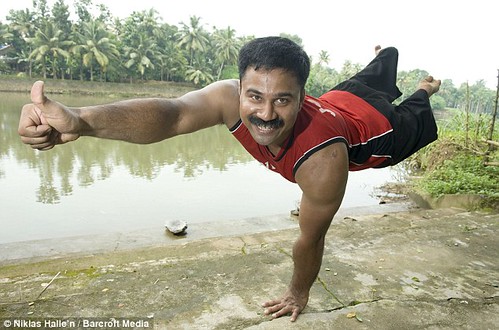
Joby Matthew holds himself up with one hand while giving the thumbs-up with another. He is on the bank of the Periyar river on the outskirts of Ernakulam. He and his fantastic mustache smile broadly at the camera.
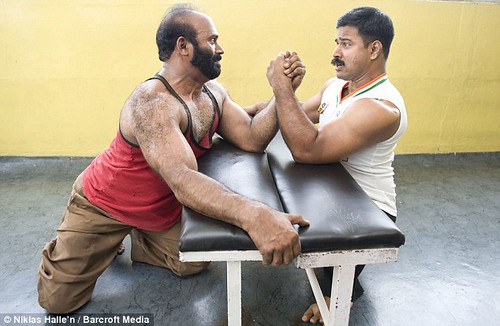
Photo: Joby Matthew holds himself up with one hand while giving the thumbs-up with another. He is on the bank of the Periyar river on the outskirts of Ernakulam. He and his fantastic mustache smile broadly at the camera.

Joby Matthew and an unidentified man arm-wrestle on a weight bench. The unidentified man, who has a beard and fully developed legs, grips the far side of the weight bench.  Both men are grimacing and neither appears to be winning.

Photo: Joby Matthew and an unidentified man arm-wrestle on a weight bench. The unidentified man, who has a beard and fully developed legs, grips the far side of the weight bench. Both men are grimacing and neither appears to be winning.

These photos highlight his exceptional abilities, and while his disability is present and visible, it’s a part of his athleticism. However, there are only two pictures in the eleven-part picture post that actually show him competing. Training and physical strength are interesting and relevant, but this is about sports: as with the article, the focus should be on his achievements as an athlete, not on OMG HOW DOES HE DO THAT? or OMG HE BEATS NORMAL ATHLETES?

The accomplishments of athletes with disabilities face a double bind. In most cases, they are ignored and erased; they are thought to be impossibility and a contradiction. When AWPD are covered in the media, it’s rarely a positive, normed framing of them as accomplished athletes with valid bodies. They are objects instead of curiosity; they are heartwarming inspirations for the currently able-bodied; they are not quite freak shows.

Moderator’s note: Moderation on guest posts is often much slower than “usual” moderation times.