Category Archives: Uncategorized

Bake Sales for Chemo

I recently read a story of a woman forced to have fundraisers to cover her chemo treatment after she was excluded from purchasing insurance coverage because of a separate pre-existing conditions:

Iowan grandmother Deb Robben  shopped the insurance market, looking for a company that would cover her. Unfortunately, after a lengthy search, she was unable to find a single insurer that was willing to offer her coverage; the companies denied her coverage because they considered the benign cysts in her breasts to be a pre-existing condition.

Last December, Robben was diagnosed with colon cancer. Because she has been unable to obtain insurance, she has had to pay the costs for treatment out-of-pocket. For chemotherapy treatment alone, Robben expects to pay almost $2,000 a month. “She’s only two months into chemo and already she’s at $50,000. Oh my, what is another four months going to bring,” says Melissa Gradischnig Nelson, a friend of Robben.

In desperation, Robben’s friends and family have turned to local fundraisers to try to pay for her treatment. Over the weekend, they held a $5-a-plate pasta dinner in the hope of putting “a dent” in Robben’s massive health care bills. Local news station WHO-TV recently interviewed Robben, who told them, “It’s kind of hard when you can’t get insurance. To say, lady you’re going to die or figure out how to come up with the money. It’s not right.”

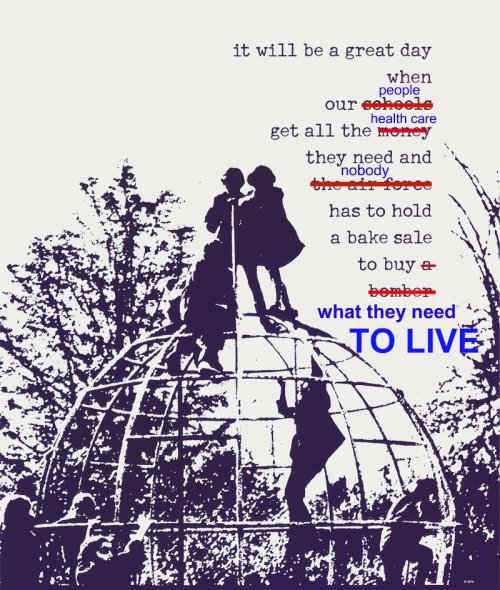
This reminded me of the bumper stickers I used to see with the slogan “It will be a great day when our schools get all the money they need and the air force has to have a bake sale to buy a bomber.” So I’ve modified it to reflect our modern times:

Graphic image of children on jungle gym with slogan about bake sales and bombers, modified to read "it will be a great day when people get all the health care they need and nobody has to hold a bake sale to get what they need to live."

QuickPress: E-Library for Women with Disabilities in Africa

I received this via a mailing list I’m part of.

Check out http://www.nawwd.co.za for an e-Library developed to support Women with Disabilitiies in Africa

In September 2009 the Secretariat of the African Decade of Persons with Disabilities (SADPD) commissioned Disability Action Research Team (DART) and CBR Education & Training for Empowerment (CREATE) to strengthen the Network of African Women with Disabilities (NAWWD). The brief included development of this e-library.

Electronic resources were collated during a systematic review of information relating to women with disabilities in Africa. The website domain contains a collection of articles, research reports, factsheets, documents and training packs produced between 1994-2009. Searches were conducted on the websites of key international Non-Government Organisations (INGOs) and Disabled People’s Organisations (DPOs,) as well as several other international bodies such as the African Union (AU). The searches took place over a period of 3 weeks and were restricted to documents which are available at no cost; all of these are in English, but where Portuguese or French versions were available, these are included. Electronic copies of all the articles cited here are available in different formats (MS Word and PDF). In addition, there is a list of websites and organizations which may be useful resources to women with disabilities on the continent.

A Conversation in the Lunch Room

I was sitting in the lunch room at work with a group of co-workers, flipping through the newspapers. I came to an article on the suicide of Marie Osmond’s son, which led to the whole table discussing the incident. And it was immediately underlined for me how little most people know about mental illness and depression. Here’s a brief list of some of the questions and statements that came up during the discussion, the entirety of which I spent shrinking into myself and trying to be invisible:

  • “Is depression even a real disease?”
  • “People who commit suicide don’t really want to die – evolution wouldn’t let us have suicidal tendencies because it goes against survival.”
  • “It must be because his mom had mental health problems too.” Someone inquired if depression was hereditary and the original speaker replied “No, but being around depressed people can turn you into a depressed person.”
  • “I once knew a bipolar. She married my cousin and my mom got so mad, like you should never marry a bipolar because it’s not a good idea for them to have kids.”

Finally, a young man told a long story about his ex-girlfriend, who had experienced major depression, and how it affected her and the serious limitations it caused her. It was a great illustration of the reality of depression and the changes it can cause in day to day life. It was unfortunately concluded with a “so that’s why you can’t be in a relationship with those people, it’s just too hard.”

We’ve got a long way to go, y’all.

QuickPress: Con_or_Bust!

I should have mentioned earlier!

For the second year in a row, the Con_or_Bust fundraiser is running. Organized by Kate Nepveu, it’s a fundraiser to help fen of colour make it to WisCon, the world’s largest Feminist Science Fiction/Fantasy Convention.

Learn more about the fundraising auction.

How fen of colour can request assistance.

The auction itself.

Bidding is in U.S. dollars unless otherwise specified, and there is some awesome stuff up for grabs.

WisCon is noted for having a very good accessibility policy.

(Other than having attended WisCon last year, and having a few bids for things, I have no affiliation with Con Or Bust. You’re best to ask any questions or make any comments to Kate.)

Feminism Objectifies Women

You’ve heard the term “choice feminism” right? Usually used derisively by a person who is arguing: Just because a woman makes a choice does not make it a feminist choice, we have to be able to examine issues on a systemic rather than individual level, some choices that individual feels are good for them are actually going to be bad for the group as a whole and even bad for that individual when systemic issues are taken into consideration.

Here’s what annoys me about this argument. It always comes from the perspective of a white, cisgendered, currently nondisabled, middle-to-upper-class, heteronormative, and otherwise socially privileged person.

That doesn’t mean that it’s that kind of person saying it: it means that the very idea comes from a very specific perspective, in response to a very specific situation.

And not all of us are in that same situation.

The assumption, when this person says “we have to be able to make some sort of systemic analysis and that will mean some choices have to be wrong” they are almost always assuming some specific things.

* Women have been historically locked in their homes tending their houses and families, and larger society pushes against women’s ability to participate in the workforce, and women should participate in the workforce at the highest level possible.

* Women are oversexualized, and that sexualization takes specific forms, such as high heels, lipstick, makeup, dresses.

* Women are stereotyped as demure and submissive, soft and giving, caring and intuitive.

* Women are forced into roles as family carers, encouraged to have as many children as possible and to be the primary carer to those children, stereotyped as having special natural ability to raise children.

That’s just a few.

Here’s the thing. Everything I just said above about “women”? Isn’t true for women. Rather, it is true for white women. Or cisgendered women. Or nondisabled women. It is not true for women as a class.

Yet we continually operate on the assumption that it is!

But ask some other women, sometime, what their experience has been. Many poor and lower-class women, for example, would gladly tell you that they have never had a whiff of an option to stay home with their children — they’ve been out there washing the rich women’s drawers, or sewing them in the first place, so that they can afford dinner for their family a few days out of the week. Ask a black woman about being a nanny and wet nurse. Ask both of those women, and a few mentally or physically disabled women, about when they had their children taken away from them or weren’t allowed to spend any time with them at all (apart from the time they spent cleaning up the messes of the children of those rich/white/nondisabled women they worked for).

Ask a little black or brown girl in some poor neighborhoods about being expected to be virginal (a concept that depends on whiteness from the very beginning) until her wedding day. She’ll probably laugh at you. She’s been continually harassed, abused and assaulted since age six. She’s portrayed in larger culture as an unsexual unwoman and yet every man who crosses her path sees her as a potent sexual opportunity.

Ask the little girl with developmental disabilities about sex sometime, too. No one ever sees fit to give her any information on the subject. They fight to have her sterilized, or even be forced with serious drugs and surgical interventions to stay in a prepubescent state for the rest of her life, so that no one will ever have to deal with the messy proposition of a menstruating or pregnant r*t*rd girl. And if she does get pregnant, that baby had better be aborted immediately, because she could never, ever be anything but an utter failure of a parent. Sterilization is proposed precisely so that she will never get pregnant even if she is sexually assaulted by carers — precisely because everyone knows that she will be.

Ask the visibly disabled woman about being expected to dress up in skirts and high-heeled shoes. Everybody around her will wince at the thought of her in form-fitting, skin-showing clothing. Because, you know, “women” are oversexualized in that way. Ask her about those super-special parenting powers she supposedly has. Everybody around her will bristle at the thought of her having primary responsibility over a child. Because, you know, “women” are stereotyped as having those super-special powers.

All of these girls and women live very different lives as girls and women. The fact that they are marginalized as girls and women is one thing they share in common. But the ways in which they are marginalized are different!

A white woman is marginalized in a different way than a Latina woman is. And a Latina woman is marginalized in a different way than an indigenous woman! A nondisabled woman is marginalized in a different way than a paraplegic woman is… and a paraplegic woman is marginalized in a different way than a bipolar woman is. An upper-middle-class woman in urban New York is marginalized in a different way than a poor woman in urban New York — and a poor woman in New York is marginalized in a different way than a poor woman in Indiana.

There are different mechanisms of marginalization for different types of people — and the greater your difference from the presumed default person, the more different your type of marginalization looks than the privileged-other-than-gender woman.

And that means that what affects you, how it affects you, what issues are important to you, what is good for you and what is bad for you, is different for different sorts of people.

So we cannot, cannot assume, if we agree that “choice feminism” is misguided (and indeed, I believe that straw-ideology would be misguided — well, surely many people think that way, but that is not usually the argument that is being put forth in these discussions), that high heels, lipstick, being submissive, foregoing paid work to raise children, etc. etc. are clearly problematic under a systemic feminist analysis. Because they might be clearly problematic for one set of women — but they are not clearly problematic for the set of all women.

Actually, sensible shoes and baggy desexualized clothing might be clearly problematic for a different set of women who have been historically deprived of their right to any sexuality. Actually, full-time participation in the paid workforce might be clearly problematic for a different set of women who have already been working outside the home for centuries and have historically been denied the right to raise their own children. Actually, being aggressive and dominating or even merely appearing assertive and self-confident might be clearly problematic for a different set of women who are culturally typed as bossy, loud, demanding and unyielding and rarely read as anything but.

Given all of this, I am distrustful of anyone who argues against “choice feminism” or the idea that “any choice is a good choice for that person” because that is not the point. When people protest as you judge their choices against your standards, they are not claiming that no choice could ever be problematic. They are protesting because you are applying the standard of your particular experience against their very different experience. They are protesting because you are assuming that your experience is universal. They are protesting because you are invalidating their own experience, their own feelings and thoughts and desires, in the process. They are protesting because you are objectifying them. And it feels pretty shitty to be objectified.

(Cross-posted at three rivers fog.)

Quickquote: Clare Hemmings on emotion and feminist stories

I’m reading Helen Merrick’s The Secret Feminist Cabal: A Cultural History of Science Fiction Feminisms[1]. This pullquote in it, from Clare Hemmings, struck me as being very relevant to the work we do on FWD/Forward and on our other blogs:

Feminist emotion … is central to the feminist stories we tell, and the way that we tell them … as a result, an account of ways of telling feminist stories needs to be attentive to the affective as well as technical ways in which our stories about the recent feminist past work. It hurts because it matters…

~~~
[1] ObDisclosure: I have met Helen in meatspace, and call her “friend”; I bought the book retail and there are no inducements of any kind involved in me blogging about it.

QuickPress: Event at McMaster University in Canada

“Supporting access to post-secondary education and employment for students
with disabilities”

All Abilities Awareness Week will take place at McMaster University, The Pulse centre, from March 1st to March 5th. The week has been designed to promote active living for people with disabilities, increase awareness in the general campus population of disability issues and provide information regarding disability services and supports on McMaster’s campus and in the community. There will be a focus on the upcoming Winter Paralympic sporting events and the Special Olympics. Paralympic athletes Jessica Tuomela, Darda Sales and Victoria Nolan will speak on Monday, March 1 to open the week. Other activities include an intramural wheelchair challenge and display tables with information on services for persons with disabilities.

For further information on the schedule for the week contact Disability Services at McMaster University: (905) 525-9140, ext. 24339.
http://www.neads.ca/en/about/events/index.php?id=187

QuickPress: Asian Women’s Carnival!

Went up on the 15th.

asian women blog carnival #5: who i am when i’m (not) with you

One of the big things for me in presenting as an Asian woman is that when I think of my identity, and of my performativity, I don’t think ‘Asian,’ I think ‘Chinese’ and I think ‘Malaysian’ and I think ‘mixed-race’ and I think ‘Caucasian.’ So when I was compiling these amazing posts by these great Asian women, I thought about indicating their ethnicities – just about every one of them mentions their ethnicity in their posts (myself included). But part of performativity is choosing how we represent our identities, and our ethnicities. This edition of the carnival is, after all, about how we choose to present as Asian women. So instead of describing the posts, for the most part, I’ve simply excerpted from them.

We are who we are, but we’re not always how you see us.

Who Killed Civil Discourse? Evelyn Evelyn, Marginalization, and Internet Discussion

Hello. I am Annaham (yes, I have a name). I am the person who posted a critique of Evelyn Evelyn on this website, which kicked off something of an internet controversy. For those who’ve just joined us, I made a post about Amanda Palmer and Jason Webley’s side project Evelyn Evelyn, Lauredhel made another post soon after, and things got a little out-of-control, to say the least. Because my post was part of this whole storm of various substances — both gross and not — I feel some responsibility to share my reaction to what’s gone down thus far.

I’d like to take a moment to talk about some basic principles of anti-oppression activism and social justice work that intersect with the work we do here at FWD, as some very specific structural issues and contexts are absolutely relevant in this discussion. Often, marginalized people are encouraged and expected to be sensitive and accommodating to the attitudes and prejudices of the dominant culture and to those of less-marginalized (ie: more privileged) people. However, this sensitivity and accommodation usually does not run both ways. Marginalized people, if they criticize something that (for example) leaves them out or makes them feel awful, are often told that they are being overly sensitive or overemotional, that they just misunderstand intent, that they are exaggerating, or that their tone is not polite enough. They are then expected to modify their behavior — and their self-expression —  to fit with the norms and values of those who are more privileged.

What the less-privileged have to say is usually not accorded much importance, critical thought, or respect, and yet they are supposed to prioritize, be patient with, and generally assign more importance to views, values and norms that are not their own. People in marginalized communities are often expected to educate the more privileged majority. They may be expected to patiently explain basic concepts, sometimes repeatedly. And if those with more privilege decide that they do not agree (with the less-privileged group’s tone, focus, or any number of other things other than the actual argument that is being made), those with less privilege are told, with varying degrees of subtlety, to shut the fuck up.

All the while, the perspectives, attitudes, norms and values of those with more privilege are made neutral. The power dynamics are rendered invisible, because that’s just the way things are, so there’s no point in trying to change any of it. Why are you so angry?  You’re just looking for things to get mad about. You just like being offended. Why can’t you focus on other/more important things? It wasn’t meant that way. You need to hold your tongue until you’ve done x, y and z. Quit taking it personally. You’re ruining everyone’s good time. Stop trying to make everyone pay attention to your pet issue, because it doesn’t affect anyone other than you. Your demands are unreasonable. Stop complaining. Shut up.

And when things don’t go entirely smoothly (which happens often), those not in a position of privilege are often blamed for it: Well, what did you expect, using that tone? You’re the one who brought it up; you’re the one who rocked the boat.

Unfortunately, these tactics are extremely common when it comes folks’ objections against many sorts of media and pop culture critique and/or backlash against critical engagement with cultural works. In other words: These are not new patterns.

I am definitely not saying that everyone has to agree with the critiques that I and others have made regarding Evelyn Evelyn; I am not suggesting that ideological lockstep is a worthy end-goal. What I am saying is that the humanity of marginalized people — those who have traditionally been left out, and who are often on the receiving end of justifications for said exclusion(s) — is not up for debate. The humanity of the participants in this discussion — that of the creators/artists, fans, and those of us who have come forward with critiques — is similarly not up for debate. What I posted, and what I am posting here, was (and is) my take on the matter. I do not, nor do I want to, claim to speak for all PWDs, or all disabled feminists, or all fans of AfP and/or Jason Webley who are also disabled or feminists, or both. We all have our different takes on Evelyn Evelyn and how things have unfolded, and I think it is a good sign that so much discussion has come from this.

As I have stated here on FWD and elsewhere, I am a fan of AfP and have been for a number of years. Many of the people who have raised concerns about Evelyn Evelyn are fans, potential fans, or former fans (and there have been solid points raised by non-fans, too). Dreamwidth’s Anti-Oppression Linkspam community has, at present, four roundups collecting posts on the matter from around the web.  I suspect that many of us who have posted on the Evelyn Evelyn project with a critical eye are not raising these concerns simply to bug or irritate Amanda and Jason, or their fans. However, there are quite a few people who seem eager to dismiss those of us with legitimate concerns as “haters” who just don’t understand art. The hostile messages from “haters” that Amanda has received are not legitimate critiques. These are personal attacks, not arguments of substance.

I almost feel like it should go without saying that I do not support people making these attacks on Amanda, but just to make it very clear: I am very much against people using this controversy — and the complex issues raised — as a bandwagon upon which they can leap to make personal attacks and/or comments about Amanda’s personal life or who she is. Unfortunately for those of us who have been trying to bring attention to Evelyn Evelyn-related issues and seriously discuss them, the “haters” are distracting from these same issues (and are apparently effective at it). I have also heard that people are making threats of physical violence against Amanda. That is not okay. It is never, ever acceptable to make threats of violence against anyone, regardless of your disagreement. That is basic human decency. It is truly disheartening to me, and to the other FWD contributors, that some are using this very difficult situation as an excuse to make horrific threats. We fiercely condemn these attacks.

One of the comments I received was from someone who, as far as I can tell, thought that my post seemed “insincere,” with a bonus implication that I was and am making other PWDs look bad “in the eyes of the abled.” Comments of this sort are often aimed at members of marginalized groups who are expected speak for everyone in their group when confronted; it basically boils down to “You are making other [disabled people] look bad.” I have to wonder why this same thing was not said to the AfP fans who found it necessary to show up here to derail, break out tone arguments,  tell me and my fellow contributors that we are crazy and/or should shut up, and who dismissed us on Twitter as just bitching about the project. It’s interesting, and rather telling, that some fans have used these tactics against me, my fellow FWD contributors, and other people who have critiqued the project, but could not (or did not want to) step back and consider their own behavior.

We were, in various other places around the web, called “retarded,” “angry bloggers,” had the legitimacy of our contributors’ disabilities questioned, and (trigger warning) threatened with rape (link goes to a screencap of a comment left on Amanda’s blog) — among many, many other things. In the comments thread to my original post, I was told that I need to focus on more important issues, that I was blowing things out of proportion, that I was censoring people and/or trampling on their free speech rights by laying out guidelines that specifically told potential commenters  to not leave derailing comments,  and that intent should excuse offensiveness. Eventually, I lost my patience.

There were also quite a few personal-attack comments left in the moderation queue; for obvious reasons, these were not published. These attacking comments were a significant part of why I closed comments on the post, though I did not explain that in my final comment. My decision was not about “censoring” what anyone had to say, or infringing upon “free speech” rights (this is a private website — one that has contributors, commenters and readers who are not only from the U.S.), or only about the fact that I lost my patience after having explained certain concepts over and over again; I and my fellow contributors simply could not deal with the personal attacks, threats, and violent language being left in the mod queue anymore.

Here is just a sampling of some of these unpublished comments from the mod queue (possible trigger warning):

“What’s the matter with you?”

“cant handle it? then just fucking die!”

“fuck u die slow nigga!”

“ONOEZ SOMEONE WANTED TO SMACK SOMEONE SUCH VIOLENCE!!! Typical retarded comment on an idiotic, stupid, moronic, weak, and lame blog. Fucking oversensitive twits.”

I think there is something analogous here to some of the more hateful comments that Amanda received on Twitter and elsewhere, but that is a bit of a tangent.

Going through the mod queue for that post was not an experience that I would want anyone to have. I could talk about the fact that it got to the point where it exhausted me to look at the comments; about the extreme anxiety and emotional hurt I felt while reading some of the comments that attacked me as an individual and/or questioned my mental health status; about how it feels to notice that your physical pain level — already there as a result of a chronic pain condition — goes up a few notches as you read criticism(s) directed not at your argument, but at you. I have a feeling that were I to discuss this in depth, some would likely construe it as “ANGRY BLOGGER BLAMES AMANDA PALMER FANS FOR HER OWN PAIN” or accuse me of using my disability as an excuse for being “too sensitive.” I get more than enough of that outside of the blogosphere.

I need a break from having attempted to be civil and polite and explain very basic concepts to a select few people who have no interest in substantially engaging with me or with others who have raised concerns about Evelyn Evelyn.  Simply put, I need some time to recharge my politeness batteries, as well as my hope that some people — and I include many of Amanda’s fans in this category  — do want to listen, learn and discuss without derailing or attacking. I wish I could address every critique that’s come our way, but I am pretty worn out (and I suspect that many of you — disabled and not — know the feeling).

In the interest of full disclosure, I should mention that Jason and I have been communicating via e-mail — he emailed me shortly after my other post went live — and discussing many of these issues in more detail; for that, and for his willingness to engage, listen, and consider the critiques that have come up, I thank him.

I wish Amanda and Jason success with their endeavors; I do not wish to shut either of them up or, worse, endorse that Evelyn Evelyn not go forward at all. There is, as I have said, quite a bit of difference between critiquing a portion of someone’s work and wanting to shut them up or silence them; I have aimed for the former. I ask, however, that they engage critically with and take seriously the numerous points that have been brought up, both about (trigger warnings apply to the first two links) specific aspects of the project and the response to critiques so far. Taking on such huge issues will doubtlessly be a difficult and ongoing process. Of course, Amanda and Jason will probably interpret all of this in different ways. What happens next does not have to be “perfect” — nor 100% Annaham-approved (because that would be unrealistic and silly), but it would be fantastic for these two very talented musicians and performers to bridge the gaps between their good intentions and what actually shows up onstage and on the album.

What are the ultimate lessons here? What can people on all sides of this discussion take away? Right now, I don’t know, and for the moment, that is okay with me. I still believe that better things are possible. I refuse to give up that hope.

[Special thanks to meloukhia for ou’s help in putting together links and other material for this post.]

Please read and abide by our comments policy.