All posts by Anna

AWP: Why writing about Language Isn’t Enough

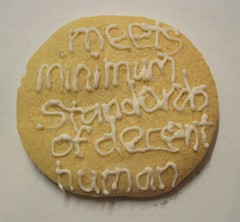
A cookie.  In icing it reads Meets Minimum Standards of Decent Human
Description: A cookie. In icing it reads Meets Minimum Standards of Decent Human. By sajbrfems, used under a Creative Commons License.

This is Part 2 of a 2-part series about Ableism & Language. Part 1: Why I Write About Ableist Language.

In social justice blogging circles, especially feminist-focused ones, it’s not unusual to have conversations about language, and why language matters. Those conversations can vary from explaining why it’s problematic to call women & girls “females”, why using “he” and “mankind” to be a generic non-gendered term is sexist, reclaiming – or not – of words like “bitch”, and what it means to refer to “undocumented immigrants” rather than “illegals”.

These conversations often focus on how sexist or racist language is a symptom of a problem that needs to be addressed. We can talk about how calling women bitches is a sign of sexism, or referring to people as “illegals” is dehumanizing to immigrants. And yet, when trying to have discussions about ableist language, we’re back to the silo of disability. Instead of talking about ableist language as part of the manifestation of the disdain and abuse of people with disabilities, it’s treated as isolated – the problem, instead of a symptom of the problem.

Ableism is not simply a language problem.

Ableism manifests in the social justice blogosphere in so many different ways. They can vary from just not thinking about disability at all when writing about social justice issues to shrugging off critiques from disability-focused bloggers as being “too sensitive”. It can be ignoring posts about disability-focused issues or only linking to non-disabled people writing about disability-issues instead of to disabled bloggers. It can be as apparent as declining to acknowledge disability exists to as “subtle” (to some) as declining to make your blog template accessible to screen readers.

There are also choices that social justice bloggers make about how we educate ourselves, and whose voices we highlight, who we approach about their writing, and who we ask to be mediators. If we’re not reading disability-focused blogs, then we’re not learning about disability-focused issues – and, in turn, we’re not highlighting those voices, bringing attention to those issues, or thinking about that analysis when writing our own posts.

Thirdly, ableism manifests in whose voices we trust. For all that I’m very happy to provide people with book lists, I’m a bit suspicious of people who decline lists of disability-focused bloggers they could be reading as well. Why does someone’s voice have to go through the publishing-sphere (and usually through academia for the books you’re going to get from me) before it counts as worth-reading?

I get why people talk about language, and I agree that language is important. But I’m not giving cookies out for publicly declaring your ally-status by saying you won’t (or will try not to) use ableist language anymore. That’s a great first step. Now move on.

[Thank you to s.e. smith for helping me clarify my ideas.]
Ableist Word Profile: Why I write about ableist language

  • Ableist Word Profile is an ongoing FWD/Forward series in which we explore ableism and the way it manifests in language usage.
  • Here’s what this series is about: Examining word origins, the way in which ableism is unconsciously reinforced, the power that language has.
  • Here’s what this series is not about: Telling people which words they can use to define their own experiences, rejecting reclamatory word usage, telling people which words they can and cannot use.
  • You don’t necessarily have to agree that a particular profiled word or phrase is ableist; we ask you to think about the way in which the language that we use is influenced, both historically and currently, by ableist thought.
  • Please note that this post contains ableist language used for the purpose of discussion and criticism; you can get an idea from the title of the kind of ableist language which is going to be included in the discussion, and if that type of language is upsetting or triggering for you, you may want to skip this post

This is Part 1 of a two-part series on Ableist Language Discussions in the Blogosphere.

There’s a lot of chatter that goes on ’round the Social Justice Blogosphere about Ableist Language: what is it? what do you mean? those words don’t mean that! how can you say that? what does that mean? why are you bringing this up? don’t you have more important things to talk about? Intentions intentions intentions! It makes my head hurt.

I talk about ableist language for a variety of reasons. The most obvious, I think, is to challenge ableist ideas that center the experiences of non-disabled people. When someone proudly assures me that words like “lame” and “dumb” and “r#tarded” are never used to describe actual people with disabilities, I’m fairly certain I’m talking to one of the currently non-disabled. Currently non-disabled readers, I’m here to tell you: those words, and any similar words you think are “archaic” and not used anymore, are used all the time, as taunts and insults towards people with disabilities, and in some cases as official diagnoses. Some of them are also used in reclamatory ways by some disabled people, but certainly not all.

But it’s more than that. Part of why I challenge ableist ideas and ableist language is because I would like more Social Justice bloggers to think “Oh, yeah. People with disabilities also read social justice blogs! I should remember that more often when I’m writing.” [I also like to challenge it in other places, which is why I occasionally go through spaces like Wikipedia & TVTropes and re-write every instance of “wheelchair bound“.]

There’s a strong tendency to assume that disability-related issues are somehow a separate thing, as though there’s a Disability Silo and things like reproductive justice, racism, heterosexism, anti-immigration, transphobia, classism, and misogyny, etc, don’t actually enter into that silo. As though no one with a disability is interested in reading about these topics, or is affected by them in any way, or is an activist on the topic, or wants to be more of one.

When someone writes something like “Wow, those anti-immigrant people are r#tarded idiots!” [I made this example up] or giggles about seeing Dick Cheney “wheelchair bound” because “it couldn’t happen to a more deserving person!” [I did not make this example up], I bring up the ableism, and my activity in the disability rights movement, as a way of reminding them that we’re here. We’re reading. We’re participating. And it’s more than a little-bit alienating to see social justice bloggers using our experiences and oppressions as their go-to for “insulting people we don’t agree with”.

But at the same time, I don’t think talking about ableist language – no matter how well-intended – is enough. It’s a step. But that’s all it is.

I will write more about that tomorrow.

Recommended reading for Monday, May 24 2010

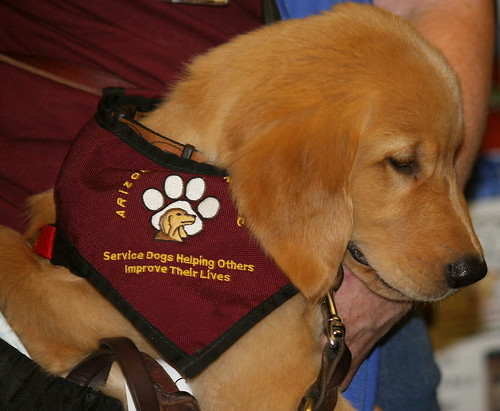
A service pup in training
Description: An Arizona Golden puppy wearing a Halter that reads “Service Dogs Helping Others Improve Their Lives”

From flickr user Cobolt 123, used under a Creative Commons License.

Teacher duct tapes disabled boy’s arm to wheelchair

Anthony Birden, a 12 year old with shaken baby syndrome, who can only communicate with his right hand, had that hand restrained with duct tape by a teacher in Colorado. Teacher Leslie Garcia said it was the only way she could make him stop doing a gagging movement. The boy’s grandmother says that is the way the child communicates.

The district attorney decided not to charge the teacher. However, the incident continues to be investigated by the Center for People with Disabilities, who believe the act is against state law. After they submit a report, they will follow up with the school. A review by the federal office of civil rights may take place.

Checking Assumptions (at the door!)

Today we have a poll!

I want you to read the scenario described below and then answer the poll questions as you read them. Please answer AS YOU READ, don’t read all the questions before you answer and please don’t read the comments before you answer!

War and Disability in Afghanistan

This article offers insight into day-to-day issues facing ordinary disabled people in different parts of the world. And it manages to avoid the melodrama that peace advocates sometimes invoke when talking about disabilities caused by war.

Even as we fight our own critical battles for civil rights and essential support services, disability rights activists must be aware of the impact of our government’s military actions on people with disabilities across the globe.

Hilary Beaumont has written a three-part article for the Halifax Media Co-Op on Rape: Part 1. Part 2. Part 3.

Via Sharon Wachsler in comments:
The Voices Behind the Disease

I want to give others a chance to use their own voice. I know that while my writing may be useful, everyone’s journey, story, experiences and needs are different. What I experience and what I say may not apply to everyone else. I wanted to help others voice their own account of Lyme and the affect that it has had on their own life, and what they wish that their friends and family would understand. It is my hope, that if I put together the words of more than one Lyme patient, I’ll be able to paint a vivid picture of the disease and its many shapes, forms and effects. We will be able to paint a vivid picture of the disease, not only for Lyme Disease Awareness Month, but for the understanding and support that every Lyme patient needs and deserves.

I posed a question: What is one thing that you wish your family and friends understood about your disease and how it has affected your daily life?

I’d like to share the answers with you.

I’ve been really enjoying some of the stuff coming my way via @disabilitygov on twitter. It’s US-based, but at least some of it is applicable to other countries as well.

Best Practices Guide in Mentoring Youth with Disabilities [link is to description, the guide itself is available in PDF & Word] I’ve only skimmed the 145-page document, but it’s reminded me how much I want to do some Mentoring programs once I settle down in one place.

A guide on best practices and programs for mentoring young people with disabilities, including suggestions on starting or expanding a program to include youth with disabilities

They’re doing a 100 Days to the ADA blog that may also be of interest.

Have you been reading RMJ’s TelevIsm posts at Bitch Blog?

In the News:

Henderson: Finding the right word to describe the disabled is often a struggle

Alberta Must Restore sex-change funding

Why Don’t Non-Disabled People Trust People With Disabilities Anyway?

Disability simulations and disability awareness days are condescending and patronizing towards people with disabilities. Instead of “raising awareness” about the “struggles” people with disabilities face, they end up raising awareness of how difficult it is to be a first-time wheelchair user, open bottles with socks on your hands, or navigate spaces with your eyes closed. They do not actually teach anyone anything about disability.


I suppose it would be wrong to end the post there.

First, a bit of context. Last week marked the third year that some Canadian Members of Parliament (federal representatives) – including my own, Megan Leslie, and the NDP party[1. NDP = New Democratic Party. They’re our more-left-of-center-than-the-Liberals party in Canada. In the UK, they’re like the LibDems, in Australia, I think they’re like the Labour Party (but I’m not sure) and in the US… well, in the US, they’re scary socialists who want universal healthcare and support unions and are pro-choice, so they’d be non-existent in your current political environment.] whip [1. The party whip is the person in a political party who ensures that party members are present for key votes and that they vote in line with party policy. The Wikipedia entry looks pretty good.] Olivia Chow – spent a day on the Hill attempting to do their jobs while using a wheelchair.

Second, important information. This year event is co-sponsored by the Canadian Paraplegic Association as part of Spinal Cord Injury and CPA Awareness Month. While their website refers only to the 2009 event, I’m assuming the relevant information is similar:

Several Members of Parliament and Senators have spent one day in May in a wheelchair. They conducted their normal working day having to make time allowances for simple things like finding wheelchair accessible shuttles and washrooms. They were only allowed to leave their chair while in the House of Commons as there is only one wheelchair accessible spot on the floor for the Parliament Hill event co-sponsor the Honorable Mr. Steven Fletcher.

I think it’s clear that not every disabled person agrees with my assertions about disability simulations, but I have some very strong reasons for describing them they way I do. Some of those reasons are best demonstrated by Olivia Chow’s tweets throughout the day. [You can see this all in context at her twitter. The event took place on May 12. Ms Chow tweeted throughout the day. Ms Leslie also tweeted about her experience, complete with pictures.]

Olivia Chow’s tweets throughout the day really irritate me. She did a series of tweets about the barriers facing wheelchair-users in Ottawa: …lack of curb cuts, bumpy sidewalks, washrooms too small, tables w wide legs…; …hills, doors that don’t open automatically, heavy chairs, elevators shutting too quickly…; Most of these barriers can be overcome by better design, government that understand disability and kind pp willing to help.

Actually, Ms Chow, all over those barriers can be overcome through better design, and while it’s nice if a government “understands” disability, I would really rather they listened to people with disabilities instead.

What Ms Chow’s tweets did is emphasize that, both as an MP and as a former City Councillor for Toronto, she doesn’t trust people with disabilities to actually be telling her the truth about their experiences. Instead, she tweeted
I wish I had this wheelchair experience day while I was a city councillor as a lot of barriers are gov by municipal code.
and Maybe I should work w the Canadian Paraplegic Asso …and challenge councillors to spend a day using wheelchairs.

Actually, Ms Chow, I have a better idea.

Why not challenge the City Councillors, and the MPs, and anyone else you know who has government power to talk to people with disabilities about what their needs are, instead of deciding that spending a day in a wheelchair gives you some special insight? (Especially egregious to me is that the nice people playing dress-up in their wheelchairs for a day could instead have asked Steven Fletcher, the Conservative MP for Charleswood—St. James—Assiniboia, Manitoba, who is a full-time wheelchair user. He might be able to shed some light on issues of accessibility in Ottawa. Mr Fletcher does support this disability simulation, but this doesn’t actually prevent anyone in Parliament from asking him about it anyway.)

It really disappoints me to see the NDP participate in these so-called disability simulations rather than use their power to highlight the voices of actual people with disabilities when discussing their accessibility needs.

Canadians with disabilities campaign constantly for their voice. We don’t need Olivia Chow, or Megan Leslie, to go around for a day tweeting about how inaccessible Ottawa is. We need our elected representatives to actually listen to our concerns. We need them to take those concerns seriously, and present them to their Party – be it NDP, Liberal, Conservative, Bloq, or Green – and to our Government. We need politicians and policy makers to believe that our voices are the ones that define what our accessibility needs are, not a day-long experiment.

I know that going around for a day in a wheelchair gets attention and kudos from the currently non-disabled. I’d rather that attention be offered to the people who continue to be notably absent from our Houses of Government.

Jenny McCarthy & Autism Part III: Spokesperson

This is the third and final part of my discussion about Jenny McCarthy. Part I was If We Shame Parents Enough Maybe Autism Can Be Cured, and Part II was Let’s All Be Normal (Acting).

Writing this last post has taken me a very long time, both because of my anger at the way autistics are talked about rather than talked to, or with, or given the opportunity to talk for themselves; and because I keep going over what I have to say here and wondering what makes me think I’m qualified to say it.

I’d like to go back for a moment to the article that started me on this: Jenny McCarthy says her son Evan never had autism.

Actually, let’s just go back to the final sentence: “And though her son may never have had autism, Jenny insists, “I’ll continue to be the voice” of the disorder.”

The way I see it, one of two things is true:

1. Jenny McCarthy cured her son of Autism.
2. Evan never had autism in the first place, but may have had another syndrome, or have been developmentally delayed and “caught up”.

In either case, Jenny McCarthy is not currently the mother of an autistic child.

Tell me – why is Jenny McCarthy the “spokesperson” for “the disorder”? According to her no one in her personal life has it.

Not even delving into the bit where it’s incredibly different to be speaking for and about those who live with autistics and those who actually are autistic, I’m not entire certain what insight McCarthy is offering anyone. The idea that autism is like your child’s soul going away? That the best metaphor for autism is a bus accident? She describes a diagnosis of autism as the worst thing that could happen, and she’s going around and doing the talk shows and is the “spokesperson for the disorder?” How does that even make any sense?

That’s why this post has taken me so long to finish. Every time I start it, I wonder why the hell I’m writing it, instead of pointing people towards the writing of actual autistics.

[Here is a tiny sample:

Just a tiny tiny sample. Each one has a blogroll. There are lots of autistic bloggers, including kaninchenzero and s.e. smith here at FWD. This tiny sample is just meant to be that. I encourage people to leave more links, including to their own blog, in the comments.]

The Times article argues that Jenny McCarthy peddles hope.

Well, here’s my hope: That in the future, autistics will be invited to speak for themselves.

Recommended Reading for May 17, 2010

A large number of crutches of multiple sizes leaning against a wall
Description: a large number of crutches of multiple sizes leaning against a wall.
“Disabling Art”, by tomswift46, creative commons license.

Childhood, Disability, and Public Space

But adults with severe cognitive disabilities, like children and the elderly, often behave in ways that challenge non-disabled adults’ beliefs about how people should behave, particularly their beliefs about how people should behave in public spaces. The ways in which I’ve seen people be made uncomfortable by children in some ways mirror the ways in which I’ve seen people be made uncomfortable by people with disabilities.

The Questionable Privilege of being med-free

As a person who lived for two years without psychiatric medication apart from a PRN tranquilizer, I have experienced the relative privilege people who don’t use medication are awarded. It is subtle, in the comments people make. “Oh, that’s good for you,” people said when I told them I wasn’t on any medication. When, at the introduction to mental health recovery I attended, one of the speakers informed the audeince that she was med-free, everyone also either cheered as if it was the greatest goal to achieve, or mumbled in sorrow that they could never achieve that. Fortunately, the speaker made it quite clear that this was her personal choice and it was not in any way meant as advice to anyone else. But it’s not just patients who do this; I repeatedly caught the ward psychiatrist in compliments on the fact that I managed without meds. Yet whether a person is or is not on psychiatric drugs, may have little to do with how well they manage.

SDS 2010 conference is upon us! attend and/or follow via web 2.0

The Society for Disability Studies’ annual conference, “Disability in the Geo-Political Imagination,” kicks off Wednesday, June 2, on the campus of Temple University in Philadelphia, Pennsylvania. This year’s will be the largest SDS conference ever, with a day-long inclusive education preconference on June 2, and five concurrent streams of papers, as well as a film festival in a dedicated theater, running Thursday, June 3 through Saturday, June 5.

To all you mothers, in every sense of the word

Even when it’s Mother’s Day, the ableists are out. They are folks who, among other things, are bound and determined to treat people with disabilities badly because they think they can.

I felt sorry for my mother when we ran into a waitress who acted as if I wasn’t capable of ordering my own meal yesterday. I watched as her eyes filled with tears when I was insulted in front of her.

I pushed back. That’s what advocates do, even on Mother’s Day. Maybe particularly on Mother’s Day. I believe I did it for all the mothers out there, in every sense of the word.

Shame, Medication and Mental Illness

Every month when my amitriptyline starts running low, I have the hardest time remembering to call it in. I don’t know what it is, but I just can’t remember on my own and if I don’t remember I’ll run out and could miss days of my medication. I missed more than a week last summer and ended up high for days and days as my body readjusted.

So every month I pick up a pen hold it to my hand and debate what reminder to write there. I don’t want to write “MEDS,” right there in big letters where everyone can see it, but that seems to be my only option. My friends suggest coining a codeword. I try faces, check marks, exclamation points and stars. Nothing works — except “MEDS.” Every time I try something else I somehow forget and end up missing a dose.

Science Fiction Writing Contest [More details at the link]

Open to Native, First Nations, Indigenous, and Aboriginal students currently enrolled part-time or full-time in any accredited university, college, or high school.

This year’s Judge: Acclaimed SF, experimental fiction, and horror writer Stephen Graham Jones (Blackfeet), author of The Fast Red Road—A Plainsong, The Bird Is Gone—A Manifesto, Ledfeather, and much more. http://www.demontheory.net/

Entrants should submit a personal statement (one paragraph) containing affiliation or descent, student status (the where, the when, the why, and the how much more), and goals for their sf writing, along with the previously unpublished writing sample.

“Canadians are most certainly welcomed! Canadians, Australians–all “indigenous” types from wherever they reside.”

News:

Three men charged for hate crime

FARMINGTON — The three men who allegedly branded a swastika on the arm of a mentally challenged man and who face hate crime charges for the incident were arraigned Monday in Farmington Magistrate Court.

Yet city and Navajo officials claim race relations in Farmington have improved dramatically during the last decade.

Not-Quite-Recommended Reading for Saturday, May 15

I’ve got a collection of Canadian news stories that are disability-related, and I don’t want to hold on to them for later.

Calling out bus stops now a human right

Regional council hopes this will fend off a potential prosecution by the Ontario Human Rights Commission. The commission says announcing stops is an immediate need and it’s not good enough for drivers to call stops on request, as they do now. This follows a landmark ruling won by a blind Toronto passenger in 2007.

[The case they’re referring to is Lepofsky vs the Toronto Transit Commission, which I found very interesting when I learned about it. Lepofsky first brought suit against the TTC in 2005, which resulted in the stops on the subway being called. After that case was won, he contacted the TTC and said “So, you’re going to do this on the buses as well, right?” and they said no, so he had to bring suit against them a second time.]

Airline apologizes for forgetting blind teen

The 18-year-old was waiting for flight attendants to escort her to a connecting flight to Florida when she heard the plane door seal shut. Ten minutes later two maintenance staff happened to find her on an unscheduled check of the plane.

She panicked in the plane, calling for help.

After a series of complaints, Cabot received a $250 airline voucher and the promise of an apology. Five weeks after her flight and a series of news stories later, she finally got one.

Why yes United is the airline that treated LJ-user Evilpuppy so shabbily, and then sent her a letter explaining that they’re really sorry, but this situation was at least in part her fault.

Wanted: People with disabilities to work in high-level banking jobs

Patey gives examples of the range of “invisible” disabilities that might qualify, “Someone who has had a heart attack who is no longer able to work at the same level as he did prior to the heart attack or individuals that experience prolonged feelings of anxiety or depression. These are the kinds of folks that we want to reach and interview for these banking jobs.”

[I admit to looking sideways at that article and its particular focus on the “right” type of disability. I haven’t sorted what I think of it at all.]

NEADS has put out their Studying and Pursuing a Science or Technology Career as a Post-Secondary Student with a Disability Guide. Not being a Science or Technology Person, I can’t really speak to it myself, but I know NEADS is an awesome resource for post-secondary students with disabilities across Canada.

From the press release:

While research has been conducted on factors affecting the inclusion of the general student population in science and technology-related programs, very little work has been done to highlight the issues and challenges faced by students and employees with disabilities within this sector. Furthermore, the identification of role models or success stories in science and technology is not encouraged every student and educator, or every employer and employee, facing these issues may well believe that they are the first, ever, to do so. Our new Success in STEM guidebook meets our initial project goals and is a unique and invaluable resource for students, teachers, service providers and employers.

Recommended Reading for Wednesday, May 12, 2010

In case of emergency, sprout wings and fly

I am sure we have all seen this one in its many guises, but I thought it was a particularly spectacular example given that nobody of historically recorded human height could have reached this pull cord. It’s about 10 feet up.

Access win? Calling all adventure service dogs

I visited a cafeteria and store at a venue along Hadrian’s Wall. Let us for the moment overlook that they had a gravel path leading to their disabled toilet facility, which then had a step on the door and look at this win for service dogs with a yen for an adrenaline rush.

The Beginning

Things quickly went downhill from there. Without a break in my mania I took LSD. Everything becomes a blur at this point. I ended up in the psych ward and was immediately diagnosed bipolar. They wanted to hold me past the 72 hours they could hold me without a legal hearing. They strongly encouraged me to stay and not go to the hearing. I went to the hearing and appeared before the judge completely lucid in my presentation. I was released. I threw away the medications they had given me.

It’s Easy [Trigger warning for violent imagery]

When you assume that something that’s simple for you is going to be simple for me, you’re making many assumptions about my ability level. Just because I look like you doesn’t mean I am like you. When you belittle the struggle the making a phone call or looking you in the eye is, it’s like a slap in the face. Just because you can’t see the fight doesn’t make it not real.

The views of a Disabled Lib Dem Supporter on a Coalition with the Conservatives

The Tories want to destroy the welfare state and the NHS. As a disabled person reliant on disability benefits and the care system, and pleased to live in a country that offers these things to its citizens, I am terrified that the Tories will leave me destitute and without care or medical support. Please stand up for the welfare state.

Nick Clegg himself has been outspoken on the Tory ‘marriage tax allowance’ policy, which privileges marriage over alternative families, including my own LGBT partnership, and the many single parent families and extended families of all shapes and sizes that make up the UK. Please stand up for alternative families.

Niqab in Quebec: The Misguided Protection of Gender Equality

While reading this deeply engaging work, I was thinking of women wearing the niqab and the recently introduced Bill C-94 in Quebec that allows many government funded institutions to refuse basic services to these women. These include government departments, crown corporations, hospitals, daycares, schools and universities which receive funding from the province. The Bill is being promoted on the premises of gender equality, requirement for integration, and security concerns. Jaques Charest has characterized the Bill as being necessary to “draw the line” in religious accomodation. Quebec Immigration Minister Yolande James further explains, “If you want to integrate into Quebec society, here are our values. We want to see your face.”

The Politics of Book Selection

And it’s not that books by women and non-white and non-heterosexual cis-gendered people haven’t been nominated before. They have. I’ve even nominated them myself. A select few have made the final short list, but for whatever reason, they don’t get picked. I have a theory about why this keeps happening, and it is not that my department is run by smelly old white dudes (the chair is a dude, but his hygiene seems fine, also young, and the co-chair is a lady). I think it’s just risk averseness. These texts keep getting picked because they are “safe.” We live in a world in which the voices and perspectives of non-white/straight/cis/male people just seem, well, inherently more “political” and therefore more likely to piss off the conservative state legislature, students, parents, and confirm that our school and department are, in fact, the stuff of David Horowitz’s fevered nightmares.

Carnivals!

Inaugural Blog Carnival: Challenges of Doing Diversity and Environment

Dance Party!

A range of women’s voices in rock

Recommended Reading for May 10, 2010

I’m sorry this is much later than usual. Today was the beginning of Don’s Radioactive Iodine Treatment, and I’ve not been myself. The folks at the hospital are being awesome, though, so everything should be fine.

Normalizing Ableism (ahahah like it’s not already)

I like this article (it’s from 2005); it’s got some really lovely ideas, about creating your own paths, and educating and design through what people choose and it’s a nice ‘think outside the box’ sort of article.

I just wish it didn’t start with this:

In the park where we play, there are nicely laid out concrete paths, leading from the swings to the picnic tables, from the castle to the soccer field, from the water fountain to the bridge, from here to there, from A to B.

And then there are the real paths, the dirt ones, the ones that shoot out from the concrete to connect where people really go, to memorialize the real actions of children playing, to acknowledge the real patterns of living, of human purpose, of some honest destination.

Forced sterilisation: a western issue too [Comments are a mess, I strongly recommend avoiding them]

A systemic devaluation of disability still exists, which allows the continual questioning of not only reproductive rights, but also the humanity of differently abled people. Because some of the conditions are deemed to be inheritable, sterilisation has historically been considered a viable social option – and though not enforced, many states still have coercive sterilisation laws on the books. The eugenicist approach to the disabled can be evidenced by the 186 deaths at “state facilities for the retarded over 18 months” in Austin, Texas.

It has to be you

I sometimes get a little embarassed for these people who, although they identify as progressive or radical, seem to have just begun grappling with the problem that a given marginalized population is made up of individual people.

Spark of Wisdom: Silence is justice delayed – perhaps even justice reversed

There are many more subtle forces that demand silence. Sometimes every time you try to address a topic, people swoop in to derail and distract. Fans of politicians or institutions will shout you down for daring to speak against their hero. People with their own agendas will demand those of the marginalised be put on hold – perhaps indefinitely. People will decide that equality is a lower priority. People will demand you put your agenda on hold and get behind issues that affect the populace as a whole – which is fine, but the populace as a whole won’t be there when the marginalised issues rise again – if they ever do. No end of people – even within our own orgs – will hit us with tone arguments – telling us to calm down, to stop criticising, to be patient, to, ultimately, shut up and wait to be noticed. Wait until the powers that be have time for you – if they ever do. Accept the crumbs they give you, the gestures, the tokens and shut up and be grateful for them. They will chide us for our impatience, our selfishness. They will insult our fight for justice as “selfish” “whining” and “sensitive.” They will belittle our pain and our losses and our anger.

Why I find your rhetoric about parenting so disturbing [Trigger Warning for disablist language and violent language]

I’m familiar with the argument that what they are truly concerned about is the safety of the children. But this is a fallacy rooted in the myth that only wealthy, neurotypical, able-bodied white couples are “capable” of raising children “properly”. What is usually meant by “properly” is being able to afford the best schools, the finest organic food, a house in a neighborhood with a lovely playground. But swiping motherhood away from women like me is not a solution. Truly, if they were concerned about the welfare of children, more effort would be made towards an end to environmental racism that forces poor women of colour into neighborhoods that are overcrowded, dangerous, and devoid of parks, green spaces and grocery stores. Or an effort to support poor families through reevaluation of wealth distribution in this country. Instead, we get rhetoric about how people like me aren’t fit to have children, based solely on a neurotypical’s notion of who is a good parent.

New Community on LJ: Film & Lit Crit about Disability

Book Reviews!

“The Shuttle” by Frances Hodgson Burnet The book is available free from Girl E-Books. I include it because the book deals with PTSD as caused by a violent relationship.

Carnivals!
Down Under Feminist Carnival has many awesome links to check out.

Headlines:

Canada: Province Cuts Some Birth Control for low-income women

Science Reporting Smell-Test of the Week [About the bad science in the reporting of the “link” between depression and/or drug abuse and abortion]

UK Signal Boost: Study about Disability & Benefits at the University of Leeds

Are you a person with a disability?

Do you currently receive disability benefits?

Do you want to work?

If so, we want to talk to you! A research project at the University of Illinois at Chicago is interested in your experiences in and views of employment programs associated with work-related activities under reform to Incapacity Benefits or the Employment and Support Allowance.

We would like for you to participate in a focus group and share your experiences with the researchers and a group of people like you.

Who?

To be eligible, you must:

live in the city of Leeds or receive services there;

be between the ages of 18 and 64;

receive Incapacity Benefits or the Employment and Support Allowance; or be participating in or eligible for employment services through Pathways to Work or the New Deal for Disabled People

Continue reading UK Signal Boost: Study about Disability & Benefits at the University of Leeds