Category Archives: recommended reading

Recommended Reading for January 6th

Warning: Offsite links are not safe spaces. Articles and comments in the links may contain ableist, sexist, and other -ist language of varying intensity. Opinions expressed in the articles may not reflect the opinions held by the compiler of the post.

Interesting posts, weekend of 1/3/10: Great linkfest at Feminists with Female Sexual Dysfunction.

WECT News: Michigan man lost wheelchair on Greyhound bus to Wilmington

Garth Ulmer was so excited to visit Wilmington he bought his Greyhound bus ticket six weeks in advance. But when he arrived in North Carolina, his excitement turned into frustration.

The Greyhound made three stops during his commute to Wilmington from Detroit. He said the bus workers were very accommodating when he would get off the bus to use the restroom.

When the bus made a final stop in Raleigh, Ulmer’s wheelchair was gone.

United States Forces Korea: Soldiers assemble wheelchairs for children

To help the Iraqi government build civil capacity and essential services, U.S. Soldiers here recently assembled wheelchairs for the local children’s hospital in Al Kut. The 1st Battalion, 10th Field Artillery Regiment troops were happy to assemble the urban-style wheelchairs, specifically designed for use on rough terrain.

The Guardian: Disabled people in Katine targeted in HIV/Aids awareness campaign

National Union of Disabled Persons in Uganda [NUDIPU] distributes information on HIV/Aids prevention to end ‘myth’ that people with disabilities are not sexually active and are free from infection. […]

According to Suleiman Kafero, the NUDIPU’s programme assistant on disability and HIV/Aids, most materials being distributed by other development organisations did not cater for disabled people, despite this group being particularly vulnerable to sexual exploitation and infection. […]

PWDs also experience stigma and marginalisation when it comes to accessing medical services and education about the virus.


CVT at Racialicious: A Broken System Part I: Unconstitutional

What aspect of U.S. life wraps all the forms of oppression and inequality into one tidy little package? What system successfully keeps women, people of color, LGBT, religious minorities, people with disabilities, and people in poverty “in their place” more effectively than any other? Why, the education system, of course.

2009 in review from Disability News Information Service in India: “The year that was…”

It has been fourteen long years since the Disability Act was passed and we are still fighting for our basic rights. The outgoing year may be another statistic, another number but yes, it did have its fair share of hopes and heartbreaks and elations. The struggle of an average disabled citizen of the country still revolves around access, education, employment and health. Two years since India ratified U.N.C.R.P.D. and the XIth Five Year Plan was unveiled, we still have a long, long way to go. Access is still dismal, education is still not inclusive, employment is as good as nought and the less said about health the better.

D.N.I.S. spoke to a few disabled rights activists, about the hits and misses of 2009 and how they would rate 2009 on a scale of 1 to 10.

The overall average rating was 4.9. Though not so cheerful, a few did have positive things to say about 2009

Deccan Herald: Proposed amendments to Disability Act upsets NGOs

Many allege that the Act passed by the Indian Parliament in 1995 does not align with the United Nations Convention for Rights of Persons With Disability (UNCRPD) that calls for a rights-based approach.

“Having signed and ratified the Convention, India has an obligation to orient its laws towards it,” Kanchan said. […]

“It was then that we brought to [MSJE Minister Mukul Wasnik’s] attention the flaws, substantial ones, that still existed in the so called ‘Amendments’ document being floated around by the Ministry,” said Abidi [Javed Abidi, Convenor of Disability Rights Group and Chairman of National Centre for Promotion of Employment for Disabled Persons (NCPEDP)].

“We then proposed that what India needs now, rather what the 70 million disabled people of India need now is a brand new, modern, forward looking, 21st century law. We even proposed a name. The Rights of Persons with Disabilities (Respect for Dignity, Effective Participation and Inclusive Opportunities) Act.”

Recommended Reading for January 5th

Warning: Offsite links are not safe spaces. Articles and comments in the links may contain ableist, sexist, and other -ist language of varying intensity. Opinions expressed in the articles may not reflect the opinions held by the compiler of the post.

staticnonsense at I Am Not: You

Telling me that I need to look at the word usage differently, as a given culture or society’s accepted usage or slang, does not erase these experiences. They do not magically disappear. They will always be a part of the person and yes, such usage can trigger them and cause harm. It also does not magically show me your perspective or why I should understand it or change my perspective to match it.

What would be awesome as a magical ability is being able to show you:

* Why the use of such words is a problem for me.
* The experiences that I have gone through that result in this problem.
* The emotional and/or physical turmoil that result from such experiences.
* Why what you’re assuming is bullshit.

abfh at Whose Planet is it Anyway? Autism Speaks Loses UK Affiliate

To briefly sum up the debacle, before releasing the I Am Autism video in September to widespread condemnation from disability rights groups, Autism Speaks had presented its text as a “poem” at a May meeting with British supporters in London, where it was received with about as much enthusiasm as a heap of decomposing Thames flotsam. After that, having apparently concluded that it didn’t matter what the Brits thought and that no propaganda was too extreme for the United States, Autism Speaks went ahead and created the video anyway. Not only did it suffer a major media embarrassment as a result, it also lost an international affiliate, as the UK nonprofit group that had been a branch of Autism Speaks has now formally cut its ties with its former parent organization and has renamed itself Autistica.

Although the newly renamed group seems to be just as interested in genetic research as the old one, it seems to have at least enough sense not to openly advocate eugenics.

cripchick: my five fav tools to dialogue about justice:

below are tools that i use in workshops that have proven to be really helpful. i use these because they shaped the way i view things. most of these deal with how to talk about ableism, access, the kind of activists we want to be, and the importance of making our movements relevant to people on the margins. i am posting this in the spirit of sharing— really hope you will send me stuff (zines, poems, activities, icebreakers, songs) you use either for yourself or others, too. here’s to a new year.

UPI: Mom of 9 sues for unwanted sterilization [More at the Boston Herald.]

Tessa Savicki, 35, whose children range in age from 3 to 21, said she provided an intra-uterine device to healthcare professionals to be installed after her last Caesarean-section, but they instead performed a tubal ligation, which Savicki said she had not authorized, the Boston Herald reported Sunday.

Savicki’s nine children were fathered by several men. She is unemployed and receives public aid for two of the four children who reside with her, receives supplemental security income because she has non-Hodgkin’s lymphoma, her mother has custody of three of the children, and two of her children are no longer minors, she said. […]

“I take care of my kids. I love my kids. I was not ready to make that kind of decision (for permanent sterilization),” she said.

Sandy Lahmann in the Summit Daily News: Disability 101: Does one voice make a difference?

However, in my experience, the biggest problem for people with disabilities is not a lack of ramps or elevators or whatever. The biggest problem is people’s attitudes. The attitudes of the able-bodied are the biggest barriers of all. Because they don’t get it. They don’t understand. […]

But the consequences can also be just daily, annoying things that happen every time a person with a disability goes out in public. Recently the annoying thing I am dealing with is that, because I use a wheelchair, everyone seems to want to touch me. I am continually patted on the shoulder.

BBC: Mobile breast screening unit has wheelchair access

A new mobile breast screening unit which will allow women wheelchair access is being launched. Breast Test Wales said the £140,000 unit, which has a large covered lift, will allow wheelchair users to enter the mobile unit safely. […]

Dr Rose Fox, deputy director of Screening Services Wales explained: “Until now, many of the women who were unable to climb the steps of our mobile units have had to travel long distances.

BBC: Secret film uncovers ‘disabled hate crime’ in Wales

Some disabled people in Wales are suffering abuse and threats for no other reason than their disability, an investigation by BBC Wales has found.

Secretly recorded footage for the documentary Why Do You Hate Me? shows a wheelchair user being mocked and threatened in a bar. In another incident a mother and daughter film an attacker smashing every window on their mobility car.[…]

The Director of Public Prosecutions, Kier Starmer QC, admitted that the justice system did not always get it right when dealing with so-called disability hate crime. He said: “I think there are lots and lots of incidents of disability hate crime. I think we haven’t collectively picked them up and investigated and prosecuted them in the way we should.”

Recommended Reading for January 4th

Warning: Offsite links are not safe spaces. Articles and comments in the links may contain ableist, sexist, and other -ist language of varying intensity. Opinions expressed in the articles may not reflect the opinions held by the compiler of the post.

NTs are Weird: Need a Ride

Many politicians in larger urban areas (like Denver) probably pat themselves on the back thinking, “See how progressive we are? We’re doing the bare minimum required by federal law to create an accessible transportation system. So now nobody has the excuse that they can’t get transportation to work or wherever else.” Let’s look at that system’s rules in Denver, though (they aren’t worse or better than most other US cities), if you can’t ride the standard bus (because of cognitive/sensory issues, location of the stop, etc).

Salma Mahbub at Bangladeshi Systems Change Advocacy Network (B-SCAN): An Open Letter of a Person with Disablity, by Sabrina Chowdhury

However, in other countries, the infrastructure and policies mean that the person with disabilities can lead a somewhat normal life and not face many of the problems and discrimination we face in this country. For example, Serina Row, the Manager of the Singapore Muscular Dystrophy Association, is also inflicted with the same condition. However, with the aid of an electric wheelchair, she is able to move around, complete her tasks and go about life as if nothing is wrong. […]

I wanted to start over, but, again, social barriers stopped me. How can a disabled woman, unable to even walk, supposed 2 start a family? My own father could not come to terms with the fact that his disabled daughter would marry.

Visible Woman: My Thoughts and Prayers [compiler’s note: caregiver point of view; interesting to contrast with chronic illness/disability, I think]

And when people say “if there is anything at all I can do?” Yeah, most don’t mean anything really. Particularly not the tough hands on patient care. Certainly when I say it I don’t mean it. It’s hard enough when you are the primary caregiver and can’t avoid it.

Mussa Chiwaula: About Disability and Assistive Devices

I vividly recall how my life was transformed when my parents,after a long time of struggle, finally acquired a wheelchair for me having been carried on the back by my brothers to and from school during the early part of my primary education.It was such a huge relief for my brothers since I was growing and also becoming heavy. […]

The demise of the Malawi Against Physical Disability (MAP) is a classic case in point.MAP manufactures low cost wheelchairs and tricycles that are ideal for the local environment and are given to disabled people throughout the country.

The services of the organisation have now come to a halt because government is reluctant to fund the project and this has resulted in many disabled people facing serious mobility problems such as school drop outs and will even unable some to cast their votes in the forthcoming elections this year thus disfranchising them and pushing them further to the margins of the society.

Bangalore Deaf Information: Hearing-impaired force a hearing

Members of the National Association for the Deaf (NAD) held a demonstration outside the office of the Chief Commissioner for Persons with Disabilities (CCPD) to protest against the denial of allotment of civil services to the three hearing impaired candidates who cleared the all-India civil services examination.

Happy Birthday, Louis Braille! On the “Is Braille Dead?” debate: [has anyone noticed – yes, you probably have – that these debates tend to assume that all blind folks have typical hearing and auditory processing? Not to mention all the non-book applications where audio may be suboptimal, like ATMs.]

New York Times Magazine: Listening to Braille

Blind Access Journal: Listening to Braille [has a copy of the article if the NYT paywall is playing up]

Media Dis & Dat: As “reading” evolves, Braille is pushed aside for audio books

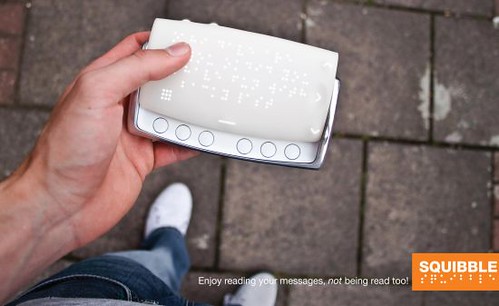
Engadget: Squibble portable Braille interface is clever, beautiful

photo of large pocket-sized electronic device with a braille display and a series of buttons. Captioned Enjoy reading your messages, not being read to!

Braille Blocks

children's style colourful wooden blocks with the letters of the alphabet printed on them in Braille and Roman

Recommended Reading for January 1st

Warning: Offsite links are not safe spaces. Articles and comments in the links may contain ableist, sexist, and other -ist language of varying intensity. Opinions expressed in the articles may not reflect the opinions held by the compiler of the post.

The Deal with Disability: Letter to Invacare

When I called to discuss this matter and get an email of someone in customer service, I was informed that you don’t have a customer service or email and the only way to file a complaint was verbally. This is impossible because my disability renders me NON-VERBAL.

UPI.com: College appeals ruling on disabled student

Oakland University in suburban Detroit says it’s appealing a court ruling that it must allow a cognitively impaired, non-degree student to live on campus. The Rochester, Mich., school says student Micah Fialka-Feldman can live on campus during the appeals process.

“The issue is a bigger issue than just Micah,” university spokesman Ted Montgomery told the Detroit Free Press. In a statement Wednesday, the university said the judge’s ruling “does not satisfy the legitimate interests of the university’s matriculated, degree-seeking students.”

ABS-CBN News: Senate OKs bill empowering persons with disabilities

MANILA, Philippines – Sen. Pia S. Cayetano has welcomed the passage by the Senate of a proposed measure that seeks to give a voice in local governance to the country’s estimated 9.7 million persons with disabilities (PWDs).

Senate Bill No.3560, otherwise known as “An Act establishing the institutional mechanism to ensure the implementation of programs and services for persons with disabilities in every province, city and municipality,” was approved unanimously on second reading by the Senate on December 16 before going on a four-week recess.

New York Times: Seeking a Cure for Optimism

Recently, a number of writers and researchers have questioned the notion that looking on the bright side — often through conscious effort — makes much of a difference. […]

A study published in the November-December issue of Australasian Science found that people in a negative mood are more critical of, and pay more attention to, their surroundings than happier people, who are more likely to believe anything they are told.

“Whereas positive mood seems to promote creativity, flexibility, cooperation and reliance on mental shortcuts, negative moods trigger more attentive, careful thinking, paying greater attention to the external world,” Joseph P. Forgas, a professor of social psychology at the University of New South Wales in Australia, wrote in the study. […]

[Barbara L. Fredrickson, a psychology professor at UNC] cautions that the idea of “fake it till you make it” can actually be harmful to one’s health. “What my research shows is that those insincere positive emotions — telling yourself ‘I feel good’ when you don’t — is toxic and actually more harmful than negative emotions.

The Washington Post: Military helps families find care for special-needs kids

The Poway Unified School District near San Diego offered Driscoll’s 11-year-old, Paul, the support of an aide for 10 hours a week — fewer than half the 21 hours Fairfax County had provided and said he deserved under federal law.

“They slashed his services in half and said, ‘We believe this is comparable,’ ” Driscoll said.

Pink News: HIV experts call for declassification of transgenderism as mental illness

An international meeting of experts on HIV has called for transgenderism to be reclassified as a medical condition, rather than a mental illness. […] It argues that trans people would then escape the stigma of mental illness that is frequently attached to them.

[editor’s note: Wouldn’t it be nice for there to be no stigma associated with mental illness? And for being transgender just being another way of being, with all management options accessible to people who need them, without having to wrangle verbosely about whether it’s ‘abnormal’ or not?]


[Re-edit Jan 2: This post is absolutely not an invitation to desultory debate on whether or not you think being trans really is a disability. I had thought my previous note made that clear, but apparently not.]

Recommended Reading for December 31

Warning: Offsite links are not safe spaces. Articles and comments in the links may contain ableist, sexist, and other -ist language of varying intensity. Opinions expressed in the articles may not reflect the opinions held by the compiler of the post.

Action Item for Europeans: European Network on Independent Living: Free Our People Now! Signature Campaign

Across Europe, thousands of disabled people still spend their lives inappropriately and unjustifiably segregated from society. With a severe lack, or complete absence, of community-based services in many European countries, untold numbers of people with disabilities have no access to quality alternatives to institutional care.

The segregation of people with disabilities in long-stay residential institutions is in itself a violation of disabled people’s human rights.

meloukhia at this ain’t livin’: Whedon’s Brunettes

It’s not enough that the Disturbed Brunette be fragile and dependent on others, she must also be unstable, and that instability must reveal tremendous danger.

Mustang Bobby at Shakesville: 2-D or Not 2-D…

But seeing a 3-D movie with the glasses would be a lost cause; I suspect that it might even make me nauseous as my brain tries to process the image from one lens to the other.

So if I go see Avatar, it will be the 2-D version. At least the studio had the courtesy to release that version so those of us without the software upgrade can see it. I just hope they don’t decide that all movies have to be done in 3-D. I may just have to go back to my BetaMax.

Amanda Kloer at Change.Org: Should Disabled Workers Be Paid Less Than Minimum Wage?

The minimum wage might have been bumped up to $7.25 an hour in 2009, but that number means little to the over 300 workers with mental disabilities working at state-run homes for the people with disabilities in Iowa. That’s because they were making, on average, $0.60 per hour for their work. One employee was even making an average of a mere $0.11 per hour, a sweatshop-level wage in any country. Yet paying employees with mental disabilities piddling wages is legal in Iowa and the rest of the country.

IPS News: RIGHTS-LAOS: Lapses with Labour – Part 2

“Most workers have limited knowledge, ultimately you don’t know how many hidden killers are in your workplace. The boss knows, but he won’t tell you,” Wang Fengping, an engineer who was once employed by Hong Kong-based Gold Peak batteries at their factory in Guongdong, China.

In 2008, Wang was unable to walk. Her kidneys had failed and she was dependent on dialysis. According to medical opinion she was unlikely to make old age. […]

The expertise does not exist to monitor the factory, nor to test the workers. Exposure limits, and the protocols needed to achieve them, are similarly absent. Detailed sex disaggregated accident or exposure reporting does not occur. There is little outside the capital a worker can do if dismissed for illness. All that is known is that some women have complained of headaches and skin rashes.

Laos like many countries is prey to development imperatives that put investment before safeguards. The New Economic Mechanism of 1986 opened the nation to foreign investment, a consumer economy and the trappings of modernisation, particularly in the cities.

Stars and Stripes: USS Cole bombing survivor dies in Fla. home

U.S. Navy Petty Officer 3rd Class Johann Gokool lost his left foot when a bomb ripped a hole in the side of the USS Cole nearly a decade ago, but the injury was nothing compared with the mental torment that ravaged him almost daily. […]

One of the brothers he lived with found him dead in their home last Wednesday, just a week after his 31st birthday, Natala Gokool said. His cause of death was unknown, though she said foul play was not suspected. The family believes the seizures just became too much for his body to handle.

Cape Cod Times/AP Wire: Now hear this: Swim-proof hearing aids to get test

Today’s newest models range from the completely invisible – it sits deep in the ear canal for months at a time – to Bluetooth-enabled gadgets that open cell phones and iPods for hearing-aid users. Now the maker of that invisible hearing aid is going a step further – attempting a swim-proof version.

Recommended Reading for December 30: Bumper midweek edition

Warning: Offsite links are not safe spaces. Articles and comments in the links may contain ableist, sexist, and other -ist language of varying intensity. Opinions expressed in the articles may not reflect the opinions held by the compiler of the post.

Action Item for USAns: Cripchick: human rights abuses in public schools

these are practices that are rightfully considered torture if done to prisoners but ones that still happen in our public schools. disabled youth are targeted every day for things like hand flapping and speaking out.

recently, a bill has been introduced in congress that addresses restraint and seclusion. […] right now this bill is in need of sponsors… please use this form to contact your congressman or via congress.org asap and let them know that you will not stand for human right abuses in our schools.

IPS Laos: How Women Cope With Disability – Part 1. Lacking any social supports and ditched by family, Lao women with disabilities create work & home for themselves:

In a family of 12 children, the illness [polio] came as huge blow.

When they found she could not walk, the reaction was one commonly held, she said. Attempting to protect her from taunts and embarrassment they refused to let her go to school. In frustration, she stole her sister’s uniform and turned up at school. The teacher was impressed and called on her parents to educate her.

Her parents were reluctant, insisting she learn to sew at home so she had a source of income. She did learn, but by dogged persistence attended school, eventually earning a BA, majoring in Business.

“Education for women is the key. In the old days they believed that disability was caused by something bad you did in a former incarnation. That type of thinking is still around but not as strong,” she said.

“The government of Laos has given approval and support to the Convention for the Rights of the Disabled and are currently drafting a decree which will govern national policy,” Chanhpheng said. But there is no social security, no income support for the disabled or their families. In short if you don’t work, you don’t live.

Haddayr Copley-Woods at MPR News: Insurance may pay for your wheelchair, unless you need it to go someplace

The people making decisions that will affect our day-to-day lives are people like Missouri’s junior Democratic senator, Claire McCaskill — who said a few months ago that we could save the government “hundreds of billions of dollars” by not “giving free scooters to Medicare beneficiaries who don’t really need them.” […]

I had to prove I needed it to help me eat, sleep and use the bathroom. That’s about all the federal government — or my insurance company — thinks I need to do.

Let me lay it out for you. Here is what this policy, and my own government, are saying:

Disabled people shouldn’t work. They certainly can’t support their families, but if they do, that was bad planning.

Disabled people shouldn’t parent — or at least not in public. Why did a defective person like you have kids in the first place?

It doesn’t matter if disabled people volunteer. You’ll just look weird and creepy and be in everybody’s way.

All a cripple needs is to get from the ‘fridge to the toilet to the bed. It’s all you deserve, and it’s all you’re good for.

News Herald Panama City: No scooters allowed at St. Andrews State Park — yet

Jessica Kemper Sims, information director for the Florida Park Service, confirmed the use of motorized scooters, even for the handicapped, is prohibited on state beaches.[…]

Sims said a non-motorized “beach wheelchair” was available free of charge at the Jetty store at St. Andrews State Park and the wheelchair “is used frequently.” Those wheelchairs are not motorized and “require the assistance of another person to be pushed through the sand,” Sims wrote.

KETV Omaha: Disabled Woman Waits For City To Clear ‘Lifeline’ [hat tip to ZeaLitY]

A disabled woman has been trapped inside her home since the most recent snowstorm while the city tries to figure out a method for clearing an alley that serves as her lifeline to the city.

NPR: Intellectually Disabled Student Wins Dorm Suit

[Micah] Fialka-Feldman, 24, attends classes at Oakland University, as part of a program for students like him, with intellectual disabilities. The campus is about 20 miles from where he lives with his parents in Huntington Woods, Mich.

A few years ago, Fialka-Feldman helped his younger sister Emma move into her dorm room when she went off to college at Mount Holyoke. It gave him another reason to want to live on campus: He thought he was missing out on an important part of college life. But his school said because he was in a special program and not a full-time student, he couldn’t live on campus.

So Micah sued.

Early yesterday morning, his cell phone rang. It was his lawyer with the news: He had won. “I’m happy and I’m proud,” say Fialka-Feldman.

Charlotte Observer: Judge backs lawsuit by disabled pair for independent living

A federal judge Monday prohibited the state and a local mental health management office from cutting services to two Wilson-area people with mental illness and developmental disabilities until they get a full hearing on their lawsuit seeking to continue independent living.

U.S. District Judge Terrence Boyle said it’s likely that two residents identified in the lawsuit as Marlo M., 39, and Durwood W., 49, would suffer irreparable harm if a local mental health office went through with a money-saving plan to move them from their apartments.

And, to wind up, a collection of links on race disparities and the US health & health care debates. Check them all out.

MPR News: Racial disparities a concern in health debate

Sonia Sekhar at The Wonk Room: Racial and Ethnic Minorities’ Stake in Health Reform

Tapped: Health Reform: Race And Representation.

bfp at flipfloppingjoy: Pet Peeve Saturday

mama at guerilla mama medicine: canary in the mine

Recommended Reading for December 29

Warning: Offsite links are not safe spaces. Articles and comments in the links may contain ableist, sexist, and other -ist language of varying intensity. Opinions expressed in the articles may not reflect the opinions held by the compiler of the post.

Wheelchair Dancer: Charity, One Non-Person At A Time

I am angered by the exploitation of individuals for organizational support. In part, I know that this is “how it’s done.” A local organization whose facilities and services I use called me to “get my story.” They were going to use me for fundraising. I was on the phone for half an hour; the interviewer struck me as greedy. Greedy for the details of my tragedy and overcoming. Greedy for the story of my pain and recovery. I didn’t have a good feeling about this, but I hung in.

Then, my interviewer dropped a bombshell.

Astrid at Astrid’s Journal: Care Packaging for the Blind

Even though even mildly disabled people with visual impairments, may have difficulties with domestic care and organizational tasks that require access to information, if you can carry out your own personal care, all you are supposed to need is some “help” (which the hours you’re approved for are not enough for), “stimulation” and “guidance”. Have the people who created this guide, ever met a single blind care user, who could explain to them their real care needs?

Media Access Australia: Social Media Accessibility Review [note that MAA focuses on sensory disabilities]

Media Access Australia has ranked the following services in order of accessibility:

1. Facebook: Facebook has made great efforts to include a wealth of accessibility features and is a good choice for people with disabilities.

2. Skype: Skype has delivered an accessible product, but they must be conscious that new versions maintain the good work done to date.

3. YouTube: YouTube has put a lot of work into the accessibility features of their site and this has been backed by a recently launched centralised accessibility portal offered by Google, YouTube’s owners.

4. Flickr: Flickr is only somewhat accessible. It still has some way to go before the site will be open to all users, but the launch of an accessible lab shows promise.

5. Twitter: Twitter has grown rapidly over a short period of time and the site has fallen short of introducing a number of easy to install accessibility features.

6. MySpace: MySpace is an inaccessible site. It has failed to deliver an accessibility policy and has no evidence of accessible design built into the service.

BBC: Rape complaint woman reaches settlement with police [WARNING]

In the first known case of its kind, a woman who made a rape complaint which was not investigated properly has reached an out of court settlement with police. Catherine says the man who raped her knew he was targeting a particularly vulnerable woman. […]

Catherine first spoke to the police in December 2005. In February 2006, she contacted them to find out how the investigation was going. Nothing at all had been done. It hadn’t been recorded as a crime.

A sergeant later said that the paperwork had been on his desk and he had forgotten about it.

Center for American Progress: How to Close the LGBT Health Disparities Gap

Furthermore, many LGBT people face outright hostility from their health care providers. One of the few existing studies of the transgender community shows that up to 39 percent of all transgender people face some type of harassment or discrimination when seeking routine health care.

Similarly, a general lack of data on LGBT people makes it difficult for doctors and other health care providers to learn about the LGBT population’s needs. This lack of information and data is reflected by the fact that most medical schools do not offer any coursework or instruction on the health needs of LGBT people.

The Globe and Mail: Nearly 50 MDs back doctor alleged to have abused welfare food forms

“A ruling against Dr. Wong would result in physicians becoming far more cautious in how they fill out the forms … and the end result from that, of course, will be less money being available to people living in poverty to be able to meet their basic needs,” said Toronto family physician Gary Bloch. […] Ontario’s special diet program allows people on social assistance to get extra money for special dietary needs if they have diabetes or celiac disease, or are obese.

Recommended Reading for December 28

Warning: Offsite links are not safe spaces. Articles and comments in the links may contain ableist, sexist, and other -ist language of varying intensity. Opinions expressed in the articles may not reflect the opinions held by the compiler of the post.

* ACTION ITEM for USAns: Corina Becker at No Stereotypes Here – Neurodiversity activist blog: Youngest Autistic Nominee on National Council on Disability

Not too long ago I posted the Press Release from the White House announcing that Ari Ne’eman of the Autistic Self Advocacy Network has been nominated by President Obama to the National Council on Disability. […] If you haven’t gathered from all the ruckus that’s being made across the Internet, this is a big deal, for two reasons:

The first is that he is the first openly autistic appointee, breaking the unsaid barriers keeping autistic people from being a part of the decision process regarding, well, everything about our lives. This marks a major step in the inclusion of autistic people as a part of society, not just in terms of social inclusion, but also on the political and governmental level, and recognizes us as citizens of the countries we live in, with the rights, freedoms and responsibilities that being a citizen includes. […]

Yet, because he doesn’t see autism and disabilities as an automatically negative element, but instead as a person’s difference that can result in unique challenges and difficulties in a setting that is ill-suited to accommodate and support individuals, there are groups out there who would rather Ari not be a member of the NCD. Actually, that’s a bit of an understatement; they are venomously against Ari and the neurodiversity movement of thought.

But of course, for returning readers of this blog, this really should not be a surprise. And of course, these people are exercising their right of free speech and protestation to encourage people to write to their Senators, stating that they are against Ari.

Now, this is up to each of you, but I would ask people who support Ari, even marginally, to contact their Senators and give them a balanced view on this, in that there are members of the autistic and cross-disability community who support Ari.

Sarah at Cat in a Dog’s World: On Failing Girlhood: Thoughts on Gender & Disability

My own pale legs bore thick, dark hair well into my teens until someone informed me that my body’s natural hair was in fact repulsive and needed to be removed from sight. My mother said I looked like a European woman, and I’m still not sure how that is entirely a bad thing. Of course, all methods of removing said body hair involved unpleasant sensory input and required that I pay more attention to such things than I felt at all inclined to do.

io9: 20 Science Fiction Characters Who Got Their Legs Back

Chances are, you’ve come across lots of SF stories where a disabled person regains the ability to walk in some fantastical way. Usually it’s a guy, and his ability to stand up on his two legs is portrayed as a reclaiming of his virility and power. Often times, the disabled hero regains full mobility along the way towards becoming super-powered — or as part of a package of superpowers.

Express.co.uk: Outrage at £250 Tax on Mobility Scooters

CAMPAIGNERS are today launching a fresh attempt to reverse a £250 EU tax which puts mobility scooters in the same class as Formula One racing cars. […]

Equipment for the ­disabled is normally exempt from tax.

Spearheading the latest attempt to overturn a tax that classes scooters as ­leisure vehicles like racing cars and so attract a 10 per cent import duty, is Scottish Parliament MP Bill Wilson.

Denver Post: Greene: Colo. funding decision stymies disabled supermom

At 38, she’s deaf and legally blind, though you’d never know it. She has a progressive neuromuscular disease that requires her to use a ventilator to breathe and a wheelchair to get around. She’s a talented lawyer and leading advocate for disabled parents in Colorado. She has adopted three daughters of her own, all with disabilities. And she’s raising a 15-year-old foster child who faced adolescence institutionalized until Lucas brought her home to Windsor, where she’s now thriving. […]

Lucas, no doubt, will cringe at being described in such superlatives, the embodiment of the untiring supercrip. Getting to work, getting things done and getting home each day are her life, real life, however rewarding or difficult. It’s what she does, just like the rest of us.

The state apparently takes a different view.

On Dec. 3, Lucas underwent surgery to insert a tracheotomy in her neck. The tubing gets blocked and disconnected, especially when she’s sleeping. Before the trach, Medicaid had paid $7,762 a month for an aide 12 hours a day who helps Lucas bathe and dress, tend to her health care needs and run her busy household. The state agreed to boost her allocation to about $15,000 to pay for the 24-hour care she now needs to make sure air is pushing into her lungs. But officials wouldn’t authorize payment, seeking instead to place her in a nursing home indefinitely.

Voice Of America: Sailors With Disabilities Ready to Tackle Classic Australian Yacht Race

Blind and paraplegic sailors as well as others with physical disabilities will crew a boat in one of the world’s great ocean events, the annual Sydney to Hobart yacht race. The race, which starts on Saturday, is one of the toughest competitions of its kind anywhere.

Berkeley Daily Planet: Caltrans Settles Class Action Disability Access Lawsuit

In a landmark achievement, Caltrans announced Tuesday a billion dollar settlement agreement with disability rights advocates to improve sidewalk access.

Recommended Reading for December 25

Warning: Offsite links are not safe spaces. Articles and comments in the links may contain ableist, sexist, and other -ist language of varying intensity.

* Bev at Asperger Square 8: How the Grinch Tried to Steal Autistic Self-Advocacy

Each autistic person deserved life a lot…
But the Grinch, who lived outside of Reason,
Thought NOT!
The Grinch hated autism, every season
He liked to chelate cats and give dogs HBOT.

He thought all he could with his tiny green head
About how to prove they’d be better off dead
Until it occurred to him how to derail
Every self-advocate, make them all FAIL. […]

* Liz Spikol at The Trouble with Spikol: Human Rights Violations at Psychiatric “Hospital”

If you haven’t heard of investigative reporter Anas Aremeyaw Anas, that’s a shame. I hadn’t heard of him either until Joe sent me a link to his latest expose on an inpatient facility in Accra, Ghana.

* Kenguru: The Car You Have All Been Waiting For (via Uppity Crip)

The first ever electrically powered vehicle designed especially for wheelchair users will become available in the UK soon.

– Driven directly from a wheelchair – access is via the rear-opening tailgate and steering is by motorbike style handlebar (joystick option will be available in time). Your own wheelchair is secured within the car by an interlocking device

– The current design allows parking rear end to the pavement for easy access and it is an ideal solution to drivers who only undertake journeys to local shops and services

– Because of its weight the Kenguru is classified as a scooter and therefore only a scooter driver’s licence is required to drive Kenguru

A little yellow car is parked rear end to pavement. A person in a wheelchair is entering the car via the rear ramp.

* The West: Wasps put sting in wheelchair sports

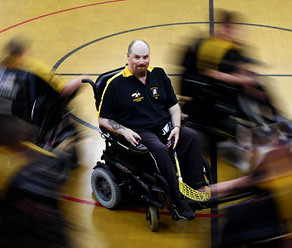
Adam Hart is a battle-hardened veteran of his sport. The 34-year-old is in training to represent WA in the National Electric Wheelchair Sports competition – for the 19th time.

A bearded man in an electric wheelchair on a court, holding a hockey stick in his hand. People in wheelchairs are whizzing around him, blurred from movement.

* High Gloss Blue: This Is GOOD Design: An Accessible Treehouse

Located around the corner from Atlanta in Rutledge, Georgia, every summer Camp Twin Lakes welcomes kids with special illnesses, disabilities, and other challenges that would exclude them from partaking in this most celebrated summer ritual elsewhere.

A wooden camp house in amongst the trees. There are ramped entrances, and a spiral slide out the other side.

Recommended Reading for December 24

Warning: Offsite links are not safe spaces. Articles and comments in the links may contain ableist, sexist, and other -ist language of varying intensity.

* Arachne Jericho at Tor.com: Post-Traumatic Stress Disorder in Fiction, Part 1, Part 2, Part 3, and Part 4

A survey of the tropes, stereotypes and more realistic portrayals of PTSD on the page and screen, from The West Wing to Lord of the Rings.

* haddayr at no_pity: “I don’t really expect much of YOU . . .

“I sometimes use a wheelchair,” I told her, and I started to explain that some people with osteoporosis who seem fine are in danger of falling, and some people with emphysema need scooters, etc., but she interrupted me.

“Well,” she said. “You have MS. I don’t expect much of YOU.”

And then, when she saw the look on my face and after I said: “Well, I certainly expect much of myself,” she said: “I don’t want to be politically incorrect!”

* Asahi.com: EDITORIAL: People with disabilities

The government established a policymaking committee where more than half of all the members will be people with disabilities. The committee is headed by Prime Minister Yukio Hatoyama.

The committee’s first job is to consider comprehensive new welfare legislation to replace the Services and Supports for Persons with Disabilities Act, which the Hatoyama administration has pledged to rescind at an early date. The law, which came into force in 2006, has proved very unpopular among people with disabilities. That’s because of the requirement that people with disabilities should, in principle, pay 10 percent of the costs of the welfare services they receive.

* Steve Carter at Examiner.com: Disability discrimination claims are up by 10%, EEOC expects continued increase [see also law.com: EEOC Will Get $23 Million to Reduce 70,000-Case Backlog]:

The number of disability discrimination claims filed with the U.S. Equal Employment Opportunity Commission increased more than 10 percent last year, and that number is expected to grow in 2010, thanks to the ADA Amendments Act. […] The commission said the Lilly Ledbetter Fair Pay Act also brought more charges. […] The Genetic Information Nondiscrimination Act, which became effective in November, is also likely to increase the number of complaints filed next year, as is the possible passage of the Employment Nondiscrimination Act, which would prohibit discrimination on the basis of sexual orientation and gender identity.

* AdelaideNow: Disabled children forced to wait ‘years’ for essential equipment

Novita Children’s Services states there are already 400 children waiting for 700 pieces of equipment and a support group says some parents are in “total despair” over the growing problem.

The average waiting time for children is 40 weeks, but varies depending on the type of equipment.

* The Age: New building rules to improve accessibility

All new homes would be built with features designed to make them more accessible to the elderly and those with disabilities, under proposed building rules for Victoria.

The changes would include a clear path from the street to an entry, wider doorways and halls, a toilet suitable for people with limited mobility and reinforced bathroom walls for grab rails.

* AFP/Google: TV presenter sorry for calling Boyle ‘retarded’

On Monday Television New Zealand upheld complaints against Henry and the broadcaster said he never intended to offend people with disabilities.

“I am sorry that some people have taken what I said in a way that I never intended,” Henry said.

In the original broadcast, Henry quoted from a magazine article which said Boyle was “starved of oxygen at birth” and suffered an intellectual disability. “If you look at her carefully, you can make it out,” Henry told viewers.

* Voxy.co.nz: Banking Services For Older And Disabled People Improved

The main areas covered by the guidelines are:

improving access to banking services including initiatives such as low tables and teller counters, user-friendly ATMs, meeting spaces and queuing aisles able to be used by wheelchairs, power assisted entry doors, layout and signage suitable for customers who are partially sighted staff, training to cover disability awareness including spotting signs of financial abuse, express tellers and queuing by numbers, observing international W3C web accessibility best practice standards, and easy to read information in alternative formats, including easy read, large print, Braille, DVD, including NZ Sign Language, and audio.

The voluntary guidelines will be reviewed in three years.