All posts by Anna

QuickPress: Con_or_Bust!

I should have mentioned earlier!

For the second year in a row, the Con_or_Bust fundraiser is running. Organized by Kate Nepveu, it’s a fundraiser to help fen of colour make it to WisCon, the world’s largest Feminist Science Fiction/Fantasy Convention.

Learn more about the fundraising auction.

How fen of colour can request assistance.

The auction itself.

Bidding is in U.S. dollars unless otherwise specified, and there is some awesome stuff up for grabs.

WisCon is noted for having a very good accessibility policy.

(Other than having attended WisCon last year, and having a few bids for things, I have no affiliation with Con Or Bust. You’re best to ask any questions or make any comments to Kate.)

QuickPress: Event at McMaster University in Canada

“Supporting access to post-secondary education and employment for students
with disabilities”

All Abilities Awareness Week will take place at McMaster University, The Pulse centre, from March 1st to March 5th. The week has been designed to promote active living for people with disabilities, increase awareness in the general campus population of disability issues and provide information regarding disability services and supports on McMaster’s campus and in the community. There will be a focus on the upcoming Winter Paralympic sporting events and the Special Olympics. Paralympic athletes Jessica Tuomela, Darda Sales and Victoria Nolan will speak on Monday, March 1 to open the week. Other activities include an intramural wheelchair challenge and display tables with information on services for persons with disabilities.

For further information on the schedule for the week contact Disability Services at McMaster University: (905) 525-9140, ext. 24339.
http://www.neads.ca/en/about/events/index.php?id=187

Erasing History

[A version of this post appeared at my personal blog.]

I’m reading The Great Cat Massacre and Other Episodes in French Cultural History, by Robert Darnton. I’ve just finished the first chapter, which makes some interesting arguments about folk tales and their use in determining what non-elites/peasants thought about… well, anything in a time period where most of them lived nasty, brutish and short, unrecorded lives.

His argument is basically that one cannot just look at folktales – whether raw, or prettied up for modern audiences, or in translation or whatever – and determine much of anything. Instead, one needs to do two things: First, one needs to look at all the surviving folktales, all the variations, and pick up the themes. Second, one needs to compare those themes to the themes one gets from folktales in other regions. It’s only in the comparison of themes that one can sort anything, and even then it’s feeling around in the dark and hoping you can sort out the elephant from the cake.

ANYWAY, what I find very interesting (as an historian who looks for hints and tips of history of disability) is where people are totally talking about disability while at the same time dismissing it or not even acknowledging it.

It’s problematic, of course, to try and apply our modern notions of disability to the past and call it good. Even the concept of disability didn’t really exist the way it does now until sometime around the industrial revolution, and there are tons of examples of people being described by contemporaries in ways that modern audiences would consider “disabled”, but that’s never anyone’s concern. So, you’ll read in the past people described as taking to their beds for months at a time, having tics and the like, but no one remarks on it as anything other than just how that particular person is.

So, in a more formal review of A Midwife’s Tale, I wrote this:

There are ten references that could be read as an opportunity to discuss mental health in A Midwife’s Tale. Ulrich mentions four people who are considered insane by the people around them – John Howard is described on page 67 as having “sank into hopeless insanity”; Rebecca Foster is “mentis inops” according to a letter outlined on page 127; and both Tabitha and Mary Sewall are described by Ulrich as suffering from “mental illness” or derangement on page 260. Three people commit suicide, including James Purrington. One of Ballard’s patients seems to suffer from post-partum depression, while Ballard herself describes her mental state as one that reads as familiar to many people with depression on page 226.

There are a variety of reasons the author might not have gone into that discussion – the one I think is going on is that the book was published in 1990 and there was even less discussion of disability in history then than there is now – but it did stand out to me.

The Great Cat Massacre does something a bit different though, at least in the first chapter.

In describing what French peasant did when hard times were really hard, Darnton writes:

…life on the road meant ceaseless scavenging for food. The drifters raided chicken coops, milked untended cows, stole laundry drying on hedges, snipped of horses’ tails (good for selling to upholsterers), and lacerated and disguised their bodies in order to pass as invalids wherever alms were being given out. … They became smugglers, highwaymen, pickpockets, prostitutes. And in the end they surrendered in hopitaux, pestilential poor houses, or else crawled under a bush or a hay loft and died…

(pg 26)

Yes, of course Darnton. You describe a life of abject misery and back-breaking labour, so obviously people faked being disabled all the time.

Throughout this first chapter he says things like (in describing a folktale) “…two discharged soldiers draw lots to see which shall have his eyes put out. Desperate for food, they can think of no way to survive except by operating as a team of beggars, the blind man and his keeper” (pg 38), describes Simple Simon as “the harmless village idiot” (pg 40), talks about Rapunzel’s lover being blinded (pg 52), and witches adding additional hunches to hunchbacked beggars just because (pg 53).

And yet, obviously people faked being disabled all the time. Because there was nothing going on that might lead to actual disabilities.

I know, it’s a throw-away comment in a book originally published in 1984 (disability-focused history is more accepted now – we even have an association), but it bugs me. It’s not a unique occurrence, and it’s difficult to know quite how to respond.

For me, of course, the thing it does most is highlight people’s biases. When I previously tried to discuss this in a class, I could not actually get the professor to understand my complaint. “But people do fake disabilities all the time!” was her response, and there are only so many hours in a day one can give towards advocacy work.

But people with disabilities are quite common in the literature, if you actually pay attention to it.

Related:

Disability Social History Project
Disability Studies, Temple U Blog
Greg Carrier on Medieval Disability
Debilitas Mentis

QuickPress: Asian Women’s Carnival!

Went up on the 15th.

asian women blog carnival #5: who i am when i’m (not) with you

One of the big things for me in presenting as an Asian woman is that when I think of my identity, and of my performativity, I don’t think ‘Asian,’ I think ‘Chinese’ and I think ‘Malaysian’ and I think ‘mixed-race’ and I think ‘Caucasian.’ So when I was compiling these amazing posts by these great Asian women, I thought about indicating their ethnicities – just about every one of them mentions their ethnicity in their posts (myself included). But part of performativity is choosing how we represent our identities, and our ethnicities. This edition of the carnival is, after all, about how we choose to present as Asian women. So instead of describing the posts, for the most part, I’ve simply excerpted from them.

We are who we are, but we’re not always how you see us.

I’m not here for your inspiration

I think I upset one of the newer employees at my favourite tea shop today. Most of the staff are used to my cynical reactions to newspaper discussions of how inspiiiiiiiiiiring people with disabilities are at this point.

But let me begin at the beginning.

Actually, no, let me begin with something important, since recent events have told me one cannot be too careful.

There is a certain way news media prefers to talk about people with disabilities. They like to tell our stories in a way that’s “inspiring”, that’s about making non-disabled people feel better about stuff. “Oh, look at how brave that person is, being all alive and stuff despite having a disability! I would rather be dead! That person/their parents/their loved ones are so brave and inspiring! I will now put issues of accessibility and disability out of my mind, because I have been inspired!”

These stories aren’t really about people with disabilities. They’re about making currently non-disabled people feel they know something, that they’ve been touched, that their lives could be suffering and badness, but look how lucky we all are. Look at the plucky crippled person, and be inspired. [This is, of course, why Helen Keller is reduced to “hand in water” stories.]

There are, of course, reasons why people with disabilities and their families participate in these stories, and I certainly don’t blame them. I know if someone offered to interview… wait, I’ve been interviewed a few times now about disability, and I did leap at the chance. I don’t think that people who are interviewed for these stories are doing anything wrong. They’re talking about their lives, and describing their experiences. No, it’s the way that these things are spun, the words being used by the reporters to fill in the gaps, that is the problem.

The tendency is so very very wide spread that Haddayr (with the help of Codeman) made a bingo card for us all:
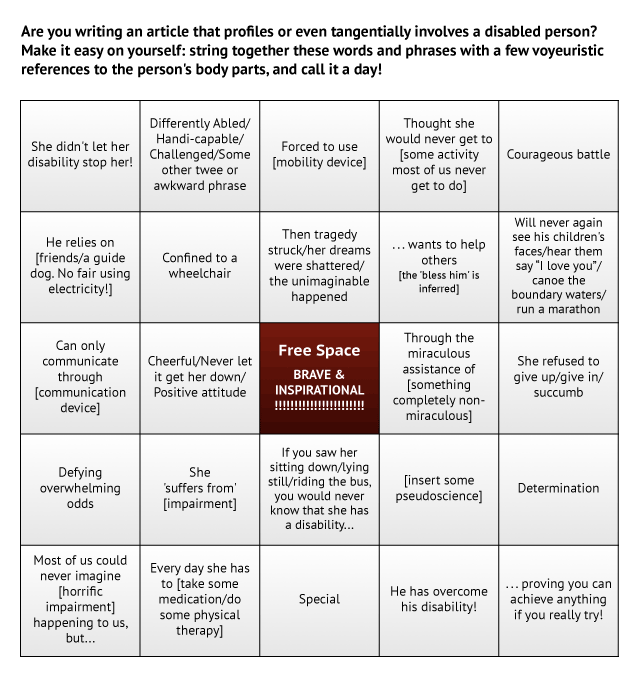
Description follows

Description written by Haddayr:
Are you writing an article that profiles or even tangentially involves a disabled person? Make it easy on yourself: string together these words and phrases with a few voyeuristic references to the person’s body parts, and call it a day!

She didn’t let her disability stop her!
Differently Abled/Handi-capable/Challenged/Some other twee or awkward phrase
Forced to use [mobility device]
Thought she would never get to [some activity most of us never get to do]
Courageous battle
He relies on [friends/a guide dog. No fair using electricity!]
Confined to a wheelchair
Then tragedy struck/her dreams were shattered/the unimaginable happened
. . . wants to help others [the ‘bless him’ is inferred]
Will never again see his childrens’ faces/hear them say ‘I love you’ canoe the boundary waters/run a marathon
Can only communicate through [communication device]
Cheerful/ Never let it get her down/ Positive attitude
Free Space:
BRAVE & INSPIRATIONAL!!!!!!!!!!!!!!!!!!!!!!!
Through the miraculous assistance of [something completely non-miraculous]
She refused to give up/give in/succumb
Defying overwhelming odds
She ‘suffers from’ [impairment]
If you saw her sitting down/lying still/riding the bus, you would never know that she has a disability…
[insert some pseudoscience]
Determination
Most of us could never imagine [horrific impairment] happening to us, but…
Every day she has to [take some medication/do some physical therapy]
Special
He has overcome his disability!
. . . proving you can achieve anything if you really try!

So, let’s go back to my story.

I haven’t been following anything to do with the Olympics for reasons I won’t go into here, but I knew exactly what was going on when I glanced at Saturday’s Globe & Mail and saw this splashed across the front:

A Different Victory: When Alex Bilodeau’s brother cheered his gold, the triumph went more than one way. The skier and the painter find inspiration in each other – and neither one accepts limits. Ian Brown travels to the intimate heart of a family.

“Oh gosh!” I said to Don, in my overly chirpy sarcastic voice. “It’s going to be an inspiring crip story, I just know it! Quick, let us purchase this fine newspaper so we can be inspired!”

Poor dude behind the counter proceeded to tell me how inspiiiiiiiirng he found “the brother of the guy who won gold”, to which my response was… less so. “Inspiring crip stories irritate the fuck out of me.”

You know what would inspire me, gentle readers? Curb cuts being cleared of snow so Don & I could get across the street without having to go three blocks out of way first. But I guess when you’re a bitter, cynical, angry person who just hates fun, that’s what you get.

Sadly for all of us, Ian Brown’s articles don’t seem to appear on the Globe & Mail’s website (except perhaps behind the paywall), so I can’t let you read the inspiriiiiiiing story of Frédéric Bilodeau, but I can show you a BINGO card that Don & I filled out while we read it.
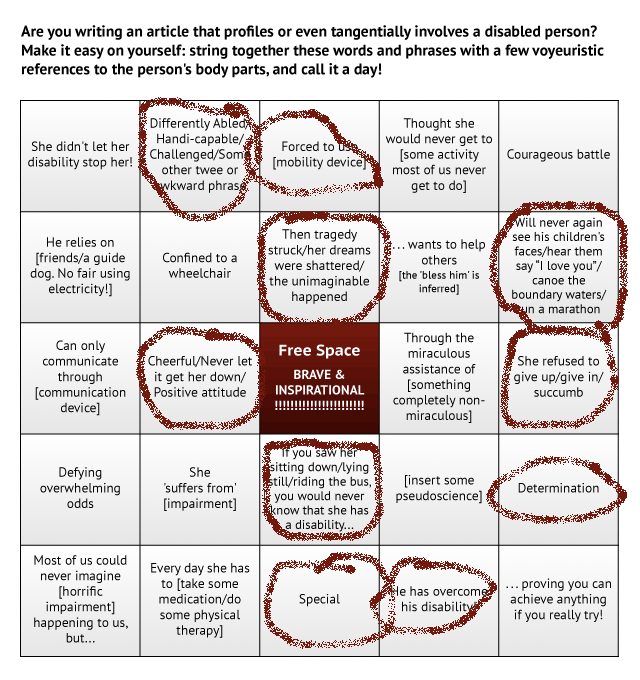
Description follows

Description: As above, but with the following squares circled:
Differently Abled/Handi-capable/Challenged/Some other twee or awkward phrase
Forced to use [mobility device]
Then tragedy struck/her dreams were shattered/the unimaginable happened
Will never again see his childrens’ faces/hear them say ‘I love you’ canoe the boundary waters/run a marathon
Cheerful/ Never let it get her down/ Positive attitude
Free Space: BRAVE & INSPIRATIONAL!!!!!!!!!!!!!!!!!!!!!!!
She refused to give up/give in/succumb
If you saw her sitting down/lying still/riding the bus, you would never know that she has a disability…
Determination
Special
He has overcome his disability!

Of course, what Frédéric Bilodeau’s story has actually managed to inspire is awesome comments at the Globe & Mail like this one:

Proud for so many reasons

Alexandre Bilodeau has provided something more than his magnificent gold performance (Gold Comes Home – Feb. 15). He has provided an example of the role that individuals with a disability play inspiring us as they overcome their challenges.

Thank you, Alex and Frédéric.

Brian Smith, Toronto

Mr Smith, with all due respect, we are not here to be your thrice-damned inspirations thank you very much. Be inspired! Lobby the Canadian government to provide funding for all universities to be fully accessible to people with disabilities! That would help lots of people with disabilities overcome their challenges!

The point of this post isn’t “here I am, talking about an article you can’t read, and being as sarcastic as possible, aren’t I witty?”. It’s actually to talk seriously about the way disabled people are written about. We’re allowed to be inspiring stories of overcoming adversity – and often those stories focus on the difficulties our loved ones have, and how hard it can be to have a disabled person in your life – or we can be a passive victim of crime. That’s it.

If new media actually presented people with disabilities as we actually are… well, that, gentle readers, would be actual news.

ETA: facesofcathy found that Ian Brown’s article’s up over at CTV. (Why? I don’t know.) Check it out: The Bilodeaus: Elusive truths from an unforgettable family. I haven’t done a side-by-side comparison of the text (I think the headings are different?) but it look pretty close.

Check out the comments if you like to headdesk over how inspiiiiiiiired people find these types of stories.

We are not to be believed

This post is going to talk in non-explicit ways about the sexual abuse of children with disabilities, and the inclination of people to not believe them.

Writing about the history of people with disabilities is often a process of reading between the lines. Surviving records tend to be written by non-disabled people in positions of power, with the only surviving writing from actual disabled people being those approved of by others.

My specific historic interest is in residential schools for people with disabilities in the Atlantic region of Canada in nineteenth century. I spent a lot of time last year trying to read between the lines, to sort out what really happened in the Nova Scotia School for the Deaf and Dumb when the second principal of the school was suddenly unceremoniously fired two years into his contract, with many records from his tenure there destroyed.

This may seem like an odd thing to bring up right now. Whatever scandal caused the school to fire him – and I argued in my thesis that it was because of his support for a specific method of teaching that was not approved of by the Board of Directors – it shouldn’t matter now. Everyone involved is dead, and the records can’t tell me much when they’ve been cut out of the record book with a razor at some indeterminate point in the past.

We’re trained to look for supporting documents, and I found my way to the New Brunswick Hansard (the recording of speeches in the Legislative Assembly) where Mr Woodbridge is mentioned quite extensively after a law suit was brought against him. I have yet to find the true nature of the allegations, since the men standing up to defend him considered the allegations so spurious, so scandalous, so without merit that they would not even name them, saying only that the girl who had brought the charges – she also was not named – had disappeared, thus proving that the charges were spurious.

For those of us who read narratives of childhood abuse in residential schools, this is a very familiar way of “dealing” with the problem.

I was thinking of this story when many people emailed me the following news report: Ex-students claim abuse at N.S. schools for deaf.

“The children were easily victimized because they were cut off from their families and also really cut off in a sense because of language, so they were perfect victims for sexual wrongdoing,” said Tony Merchant, the Saskatchewan-based lawyer handling the suit.

The comments, as all comments are on any discussion of charges of sexual abuse, are full of disbelieve and distrust.

I think of this, and I think of the distressing results of the only study in Canada that attempted to discover the abuse of people with disabilities in any form of institutionalised “care”. This PDF outlines their results on Page 3. To sum it up: Most people with disabilities, especially women, will be sexually abused in their lifetimes.

And we are not believed.

I look at the destroyed records in Halifax, and at the brief mentions I can find of accusations against Mr Woodbridge in 1886, and the accusations that former students are bringing against the school from the 1950s and 60s, and I wonder, truly, how many more people are not stepping forward because they know they won’t be believed.

ETA: People are discussing very specific and graphic examples of abuse of people with disabilities in the comments.

Pop Culture: The Good Wife & Disability

About two or three weeks ago, I finally got around to noting the existence of the show The Good Wife. And then I watched every episode I could, as quickly as I could, because wow is this show good.

It’s one part legal drama, one part family drama, and one part mysterious conspiracy theory drama. The Wikipedia summary is pretty good: “The storyline focuses on Julianna Margulies as Alicia Florrick, the wife of Peter Florrick (Chris Noth). Her husband has been jailed following a very public sex and corruption scandal. She returns to her old job as a litigator to rebuild her reputation and provide for her two children.”

Except the whole article somehow manages to skip over how feminist the show is. In the early episodes, Alicia has a male coworker who is pretty damn sexist to her, including talking down to her, ignoring what she says entirely, and acting like her being both older and a parent makes her not very smart. Later episodes have her pointing out how she keeps getting shunted aside to “hand hold” clients, which she admits is important but is curtailing her career. And these things are shown as being bad, not as being acceptable because, you know, woman.

The show is filled with interesting relationships between women as well. We’ve got Alicia’s relationship with both her investigator, Kalinda, and one of the managing partners, Diane. Both relationships are complicated by professional needs and the fact that they’re still working in a sexist office environment. Diane is involved in EMILY’s List, and there’s an implication that her “pet project” is looked down on by her male colleagues.

At home, Alicia’s mother-in-law has come in to help care for the kids while she’s working and Peter’s in jail, and their relationship is also complicated, with concerns about parenting and their different views of Peter’s prison sentence.

I just love this show. Love it.

But I’m not just talking about it here because it’s awesome. It also managed to (mostly) side-step some disability fail that I was expecting.

The rest of this is full of spoilers for Season 1, Episode 4, “Fixed”.
Continue reading Pop Culture: The Good Wife & Disability

Accessibility & Sustainable Transportation

Last week I attended a meeting at my university campus regarding sustainable transportation options for the next five to ten years. We’re at an interesting point in time here, as both the transit routes and the university are putting in long-term planning, so we may have a chance to push for real, useful, interesting change that can have long-term impact on both the university community and the greater community.

I would say “Ask me what wasn’t covered at all!” but I’m sure you can all guess – accessibility was never mentioned, even though the initial study into the needs of students, faculty and staff on campus had raised issues of accessibility.

But! Credit where credit is due. I brought this up at the meeting, and then again (as in, ten minutes later) with head of my particular branch of student government, and this afternoon attended a meeting including myself, the president of my particular branch of the student union, and student accessibility services to talk about concerns regarding accessible transport and sustainable transport.

Basically, the topics of conversation were around the fact that we’re a growing campus, we have greater needs regarding getting people to and from campus every day, but we want those needs to be Green in focus. The initial meeting I attended last week focused on things like faculty bus passes, incentives to car pool, and what encourages people to walk or bike to campus.

What we talked about today were more focused ideas that were inclusive of people with physical and sensory disabilities. I wanted to talk about this here, because I have no illusions: Even with student accessibility services there, we were still only talking from a limited perspective. I focus a lot on mobility needs, and more specifically on the needs of people using wheelchairs, for reasons I think are obvious, and the gentleman from student accessibility services then focused a lot on issues around students with low-vision, or who are blind.

I figure I’ll use our meeting for a greater discussion here. I want to both bring attention to others about sustainable transportation conversations and how to include concerns about accessibility and people with disabilities in them, but also I want to have more feedback and input. There are new students every year, new faculty who may have different issues regarding transportation and accessibility. The more we talk, the more we collectively can ask for things that will aid as many of us as possible.

Things that were brought up:

– Sidewalks. We talked about how horrible they are around the university, although this is pretty universal in our city. SAS brought up the needs of students who are low-vision or blind about sidewalks, including the need for high-contrast paint jobs on the curbs and around obstructions, and to have some sort of guide on the actual sidewalk for canes.

– Buses. More seating for bus stops around campus. Pushing to get more accessible routes to come here. Stop announcements (municipally they’re on the agenda for next year). Giving out cards to people so they can just show their card (usually something bright) so the bus driver will just lower the low-floor buses without you needing to ask. A recording to indicate when the next bus is coming.

I happen to know from looking at the current five-year plan regarding the bus service here that it will cost $1500 per stop to get a stop up to what they want for accessibility needs, and that a route must be entirely made up of those stops before it is allowed to carry people who use wheelchairs. This is a long-term project, sadly.

– Parking. I confirmed that here there is no additional charge for parking passes if you have a disability, you get guaranteed parking, and if there is a greater need for parking in front of a building, Facilities Management will actually designate more spots accessible. I don’t know how that plays out in reality, though. (I note there’s only one accessible parking space in front of the Library, for example.)

What are your thoughts regarding this?