All posts by Anna

Words, Language, Context

I had a conversation with Dorian the other day after he posted You Don’t Get It on his personal blog. He said:

My brain doesn’t really work like everyone else’s. So when you say you “know exactly what [I’m] going through”? You don’t, really. You know the same result – a paper not getting written. But you don’t really seem to explain the process that gets me to that point in my brain. It’s frankly kind of agonizing–I want to write that paper pretty badly! You don’t get it.

People didn’t like this comment of Dorian’s. [It also went ’round Tumblr for a bit.] One commenter said:

What exactly do you want people to say when you describe something like this? That you are the only one that goes through it? I can understand the hardship that you may be going through but that doesn’t mean someone else can’t experience too.

When I responded to this, I took the analogy away from struggling to complete tasks and to something that most people will see as a “real” disability [yay, disability hierarchy!!!!].

I do not have a chronic pain condition, nor do I get migraine headaches. When I’m in pain, my joints ache. I feel tired. My muscles are sore. I want to lie down.

I take some over-the-counter drugs, or have a bath, or nap, and usually wake up with little to no pain and go about my day.

When Don talks about his experiences, he talks about being in pain. His joints ache. He’s tired. His muscles are sore. He wants to lie down.

He takes a wide assortment of drugs: two doses a day of 12-hour morphine, a daily dose of oxycodin, the associated drugs to deal with the side-effects of both of those, and a few other things lying around for “breakthrough pain”, one of which we have to sign for before we take it out of the pharmacy, and another of which our regular pharmacy doesn’t carry routinely. He’s a full-time wheelchair user so he can leave the house more than once every few weeks. He spends most of the day lying down.

We use the same words to describe our pain.

Dorian also uses the same words to describe his difficulties in completing tasks that I do. When I’m procrastinating, I’m quite happy to tell anyone who will listen (and several who will not) that I’m procrastinating and having troubles and words won’t come and make my essay/blog spot write itself now please.

But my troubles are not the same as Dorian’s, anymore than my pain is the same as Don’s.

We just use the same words.

My point isn’t that people with disabilities need to use different words or that currently non-disabled people need to use different words. It’s that words come with context. When Don says he’s in pain, he’s typically talking about his chronic pain condition. When I say I’m in pain, I’m typically talking about having sat wrong for a few hours.

Context matters.

Recommended Reading for April 8, 2010

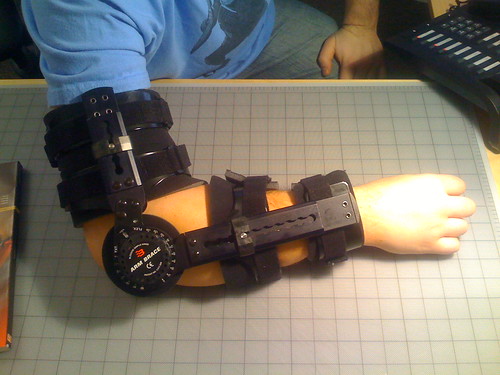
A white person's right arm in a (self-described) terminator-esque arm brace.  It has thick black straps supporting the upper arm, a huge dial on the elbow, and more thick straps on the lower arm

Description: A white person’s right arm in a (self-described) terminator-esque arm brace. It has thick black straps supporting the upper arm, a huge dial on the elbow, and more thick straps on the lower arm

Daily Access Irritations: The Moan Meme

I thought I’d rant a little about the access irritations I encountered today.

Today I’ll complain about inaccessible elements of the environment which nominally increase access. Otherwise known as “access theater,” or access done wrong, it’s particularly infuriating.

Implementation of Low Vision Rehabilitation Advice for People with Intellectual Disabilities

People with intellectual disabilities are at a very high risk of visual impairment, often due to undiagnosed refractive errors and cataracts. Oftentimes, however, these people are being cared for in facilities that do not have knowledge about low vision, and do not know how to detect it. Low vision centers in the Netherlands take a pretty proactive role in screening for visual impairments in people with intellectual disabilities. However, it doesn’t help much if the advice these centers give, for example for glasses or lighting, is not followed up on by the intellectual disability facilities the people live in.

Miscellaneous Thoughts on Parenthood [NBC series]

-Shockingly (or not), the behavioral therapist turns out to be a Magical Therapist who not only helps Max play with another child, but gives soothing advice to his mom–allaying her fears and improving her sex life. All in one afternoon!

It really bothers me to see people who work with autistic people portrayed as saints with no obvious flaws, which is what this therapist character (Gabby) seems to be so far. Because obviously anyone who would choose to work with autistic people must be a saint, by definition. Far too many people actually believe that kind of nonsense, which obscures the very real power which therapists hold over their clients, and the very real potential (and actuality) of abuse. It’s just really, really uncomfortable. Pretty Nice Behavioral Therapist Girl holds power over the children she works with.

Being inclusive vs not being exclusive

This is something I come across once in a while, and have had at least one argument with someone over. A group of people put on some creative project, and someone notices that there’s a lack of representation of X Minority for whatever reason, sometimes noting that they themselves are in the minority. The people organising the project get defensive and say “But we’re not excluding anyone! We are open to everybody! They just need to sign on!”

There is a huge difference between not being exclusive and being inclusive.

In the eye of the beholder

But we have entered into another phase of the understanding of beauty. We are staying, right now, in a huge resort north of Toronto. It’s on the way to the consultation and will cut our driving down by several hours. We decided, what the heck treat ourselves. Into a huge lobby, up to a luxurious room. Wow. Then Joe went into the bathroom and said, breathlessly like he has when listening to Madama Butterfly or contemplating a painting by Turner or finishing a book by Furst or by watching that nude scene in A Single Man … it’s, it’s, beautiful.

One Can’t be a Cutup when one is talking about Cutouts

The guidelines for my suggestions of “ideal cutouts” are simple:

1. All of the ADA style guidelines related to angle and such (not crucial for me with the iBot or most powered chairs, but much more important for scooters that can’t handle angles, manual chairs, or people that might have trouble with the angle);
2. Always have the ramp be at a complete 18090° with the street it is bisecting, with a consistent and equal upward trend until it reaches the top.
3. Keep the direction of the inclination be the same as the direction of travel, without requiring left/right “yaw” adjustment.
4. Have the cutouts as close to the curb as is feasible.
5. Position the cutouts firmly in the crosswalk’s span.
6. Keep the cutouts on opposite sides of the street that assume a lateral connection lined up with each other.
7. When fancy painting/grooves are done, have the paint/groves match both the angle and the direction of the inclination (i.e. if any of the previous two points — especially points 2 and 3 — are not done, do not use the paint/grids as if they were).
8. Remember that Functional > Aesthetically pleasing but impractical > impassible (by which I mean impossible).

Headlines:

US: Appellate court rules [service] dogs ineligible for food stamps

Just to let y’all know, we’re going to be splitting up Recommended Reading duties among FWD contribs for a while, starting tomorrow!

Recommended Reading for April 7, 2010

A red, white and black butterfly is standing on the very edge of a curly bench arm.  Arm-crutches are looped around the bench.

Another short one today – the stuff in my personal life is ongoing. I’m sorry.

The cost of art

As I know that with Palmer’s projects and statements, there are things I might miss because I am able bodied, because I am privileged as Palmer is herself. I know that I have been made to think about the ways I think of disabled bodies and about the history of racial violence and murder in this country. I have been forced to examine myself, to see the ways in which I am no better (or maybe worse) than Palmer. But when the time came and is still coming that opinions about the disabled, about them speaking up for themselves are formed, when people insult and laugh at and ignore and disregard the disabled, accuse them of faking it or belittle them, or use them as tools to be “inspirational” to able people, it will not be Palmer who bears that cost, who gets hit in the face. When it comes time for people to handwave away murder and torture and the history of racial violence in this nation and how the images and words connected with it still hurt for some but are meaningless for others, Palmer will not be hurt by that. Palmer will not pay the price for it. Palmer will surf the wave of controversy and sadly free publicity to interviews and sales and she will laugh all the way to her bank.

Because it comes down to this, as I’ve said before. When the price for art and statements about art came around, Badu paid up, in full, on time, and without hesitation from her own metaphorical coiffers, and it is becoming a steep price. Palmer passed the buck onto those who have already paid so much for the statements and “art” and “irony” of others. The price is steep, but she is not and never will truly be on the hook for it. Because she chose other bodies, other selves to put in the line of fire.

Sometimes the Best Self-Advocacy is Shutting the Fuck Up

I really, really don’t want to write about disability for normal people.

I don’t want to explain that I don’t see people as objects. I don’t want to explain that I’m not just imagining that I have a disability. I don’t want to have to make an analogy where I go, “Some people with cerebral palsy can talk and some can’t, they all have cerebral palsy, and it’s the same with autism spectrum disorders.” (Also, who knows if people will even get that. My dad thinks that the reason CK can walk is that he’s really energetic and determined.)

I have recently been trying to have these conversations with my mom. I don’t know why. I just get told that, for example, I should imagine why someone might kill their kid with a disability. This really upsets me because it’s not that I don’t have compassion for people who do bad things, but constantly reminding me to have compassion for a particular group of people who do bad things seems to imply that what they do is less bad than what other people do.

Normalization Wastes Energy

In contrast, I was two years old and, according to my mom, not talking yet, not looking at her, and with a laundry list of other difficulties that she had not anticipated at the time that I was diagnosed. In addition, the coverage given to the issue of autism was being filled with more and more fear-mongering and talk about early behavioral “interventions.” The way this impacted me mostly involved my parents placing me in some of these programs to ensure that I didn’t end up like Rainman or the difficult autistic children they read about in nonfiction books that were rife with “tragedy” talk. These involved things that helped, such as speech lessons and OT that taught me a little bit of cooking in addition to some sewing and knitting as well as being a time when I could calm down and “recharge.”

However, there were also things that have tainted my life experience forever. Because I was autistic, it was considered justifiable for teachers to twist my head around so that I would make eye contact.

US: Cancer Clusters in Florida Worry Parents

After months of prodding, Florida’s health department began investigating. This year, the agency concluded that The Acreage was the site of a cancer cluster.

The finding was a vindication for some, but what followed infuriated many: A state health official said there was no plan to search for an environmental cause. Residents and elected officials protested, and that position was quickly reversed. But many residents in The Acreage remain suspicious about the state’s commitment to the investigation.

US: Constance McMillien, and “two students with learning difficulites” were sent to a fake prom. McMillen: I Was Sent to Fake Prom

“They had two proms and I was only invited to one of them,” McMillen says. “The one that I went to had seven people there, and everyone went to the other one I wasn’t invited to.”
Last week McMillen asked one of the students organizing the prom for details about the event, and was directed to the country club. “It hurts my feelings,” McMillen says.

Two students with learning difficulties were among the seven people at the country club event, McMillen recalls. “They had the time of their lives,” McMillen says. “That’s the one good thing that come out of this, [these kids] didn’t have to worry about people making fun of them [at their prom].”

‘Breaking Bad’ actor RJ Mitte finds ‘perfect role’ prepared him to become an activist

While winning the role may have been serendipitous for R.J., what he is making out of the opportunity is quite deliberate. It has allowed him to discover himself — not only as an actor but also as an activist for the rights of people with disabilities in the entertainment industry.

He has become a spokesman for I AM PWD (Inclusion in the Arts and Media of Performers With Disabilities), an advocacy campaign sponsored by three entertainment industry unions — Screen Actors Guild, American Federation of Television and Radio Artists and Actors’ Equity Association.

The campaign highlights long-simmering issues regarding people with disabilities in the entertainment industry — access, inclusion and accuracy of portrayal.

Dear Carolyn Hax: Thank You

I was so pleased when s.e. brought Carolyn Hax’s advice to a grandparent of an autistic girl to my attention.

Here’s a clip of the letter Carolyn is responding to:

The mother of my grandgirls is making life a problem. The middle girl is extremely autistic and has not been taught the social rules we all need. That means it is extremely hard to take her anywhere. She is manageable in the car, taken out to a fast food restaurant and back home. But she is not social enough to take to a store or overnight. The parents think we should be able to take her overnight and anywhere we take the other girls.

As I mentioned in yesterday’s post about Appearing Normal, children are not unaware of these sorts of situations, and they do have long-term consequences. Carolyn doesn’t pull any punches:

If it already hasn’t screamed its way off the page, here’s where I’m going with these questions: There are ways you can show an interest in including Jane, and if you haven’t tried them, then you’re the one who is making life a problem. You can ask your daughter to teach you her strategies for bringing Jane on successful outings, or, if you’ve learned those already, then you can admit that Jane overwhelms you and ask for outing ideas that are a notch above McDonald’s that can build your confidence with her. Then you can take Jane with you, one-on-one, for as many of these outings as you take the other girls.

Basically: Stop treating your grandchild like a problem to be solved. The problem here is not “Jane”.

In my experience, situations like this one are pretty common, and not just in family members. It’s easier to just… not invite or plan for the wheelchair-user than it is to be limited to the small number of places they can go. It’s easier not to include things that can be helpful to people who are disabled than it is to contact people with disabilities and find out what their needs are.

I’m really glad to read Carolyn Hax calling that shit out for what it is.

I really recommend reading the whole thing.

Recommended Reading for April 6, 2010

Assistive tech keyboards - three of them, all with large print and brightly contrasted colours

I’m sorry this is short today – something came up in my personal life.

Assumptions: Unfair & Not Unfair

This is an ethics professor discussing the ethics of caring for patients whose injuries were, in our view as physicians, “brought upon themselves”, or for patients whom we don’t necessarily like.

Racist, Sexist, and Homophobic

I posted Monday about the “Writing the Other” panel at Millennicon. Today I wanted to address one of the comments. Jim Van Pelt … described an academic panel in which the moderator opened by saying, “If you are white, male and straight in America, you are also, automatically racist, sexist and homophobic.” Comment link here.

This next part is scary to write. To be clear, I’m not talking about you. I’m not talking about Van Pelt. I’m not talking about anyone except myself, ‘kay?

That moderator is correct. I am a straight white male raised in the U.S. I am also racist. I am sexist. I am homophobic.

How the left enables the right’s racism: The Obama rape comic TRIGGER WARNING

But what really got my side-eye going was AlterNet’s accompanying article to the cartoon, where I originally saw the cartoon. Once again, it’s another progressive dismissal of racism and racists as “something” thought/said/done by “them” over “there.” Of course, the post’s intent (sigh) is calling out the blatantly viciously anti-Black bigotry while offering some sort of “compassion” to those “afflicted” with the “racist condition.” Well, sort of.

However, calling out racism as a “mental illness” both enables the racism and is ableist to those with differing mental and physical capabilities than the “able-bodied.”

Fighting Ableism Fights Sexual Assault TRIGGER WARNING

Women with disabilities are more than twice as likely to be victims of rape or sexual assault than women without disabilities. More than twice as likely than what is already a terrifyingly high probability of being a victim of rape or sexual assault. I myself am a woman with a mental health disability who is also a victim of sexual assault, and seeing this statistic always makes my stomach drop and my muscles tense. But when I think about it, what influences that statistic, it makes perfect sense. Rape and sexual assault are crimes of power and control. Women with disabilities are subject to sets of interlocking, intersecting oppressions on the basis of their gender and their disability status. Both gender-based oppression and disability-based oppression separately accept and even encourage abuse and denigration of people in those groups. So of course it makes sense that sexism and ableism would add to each other, reinforce each other’s power, resulting in the heightened vulnerability to assault reflected in the statistics.

Post-Secondary Students, I am looking for your stories

Are you, or have you been, a post-secondary student with a disability? What have been your experiences with navigating your institution as a disabled student? Is/was there a Student Accessibility Services office, and how effective were they in assisting you?

If you are willing to talk about what happened – good or bad – please email me. anna @ disabledfeminists.com

Jenny McCarthy & Autism Part 2: Let’s All Be Normal (Acting)

When I wrote about Jenny McCarthy last week, I focused primarily on how her “cure” efforts affect parents. Today, I want to write about how “cure” efforts affect children with disabilities.

I feel pretty safe in saying that most people who are born with disabilities, or develop a disability very early in life, have experienced the Pressure To Appear Normal. The ones I have talked to have told me that the greatest amount of pressure to Appear Normal has come, either directly or indirectly, from their parents.

In my case, I remember being yelled at by my father after my parents, unaware of how unwell I was, and still am, read the diary I was required to keep at school. Finding out how unhappy I was that way made my mother cry. After that, I only wrote fictional stories in my required-diary at school. I didn’t want to upset my parents by being “sad”. [My parents may have a different understanding of this event. I’ve never talked to them about it. I also haven’t talked to them about my repeated hospitalizations.]

It took me a long time to convince Don that it was okay to talk about being in pain and how he felt about everything. Like me, his previous attempts to talk about his disability led to his mother being upset. His attempts to appear normal means he went over a decade needing far more assistance than he was getting. He felt like a failure for getting a cane, because everyone would “know” he was disabled. Getting the cane, and now his wheelchair, has led to a drastic improvement to his quality of life – and it didn’t happen until he was in his late 20s.

If you read many of the Very Special Lessons-type news media stories about disability, they will often include a paragraph about how the person with a disability’s parents had at some point pushed for them to be in a “regular” school until, giving up, they finally admitted their child needed more help than they were able to get there. It’s often presented as a sadness, that this child couldn’t “overcome”.

From Deaf children being denied Sign Language until their late teens to grandparents refusing to be seen in public with their autistic grandchildren until they can learn to behave, there is are a lot of messages disabled children receive from their families: Be Normal. Look Normal. Don’t upset us by not being Normal.

I hope my last post made it clear that I’m very sympathetic to the situation parents find themselves in. There are simply not enough resources available to help families. There is constant pressure on parents to explain how they “made” their kids disabled, and what they’re doing to “fix it”. I don’t just think that pressure is there. I know it. I know for certain that Don’s mother still feels guilty for “making” Don disabled.

But children are very aware of the pressure to be normal. And when people like Jenny McCarthy and her ilk push “cures” for disability out there, not only are parents asked why they aren’t administering these cures, children are, either directly or indirectly, asked why they aren’t cured, too.

“Why are you still disabled when your disability is curable?”

“What are you doing to make yourself better?”

Try harder. Do more. It will make everyone else feel more comfortable.

Let me tell you all about my disability super powers

I first learned about panic attacks as a disability in the Mercedes Lackey novel Children of the Night. The main character, Diana Tregarde, has crippling panic attacks in the aftermath of a major attack on her. The panic attacks are so bad that she feels she is reliving the moment, and even blacks out from panic. They come on her without warning, when anyone says something that brings the night of her attack to mind.

Over the course of one (exhausting) evening, her vampire lover teaches her to turn the energy generated by these panic attacks into a magical shield of light that affects vampires and protects her. This shield, of course, helps save the day.

And, of course everyone “knows” that blind people develop extra-sensory hearing abilities to “compensate” for their blindness. I remember an episode of M*A*S*H* – a US show set during the Korean war, a dramedy that focuses on the doctors in a medical unit stationed there – in which Dr Hawkeye Pierce is temporarily blinded, and within a few days is able to hear the choppers bringing in the wounded before anyone else. Because that’s just how it works, right? (He also manages to smell a problem his fellow doctor is having in the OR – a perforated bowel. It’s realistic, I think, that someone of Hawkeye’s experience would be able to do that, but it’s strongly implied his temporary blindness is what enabled him to do so.)

It’s even better in “Blind Date”, an episode of Angel where the “vampire with a soul” has to battle a blind assassin. She, of course, is acquitted of her crimes because no one believes a blind woman can commit crimes. But within the episode she can “see outside the normal range of human sight”, and apparently can hear people’s heartbeats.

Of course she can.

The number of times I see a person with a disability in pop culture with some form of super-power versus the number of times I’ve seen someone with a disability portrayed somewhat realistically is… Well, there isn’t really a lot of the latter, and there sure is a lot of the former. There are so many of the former that TV Tropes has a page, with many sub-pages, for Disability Superpower. [See Also: TV Tropes on Inspirationally Disadvantaged]

Depending on the day of the week, I see these stories in one of three ways: Either the creator is thinking “I really want to include disability in my storyline, but I don’t think disabled people are interesting on their own. I better come up with something to make them more interesting to the storyline.” Or “You know what’s Special? Disability! Let’s do a disability special, and make that person have special powers!”.

(The third way is “Damn it, I’m irritated as all get out. Why am I even watching this?” Which is why I’ve never seen past the the radar-rain scene in Daredevil.)

I get frustrated with these stories not because there’s something deeply wrong with Disability Superpowers, but because there’s very little to counter-balance them in pop culture. It feels like, outside of the news (where people with disabilities are either tragedies or Very Special Lessons), television, books, and movies go for Super Powered, Special Lessons, or Not At All.

This is why we keep talking about it.

Recommended Reading for April 5, 2010

Woman seated in a chair with brocade throw over the back, holding a crutch in her left hand. She sits facing forward in a fenced yard

Power

The media world hasn’t stopped writing bad articles about disability in general and disability and dance in particular. I will run right over the next person who uses the “inspiring” word. There have been some truly shocking things — things that should call us as moral humans to action — but for some reason, I find myself lacking in outrage and anger. I am so happy that it is Spring. I am on a retreat, in some kind of refuge, relaxing in the city. Mildness is the word of the day.

We leave again on Monday; I have the weekend to finish my laundry, clean my brushes, recheck my chair, and pack (at least I now have a check list). When I was first packing for this trip a couple of weeks ago, I dug out my fleece pants and fleece-lined tights (these things are just awesome). Now, I am thinking about light blouses and cotton yoga pants. The weather has changed and with it my sense of place in the world.

Special Autism Fools Day Link-o-Rama

When T.S. Eliot said that “April is the cruelest month,” he truly got it right. For you Normals (using the word in a humorous context, of course…), it may be hunky dory, what with all the opportunities to make yourselves look and feel charitable by simply giving money to any autism charity organization that advocates for a cure. However, for us autistic people Autism Awareness Month is often aggravating.

Fire in the Frost: Fiesty Olympians Defy the Odds

Despite being born with the use of both legs, many of these bipedal athletes inspire us with their commitment and guts. Having typically learned to walk around the age of one, these amazing Olympians don’t let their lurching two-phase locomotion hold them back. Thought they may look unwieldy to the naive eye, as viewers their movements soon look natural to us. We can see their grace and nimbleness shine through.

Two-legged skiers don’t let their long bulky hindlimbs weigh them down on the slopes; they have learned to use them to the fullest to guide their path down the mountain. In the freestyle aerial competitions, they inspire us as they twirl against the blue Canadian skies, looking almost graceful – unless they fail to keep their dual legs parallel, a particularly common trap for skiers in this event! Sighted skiers seem to remain undistracted by seeing objects near the course while hurtling down the slopes. They handle their unique visual issues well, managing to put aside most distractions and focus on the task at hand. These skiers don’t let their vision stand in their way on the snow!

New Childcare Subsidy Regulations

Last April, when I finished my exams, you gave me 90 days to find a job before I lost my childcare funding. You understood that jobs do not appear out of thin air, they take work to aquire. This year, you decided that I am to lose my childcare space the day the exam period is over.

Now I ask you, Mr. Neo-liberal Policy Maker, how am I supposed to find a job without daycare? You say I can look for work while my children are in school. I accept that premise, but what you don’t answer is what I am supposed to do when I find a job and have already lost my daycare spots? I will have to turn down the job because I won’t be able to go to work without daycare- especially because my son is in kindergarten, and, as such, is not yet in school full-time. It took me 3 years to get through the waiting list at the daycare my children need to be in for me to attend grad school in September because it is the only childcare center in the city that is open later than 6:00 and my classes will run in the evening. That means that if I lose this daycare spot, I may not be able to go to grad school in September. But I’m glad you saved a few dollars.

An Immortal Story: The Immortal Life of Henrietta Lacks

There is so much that this book makes you think about: medical ethics (using cells/doing research on people without consent happened a lot–note the Tuskegee studies, and the question of ownership of bodies), the role of women (along with issues of abuse, equality in the workplace, the role of a mother), education, health insurance (Henrietta’s family is still unable to afford health insurance today) and how all those issues are affected by race and social class (i.e. because Henrietta was a black female she didn’t go to school; lower class people live without health care because they can’t afford it, etc.). In writing about all these subjects, Skloot herself becomes part of this family’s story which adds even more heart to it. She writes about it all with a knowledge of her subject and a compassion for the people she profiles, interviews, and—sometimes—lives with, all while giving well-deserved, belated recognition to the woman behind HeLa.

On Autism Awareness Month

Growing up with autism in my world has taught me a lot about communication…about the power of sound, the meaning behind high pitched wails or low rumbling laughter.

Autism has taught me the precious value of a hug or a kiss…of eye contact or a quick glance…of a tickle and the giggles it inspires.

I have lived my entire life with autism.

For me and mine, autism is…it just is. Sometimes it’s a pain in the ass and sometimes it is the most amazing thing, but autism is a constant thing not limited to months or years or days when walks take place.

If you do nothing else today, read this

Let’s imagine for a moment that you are long into the public mental health system. You have been in the hospital multiple times, in a couple of partial hospitalization programs, and have spent years in sheltered workshops and day programs. You’ve received the Prophecy of Doom, “Too sick for too long to get any better.” You’ve heard plenty of statements beginning with “You can’t, You won’t, and You will never.” You’ve been told endlessly that something is intrinsically (genetically) wrong with you and the only thing that will truly save you is a medication yet to be discovered. You’ve also been told that the most important thing you can do is get on SSI or SSDI in light of the prolonged and persistent nature of your illness. You’ve been told to engage in meaningful activities generally limited to walking, listening to music, and reading. You’ve been told countless times to avoid any stressors which might be associated with more rewarding activities and these stressors will doubtless lead to yet another hospitalization. You’ve been told so many things.

Headlines:

Military plans to test brain-injury therapy

Burger King ad featuring its mascot as crazy offends mental health organizations NOTE: Unless the author has gone ahead and changed it since I posted it, this article is basically making fun of the idea that anyone would think that there’s anything to the criticism.

Via Sweet Machine: Cinemas turn up lights, turn down sound for families touched by autism: AMC and Kerasotes Theaters adjust theaters’ lighting and sound, while letting people with autism and their families clap, dance and sing

Recommended Reading for April 2, 2010

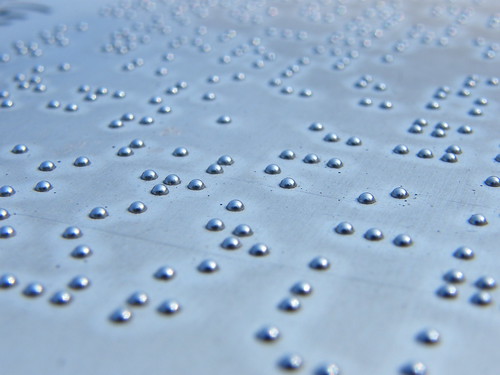
A metal plate covered in braille

Accessible Information is Understandable

You can present information in Braille, large print, Sign Language, or easy read, but it will still be useless if it cannot be understood.

Once again we are talking about clear and straightforward communication, familiar language, jargon free text and information that is well structured and easy to follow. This is true whether the information is presented in a web site that has clearly understandable navigation and other interactions such as forms, or in any other format.

An Education

I’m worried about dropping out of school at some point. And part of that is because I like education. Which is a valid reason to feel worry about not being able to complete it. But part of that, part of it is because of the enormous social pressure to succeed in this environment. Part of it is the society telling me that if I can’t handle university, the problem is with me not wanting it hard enough, or not trying hard enough. The problem is me, not the system that isn’t set up to accommodate more than one (fairly specific) type of learning. And it’s really hard not to internalize those messages, even if you know about the problems with them. It’s hard not to buy into something you see everywhere.

Cybernetic Space Princess on Mars.

Because I am very functional, and because the standard image of “someone with OCD” is Adrian Monk or Hannelore, I do occasionally have to deal with people assuming I’m exaggerating. I don’t compulsively wash my hands or clean my kitchen, I’m definitely not a germaphore, and if I re-type books completely between drafts, well, that’s just a quirk. But obsession and compulsion both take many forms, and while I have found peace with mine, and consider them a vital part of who I am, that doesn’t mean they don’t exist. (Why I would joke about having something that is considered a mental illness, I don’t know.)

Remember that just because someone is a functional, relatively normal-seeming human being, that doesn’t mean they’re wired the way that you are. I have to remind myself that not everybody wants their day broken down into fifteen-minute increments, because for me, that is the norm. The human mind is an amazing thing, full of possibilities, and each of us expresses them differently. I am a cybernetic space princess from Mars, and that’s not a choice I made; that’s the way I was made. I can get an address on Earth, but Mars will always be my home.

The next Disability Carnival is at River of Jordan, and the theme is Balance.

In the news (just headlines today, all from the US):
Short Bursts of Activity Ease Fibromyalgia

Grieving Kettleman City mothers tackle a toxic waste dump – Each had miscarried or given birth to a child with birth defects. Their pain gave them strength to fight for justice.

A Pennsylvania government study commission has proposed legal reforms to curtail power-of-attorney abuses that have cheated the elderly, the disabled and their heirs.

Retired couples may need $250k for health care