All posts by lauredhel

About lauredhel

Lauredhel is an Australian woman with a disability.

Recommended Reading for February 10th

Warning: Offsite links are not safe spaces. Articles and comments in the links may contain ableist, sexist, and other -ist language and ideas of varying intensity. Opinions expressed in the articles may not reflect the opinions held by the compiler of the post. I attempt to provide extra warnings for material like extreme violence/rape; however, your triggers/issues may vary, so please read with care.

Niamh at Get Ahead Blog: Fee paying schools need a shift in thinking.

Many children with disabilities are being inadvertently discriminated against in Irish schools because of attitudes and unchallenged thinking about disability. What are these attitudes? What do principals, staff and parents think about the ability of students with disability? It is nearly a cliché, but they see the DISability not the child. In schools where parents are paying high fees for an excellent education, disability is perceived as a threat to a concept of the gold star student.

The Hindu: Disability groups apprehensive of amendments to laws

Disability groups on Sunday expressed strong apprehension that the Centre was going ahead with proposed amendments/harmonisation in various laws without consulting them.

Participants at the two-day meet that concluded here on national cross-disability consultation, titled ‘Harmonisation of laws with the United Nations Convention on Rights of Persons with Disabilities [UNCRPD],’ felt that the government would make a shoddy job of it and compromise the real objectives if there was no effective consultation.

Hawke’s Bay Today: Young sailors tame Lion

By the end of the year, Katy Wylam hopes to recruit up to 80 people who, despite their disabilities, will have a chance like everyone else to experience sailing in Hawke Bay. And this weekend that goal came a step closer when the well-known yacht Lion New Zealand visited Napier on a special fundraising day for Ms Wylam’s Sailability Hawke’s Bay. The organisation, a trust formed a year ago, aims to provide boats and sailing equipment for people with disabilities to enjoy recreational and competitive sailing.

ABC: Muni passengers sound off at town hall meeting

“My name is Herbert Weiner and I’m a Muni victim,” Weiner said at a town hall meeting Saturday.

Muni riders are angry. They packed the meeting to voice their outrage over the money-saving measures Muni is proposing. Muni needs to bridge a $16.9 million budget shortfall. The Muni board is considering raising monthly passes from $15 to $30 for seniors, the disabled and youth, reducing service system wide and renegotiating Muni drivers’ contracts.

Daily Mercury: Better wheelchair access needed

William Lowe can smell the coffee but he can’t drink it. He can see the goods but he can’t purchase them. That is because he is wheelchair-bound and the majority of shops and cafes in Mackay’s City Heart are not accessible by wheelchair. […]

“Hog’s Breath Cafe is one I have tried to go to but can’t get in. It is a problem everywhere.” Mr Lowe said there were a few shops that had built-in or portable ramps but most did not. “In a way it is discrimination,” he said. “Some of them have only a little lip at the door but because you have only a small amount of room on the bottom of your chair, you can’t get over it. People have offered to lift the chair into some shops but it is just too heavy with the combined weight of me and the 110kg chair.” An owner of Hog’s Breath Cafe denied there was an access problem at his premises and refused to speak about the issue.

The Guardian: Disability tests in need of overhaul

Already research has highlighted problems: the National Autistic Society found that the system was not always working for people with autism; Citizens Advice Scotland reported that the system was causing disabled people “unnecessary financial distress and emotional strain”; Macmillan and Citizens Advice reported that some people with terminal cancer were not being fast-tracked through the system.[…]

Benefits should not be about targets but about ensuring the right support is delivered to those who need it. If disabled people can be supported into work then there will be a direct benefit for them, and also for the taxpayer. But if people are forced off the benefits designed to support them and into appeals by an unfair system, then that could lead to wasted opportunities, and even poverty.
Recommended Reading for February 10th

WARNING: Offsite links are not safe spaces. Articles and comments in the links may contain ableist, sexist, and other -ist language of varying intensity. Opinions expressed in the articles may not reflect the opinions held by the compiler of the post. I attempt to provide extra warnings for material like extreme violence/rape; however, your triggers/issues may vary, so please read with care.

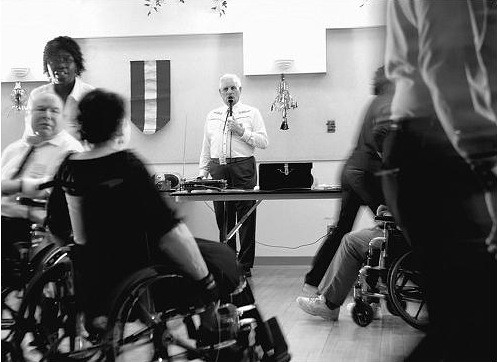
black and white photo of wheelchair users squaredancing, and a caller. There is movement blurring.

Edmonton Journal: Rockin’ rollers spin the night away: Swinging Spokes troupe puts fancy wheelwork into their square dancing

When Al Deby calls for “fancy footwork” from the Swinging Spokes, he expects both fast feet and snappy steering.

Half of the square dance troupe get around in wheelchairs and nimble rolling is essential. That and quick wits, to help navigate a setup that’s more rhombus than square. […]

But the Swinging Spokes are old pros at this. Modelled after Vancouver’s Wheeling Eights and run through the Paralympic Sports Association, the group has been dancing since 1976 and have travelled cross-country to boogie at jamborees, nursing homes, shopping malls, and every Canadian National Square and Round Dance convention, held biennially.

CaitieCat at Shakesville: Russian Debate About Rights of the Disabled

(Trigger warning: this post discusses a progressive response to a violent ‘solution’ to the problem of people with disabilities, as well as some language which will be very offensive to people with disabilities) […]

One of my Russian friends posted a link today to a post on Livejournal – which has always had a thriving Russian-speaking community, where it’s called “zheh-zheh”, analogous to our “el-jay” – about a journalist on a Moscow radio station who’d posed the question: “Do ‘defective’ children have the right to life?”

Afronline: Disabled rights group seek 20 seats in House

Representatives of disabled people have asked the Committee of Experts and the House to give them at least 20 seats in the next Parliament. This the number would comprise 15 seats in the National Assembly through mixed representation and five seats in the Senate. The group also wants at least one representative in all constitutional commissions.

Wales Online: Study to look at ways of protecting the vulnerable

A three-year research study has been launched in a bid to keep people with learning disabilities safe from abuse.

The project by the University of Glamorgan, New Pathways in Merthyr Tydfil and Rhondda Cynon Taff People First, has received more than £410,000 from the Big Lottery Fund.

The study will explore what people with learning disabilities understand by abuse, what help and support they need to keep themselves safe from abuse and, if someone has been abused, what are the best ways to provide support. It comes after people with learning disabilities have been identified as some of the most vulnerable in society. […]

An earlier work has found that people with learning disabilities are rarely consulted on policy and do not know what is available to protect them.

Brimbank Leader: Disabled doesn’t mean unable for Taylors Lakes woman

Ms [Elvira] Alic is heading Models of Diversity~Down Under, an extension of the UK-born campaign Models of Diversity founded by Angel Sinclair. […]

In January, Ms Alic, who has spinal muscular atrophy type 2, auditioned for Australia’s Next Top Model with fellow campaigner Jodie De Ruvo. While she said they received the recognition they were after from the judges, there were no ramps available to get on stage.

“That itself shows people will assume people with disabilities won’t go to auditions,” Ms Alic said. “You should be able to go there and hold your head up high.”

The Australian: Disabled in remote areas abandoned

The disabled are left to fend for themselves in remote Aboriginal communities, and the Northern Territory’s worst mental health cases are confined to isolation cells in prison, a damning report that has been suppressed by the Labor government reveals.

Recommended Reading for February 9th

Warning: Offsite links are not safe spaces. Articles and comments in the links may contain ableist, sexist, and other -ist language of varying intensity. Opinions expressed in the articles may not reflect the opinions held by the compiler of the post. I attempt to provide extra warnings for material like extreme violence/rape; however, your triggers/issues may vary, so please read with care.

Unreality Shout: Disability abuse- ignored and condoned. Have we learnt nothing from the Deaths of the Pilkingtons? [You can find video and a transcript here.]

On Big Brother’s Big Mouth Vinnie Jones describes Davina McCalls’ walk as being like a “retard” then gets up and demonstrates what he means. Awful complaints will follow.Jones will be forced to publicly apologise for his vile behaviour using the same word and gestures that were used against Fiona Pilkington and her disabled daughter which drove them to their deaths. Davina will lose her contracts and probably be removed from Comic Relief which sponsors projects for disabled people for her blatant disablism.

Sadly no.

The audience laughed as did Davina who then repeated the word.

NO action was taken.

No apology made.

stevenf.com: Shutup.css [works for sites and comment systems like Digg, Disqus, Youtube, Slashdot, CBC, CNet, Reddit, WaPo, Globe and Mail]:

shutup.css is a custom user stylesheet that can be applied to your browser to hide comments on many popular web sites without user intervention.

Turner and Kowalski: WordPress is killing me!!!

I really appreciate that WordPress offers a fuckton of useful features, but they’re really crap at explaining them which makes WordPress kind of inaccessible.

New York Times: For Some Survivors, Polio Won’t Fade Into the Past

But Ms. Lloyd [a historian] soon found that polio’s past was not dead and gone. It was not even past. In all the early interviews, people talked about an after-echo legacy of the disease called post-polio syndrome that had come back to hit them in their 60s and 70s. […]

[Dr Jacquelin Perry’s] conclusion about polio and age is that the people who worked hardest to overcome disability have in many cases been hit hardest by its second-wave attack, as over-used muscles and nerves gave out after decades of strain. Her observation is backed up by numerous studies.

“It’s overuse,” Dr. Perry said in a telephone interview. “The people who tried hardest to be normal, and pushed hardest, have been hit more with post-polio.”

KuwaitSamachar.com: Disabled citizens bring honor to Kuwait

[Sheikh Ahmad Al-Fahad Al-Sabah, the Deputy Prime Minister for Economic Affairs and State Minister for Development and Housing Affairs] indicated that enforcing the disability rights legislation is the best way of supporting this segment of society, saying that the new law will help to support the disabled socially and in terms of sports and leisure activities.

Sheikh Ahmad Al-Fahad asserted that the new legislation will ensure disabled citizens’ rights, and help them in becoming vital components of society, reported Al-Watan. The minister congratulated disabled citizens on the enforcement of the new legislation, acknowledging the cabinet’s and parliament’s roles in achieving this goal.

Abubakarr Messeh Kamara at Cocorioko.net: Time for Sierra Leone’s youths to put their case forward

My question is: where will the youth be to put their case across? I believe the Secretary General’s visit will mean nothing to Sierra Leone unless the youth (the future of Sierra Leone) are given the opportunity to be heard loud and clear on pertinent issues that affect their wellbeing. […]

Poor health services continuing to endanger the life of the youth; with limited access to care, medication and so on. The country’s HIV/AIDS rate remains high particularly amongst the youth. Unfortunately, most of the doctors have indulged in to the practice of operating their own private surgeries where more money could be incurred at the expense of saving the lives of the poor in public hospitals. I believe that a combination of factors such as proper health policy, free health service, care and education can help in the fight against diseases.

The issue of disabled persons rights and the huge number of street children sleeping in market stall is nothing good to talk about. The 2007 Child Rights Act and the 2009 Disability Rights Act have only become a black and white paper in the shelves of policy makers. I think we are failing in our responsibility.

Recommended Reading for February 8th

Warning: Offsite links are not safe spaces. Articles and comments in the links may contain ableist, sexist, and other -ist language of varying intensity. Opinions expressed in the articles may not reflect the opinions held by the compiler of the post. I attempt to provide extra warnings for material like extreme violence/rape; however, your triggers/issues may vary, so please read with care.

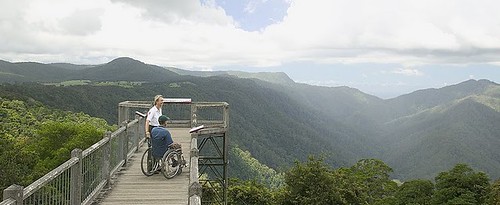
Accessible Tourism Research: Accessible Alpine Tourism Project [via Rolling Rains Report]

boardwalk lookout over incredible moutain forest view. 2 people on lookout, one in a wheelchair

Image caption: What an accessible view! (source: Tourism New South Wales Image Library)

Image description: A wooden boardwalk overlooks an incredible misty view of forested mountains. Two people are on the boardwalk; one standing, one sitting in a wheelchair.

Columbia Daily Tribune: Disabled advocate takes on town, mayor

John Hinten is co-founder of a committee focused on improving accessibility for disabled people in this north Boone County town, and he was recently recognized as a “champion” for the disabled in a proclamation by Gov. Jay Nixon.

But Hinten these days is barred from meetings of the Centralia Accessibility Committee because he filed a disability discrimination complaint against Mayor Tim Grenke. Grenke notified the panel he could not attend the CAC meetings until the complaint is resolved, citing a potential conflict of interest. […]

Grenke also said Hinten had contacted him only once about the inaccessible coffee session at J.R.’s Diner. The mayor said he has had similar “coffee” events at other establishments that are not handicap-accessible. Where accessibility is an issue, Grenke said, businesses “make reasonable accommodations” to handle wheelchair-users by lifting them up steps or across other barriers.

Grenke insisted he has hosted coffees at wheelchair-accessible sites, but Hinten has attended only one. Hinten said that carrying a wheelchair-user is “neither legal nor dignifying.”

Canadian Tourism Commission: Realwheels shows some SPINE during 2010 Paralympic Winter Games.

Kerr wrote [SPINE] specifically for leading man James Sanders, a British Columbia actor who plays a guy escaping the limits of his physical body by beaming into cyberspace. The whole enterprise is pretty high-tech: there’ll be video screens and live actors who “interact” with computer-generated people created by the artists (and operated like puppets via computer) for an effect Sanders calls “blended reality.” […]

The 39-year-old actor is quadriplegic. In 1990, during his third semester of theatre school, Sanders broke his neck in a freak accident while playing in knee-deep snow. What to do? Well, he was still an actor. Sanders realized that if parts for quadriplegics weren’t exactly budding on trees, he could create some.

Richmond Times-Dispatch: Va. deaf inmates’ rights violated, lawsuit contends

A lawsuit has been filed against the Virginia Department of Corrections and other officials alleging that the rights of deaf state prison inmates are being violated.

Among other things, the complaint contends that deaf inmates do not have adequate access to sign-language interpreters, visual notifications of safety announcements, and devices that would allow them to communicate with family and friends outside of the prison.

MySA News: New chamber chief has survived challenges

Jane Thomas has survived plenty of challenges, from losing the ability to walk as a teenager, to a diagnosis of Stage III breast cancer as an adult.

She managed to make it through with a good sense of humor and a sense of purpose that has carried through today. On Friday, Thomas, 43, became chair of the South San Antonio Chamber of Commerce.

But the chamber’s new officer induction ceremony proved another obstacle: the stage for the ceremony had no wheelchair ramp.

Star Tribune: Deaf patient was dying, but no one told her

For three months, the Nelsons [both Deaf] met with doctors at North Memorial Medical Center, but they weren’t aware Mary Ann was dying of cancer. In fact, they thought she was doing well enough in her battle with the disease that she could go to her retirement party. So they were stunned in March 2006 when her oncologist abruptly put an end to their hopes — and their request — with a terse note saying, “We can’t cure the cancer!” […]

state regulators announced that North Memorial agreed to pay $105,000 to settle charges that Nelson and another patient were not provided access to qualified sign language interpreters. Often, David Nelson had to read lips or write notes to communicate with doctors and nurses, despite his repeated requests for an interpreter.

Daniel Island News: Daniel Island boy makes debut in Hollywood film [meloukhia also points out a story about Claire Danes playing Temple Grandin]:

It has not been an easy road, but where there have been challenges, there have also been triumphs. Most notably, [Braeden Reed’s] recent debut performance in the movie Dear John as a boy with autism. The film, based on the novel by Nicholas Sparks, was shot in the Charleston area last fall and is set to be released in late 2009 or early 2010. […]

“To work with Braeden in Dear John was completely wonderful,” said Lasse Hallstrom, the film’s Oscar-nominated director, whose credits also include The Cider House Rules and Chocolat. “He brought charm and intelligence and spontaneity to the part he played. He was fearless and he lacked that inhibition that many other kids have in front of the camera.”

“I thought it was nice!” exclaimed Braeden, about his Hollywood experience.

Chatterday! Open Thread.

transparent-skinned frog, hanging from a twig. The frog's internal organs are visibleThis is our weekly Chatterday! open thread. Use this open thread to talk amongst yourselves: feel free to share a link, have a vent, or spread some joy.
What have you been reading or watching lately (remembering spoiler warnings)? What are you proud of this week? What’s made your teeth itch? What’s going on in your part of the world? Feel free to add your own images. (Anna insists that these should only be of ponies, but I insist that very small primates, camelids, critters from the weasel family, smooching giraffes, and cupcakes are also acceptable.) Just whack in a bare link to a webpage, please – admin needs to deal with the HTML code side of things.

Today’s chatterday backcloth, a endangered transparent-skinned “glass frog” from the South American rainforest, comes from National Geographic, via Neatorama.

Who Shall Remain Nameless: The Othering of PWD

Julie Petty.

Ricardo Thornton.

These are the names of the self-advocates who joined Special Olympics CEO Shriver and others in asking Rahm Emanuel to apologise for his use of the R Word, and to join the R-Word campaign (the original R-Word campaign is here).

But you’ll be hard pressed to find that info in most of the papers. They’ve been erased. Relegated to “other…”.

A P.S., at best.

What we’re hearing, instead, is that Emanuel apologised to Shriver, and Shriver accepted his apology. A few examples:

LA Times:

[Emanuel] apologized and met privately this week with half a dozen advocates for people with disabilities, including Timothy Shriver, chairman and chief executive of the Special Olympics.

HuffPo (who also published “Rage Against Rahm Was, Well, “Retarded”“, by a “humourist”):

Special Olympics Chairman and CEO Timothy Shriver personally accepted an apology from White House Chief of Staff Rahm Emanuel on Wednesday, days after comments surfaced in which Emanuel used the word “retarded” to describe a proposal made by a group of liberal Democrats.

According to a joint statement from Shriver and five other disability advocates who attended a meeting at the White House, Emanuel “sincerely apologized for his mistake and the pain it caused in our community.”

ABC News:

After the Journal story was published, Emanuel called Special Olympics Chairman and CEO Timothy Shriver to apologize.

Shriver and four other advocates for the disabled community will meet with Emanuel at the White House at 2:00 PM tomorrow, Wednesday February 3, 2010.

New York Times:

Mr. Emanuel apologized to Tim Shriver, the CEO of the Special Olympics, but today went one step further, by meeting for about 30 minutes in his West Wing office with Mr. Shriver and other advocates, including leaders of groups like The American Association of People with Disabilities and The Arc, which changed its name nearly 20 years ago from the Association for Retarded Citizens.

Washington Post:

In a statement after an afternoon meeting at the White House, Shriver and five other disability rights advocates said Emanuel had “sincerely apologized” for the earlier comment during a strategy meeting, which was reported in the Wall Street Journal.

Disability Scoop:

Special Olympics CEO Tim Shriver, Andrew Imparato of the American Association of People with Disabilities and Peter Berns, CEO of The Arc of the United States, were invited to the White House meeting. Two self-advocates and a parent advocate are also expected to attend.

Telegraph UK:

After a White House meeting, Mr Emanuel apologised to Tim Shriver, head of the Special Olympics, and other advocates for the mentally disabled.

The exceptions: The Wall Street Journal, and CBS. Kudos.

Recommended Reading for February 5th

Warning: Offsite links are not safe spaces. Articles and comments in the links may contain ableist, sexist, and other -ist language of varying intensity. Opinions expressed in the articles may not reflect the opinions held by the compiler of the post. I attempt to provide extra warnings for material like extreme violence/rape; however, your triggers/issues may vary, so please read with care.

Assiya at For a Fairer Today: “But I don’t see disableism very often”

A couple of months ago I tried talking to my best friend about why I find “Glee” ableist, which turned into a conversation about disableism in society. My best friend is a sociology major who always seems better at me at noticing failure around -isms. So I was shocked when she said she rarely sees disableism.

Amanda Forest Vivian at I’m Somewhere Else: The harder fallacy [spoilers for Precious]

I keep thinking about something my friend said after we watched Precious and I was talking about how the portrayal of the child with Down Syndrome was offensive. (I’m going to refer to the character as Quishay, which is the name of the little girl who played her.) My friend kept saying, “Well, it IS harder to raise a kid with Down Syndrome.” I said “Do you actually know any people with Down Syndrome, because if you did, I think you’d feel differently.” My friend was like, “What do you mean, do you think I wouldn’t think it’s harder to have Down Syndrome? It’s a DISABILITY. It’s not a good thing.

jackandahat in accessibility_fail: When the people who claim to help are the problem. [warning: violence wish expressed]

Right now I’m looking for work, and I’ve just been sent to an agency – Remploy – who deal with getting disabled people into work. […]

The other advisor – I don’t know his name, call him Stupid Fuck – picked up my cane and put it behind his back, and started giving a speech about how now no-one would know I was disabled, and I had to think of it like that.

lightgetsin at the light’s how they find you: So it turns out there are people with disabilities in fandom [warning: description of residential care neglect]

Except those three times I bit my tongue? Not a single one was actually about the content of what people were saying in response to the post. Every single time it was because people were responding to the post with the clear, unthinking default assumption that there were no people with disabilities in the comment thread.

It’s not about hate or disgust or any active form of discrimination. It’s about the silent, reflexive belief that you are all like me.

chaoticidealism: Baby Expectations

When baby-doll advertising doesn’t stick to just describing the doll’s features, it usually reflects the ideas that the general public seems to have about what raising a baby should ideally be like; and practically all of that is focused straight on what the baby will do for you. […]

What if, instead of babbling and cooing, Baby stares in fascination at the play of light on the dust motes in the air? What if, instead of kissing Mommy, Baby pulls back from the overwhelming touch and cries inconsolably? What if, instead of saying, “I love you, Mommy,” Baby recites the full script of her favorite Sesame Street episodes?

Nafisa Khanbhai: Dear Diary: The Story of a Disabled Asian Woman, Disability Studies Quarterly, Vol 29, No 4 (2009)

Having personally experienced a lot of discrimination from friends in the Asian community and at times from the extended family, I decided that it was time to prove my capabilities and create awareness about disability in my community. I went to work at the Rotaract Club for eight years. Rotaract is an organization that assists the needy in society and that includes the physically and mentally challenged. However, I noticed that the organization did not create awareness about those with special needs in society. Instead the organization runs on a simplistic, easy charity model — food, clothes, sometimes cash — a token approach that salves the giver’s conscience. Even though this approach might serve immediate needs, I knew that we needed to and could do more. And then that old problem cropped up again; persons with disabilities have no voice in my community, and being the only such member in the club made it difficult to express my views, and when I did they were not appreciated. I did not blame the other members since I understood that either they are different or I am, and naturally our views would also be different.

These encounters emboldened me in my yearning to create awareness for disability issues generally in Mombasa.

Stephanie Lyn Keil at A Grand Illusion: Is Neurodiversity Economically Feasible? How to Help

I agree with much of Neurodiversity’s philosophy but in their idealism they fail to grasp a couple of realities: the economic impact of their idealism being one of them […] If Neurodiversity wants their idealism to be a reality than they need to begin cutting costs in as many areas as possible.

Question Time: Small Talk

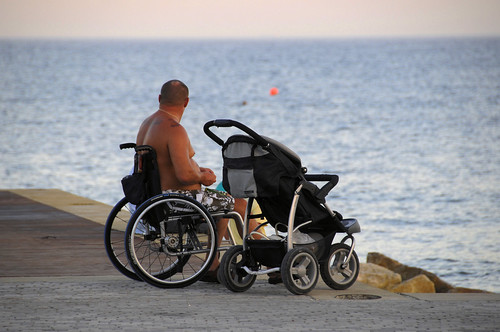
man in wheelchair sitting at jetty edge looking to the ocean. Next to him is a pram.[image source: Son of Groucho on flickr]

If you’re out and about at all, you’ll run into small talk situations. Perhaps at the checkout, perhaps getting coffee, perhaps at the library, perhaps at school or playgroup or college or perhaps at a party or dinner, or in the staffroom at work or with customers.

What sort of small talk happens, for you, if any? What would you like to happen? How does your disability inflect your small talk, and affect your ability to participate? Have people – strangers or acquaintances – asked you about your disability? How do you feel about that? What would your ideal small-talk world look like?

Recommended Reading for February 4th, editorialising edition

Warning: Offsite links are not safe spaces. Articles and comments in the links may contain ableist, sexist, and other -ist language of varying intensity. Opinions expressed in the articles may not reflect the opinions held by the compiler of the post. I attempt to provide extra warnings for material like extreme violence/rape; however, your triggers/issues may vary, so please read with care.

Disability Scoop: ‘R-Word’ Remark Prompts Emanuel To Meet With Disability Advocates

White House Chief of Staff Rahm Emanuel will meet with a group of disability advocates Wednesday, more than a week after a media report quoted him using the word “retarded.” […]

Special Olympics CEO Tim Shriver, Andrew Imparato of the American Association of People with Disabilities and Peter Berns, CEO of The Arc of the United States, were invited to the White House meeting. Two self-advocates and a parent advocate are also expected to attend.

Some of the advocates say they intend to ask Emanuel to become involved in the Special Olympics campaign “Spread the Word to End the Word.”

And today’s followup:

Washington Post: Emanuel says he will join effort to stop use of ‘retarded’

White House Chief of Staff Rahm Emanuel apologized again Wednesday for using the word “retarded” during a private meeting last summer, telling advocates for the disabled that he will join their campaign to help end the use of the word.

I’ll note here that it is Shriver and the STILL unnamed self-advocates that reported Emanuel is joining the campaign. Emanuel’s staff declined to comment. WHY are the currently-nondisabled people the only people who have had names throughout this debate? Why are the CND people the ones accepting the apologies? What the fuck is this, also in the WaPo article?:

The meeting at the White House included Shriver; Andrew Imparato, the president and chief executive of the American Association of People with Disabilities; Peter V. Berns, the chief executive of the Arc; and three advocates for disability rights. A spokeswoman for Shriver said Wednesday after the meeting that, “Tim accepted the apology.”

A. Rahmnan Ford at Racialicious: Race, Disability and Denial

[description of photo on post: a thin black man stands naked apart from a sign in front of his pelvis saying I AM A MAN. His face is half in shadow, his head slightly turned but eyes facing the camera.]

The photo, titled “undesirable,” is essentially about me ultimately beginning the journey of accepting my disability as I have my blackness. More broadly, it is to protest what I refer to as the negative fetishism of poor bodies, bodies that are deemed broke and broken, crooked and criminal, dilapidated and degenerate, ugly and useless.

liz at Dis/Embody: Everyone’s a little bit disabled?

Though the ads may do a good job of cracking through public ignorance of the employment issues often faced by people with disabilities, and they have gotten positive responses from people with disabilities involved with the campaign, I doubt their potential to ameliorate workplace conditions. By placing disability on a level with various quirks, the realities of disability as a lived experience is erased. How will a hiring manager inspired by this campaign react when they realize that they hired someone who will need significant accommodations to succeed in the workplace?

The question of ability or needs is conspicuously absent from the campaign, evidencing the desire to move beyond “labels” but not to address real physical or social challenges. Think Beyond the Label describes itself as “committed to making the business case for employing people with disabilities” – this is really similar to the dominant discourse on web accessibility (it can optimize your search engine results and bring new customers!). Where is the social justice case? The moral argument? The rights-based realities of the ADA and other legislation?

The Drama Student Online: Don’t Play Me, Pay Me – Campaigning for disabled actors

For the issue is not just that there are very few disabled parts being written for mainstream media, but that when disabled characters are featured they are too often portrayed by able-bodied actors ‘putting on’ the disability.

A new campaign, entitled Don’t Play Me, Pay Me, has called for this to be seen as akin to blacking up, and for only disabled actors to be cast in disabled parts. The campaign is run by Nicky Clark, whose daughter Lizzy has Aspergers Syndrome, and appeared in Dustbin Baby in 2008 playing a character with the same condition.

Joanna Whitehead: Gym changing rooms: the last bastion of body realism?

Colleagues ‘A’ and ‘B’ were both vehemently opposed to taking their clothes off in a designated changing area, fleeing instead to the individual changing cubicles.

When I heard this, I was shocked – and then I was sad. […]

As someone who is not restricted, however, I feel entitled to disrobe in such an environment, rather than hiding myself away. My reasoning is based on a simple fact: my body works, and while it continues to function healthily, I should not feel shame at its mere aesthetics, but exceptional and infinite thanks for its very functionality.

[My comments on Whitehead’s piece remain unpublished, however, a number of other commenters have expressed their hurt. Whitehead subsequently “apologised” – putting ableism in quotemarks – “if anyone felt offended or hurt “.]

Alecia Simmonds at The Age: Barring disabled migrants makes Australia the loser

A Senate committee inquiry into the migration treatment of disability in Australia is revealing that Australia systematically discriminates against people with impairments. The committee, which has been holding public hearings in capital cities and will continue to do so throughout the month, is assessing the appropriateness of health tests for people wanting to migrate to Australia.

Under the Migration Act, people with impairments have their disability taken into consideration in meeting the health criteria as a condition of entry. The Disability Discrimination Act is suspended for the purposes of the Migration Act. As a result, disabled people are automatically excluded from consideration.

The Irish Times: 4,200 intellectually disabled ‘should be rehoused’

Of the people with intellectual disabilities living in institutional care, some 300 are residing inappropriately in psychiatric hospitals, even though they may not have a mental illness. A further 350 disabled people live in “de-designated” units, parts of psychiatric hospitals that were reclassified as community units about 20 years ago.

Latest international research indicates that the best outcomes for people with disabilities in residential care are for those living independently. However, the quality of support is considered crucial to avoid creating “mini institutions”.

Experts say the numbers still living in institutions in Ireland are out of step with most western European countries which have been shutting institutions for the past 30 years.

Recommended Reading for February 3rd

Warning: Offsite links are not safe spaces. Articles and comments in the links may contain ableist, sexist, and other -ist language of varying intensity. Opinions expressed in the articles may not reflect the opinions held by the compiler of the post. I attempt to provide extra warnings for material like extreme violence/rape; however, your triggers/issues may vary, so please read with care.

Beneditta Ngina Gathecha: Between Disability and Womanhood: The Everyday Struggles and Triumphs of a Kenyan Woman, Disability Studies Quarterly, Vol 29, No 4 (2009)

Setting off on my journey to school in the cold twilight of 5.30am I would always be late, arriving at 9am or 10am. I never would escape the beating from the teacher on duty for lateness; disability was not an exception to curricular requirements. I would sneak away from school by 3pm to be home before night fall.

chaoticidealism at Reports from a Resident Alien: The Cure Question

So the autism cure question is theoretical, but it’s increasingly becoming symbolic. It’s really not the prospect of a cure that’s being discussed when people talk about it; the real question is something more along the lines of, “Should we accept or even treasure having autism; or should we fight autism and accept only the person we would be without it?” It’s a question that is fundamental to our identities as autistic people. […]

To focus on a cure when there is no cure is a very good way of saying, “We don’t want autistic people in our community; we don’t want to have to deal with the hassle; we don’t want to have to deal with people who are different. We just want them cured so that they will be like us.”

Princess Malphaba at Life is Short…So Am I…: Life is a Highway

I signed up for Driver’s Ed when I was fifteen (the age of driver’s ed.) I wanted to take it with all my peers even though at this time I didn’t have a car. I knew that this would make it challenging for me to get “my hours” in on the road, but after talking to the school they told me to enroll and we would “get the ball rolling.” There was no ball. It did not roll. It came to a screeching halt. Halfway through the class portion, the teacher took me out to sit in her car to “assess” what I might need for adaptations. As one would predict, my legs came to about the end of the driver’s seat and I couldn’t see over the steering wheel.

“Hmm, yea that’s going to be tricky.” She said. And class continued.

The Independent UK: The house that mends coppers: A haven for injured police

As a rehabilitation centre, Flint House puts itself on a par with the MoD’s Headley Court. But as demand soars, it is struggling for funds. […]

The centre says it is struggling to cope. Despite a £1.14m government grant to fund an extension, police claim the state is not doing enough to support them when they are injured in the line of duty. Kevin Knight, a police officer from Coventry who has stayed in the facility four times, said last week: “If you are injured on duty it is like the soldiers being injured in Afghanistan. There shouldn’t be a limit to what the Government does for people in that situation.” […]

The centre is presently funded almost entirely by regular donations from 67,000 police officers.

Dan Kennedy at the Guardian: Wiping out human variation

Following the examination, she sat us down and began speaking in her best concerned-doctor tone of voice. “I want you to know,” she said, “that there really wasn’t anything you could have done about this.”

What she meant – and what we instantly knew she meant – was that there would have been no way of, and no reason to, screen for achondroplasia ahead of time. No way to terminate the pregnancy and try again, and to hope for something that she believed, or that she assumed we believed, would be better.

The Vancouver Sun: Library access for blind in danger

The Vancouver teacher is one of 800,000 Canadians, including 112,000 British Columbians, whose access to library services will be compromised if the federal and provincial governments refuse to take over the responsibility of providing library services to them.

“I have thought for a long time library services for the visually impaired should not be provided by charity. I pay taxes just like anyone else and should be able to use the library.” […]

“We can’t continue to operate library services as a charitable entity,” said John Mulka, CNIB’s executive director in B.C. and the Yukon. “It’s not right. Canada is the only G-8 country that does not publicly fund any library services for people with vision loss.” He said the CNIB wants the federal and provincial governments and the Northwest Territories to go into partnership with them to provide library services for the blind and visually impaired.

Ensuing debate on the CNIB/library issue in the Times Colonist:

Dave Obee column: CNIB off base in bid for government cash

John Mulka: CNIB Library needs government support

Graeme McCreath: CNIB should not be running library service

Doris Belusic: Blind people are not wards of charities

Donald Walls: CNIB strives to fill gap left by public library