All posts by lauredhel

About lauredhel

Lauredhel is an Australian woman with a disability.

Recommended Reading

Warning: Offsite links are not safe spaces. Articles and comments in the links may contain ableist, sexist, and other -ist language and ideas of varying intensity. Opinions expressed in the articles may not reflect the opinions held by the compiler of the post. I attempt to provide extra warnings for material like extreme violence/rape; however, your triggers/issues may vary, so please read with care.
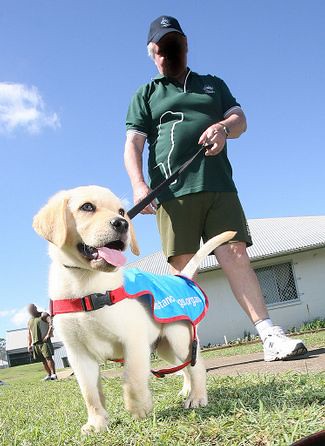
Man in a cap with yellow lab guide puppy Logan in working vest in a prison yardThe Ipswich Advertiser: Prison pups deliver new purpose

WHEN Kris was sentenced to life in prison, he didn’t expect to spend the long nights cuddled up to a 10-week-old labrador pup named Oxley. Oxley joined three other pups to enter Ipswich’s Borallon Correctional Centre last week, where eight maximum security prisoners will be responsible for full-time care of the assistance dogs-in-training.

This is the first time the program will run in an Australian maximum security prison. The offenders will teach them basic obedience commands to prepare them for helping people with a disability. These tasks include opening doors, fetching phones and mail, picking up dropped items and paying cashiers at shops.

The Age: Code opens doors to disabled

The Rudd government will today announce minimum access requirements for public buildings built or renovated from May 1 next year.

For the first time, uniform building rules will be mandated across Australia to end the isolation felt by as many as 4 million people who cannot use many public facilities. These go beyond buildings – to swimming pools and cinemas.

CBS: “Fight Club” for Mentally Disabled Brings Conviction; Guadalupe Delarosa Caught on Tape, Prison Next [WARNING]

An employee of a Texas home for the disabled who staged fights between the residents for “entertainment” is going to prison.

Coshocton Tribune: Independence important to residents with disabilities

Coshocton residents such as Connors and Wagner, who in the past would have been relegated to care facilities or be cared for by family members, have the option to become independent. Medicare has a waiver program that addresses different levels of care for these clients by providing them with help on meeting independent goals but at the same time offering a support system to provide for individual care.[…]

Living outside intermediate and long-term health care facilities gives developmentally disabled individuals the opportunity to choose what church they’ll attend, where they’ll go to work and who will take care of them if they need assistance.

“It’s exciting being out on my own and I’ve enjoyed the past eight months,” Connors said. “The best part is the privacy.”

Daily Sun: Persons with disability want constitution amended

A group, Joint National Association of Persons With Disabilities (JONAPWD) has called on the two chambers of the National Assembly to amend section 42 of 1999 Constitutions as well as section 57, 52 of Electoral Act of 2006.

National President of the group, Barrister Danlami Bashiru, made this call at a recent event in Lagos to commemorate the 2010 International Women’s Day with the theme; “Equal rights for Disabled Women in this Democratic Dispensation.” […]

Barrister Bashiru noted that women in this group suffers triple jeopardy, first as a woman, secondly as woman with disabilities and thirdly, they suffer discrimination from fellow women in the society.
He, however, revealed that JONAPWD has inaugurated the women’s wing of the body in Lagos for disabled women to have a strong voice, speak for themselves, demand for their rights and to provide lasting solution to challenges they faced.

The Telegraph: Self defence for the elderly – using an NHS walking stick

Kevin Garwood, 61, a triple black belt, has developed special ”cane work” courses for people over 50. The course is based on martial arts from around the world that use the sabre, bayonet and staff, which have been adapted specifically for stick users with limited mobility.

Typical moves include throws, takedowns and ‘neck hooks’ which use the crook of the stick for locks and strangleholds as well as gentle exercises using the 3ft long canes.

Recommended Reading

Warning: Offsite links are not safe spaces. Articles and comments in the links may contain ableist, sexist, and other -ist language and ideas of varying intensity. Opinions expressed in the articles may not reflect the opinions held by the compiler of the post. I attempt to provide extra warnings for material like extreme violence/rape; however, your triggers/issues may vary, so please read with care.

Nisha at bell bajao: Regulation of Disabled Women’s Sexuality

The pressure to ignore the bodily experiences for a collective voice to locate and challenge the barriers “out there” has made disability theorists and activists collude with “the idea that the ‘typical’ disabled person is a young man in a wheelchair who is fit, never ill, and whose only needs concern a physically accessible environment.”[14] This collusion has led to the sidelining of disabled women, non-visible impairments, intellectual impairments, elderly with chronic conditions[15], and disabiliy’s interaction with gender and other social, cultural oppressions[16]. Further, it has ended up contributing to the disappearance of the embodied experiences from most disability literature[17]. […]

The social norm of sexuality which is based on being “able-bodied” and the material situations of disabled women as “asexual objects” creates “rolelessness” – “social invisibility and this cancellation of femininity” prompts some disabled women to claim essential femininity which culture denies them[25]. This may give the impression that most disabled women have freedom from the standards set by the patriarchal male gaze and that they are in a position to develop and lead happy alternative lifestyles. In reality, imagining them as “antithesis of the normative woman”[26] adds to their disadvantage of being women.

Lisa I. Iezzoni and Laurence J. Ronan at the Annals of Internal Medicine: Disability Legacy of the Haitian Earthquake

Even before the earthquake struck, Haiti had few rehabilitation professionals and little capacity to manufacture essential assistive technologies, including prostheses and wheelchairs. While international organizations are assisting to fill these gaps, ultimately rehabilitation programs and assistive technologies will need to fit the specific demands of Haiti’s culture and rugged natural physical environments. As Haiti rebuilds its public and private spaces, ensuring accessibility to persons with disabilities will be critical.

About.com: Wheelchair-Using Child Actor Sought for NBC Pilot

If you’ve been unhappy with a character who uses a wheelchair being played by an actor who doesn’t on Glee, here’s some promising news: An open online casting call has gone out for a child actor who uses a wheelchair to play the son of Paul Reiser (pictured) in a pilot for NBC. The casting call, seeking performers age 10-13, describes the character as “sweet, funny, really smart and upbeat. He loves sports, music, and everyone he meets — especially adults. Inquisitive and with a mind like a steel trap, he remembers everything — which can be good or bad! He can easily get anxious and sometimes gets a bit obsessively focused on things. And oh, he has used a wheelchair since birth.” Not quite sure how you use a wheelchair at birth, but I applaud the intention.

NSW Human Services: Community garden for people with a disability

A community garden at Macleay Valley Community Care Centre is proving its value to people with a disability. Not only does the garden offer a place for them to enjoy or simply relax, it also provides them with fruit and vegetables.[…]

The project involved erecting a fence around the garden, screening under an existing deck, laying concrete paths and removing existing diseased trees. Six planting troughs were concreted into an area that is wheelchair accessible and garden beds are at a suitable height so they can be easily reached by older citizens and people with a disability.

World Health Organisation: Marking International Women’s Day [podcast transcript]

Veronica Riemer: Women are also facing discrimination in their opportunities for education. Bliss Temple from North Carolina in the USA, is a medical student who uses a wheelchair because of her disability. She talks to us about the challenges she has faced in taking forward her studies.

Bliss Temple: When I went to apply to medical school, because of my disability, I knew that it was unchartered territory. So I applied very widely to 28 different schools. About a third of them rejected me out of hand and said “you are too disabled; we won’t even consider your application”. It ended up that I did get accepted in several places and at the school that I chose, Duke University, I was the first person who was a wheelchair user. I think the first with what many people would classically think of as a disability; although there have been people with mental health problems.

Veronica Riemer: Bliss tells us why it is important for persons with disabilities to be accepted for medical training.

Bliss Temple: The world of medicine can really use people with disabilities. We are health care consumers of course and it is really important that we have more providers that understand the experience of having a disability.

The Wichita Eagle: Disability advocates ask court to halt cuts

A petition filed Friday by InterHab, an association for developmental disability service providers, seeks a temporary restraining order and asks that $10 million cut by the [Kansas] governor and Legislature be returned.

The cuts mean services for Topeka advocate Nancy Spano’s daughter Heather have been greatly scaled back. Heather is 24, but health problems and severe developmental disabilities mean she functions more like a 5- or 8-year-old child. Spano said her daughter needs round-the-clock care and help with basic hygiene. After the cuts, Heather was left alone at night and had no staff for help on the weekends. She frequently called her parents at all hours of the night, frightened.

Recommended Reading

Warning: Offsite links are not safe spaces. Articles and comments in the links may contain ableist, sexist, and other -ist language and ideas of varying intensity. Opinions expressed in the articles may not reflect the opinions held by the compiler of the post. I attempt to provide extra warnings for material like extreme violence/rape; however, your triggers/issues may vary, so please read with care.

Ally at Every Crooked Step Forward: Well, there goes that plan.

We, as members of the disabled community, do not need you to represent us, artistically or otherwise. We need to be given the opportunity to represent ourselves. We do not exist to provide you something interesting to look at, dissect, discuss, or parody. We do not exist to provide you with thinking points or talking points. We are not a theme. We are not the gun on the wall. We are not here to make a point to you about the preciousness of life, the resiliency of the human spirit, or even how fucking weird the world can be. Our lives are not made meaningful by enriching or educating you. We do not need you to make our lives meaningful.

newsflash in accessibility_fail: Mt. Holyoke College fails [more in comments at link, and at Dog in the Dorm]

To make a long, painful story very short, she’s had a shocking, nightmarish experience at Mount Holyoke, which you would expect to be a liberal, supportive environment since it’s a women’s college. She was led to believe everything would be in place for her arrival and that disability services there were top notch. However, it’s been a nightmare. She was unable to eat in the cafeteria the first two months of school because the student workers told her she couldn’t bring a dog in. Disability services told her they weren’t sure what they could do, because not all student workers might understand an email saying they couldn’t refuse her service. She was given a room on a third floor that her scooter wouldn’t fit in, and when she complained she was told to leave her expensive piece of medical equipment in the lobby. When they finally moved her to a new dorm room, she had to go across campus to shower in her old dorm because they didn’t install grab bars in her shower.

Stephen Kuusisto at Planet of the Blind: Disability and Its Discontents

Most of this blog’s readers are familiar with this puzzle, many of them are, like me, living that puzzle. Many of them are alertly, day by day building lives of evident accomplishments with or in spite of disabilities; many are still misunderstood when they’re on street. “How do you know when you dog has made a poopy?” asks a woman. And one wants to say, “Well I have an advanced degree Madame.” Mostly one winces. Moreover, one says something benign: “They teach you about that at the Guide Dog School”.

The Vancouver Sun: No sugar-coating for disability exhibit

For disability rights activist Catherine Frazee, the personal overlaps with the political even when she doesn’t intend it. That happened with Frazee’s recent journey to Vancouver from Toronto for Out From Under, a unique exhibition on the social history of disability in Canada.[…]

The only option for her was to take the train. Frazee was willing to make sacrifices to travel out west, such as sleeping in her electric wheelchair. She can’t be separated from her wheelchair, which is uniquely customized to her body’s needs. At times, for example, she has to tilt it slightly back to help with her breathing. When she contacted Via Rail, she was told that she and her wheelchair had to travel separately. […]

From Toronto, Frazee and Seeley drove south to Chicago where they got on a train that had a railcar with an accessible room. They travelled across the U.S. to Seattle, where they rented a van with a ramp and drove north to Vancouver. The irony of not being able to cross the country for a disability exhibition during the Winter Paralympic Games wasn’t lost on Frazee, one of the country’s most articulate advocates for the rights of the disabled.

tonic: Nonprofit Sends Heavy-Duty Wheelchairs to Haiti

Whirlwind Wheelchair International is sending 350 specially designed extra-durable wheelchairs to Haiti to help those who need them most.

Have you seen the movie Murderball? The Internet Movie Database calls it, “a film about paraplegics who play full-contact rugby in Mad Max-style wheelchairs.” While rugby and extreme sports have little to do with Haiti at the moment, wheelchairs sure do, especially “Mad Max-style” ones. In a situation where towns are covered in rubble and many people have severe injuries from the recent earthquakes, there’s a desperate need for low-cost, durable wheelchairs.

Oregon Live: Multiple sclerosis turns the tables on Portland oncologist, as patients become caregivers

Patients, who typically expect doctors to be invincible and need them to be on top of their game, had to know, too. Word spread swiftly.

One patient in the throes of treatment texted Webster, asking how she was. Webster remembers replying: “Don’t worry about me. I’ll be back.” The woman, adamant that sometimes — even in the stoic world of medicine — the tables turn, wrote, “No. We get to worry about you, too.” […]

She lived in a three-story townhouse, and just managing the stairs would be a hefty challenge. She’d need rides to doctor and therapy appointments, not to mention assistance with routine household tasks, especially during the hours when her partner, another busy physician, wasn’t around to help.

As patients offered to assist, Webster wrestled with the question: Was it OK to let them?

Chatterday! Open Thread.

This is our weekly Chatterday! open thread. Use this open thread to talk amongst yourselves: feel free to share a link, have a vent, or spread some joy.

What have you been reading or watching lately (remembering spoiler warnings)? What are you proud of this week? What’s made your teeth itch? What’s going on in your part of the world?

Today’s zombie-kitten Chatterday backdrop is via the Daily Squee.

Sunlit cute kittens walking on hindlegs like zombies

Recommended Reading

Since I couldn’t do a Rec Reading yesterday – my spoons were needed elsewhere – here’s a bumper edition for today.

Warning: Offsite links are not safe spaces. Articles and comments in the links may contain ableist, sexist, and other -ist language and ideas of varying intensity. Opinions expressed in the articles may not reflect the opinions held by the compiler of the post. I attempt to provide extra warnings for material like extreme violence/rape; however, your triggers/issues may vary, so please read with care.

Thedeviante at The Deviated Norm: Today In: Things Any Disability Rights Activist Could Tell You

So, people are nosy assholes. Well, let me amend that. Many people think that your body (or your loved one’s body) is totally their business, the second that you (or your loved one) have something that sets you apart from “normal.”

Things that set you apart from “normal” include: being pregnant, having a visible disability, having an invisible disability (and telling people about it), being mentally ill (and telling people about it), being fat, oh, and getting one of the “big” sicks (including our good friend cancer).

Let me tell you a little story.

Nicholas Patrick in The Age: Australias disability laws need critical review

For some four million Australians and their families, a threadbare patchwork of state and federal laws, often ignored international conventions and, an all round lack of understanding make life more challenging than it already is. What’s needed is a complete review of the existing legal framework to ensure that people with disability live lives of dignity and can realise their potential to fully participate in Australian society.

Much newsprint and digital space has been devoted to such issues as wheelchair access on domestic and international flights, mental health in the Northern Territory, and, on Four Corners recently, the dire state of government support for parents of children with disabilities. Other cases, gaining less media attention, such as access to education and electoral rights for voters, are progressing through the courts.

Yet, for all the very real pain and injustice these stories draw on, they are only mountain peaks of public awareness. The state of legal rights for people with disability are, in fact, far worse than even these very serious cases might suggest.

Sarah Burnside at Challenging The Market: Sarah Burnside on market logic and welfare reform

Opposition Leader Tony Abbott drew media attention recently for proposing a “welfare crackdown”, to include compulsory work-for-the-dole schemes and higher threshold for eligibility for disability pensions. With respect to the latter, Abbott proposed a review by the National Audit Office to determine more stringent eligibility rules for the disability pension and suggested that recipients with “less serious medical conditions” be required to undergo annual medical reassessments and sit two interviews each year to “encourage them into employment”. Currently, 700,000 Australians receive the disability pension. Abbott estimates that around one-third of these people have conditions he would class as “less serious”. […]

Second, Abbott’s classification of muscular-skeletal and psychological/psychiatric disabilities as the categories within which “less serious” conditions might be found seems opportunistic. Muscular-skeletal conditions may involve chronic pain which is inherently difficult for external parties to perceive. Similarly, psychological or psychiatric illness is not readily identifiable by bureaucrats seeking to limit entitlements to government benefits.

The nomination of these categories suggests a certain lack of sophistication – if someone’s not in a wheelchair or holding a cane, they must be capable of work.

CBC News: Canada ratifies UN treaty for disabled rights

Canada has ratified the UN Convention on the Rights of Persons with Disabilities on the eve of the Paralympic Games in Vancouver.[…]

However, the convention is about much more than adding wheelchair ramps. It shifts the focus from institutionalizing those with disabilities to housing them in the community and allowing disabled people to challenge in Canadian courts, laws or policies that contravene the international law.

However, the signing did not go ahead without a glitch. The location of the news conference had to be hastily changed when organizers realized the original room was not wheelchair accessible.

NPR: Google Launches Closed Captioning For YouTube [Transcript included]

Google this week introduced closed captioning for the deaf on its YouTube video site. Ken Harrenstien, the lead engineer behind Google’s automatic captioning technology, says that as a deaf person he lobbied his bosses for years to introduce the technology.

WorldNewsVine: Disabled Nigerians Demand Their Rights to Vote

People with disabilities are proposing the creation of the National Commission for Persons with Disabilities Bill in the National Assembly of Nigeria. The proposal has been submitted and under consideration with the Federal Government of Nigeria for almost 4 years, yet nothing has been done by the lawmakers so far.

Speaking on stigma and discrimination against women with disabilities, the National Financial Secretary of Persons with Disability, Miss Bilkisu Ado Zango said that as long as the males in Nigeria are concerned “disabled women are corpses and the living have nothing do with the dead”.

“Women with disabilities face tipple the challenges men with the same conditions experience in Nigeria with regard to education and employment. The society in Northern Nigeria believes that women in general do not need to be educated. Disabled women seeking recognition; therefore might seem an impossible task; however, we believe that we will be able to break through.”

Wired: DARPA Pushes for Fail-Proof Prosthetics

DARPA, the military’s risk-taking research agency, is launching the next phase of its Revolutionizing Prosthetics program, which was started in 2000 with the goal of creating a fully-functioning, neurally-controlled human limb within five years.

BBC: DVD offers crime prevention advice for deaf people

The DVD was devised by Kevin Childs from Gwent Police, who had spent time working with deaf people in the area. He teamed up with the British Deaf Association and made the film featuring two deaf lead characters in various crime prevention scenarios. The film will now be distributed to forces throughout the UK.

Insp Childs said after working with local community groups he had concluded the main challenges were a lack of suitably accessible crime prevention literature and lack of engagement with, and access to, police officers. The DVD offers a variety of visual aid options for users which can be switched on and off as needed, including signing, subtitles in a variety of languages and a facility for lip reading.

ruthtamari at Life Changes: Personal Leadership & Being the Difference

My dream and vision for Toronto, Canada is that the city will be accessible by anyone who uses a wheelchair, scooter, walker, crutches, cane or assistive device. Every curb, entrance, washroom, subway, bus, theatre, restaurant and building would be accessible by everyone. Wouldn’t that be an amazing city to live in? One thing that is sure to promote healthy living, healthy aging, healthy communities and inclusion is having access to whatever you want to do and wherever you choose to go.

SF State University News: Anita Silvers honored for lifetime achievement

Anita Silvers, professor and chair of the Philosophy Department and a nationally recognized advocate for disability rights, was awarded the 2010 Quinn Prize from the American Philosophical Association (APA). […] Disabled by polio as a child, Silvers is a leading advocate for equality for persons with disabilities. Her papers and books have contributed to the legal interpretation of the Americans with Disabilities Act, enacted in 1990. Her groundbreaking and acclaimed monograph, “Disability. Difference. Discrimination: Formal Justice” (1998) is widely cited in legal affairs. “Americans with Disabilities” (2000), which she co-edited with Leslie Pickering Francis, anthologizes essays by other leading philosophers, as well as legal theorists, bioethicists and policymakers on the moral foundations of disability law and policy.

Am J Cardiol concern-trolling: “But mobility aids will stop them EXERCISING!”

So I stumble across this at Diabetes.co.uk: Mobility Scooters Can Increase Your Risk of Developing Daibetes and Heart Disease

“O really?”, thought I, “I wonder how well-controlled that scoldy little piece of disability panic was?” So I read on.

However, recent research suggests that mobility scooters can do more harm than good by heightening the risk of diabetes and heart disease .

“More harm than good?”, thought I, “I wonder who measured that? How did they decide which effects outweighed which in the goodness vs. badness stakes?” So I read on.

Astonishingly, a study of scooter users in the U.S.A discovered that almost one in five developed diabetes after buying one to get around.

“Huh”, though I. “One in five, eh? Hm, that doesn’t sound all that different from the baseline prevalence in the population, let alone the older/ill/disabled population.” So I read on.

The research, published in the American Journal of Cardiology, highlights how multiple benefits to patients’ health from being able to get around more easily are being erased by the effects on the cardiovascular system.

“Erased?”, thought I. “Completely wiped out? Huh. Was it the people concerned who decided this, or someone else?” So I read on.

Researchers are urging doctors to consider the risks of scooter use before making recommendations to patients invest in a scooter.

“*Doubletake*”, thought I. “Doctors should consider the risks? Doctors? Not, say, people with disabilities? Just doctors? Doctors should weigh up the risks before offering any options at all? Doctors should decide?” So I read on.

[…] There have even been incidents when scooters have killed individuals.

OMG RANDOM IRRELEVANT SCOOTERPANIC!

Moving on.

They recruited 102 patients, with an average age of 68, who had obtained medical approval for a scooter and monitored their health over six years. Even though patients stated that they felt better physically and mentally, tests demonstrated that 18.7 per cent developed diabetes during the follow-up period.

“Erm”, thought I, “Right then. Sure enough, it was an older population- nearly seventy years old on average. The prevalence of diabetes in the population older than 60 in the USA is 23.1%, and that’s not people who are already ill and have other risk factors. That’s not really a surprising number.”

“I wonder,” thought I, “I wonder how that control group did, the age- and disability-matched control group, the one who didn’t get scooters at the same time?”

OH WAIT.

Yeah, there wasn’t one. No control group.

Just a group of elderly people with cardiac failure, neurologic disease, disabling arthritis, and chronic lung disease. Just a group of people with disabilities trying to eke out a life and getting used as a Lesson To All Of Us about the dangers of sloth.

The abstract is here, in the American Journal of Cardiology. Effect of Motorized Scooters on Quality of Life and Cardiovascular Risk, Brian W Zagol and Richard A. Krasuski, Volume 105, Issue 5, Pages 672-676 (1 March 2010).

This sterling little doctor-centric chastisement does contain one really useful piece of information:

[…] significant physical and psychological improvements in all quality-of-life categories (p <0.001) [...]

I’ll say that again, ‘cos they buried the lead. After getting a scooter, people experienced:

[…] significant physical and psychological improvements in all quality-of-life categories (p <0.001) [...]

But the authors decided to slap a big ol’ “DESPITE” before this statement about how the lives of people with disabilities were improved by appropriate mobility aids, and instead go on to list the way several laboratory parameters became “worse” over time in this group of ill elderly people. In a study with NO. CONTROL. GROUP.

We have absolutely no idea how these laboratory parameters would have fared had the people concerned not obtained mobility scooters. All we know is that their quality of life improved significantly in all domains.

What the study fails to recognise – among other things – is that the alternative to getting about on mobility aids isn’t a day of jaunty strolling; it’s immobility. The alternative to going out sitting on a scooter isn’t a doubles tennis match and a brisk swim followed by a bootscooting class; it’s sitting at home.

But the quality of life of PWD, the lack of alternatives, is dismissed by these concerned medicos as a relatively trivial aside; as just one factor for doctors to consider before deciding whether to withhold their blessing – and their financial rubber-stamp – to mobility aids:

In conclusion, interventions, such as scooters, that improve self-perceived quality of life, can have detrimental long-term effects by increasing cardiovascular risk, particularly insulin resistance. Physicians should carefully weigh such risks before approving their use, as well as ensure healthy levels of activity afterward.

Dudes. Newsflash. You’re not the ones who should be carefully weighing this hypothetical “risk”. We are. And you sitting there planning to deliberately withhold mobility aid funding to the poorest people in the population because you think they might – not will, only might – see their blood glucose tweak a few points? Not ok.

You don’t get to dismiss the importance our self-perceived quality of life (“self-perceived”? Who do you think is the best person to assess our quality of life? You?) with a parenthetical “Despite”. What is important to us is important to us; you don’t get to override that with your misinformed concern-trolling. You don’t get to decide on your own, then inform us what’s important in our lives. You don’t get to exclude us from the conversation. You don’t get to tell us which risks are worth taking.

You don’t have the moral right to immobilise us based on your imposition of your own value system on our lives. You wouldn’t even have that right if this was good research. When it’s fucked-up hand-waving? Put the journal down, and start seeing real people. The people right in front of you, who are looking for independence, the ability to shop, the ability to socialise, the ability to go to the fucking doctor, the choice to have a better life. The life you’re planning to say “no” to.

Recommended Reading for Décadi, 20 Ventôse CCXVIII

Warning: Offsite links are not safe spaces. Articles and comments in the links may contain ableist, sexist, and other -ist language and ideas of varying intensity. Opinions expressed in the articles may not reflect the opinions held by the compiler of the post. I attempt to provide extra warnings for material like extreme violence/rape; however, your triggers/issues may vary, so please read with care.

melinda at I Don’t Believe in Ellen Greene’s God: Only non-defective aliens, please

The re-entry permit for residents to re-enter the United States explains that it does not guarantee re-entry. It outlines possible reasons for a resident to be denied re-entry. […] And if you’re not “criminal,” “immoral,” or “insane,” you still may be “mentally or physically defective” in the eyes of the US government, which evidently views people akin to products you can send back to the factory when they don’t work right.

Southern Courier: Historic day for blind voters

Australians take pride in being the first country in the world to introduce the secret ballot. Unfortunately, this democratic right has not been secret for all. Today’s announcement made by the Federal Government is an initial step towards ensuring that people who are blind or have low vision will eventually have the opportunity to exercise their constitutional right to vote privately. […]

“This is a historic day for members of the blindness community like me who have been campaigning for a method of voting that is both accessible and private for many years,” said Vision Australia’s Maryanne Diamond, current President of the World Blind Union. “Since 1902, Australians who are blind have had to rely on friends, family or even strangers to exercise this basic democratic right.”

express buzz: ‘Disabled women face double discrimination’

The marchers pointed out that the rights of disabled women had received special mention in the United Nations Convention on the Rights of Persons of Disability, which India had ratified on October 1, 2007, said Meenakshi, a member of Vidya Sagar. But, India had failed to implement the provisions of the charter, she added.

“There is barely any attention being paid to the rights of disabled women”, she argued. “Disabled women are subjected to double discrimination, both on the grounds that they are women and that they are disabled,” she added.

Disability Scoop: Education Department To Step Up Enforcement Of Disability Rights

The federal government is redoubling its efforts to crack down on civil rights violations against students with disabilities and other minority groups, Secretary of Education Arne Duncan said Monday. The Department of Education’s Office of Civil Rights will be issuing a series of letters offering guidance to school districts across the country and ramping up efforts to reach out to parents and advocacy groups, Duncan said in a speech in Selma, Ala.

Tara Parker-Pope at NY Times: The Voices of Fibromyalgia

People who suffer from fibromyalgia experience problems beyond the pain caused by their illness. Their condition is little understood and hard to explain, and often they are disbelieved by doctors. […] For a glimpse into the frustrating world of fibromalgia sufferers, listen to the latest installment in the Patient Voices series by producer Karen Barrow in which six men and women speak about living with the condition.

WA Today: Disabled girl can be sterilised: court

Disability groups are split over a Family Court decision to approve the sterilisation of an 11-year-old girl.

Family Court judge Paul Cronin found that the performance of a hysterectomy on the child, identified only as Angela, was “in the child’s best interests”.

Recommended Reading for JD 2455264.5

Warning: Offsite links are not safe spaces. Articles and comments in the links may contain ableist, sexist, and other -ist language and ideas of varying intensity. Opinions expressed in the articles may not reflect the opinions held by the compiler of the post. I attempt to provide extra warnings for material like extreme violence/rape; however, your triggers/issues may vary, so please read with care.

Athena, Ivan and the Integral: Disability Blog Carnival Number 64: caught us with our pants down [submission deadline: March 31st]

The theme of our issue of the disability blog carnival is the following: breaking down stereotypes. We posed the following question: if you could break down one single stereotype, which would it be and why?

Trib Local: Disabled dancer reaches for dreams in ‘Prayer’

Lane has said she is not interested in hearing how inspiring and wonderful people think she is to do something like this despite being in a wheelchair.

Wheelchair Dancer: Do You Work?

Whether or not one is employed is a standard part of the social profile that new doctors seem to want to know — particularly in my case, since I don’t have a clear single diagnosis. “Work” for a doctor seems to serve as a bright line between genuinely disabled and neurotic, psychosomatizer. For far too many within the medical system, work serves as a talisman between a healthy coper and a drag on the medical and welfare systems.

Sunderland Echo: Wheelchair users face rail footbridge woe

Wheelchair users are facing a lengthy diversion if plans for a footbridge over a railway line go ahead. Network Rail wants to remove level crossings at Dawdon as part of a scheme to upgrade signals along the East Durham coast. Crossing the tracks on foot near Princess Road and at the town’s station would be stopped once footbridges are installed.[…]

Coun Bob Arthur, who represents the Dawdon ward on Durham County Council, said: “There is growing concern from people and they have been on to me about this because the bridge would not be suitable for wheelchairs and pushchairs.

NPR: Nine More Airports To Get Body Scanners

The Transportation Security Administration on Friday announced nine more U.S. airports that will receive body-scanning technology, as the U.S. heightens its effort to detect hidden explosives and contraband amid a threat highlighted by an attempted bombing on Christmas Day.

The Consumerist: New Airport Screening Machines To Launch Monday

These new “backscatter” type machines are different — and one would hope improved — from the existing “millimeter wave” types already being used in various spots around the country. Some of you might remember the story from a few weeks back of a millimeter wave machine in Denver being set off by an artificial breast.

BBC News: Women refuse to go through airport body scanners

Two women were stopped from boarding a plane at Manchester Airport after refusing to undergo a full body scan. The passengers were due to fly to Islamabad on 19 February when they were selected at random to go through the new scanning machine. […] The women were warned they were legally required to go through the scanner, after being chosen at random, or they would not be allowed to fly, an airport spokesman said.

Kelly Kleiman at Huffington Post: Full Body Scans Are a Feminist Issue

Surprisingly, a pair of otherwise civil-libertarian friends shrugged when they heard this rant. “I’m not with you on this one,” they said. They cited the impersonality and brevity and
disposability of the images. (I’m skeptical of the proposition that the government will
collect information and throw it away: since when?) They reduced me to inarticulate dudgeon, because I couldn’t imagine how they could fail to share a response I felt so viscerally.

And then I realized: they’re men. They haven’t spent their entire lives bracing themselves
against precisely the violation of being stripped naked by a stranger. As far back as grammar
school, it was accepted practice in my middle-class neighborhood for a boy to threaten to grab a girl walking home and strip her. I don’t know if this was ever actually done, but the mere threat was effective in keeping girls frightened and under control. And, as Susan Brownmiller established, the threat of rape-including the notion if not the actuality of nakedness-is the pervasive device by which men keep women in line.

Muslimah Media Watch: Naked Ambition: Airport Body Scanners Only Offensive to Muslim Women?

As much as having naked images of their bodies taken and viewed by strangers may be an upsetting idea to many Muslim women, why focus only on us? Or religious groups in general (The Jewish Daily Forward’s article claims that the airport scanners run “afoul of Jewish law.”)? The American Civil Liberties Union has issued a statement against the scanners that does not single out any specific religious group or gender. It seems likely many people would be equally offended by both the breach of personal privacy and the indignity of being constantly suspect while traveling or merely going about their business—why should the media assume that Muslim women are the only ones who will have ethical, ideological, or personal issues about the airport body scanners?

Black, Hispanic, Poor people wait longer for breast cancer treatment, experience more recurrences

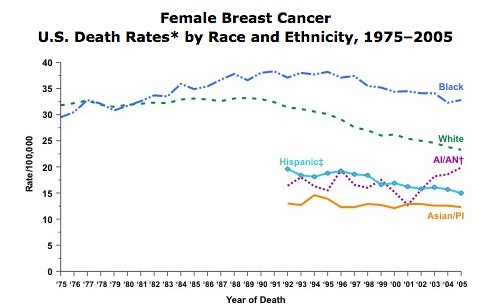
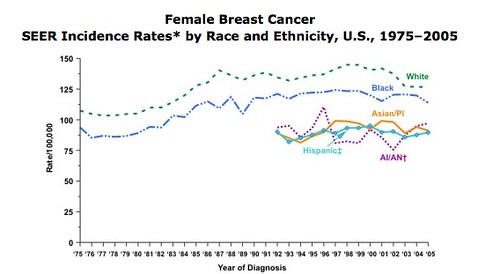
In the USA, Black women have the highest mortality from breast cancer of any other group, despite the rate of diagnosis of breast cancer being highest in White women. Hispanic women have a lower breast cancer diagnosis incidence than either, but mortality rates are disproportionately high in Hispanic women also. Here are the CDC incidence and mortality statistics over time:

“Incidence rate” means how many women out of a given number get the disease each year. The graph below shows how many women out of 100,000 got breast cancer each year during the years 1975–2005. The year 2005 is the most recent year for which numbers have been reported. The breast cancer incidence rate is grouped by race and ethnicity.

For example, you can see that white women had the highest incidence rate for breast cancer. Black women had the second highest incidence of getting breast cancer, followed by American Indian/Alaska Native, Asian/Pacific Islander, and Hispanic women.

Breast ca incidence stats showing White women at highest risk

The graph below shows that in 2005, black women were more likely to die of breast cancer than any other group. White women had the second highest rate of deaths from breast cancer, followed by women who are American Indian/Alaska Native, Hispanic, and Asian/Pacific Islander.

Breast ca mortality stats showing Black women at greatest risk

A number of contributors to this disproportionate mortality have been proposed, including environmental toxin and pesticide exposure, more aggressive tumours, and later diagnosis. Most alarmingly, the mortality gap seems to be widening.

This week’s British Medical Journal (BMJ) has an important article today demonstrating one of the consequences of healthcare racism in the USA:

Impact of interval from breast conserving surgery to radiotherapy on local recurrence in older women with breast cancer: retrospective cohort analysis[1]

The researchers analysed national cancer records for 18,050 US women, aged 65 or older and otherwise non-disabled, who were diagnosed with early stage breast cancer during an eleven year period to 2002, and who received breast conserving surgery and radiotherapy, but not chemotherapy.

30% of the women in this study had to wait more than six weeks after their surgery before they could have radiotherapy. Delays greater than six weeks were associated with a modest but significant increase in local recurrence of the breast cancer.

The study also showed that there was a continuous relationship between radiotherapy delays and local recurrence; the sooner radiotherapy was started, the lower the risk of cancer recurrence, and this relationship was strong. This is concordant with previous studies.

So who was subject to these long, risky delays in treatment?

Sadly, the answer will not surprise you: Black women, Hispanic women, and poor women. Black women were almost 50% more likely to experience a longer than six week gap before radiotherapy treatment, and Hispanic women experienced a 30% increase in risk of delay.

The followup was only five years long in this study, and breast cancer tends to be a cancer that bides its time; the increase in risk (and in consequence mortality) may be greater, even much greater, with longer followup. In addition, as local recurrence risk tends to more common in younger women and this study focused on older women, the effect could be more pronounced in the total population of those with breast cancer. In addition, the study studied mostly White women, as Black women tend to get their cancers younger and have a decreased likelihood of receiving breast-conserving surgery and radiotherapy. In other words, this study was set up in a way that made it, in some ways, particularly difficult to find a significant difference in the effect they were looking at; the fact that they still found one means that the effect is likely to be really quite pronounced.

The accompanying BMJ editorial by Ruth H Jack and Lars Holmberg[2] goes on to suggest one possible model of healthcare delivery that might alleviate these delays:

One good example of how practices can be improved is the Rapid Response Radiotherapy programme in Ontario. This programme has drastically shortened waiting times for patients having palliative radiotherapy by restructuring the referral process so that many patients are treated on the same day as their consultation.9 Countries where disconnected systems are responsible for different aspects of treatment will find it more difficult to ensure that diagnosis, referral, and treatment are not subject to delay.

++++++++++++++++++++++++++++++++++++++++++

[1] Impact of interval from breast conserving surgery to radiotherapy on local recurrence in older women with breast cancer: retrospective cohort analysis
Rinaa S Punglia, Akiko M Saito, Bridget A Neville, Craig C Earle, Jane C Weeks.
BMJ 2010;340:c845; Published 2 March 2010,
doi:10.1136/bmj.c845

[2] Waiting times for radiotherapy after breast cancer
BMJ 2010;340:c1007
Published 2 March 2010,
doi:10.1136/
bmj.c1007

Recommended Reading for Stardate 63649.1

Warning: Offsite links are not safe spaces. Articles and comments in the links may contain ableist, sexist, and other -ist language and ideas of varying intensity. Opinions expressed in the articles may not reflect the opinions held by the compiler of the post. I attempt to provide extra warnings for material like extreme violence/rape; however, your triggers/issues may vary, so please read with care.

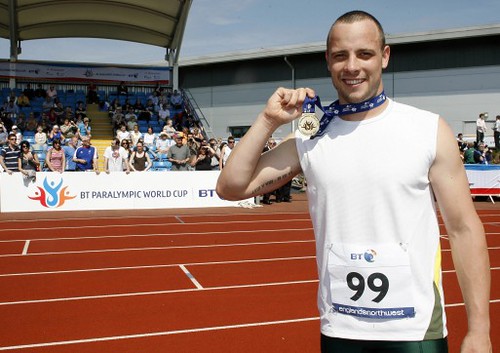
Oscar Pistorius shows off his medals on a sunny day at the track

More Than The Games: Pistorius hoping for fast times at the BT Paralympic World Cup

Oscar Pistorius will again be the marquee name of the 2010 BT Paralympic World Cup after the South African confirmed his participation at the annual event in May. The 23-year-old, a four-time Paralympic gold medallist, will defend his 100m and 400m titles in Manchester as he continues his bid to compete at the 2012 Olympics and Paralympics in London.

In 2008, Pistorius, dubbed the Blade Runner, was cleared to compete at in IAAF able-bodied events by Court of Arbitration for Sport, but failed to achieve the qualifying time for the 2008 Olympics by 0.7 seconds.

Laura Overstreet at LeftyByDefault.com: Things that make you go hhhmmm….

Getting a Maid of Honor dress has been a little more difficult, simply because I need separates and sizing is a little wacky with me. Not really a huge deal though. I decided that going to a dressmaker would be easiest. Or it seemed easiest until I visited one yesterday.[…]

She then said, “You are very unlucky,” and I don’t remember what I said or did, but I know I was in shock. That was a new one on me. I have been asked this question more times than I can count and never heard that one. She went on to say, “You must cry all the time.” Uh, not so much.

Wheelchair Dancer: Thinking Beyond The Label? Not Quite

The advertising campaign is the first nation-wide campaign about employment for PWD. It’s on the television and the radio; there’s a website. I have yet to see a paper version. It’s not working for me. It’s not just the slogan, “Evolve Your Workplace,” (eek — misuse! infelicities!), it’s the way disability is presented.

Activists have spent a long time trying to educate people about the dangers of assuming everyone is a “little bit disabled.”

Serene Vannoy at serenejournal: Next week: Disability Awareness Week!

Next week is Disability Awareness Week at Cal and we are working to spread the word as much as possible. […]

UC Berkeley is considered by many to be the birthplace of the disability rights movement, and the students, staff, and faculty of UCB are committed to continuing that tradition. That is why the Disabled Students Union, Disabled Students Program, and the ASUC are coordinating the fourth annual Disability Awareness Week.

UPI.com: U.N. to safeguard Haitian disabled rights

A group of U.N. experts will look into the plight of Haitians with disabilities, disproportionately affected by January’s earthquake, the United Nations said. […] The group also will look into the situation of people with disabilities in other countries affected by natural disasters, including Chile, which was struck by an 8.8-magnitude earthquake last weekend.

Sydney Morning Herald: All the world’s a stage – some can’t get in

But amid the graphs and tables illustrating the positive findings in the Australia Council for the Arts report More than Bums on Seats: Australian participation in the arts was some less palatable news: people with disabilities and migrants from non-English-speaking countries are being left behind.

The council’s last similar survey was released in 1999. How far has access to the arts progressed for people with disabilities – one in five nationwide, or more than 4 million? “Not very far would be my summary,” Australia’s Disability Discrimination Commissioner, Graeme Innes, says.

“Many, many venues are not accessible for people who use wheelchairs. There are only 15, I think, cinema screens around Australia – out of the 2000 or 3000 screens showing movies – that show movies with captions for people who are deaf or have a hearing impairment. There are even less cinemas providing audio description for people who are blind or have a vision impairment. I think that the arts community and deliverers of arts have got a long, long way to go before people with a disability are anywhere near in an equal situation.”

Sydney Morning Herald: Access still a hurdle, says film buff

Andrew Longhurst knows all about the difficulties that can discourage people with disabilities from going to shows or other forms of the arts and entertainment. As someone with a bone disorder who has used a wheelchair for most of his 35 years, he has encountered just about every barrier, beginning with physical access. “It’s a general rule that if you can’t get in the front door, it’s pretty much game over,” Longhurst says. But he’s not fussy: “Any door will do.”

Entry is just one consideration of many — from parking and distance to mobility challenges inside — when weighing up an unfamiliar venue. “I’m very adaptable . . . I can climb up steps on my backside,” he says. “I make it work. But if it’s entertainment, if it’s arts, it’s supposed to be enjoyable.”