Yearly Archives: 2010

Recommended Reading for Wednesday, November 3

I’m sorry this is at an odd time today. I forgot it was Wednesday. (I forgot yesterday was Tuesday, so this makes total sense.)

Monday was Autistics Speaking Day:

Corina Becker at No Stereotypes Here: Preparing to be Loud

When I proposed Autistics Speaking Day, I merely thought that it’ll be myself plus a couple of others participating. However, it turns out that there are a lot of people who feel the same, and different names for it, from Autism ShoutOut! to our Autistics Speaking Day.

The name for it doesn’t matter. This is a day that is supposed to be about spreading Autism Awareness, therefore it’s OUR day. It doesn’t just belong to me, it belongs to all of us, and what matters is that we stand together to raise Autism awareness.

Corina followed up with The Success of Speaking

I will be honest, when I proposed Autistics Speaking Day, I thought that at best it would be myself and a few others, tweeting on Twitter and maybe putting up a few blog posts. And when the criticisms came in, with people saying that much wouldn’t happen, so why bother, I thought of two things. The two things that leads me to be active in the Autism and Disability communities.

Corinna and Kathryn Bjørnstad have made a very long list of bloggers that participated in Autistics Speaking Day. I recommend checking them all out.

Steve Silberman at Neurotribes: I’m Right Here: Rudy Simone on Life as an “Aspergirl”

Unlike autistic author and animal-behavior expert Temple Grandin — whose life was the subject of an acclaimed HBO biopic starring Clare Danes — Simone wasn’t diagnosed until she was in her 40s. Diagnosis in mid-life is common for women with Asperger Syndrome. Often highly intelligent and articulate, they’re able to mask their social deficits while leveraging their ability to focus intensely into achievements in school and the workplace.

Simone had a relatively happy — if eccentric — childhood, but when she hit adolescence, the social tide seemed to turn against her, washing away most of her friends. Suddenly, her trusting exuberance and hyper-focus made her weird in the eyes of her peers, and a convenient target for bullying and abuse. One day, Simone’s chief tormentor at school brutally beat her in front of a cheering crowd of older kids. Humiliated, the 12-year-old Simone stopped singing and laughing in public

The Untoward Lady at the Vibrating Square: Memories [Discusses bullying]

I expected to remember the bullies. I expected to remember the pain that had been caused. I had thought that the faces of my memory, the pain, would come and surface again as I looked at the rows of portraits.

MASSIVE TRIGGER WARNING ON THIS ONE: Dave Hingsburger at Rolling Around in my Head: Curbing Anger: Daring Difference (TW for abuse of autistic boy)

What they did defies understanding. Maybe it just defies MY understanding. For three days they tortured a young 17 year old man with autism. The list of what they did is astonishing in its length, in its cruelty, and (it must be said) in its creativity. Here’s a brief survey of what a teen boy with autism suffered at the hands of his tormentors.

The Quixotic Autistic: New Age & Autism Part One: The Horse Boy (See also Part Two)

My very first instalment in my series on New Age perspectives on autism begins with the book and movie of the same title, The Horse Boy, the book being written by Rupert Isaacson, the movie directed by Michael O. Scott. At the centre of both though is Rowan Isaacson, son of Rupert and Kristin. He is the titular “Horse Boy” and he has autism. The book and film both chronicle his parents taking him on a special trip to Mongolia to consult with traditional Mongolian shamans, in hopes of “healing” Rowan from his tantrums and incontinence, as well as helping him become more social and less agitated by overstimulation. The idea is that the combination of riding horses and shamanistic healing will benefit Rowan emotionally and physically.

jholverstott: A Shade unDifferent: Latent Bullying and ASD, the Epidemic Grows

Most of what I have read in the literature suggests that anti-bullying campaigns are ineffective, at best, and potentially damaging, at worst. Kid with ASDs are a tricky audience, regardless. They are kind, too kind to stand up for themselves with the empowered and sometimes sassy words that stand down a bully. They are not equipped to recognize the savviness of cyber- and mobile-bullying, with its faceless and nameless tactics. They are primed targets because they want so desperately to believe in others, to believe in a friend, to have a friend. They are cyclical victims because of the flaws of the system that shields them; “tattle” and enlarge the target.
The 2010 Don’t DIS My ABILITY Campaign Has Kicked Off!

People. People. I cannot even tell you how excited I am. In November-December in New South Wales, the awesome-est state in Australia[1. My esteemed co-blogger Lauredhel might disagree with me there.], we have a little something called the Don’t DIS My ABILITY campaign. There are loads of events run around the state leading up to the International Day of People with a Disability.

My personal favourite bit is the campaign magazine, Made You Look. You may remember that Lauredhel wrote about playground accessibility for disabled parents for the magazine last year. This year, Ouyang Dan and I both contributed pieces. OYD’s is on ableist language and is called “Think before you speak,” mine are “Type (re)Cast,” about popular culture representations of PWD, and “Seen and not heard,” on my experiences of being young and disabled. If you’re in NSW, you can pick up a hardcopy at your local library, all over Sydney and at loads of regional newsagencies (full list of places you can obtain the mag here). If you are elsewhere, you can download a copy, in one go or in sections, if that’s easier.

But that’s not all! Check out the Don’t DIS blog. I’m going to be writing there over the next month about such topics as who gets to speak about disability advocacy, narratives of disabled laziness, where conversations about disability tend to stop, body image while disabled and what respecting disabled people means. You yourself can participate: check out this post about blogging for the campaign here.

It’s going to be a fabulous month, readers.

Recommended Reading for November 2, 2010

Siddharta Mukherjee for the New York Times Magazine: The Cancer Sleeper Cell

In fact, this view of cancer — as tenaciously persistent and able to regenerate after apparently disappearing — has come to occupy the very center of cancer biology. Intriguingly, for some cancers, this regenerative power appears to be driven by a specific cell type lurking within the cancer that is capable of dormancy, growth and infinite regeneration — a cancer “stem cell.”

staticnonsense at Some Assembly Required: The Abstracts of the Mind and the Schizophrenic Metaphor

One of the elements of psychosis is what is called cognitive disorganization, or formal thought disorder. This can lead the brain to think in more abstract forms. This is also where people get the idea that those with schizotypy are artistic, when we may not exactly see ourselves as such. Much like other elements of psychosis, this is heavily impacted by stress levels. Seeing as I was in an abusive relationship at the time, one that amplified all of the symptoms of my mental illnesses, one can imagine that this cognitive disorganization was also amplified.

XLII at Aceldama (Tumblr): Everyone makes me want to puke

no, helen keller jokes aren’t funny. she rose to great prominence and is a role model for all people with similar disabilities. making fun of her is making fun of us and telling us that even if we become powerful, people will just see us for our disabilities and as a joke.

NPFP Guest Poster at Raising My Boychick: Hold This Thread as I Walk Away

People try to joke with me, saying they wish they had that ability like I do. Most of the time I just laugh it off. I don’t expect them to understand. After all, if you’re not there, you can’t experience what’s going on in the world around you, right? It can’t affect you.

Right?

I wish. Unfortunately, it doesn’t work that way.

Joyojeet Pal at Yahoo! Accessibility blog: Disability in the Media: Issues for an Equitable Workplace

The canonical western cinema has followed a few dominant patterns regarding the portrayal of people with disabilities. Characters could typically be pitiable (Coming Home), burdensome (Whose life is it anyway?), sinister (Dr. Strangelove), or unable to live a successful integrated life (Gattaca). The fundamental underlying theme has been the disabled character’s maladjustment or incompatibility in the public sphere, effectively highlighting what we can be referred to as an “otherness” from the non-disabled population.

If you’re on Delicious, feel free to tag entries ‘disfem’ or ‘disfeminists,’ or ‘for:feminists’ to bring them to our attention! Link recommendations can also be emailed to recreading at disabledfeminists dot com. Please note if you would like to be credited, and under what name/site.

Guest Post from Jesse the K: Voting Opportunities and Mechanics

Jesse the K hopes you can take a disabled feminist to tea this month. Her previous guest post was Making Space for Wheelchairs and Scooters.

There are many things we can do to improve everyone’s lives. Voting is not the only thing, but it sure is easy to do. Many have given their health, their peace of mind, and their lives for the right to exercise the franchise. If you live in the U.S., join me[1. As long as you’re government approvable, that is, you’re the right color or rich enough to become a citizen or you haven’t been arrested or too recently paroled as part of your systematic community destruction program] and head on down to the polls in your municipality this coming Tuesday.

And while you’re there, you might be wondering, “Gee, just how do people with disabilities vote?” As it happens, I know a little about this.

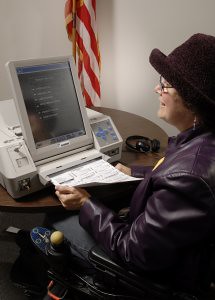
Description is below text
CAPTION: laptop size plastic machine with letter-size screen. Woman using powerchair, wearing purple hat and favorite[1. How do I know it’s her favorite jacket? I modeled for the photo] purple jacket feeds ballot into slot below screen.

One decent result from the G.W.Bush administration was that the voting process must be independently accessible to people with disabilities. Before then, most people with disabilities would enlist the assistance of a helper where needed. Then they’d vote absentee (returning the ballot in the mail) or bring the helper into the voting booth on the day. I remember assisting a blind person with a mechanical voting machine–a lever for each name! Xe jested that it was a refreshing change to depend on someone with whose politics xe was unsure (as opposed to xir long-time partner), and yet the joke had a bit of a sting to it.

Reflecting strong republican sentiment in the U.S., voting is controlled at the lowest possible administrative level. Voting techniques vary widely from state to state (sometimes city to county). In Wisconsin you can register to vote five minutes before casting your ballot, but in some states you must register 30 days in advance. But since I can now depend on getting my power wheelchair into the polling place, it seemed like a good year to volunteer as a poll worker. I went to the “new election official in Madison” training today [Editor’s note – October 28].

Two points up front:
1. I wasn’t expecting the disablist training, so I wasn’t taking verbatim notes. I could not swear to any of the following in court; as far as the essential drift, I do believe I’m correct and I heard the trainer acknowledge this. (Memo to self: take notes on life.)
2. I am not hosting a discussion of the political or technical validity and/or vulnerability of voting machines. (For the record, I support 3b; it works for us in Wisconsin, which used to be an exemplar of clean politics.)

When our trainer finished walking us through the various elements of a correctly marked ballot, I raised my hand and said, “And then there’s another way to mark the ballot, right, with the accessible voting machine?” Her response began with a non-verbal eye-roll, which I interpreted as ‘yipes, why did she bring this up?’ Then, she spoke aloud “Yes, that’s right. The accessible voting machine is challenging and we’ll get to that later.”

3. Since she never did do a decent job, let me tell you a bit about accessible voting. The access depends in part on the underlying voting technology. Either
a) Everybody votes using a machine.
In this case, one of the machines needs to supply large print, speech output (usually to headphones), touch screen input (no grip required), single-switch input (more details below) and various other hardware “hooks” to the wide variety of assistive tech in use today.
b) Everybody marks a paper ballot, then feeds the marked ballot into a tabulator (a tallying box like the dollar-bill slot on a vending machine).
Typical people use the ballot-marking tools at the end of their wrists. The rest of us have an accessible machine as above which just marks the ballot. (Ridiculously, the manufacturer’s link don’t provide a fully-accessible presentation.)

OK, back to the end of my training session, where I noted she had never gotten back to the voting machine.

She said the accessible voting machine is very important and everyone must have one working at each polling place. She said they could be used by someone who’s blind, or someone who has low vision, or can’t read for any reason, or really just anybody who wants to. She also said that they were very fussy mechanically, so they may not work as well as you’d like.

(At this point fury stunned me into silence. What I should have said is, “And here we have an excellent chance for you to get in front of these issues by training us in how to get them to work correctly! Seize the moment!”)

Another trainee asked what poll workers should do if they thought a voter was being unduly influenced in filling out a ballot. Xe said, “This happened around 6 years ago, when someone who, well, frankly, he was just not cognizant enough to be voting. And the person with them was filling out the ballot for them.” I piped up that this could be a good option to use the accessible machine: somebody who can’t read could be able to understand the speech.

(FWIW, the “Six years ago this r#tarded person was influenced in their vote” is a perennial election year rumor. Neurotypical people are quick to define the minimum IQ they’d set for voting, without exploring the profound mismatch between IQ and ability. Absolutely every social justice activist would do well to read Gould’s The Mismeasure of Man.)

When the training was over, I’d been cleansed by fury and recovered the power of speech, I stopped to discuss my issues with the trainer. I said I was disappointed in her presentation of the voting machine. She reiterated they were frustrating and difficult to use. “Don’t you realize,” she asked, “that most poll workers are over 60 and they are not going to be able to understand this computer?” (Reality check: accessible voting machines are no more a computer than an ATM. Ninety percent of the people in the training were under 55; in all regards it looked like Madison: gender presentation, ethnicity, education levels, evident disability, income levels, number of piercings, which made me happy about my city.)

I asked if that meant my rights as a voter were also frustrating her? How would she feel if I said that permitting her to vote was too difficult? The penny dropped, and she began to apologize for “not presenting in the most effective manner.” At this point her supervisor’s ears pricked up. “Who was deprecating use of the voting machines?” The trainer allowed that her “initial presentation was sub-optimal.” While I was gratified that she’d finally understood, I was frustrated that this right, so long fought for by so many, is still not a matter of fact in our daily lives.

If you’re up for some voting day advocacy, the U.S. Department of Justice provides a detailed guide for access verifiers at Voting Checklist. Folks outside the U.S., what’s the voting situation for you?

Quoted: Susan Wendell

Feminist organizations have become more aware of the need to make their activities accessible to women who use wheelchairs, women who need written material in alternative formats, and women who need Sign Language translation, but much feminist practice still assumes a consistently energetic, high-functioning body and mind, and certainly not a body and mind that are impaired by illness. Moreover, in their writing and organizing, most feminists still assume that feminists are giving, and not receiving, care, and that all significant contributions to feminist movements happen in meetings, at public events, and in demonstrations on the streets. The accepted image of a good feminist still includes handling paid work and family responsibilities and having plenty of energy left over for political activity in the evenings or on weekends. In these circumstances, women with chronic illnesses are likely to find it difficult to participate in feminist movements or to identify themselves as feminists.

— From “Unhealthy Disabled: Treating Chronic Illnesses as Disabilities” (originally published in the Fall 2001 issue of Hypatia)

Recommended Reading for 1 November, 2010

Welcome to November. Gentle reader, be cautioned: comments sections on mainstream media sites tend to not be safe and we here at FWD/Forward don’t necessarily endorse all the opinions in these pieces. Let’s jump right in, shall we?

Queen Emily at Questioning Transphobia: attacking the already vulnerable:

In the UK, people with disabilities have been among the hardest hit by the recent Thatcher 2.0 ConDem cuts of the Osborne Review. The employment support allowance (ESA) which was previously able to be claimed until the person finds a job has now been set with a limit of one year. I’m sure that’ll be of great comfort to people, cos disabilities also expire after year amiright?

It’s election time in the United States. Melissa Mitchell at Service Dogs: A Way of Life: Cast your vote November 2.

I ask you, my loyal readers how can we as a community expect our current rights to continue to be protected, our equity as members of society to be validated, or our issues to be seen as important when we are not seen as a community that votes?

Also, Leah at Cromulent Words: Voting and Privilege:

And what do you need to do after you’ve recognised your privilege of voting access? You can either use your privilege to uplift the people you oppress or you can ignore it and continue to harm (directly or indirectly) the most vulnerable people in our country.

New South Wales, Australia: ABC News: Thousands rally for disability services funds

The State Government committed funding for disability services five years ago under the Stronger Together program, but money for the next five years has not been included in the forward estimates of the next budget.

Times of India: Sleep disturbances ups work disability:

A new study, conducted by the Finnish Institute of Occupational Health in collaboration with the universities of Turku and London, has revealed that sleep disturbances increase the risk of work disability and may slow the return to work process.

That’s all for this time. Send your links to recreading[@]disabledfeminists[.]com. Let us know if/how you want to be credited.

Fiction Book List!

Almost, but not quite, a year ago today I put a call out on my personal journal looking for recommendations or lists of YA books that feature characters with disabilities.

From that call out, I got just under 200 books (many listed multiple times), as well as lists of book recs from other sources.

I’m still going through and sorting them, looking for reviews of the books, but I thought it might be interesting to discuss here any pros & cons of the books listed, and the books that are included in other lists.

Part of the reason I like books like this is that the response to pop culture criticism from a disability-rights standpoint often is met with “But, what sort of stories do you want us to tell?” or “Telling such stories is difficult!” I want to generate a list of fiction that shows that yes, people with disabilities have stories – and not all of them are magical cures or dreams of being non-disabled. (Certainly not all of the books below don’t fall into those various traps – in the document I’m finishing up right now, many are flagged up as problematic, so this is more a book list than a book recommendation list!)

So, share your thoughts! What books would you recommend? Do you see any books on this list that you want to gush about, or point out as a problem? Anything you’d love to discuss with other readers? Feel free to link reviews of the books (your own or someone else’s), especially if they specifically mention the disability-related aspect.

Please flag up any spoilers in your comments.

Schneider Family Book Award Winners List

The Schneider Family Book Awards honor an author or illustrator for a book that embodies an artistic expression of the disability experience for child and adolescent audiences.

The Young Adult Library Association does lists of titles under certain topics every year.

Bodies: “They come in all shapes, sizes, and abilities…love it or hate it, you only have one body.”

What Ails You?

K-State Library Subject Guide: Disability.

Below the cut is the list that was generated from the comments on the above-linked post, sorted by author.
Continue reading Fiction Book List!

Things That Make My Life/Art Easier: Pens

As s.e. wrote about in a post earlier this week, I am a cartoonist in addition to all the other crap that I do. I’ve been drawing (and writing) for most of my life, and finding the perfect pen has been something of a wild turkey-chase with mixed results. I know that an entire post devoted to pens may seem silly, particularly given the more serious things that I have written about here on FWD. Re-reading some of Amanda‘s Things That Make My Life Easier posts has inspired me to write about…well, writing (and drawing) implements, because the right ones do make things easier for me.

I first read about the pain-reducing benefits of felt-tip pens in the second edition of Starlanyl and Copeland’s Fibromyalgia and Chronic Myofascial Pain: A Survival Manual; the authors, both medical professionals, include the use of felt-tip pens in a lengthy list of tips designed to reduce pain on an everyday basis. Felt-tip pens tend to be easier on the hands and joints. My one huge issue with felt-tips, however, is that many of them produce stronger lines than I would like. This is more of a problem when I attempt to use them for artistic purposes, as I don’t mind a little more heft in my hand-written notes and scribbles. I do use felt-tips on occasion in my cartoon work — especially for panel borders and heavy lines — just not very often.

Felt-tips are good for writing, but depending upon what sort of lines you’d like in your artistic works, the ease of use that felt-tips produce may be their only advantage. Obviously, they’re not the greatest for detail work. I tend to shy away from brushes and pens that require the use of an inkwell or a separate bottle of ink, as the gorgeous lines one can produce with those tools so often translates into absolute hell on my hand and wrist joints, plus a lot of repetitive motion from dipping the brush or pen into the ink and bringing it back to the page (which often equals further hell).

Ball-point pens that don’t have a lot of ink “flow,” in my experience, aren’t great for cartooning either, though they can be useful for storyboards and quick sketches. The ball-points that have worked the most effectively for me have been the “business”-type pens that most folks associate with actual business work. Perhaps people in business have to write things quickly and therefore cannot depend on crappy ball-points and/or face the frustration that inevitably arises when said crappy ball-point runs out of ink. Non-crappy ball points, such as the Uni-ball line of products, may be a bit more expensive than “traditional” ball-points, but if you want a smooth line that is not going to translate into extreme wrist or hand pain, a “business” pen of this sort might be for you.

Another pen type with which I have had some success has been actual drawing pens; many brands are available at art-supply stores or bookstores. I have found that experimentation with different types of pens is a good bet, if you’ve got the time for it (and assuming that you are cool with dropping a couple bucks on pens that might be either awesome or a total disaster). The Preppy fountain pen, made by Japan’s JetPens, may be a good bet for people who would like to experiment with fountain pens and the lines that these pens can create, but who may not have the time, energy or inclination to use a more traditional fountain pen (it has a reloadable ink-cartridge system that is very convenient). There is also the Stabilo brand, which I discovered quite by accident in the clearance rack of an art supply store (I bought a couple specifically because they were on sale). I use the Point 88 type because it’s light, comfortable to hold and can do excellent detail work, but your artistic/writing mileage may vary.

There is no “perfect” pen, of course, but there are some damn good ones out there if you’ve got the inclination to experiment.

QuickPress: The First Assistance Dog Blog Carnival is Live!

This actually went up a few days ago, and it is awesome.

Sharon’s hosted the First Assistance Dog Blog Carnival at After Gadget.

From the tremendous response of the AD blogging community, it seems as if I’m not the only one who is excited to share an AD “First” with our readers. In fact, the themes of excitement, joy, and pride run throughout the blogs in this edition. There were also a lot of blogs on the same or similar topics. I had hoped to be able to amply blurb/review every submission, but in the end it felt like it would make this post too long and repetitive. So, I have highlighted those that stand out for me in some way in each category — sometimes because a piece is written particularly well, other times because it covers an unusual topic or takes it on in an unusual way — but also included the links for other worthy posts in each category.

Enjoy! If you can’t read them all today, bookmark the page and work your way through the rest over time.

Guest Post: Stuck and tired: How universities are failing disabled students (like me)

Diane Shipley is a freelance writer obsessed with feminism, US TV, memoirs and pizza. She writes about those things and more at her blog, the imaginatively-named Diane Shipley Blogs (http://blog.dianeshipley.com) and is almost always on Twitter (username: @dianeshipley).

You’re intelligent, personable, and get good grades. It might look like higher education is a given.

But it isn’t. Not when you have a disabling illness. Then, making it to graduation could be more challenging than you ever imagined.

Last year, I tried to finish the degree I dropped when I got ill back in 1998. The disability services department at my new university contacted me the summer before I started my course, asking what extra help I would need.

I had never been a student with disabilities before, so I couldn’t anticipate all the challenges I might face. But the system for reporting those I was aware of seemed doomed to failure: a disability advisor emailed my department in the first week of the semester to advise them that I needed my seminars and lectures to be accessible. Inevitably, this was too late. One of my lectures was in a building with a lift that was almost always out of order, leaving me the choice of missing out or making myself ill. And my registration experience was disastrous.

Registration and enrolment were in two separate buildings nowhere near each other. As no buses ran in that direction, this meant a fifty-minute round trip on foot, well beyond what I could cope with. So I emailed the university to explain this, asking if I could register and enrol online, instead.

Here’s where I point out something that should be obvious but seems not to be: when disabled students express a preference, it shouldn’t be brushed aside in favour of what administrative staff would prefer. Being assertive can be very difficult, especially in situations where someone has power over you. Expressing one’s needs can also be embarrassing, as many long-term illnesses and disabilities are stigmatised. It’s an issue that deserves to be treated with sensitivity, but too often isn’t.

Instead of granting my request, a member of staff from registry services suggested I meet her late in the afternoon, instead. Because her address was at the end of her email, and was somewhere I could access by bus, I agreed. But when I went to her office at 5 PM on registration day, the shutters were closed. Tired, upset, and alone, I vented on Twitter: “I don’t think this university cares about disabled students.” Then I called my mum in tears and she offered to leave work and drive me to the building where registration was taking place. I finally made it and explained the mix-up to one of the staff, who said someone there wanted to speak to me.

The head of registry services strode over and introduced herself, a stern expression on her face. She then shouted that I couldn’t say what I liked on Twitter without giving them “right of reply” and that the university did care about disabled students. “I’m fully conversant in equality law,” she snapped. When I mentioned the mix-up over where I was registering, she said that perhaps I should read emails more carefully in future.

She wasn’t wrong: I could have double-checked. But in my defence, starting university was an overwhelming undertaking, and confusion and anxiety are big parts of my illnesses. I had also made the mistake of assuming that no-one would suggest we meet somewhere I had specifically said I couldn’t access.

I was finally able to register but because of the delay, I couldn’t get into the student intranet until two days later, so the seminars I wanted to sign up for were full. This meant that instead of organizing them at times to suit my illness, I had to take whatever was left. When I contacted my departmental disability liaison officer to ask if I could be squeezed into more convenient seminars for a couple of subjects,  he demurred, and I got the impression he thought I was trying it on. I didn’t have the energy to argue that this seemingly small issue was essential to the management of my illness.

As I thought I would, I struggled with my schedule.  Ten hours of class time isn’t much, but I hadn’t counted on the extra time I’d need to walk to lectures (and then sit down and catch my breath). In retrospect, I needed to take taxis to my classes. But I was reluctant to organise this because one of the disability support staff told me that some taxi drivers were “funny” about short journeys.

But my biggest challenge was the fire alarms, which went off once or twice a week. We would traipse out of the classroom, walk down three or four fights of stairs, stand around for ten minutes, and then go back up again. I had no idea what disabled students were supposed to do, and didn’t know who to ask, so I just struggled on, my muscles spasming from pain and stress.

I know what some people will think: maybe I was too ill to be at university in the first place. But I had a good reason for attempting it: money. In England, if you’re on a full-time course, you are entitled to loans, grants, and bursaries, which add up to (just about) enough to live on. A part-time student is only entitled to £225 a year. So I took a risk.

It’s a risk that failed. Although I could cope academically, physically I was falling apart. After five weeks, I suffered a severe stress-induced relapse and the university recommended I take a leave of absence. This meant I wouldn’t have to reapply if I felt well enough to return, but I wouldn’t be entitled to student finance or disability benefits during this time, either. I only scraped by thanks to my overdraft, a little writing work, and my supportive parents.

This summer, I had to decide whether or to go back. I decided against it. I didn’t feel well, and I didn’t feel welcome.

I don’t think my experience is unique: I suspect it is more common than universities realize. The way I was treated is part of a much larger problem: how we, as a society, view people with disabilities. We need to stop being surprised when someone has special needs, and there needs to be a socially acceptable way of saying “I can’t do that,” or “I need more help”, especially in educational institutions and the workplace.

Policies like the British government’s plan to reduce the number of people claiming disability benefits (without regard for the number of people with disabilities) perpetuate the sadly still prevalent belief that those of us who have disabling illnesses which are not terminal or immediately visible are lazy, when nothing could be further from the truth.

The fact is, students with disabilities need better support. An attempt to understand and cater to students’ individual needs rather than just paying lip service to the idea of equality would be an excellent start.