Daily Archives: 14 December, 2010

Recommended Reading for December 14, 2010

K__ at Feminists with FSD: Notes on MTV’s True Life: I Can’t Have Sex

Actual, proper terminology was used throughout the show. Chronic pelvic pain conditions were named, but some conditions that overlap were not mentioned at all (interstitial cystitis, for example, was not explored in this episode. This is a shame – interstitial cystitis is another misunderstood condition which would benefit from careful media coverage.) This episode focused on the impact of chronic pelvic pain on the women’s sex lives. And that means that while you could learn a little about life with chronic pelvic pain from this episode, for a clinical discussion and details on specific conditions and available treatments, you’ll need to look elsewhere.

Carol at Aspieadvocate: I’m an Embarrassment

Yeah, I know some parents of autistic kids worry about the kids embarrassing the rest of the family in public with their unusual behavior. But for me it’s the other way around. I never shut up about autism, mine or his, and while I have every right to out myself, I’m making decisions about him that should really be his to make. Except even if he’s made different decisions about disclosure than I have, he’s not (yet) verbal enough to tell anyone.

David Gorksi at Science-Based Medicine: Death by “alternative” medicine: Who’s to blame? [trigger warning]

Of course, the implication of “Secret” thinking is that, if you don’t get what you want, it’s your fault, an idea that also resonates with so much “alternative” medicine, where a frequent excuse for failure is that the patient either didn’t follow the regimen closely enough or didn’t want it badly enough. Basically, The Secret is what inspired Kim Tinkham to eschew all conventional therapy for her breast cancer and pursue “alternative” therapies, which is what she has done since 2007. Before I discuss her case in more detail, I’m going to cut to the chase, though.

This weekend, I learned that Kim Tinkham’s cancer has recurred and that she is dying.

Arwyn at Raising My Boychick: How far I’ve come

Eight years ago I was withdrawing from college. Again. I’d started medication, divalproex sodium, and that was going to cure me; we’d packed up our possessions, bought furniture in flat boxes, and drove it most of the way across the country to this town with one redeeming feature: the college from which I had just withdrawn because it was better than flunking out from chronic absences. I did not know who I was, what good I was, if I could not do college, be a student. I could not see a future, and mostly did not believe I had one.

Linsay at Autist’s Corner: Autism-related gene spotlight: CNTNAP2

EXECUTIVE SUMMARY: CNTNAP2 is a large gene near the end of chromosome 7 that encodes a cell-adhesion protein involved in distributing ion channels along axons (the long tails of nerve cells) and in attaching the fatty cells making up the myelin sheath to the surface of the axon. DIsruptions in this gene have been associated with autism, epilepsy, Tourette syndrome and other neurodevelopmental disorders. Variations at certain points within the gene that don’t alter or disrupt its expression have also been associated with an increased likelihood of autism.

“There’s a suggestion that you were rolling towards the police in your wheelchair”: BBC Interviews Jody McIntyre About His Assault By London Metropolitan Police Officers

I would like you to take a moment to imagine the look on my face when I realised that the BBC interviewer in the following clip (transcript below) actually asked Jody McIntyre, a 20 year old man who uses a wheelchair and has cerebral palsy, whether or not the fact that Jody is a “revolutionary” is reason enough for the police to have assaulted him twice during the London riots last week. The following interview is full of similar gems, including a rather pointed “appear to show” what the actual footage shows.

I want to salute Joey for his calm yet firm responses throughout the interview.

BBC Jody McIntyre interview

[This is an interview conducted by an unidentified male BBC reporter Ben Brown with Jody McIntyre, a man with Cerebral Palsy who was pulled by police officers from his wheelchair during the recent protests against tuition fee increases in the UK. There is repeated footage of McIntyre being pulled from his chair, which was being pushed by his brother. The footage shows multiple London police officers pulling McIntyre from his chair and dragging him across the pavement and away from his brother and his chair while outraged bystanders shout in horror at what they’re seeing. The clip shown is a cleaned up and enhanced version of the clip that went up on YouTube – the original is full of a lot of cursing and screaming from bystanders which has been edited out by the BBC.]

Interviewer: Pictures of a disabled man being dragged from his wheelchair by police officers during the protests in London over the tuition fees have emerged online. Now these pictures appear to show Jody McIntyre, 20 year old fiscal activist and blogger who suffers from cerebral palsy being pulled out of his wheelchair and dragged across the road to the pavement. While the Metropolitan Police have released this statement on that incident, saying

In connection with the incident shown on YouTube of of a tuition fees protestor in a wheelchair the Metropolitan Police confirm that the man involved, Jody McIntyre, has not launched an official complaint. The issue has been referred by the Metropolitan Police to the Directorate of Professional Standards and the Met Police say they will contact Jody McIntyre directly.

That is the statement from the police that we’ve received, and we can speak to Jody McIntyre now whose in our Westminster Studio.

Interviewer: Good evening to you.

Jody (JM): Good Evening.

Interviewer: Could you just explain what happened to you?

JM: Well, during the demonstration I was attacked by and pulled out of my wheelchair by the police on two occasions. The footage you have just shown is of a second incident. One of the police men who had dragged me down the road in the first incident obviously recognized me, came running over, pushed me out of my wheelchair on to the road, and then dragged me across the road.

Interviewer: The police say you haven’t made any kind of complaint, so why not?

JM: I haven’t made a complaint yet but I’m in contact with a lawyer and I will be doing so.

Interviewer: It’s been a few days since this happened. Why haven’t you complained before?

JM: Because I wanted to consider my options before taking that step.

Interviewer: There’s a suggestion that you were rolling towards the police in your wheelchair. Is that true?

JM: I think justifying a police officer pulling a disabled person out of a wheelchair and dragging them across a concrete road is quite ridiculous and I’m surprised that you’ve just tried to do so.

Interview: So that’s not true, you were not wheeling yourself towards the police.

JM: Well I can’t physically use my wheelchair myself. My brother was pushing me. I think it’s quite obvious from the footage that I was 100% not a threat to anyone.

Interviewer: In the Observer newspaper you were described as a cyber radical and you were quoted as saying you want to build a revolutionary movement and that can only happen through direct action on the streets. Do you classify yourself as a revolutionary? [Anna: I think this is the article he’s referring to]

JM: I don’t classifying myself as anything but I think we all have a right to fight against what the government are trying to do. They’re trying to tier education system whereby only the rich will be able to afford it. That is something that I think we should all be fighting against.

Interviewer: Now the police have said that they have referred this incident to the Directorate of Professional Standards… what’s your reaction to that?

JM: I don’t have a reaction to that but I will be making a complaint in the near future. I would say that it’s very important not to see this as an isolated incident. This is the police’s role at demonstrations. To incite and provoke violence. They’ve done it in the past and they’re continuing to do it now. I am not the real victim here. The real victims are the students, like Alfie Meadows, who is in hospital within an inch of his life after a policeman struck him on the head with a truncheon and he needed emergency brain surgery. Now imagine if it was Prince Charles, or Camilla, or a police officer who had been within an inch of their life.

Interviewer: But I have to say, I was in Parliament Square covering that demonstration and I saw protesters throwing lumps of rock at the police, throwing missiles, various missiles, at the police. Were you throwing anything at all at the police that day?

JM: I wasn’t throwing anything at the police during that day or during any [unclear] But what is clear is that the media are trying to distract the public from the real issue, which is the cuts that the government are making.

Interviewer: Were you harmed in any way in that incident with the police?

JM: Not in that … incident, in the incident that’s being shown. There was also another incident around 45 minutes earlier when a police officer struck me with a baton and yes that did cause some injury.

Interviewer: And why then, do you think– Are you saying the police picked on your twice. Why do you think they did?

JM: I have no idea. I mean, to make one suggestion, I think in the second incident at least, I think there’s a clear element of trying to provoke protesters into violence. Personally, I see myself as equal to anyone else, but I do understand that I could be perceived as more vulnerable, so I think there was an element of trying to provoke violence from others.

Interviewer: Did you shout anything provocative or throw anything that would have induced the police to do that to you?

JM: Do you really think a person with Cerebral Palsy in a wheelchair can pose a threat to a police officer who is armed with weapons?

Interviewer: But you do say that you’re a revolutionary.

JM: That’s a word, it’s not a physical action that I’ve taken against the police officers, a word that you’re quoting from a website. I’m asking you: do you think I could have in any way posed a physical threat from the seat of my wheelchair to an army of police officers armed with weapons? This whole line of argument is absolutely ludicrous because you’re blaming the victims of violence for that violence. In fact, it reminds me a lot of the way the BBC report on the Palestinian conflict–

Interviewer: When are you going to make your compalint to the police?

JM: I will be making my complaint very shortly, in the near future.

Interviewer: Okay, Jody McIntyre, thanks very much for your time, thanks for talking to us this evening.

JM: Thank you.

Further Reading: Jody McIntyre’s blog, Life on Wheels

[ETA: Thanks to various people for letting me know the interviewer is Ben Brown.]

Guest Post: Reflections on being Jewish and Autistic: Different minorities, same critique

Rachel Cohen-Rottenberg is a wife, mother, writer, editor, artist, photographer, and leader of the Vermont Chapter of the Autistic Self Advocacy Network (ASAN). She blogs at Journeys with Autism, and her latest book, The Uncharted Path: My Journey with Late-Diagnosed Autism, was published in July of 2010. Her last guest post for FWD was “I Do Not Suffer From Autism.”

In writing this piece, I in no way wish to imply that my approach is the only approach, that having a religion is better than having no religion, or that Judaism is right and that other paths are wrong. As long as people act consciously and ethically, I really don’t care what they believe, or whether they avoid religion like the plague. I have been involved in social justice work on behalf of all people from a progressive Jewish perspective for much of my life, because that is the culture in which I find myself at home and because it provides me with a useful framework for action. I abhor proselytizing and fundamentalism of any variety; I reject violence, no matter who carries it out; and I support a just, two-state solution in Israel/Palestine, may it be in our lifetimes.

For almost two years now, I’ve become increasingly aware of how other people regard autistics. As you all know, the news is not altogether good. As I’ve waded my way through all manner of error and nonsense, I’ve had the most familiar feeling, as though I had heard it all before. The other day, it finally occurred to me: I’ve encountered the same basic stereotypes and misinformation about Jewish people as I have about autistic people.

All minority people, to some extent, have to endure similar false charges, but the similarities between my experience of prejudice as a Jew and my experience of prejudice as an autist are striking. Here are some of the most damaging myths:

We don’t love properly. In the larger, mainly Christian culture in which I’ve lived my life, the view seems to be that the Jews of the “Old Testament” were all about strict justice, and that the Christians of the “New Testament” were all about love. (I put the names of the books in quotation marks because I don’t see one as being old and outmoded and the other as having superseded it; I see them both as valid traditions in their own right.)

The Jewish God, the critique goes, is only a God of judgment, a God of punishment, a God who lacks forgiveness, and we are just like our God: cold, judgmental, merciless. The Christian God, on the other hand, is a God of love and forgiveness. When I was growing up, without much of a Jewish education, I actually believed all of this. I believed it until I was in my late thirties, and I asked a rabbi whether there was anything in Judaism to help me heal my broken heart. His reply? “Yes. Our people brought the truth to the world that there is a God who loves us and cares about our lives.” I nearly fainted. When I began to study and practice Judaism in adulthood, I was startled to find that we are instructed to love our neighbors, to love our enemies, to love mercy, and to make right the wrongs of the world.

And what did I believe about autistic people until I found out that I actually am one? I believed that autistic people don’t have empathy, the very basis of loving relationships. The lack-of- empathy trope has been at the core of autism theory for a number of years, and it’s appalling how many people still believe it. Of course, they don’t appear to have met any of the autistic people I know, nor do they seem to have much empathy for the pain and suffering this canard causes autistic people on a daily basis.

We think terms of black and white. Now, the interesting thing about this particular myth is that it betrays some pretty black-and-white thinking on the part of the people who accuse us of black-and-white thinking. For example, when people say that Jews are only about justice, it’s justice of a kind that brooks no shades of gray. Christians, on the other hand, are said to be all about love, which encompasses many, many shades of gray. But the truth is that Jewish tradition has always been concerned with a concept called tzedakah, which is essentially an action that combines justice (righting a wrong) with love (easing and, ultimately, healing the suffering of other beings). We do not think in black and white about justice and love; in fact, we combine them. To split them apart is an example of black-and-white thinking at its best.

Now, consider the myth that autistics think in black and white, usually expressed as our being all about logic and systems. In fact, some researchers believe that we have Extremely Male Brains that are high on systemizing, while non-autistics have brains that are high on empathizing. And yet, when I look at my own life, and that of other autistic people, I often see a capacity for high levels of both systemizing and empathizing, and I see them working together. We don’t split them apart. Other people do, and then they tell us that we’re the ones with the black-and-white thinking. It’s enough to make you weep.

We are excessively logical. Many people believe that Judaism is all about “legalisms,” and that it does not concentrate on coming from the heart. This particular myth is very old and very intractable, in part because most people believe that Judaism begins and ends with the “Old Testament,” ignoring thousands of years of mysticism, story-telling, discussion, ritual, and practice that are all about opening one’s heart. I’m not saying that all Jews come from the heart, any more than all Christians come from the heart. I’m saying that Jewish culture has its own ways of combining head-thinking with heart-wisdom that are little known or understood by others.

Of course, autistics are constantly stereotyped as being overly logical—except when we’re stereotyped as being out of control. And yet, somehow, we manage to have friends, families, relationships, children, and ethical lives.

We insist upon being different. For a number of years, I wore garb that clearly identified me as Jewish. For awhile, I wore a yarmulke and tzitzis (ritual fringes) every day, all day. During another period, I only wore headscarves and dresses. I now dress in a thoroughly secular fashion. When I didn’t, I got all kinds of attitude about “setting myself apart.” Of course, I wasn’t setting myself apart. I was just being myself. And I wear what I wear now because I am just being myself.

I grow. I change. I morph. I explore. I’m inconsistent. I’m human. Go figure.

Not surprisingly, I have gotten similar messages regarding my autistic sensitivities to all things sensory. I’m told that I’m “choosing” to be so sensitive, that I’m setting myself apart, when I’m really just being myself. And when my sensitivities are not as troubling, I’m also just being myself.

I grow. I change. I morph. I explore. I’m inconsistent. I’m human. Go figure.

Other people are normal, and we are abnormal. Many years ago, when my daughter was small, her father used to pick up one of her friends after school and bring him home. One December, on the way home, the young man said, “We celebrate Christmas at my house. We don’t celebrate Chanuka. We’re not like you. We’re normal.” My ex-husband took the long way home and patiently explained the concept of diversity to the young man until he got the picture.

And of course, we autists get stuck with the “abnormal” label all the time—more evidence of that dualistic, black-and-white thinking that “normal” people aren’t supposed to engage in.

We are all alike. In response to all the many myths surrounding Judaism and Jewish people, I did interfaith work for a number of years, teaching workshops in areas schools and churches. Some of the most common questions I got began with the words, “So what do Jews believe?”—as though we all believe the same thing! That was the moment I’d introduce the mantra of “You get two Jews in a room, you get three opinions.”

Likewise, it seems, people have an excessive need to see autistic people as being all alike. It usually expresses itself in terms of narrowing the definition of what autistic means. (I recently saw a YouTube video in which the mother of an autistic young man actually said that you can’t be autistic if you can speak. I was flabbergasted. ) At other times, this need to see us as alike expresses itself in conclusions by researchers that autistic people are a collection of deficits and impairments without any strengths at all. If we have strengths, they are usually called “splinter skills” (a term I despise, even though it’s got some cool alliteration and assonance going on).

Of course, we’re as varied as any other group. I’m not sure what kind of impairment, oops, I mean, neurological difference keeps people from seeing that variation. It might be interesting to do some genetic research on the matter.

We are not fully human. I first became aware that some people believe that Jews are not fully human when I was in Hebrew school and saw a piece of Nazi propaganda in which Jews were likened to vermin. I felt such pride in who I was that I just couldn’t believe my eyes. Who could really think that Jews weren’t people? Apparently, at certain times in history, a great many people.

I was reminded of this experience when I happened upon some writing by Dr. Ivar Lovaas, the psychologist who pioneered the treatment now known as Applied Behavioral Analysis. In discussing the basis of his treatment, he wrote of autistics in 1974:

“You see, you start pretty much from scratch when you work with an autistic child. You have a person in the physical sense—they have hair, a nose and a mouth—but they are not people in the psychological sense. One way to look at the job of helping autistic kids is to see it as a matter of constructing a person. You have the raw materials, but you have to build the person.”

I shudder to think of how many people still believe this kind of thing.

Of course, Jews, autistics, and members of any other minority group share similar experiences: we are vulnerable no matter how well we “pass” and live up to the standards of the larger culture, and we constantly have to fight against the appropriation of our own voices. Moreover, the solution to whatever problem we appear to pose consists of attempts to do at least one of the following: a) efface our differences to make us indistinguishable from others, b) demand at least a pro forma conversion to the dominant paradigm, which means that we can stim/rock back and forth in prayer/be ourselves, but only out of the public eye, or c) isolate us in ways both visible and invisible.

There are many, many autistic people who cannot do a “pro forma conversion,” who cannot “pass” as I do, and who have endured severe levels of bullying, assault, and isolation as a result. I shy away from the word Aspie and I use the word autistic to describe myself in order to make common cause with people across the spectrum (in the same way that I refer to myself as a Jew, not a denominational Jew, in order to make common cause with other Jews, no matter how differently they may think and practice, and how vehemently I may disagree with them). I will continue to do both. I have Asperger’s Syndrome, and that makes me autistic. I had Jewish parents, and that makes me a Jew. I may present differently from others in my group, but then again, so do trees and birds and rocks. Why should people be any less diverse than the whole of creation?

[Interested in guest posting for FWD? Please see our Guest Posting page for more information!]
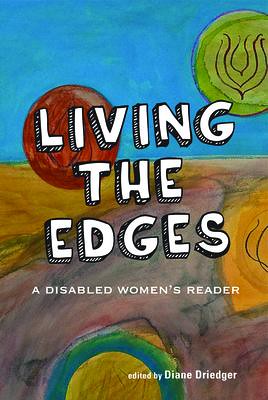
New book: Living the Edges: A Disabled Women’s Reader

Living the Edges book cover, with a white title on background of an abstract type painting with a road or path and floating spheres of colourHere’s a book for your list, if you’re celebrating a gifty holiday soon – or just splurge on it for yourself!

Living the Edges: A Disabled Women’s Reader, edited by Diane Driedger, was launched last week in Canada, and it should contain plenty of interest for readers of FWD/Forward.

The McNally Robinson book-launch blurb is as follows:

Diane Driedger has written extensively about the issues of women and people with disabilities over the past 30 years. Diane is an educator, administrator, activist, and researcher in the area of disabled women’s issues in Canada and internationally. She is also a visual artist and poet, and holds a Ph.D. in Education. She lives in Winnipeg.

This collection brings together the diverse voices of women with various disabilities, both physical and mental. The women speak frankly about the societal barriers they encounter in their everyday lives due to social attitudes and physical and systemic inaccessibility. They bring to light the discrimination they experience through sexism, because they are women, and through ableism, because they have disabilities. For them, the personal is definitely political.

While society traditionally views having a disability as “weakness” and that women are the “weaker” sex, this collection points to the strength, persistence, and resilience of disabled women living the edges.

A partial contents list, from Disability Research Forum reveals a whole lot of must-read articles:

“Feminism, Disability and Transcendence of the Body” by Susan Wendell

“Living on the Edges” by Charlotte Caron and Gail Christy

“Mirror Woman: Cracked Up Crazy Bitch Conja Identity” by Marie Annharte Baker;

“Margins Are Not For Cowards” by Cheryl Gibson;

“Triple Jeopardy: Native Women with Disabilities” by Doreen Demas

“Coming Out of Two Closets” by Jane Field;

“Performing My Leaky Body” by Julie Devaney

“To Be Or Not to Be? Whose Question Is It, Anyway? Two Women With Disabilities Discuss the Right To Assisted Suicide” by Tanis Doe and Barbara Ladouceu

“Living Poorly: Disabled Women on Income Support” by Sally Kimpson

“‘Have You Experienced Violence or Abuse?’: Talking With Girls and Young Women with Disabilities” by Michelle Owen

“The Geography of Oppression” by Joy Asham

There was an audio interview with Diane Driedger at CBC’s Weekend Morning Show last Sunday, in which Diane speaks of the book and of her experiences with invisible disabilities and workplace accommodations.

My transcript of the Weekend Morning Show interview, titled “Double Jeopardy”, is below the cut. All errors in transcription are mine.

Continue reading New book: Living the Edges: A Disabled Women’s Reader