Jesse the K hopes you can take a disabled feminist to tea this month. Her previous guest post was Making Space for Wheelchairs and Scooters.
There are many things we can do to improve everyone’s lives. Voting is not the only thing, but it sure is easy to do. Many have given their health, their peace of mind, and their lives for the right to exercise the franchise. If you live in the U.S., join me[1. As long as you’re government approvable, that is, you’re the right color or rich enough to become a citizen or you haven’t been arrested or too recently paroled as part of your systematic community destruction program] and head on down to the polls in your municipality this coming Tuesday.
And while you’re there, you might be wondering, “Gee, just how do people with disabilities vote?” As it happens, I know a little about this.
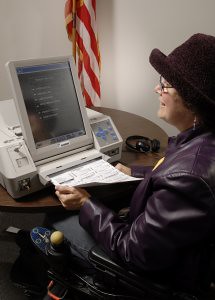
CAPTION: laptop size plastic machine with letter-size screen. Woman using powerchair, wearing purple hat and favorite[1. How do I know it’s her favorite jacket? I modeled for the photo] purple jacket feeds ballot into slot below screen.
One decent result from the G.W.Bush administration was that the voting process must be independently accessible to people with disabilities. Before then, most people with disabilities would enlist the assistance of a helper where needed. Then they’d vote absentee (returning the ballot in the mail) or bring the helper into the voting booth on the day. I remember assisting a blind person with a mechanical voting machine–a lever for each name! Xe jested that it was a refreshing change to depend on someone with whose politics xe was unsure (as opposed to xir long-time partner), and yet the joke had a bit of a sting to it.
Reflecting strong republican sentiment in the U.S., voting is controlled at the lowest possible administrative level. Voting techniques vary widely from state to state (sometimes city to county). In Wisconsin you can register to vote five minutes before casting your ballot, but in some states you must register 30 days in advance. But since I can now depend on getting my power wheelchair into the polling place, it seemed like a good year to volunteer as a poll worker. I went to the “new election official in Madison” training today [Editor’s note – October 28].
Two points up front:
1. I wasn’t expecting the disablist training, so I wasn’t taking verbatim notes. I could not swear to any of the following in court; as far as the essential drift, I do believe I’m correct and I heard the trainer acknowledge this. (Memo to self: take notes on life.)
2. I am not hosting a discussion of the political or technical validity and/or vulnerability of voting machines. (For the record, I support 3b; it works for us in Wisconsin, which used to be an exemplar of clean politics.)
When our trainer finished walking us through the various elements of a correctly marked ballot, I raised my hand and said, “And then there’s another way to mark the ballot, right, with the accessible voting machine?” Her response began with a non-verbal eye-roll, which I interpreted as ‘yipes, why did she bring this up?’ Then, she spoke aloud “Yes, that’s right. The accessible voting machine is challenging and we’ll get to that later.”
3. Since she never did do a decent job, let me tell you a bit about accessible voting. The access depends in part on the underlying voting technology. Either
a) Everybody votes using a machine.
In this case, one of the machines needs to supply large print, speech output (usually to headphones), touch screen input (no grip required), single-switch input (more details below) and various other hardware “hooks” to the wide variety of assistive tech in use today.
b) Everybody marks a paper ballot, then feeds the marked ballot into a tabulator (a tallying box like the dollar-bill slot on a vending machine).
Typical people use the ballot-marking tools at the end of their wrists. The rest of us have an accessible machine as above which just marks the ballot. (Ridiculously, the manufacturer’s link don’t provide a fully-accessible presentation.)
OK, back to the end of my training session, where I noted she had never gotten back to the voting machine.
She said the accessible voting machine is very important and everyone must have one working at each polling place. She said they could be used by someone who’s blind, or someone who has low vision, or can’t read for any reason, or really just anybody who wants to. She also said that they were very fussy mechanically, so they may not work as well as you’d like.
(At this point fury stunned me into silence. What I should have said is, “And here we have an excellent chance for you to get in front of these issues by training us in how to get them to work correctly! Seize the moment!”)
Another trainee asked what poll workers should do if they thought a voter was being unduly influenced in filling out a ballot. Xe said, “This happened around 6 years ago, when someone who, well, frankly, he was just not cognizant enough to be voting. And the person with them was filling out the ballot for them.” I piped up that this could be a good option to use the accessible machine: somebody who can’t read could be able to understand the speech.
(FWIW, the “Six years ago this r#tarded person was influenced in their vote” is a perennial election year rumor. Neurotypical people are quick to define the minimum IQ they’d set for voting, without exploring the profound mismatch between IQ and ability. Absolutely every social justice activist would do well to read Gould’s The Mismeasure of Man.)
When the training was over, I’d been cleansed by fury and recovered the power of speech, I stopped to discuss my issues with the trainer. I said I was disappointed in her presentation of the voting machine. She reiterated they were frustrating and difficult to use. “Don’t you realize,” she asked, “that most poll workers are over 60 and they are not going to be able to understand this computer?” (Reality check: accessible voting machines are no more a computer than an ATM. Ninety percent of the people in the training were under 55; in all regards it looked like Madison: gender presentation, ethnicity, education levels, evident disability, income levels, number of piercings, which made me happy about my city.)
I asked if that meant my rights as a voter were also frustrating her? How would she feel if I said that permitting her to vote was too difficult? The penny dropped, and she began to apologize for “not presenting in the most effective manner.” At this point her supervisor’s ears pricked up. “Who was deprecating use of the voting machines?” The trainer allowed that her “initial presentation was sub-optimal.” While I was gratified that she’d finally understood, I was frustrated that this right, so long fought for by so many, is still not a matter of fact in our daily lives.
If you’re up for some voting day advocacy, the U.S. Department of Justice provides a detailed guide for access verifiers at Voting Checklist. Folks outside the U.S., what’s the voting situation for you?