Monthly Archives: May 2010

UK Signal Boost: Study about Disability & Benefits at the University of Leeds

Are you a person with a disability?

Do you currently receive disability benefits?

Do you want to work?

If so, we want to talk to you! A research project at the University of Illinois at Chicago is interested in your experiences in and views of employment programs associated with work-related activities under reform to Incapacity Benefits or the Employment and Support Allowance.

We would like for you to participate in a focus group and share your experiences with the researchers and a group of people like you.

Who?

To be eligible, you must:

live in the city of Leeds or receive services there;

be between the ages of 18 and 64;

receive Incapacity Benefits or the Employment and Support Allowance; or be participating in or eligible for employment services through Pathways to Work or the New Deal for Disabled People

Continue reading UK Signal Boost: Study about Disability & Benefits at the University of Leeds

An Open Letter to Ms Magazine Blog

Dear Ms Magazine Blog:

My name is Anna. I’m what some people in North America would call a person with a disability, and some people in the UK would call a disabled person. My husband, many of my friends, all of my co-bloggers, and a large number of our commenters are also people with disabilities/disabled people.

Your blogger, Carol King, would instead refer to us as “the disabled”, and as pawns of the religious right. In her blog post Kevorkian and the Right to Choose , she wrote:

The “right-to-lifers” enlisted the disabled in their cause when they cautioned that allowing people to choose to die would soon become their “duty to die.”

I’m pretty angry about that. Not offended, Ms Magazine, angry. You see, I’m really tired of “the disabled” being treated like we’re unthinking masses. I’m especially tired of the feminist movement – you know, one that allegedly wants equal rights for all people, including women with disabilities – doing this. It makes me angry because I’m a feminist as well as a woman as well as a person with a disability as well as someone who is not the pawn of anyone, thank you very much.

Some people with disabilities support the right to die. Others do not. Others do in some cases and not in others. Each of us has come to the conclusions we have because we are reasoning individuals. Gosh, some of us are even feminists who use a feminist lens to come to our decisions, regardless of which of the many places on that particular spectrum of opinion we find ourselves.

People with disabilities deserve better treatment than you have given them. We are not a throw-away line so you can score some sort of points. We are people, and I’m appalled that a feminist blog like Ms would publish something that would treat us as otherwise.

Frankly, I am so fucking tired of this shit. I’m tired of smiling while feminist organisations treat people with disabilities like they’re afterthoughts and problems to be solved. Like we’re just pawns in politics, like we need to be appeased but never spoken to or considered, like we’re too angry or not angry enough, like we have to push this fucking rock of dis/ableism uphill while you – our “sisters” – stand by and politely look away.

Do you remember Beijing, Ms Magazine? You’ve talked about it a lot lately. You know what I know about Beijing? I know the accessibility tent was inaccessible to people with disabilities. [transcript follows]

“We will achieve our rights and the respect we deserve as women with disabilities.” “Because the issues of women with disabilities have often been excluded, the goal this year was to make sure the concerns of disabled women were addressed.” Oh, hell, just watch the whole damned thing – it’s subtitled – and see the commitment feminists made to women with disabilities. Ask yourself, seriously, Ms Magazine, why your new blog has decided not to talk much about women with disabilities. “No woman who attends this conference should be able to leave Beijing without thinking about the rights of women with disabilities.” Do you?

You know what? If that’s something you can’t do, let me sum it up:

Nothing about us without us.

You wanna talk “about” “the disabled”? How about talking to us? How about letting us talk for ourselves?

How about treating us – people with disabilities – the way you would like women like yourselves to be treated? As though we have some understanding of our own experiences, our own opinions, our own thoughts. As though our thoughts do not belong to anyone but ourselves?

As though we are thinking beings?

Again, my name is Anna. I, like you, am a woman, and I am also a person with a disability. And we deserve better from you.

Sincerely,

Anna.

Please note: This thread is meant to be about the continued marginalization of people with disabilities in the Feminist Movement. I won’t be approving any comments about Kevorkian or related discussions.
Continue reading An Open Letter to Ms Magazine Blog

Signal Boost: Disenfranchisement at its Worst

Jady Lady describes her experience as a blind vote in today’s election in the UK

It was only whilst walking home with my partner that we compared notes. It appeared that my template had been placed fairly close to the left hand edge of the form, and my partner’s had been nearer the middle of the form. We phoned a friend and asked where the boxes appear on the ballot paper and were told that they are down the right hand side.

It would therefore appear that both our bballot papers are spoilt and we haven’t had a vote in this very important election.

If I never campaign for anything else in my life, I’m determined to get my voice heard on this one.

If you read this, I would urge you, please circulate it as widely as possible. I want as many people to realise how open to error the voting system is for blind people.

Our right to independence relies wholly on a sighted person to line the template up for us, and we have no way of checking that the vote has been cast properly.

I wonder how many other blind people’s ballot papers have been unknowingly spoilt today?

Read the whole thing.

Recommended Reading for Thursday, May 6

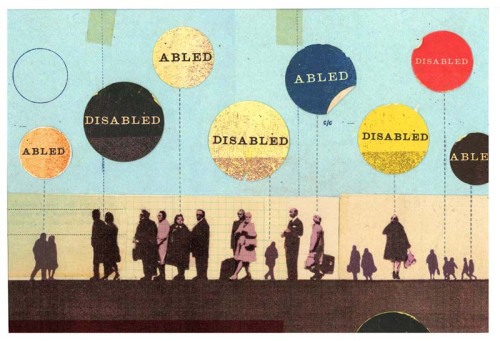
A collage, with black and white newspaper figures at the bottom. Some have bubbles above their heads, some reading 'abled' and some reading 'disabled.'

“Society” by Martin O’Neill, via Laugh or Cry.

the personal hurricanes of kirsty mitchell – the guardian asks why so many women suffer from depression.

hmmm, i’m getting a little tired of articles like this that always seem to be about the same thing. white, middle class, married, slightly older than ‘normal’ mothers talking about how they got depression trying to hold down a city job, run a family, and still look (and i quote) fabulous. the tone is always this one of overwhelming apathy, this ‘but i was only trying to have it all’ whinge, rather than a direct look at the root causes of what’s making them feel that they have to have it all, at once, in the first place.

MarketWatch – MetLife Study Finds Less Than Half of Americans out of Work Because of a Disability Had Income Protection in Place

Three in five individuals who were out of work for at least six months because of a disability did not have disability income protection, according to findings from a new MetLife study released today. The MetLife Study of the Emotional and Financial Impact of Disability also found that among those individuals who did have coverage, only about one-third of their income, on average, was protected.

Journal of Medical Internet Research – Mobile Therapy: Case Study Evaluations of a Cell Phone Application for Emotional Self-Awareness

We developed a mobile phone application with touch screen scales for mood reporting and therapeutic exercises for cognitive reappraisal (ie, examination of maladaptive interpretations) and physical relaxation. The application was deployed in a one-month field study with eight individuals who had reported significant stress during an employee health assessment. Participants were prompted via their mobile phones to report their moods several times a day on a Mood Map—a translation of the circumplex model of emotion—and a series of single-dimension mood scales. Using the prototype, participants could also activate mobile therapies as needed. Five case studies illustrate participants’ use of the mobile phone application to increase self-awareness and to cope with stress.

Disability Scoop – Poll Shows Public Support For Community Living

A Harris Interactive poll released Wednesday indicates that a majority of Americans support legislation that would allow people with disabilities to choose community-based care over nursing homes. The poll commissioned by the self-advocacy group ADAPT and the Coalition for Community Integration, gauged opinions on the Community Choice Act, a bill proposed in Congress that would mandate that states offer people with disabilities the option to use Medicaid funding to pay for community-based rather than institutional care. Findings from the poll indicate that 66 percent of Americans support the legislation without knowing what it would cost. When informed that the measure would likely add no more than $6 to a middle class taxpayer’s bill, 89 percent of respondents were supportive.

More Than Coping – “When Medicine Got It Wrong”: When We Blamed Schizophrenia On The Parents Airing on PBS Beginning This Week

When Medicine Got it Wrong is the groundbreaking story of a small group of loving California families in the 1970s who challenged the commonly-held belief that schizophrenogenic parents caused schizophrenia. Angry at being blamed for an illness they knew was not their fault, mothers and fathers in San Mateo, California started Parents of Adult Schizophrenics (PAS) and began fighting for better understanding and treatment. The story starts in 1974, and centers on two families — the Oliphants and Hoffmans — whose sons developed schizophrenia in their teens. Doctors told the boys that their parents were the cause of their problems. Medical records labeled each child as the “identified patient” in a dysfunctional family structure wherein the parents were more psychologically ill than the family member exhibiting delusional and psychotic symptoms. The cure: separation from the parents. The boys were institutionalized at Napa State Hospital, and the parents were warned that visits would be detrimental to their sons’ chances of recovery. The Oliphants and Hoffmans prompted researchers to question their assumptions about schizophrenia’s etiology. Their passion inspired parents across the country to organize and lobby for research and more appropriate, compassionate care. Their passion paid off: by the end of the 1970s neuroscience was investigating causes outside of family dysfunction and interpersonal relationships. Rapid discoveries in the next decades revolutionized medicine’s understanding of these brain diseases. By the mid-1980s, textbooks dropped the term “schizophrenogenic,” and in the 1990s pharmaceutical companies introduced the first new generation of medication in decades.

Los Angeles Times – When prescribing a drug, doctors have many choices — too many in some cases (h/t notemily)

Even when research has identified the best drug choice, doctors don’t always prescribe it. “Physicians make many decisions that aren’t evidence-based,” says Dr. Michael Hochman, assistant professor of clinical medicine at USC and lead author of the JAMA article. “Every physician decides a bit differently.” Some physicians can’t keep up with all of the new drug information. Others simply prescribe medications out of habit; they may learn to use one drug during their medical training and, if they have good experiences with it, continue to use it for many years. Still others factor a drug’s cost into their decision-making to help their patients save a bit of money. Then there’s the pharmaceutical industry. It can affect the choices of doctors and patients. Many drug companies provide physicians with medication samples, and the availability of these samples can dramatically alter doctors’ prescribing patterns, studies have shown. It can lead physicians, in short, to dispense and prescribe medications that wouldn’t otherwise be their first choice.

Signal Boost: Feminism and Mental Health – Call for Submissions

Feminism and Mental Health – Call for Submissions – Deadline: June 1, 2010

Call for Submissions:

The lived experience(s) of mental health in feminist communities

Call for submissions from people of any gender who identify with feminism and have lived experiences of a psychiatric diagnosis.

Our upcoming anthology, Feminist’s Navigate Mental Health (working title), will explore the complexities of navigating mental health and how a feminist identity may (or may not) shape those experiences, thoughts and feelings.

Submissions are welcomed in the form of personal short stories.

The submissions received will shape the outcome of the book. The final
manuscript will be submitted to relevant independent publishers.

Possible themes may include (but are not limited to):
o Coping – what works and what doesn’t
o Any positive aspects of your mental health that are commonly considered deficits
o Treatment preferences and past experiences
o Medication
o Personal/lived understandings of your diagnosis (acceptance or rejection)
o Stigma/tension around mental health issues in the feminist community
o Feminism and well-being/strength/empowerment
o Feminism and distress

Guidelines:
o Remember to take care of yourself while writing about topics that may be distressing;
o Good writing skills are great, but not mandatory! We will work with you to edit your piece;
o Submissions should be saved in .doc or .rtf, size 12 font, Arial or Times New Roman, and double spaced;
o 500 to 4000 words
o Include contact information and a brief biography;
o Only email submissions will be accepted;
o Submission deadline is June 1st, 2010.

Who we are
The women behind this project are Jenna MacKay and Alicia Merchant. Jenna is a psychiatric survivor and community activist who is particularly interested in violence and mental health. Alicia is a freelance writer and contributing editor for various magazines and has been published in CR Magazine, thirdspace and the Globe & Mail. Both self-identify as feminist, are interested in critical perspectives of health and live in Toronto. This project is not affiliated with any institution or organization.

Comments, concerns, questions and submissions should be directed to:

fnmhsubmissions@gmail.com

I Can’t Decide What I Think of This

Via Sociological Images, I read a story about a nursing home in Dusseldorf, Germany.

As patients age, nursing homes risk that they will become disoriented and “escape” the nursing home.  Often, they are trying to return to homes in which they lived previously, desperate that their children, partners, or even parents are worried and waiting for them.

When they catch the escapee in time, the patient is often extremely upset and an altercation ensues.  If they don’t catch them in time, the patient often hops onto public transportation and is eventually discovered by police.  The first outcome is, of course, traumatizing for everyone involved and the second outcome is very dangerous for the patient.  Most nursing homes fix this problem by confining patients who’ve began to wander off to a locked ward and resigning themselves to physically or chemically restraining a desperate and emotionally-wrought patient.

An employee at the Benrath Senior Center came up with an alternative solution: a fake bus stop placed right outside of the front doors of the nursing home.

This fake bus stop is described as having two beneficial effects. First, making it easy for staff to find and protect the people experiencing delusions, which “meant that many disoriented patients no longer needed to be kept in locked wards.” Second, comforting the person experiencing a delusion and allowing them to move towards their goal.

I think this is an interesting idea and I definitely support minimally restrictive policies that avoid people being locked up or restrained. But it makes me feel just a little uneasy, like there’s an edge of mockery. Am I being too prickly? What do you think?

Canadian Signal Boost: NEADS’ 2010 Conference Call for Speakers

[National Educational Association of Disabled Students]

NEADS’ 2010 National Conference “Learning Today – Leading Tomorrow” invites expressions of interest to speak at this conference to be held November 12-14, 2010 in Winnipeg, Manitoba. The event provides the only Canadian opportunity of its kind to share and exchange best practices and expertise on education, accessibility, and employment for post-secondary students and graduates with disabilities.

A wide variety of submissions are encouraged in the topic areas outlined below. The list is suggestive of the types of submissions for consideration, but by no means restrictive to these specific areas. Reviewers will be looking for proposals in the general domains of education, employment, accessibility, and disability issues.

Session presentations are 15 to 20 minutes in length and are scheduled as part of workshops on Saturday, November 13 and Sunday, November 14. By submitting, speakers agree that their presentation may be scheduled at any time, on any of these days, at the discretion of the conference planning committee.

Submissions are due by Friday, June 4, 2010

Submit your Expressions of interest Online

Recommended Reading for May 5, 2010

A tree with signs showing wheelchairs with arrows pointing left and forward
Description: A tree with signs showing wheelchairs with arrows pointing left and forward.

Chally is interviewed by BitchMagazine! There is audio, and a transcript!

My full-length interview with Chally, who talks about her love of sci-fi, why it’s problematic to have feminist “icons,” her experience as a teen in social justice movement, and of course, the internet.

Disability in Speculative Fiction: Monsters, Mutants, and Muggles

Fiction reflects social attitudes, and the social attitudes to disabled people tend to suck. Disabled people are presented as scary, pathetic, exotic, demanding, laughable, etc.

But some tropes are popular/unique to SF.

It’s not all bad: speculative fiction allows for powerful allegory, and can also make very interesting explorations/extrapolations of future attitudes/experiences of disability.

Elton John’s letter to Ryan White, 20 years after his death from AIDS

When the media heralded you as an “innocent victim” because you had contracted AIDS through a blood transfusion, you rejected that label and stood in solidarity with thousands of HIV-positive women and men. You reminded America that all victims of AIDS are innocent.

When you became a celebrity, you embraced the opportunity to educate the nation about the AIDS epidemic, even though your only wish was to live an ordinary life.

Ryan, I wish you could know how much the world has changed since 1990, and how much you changed it.

Is being an ordinary human possible?

How and why I wonder are people with no knowledge of disability so stupid. In large part I blame the mainstream media. Sob stories about disability abound. Here I refer to the heart breaking story about an ordinary person that is struck down by a disability and their life is destroyed. The reader counts his or her blessings and moves on with their day. The message however is clear, disability is bad and can run your life. The other extreme reference to disability is one I have learned to detest because I am too often put in this category–the super cripple! There was a long article in the New York Times that took the super cripple to a new and bizarre extreme. The story was a hybrid–the person portrayed, Dayniah Manderson, was a super cripple but doomed by their disability at the same time. Here I am referring to the NYT story “Bent Not Broken” by Kassie Bracken and Erik Olson (April 30) that was accompanied by a ten minute video. By the time I was done reading this story I was livid. Maudlin in the extreme, lines such as “From the time she wakes up until the hour she is lifted into bed, each moment can be a reminder of what does not fit–a spirit that does not fit a body, a body that does not fit a wheelchair, a wheelchair that does not fit a world” were painful to read. Worse yet her friend and doctor, Roberta Shapiro, who “counseled” Manderson and secured life saving surgery for her dramatically states “I couldn’t live inside her body”.

Incarcerated Girls and the HPV Vaccine [United States]

Studies show that incarcerated girls are less likely to have health insurance and more likely to live in poverty than their peers in the mainstream population. These young women are often in the exact vulnerable positions described by Szabo and others.

Writing My Own

I learned the names of Immanuel Kant, Rosseau, and Sir Thomas More in secondary school. I cannot name similar modern philosophers from Asia. They are not taught, which led me to think they were not as important, not as good. In first year of university, my Introduction to Philosophy class textbook featured exclusively white men. A fine sampling of the thought that has shaped the Western-dominated modern world.

So when I wrote, I wrote characters and stories informed by what I consumed. They were cheap knock-offs of medieval romance novels, Forgotten Realms stories, and Disney movies. I only ever wrote a single character who was Malaysian, and she was my secret Mary Sue and had adventures that took her into otherworldly realms, never truly part of the Malaysian landscape.

The Life Expectancy of People with Down Syndrome

For most of history, then, the life expectancy of people with Down was very low. But, with advances in knowledge and access to health care, life expectancy has risen dramatically… especially for white people.

Canadians! Bill C-11, altering the Refugee system: signal-boosting to Canadians

“The government has recently introduced Bill C-11, legislation that would dramatically change the current legislation around Immigration and Refugee Protection. There are a number of problems with this legislation, which appears to have been drafted without input from key stakeholders. The Refugee Lawyers Association, Canadian Council of Refugees, Amnesty International, and the Canadian Bar Association all hold the position that this Bill should be referred to the House of Commons Standing Committee on Citizenship and Immigration BEFORE A SECOND READING. This provides the best opportunity to make amendments to the Bill.

I have contacted my MP (by email) and am forwarding a “model” letter in case you wish to contact your MP. The letter (put out by the Canadian Council for Refugees) outlines some of the main problems with the legislation, which will make it much more difficult for refugees to get a fair hearing in Canada. If you have the time and agree with the issues below, please contact your MP as well.

Psychiatric Hospitals and Music Videos: Part 1

After reading Anna’s recent post on Janelle Monae’s ‘Tightrope’ video and how it “is a great example of how not to completely screw up representation(s) of disability,” I started remembering other music videos set in psychiatric hospitals. And then I started watching all these music videos!

One of the earliest I remember is Melissa Etheridge’s ‘Come to My Window.’

In the video (lyrics here), Juliette Lewis is in a bare room with a cot-like bed and a barred window. She wears a white tank top and white srub pants and has a white bandage around her left wrist. She paces, climbs, cries, scrawls on the walls and the floor. Intercut are shots of Etheridge, singing with an acoustic guitar and an old fashioned microphone. At times, the song stops and Lewis speaks/screams the lyrics in the bare room. At the end of the video the bandage comes off Lewis’ wrist and there is no cut or scar.

I feel kind of neutral about that one – I think the ending can be read either as “she was never crazy the whole time!” or as “she’s healing and going to be ok!” and both are somewhat problematic. But neither is it overtly offensive. For that, you have to look for N’Sync’s video for “I Drive Myself Crazy” (I bet you can guess where they’re going with this…)

The video (lyrics here) has segments of each of the band members with their girlfriends and then breaking up with them – inter cut with scenes of them in a psychiatric hospital, acting as stereotypically “crazy” as is possible. (Although wearing satin pajamas, inexplicably.) Clearly meant by the band to be a lighthearted and humorous video, the “joke” is that losing the girlfriend has been so traumatic that the band members have been rendered “crazy.”

Another video featuring psychiatric commitment as a result of losing a romantic partner is Missy Elliot’s “Teary Eyed.”

In the video (lyrics here), Missy Elliot breaks up with a boyfriend, follows him to a building where he is with a new girlfriend, and slashes the tires on his car, causing a horrible accident that kills him. She is sentenced in a court and goes to jail and then presumably to an institution for the “criminally insane.” There are several scenes in a stereotypical padded room, where Missy and sometimes backup dancers wear and dance in straitjackets. While this video certainly brings more seriousness to the subject, it’s hard to argue that it’s portrayal of people with mental illness was any more positive or accurate.

A video I have much more mixed emotions about is Bjork’s video for Violently Happy:

The song (lyrics here) is about the wild and overwhelming emotional exuberance that can go along with love and has long been a favorite of mine. But the video – featuring Bjork and other dancers shown individually in a stark padded room – seems to depict that emotion through the imagery of a psych hospital. I’m not entirely sure how to read this video – is it mocking or endorsing equating of the flush of love with psychiatric disorder? Why is everyone cutting or shaving their hair? – but overall it leaves me with a vaguely icky feeling. (Precise language, I know.)

I had to take a little break after watching those four. All of which depicted almost cartoonishly stereotypical “mental institutions,” with bare cots, padded rooms, and straitjackets. All of them drew parallels between psychiatric hospitalization and jail – the room in Ethridge’s video was bare like a jail cell with bars on the wall, the N’Sync boys were kept in line by guards, and both Bjork and Missy Elliot were straitjacketed in padded cells, Elliot having been sentenced there for her crimes. But none of this directly relates to any actual mental illnesses or disabilities. Instead, the videos co-opt the symbols and accessories to illustrate the extremity and depth of the singer’s emotions. And in all the videos it’s the same emotion being felt so extremely and deeply – love.

Thus concludes Part 1 of Psychiatric Hospitals and Music Videos! Check out Part 2 to see if these patterns continue!

The One Damned Sock…

May 1st was Blogging Against Disablism Day, and I have in my drafts at all three blogs to which I contribute regularly a post started where I had intended to write something for the day. I had my work writing caught up, so it was all I had left, really. Then something unexpected happened.

I had a really good day that day.

Like, a low pain, high energy day. The kind where I woke up and the first thought in my mind was not “oh, damn, my neck should not be moving right now”. The kind where I was able to sit up right away, get dressed, make the bed, and not even think about much else other than what I wanted to do. I didn’t have to stretch or cry or shake The Guy awake for a pain pill. I felt… good.

I got up before anyone else, and went straight to the kitchen, and turned on the stove, and got out all of the ingredients to make my famous on two continents and a Pacific Island brownies, which I had been wanting to do, but hadn’t really felt up to in quite some time. I have managed to do the things I have needed to do, mostly with great pain, and some of the things I have wanted, with guaranteed pain. Often “things I have wanted” meant that I had to plan on some quality time with my sofa, or even my bed the day after because of the massive overdraw of spoons. But on this day, this particular day, I got up and made brownies, before anything else (OK, I lied, I went to the bathroom and such things). I made brownies, and when Kid woke up she arrived just in time for me to have finished the double boiler melting portion and she got to help, and it was a joyous experience that we seldom get to share.

Then, as the brownies were baking I made Kid’s favorite breakfast; Spam, eggs, and rice. We ate to the wonderful smell of chocolate baking in my DeMarle muffin cups, which I managed to rig in my Korean oven, all while correctly guessing the temperature (our oven doesn’t have numbers on the dial for whatever reason and we have yet to find an oven thermometer) and to the sound of my new Kelly Clarkson CD mixed with my pop/rock mix on the iPod dock in the kitchen. Everything was perfect by the time we cleaned up. We had cupcake-shaped brownies for later, a clean kitchen, and I still had energy… all before 1000 (that’s 10 AM for you non-military folk).

So, since laundry is my nemesis and I was feeling spunky, I rounded up all the white clothes to be done and tossed them in our Korean combo. We packed up all of the things we needed for the baseball game for that afternoon ahead of time so we wouldn’t be rushed later. I washed and packed our new sun tea-pot and the tea we intended to brew (Ginger Snappish, you can’t find that when it isn’t the holidays, but thankfully my Guy picked up a ton of it at the after X-mas fiasco sales) and snacks. We had Kid pack her after game bag for her over night play date (you mean, a grown up night alone!?! Perish the thought!). Everything went so smoothly. Showers, dressing, all without near-passing out in the shower simply trying to wash up. I didn’t have to sit down for a rest after my shower before dressing and managing my hair. Everyone was ready to go, and I checked on the laundry before we left: one hour to go and we could hang it when we got home.

The baseball game was so much fun, as I have decided Coach Pitch games are. If you haven’t had the pleasure you should swing by one and check it out. NO ONE KEEPS SCORE! It is one of those rare things that fills you with such glee (the lighthearted joyeux feeling kind, not the rage-inducing trainwreck of a U.S. Telly show kind). There is something about the event that is kids sliding into home plate when no one is even in the vicinity of the catcher with a ball. We bantered with our new friends while our kids picked flowers in the outfield (“Hey! The ball is coming right at you, Center Field!”) and our tea brewed in the sun. A good friend I have made here wandered over and we had a genuinely great time watching 6-8 year olds slide into home plate while perfectly safe.

The Guy and I had a quiet evening and went up to the mall to catch a movie, and after eating at our favorite Ramen place (because my new throat thing has left me Not Allowed to have spicy food, so budae jjigae, which is our usual grown up night dinner, was right out. WOES!). We wandered through the book store and I got a lovely key chain for 3,000 won that is shaped like a shooting star and a pencil case for my purse, and a few bobs and bits for crafting. We went to the theater at iPark to see what was playing, and saw that Iron Man 2 was here, but decided that we just can’t see it w/o Kid, so we decided to have some Red Mango and go home.

We got a cab easily, which is a surprise, got home and put on some comfy clothes. I read my new Star Wars book and laid my head in The Guy’s lap while he rode a Chocobo around for some post-game Final Fantasy XIII fun. Then, before long we just went to bed. Because it was the end of the day and we were sleepy. Not because I was exhausted or because I was in so much pain after having been out for the day that I was pleading for a pain-killer and sleep to get through it. Just…because.

The next morning we decided to treat ourselves to Early Bird Brunch at the Dragon Hill Lodge (where, as it turns out, The Kid was brunching with her school mate and her family, but we played like we were some big movie stars hiding in the corner, which was both funny and ineffectual). With the hour and a half we had before we had to pick Kid up we hopped a cab toward Dongdaemun to do some quick errands. I got a new mug with a smiling waffle on it, which makes me so happy I could *squee*. A smiling waffle! On my coffee mug! I love Korea!

Kid and her Friend and Friend’s Brother were playing baseball at the playground when we picked her up. We loaded her stuff up, brought her home for a short nap before we did our Sunday chores (like we have regular chores on Sunday! HA!). When Kid was rested from her night of fun, she helped me hang all of that laundry. Getting all of the white clothes done is a special accomplishment for me because I hate washing and folding socks. Like, loathe with the passion of ten thousand suns hate. I remember my mother saving entire baskets of socks for me to mate and fold, and to this day I detest the chore. They were all done and I was so happy. Yay me and my body that let me get something done.

And that is when I found it. Stuck under the shelf in our laundry area. One sock. One damned sock, smudged with baseball dirt from the field from last week’s game I am sure or maybe practice, but there it was. All of the white clothes hung on the line clean, and there I was with one dirty sock.

That might also be the time I realized that I had missed finishing any post about BADD. I honestly felt like crap about both. In truth, though, I think that when we live with disabilities we seldom remember that living those good days — if we are privileged enough to have them — is our own way of speaking out against ablesism/disablism in small but powerful ways. We are allowed to live, and to not make every moment about our disability if we are able. Because we are more than the sum of our abilities or disabilities. We are also people. We have lives and families and friends events that mean things to us. There are things that happen every day that keep us, sometimes, from that drafts folder. Occasionally life happens and we are allowed to hold on to it.

This is not to downplay the activism that is writing and blogging because these things are essential in my life. They keep me whole as a person and fill wounds that are gaping for me, emotionally, especially when there are so many that doctors can’t fill for me physically. It has given me a network of people who I can’t believe I ever did without. But I am going to say that I will not flog myself for missing this one event this one day, or rather, getting this done a few days late.

That one damned sock got away from me on Saturday, and I am going to wash it eventually, but it will have to wait until I am ready. I certainly didn’t plan for my disability to take over my life, and I don’t get to plan my good days. I just take them when I get them.

Originally posted at random babble… on o3 May 2010