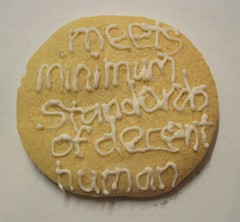
Description: A cookie. In icing it reads Meets Minimum Standards of Decent Human. By sajbrfems, used under a Creative Commons License.
This is Part 2 of a 2-part series about Ableism & Language. Part 1: Why I Write About Ableist Language.
In social justice blogging circles, especially feminist-focused ones, it’s not unusual to have conversations about language, and why language matters. Those conversations can vary from explaining why it’s problematic to call women & girls “females”, why using “he” and “mankind” to be a generic non-gendered term is sexist, reclaiming – or not – of words like “bitch”, and what it means to refer to “undocumented immigrants” rather than “illegals”.
These conversations often focus on how sexist or racist language is a symptom of a problem that needs to be addressed. We can talk about how calling women bitches is a sign of sexism, or referring to people as “illegals” is dehumanizing to immigrants. And yet, when trying to have discussions about ableist language, we’re back to the silo of disability. Instead of talking about ableist language as part of the manifestation of the disdain and abuse of people with disabilities, it’s treated as isolated – the problem, instead of a symptom of the problem.
Ableism is not simply a language problem.
Ableism manifests in the social justice blogosphere in so many different ways. They can vary from just not thinking about disability at all when writing about social justice issues to shrugging off critiques from disability-focused bloggers as being “too sensitive”. It can be ignoring posts about disability-focused issues or only linking to non-disabled people writing about disability-issues instead of to disabled bloggers. It can be as apparent as declining to acknowledge disability exists to as “subtle” (to some) as declining to make your blog template accessible to screen readers.
There are also choices that social justice bloggers make about how we educate ourselves, and whose voices we highlight, who we approach about their writing, and who we ask to be mediators. If we’re not reading disability-focused blogs, then we’re not learning about disability-focused issues – and, in turn, we’re not highlighting those voices, bringing attention to those issues, or thinking about that analysis when writing our own posts.
Thirdly, ableism manifests in whose voices we trust. For all that I’m very happy to provide people with book lists, I’m a bit suspicious of people who decline lists of disability-focused bloggers they could be reading as well. Why does someone’s voice have to go through the publishing-sphere (and usually through academia for the books you’re going to get from me) before it counts as worth-reading?
I get why people talk about language, and I agree that language is important. But I’m not giving cookies out for publicly declaring your ally-status by saying you won’t (or will try not to) use ableist language anymore. That’s a great first step. Now move on.
[Thank you to s.e. smith for helping me clarify my ideas.]