Editor’s note: We are very pleased to host this post from RMJ, and will be featuring some more writing from her, and several other awesome guest posters, soon. FWD welcomes guest posts: please email guestposting [at] disabledfeminists.com for more information.
RMJ is a twentysomething with OCD who grew up in Kansas and currently lives in Virginia. She works in education and loves cooking, cats, and television. She blogs about feminism and stuff at Deeply Problematic. This post also appears at Deeply Problematic
Athletes with physical disabilities (hereafter AWPD) are a problematized group. Their accomplishments are questioned and devalued as less valid or challenging than those of able-privileged athletes. They are not party to the often problematic veneration of athletes in today’s society, nor are they permitted to participate in generalized sporting events.
Arm-wrestling is a sport, though, that seems to both accommodate and welcomes athletes with disabilities into their ranks. There is a specific subset of arm wrestling for athletes with disabilities that seem to be a regular part of official arm-wrestling tournaments. I don’t know much about the sport and I’m not currently physically disabled, so my perspective on this is far from authoritative. But my tentative reaction to this is positive, particularly since athletes with disabilities can and do succeed in general competition.
Larry Feezor is an athlete with disabilities who competed recently in the 3rd Annual U.S. Open Armwrestling Championship. He has used a mobility aid since a motorcycle accident paralyzed him from the waist down. This story from an Oregon television station makes Feezor the focal point of the championship. The story is pretty short and context is important to my analysis, so I’m going to reproduce it here in full:
FLORENCE, Ore. – The Third Annual U.S. Open Arm Wrestling Championship wrapped up in Florence Sunday, as amateur wrestlers took to the ring to battle it out.
One competitor stood out for beating the odds: Larry Feezor.
He has been arm wrestling for 18 years, traveling from Weaverville, Calif., to Oregon to participate in the competition. This sport is his outlet since he became disabled.
“I was involved in a motorcycle accident and a drunk driver ran me off the road,” Feezor tells KVAL. “I hit a bank at about 70 miles per hour, [and] was paralyzed from the chest down.”
Feezor received roaring applause when he beat his first opponent.
On Sunday he arm wrestled some of the strongest competitors at The Three Rivers Casino. And he wasn’t going down without a fight.
“Right after my accident,” Feezor said, “I told my father that I would fight, as hard as I could, for as long as I could.”
Feezor isn’t letting his disability bring him down. As a former athlete, he said his body may not be like it used to be, but his mind is stronger than ever.
“I am out here just like these other guys,” Feezor said. “I just happen to be in a wheelchair.”
Before I break this article down, I should mention its good points. It is wonderful that athletes with disabilities recognized. It’s fantastic that Feezor’s achievements are reported on in a positive fashion. Feezor is ostensibly framed as normative. The newspaper is using Feezor’s words and Feezor’s voice, rather than, say, his father’s.
However. Feezor’s participation is the only aspect of the tournament that’s detailed, and his accomplishments are not well-articulated. The singling-out of Feezor and complete erasure of any other athletes in competition is problematic because it trivializes Feezor’s competition in a sport. It implies that the sport is only notable for the inclusion of a person with disabilities – Feezor is not in a competition, but instead someone to be cooed over and patted on the head simply for participating. He’s not being applauded for his accomplishments, he’s being singled out because he “beats the odds”, whatever that means. If this were an angle in a story that clearly reported on the events of the tournament, it would be significantly less problematic. Feezor would be presented in the context of other athletes, and not just othered because of his disability and his marginalized sport.
An example of this is Joby Matthew, an Indian arm-wrestler, who has underdeveloped legs due to Proximal Femoral Focal Deficiency. Matthew seems to be higher-profile than Feezor, but increased coverage also means increased problems, particularly since it’s from the Daily Mail:
Who needs legs? Meet Joby, the 3ft 5in world champion arm wrestler who can bring down opponents twice his size
Instead of bemoaning what he lacks, Joby Matthew is using what he’s got.
Matthew’s accomplishments are not notable in this article: only his disabilities. I’m not quoting or going through the whole article because the able privilege is so dense. The first line is indicative of the attitude taken in the article: Matthew doesn’t “bemoan”, unlike those other people with disabilities who would surely be champion athletes if they just tried. The construction is an ableist implication that other folks with disabilities are lazy whiners. Throughout the article, every reference to barriers Matthew faced is immediately matched by emphasis on how he overcame this disability. The focus is not on his exceptional effort and achievements, but on the “heartwarming” “good cripple”.
There are a few good aspects of the article. It’s composed largely of quotes from Matthew, and it does make note of his many medals and of his training regiment (though that, of course, is as much focused on what he can’t do as what he can’t.) Matthew’s childhood athleticism is made a major point of focus, particularly his struggles in playing with other children. While I appreciate that the authors focused on quotes from Matthew, the focus on competition with currently able-bodied athletes frames participation in sports against currently able-bodied (CAB) athletes as the standard for athletic accomplishment for AWPD.
While I do not love the article, I loved these pictures of Matthew and am quite impressed with his accomplishments and his goal of climbing Mount Everest. Though the exceptionalist attitude makes the context problematic, these pictures are awesome:
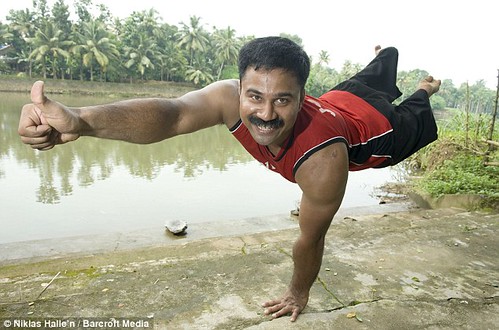
Photo: Joby Matthew holds himself up with one hand while giving the thumbs-up with another. He is on the bank of the Periyar river on the outskirts of Ernakulam. He and his fantastic mustache smile broadly at the camera.
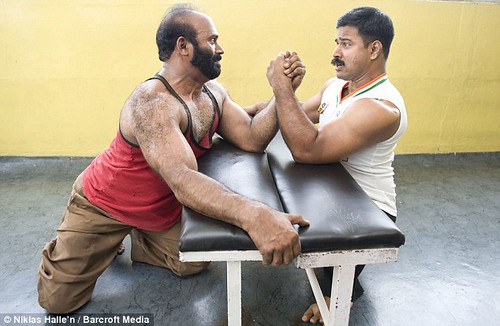
Photo: Joby Matthew and an unidentified man arm-wrestle on a weight bench. The unidentified man, who has a beard and fully developed legs, grips the far side of the weight bench. Both men are grimacing and neither appears to be winning.
These photos highlight his exceptional abilities, and while his disability is present and visible, it’s a part of his athleticism. However, there are only two pictures in the eleven-part picture post that actually show him competing. Training and physical strength are interesting and relevant, but this is about sports: as with the article, the focus should be on his achievements as an athlete, not on OMG HOW DOES HE DO THAT? or OMG HE BEATS NORMAL ATHLETES?
The accomplishments of athletes with disabilities face a double bind. In most cases, they are ignored and erased; they are thought to be impossibility and a contradiction. When AWPD are covered in the media, it’s rarely a positive, normed framing of them as accomplished athletes with valid bodies. They are objects instead of curiosity; they are heartwarming inspirations for the currently able-bodied; they are not quite freak shows.
Moderator’s note: Moderation on guest posts is often much slower than “usual” moderation times.
